Tuesday, October 16, 2012

Dark Matter Filament Studied in 3D for the First Time

This enormous image shows Hubble's view of massive galaxy cluster MACS J0717.5+3745. The large field of view is a combination of 18 separate Hubble images.

Studying the distorting effects of gravity on light from background galaxies, a team of astronomers has uncovered the presence of a filament of dark matter extending from the core of the cluster.

The location of the dark matter is revealed in a map of the mass in the cluster and surrounding region, shown here in blue. The filament visibly extends out and to the left of the cluster core.

Using additional observations from ground-based telescopes, the team was able to map the filament's structure in three dimensions, the first time this has ever been done. The filament was discovered to extend back from the cluster core, meaning we are looking along it. Copyright: NASA, ESA, Harald Ebeling (University of Hawaii at Manoa) & Jean-Paul Kneib (LAM) . Hi-Res [jpg]
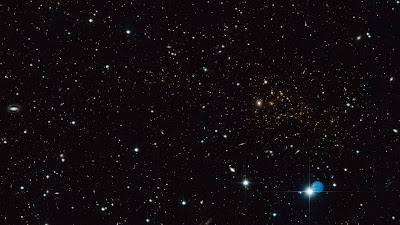
This enormous image shows Hubble's view of massive galaxy cluster MACS J0717.5+3745. The large field of view is a combination of 18 separate Hubble images.

Studying the distorting effects of gravity on light from background galaxies, a team of astronomers has uncovered the presence of a filament of dark matter extending from the core of the cluster. This is one of the first positive detections of a filament, and the most precise to date.

Using additional observations from ground-based telescopes, the team were able to map the filament's structure in three dimensions, the first time this has ever been done. Copyright: NASA, ESA, Harald Ebeling (University of Hawaii at Manoa) & Jean-Paul Kneib (LAM).
Hi-Res [jpg]    

This diagram shows Hubble's image of MACS J0717 overlaid with the location of the cluster and filament's mass (in blue), and with a schematic of the cluster and filament (in white). Below, the diagram shows the geometry from our perspective in which the filament lies almost directly along our line of sight, and from a different perspective in which the filament is seen side-on. This shows how the filament appears greatly foreshortened from our perspective.  Copyright: NASA, ESA, Harald Ebeling (University of Hawaii), Karen Teramura (University of Hawaii) .  Hi-Res [jpg]

Astronomers using the NASA/ESA Hubble Space Telescope have studied a giant filament of dark matter in 3D for the first time. Extending 60 million light-years from one of the most massive galaxy clusters known, the filament is part of the cosmic web that constitutes the large-scale structure of the Universe, and is a leftover of the very first moments after the Big Bang. If the high mass measured for the filament is representative of the rest of the Universe, then these structures may contain more than half of all the mass in the Universe.

The theory of the Big Bang predicts that variations in the density of matter in the very first moments of the Universe led the bulk of the matter in the cosmos to condense into a web of tangled filaments. This view is supported by computer simulations of cosmic evolution, which suggest that the Universe is structured like a web, with long filaments that connect to each other at the locations of massive galaxy clusters. However, these filaments, although vast, are made mainly of dark matter, which is incredibly difficult to observe.

The first convincing identification of a section of one of these filaments was made earlier this year [1]. Now a team of astronomers has gone further by probing a filament’s structure in three dimensions. Seeing a filament in 3D eliminates many of the pitfalls that come from studying the flat image of such a structure.

“Filaments of the cosmic web are hugely extended and very diffuse, which makes them extremely difficult to detect, let alone study in 3D,” says Mathilde Jauzac (LAM, France and University of KwaZulu-Natal, South Africa), lead author of the study.

The team combined high resolution images of the region around the massive galaxy cluster MACS J0717.5+3745 (or MACS J0717 for short), taken using Hubble, NAOJ’s Subaru Telescope and the Canada-France-Hawaii Telescope, with spectroscopic data on the galaxies within it from the WM Keck Observatory and the Gemini Observatory. Analysing these observations together gives a complete view of the shape of the filament as it extends out from the galaxy cluster almost along our line of sight.

The team’s recipe for studying the vast but diffuse filament combines several crucial ingredients.

First ingredient: A promising target. Theories of cosmic evolution suggest that galaxy clusters form where filaments of the cosmic web meet, with the filaments slowly funnelling matter into the clusters. “From our earlier work on MACS J0717, we knew that this cluster is actively growing, and thus a prime target for a detailed study of the cosmic web,” explains co-author Harald Ebeling (University of Hawaii at Manoa, USA), who led the team that discovered MACS J0717 almost a decade ago.

Second ingredient: Advanced gravitational lensing techniques. Albert Einstein’s famous theory of general relativity says that the path of light is bent when it passes through or near objects with a large mass. Filaments of the cosmic web are largely made up of dark matter [2] which cannot be seen directly, but their mass is enough to bend the light and distort the images of galaxies in the background, in a process called gravitational lensing. The team has developed new tools to convert the image distortions into a mass map.

Third ingredient: High resolution images. Gravitational lensing is a subtle phenomenon, and studying it needs detailed images. Hubble observations let the team study the precise deformation in the shapes of numerous lensed galaxies. This in turn reveals where the hidden dark matter filament is located. “The challenge,” explains co-author Jean-Paul Kneib (LAM, France), “was to find a model of the cluster’s shape which fitted all the lensing features that we observed.”

Finally: Measurements of distances and motions. Hubble’s observations of the cluster give the best two-dimensional map yet of a filament, but to see its shape in 3D required additional observations. Colour images [3], as well as galaxy velocities measured with spectrometers [4], using data from the Subaru, CFHT, WM Keck, and Gemini North telescopes (all on Mauna Kea, Hawaii), allowed the team to locate thousands of galaxies within the filament and to detect the motions of many of them.

A model that combined positional and velocity information for all these galaxies was constructed and this then revealed the 3D shape and orientation of the filamentary structure. As a result, the team was able to measure the true properties of this elusive filamentary structure without the uncertainties and biases that come from projecting the structure onto two dimensions, as is common in such analyses.

The results obtained push the limits of predictions made by theoretical work and numerical simulations of the cosmic web. With a length of at least 60 million light-years, the MACS J0717 filament is extreme even on astronomical scales. And if its mass content as measured by the team can be taken to be representative of filaments near giant clusters, then these diffuse links between the nodes of the cosmic web may contain even more mass (in the form of dark matter) than theorists predicted. So much that more than half of all the mass in the Universe may be hidden in these structures.

The forthcoming NASA/ESA/CSA James Webb Space Telescope, scheduled for launch in 2018, will be a powerful tool for detecting filaments in the cosmic web, thanks to its greatly increased sensitivity.

Notes

The Hubble Space Telescope is a project of international cooperation between ESA and NASA.

The international team of astronomers in this study consists of Mathilde Jauzac (Laboratoire d’Astrophysique de Marseille, France, and University of KwaZulu-Natal, South Africa), Eric Jullo (Laboratoire d’Astrophysique de Marseille, France and Jet Propulsion Laboratory, USA), Jean-Paul Kneib (Laboratoire d’Astrophysique de Marseille), Harald Ebeling (University of Hawaii, USA), Alexie Leauthaud (University of Tokyo, Japan), Cheng-Jiun Ma (University of Hawaii), Marceau Limousin (Laboratoire d’Astrophysique de Marseille and University of Copenhagen, Denmark), Richard Massey (Durham University, UK) and Johan Richard (Lyon Observatory, France)

The research is presented in a paper entitled “A Weak-Lensing Mass Reconstruction of the Large-Scale Filament Feeding the Massive Galaxy Cluster MACSJ0717.5+3745”, to be published in the 1 November 2012 issue of Monthly Notices of the Royal Astronomical Society. The paper will be published online this week.

[1] The first identification of a dark matter filament was published in J. Dietrich et al, “A filament of dark matter between two clusters of galaxies” published in Nature on 4 July 2012.

[2] Dark matter, which makes up around three quarters of all matter in the Universe, cannot be seen directly as it does not emit or reflect any light, and can pass through other matter without friction (it is collisionless). It interacts only by gravity, and its presence must be deduced from its gravitational effects, for example its effect on the rotation rate of galaxies and its ability to deflect light according to the theory of general relativity.

[3] The light captured by telescopes encapsulates information about the object that emitted it. One important application of this is to study the redshift of an object (the extent to which its light is reddened by the expansion of the Universe) which can be used to measure distances. Estimating distances based on the relative brightnesses of colours that galaxies appear in images is done using a technique called photometric redshift. Although the precision of the distance estimate is limited, it is a relatively straightforward technique to use on large numbers of galaxies, and it works well even for faint objects.

[4] Spectrometers analyse the detailed properties of the light coming from an object. In this study, the subset of galaxies observed with spectrometers provided detailed information on the motion of the objects within the filament.

Links

Contacts

 Mathilde Jauzac
 University of KwaZulu-Natal, South Africa and Laboratoire d’Astrophysique de Marseille
 France
 Tel: +33 6 52 67 15 39
 Email:
mathilde.jauzac@gmail.com

 Jean-Paul Kneib
 Laboratoire d’Astrophysique de Marseille
 France
 Tel: +41 22 379 24 73
 Cell: +33 695 795 392
 Email:
jean-paul.kneib@oamp.fr

 Eric Jullo
 Laboratoire d’Astrophysique de Marseille
 France
 Tel: +33 (0)491 084 215
 Email:
eric.jullo@oamp.fr

 Harald Ebeling
 Institute of Astronomy, University of Hawaii at Manoa
 USA
 Tel: +1(808)956-9695
 Email:
ebeling@ifa.hawaii.edu

Cheng-Jiun MaInstitute of Astronomy, University of Hawaii and Harvard-Smithsonian Center for Astrophysics 
USA
Tel: +1 (617) 496-7824
Email: cjma@head.cfa.harvard.edu

 Oli Usher
 Hubble/ESA
 Garching, Germany
 Tel: +49-89-3200-6855
 Email:
ousher@eso.org

Citizens Discover Four-Star Planet with NASA's Kepler

A Four-Star Planet: An artist's illustration of PH1, a planet discovered by volunteers from the Planet Hunters citizen science project. PH1, shown in the foreground, is the first reported case of a planet orbiting a double-star that, in turn, is orbited by a second distant pair of stars. The phenomenon is called a circumbinary planet in a four-star system. Image credit: Haven Giguere/Yale . Full image and caption

The discovery of planets continues to expand beyond th e domain of professional astronomers. A joint effort of amateur astronomers and scientists has led to the first reported case of a planet orbiting a double star that, in turn, is orbited by a second distant pair of stars.

Aided by volunteer citizen scientists using the Planethunters.org website, a Yale-led international team of astronomers identified and confirmed discovery of the phenomenon, called a circumbinary planet in a four-star system. Only six planets are known to orbit two stars but none of these are orbited by a distant binary.

Coined PH1, the planet was identified by the citizen scientists participating in Planet Hunters, a Yale-led program that enlists the public to review astronomical data from NASA's Kepler spacecraft for signs of planet transits of distant stars.

"I celebrate this discovery as a milestone for the Planet Hunters team: discovering their first exoplanet lurking in the Kepler data. I celebrate this discovery for the wow-factor of a planet in a four-star system," said Natalie Batalha, Kepler scientist at NASA's Ames Research Center, Moffett Field, Calif. "Most importantly, I celebrate this discovery as the fruit of exemplary human cooperation -- cooperation between scientists and citizens who give of themselves for the love of stars, knowledge and exploration."

A bit larger than Neptune and thought to be a gas giant, PH1 orbits its host stars every 137 days. Beyond the planet's orbit, approximately 900 times the distance between the sun and Earth, a second pair of stars orbits the planetary system.

The research paper submitted to the Astrophysical Journal is scheduled to be presented today at the annual meeting of the Division of Planetary Sciences of the American Astronomical Society in Reno, Nev.

To read more about the discovery, visit: http://blog.planethunters.org/2012/10/15/ph1-a-planet-in-a-four-star-system/.

NASA's Ames Research Center manages Kepler's ground system development, mission operations and science data analysis. NASA's Jet Propulsion Laboratory, Pasadena, Calif., managed the Kepler mission's development.

Ball Aerospace & Technologies Corp. in Boulder, Colo., developed the Kepler flight system and supports mission operations with the Laboratory for Atmospheric and Space Physics at the University of Colorado in Boulder.

The Space Telescope Science Institute in Baltimore archives, hosts and distributes Kepler science data. Kepler is NASA's 10th Discovery Mission and is funded by NASA's Science Mission Directorate at the agency's headquarters in Washington.

For information about the Kepler Mission, visit: http://www.nasa.gov/mission_pages/kepler/main/index.html.

Whitney Clavin 818-354-4673
Jet Propulsion Laboratory, Pasadena, Calif.

whitney.clavin@jpl.nasa.gov

Monday, October 15, 2012

NASA's WISE Colors in Unknowns on Jupiter Asteroids

 
New results from NASA's Wide-field Infrared Explorer, or WISE, reveal that the Jovian Trojans -- asteroids that lap the sun in the same orbit as Jupiter -- are uniformly dark with a hint of burgundy color, and have matte surfaces that reflect little sunlight. Image credit: NASA/JPL-Caltech . Full image and caption

Scientists using data from NASA's Wide-field Infrared Survey Explorer, or WISE, have uncovered new clues in the ongoing mystery of the Jovian Trojans -- asteroids that orbit the sun on the same path as Jupiter. Like racehorses, the asteroids travel in packs, with one group leading the way in front of the gas giant, and a second group trailing behind. 

The observations are the first to get a detailed look at the Trojans' colors: both the leading and trailing packs are made up of predominantly dark, reddish rocks with a matte, non-reflecting surface. What's more, the data verify the previous suspicion that the leading pack of Trojans outnumbers the trailing bunch. 

The new results offer clues in the puzzle of the asteroids' origins. Where did the Trojans come from? What are they made of? WISE has shown that the two packs of rocks are strikingly similar and do not harbor any "out-of-towners," or interlopers, from other parts of the solar system. The Trojans do not resemble the asteroids from the main belt between Mars and Jupiter, nor the Kuiper belt family of objects from the icier, outer regions near Pluto. 

"Jupiter and Saturn are in calm, stable orbits today, but in their past, they rumbled around and disrupted any asteroids that were in orbit with these planets," said Tommy Grav, a WISE scientist from the Planetary Science Institute in Tucson, Ariz. "Later, Jupiter re-captured the Trojan asteroids, but we don't know where they came from. Our results suggest they may have been captured locally. If so, that's exciting because it means these asteroids could be made of primordial material from this particular part of the solar system, something we don't know much about." Grav is a member of the NEOWISE team, the asteroid-hunting portion of the WISE mission. 

The first Trojan was discovered on Feb. 22, 1906, by German astronomer Max Wolf, who found the celestial object leading ahead of Jupiter. Christened "Achilles" by the astronomer, the roughly 220-mile-wide (350-kilometer-wide) chunk of space rock was the first of many asteroids detected to be traveling in front of the gas giant. Later, asteroids were also found trailing behind Jupiter. The asteroids were collectively named Trojans after a legend, in which Greek soldiers hid inside in a giant horse statue to launch a surprise attack on the Trojan people of the city of Troy. 

"The two asteroid camps even have their own 'spy,'" said Grav. "After having discovered a handful of Trojans, astronomers decided to name the asteroid in the leading camp after the Greek heroes and the ones in the trailing after the heroes of Troy. But each of the camps already had an 'enemy' in their midst, with asteroid 'Hector' in the Greek camp and 'Patroclus' in the Trojan camp." 

Other planets were later found to have Trojan asteroids riding along with them too, such as Mars, Neptune and even Earth, where WISE recently found the first known Earth Trojan: http://www.jpl.nasa.gov/news/news.php?release=2011-230 .

Before WISE, the main uncertainty defining the population of Jupiter Trojans was just how many individual chunks were in these clouds of space rock and ice leading Jupiter, and how many were trailing. It is believed that there are as many objects in these two swarms leading and trailing Jupiter as there are in the entirety of the main asteroid belt between Mars and Jupiter. 

To put this and other theories to bed requires a well-coordinated, well-executed observational campaign. But there were many things in the way of accurate observations -- chiefly, Jupiter itself. The orientation of these Jovian asteroid clouds in the sky in the last few decades has been an impediment to observations. One cloud is predominantly in Earth's northern sky, while the other is in the southern, forcing ground-based optical surveys to use at least two different telescopes. The surveys generated results, but it was unclear whether a particular result was caused by the problems of having to observe the two clouds with different instruments, and at different times of the year. 

Enter WISE, which roared into orbit on Dec. 14, 2009. The spacecraft's 16-inch (40-centimeter) telescope and infrared cameras scoured the entire sky looking for the glow of celestial heat sources. From January 2010 to February 2011, about 7,500 images were taken every day. The NEOWISE project used the data to catalogue more than 158,000 asteroids and comets throughout the solar system. 

"By obtaining accurate diameter and surface reflectivity measurements on 1,750 Jupiter Trojans, we increased by an order of magnitude what we knew about these two gatherings of asteroids," said Grav. "With this information, we were able to more accurately than ever confirm there are indeed almost 40 percent more objects in the leading cloud." Trying to understand the surface or interior of a Jovian Trojan is also difficult. The WISE suite of infrared detectors was sensitive to the thermal glow of the objects, unlike visible-light telescopes. This means WISE can provide better estimates of their surface reflectivity, or albedo, in addition to more details about their visible and infrared colors (in astronomy "colors" can refer to types of light beyond the visible spectrum). 

"Seeing asteroids with WISE's many wavelengths is like the scene in 'The Wizard of Oz,' where Dorothy goes from her black-and-white world into the Technicolor land of Oz," said Amy Mainzer, the principal investigator of the NEOWISE project at NASA's Jet Propulsion Laboratory in Pasadena, Calif. "Because we can see farther into the infrared portion of the light spectrum, we can see more details of the asteroids' colors, or, in essence, more shades or hues." 

The NEOWISE team has analyzed the colors of 400 Trojan asteroids so far, allowing many of these asteroids to be properly sorted according to asteroid classification schemes for the first time. 

"We didn't see any ultra-red asteroids, typical of the main belt and Kuiper belt populations," said Grav. "Instead, we find a largely uniform population of what we call D-type asteroids, which are dark burgundy in color, with the rest being C- and P-type, which are more grey-bluish in color. More research is needed, but it's possible we are looking at the some of the oldest material known in the solar system." 

Scientists have proposed a future space mission to the Jupiter Trojans that will gather the data needed to determine their age and origins. 

The results were presented today at the 44th annual meeting of the Division for Planetary Sciences of the American Astronomical Society in Reno, Nev. Two studies detailing this research are accepted for publication in the Astrophysical Journal. 

JPL manages, and operated, WISE for NASA's Science Mission Directorate. The spacecraft was put into hibernation mode in 2011, after it scanned the entire sky twice, completing its main objectives. Edward Wright is the principal investigator and is at UCLA. The mission was selected competitively under NASA's Explorers Program managed by the agency's Goddard Space Flight Center in Greenbelt, Md. The science instrument was built by the Space Dynamics Laboratory in Logan, Utah. The spacecraft was built by Ball Aerospace & Technologies Corp. in Boulder, Colo. Science operations and data processing take place at the Infrared Processing and Analysis Center at the California Institute of Technology in Pasadena. Caltech manages JPL for NASA. More information is online at http://www.nasa.gov/wise , http://wise.astro.ucla.edu and http://www.jpl.nasa.gov/wise.

Whitney Clavin 
818-354-4673 
Jet Propulsion Laboratory, Pasadena, Calif. 

From Cosmic Spare Tyre to Ethereal Blossom


 IC 5148
Credit: ESO

IC 5148 is a beautiful planetary nebula located some 3000 light-years away in the constellation of Grus (The Crane). The nebula has a diameter of a couple of light-years, and it is still growing at over 50 kilometres per second — one of the fastest expanding planetary nebulae known. The term “planetary nebula” arose in the 19th century, when the first observations of such objects — through the small telescopes available at the time — looked somewhat like giant planets. However, the true nature of planetary nebulae is quite different.

When a star with a mass similar to or a few times more than that of our Sun approaches the end of its life, its outer layers are thrown off into space. The expanding gas is illuminated by the hot remaining core of the star at the centre, forming the planetary nebula, which often takes on a beautiful, glowing shape.

When observed with a smaller amateur telescope, this particular planetary nebula shows up as a ring of material, with the star — which will cool to become a white dwarf — shining in the middle of the central hole. This appearance led astronomers to nickname IC 5148 the Spare Tyre Nebula.

The ESO Faint Object Spectrograph and Camera (EFOSC2) on the New Technology Telescope at La Silla gives a somewhat more elegant view of this object. Rather than looking like a spare tyre, the nebula resembles ethereal blossom with layered petals.

UCLA astronomers at Keck Observatory discover pivotal star to test Einstein’s theory

Credit: Dan Birchall

Credit: Ethan Tweedie

The two W. M. Keck Telescopes on Mauna Kea, Hawaii, observing the galactic center. The lasers are used to create an artificial star in Earth's upper atmosphere, which is then employed to measure the blurring effects of the lower atmosphere (the unfortunate effect that makes the stars twinkle in the night sky). The blurring gets corrected in real time with the help of a deformable mirror. This is the adaptive optics technique.

Today (October 4, 2012), UCLA astronomers using the W. M. Keck Observatory reported the discovery of a remarkable star that orbits the enormous black hole at the center of our Milky Way galaxy in a blistering 11-and-a-half years, the shortest known orbit of any star near this black hole.

The star, known as S0-102, may help astronomers discover whether Albert Einstein was right in his fundamental prediction of how black holes warp space and time, said Andrea Ghez, leader of the discovery team and professor of physics and astronomy, who holds UCLA’s Lauren B. Leichtman and Arthur E. Levine Chair in Astrophysics, and is a co-author. The research is published Oct. 5 in the journal Science.

Before this discovery, astronomers knew of only one star near the black hole with a very short orbit: S0-2, which Ghez used to call her “favorite star” and whose orbit is 16 years. (The “S” is for Sagittarius, the constellation containing the galactic center; its name is Latin for the archer.)

“I’m extremely pleased to find two stars that orbit our galaxy’s supermassive black hole in much less than a human lifetime,” said Ghez, who studies 3,000 stars that orbit the black hole, and has been studying S0-2 since 1995. Most of the stars have orbits of 60 years or longer, she said.

“It is the tango of S0-102 and S0-2 that will reveal the true geometry of space and time near a black hole for the first time,” Ghez said. “This measurement cannot be done with one star alone.”

Taft Armandroff, Director of the W. M. Keck Observatory, noted that “The pivotal research by Ghez’s UCLA group using the Keck Observatory has evolved from proving that a supermassive black hole exists in the center of our Galaxy, to testing the very fundamentals of physics. This is truly an exciting time in astronomy.”

Black holes form out of the collapse of matter to such high density that nothing can escape their gravitational pull, not even light. They cannot be seen directly, but their influence on nearby stars is visible and provides a signature, said Ghez, a 2008 MacArthur Fellow.

“Today, Einstein is in every iPhone, because the GPS system would not work without his theory,” said Leo Meyer, a researcher in Ghez’s team and lead author of the study. “What we want to find out is, would your phone also work so close to a black hole? The newly discovered star puts us in a position to answer that question in the future.”

“The fact that we can find stars that are so close to the black hole is phenomenal,” said Ghez, director of the UCLA Galactic Center Group. “Now it’s a whole new ballgame in terms of the kinds of experiments we can do to understand how black holes grow over time, the role supermassive black holes play in the center of galaxies, and whether Einstein’s theory of general relativity is valid near a black hole, where this theory has never been tested before. It’s exciting to now have a means to open up this window.

“This should not be a neighborhood where stars feel particularly welcome,” she added. “Surprisingly, it seems that black holes are not as hostile to stars as was previously speculated.”

Over the past 17 years, Ghez and colleagues have used the W. M. Keck Observatory, which sits atop Hawaii’s dormant Mauna Kea volcano, to image the galactic center at the highest angular resolution possible. They use a powerful technology Ghez has helped to pioneer called adaptive optics to correct the distorting effects of the Earth’s atmosphere in real time. With adaptive optics at the Keck Observatory, Ghez and her colleagues have revealed many surprises about the environment surrounding supermassive black holes, discovering, for example, young stars where none were expected and seeing a lack of old stars where many were anticipated.

“The Keck Observatory has been the leader in adaptive optics for more than a decade, and has enabled us to achieve tremendous progress in correcting the distorting effects of the Earth’s atmosphere with high–angular resolution imaging,” Ghez said. “It’s really exciting to have access to the world’s largest and best telescope. It is why I came to UCLA and why I stay at UCLA.”

In the same way that planets orbit around the sun, S0-102 and S0-2 are each in an elliptical orbit around the galaxy’s central black hole. The planetary motion in our solar system was the ultimate test for Newton’s gravitational theory 300 years ago; the motion of S0-102 and S0-2, Ghez said, will be the ultimate test for Einstein’s theory of general relativity, which describes gravity as a consequence of the curvature of space and time.

“The exciting thing about seeing stars go through their complete orbit is not only that you can prove that a black hole exists, but you have the first opportunity to test fundamental physics using the motions of these stars,” Ghez said. “Showing that it goes around in an ellipse provides the mass of the supermassive black hole, but if we can improve the precision of the measurements, we can see deviations from a perfect ellipse — which is the signature of general relativity.”

As the stars come to their closet approach, their motion will be affected by the curvature of space-time, and the light travelling from the stars to us will be distorted, Ghez said.

S0-2, which is 15 times brighter than S0-102, will go through its closet approach to the black hole in 2018.

The deviation from a perfect ellipse is very small and requires extremely precise measurements. Over the last 15 years, Ghez and her colleagues have dramatically improved their ability to make these measurements.

Over the years, Keck Observatory has been the primary tool in Ghez’s research. As the two biggest, fully-steerable telescopes, Keck Observatory collects more light than any other system in the world. Additionally, Keck has been continually developing and installing leading-edge instruments to allow astronomers like Ghez to make critical discoveries.  

In 1998, Ghez answered one of astronomy’s most important questions, showing that a monstrous black hole resides at the center of our Milky Way galaxy, some 26,000 light-years away from Earth, with a mass approximately four million times that of the sun. The question had been a subject of raging debate among astronomers for more than a quarter of a century.

In 2000, she and colleagues reported that for the first time, astronomers had seen stars accelerate around a supermassive black hole. Their research demonstrated that three stars had accelerated to more than 250,000 mph as they orbited the supermassive black hole. The speed of S0-102 and S0-2 should also accelerate to more than 250,000 miles per hour at their closest approach, Ghez said.

In 2003, Ghez reported that the case for the Milky Way’s black hole had been strengthened substantially and that all of the proposed alternatives could be excluded. In 2005, she and her colleagues took the first clear picture of the center of the Milky Way, including the area surrounding the black hole, using laser guide star adaptive optics technology at the Keck Observatory. 

Ghez is the first woman to receive the prestigious Crafoord Prize by the Royal Swedish Academy of Sciences, which she was awarded this May.

The W. M. Keck Observatory operates two 10-meter optical/infrared telescopes on the summit of Mauna Kea on the Big Island of Hawaii. The twin telescopes feature a suite of advanced instruments including imagers, multi-object spectrographs, high-resolution spectrographs, integral-field spectroscopy and a world-leading laser guide star adaptive optics system. The Observatory is a private 501(c) 3 non-profit organization and a scientific partnership of the California Institute of Technology, the University of California and NASA.


Saturday, October 13, 2012

X-raying colliding stellar winds

XMM-Newton view of the core of the Cyg OB2 association
Credit: ESA/ G. Rauw


Simulation of colliding wind binary
Credit: Australian National University/E.R. Parkin, University of Liège/E. Gosset. 
Click here for more information on this video.


Simulation of the orbits of the 2 massive O stars in Cyg OB2 #9, and the XMM-Newton and Swift observations of X-ray emission from this binary system. Credit: NASA/GSFC . Click here for larger versions and more information on this video.

Ground- and space-based observations, including studies by ESA's XMM-Newton X-ray observatory, have provided unique insights into a star system dominated by two Galactic giants.

The region under scrutiny, known as Cygnus OB2, is a huge cloud of interstellar gas and dust. Approximately 4700 light years from Earth in the constellation of Cygnus, it is home to about 100 O class stars - some of the most massive and most luminous stars known.

 These extremely rare, blue-white stars, which are typically 50 times the mass of the Sun and five to 10 times hotter at the surface, have extremely short (by Universal standards) and violent lives. Like gigantic furnaces that are out of control, they consume all of their hydrogen and helium fuel within a few million years.

As the nuclear fusion in their cores progresses, ultraviolet and X-ray radiation pours into space, heating and energising any nearby interstellar material. Enormous amounts of material are also blasted into space in the form of stellar winds. These winds come from material "pushed" away from the stellar surface by the pressure from the starlight. The stream of energetic particles – mainly protons and electrons – is 10 times faster and tens of billions of times more massive than the solar wind.

In an effort to discover more about these mysterious objects, an international team of astronomers has been focusing its attention on a pair of O stars, known as Cyg OB2 #9. Although the system has been known for many decades, the binary nature of Cyg OB2 #9 has only been proved in recent years. Key clues came with the discovery of periodic variations in its radio emission on a timescale of 2.355 years, combined with a clear doubling of spectral lines.

Continued monitoring of the system indicated that Cyg OB2 #9 is composed of two nearly equal-mass objects which follow a very eccentric orbit around their common centre of gravity.

Analysis of previous XMM-Newton observations revealed no unexpected features in the spectrum, although the data were obtained when the stars were far from each other and any interaction was relatively weak. Only some unusual, small changes in the X-ray signature hinted at the presence of colliding stellar winds.

In order to better understand this system and the likely head-on collision between their winds, the team decided to conduct a dedicated monitoring programme that coincided with the periastron (closest approach) of the two stars in June-July 2011 - the first opportunity to do so following the discovery of the binary system.
The campaign was organised to observe all aspects of the event: monitoring of radio emission using the Expanded Very Large Array; refining the orbit of the two stars using the CHARA optical/infrared telescope array; spectroscopic monitoring in the optical with the OHP-Sophie and WIRO spectrographs to further tie down the orbit; and X-ray studies to detect and understand the high energy emission from the collision between the winds blowing outward from each star.

Five sets of X-ray flux observations were carried out with NASA's Swift orbital observatory during 2011, in order to monitor the stars for 10 months around the date of periastron. Full monitoring of Cyg OB2 #9 with XMM-Newton was not possible, but a high resolution spectral observation was made near the predicted time of the periastron passage.

"These were difficult measurements to make since they had to be made when the two stars were orbiting closest to each other," said Yael Nazé, a FNRS researcher at the University of Liège, Belgium, and lead author of the paper which has been accepted for publication in the journal Astronomy & Astrophysics.

"Thanks to radio and optical data, we knew the orbital period was about 860 days, so we could precisely schedule observations around the time of periastron. In light of our refined orbital solution, Cyg OB2 #9 appears to be a massive O+O binary with a long period and high eccentricity. Its components have similar masses and similar luminosities."

The new X-ray data also provided the first concrete evidence that a wind-wind collision is taking place. Two sets of measurements taken 5.5 days apart around the time of periastron - one by XMM-Newton and one by Swift - showed a quadrupling of the X-ray flux when the stars were closer together.

"Cyg OB2 #9 displays long-term variations which coincide with the timescale of the orbital period," said Yael Nazé. "The colliding winds of the two stars generate very hot gas, which in turn emits X-rays. Close to the stars, the winds are denser, hence the collision is expected to be stronger. This is exactly what is seen in the data, so we believe it supports the presence of a wind-wind collision in the binary system.

"Overall, Cyg OB2 #9 seems to be the first example of an undisturbed colliding wind system involving two ordinary, massive stars."

Such studies are important because, unlike Cyg OB2 #9, many massive binaries show no signature of colliding winds. Understanding why will improve scientists' knowledge of collision mechanisms and stellar wind properties. This, in turn, will improve understanding of how massive stars evolve and how they interact with their immediate surroundings and with the Universe as a whole.

"The winds of massive stars have a profound impact on their environment," said Norbert Schartel, ESA's XMM-Newton project scientist. "Together with supernova explosions, the winds inject new elements into the interstellar medium, shape molecular clouds and trigger new star formation."

"There are currently intense debates in the massive star community about wind properties," said Yael Nazé. "To gain a better insight into the evolution of distant galaxies where individual stars are not detectable, it is important to know about winds in detail."

"Since the nature of its wind-wind collision remains identical throughout the orbit, Cyg OB2 #9 represents a milestone in our understanding of massive star winds."

Notes for editors

 The XMM-Newton observations were carried out using the three European Photon Imaging Cameras (EPIC); these detect X-rays in the energy range of 0.2 keV - 10 keV. Observations of Cyg OB2 #9 were also obtained with the Swift X-ray Telescope, covering a range 0.5-10 keV, with the high-resolution echelle spectrograph (SOPHIE) on the 1.93m telescope at the Observatoire de Haute-Provence, France, and with the Wyoming Infrared Observatory (WIRO) longslit spectrograph, USA.

 The European Space Agency's X-ray Multi-Mirror Mission, XMM-Newton, was launched in December 1999. It is the biggest scientific satellite to have been built in Europe and uses over 170 wafer-thin cylindrical mirrors spread over three high throughput X-ray telescopes. Its mirrors are among the most powerful ever developed. XMM-Newton's orbit takes it almost a third of the way to the Moon, allowing for long, uninterrupted views of celestial objects. The scientific community can apply for observing time on XMM-Newton on a competitive basis.

Related publication

 Y. Nazé, et al., "The 2.35 year itch of Cygnus OB2 #9 - I. Optical and X-ray monitoring", 2012, Astronomy & Astrophysics, 546, A37, doi:10.1051/0004-6361/201219442

 Contacts

Yael Nazé
 FNRS Research Associate
 Groupe d'Astrophysique des Hautes Energies
 Université de Liège, Belgium
 Email: naze@astro.ulg.ac.be
 Phone: + 32 4 366 97 20

Norbert Schartel
 ESA XMM-Newton Project Scientist
 Directorate of Science and Robotic Exploration
 European Space Agency
 Email: Norbert.Schartel@esa.int
 Phone: +34 91 8131 184

Friday, October 12, 2012

DR21 Ridge

The area surrounding the DR21 ridge, with a few other notable regions labelled. Click here for the maximum resolution available. An unannotated version of this image is available ESA's Online Showcase of Herschel Images . Credit: ESA/Herschel/SPIRE/PACS/HOBYS


 The DR21 ridge and the associated filaments with their labels
Credit: ESA/Herschel/SPIRE/PACS/HOBYS
 
This image shows the DR21 ridge, a very massive filamentary structure oriented north-south in the extremely active star-forming region Cygnus X. It resides at a distance of about 4500 light-years from Earth in the constellation of Cygnus, the Swan.

A combination of three maps observed by ESA's Herschel space observatory, the image reveals the finely detailed structure of the cold interstellar material in red colour. This cold material is organised into filaments, many of which converge towards the main ridge, as shown in the main image above. These filaments appear to be around 1 light year in diameter, and other observations have indicated that some of the material seems to be falling onto the main ridge. As the material collapses onto the filaments it cools, which makes them appear redder in the image above.

Within the ridge, bright white compact sources trace the very young new stars that are caught in the process of formation, including several high-mass stars. Along the entire length of the filament, which is around 13 light years, there are 22 individual dense clumps of gas and dust that are in the process of forming massive stars. Due to the amount of gas in the region, the DR21 ridge is expected to transform into the most massive young star cluster in the whole Cygnus X region.

Herschel also shows the evolution of star formation along the DR21 ridge. The DR21 region itself, seen at the lower end of the main ridge in the image on the left, is glowing brightly due to the gas and dust being heated by massive stars. Towards the top end of the ridge, the smaller filaments are still in the process of merging, and so the star formation is not as well progressed.

High-mass stars are rare in number relative to stars like our Sun, but due to their much stronger radiation and their violent deaths as supernovae, they have a large influence on the evolution of the interstellar medium in our Galaxy. As the shine brightly they often blow bubbles in the nebulae, and several of these are seen in the region surrounding the DR21 ridge.

These new Herschel observations strongly suggest that the convergence of filaments in areas like the DR21 ridge is a way nature forms massive star clusters containing high-mass stars. The filaments play an important role in the process as they channel material towards the DR21 ridge to build up a large reservoir of mass.

The DR21 region and its neighbours are named after the initials of two astronomers, Downes and Rinehart, who first catalogued them in the 1960s.

Detailed Information

Object Name:  DR21 Ridge
Type of Object:   Star-forming region
Image Scale:  The main image is around 25 light years across.
Coordinates:   Right Ascension: 20h 33m 12s ; Declination: +41° 10′
Constellation:  Cygnus the Swan
Instrument:   SPIRE and PACS

Wavelengths:  70 microns (blue), 160 microns (green), 250 microns (red)
Distance of Object:  4500 light years
Date of Release: 29/06/2012
Key Programme:
HOBYS
Publication:  Hennemann et al. (2012) A&A 543, L3 "The spine of the swan: a Herschel study of the DR21 ridge and filaments in Cygnus X" (astro-ph/1206.1243)
Further information: The Spine of the Swan (Online Showcase of Herschel Images)

Thursday, October 11, 2012

Nearby super-Earth likely a diamond planet

Illustration of the interior of 55 Cancri e — an extremely hot planet with a surface of mostly graphite surrounding a thick layer of diamond, below which is a layer of silicon-based minerals and a molten iron core at the center. (Image by Haven Giguere)

Star map showing the planet-hosting star 55 Cancri in the constellation of Cancer. The star is visible to the naked eye, though better through binoculars. (Image by Nikku Madhusudhan; created using Sky Map Online)

New research led by Yale University scientists suggests that a rocky planet twice Earth's size orbiting a nearby star is a diamond planet.

“This is our first glimpse of a rocky world with a fundamentally different chemistry from Earth,” said lead researcher Nikku Madhusudhan, a Yale postdoctoral researcher in physics and astronomy. “The surface of this planet is likely covered in graphite and diamond rather than water and granite.”

The paper reporting the findings has been accepted for publication in the journal Astrophysical Journal Letters.

The planet — called 55 Cancri e — has a radius twice Earth’s, and a mass eight times greater, making it a “super-Earth.” It is one of five planets orbiting a sun-like star, 55 Cancri, that is located 40 light years from Earth yet visible to the naked eye in the constellation of Cancer.

The planet orbits at hyper speed — its year lasts just 18 hours, in contrast to Earth’s 365 days. It is also blazingly hot, with a temperature of about 3,900 degrees Fahrenheit, researchers said, a far cry from a habitable world.

The planet was first observed transiting its star last year, allowing astronomers to measure its radius for the first time. This new information, combined with the most recent estimate of its mass, allowed Madhusudhan and colleagues to infer its chemical composition using models of its interior and by computing all possible combinations of elements and compounds that would yield those specific characteristics.

Astronomers had previously reported that the host star has more carbon than oxygen, and Madhusudhan and colleagues confirmed that substantial amounts of carbon and silicon carbide, and a negligible amount of water ice, were available during the planet’s formation.

Astronomers also thought 55 Cancri e contained a substantial amount of super-heated water, based on the assumption that its chemical makeup was similar to Earth’s, Madhusudhan said. But the new research suggests the planet has no water at all, and appears to be composed primarily of carbon (as graphite and diamond), iron, silicon carbide, and, possibly, some silicates. The study estimates that at least a third of the planet's mass — the equivalent of about three Earth masses — could be diamond.

“By contrast, Earth’s interior is rich in oxygen, but extremely poor in carbon — less than a part in thousand by mass,” says co-author and Yale geophysicist Kanani Lee.

The identification of a carbon-rich super-Earth means that distant rocky planets can no longer be assumed to have chemical constituents, interiors, atmospheres, or biologies similar to those of Earth, Madhusudhan said. The discovery also opens new avenues for the study of geochemistry and geophysical processes in Earth-sized alien planets. A carbon-rich composition could influence the planet’s thermal evolution and plate tectonics, for example, with implications for volcanism, seismic activity, and mountain formation. 

“Stars are simple — given a star's mass and age, you know its basic structure and history,” said David Spergel, professor of astronomy and chair of astrophysical sciences at Princeton University, who is not a co-author of the study. “Planets are much more complex. This ‘diamond-rich super-Earth’ is likely just one example of the rich sets of discoveries that await us as we begin to explore planets around nearby stars."

In 2011, Madhusudhan led the first discovery of a carbon-rich atmosphere in a distant gas giant planet, opening the possibility of long-theorized carbon-rich rocky planets (or “diamond planets”). The new research represents the first time that astronomers have identified a likely diamond planet around a sun-like star and specified its chemical make-up. Follow-up observations of the planet's atmosphere and additional estimates of the stellar composition would strengthen the findings about the planet’s chemical composition.

The authors of the paper are Madhusudhan, Lee, and Olivier Mousis, a planetary scientist at the Institut de Recherche en Astrophysique et Planetologie in Toulose, France.

The paper is titled “A Possible Carbon-rich Interior in Super-Earth 55 Cancri e.”

The research was supported by the Yale Center for Astronomy and Astrophysics (YCAA) in the Yale Department of Physics through Madhusudhan’s YCAA postdoctoral prize fellowship.

Contact

Eric Gershon
eric.gershon@yale.edu
203-432-8555 

NGC 6543: A Planetary Nebula Gallery

 
Credit: X-ray: NASA/CXC/RIT/J.Kastner et al.; O
ptical: NASA/STScI


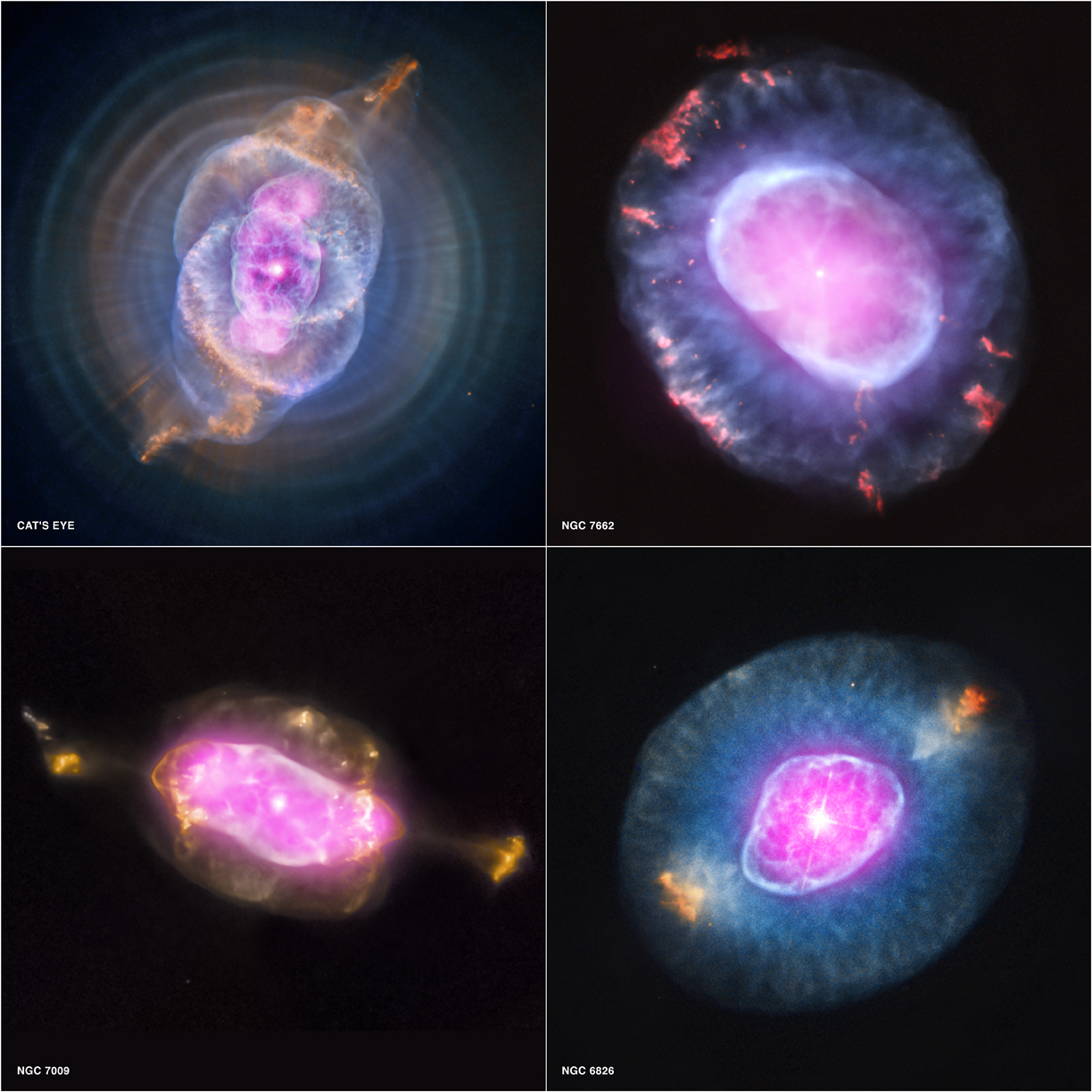
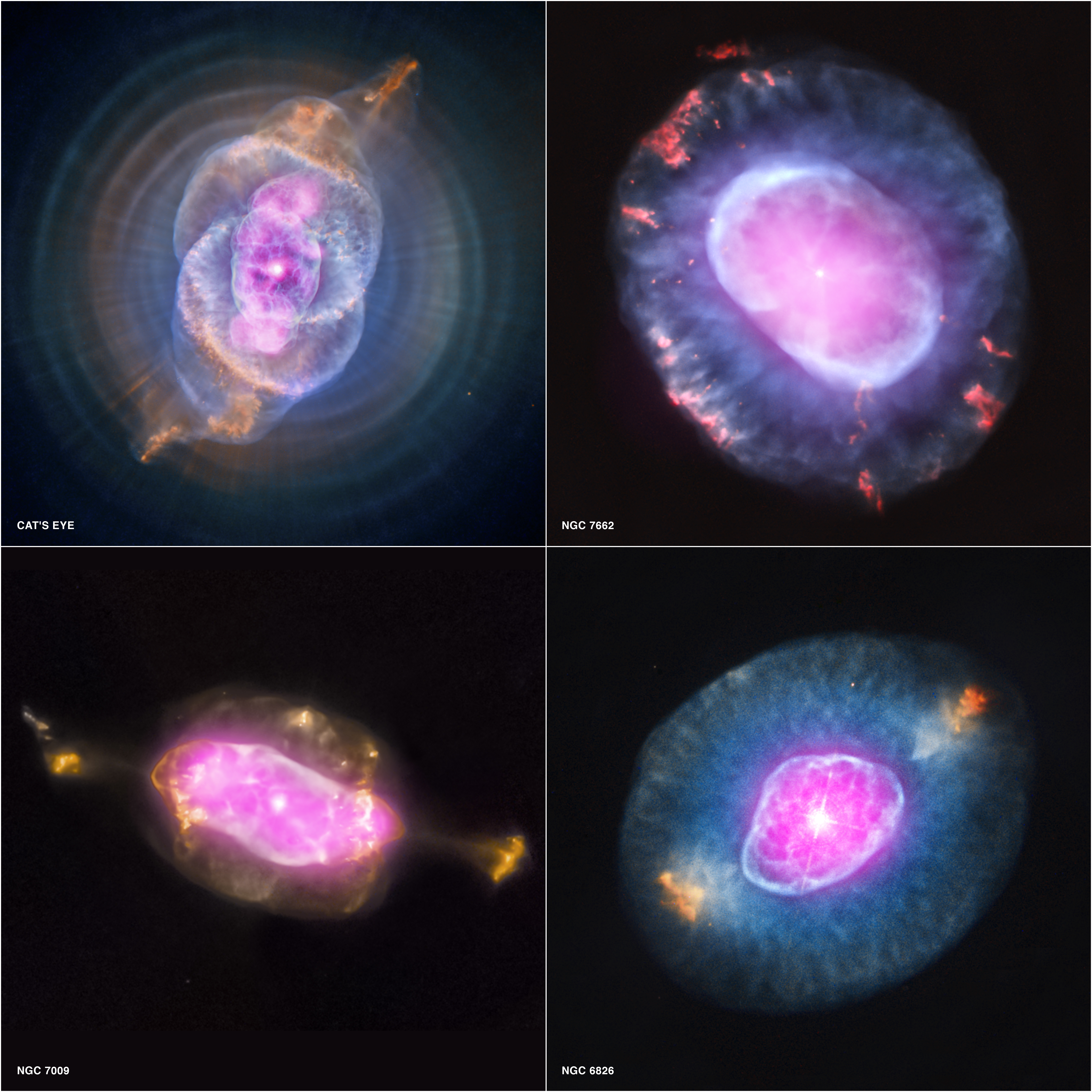
This gallery shows four planetary nebulas from the first systematic survey of such objects in the solar neighborhood made with NASA's Chandra X-ray Observatory. The planetary nebulas shown here are NGC 6543, also known as the Cat's Eye, NGC 7662, NGC 7009 and NGC 6826. In each case, X-ray emission from Chandra is colored purple and optical emission from the Hubble Space Telescope is colored red, green and blue.

In the first part of this survey, published in a new paper, twenty one planetary nebulas within about 5000 light years of the Earth have been observed. The paper also includes studies of fourteen other planetary nebulas, within the same distance range, that Chandra had already observed.

A planetary nebula represents a phase of stellar evolution that the Sun should experience several billion years from now. When a star like the Sun uses up all of the hydrogen in its core, it expands into a red giant, with a radius that increases by tens to hundreds of times. In this phase, a star sheds most of its outer layers, eventually leaving behind a hot core that will soon contract to form a dense white dwarf star. A fast wind emanating from the hot core rams into the ejected atmosphere, pushes it outward, and creates the graceful, shell-like filamentary structures seen with optical telescopes.

The diffuse X-ray emission seen in about 30% of the planetary nebulas in the new Chandra survey, and all members of the gallery, is caused by shock waves as the fast wind collides with the ejected atmosphere. The new survey data reveal that the optical images of most planetary nebulas with diffuse X-ray emission display compact shells with sharp rims, surrounded by fainter halos. All of these compact shells have observed ages that are less than about 5000 years, which therefore likely represents the timescale for the strong shock waves to occur.

About half of the planetary nebulas in the study show X-ray point sources in the center, and all but one of these point sources show high energy X-rays that may be caused by a companion star, suggesting that a high frequency of central stars responsible for ejecting planetary nebulas have companions. Future studies should help clarify the role of double stars in determining the structure and evolution of planetary nebulas.

These results were published in the August 2012 issue of The Astronomical Journal. The first two authors are Joel Kastner and Rodolfo Montez Jr. of the Rochester Institute of Technology in New York, accompanied by 23 co-authors.

NASA's Marshall Space Flight Center in Huntsville, Ala., manages the Chandra program for NASA's Science Mission Directorate in Washington. The Smithsonian Astrophysical Observatory controls Chandra's science and flight operations from Cambridge, Mass.

Fast Facts for NGC 6543:

Release Date:     October 10, 2012
Scale:     Image is 1.2 arcmin across. (about 1.7 light years)
Category:
    White Dwarfs & Planetary Nebulas
Coordinates: (J2000)     RA 17h 58m 33.30s | Dec +66'° 37' 59.20"
Constellation:  
   Draco
Observation Dates:      10 May, 2000
Observation Time :    13 hours
Obs. IDs:      630
Instrument:
    ACIS
References:     Kastner, J. et al, 2012, AJ, 144, 58; arXiv:1204.6055
Color Code:     X-ray (Purple), Optical (Red, Green, Blue)

Wednesday, October 10, 2012

Surprising Spiral Structure Spotted by ALMA

Curious spiral spotted by ALMA around red giant star R Sculptoris 
(data visualisation)

The red giant star R Sculptoris in the constellation of Sculptor (The Sculptor)

Wide-field view of the sky around the red giant star R Sculptoris

Videos

Slicing through a 3D ALMA view of the material around the red giant star R Sculptoris

Slicing through a 3D model of the material around the red giant star R Sculptoris

  PR Video eso1239c
Zooming into the red giant star R Sculptoris

   PR Video eso1239d
Model of the evolution of the material around the old star R Sculptoris over 2000 years

 New observations reveal the secrets of a dying star

Astronomers using the Atacama Large Millimeter/submillimeter Array (ALMA) have discovered a totally unexpected spiral structure in the material around the old star R Sculptoris. This is the first time that such a structure, along with an outer spherical shell, has been found around a red giant star. It is also the first time that astronomers could get full three-dimensional information about such a spiral. The strange shape was probably created by a hidden companion star orbiting the red giant. This work is one of the first ALMA early science results to be published and it appears in the journal Nature this week.

A team using the Atacama Large Millimeter/submillimeter Array (ALMA), the most powerful millimetre/submillimetre telescope in the world, has discovered a surprising spiral structure in the gas around the red giant star R Sculptoris [1][2][3]. This means that there is probably a previously unseen companion star orbiting the star [4]. The astronomers were also surprised to find that far more material than expected had been ejected by the red giant.

“We’ve seen shells around this kind of star before, but this is the first time we’ve ever seen a spiral of material coming out from a star, together with a surrounding shell,”
says the lead author on the paper presenting the results, Matthias Maercker (ESO and Argelander Institute for Astronomy, University of Bonn, Germany).

Because they blow out large amounts of material, red giants like R Sculptoris are major contributors to the dust and gas that provide the bulk of the raw materials for the formation of future generations of stars, planetary systems and subsequently for life.

Even in the Early Science phase, when the new observations were made, ALMA greatly outperformed other submillimetre observatories. Earlier observations had clearly shown a spherical shell around R Sculptoris, but neither the spiral structure nor a companion was found.

"When we observed the star with ALMA, not even half its antennas were in place. It's really exciting to imagine what the full ALMA array will be able to do once it's completed in 2013," adds Wouter Vlemmings (Chalmers University of Technology, Sweden), a co-author of the study.

Late in their lives, stars with masses up to eight times that of the Sun become red giants and lose a large amount of their mass in a dense stellar wind. During the red giant stage stars also periodically undergo thermal pulses. These are short-lived phases of explosive helium burning in a shell around the stellar core. A thermal pulse leads to material being blown off the surface of the star at a much higher rate, resulting in the formation of a large shell of dust and gas around the star. After the pulse the rate at which the star loses mass falls again to its normal value.

Thermal pulses occur approximately every 10 000 to 50 000 years, and last only a few hundred years. The new observations of R Sculptoris show that it suffered a thermal pulse event about 1800 years ago that lasted for about 200 years. The companion star shaped the wind from R Sculptoris into a spiral structure.

“By taking advantage of the power of ALMA to see fine details, we can understand much better what happens to the star before, during and after the thermal pulse, by studying how the shell and the spiral structure are shaped,” says Maercker. “We always expected ALMA to provide us with a new view of the Universe, but to be discovering unexpected new things already, with one of the first sets of observations is truly exciting.” 
In order to describe the observed structure around R Sculptoris, the team of astronomers has also performed computer simulations to follow the evolution of a binary system [5]. These models fit the new ALMA observations very well.

"It’s a real challenge to describe theoretically all the observed details coming from ALMA, but our computer models show that we really are on the right track. ALMA is giving us new insight into what's happening in these stars and what might happen to the Sun in a few billion years from now,"
says Shazrene Mohamed (Argelander Institute for Astronomy, Bonn, Germany and South African Astronomical Observatory), a co-author of the study.

“In the near future, observations of stars like R Sculptoris with ALMA will help us to understand how the elements we are made up of reached places like the Earth. They also give us a hint of what our own star's far future might be like,” concludes Matthias Maercker.

Notes

[1] R Sculptoris is an example of an asymptotic giant branch (AGB) star. These are stars with initial masses between 0.8 and 8 solar masses in the late stages of their lives. They are cool, red giants with large mass loss in the form of strong stellar winds, and are typically long-period variables. Their structure consists of a tiny central core of carbon and oxygen surrounded by a helium and hydrogen burning shell, and then an enormous convective envelope. The Sun will eventually evolve into an AGB star.

[2] The ejected shell formed around AGB stars is composed of gas and dust grains. The dust grains can be spotted by looking for thermal emission extending from the far infrared through millimetre wavelengths. At millimetre wavelengths emission from the CO molecule allows astronomers to obtain high-resolution maps of the gas emission from the strong stellar wind generated by the AGB stars. These observations are also excellent tracers of the gas distribution around these objects. The high sensitivity of ALMA makes it possible to directly image the dust condensation zone and the structure of the material around AGB stars, showing details smaller than 0.1 arcsecond.

[3] A similar spiral, but without a surrounding shell, has been seen in NASA/ESA Hubble Space Telescope observations of the star LL Pegasi. But, unlike the new ALMA observations, these data did not allow the full three-dimensional structure to be studied. The Hubble observations detect the dust and ALMA the molecular emission.

[4] Unseen binaries have also been suggested as an explanation for the odd shapes seen in related objects, planetary nebulae. After the AGB phase, intermediate and low-mass stars (0.8–8 solar masses) will end their lives by forming a planetary nebula. These are the glowing remains of the stellar envelope of gas ejected during the AGB phase, which is ionised by ultraviolet radiation emitted by the central star. Many planetary nebulae have extremely complex and varied morphologies. Binary central stars, stellar discs and magnetic fields have been suggested as the mechanism that produces such a variety of shapes.

[5] The system modelled here consists of a primary AGB star going through a thermal pulse and a small companion star. The separation between the stars used in the simulation is 60 astronomical units with a total mass of the system of two solar masses. The orbital period is 350 years.
More information

This research was presented in a paper, “Unexpectedly large mass loss during the thermal pulse cycle of the red giant star R Sculptoris”, by Maercker et al. to appear in the journal Nature.

The team is composed of M. Maercker (ESO; Argelander Institute for Astronomy, University of Bonn, Germany), S. Mohamed (Argelander Institute for Astronomy; South African Astronomical Observatory, South Africa), W. H. T. Vlemmings (Onsala Space Observatory, Chalmers University of Technology, Onsala, Sweden), S. Ramstedt (Argelander Institute for Astronomy, University of Bonn; Uppsala University), M. A. T. Groenewegen (Royal Observatory of Belgium, Brussels, Belgium), E. Humphreys (ESO), F. Kerschbaum (Department of Astronomy, University of Vienna, Austria), M. Lindqvist (Onsala Space Observatory), H. Olofsson (Onsala Space Observatory), C. Paladini (Department of Astronomy, University of Vienna, Austria), M. Wittkowski (ESO), I. de Gregorio-Monsalvo (Joint ALMA Observatory, Chile) and L. A. Nyman (Joint ALMA Observatory).

The year 2012 marks the 50th anniversary of the founding of the European Southern Observatory (ESO). ESO is the foremost intergovernmental astronomy organisation in Europe and the world’s most productive ground-based astronomical observatory by far. It is supported by 15 countries: Austria, Belgium, Brazil, the Czech Republic, Denmark, France, Finland, Germany, Italy, the Netherlands, Portugal, Spain, Sweden, Switzerland and the United Kingdom. ESO carries out an ambitious programme focused on the design, construction and operation of powerful ground-based observing facilities enabling astronomers to make important scientific discoveries. ESO also plays a leading role in promoting and organising cooperation in astronomical research. ESO operates three unique world-class observing sites in Chile: La Silla, Paranal and Chajnantor. At Paranal, ESO operates the Very Large Telescope, the world’s most advanced visible-light astronomical observatory and two survey telescopes. VISTA works in the infrared and is the world’s largest survey telescope and the VLT Survey Telescope is the largest telescope designed to exclusively survey the skies in visible light. ESO is the European partner of a revolutionary astronomical telescope ALMA, the largest astronomical project in existence. ESO is currently planning the 39-metre European Extremely Large optical/near-infrared Telescope, the E-ELT, which will become “the world’s biggest eye on the sky”.

The Atacama Large Millimeter/submillimeter Array (ALMA), an international astronomy facility, is a partnership of Europe, North America and East Asia in cooperation with the Republic of Chile. ALMA is funded in Europe by the European Southern Observatory (ESO), in North America by the U.S. National Science Foundation (NSF) in cooperation with the National Research Council of Canada (NRC) and the National Science Council of Taiwan (NSC) and in East Asia by the National Institutes of Natural Sciences (NINS) of Japan in cooperation with the Academia Sinica (AS) in Taiwan. ALMA construction and operations are led on behalf of Europe by ESO, on behalf of North America by the National Radio Astronomy Observatory (NRAO), which is managed by Associated Universities, Inc. (AUI) and on behalf of East Asia by the National Astronomical Observatory of Japan (NAOJ). The Joint ALMA Observatory (JAO) provides the unified leadership and management of the construction, commissioning and operation of ALMA.

The ALMA Observatory will be inaugurated on 13 March 2013.

Links


Contacts

 Matthias Maercker
 ESO ALMA Cofund Fellow
 Argelander Institute for Astronomy, University of Bonn, Germany
 Tel: +49 228 735768
 Cell: +49 176 706 21 632
 Email:
maercker@astro.uni-bonn.de

 Wouter Vlemmings
 Onsala Space Observatory
 Chalmers University of Technology, Sweden
 Tel: +46 31 772 5509
 Cell: +46 733 544 667
 Email:
wouter.vlemmings@chalmers.se

 Shazrene S. Mohamed
 Postdoctoral Research Fellow
 South African Astronomical Observatory, Cape Town, South Africa
 Tel: +27 21 447 0025 ext 7025
 Cell: +27 729 661 707
 Email:
shazrene@saao.ac.za

 Douglas Pierce-Price
 Public Information Officer, ESO
 Garching bei München, Germany
 Tel: +49 89 3200 6759
 Email:
dpiercep@eso.org
Twists and Turns in Interacting Galaxies

A computer simulation of two colliding galaxies seen here at one early evolutionary stage, showing some of the twists and warps that typically develop and introduce misalignments between a host galaxy and its black hole nucleus.  Credit: Hopkins 2012. Low Resolution Image (jpg)

Almost thirty years ago the Infrared Astronomy Satellite, IRAS, discovered that the universe contained many fabulously luminous galaxies, some of them more than a thousand times brighter than our own galaxy, but which are practically invisible at optical wavelengths. The reason for their optical dimness is that their bright light comes not from stars, which can be seen in the visible, but from dust that is warmed by bursts of star formation to temperatures of about 70 kelvin (about 200 degrees below zero Celsius) where infrared radiation predominates. Luminous galaxies not only shed light on how galaxies evolve and form stars, they act as lanterns that can be seen across cosmological distances, thereby helping scientists study the relatively early universe.

 The IRAS galaxies are luminous because they contain so much of this warm dust. Astronomers suspect that most of them have been involved in collisional encounters that stimulated vigorous star formation, as gravitational effects induce interstellar gas to condense into stars. The issue for astronomers is how to confirm and refine these general conclusions. CfA astronomers have an active research effort that uses computer simulations of interacting galaxies to calculate the luminosity of these systems, to uncover how their luminosity evolves with time, and to determine the specific contribution of starburst activity to the infrared emission.

 A new paper by CfA astronomers Lars Hernquist and Chris Hayward and two of their colleagues looks carefully at the ways in which galaxy collisions can distort the shapes of the galaxies involved, including the shapes and orientations of the regions around their central black holes. They compare the orientation of the nuclei (as measured by disks and outflowing jets) with the large-scale orientations of the host galaxies. In their computer simulations, they report finding only weak correlations between these alignments. It turns out that misalignments can easily be introduced as giant clumps of material fall into the region of the black hole and alter its spin, or more gradually as twists develop and evolve in the gas of the spinning galaxy. Their conclusion is in excellent agreement with the observational data, namely, that there is a poor correlation between the orientation of the spin axis of a host galaxy and of its black hole nucleus. The results will help shed light on a range of related issues, including how infalling gas in a galaxy can efficiently feed its black hole, and whether light from the nuclear region is likely to be obscured by viewing through the galaxy's disk of material.