Wednesday, July 06, 2011

Hydrogen Peroxide Found in Space

PR Image eso1123a (annotated)
PR Image eso1123b
The Rho Ophiuchi star formation region,

where hydrogen peroxide has been detected in space


PR Image eso1123c
The constellation Ophiuchus,
showing the Rho Ophiuchi star formation region


Molecules of hydrogen peroxide have been found for the first time in interstellar space. The discovery gives clues about the chemical link between two molecules critical for life: water and oxygen. On Earth, hydrogen peroxide plays a key role in the chemistry of water and ozone in our planet’s atmosphere, and is familiar for its use as a disinfectant or to bleach hair blonde. Now it has been detected in space by astronomers using the ESO-operated APEX telescope in Chile.

An international team of astronomers made the discovery with the Atacama Pathfinder Experiment telescope (APEX), situated on the 5000-metre-high Chajnantor plateau in the Chilean Andes. They observed a region in our galaxy close to the star Rho Ophiuchi, about 400 light-years away. The region contains very cold (around -250 degrees Celsius), dense clouds of cosmic gas and dust, in which new stars are being born. The clouds are mostly made of hydrogen, but contain traces of other chemicals, and are prime targets for astronomers hunting for molecules in space. Telescopes such as APEX, which make observations of light at millimetre- and submillimetre-wavelengths, are ideal for detecting the signals from these molecules.

Now, the team has found the characteristic signature of light emitted by hydrogen peroxide, coming from part of the Rho Ophiuchi clouds.

“We were really excited to discover the signatures of hydrogen peroxide with APEX. We knew from laboratory experiments which wavelengths to look for, but the amount of hydrogen peroxide in the cloud is just one molecule for every ten billion hydrogen molecules, so the detection required very careful observations,” says Per Bergman, astronomer at Onsala Space Observatory in Sweden. Bergman is lead author of the study, which is published in the journal Astronomy & Astrophysics.

Hydrogen peroxide (H2O2) is a key molecule for both astronomers and chemists. Its formation is closely linked to two other familiar molecules, oxygen and water, which are critical for life. Because much of the water on our planet is thought to have originally formed in space, scientists are keen to understand how it is created [1].

Hydrogen peroxide is thought to form in space on the surfaces of cosmic dust grains — very fine particles similar to sand and soot — when hydrogen (H) is added to oxygen molecules (O2). A further reaction of the hydrogen peroxide with more hydrogen is one way to produce water (H2O). This new detection of hydrogen peroxide will therefore help astronomers better understand the formation of water in the Universe.

“We don’t understand yet how some of the most important molecules here on Earth are made in space. But our discovery of hydrogen peroxide with APEX seems to be showing us that cosmic dust is the missing ingredient in the process,” says Bérengère Parise, head of the Emmy Noether research group on star formation and astrochemistry at the Max-Planck Institute for Radio Astronomy in Germany, and a co-author of the paper.

To work out just how the origins of these important molecules are intertwined will need more observations of Rho Ophiuchi and other star-forming clouds with future telescopes such as the Atacama Large Millimeter/submillimeter Array (ALMA) — and help from chemists in laboratories on Earth.

APEX is a collaboration between the Max-Planck Institute for Radio Astronomy (MPIfR), the Onsala Space Observatory (OSO) and ESO. The telescope is operated by ESO.

Notes

[1] The new discovery of hydrogen peroxide may also help astronomers understand another interstellar mystery: why oxygen molecules are so hard to find in space. It was only in 2007 that oxygen molecules were first discovered in space, by the satellite Odin.

More information

This research is published in the journal Astronomy & Astrophysics.

The team is composed of P. Bergman (Onsala Space Observatory, Chalmers University of Technology, Onsala, Sweden), B. Parise (Max-Planck Institute for Radio Astronomy, Bonn, Germany), R. Liseau (Chalmers University of Technology, Onsala, Sweden), B. Larsson (Stockholm University, Sweden), H. Olofsson (Onsala Space Observatory, Chalmers University of Technology), K. M. Menten (Max-Planck Institute for Radio Astronomy) and R. Güsten (Max-Planck Institute for Radio Astronomy).

ESO, the European Southern Observatory, is the foremost intergovernmental astronomy organisation in Europe and the world’s most productive astronomical observatory. It is supported by 15 countries: Austria, Belgium, Brazil, the Czech Republic, Denmark, France, Finland, Germany, Italy, the Netherlands, Portugal, Spain, Sweden, Switzerland and the United Kingdom. ESO carries out an ambitious programme focused on the design, construction and operation of powerful ground-based observing facilities enabling astronomers to make important scientific discoveries. ESO also plays a leading role in promoting and organising cooperation in astronomical research. ESO operates three unique world-class observing sites in Chile: La Silla, Paranal and Chajnantor. At Paranal, ESO operates the Very Large Telescope, the world’s most advanced visible-light astronomical observatory and two survey telescopes. VISTA works in the infrared and is the world’s largest survey telescope and the VLT Survey Telescope is the largest telescope designed to exclusively survey the skies in visible light. ESO is the European partner of a revolutionary astronomical telescope ALMA, the largest astronomical project in existence. ESO is currently planning a 40-metre-class European Extremely Large optical/near-infrared Telescope, the E-ELT, which will become “the world’s biggest eye on the sky”.

Links
Research paper (Astronomy & Astrophysics)
About the APEX telescope, from ESO
The APEX science website
More on ALMA from ESO
The Joint ALMA Observatory website
The Max-Planck Institute for Radio Astronomy press release (English, German)
Chalmers press release (English, Swedish)

Contacts

Per Bergman
Onsala Space Observatory / Chalmers University of Technology
Sweden
Tel: +46 31 772 5500
Cell: +46 70 239 1741
Email: per.bergman@chalmers.se

Bérengère Parise
Max Planck Institute for Radio Astronomy
Bonn, Germany
Tel: +49 228 525 153
Email: bparise@mpifr-bonn.mpg.de

Douglas Pierce-Price
ESO, Public Information Officer
Garching, Germany
Tel: +49 89 3200 6759
Email: dpiercep@eso.org

Tuesday, July 05, 2011

NASA's Hubble Makes One Millionth Science Observation

Transiting Exoplanet HAT-P-7b
Credit: NASA, ESA, and G. Bacon (STScI)

All-Sky illustration of all Hubble observations as of June 27, 2011
Credit: NASA, ESA, and R. Thompson (CSC/STScI)

NASA's Hubble Space Telescope crossed another milestone in its space odyssey of exploration and discovery. On Monday, July 4, the Earth-orbiting observatory logged its one millionth science observation during a search for water in an exoplanet's atmosphere 1,000 light-years away.

"For 21 years Hubble has been the premier space science observatory, astounding us with deeply beautiful imagery and enabling ground-breaking science across a wide spectrum of astronomical disciplines," said NASA Administrator Charles Bolden. He piloted the space shuttle mission that carried Hubble to orbit. "The fact that Hubble met this milestone while studying a faraway planet is a remarkable reminder of its strength and legacy."

Although Hubble is best known for its stunning imagery of the cosmos, the millionth observation is a spectrocopic measurement, where light is divided its component colors. These color patterns can reveal the chemical composition of cosmic sources.

Hubble's millionth exposure is of the planet HAT-P-7b, a gas giant planet larger than Jupiter orbiting a star hotter than our Sun. HAT-P-7b, also known as Kepler 2b, has been studied by NASA's planet-hunting Kepler observatory after it was discovered by ground-based observations. Hubble now is being used to analyze the chemical composition of the planet's atmosphere.

"We are looking for the spectral signature of water vapor. This is an extremely precise observation and it will take months of analysis before we have an answer," said Drake Deming of the University of Maryland and NASA's Goddard Space Flight Center in Greenbelt, Md. "Hubble demonstrated it is ideally suited for characterizing the atmospheres of exoplanets, and we are excited to see what this latest targeted world will reveal."

"This exciting set of observations in search of water vapor on a planet orbiting another star is laying the foundation for how we plan to use the James Webb Space Telescope's more powerful vision to look for liquid water on nearby planets, the necessary precursor to extraterrestrial life," said Matt Mountain, STScI director.

Hubble was launched April 24, 1990, aboard space shuttle Discovery's STS-31 mission. Its discoveries revolutionized nearly all areas of astronomical research from planetary science to cosmology. The observatory has collected more than 50 terabytes of data to-date. The archive of that data is available to scientists and the public at: http://hla.stsci.edu/

Hubble's odometer reading includes every observation of astronomical targets since its launch and observations used to calibrate its suite of instruments. Hubble made the millionth observation using its Wide Field Camera 3, a visible- and infrared-light imager with an on-board spectrometer. It was installed by astronauts during Hubble Servicing Mission 4 in May 2009.

"The Hubble keeps amazing us with groundbreaking science," said Sen. Barbara Mikulski, the chairwoman of the Senate Commerce, Justice, Science and Related Agencies Appropriations Subcommittee that funds NASA. "I championed the mission to repair and renew Hubble not just to get one million science observations, but also to inspire millions of children across the planet to become our next generation of stargazers, scientists, astronauts and engineers."

CONTACT

Trent Perrotto
NASA Headquarters, Washington, D.C.
trent.j.perrotto@nasa.gov
202-358-0321

Ray Villard
Space Telescope Science Institute, Baltimore, Md.
410-338-4514
villard@stsci.edu

Monday, July 04, 2011

‘Zombie' Stars Key to Measuring Dark Energy

Chandra X-ray image of Tycho's supernova remnant. This Type Ia supernova was observed by Tycho Brahe in 1572, and today is just an expanding ball of gas. Astronomers used to have to wait years for a close, bright supernova to learn about them. Today big surveys are discovering supernovae by the thousands. Credit: NASA/Chandra X-ray Observatory

Supernova 1994D. The supernova is the bright point in the lower-left. It is a type Ia thermonuclear supernova like those described by Howell. The supernova is on the edge of galaxy NGC 4526, depicted in the center of the image.
Credit: NASA/Hubble Space Telescope

D. Andrew Howell
Credit: Katrina Marcinowski

(Santa Barbara, Calif.) –– "Zombie" stars that explode like bombs as they die, only to revive by sucking matter out of other stars. According to an astrophysicist at UC Santa Barbara, this isn't the plot for the latest 3D blockbuster movie. Instead, it's something that happens every day in the universe –– something that can be used to measure dark energy.

This special category of stars, known as Type Ia supernovae, help to probe the mystery of dark energy, which scientists believe is related to the expansion of the universe.

Andy Howell, adjunct professor of physics at UCSB and staff scientist at Las Cumbres Observatory Global Telescope Network (LCOGT), wrote a review article about this topic, published recently in Nature Communications. LCOGT, a privately funded global network of telescopes, works closely with UCSB.

Supernovae are stars that have been observed since 1054 A.D., when an exploding star formed the crab nebula, a supernova remnant.

More recently, the discovery of dark energy is one of the most profound findings of the last half-century, according to Howell. Invisible dark energy makes up about three-fourths of the universe. "We only discovered this about 20 years ago by using Type Ia supernovae, thermonuclear supernovae, as standard or ‘calibrated' candles," said Howell. "These stars are tools for measuring dark energy. They're all about the same brightness, so we can use them to figure out distances in the universe."

These supernovae are so bright that they shine with the approximate power of a billion suns, noted Howell.

He calls Type Ia supernovae "zombie" stars because they're dead, with a core of ash, but they come back to life by sucking matter from a companion star. Over the past 50 years, astrophysicists have discovered that Type Ia supernovae are part of binary systems –– two stars orbiting each other. The one that explodes is a white dwarf star. "That's what our sun will be at the end of its life," he said. "It will have the mass of the sun crammed into the size of the Earth."

The white dwarf stars that tend to explode as Type Ia supernovae have approximately the same mass. This was considered a fundamental limit of physics, according to Howell. However, in an article in Nature about five years ago, Howell reported his discovery of stars that go beyond this limit. These previously unknown Type Ia supernovae have more than typical mass before they explode –– a fact that confounds scientists.

Howell presented a hypothesis to understand this new class of objects. "One idea is that two white dwarfs could have merged together; the binary system could be two white dwarf stars," he said. "Then, over time, they spiral into each other and merge. When they merge, they blow up. This may be one way to explain what is going on."

Astrophysicists are using Type Ia supernovae to build a map of the history of the universe's expansion. "What we've found is that the universe hasn't been expanding at the same rate," said Howell. "And it hasn't been slowing down as everyone thought it would be, due to gravity. Instead, it has been speeding up. There's a force that counteracts gravity and we don't know what it is. We call it dark energy."

The new findings relate to Einstein's concept of the cosmological constant. This is a term he added into his equations to make them valid. However, Einstein did it because he thought the universe was static; he didn't know the universe was expanding. When it was revealed that the universe is expanding, Einstein believed this concept was his biggest blunder. "It turns out that this cosmological constant was actually one of his greatest successes," said Howell. "This is because it's what we need now to explain the data."

He said that dark energy is probably a property of space. "Space itself has some energy associated with it," said Howell. "That's what the results seem to indicate, that dark energy is distributed everywhere in space. It looks like it's a property of the vacuum, but we're not completely sure. We're trying to figure out how sure are we of that –– and if we can improve Type Ia supernovae as standard candles we can make our measurements better."

Throughout history, people have noticed a few supernovae so bright they could be seen with the naked eye. With telescopes, astronomers have discovered supernovae farther away. "Now we have huge digital cameras on our telescopes, and really big telescopes," said Howell, "We've been able to survey large parts of the sky, regularly. We find supernovae daily." Astronomers have discovered thousands of supernovae in recent years.

During his career, Howell has used these powerful telescopes to study supernovae. Currently, besides teaching at UCSB, he is involved in LCOGT's detailed study of supernovae that is aimed at helping to understand dark energy. With this extensive network of observatories, it will be possible to study the night sky continuously.

"The next decade holds real promise of making serious progress in the understanding of nearly every aspect of supernovae Ia, from their explosion physics, to their progenitors, to their use as standard candles," writes Howell in Nature Communications. "And with this knowledge may come the key to unlocking the darkest secrets of dark energy."

CONTACT

Gail Gallessich
805-893-7220

George Foulsham
805-893-3071

Return to the Carina Nebula

Carina Nebula
Credit: ESA/Hubble & NASA

Looking like an elegant abstract art piece painted by talented hands, this picture is actually a NASA/ESA Hubble Space Telescope image of a small section of the Carina Nebula. Part of this huge nebula was documented in the well-known Mystic Mountain picture (heic1007a) and this picture takes an even closer look at another piece of this bizarre astronomical landscape (heic0707a).

The Carina Nebula itself is a star-forming region about 7500 light-years from Earth in the southern constellation of Carina (The Keel: part of Jason’s ship the Argo). Infant stars blaze with a ferocity so severe that the radiation emitted carves away at the surrounding gas, sculpting it into strange structures. The dust clumps towards the upper right of the image, looking like ink dropped into milk, were formed in this way. It has been suggested that they are cocoons for newly forming stars.

The Carina Nebula is mostly made from hydrogen, but there are other elements present, such as oxygen and sulphur. This provides evidence that the nebula is at least partly formed from the remnants of earlier generations of stars where most elements heavier than helium were synthesised.

The brightest stars in the image are not actually part of the Carina Nebula. They are much closer to us, essentially being the foreground to the Carina Nebula’s background.

This picture was created from images taken with Hubble’s Wide Field Planetary Camera 2. Images through a blue filter (F450W) were coloured blue and images through a yellow/orange filter (F606W) were coloured red. The field of view is 2.4 by 1.3 arcminutes.

Friday, July 01, 2011

Clocking Neptune's Spin

Neptune as seen by the Voyager 2 spacecraft in 1989.
(Photo: NASA)

By tracking atmospheric features on Neptune, a UA planetary scientist has accurately determined the planet's rotation, a feat that had not been previously achieved for any of the gas planets in our solar system except Jupiter.

A day on Neptune lasts precisely 15 hours, 57 minutes and 59 seconds, according to the first accurate measurement of its rotational period made by University of Arizona planetary scientist Erich Karkoschka.

His result is one of the largest improvements in determining the rotational period of a gas planet in almost 350 years since Italian astronomer Giovanni Cassini made the first observations of Jupiter's Red Spot.


Animation: Atmospheric Features on Neptune
Copyright: Erich Karkoschka/University of Arizona
Link YouTube

"The rotational period of a planet is one of its fundamental properties," said Karkoschka, a senior staff scientist at the UA's Lunar and Planetary Laboratory. "Neptune has two features observable with the Hubble Space Telescope that seem to track the interior rotation of the planet. Nothing similar has been seen before on any of the four giant planets."

The discovery is published in Icarus, the official scientific publication of the Division for Planetary Sciences of the American Astronomical Society.

Unlike the rocky planets – Mercury, Venus, Earth and Mars – which behave like solid balls spinning in a rather straightforward manner, the giant gas planets – Jupiter, Saturn, Uranus and Neptune – rotate more like giant blobs of liquid. Since they are believed to consist of mainly ice and gas around a relatively small solid core, their rotation involves a lot of sloshing, swirling and roiling, which has made it difficult for astronomers to get an accurate grip on exactly how fast they spin around.

"If you looked at Earth from space, you'd see mountains and other features on the ground rotating with great regularity, but if you looked at the clouds, they wouldn't because the winds change all the time," Karkoschka explained. "If you look at the giant planets, you don't see a surface, just a thick cloudy atmosphere."

In this image, the colors and contrasts were modified to emphasize the planet’s atmospheric features. The winds in Neptune’s atmosphere can reach the speed of sound or more. Neptune’s Great Dark Spot stands out as the most prominent feature on the left. Several features, including the fainter Dark Spot 2 and the South Polar Feature, are locked to the planet’s rotation, which allowed Karkoschka to precisely determine how long a day lasts on Neptune. (Image: Erich Karkoschka)

"The rotational period of a planet is one of its fundamental properties," said Karkoschka, a senior staff scientist at the UA's Lunar and Planetary Laboratory. "Neptune has two features observable with the Hubble Space Telescope that seem to track the interior rotation of the planet. Nothing similar has been seen before on any of the four giant planets."

The discovery is published in Icarus, the official scientific publication of the Division for Planetary Sciences of the American Astronomical Society.

Unlike the rocky planets – Mercury, Venus, Earth and Mars – which behave like solid balls spinning in a rather straightforward manner, the giant gas planets – Jupiter, Saturn, Uranus and Neptune – rotate more like giant blobs of liquid. Since they are believed to consist of mainly ice and gas around a relatively small solid core, their rotation involves a lot of sloshing, swirling and roiling, which has made it difficult for astronomers to get an accurate grip on exactly how fast they spin around.

"If you looked at Earth from space, you'd see mountains and other features on the ground rotating with great regularity, but if you looked at the clouds, they wouldn't because the winds change all the time," Karkoschka explained. "If you look at the giant planets, you don't see a surface, just a thick cloudy atmosphere."

"On Neptune, all you see is moving clouds and features in the planet's atmosphere. Some move faster, some move slower, some accelerate, but you really don't know what the rotational period is, if there even is some solid inner core that is rotating."

In the 1950s, when astronomers built the first radio telescopes, they discovered that Jupiter sends out pulsating radio beams, like a lighthouse in space. Those signals originate from a magnetic field generated by the rotation of the planet's inner core.

No clues about the rotation of the other gas giants, however, were available because any radio signals they may emit are being swept out into space by the solar wind and never reach Earth.

"The only way to measure radio waves is to send spacecraft to those planets," Karkoschka said. "When Voyager 1 and 2 flew past Saturn, they found radio signals and clocked them at exactly 10.66 hours, and they found radio signals for Uranus and Neptune as well. So based on those radio signals, we thought we knew the rotation periods of those planets."

But when the Cassini probe arrived at Saturn 15 years later, its sensors detected its radio period had changed by about 1 percent. Karkoschka explained that because of its large mass, it was impossible for Saturn to incur that much change in its rotation over such a short time.

"Because the gas planets are so big, they have enough angular momentum to keep them spinning at pretty much the same rate for billions of years," he said. "So something strange was going on."

Even more puzzling was Cassini's later discovery that Saturn's northern and southern hemispheres appear to be rotating at different speeds.

"That's when we realized the magnetic field is not like clockwork but slipping," Karkoschka said. "The interior is rotating and drags the magnetic field along, but because of the solar wind or other, unknown influences, the magnetic field cannot keep up with respect to the planet's core and lags behind."

Instead of spacecraft powered by billions of dollars, Karkoschka took advantage of what one might call the scraps of space science: publicly available images of Neptune from the Hubble Space Telescope archive. With unwavering determination and unmatched patience, he then pored over hundreds of images, recording every detail and tracking distinctive features over long periods of time.

Other scientists before him had observed Neptune and analyzed images, but nobody had sleuthed through 500 of them.

"When I looked at the images, I found Neptune's rotation to be faster than what Voyager observed," Karkoschka said. "I think the accuracy of my data is about 1,000 times better than what we had based on the Voyager measurements – a huge improvement in determining the exact rotational period of Neptune, which hasn't happened for any of the giant planets for the last three centuries."

Two features in Neptune's atmosphere, Karkoschka discovered, stand out in that they rotate about five times more steadily than even Saturn's hexagon, the most regularly rotating feature known on any of the gas giants.

Named the South Polar Feature and the South Polar Wave, the features are likely vortices swirling in the atmosphere, similar to Jupiter's famous Red Spot, which can last for a long time due to negligible friction. Karkoschka was able to track them over the course of more than 20 years.

An observer watching the massive planet turn from a fixed spot in space would see both features appear exactly every 15.9663 hours, with less than a few seconds of variation.

"The regularity suggests those features are connected to Neptune's interior in some way," Karkoschka said. "How they are connected is up to speculation."

One possible scenario involves convection driven by warmer and cooler areas within the planet's thick atmosphere, analogous to hot spots within the Earth's mantle, giant circular flows of molten material that stay in the same location over millions of years.

"I thought the extraordinary regularity of Neptune's rotation indicated by the two features was something really special," Karkoschka said.

"So I dug up the images of Neptune that Voyager took in 1989, which have better resolution than the Hubble images, to see whether I could find anything else in the vicinity of those two features. I discovered six more features that rotate with the same speed, but they were too faint to be visible with the Hubble Space Telescope, and visible to Voyager only for a few months, so we wouldn't know if the rotational period was accurate to the six digits. But they were really connected. So now we have eight features that are locked together on one planet, and that is really exciting."

In addition to getting a better grip on Neptune's rotational period, the study could lead to a better understanding of the giant gas planets in general.

"We know Neptune's total mass but we don't know how it is distributed," Karkoschka explained. "If the planet rotates faster than we thought, it means the mass has to be closer to the center than we thought. These results might change the models of the planets' interior and could have many other implications."

Contact Info

Erich Karkoschka
UA Lunar and Planetary Laboratory
520-621-3994
erich@lpl.arizona.edu

'Odd Couple' Binary Makes Dual Gamma-ray Flares


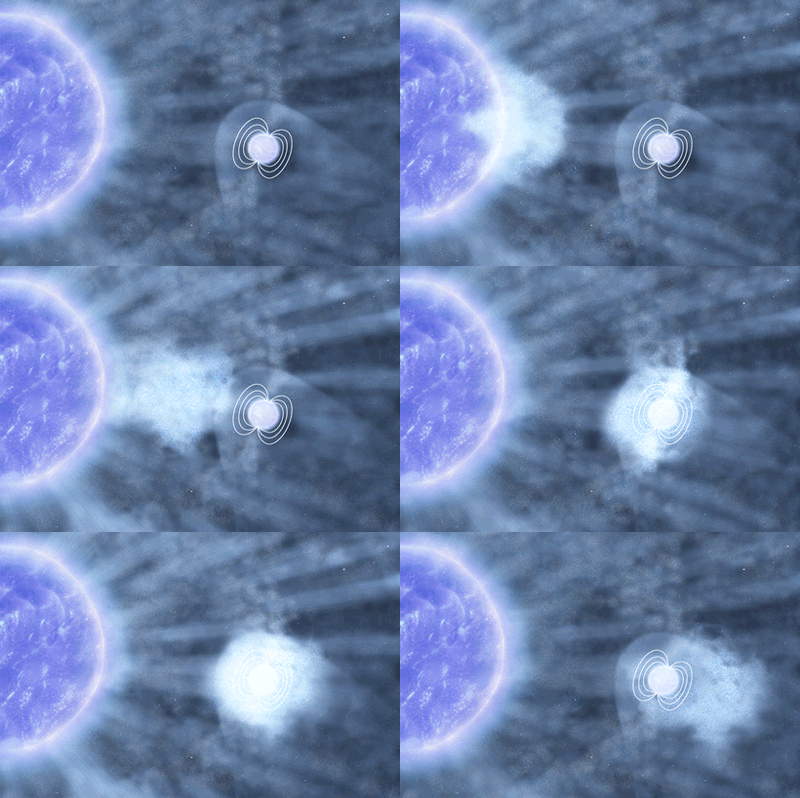
Every 3.4 years, pulsar B1259-63 dives twice through the gas disk surrounding the massive blue star it orbits. With each pass, it produces gamma rays. During the most recent event, NASA's Fermi observed that the pulsar's gamma-ray flare was much more intense the second time it plunged through the disk. Astronomers don't yet know why. (Credit: NASA's Goddard Space Flight Center, Conceptual Image Lab).

"Even though we were waiting for this event, it still surprised us," said Aous Abdo, a Research Assistant Professor at George Mason University in Fairfax, Va., and a leader of the research team.

Few pairings in astronomy are as peculiar as high-mass binaries, where a hot blue-white star many times the sun's mass and temperature is joined by a compact companion no bigger than Earth -- and likely much smaller. Depending on the system, this companion may be a burned-out star known as a white dwarf, a city-sized remnant called a neutron star (also known as a pulsar) or, most exotically, a black hole.

Just four of these "odd couple" binaries were known to produce gamma rays, but in only one of them did astronomers know the nature of the compact object. That binary consists of a pulsar designated PSR B1259-63 and a 10th-magnitude Be-type star known as LS 2883. The pair lies 8,000 light-years away.

The pulsar is a fast-spinning neutron star with a strong magnetic field. This combination powers a lighthouse-like beam of energy, which astronomers can easily locate if the beam happens to sweep toward Earth. The beam from PSR B1259-63 was discovered in 1989 by the Parkes radio telescope in Australia. The neutron star is about the size of Washington, D.C., weighs about twice the sun's mass, and spins almost 21 times a second.

The pulsar follows an eccentric and steeply inclined orbit around LS 2883, which weighs roughly 24 solar masses and spans about nine times its size. This hot blue star sits embedded in a disk of gas that flows out from its equatorial region.

At closest approach, the pulsar passes less than 63 million miles from its star -- so close that it skirts the gas disk around the star's middle. The pulsar punches through the disk on the inbound leg of its orbit. Then it swings around the star at closest approach and plunges through the disk again on the way out.

This diagram, which illustrates the view from Earth, shows the binary's anatomy as well as key events in the pulsar's recent close approach. (Credit: NASA's Goddard Space Flight Center/Francis Reddy).

"During these disk passages, energetic particles emitted by the pulsar can interact with the disk, and this can lead to processes that accelerate particles and produce radiation at different energies," said study co-author Simon Johnston of the Australia Telescope National Facility in Epping, New South Wales. "The frustrating thing for astronomers is that the pulsar follows such an eccentric orbit that these events only happen every 3.4 years."

In anticipation of the Dec. 15, 2010, closest approach, astronomers around the world mounted a multiwavelength campaign to observe the system over a broad energy range, from radio wavelengths to the most energetic gamma rays detectable. The observatories included Fermi and NASA's Swift spacecraft; the European space telescopes XMM-Newton and INTEGRAL; the Japan-U.S. Suzaku satellite; the Australia Telescope Compact Array; optical and infrared telescopes in Chile and South Africa; and the High Energy Stereoscopic System (H.E.S.S.), a ground-based observatory in Namibia that can detect gamma rays with energies of trillions of electron volts, beyond Fermi's range. (For comparison, the energy of visible light is between two and three electron volts.)

"When you know you have a chance of observing this system only once every few years, you try to arrange for as much coverage as you can," said Abdo, the principal investigator of the NASA-funded international campaign. "Understanding this system, where we know the nature of the compact object, may help us understand the nature of the compact objects in other, similar systems."

Despite monitoring of the system with the EGRET telescope aboard NASA's Compton Gamma-Ray Observatory in the 1990s, gamma-ray emission in the billion-electron-volt (GeV) energy range had never been seen from the binary.

Late last year, as the pulsar headed toward its massive companion, the Large Area Telescope (LAT) aboard Fermi discovered faint gamma-ray emission.

"During the first disk passage, which lasted from mid-November to mid-December, the LAT recorded faint yet detectable emission from the binary. We assumed that the second passage would be similar, but in mid-January 2011, as the pulsar began its second passage through the disk, we started seeing surprising flares that were many times stronger than those we saw before," Abdo said.

Stranger still, the system's output at radio and X-ray energies showed nothing unusual as the gamma-ray flares raged.

"The most intense days of the flare were Jan. 20 and 21 and Feb. 2, 2011," said Abdo. "What really surprised us is that on any of these days, the source was more than 15 times brighter than it was during the entire month-and-a-half-long first passage."

The study will appear in the July 20 issue of The Astrophysical Journal Letters and is available online.

"One great advantage of the Fermi LAT observations is the continuous monitoring of the source, which gives us the most complete gamma-ray observations of this system," said Julie McEnery, the Fermi project scientist at NASA's Goddard Space Flight Center in Greenbelt, Md.
Link
Astronomers are continuing to analyze their bounty of data and working to understand the surprising flares. And in May 2014, when the pulsar once again approaches its giant companion, they'll be watching.


Related Links

› Cygnus X-3: Fermi Telescope Peers Deep into Microquasar
› More visuals from NASA Goddard's Scientific Visualization Studio


Francis Reddy
NASA's Goddard Space Flight Center, Greenbelt, Md.

Thursday, June 30, 2011

NASA's Spitzer Finds Distant Galaxies Grazed on Gas

This split view shows how a normal spiral galaxy around our local universe (left) might have looked back in the distant universe, when astronomers think galaxies would have been filled with larger populations of hot, bright stars (right). Image credit: NASA/JPL-Caltech/STScI. Full image and caption

PASADENA, Calif. -- Galaxies once thought of as voracious tigers are more like grazing cows, according to a new study using NASA's Spitzer Space Telescope.

Astronomers have discovered that galaxies in the distant, early universe continuously ingested their star-making fuel over long periods of time. This goes against previous theories that the galaxies devoured their fuel in quick bursts after run-ins with other galaxies.

"Our study shows the merging of massive galaxies was not the dominant method of galaxy growth in the distant universe," said Ranga-Ram Chary of NASA's Spitzer Science Center at the California Institute of Technology in Pasadena, Calif. "We're finding this type of galactic cannibalism was rare. Instead, we are seeing evidence for a mechanism of galaxy growth in which a typical galaxy fed itself through a steady stream of gas, making stars at a much faster rate than previously thought."

Chary is the principal investigator of the research, appearing in the Aug. 1 issue of the Astrophysical Journal. According to his findings, these grazing galaxies fed steadily over periods of hundreds of millions of years and created an unusual amount of plump stars, up to 100 times the mass of our sun.

"This is the first time that we have identified galaxies that supersized themselves by grazing," said Hyunjin Shim, also of the Spitzer Science Center and lead author of the paper. "They have many more massive stars than our Milky Way galaxy."

Galaxies like our Milky Way are giant collections of stars, gas and dust. They grow in size by feeding off gas and converting it to new stars. A long-standing question in astronomy is: Where did distant galaxies that formed billions of years ago acquire this stellar fuel? The most favored theory was that galaxies grew by merging with other galaxies, feeding off gas stirred up in the collisions.

Chary and his team addressed this question by using Spitzer to survey more than 70 remote galaxies that existed 1 to 2 billion years after the Big Bang (our universe is approximately 13.7 billion years old). To their surprise, these galaxies were blazing with what is called H alpha, which is radiation from hydrogen gas that has been hit with ultraviolet light from stars. High levels of H alpha indicate stars are forming vigorously. Seventy percent of the surveyed galaxies show strong signs of H alpha. By contrast, only 0.1 percent of galaxies in our local universe possess this signature.

Previous studies using ultraviolet-light telescopes found about six times less star formation than Spitzer, which sees infrared light. Scientists think this may be due to large amounts of obscuring dust, through which infrared light can sneak. Spitzer opened a new window onto the galaxies by taking very long-exposure infrared images of a patch of sky called the GOODS fields, for Great Observatories Origins Deep Survey.

Further analyses showed that these galaxies furiously formed stars up to 100 times faster than the current star-formation rate of our Milky Way. What's more, the star formation took place over a long period of time, hundreds of millions of years. This tells astronomers that the galaxies did not grow due to mergers, or collisions, which happen on shorter timescales. While such smash-ups are common in the universe -- for example, our Milky Way will merge with the Andromeda galaxy in about 5 billion years -- the new study shows that large mergers were not the main cause of galaxy growth. Instead, the results show that distant, giant galaxies bulked up by feeding off a steady supply of gas that probably streamed in from filaments of dark matter.

Chary said, "If you could visit a planet in one of these galaxies, the sky would be a crazy place, with tons of bright stars, and fairly frequent supernova explosions."

NASA's Jet Propulsion Laboratory in Pasadena, Calif., manages the Spitzer Space Telescope mission for the agency's Science Mission Directorate in Washington. Science operations are conducted at the Spitzer Science Center at Caltech. Caltech manages JPL for NASA.

For more information about Spitzer, visit http://www.nasa.gov/spitzer and http://spitzer.caltech.edu/ .

Whitney Clavin 818-354-4673
Jet Propulsion Laboratory, Pasadena, Calif.
whitney.clavin@jpl.nasa.gov

Trent Perrotto 202-358-0321
Headquarters, Washington
trent.j.perrotto@nasa.gov

Integral challenges physics beyond Einstein

December 2004 that Philippe Laurent and colleagues have now analysed in detail. It was so bright that Integral could also measure its polarisation, allowing Laurent and colleagues to look for differences in the signal from different energies. The GRB shown here, on 25 November 2002, was the first captured using such a powerful gamma-ray camera as Integral’s. When they occur, GRBs shine as brightly as hundreds of galaxies each containing billions of stars. Credits: ESA/SPI Team/ECF

ESA’s Integral gamma-ray observatory has provided results that will dramatically affect the search for physics beyond Einstein. It has shown that any underlying quantum ‘graininess’ of space must be at much smaller scales than previously predicted.

Einstein’s General Theory of Relativity describes the properties of gravity and assumes that space is a smooth, continuous fabric. Yet quantum theory suggests that space should be grainy at the smallest scales, like sand on a beach.

One of the great concerns of modern physics is to marry these two concepts into a single theory of quantum gravity.

Now, Integral has placed stringent new limits on the size of these quantum ‘grains’ in space, showing them to be much smaller than some quantum gravity ideas would suggest.

According to calculations, the tiny grains would affect the way that gamma rays travel through space. The grains should ‘twist’ the light rays, changing the direction in which they oscillate, a property called polarisation.

High-energy gamma rays should be twisted more than the lower energy ones, and the difference in the polarisation can be used to estimate the size of the grains.

Philippe Laurent of CEA Saclay and his collaborators used data from Integral’s IBIS instrument to search for the difference in polarisation between high- and low-energy gamma rays emitted during one of the most powerful gamma-ray bursts (GRBs) ever seen.

GRBs come from some of the most energetic explosions known in the Universe. Most are thought to occur when very massive stars collapse into neutron stars or black holes during a supernova, leading to a huge pulse of gamma rays lasting just seconds or minutes, but briefly outshining entire galaxies.

GRB 041219A took place on 19 December 2004 and was immediately recognised as being in the top 1% of GRBs for brightness. It was so bright that Integral was able to measure the polarisation of its gamma rays accurately.

Dr Laurent and colleagues searched for differences in the polarisation at different energies, but found none to the accuracy limits of the data.

Some theories suggest that the quantum nature of space should manifest itself at the ‘Planck scale’: the minuscule 10-35 of a metre, where a millimetre is 10-3 m.

However, Integral’s observations are about 10 000 times more accurate than any previous and show that any quantum graininess must be at a level of 10-48 m or smaller.

“This is a very important result in fundamental physics and will rule out some string theories and quantum loop gravity theories,” says Dr Laurent.

Integral made a similar observation in 2006, when it detected polarised emission from the Crab Nebula, the remnant of a supernova explosion just 6500 light years from Earth in our own galaxy.

This new observation is much more stringent, however, because GRB 041219A was at a distance estimated to be at least 300 million light years.

In principle, the tiny twisting effect due to the quantum grains should have accumulated over the very large distance into a detectable signal. Because nothing was seen, the grains must be even smaller than previously suspected.

“Fundamental physics is a less obvious application for the gamma-ray observatory, Integral,” notes Christoph Winkler, ESA’s Integral Project Scientist. “Nevertheless, it has allowed us to take a big step forward in investigating the nature of space itself.”

Now it’s over to the theoreticians, who must re-examine their theories in the light of this new result.

Contact for further information

Markus Bauer
ESA Science and Robotic Exploration Communication Officer
Email: markus.bauer@esa.int
Tel: +31 71 565 6799
Mob: +31 61 594 3 954

Dr Philippe Laurent
Laboratoire APC, CEA/IRFU
Email: philippe.laurent@cea.fr
Tel: +33 1 69 08 80 66 or +33 1 57 27 60 72

Dr Christoph Winkler
ESA Integral Project Scientist
Email: christoph.winkler@rssd.esa.int
Tel: +31 71 5653591

Notes for editors

Constraints on Lorentz Invariance Violation using INTEGRAL/IBIS observations of GRB041219A by P. Laurent, D. Götz, P. Binetruy, S. Covino, A. Fernandez-Soto is published online at Physical Review D June, 28th 2011, Vol. 83, issue 12.

Wednesday, June 29, 2011

Making a Spectacle of Star Formation in Orion

Best known as Messier 78, the two round greenish nebulae are actually cavities carved out of the surrounding dark dust clouds. Image credit: NASA/JPL-Caltech. Full image and caption

Looking like a pair of eyeglasses only a rock star would wear, this nebula brings into focus a murky region of star formation. NASA's Spitzer Space Telescope exposes the depths of this dusty nebula with its infrared vision, showing stellar infants that are lost behind dark clouds when viewed in visible light.

Best known as Messier 78, the two round greenish nebulae are actually cavities carved out of the surrounding dark dust clouds. The extended dust is mostly dark, even to Spitzer's view, but the edges show up in mid-wavelength infrared light as glowing, red frames surrounding the bright interiors. Messier 78 is easily seen in small telescopes in the constellation of Orion, just to the northeast of Orion's belt, but looks strikingly different, with dominant, dark swaths of dust. Spitzer's infrared eyes penetrate this dust, revealing the glowing interior of the nebulae.

The light from young, newborn stars are starting to carve out cavities within the dust, and eventually, this will become a larger nebula like the "green ring" imaged by Spitzer (see http://www.jpl.nasa.gov/news/news.cfm?release=2011-183).

A string of baby stars that have yet to burn their way through their natal shells can be seen as red pinpoints on the outside of the nebula. Eventually these will blossom into their own glowing balls, turning this two-eyed eyeglass into a many-eyed monster of a nebula.

This is a three-color composite that shows infrared observations from two Spitzer instruments. Blue represents 3.6- and 4.5-micron light, and green shows light of 5.8 and 8 microns, both captured by Spitzer's infrared array camera. Red is 24-micron light detected by Spitzer's multiband imaging photometer.

Whitney Clavin (818) 354-4673
Jet Propulsion Laboratory, Pasadena, Calif.
whitney.clavin@jpl.nasa.gov

Most Distant Quasar Found

PR Image eso1122a
An artist’s rendering of the most distant quasar

PR Image eso1122b
The most distant quasar

PR Image eso1122c
Wide-field view of the sky around the most remote quasar

PR Video eso1122a
ESOcast 32: Most Distant Quasar Found

PR Video eso1122b
Zooming in on the most distant quasar found so far

PR Video eso1122c
A 3D animation of the most distant quasar

A team of European astronomers has used ESO’s Very Large Telescope and a host of other telescopes to discover and study the most distant quasar found to date. This brilliant beacon, powered by a black hole with a mass two billion times that of the Sun, is by far the brightest object yet discovered in the early Universe. The results will appear in the 30 June 2011 issue of the journal Nature.

“This quasar is a vital probe of the early Universe. It is a very rare object that will help us to understand how supermassive black holes grew a few hundred million years after the Big Bang,” says Stephen Warren, the study’s team leader.

Quasars are very bright, distant galaxies that are believed to be powered by supermassive black holes at their centres. Their brilliance makes them powerful beacons that may help to probe the era when the first stars and galaxies were forming. The newly discovered quasar is so far away that its light probes the last part of the reionisation era [1].

The quasar that has just been found, named ULAS J1120+0641 [2], is seen as it was only 770 million years after the Big Bang (redshift 7.1, [3]). It took 12.9 billion years for its light to reach us.

Although more distant objects have been confirmed (such as a gamma-ray burst at redshift 8.2, eso0917, and a galaxy at redshift 8.6, eso1041), the newly discovered quasar is hundreds of times brighter than these. Amongst objects bright enough to be studied in detail, this is the most distant by a large margin.

The next most-distant quasar is seen as it was 870 million years after the Big Bang (redshift 6.4). Similar objects further away cannot be found in visible-light surveys because their light, stretched by the expansion of the Universe, falls mostly in the infrared part of the spectrum by the time it gets to Earth. The European UKIRT Infrared Deep Sky Survey (UKIDSS) which uses the UK's dedicated infrared telescope [4] in Hawaii was designed to solve this problem. The team of astronomers hunted through millions of objects in the UKIDSS database to find those that could be the long-sought distant quasars, and eventually struck gold.

“It took us five years to find this object,” explains Bram Venemans, one of the authors of the study. “We were looking for a quasar with redshift higher than 6.5. Finding one that is this far away, at a redshift higher than 7, was an exciting surprise. By peering deep into the reionisation era, this quasar provides a unique opportunity to explore a 100-million-year window in the history of the cosmos that was previously out of reach.”

The distance to the quasar was determined from observations made with the FORS2 instrument on ESO’s Very Large Telescope (VLT) and instruments on the Gemini North Telescope [5]. Because the object is comparatively bright it is possible to take a spectrum of it (which involves splitting the light from the object into its component colours). This technique allowed the astronomers to find out quite a lot about the quasar.

These observations showed that the mass of the black hole at the centre of ULAS J1120+0641 is about two billion times that of the Sun. This very high mass is hard to explain so early on after the Big Bang. Current theories for the growth of supermassive black holes predict a slow build-up in mass as the compact object pulls in matter from its surroundings.

“We think there are only about 100 bright quasars with redshift higher than 7 over the whole sky,” concludes Daniel Mortlock, the leading author of the paper. “Finding this object required a painstaking search, but it was worth the effort to be able to unravel some of the mysteries of the early Universe.”

Notes

[1] About 300 000 years after the Big Bang, which occurred 13.7 billion years ago, the Universe had cooled down enough to allow electrons and protons to combine into neutral hydrogen (a gas without electric charge). This cool dark gas permeated the Universe until the first stars started forming about 100 to 150 million years later. Their intense ultraviolet radiation slowly split the hydrogen atoms back into protons and electrons, a process called reionisation, making the Universe more transparent to ultraviolet light. It is believe that this era occurred between about 150 million to 800 million years after the Big Bang.

[2] The object was found using data from the UKIDSS Large Area Survey, or ULAS. The numbers and prefix ‘J’ refer to the quasar’s position in the sky.

[3] Because light travels at a finite speed, astronomers look back in time as they look further away into the Universe. It took 12.9 billion years for the light from ULAS J1120+0641 to travel to telescopes on Earth so the quasar is seen as it was when the Universe was only 770 million years old. In those 12.9 billion years, the Universe expanded and the light from the object stretched as a result. The cosmological redshift, or simply redshift, is a measure of the total stretching the Universe underwent between the moment when the light was emitted and the time when it was received.

[4] UKIRT is the United Kingdom Infrared Telescope. It is owned by the UK’s Science and Technology Facilities Council and operated by the staff of the Joint Astronomy Centre in Hilo, Hawaii.

[5] FORS2 is the VLT’s FOcal Reducer and low dispersion Spectrograph. Other instruments used to split up the light of the object were the Gemini Multi-Object Spectrograph (GMOS) and the Gemini Near-Infrared Spectrograph (GNIRS). The Liverpool Telescope, the Isaac Newton Telescope and the UK Infrared Telescope (UKIRT) were also used to confirm survey measurements.

More information

This research was presented in a paper to appear in the journal Nature on 30 June 2011.

The team is composed of Daniel J. Mortlock (Imperial College London [Imperial], UK), Stephen J. Warren (Imperial), Bram P. Venemans (ESO, Garching, Germany), Mitesh Patel (Imperial), Paul C. Hewett (Institute of Astronomy [IoA], Cambridge, UK), Richard G. McMahon (IoA), Chris Simpson (Liverpool John Moores University, UK), Tom Theuns (Institute for Computational Cosmology, Durham, UK and University of Antwerp, Belgium), Eduardo A. Gonzáles-Solares (IoA), Andy Adamson (Joint Astronomy Centre, Hilo, USA), Simon Dye (Centre for Astronomy and Particle Theory, Nottingham, UK), Nigel C. Hambly (Institute for Astronomy, Edinburgh, UK), Paul Hirst (Gemini Observatory, Hilo, USA), Mike J. Irwin (IoA), Ernst Kuiper (Leiden Observatory, The Netherlands), Andy Lawrence (Institute for Astronomy, Edinburgh, UK), Huub J. A. Röttgering (Leiden Observatory, The Netherlands).

ESO, the European Southern Observatory, is the foremost intergovernmental astronomy organisation in Europe and the world’s most productive astronomical observatory. It is supported by 15 countries: Austria, Belgium, Brazil, the Czech Republic, Denmark, France, Finland, Germany, Italy, the Netherlands, Portugal, Spain, Sweden, Switzerland and the United Kingdom. ESO carries out an ambitious programme focused on the design, construction and operation of powerful ground-based observing facilities enabling astronomers to make important scientific discoveries. ESO also plays a leading role in promoting and organising cooperation in astronomical research. ESO operates three unique world-class observing sites in Chile: La Silla, Paranal and Chajnantor. At Paranal, ESO operates the Very Large Telescope, the world’s most advanced visible-light astronomical observatory and two survey telescopes. VISTA works in the infrared and is the world’s largest survey telescope and the VLT Survey Telescope is the largest telescope designed to exclusively survey the skies in visible light. ESO is the European partner of a revolutionary astronomical telescope ALMA, the largest astronomical project in existence. ESO is currently planning a 40-metre-class European Extremely Large optical/near-infrared Telescope, the E-ELT, which will become “the world’s biggest eye on the sky”.

Links
Research paper: Nature paper
Photos of the VLT

Contacts

Daniel Mortlock
Astrophysics Group, Blackett Laboratory, Imperial College London
London, United Kingdom
Tel: +44 20 7594 7878
Email: d.mortlock@imperial.ac.uk

Bram Venemans
ESO Astronomer
Garching bei München, Germany
Tel: +49 89 3200 6631
Email: bveneman@eso.org

Richard Hook
ESO, La Silla, Paranal, E-ELT and Survey Telescopes Public Information Officer
Garching bei München, Germany
Tel: +49 89 3200 6655
Email: rhook@eso.org

Tuesday, June 28, 2011

Neutron star bites off more than it can chew

HI-RES GIF (Size: 10 261 kb)
This animated sequence of images illustrates the partial ingestion of a clump of matter by the neutron star hosted in the Supergiant Fast X-Ray Transient, IGR J18410-0535.

The ingestion of the clump material produced a dramatic increase in the X-rays released by the neutron star, which was detected with XMM-Newton. The peak in the X-ray luminosity corresponds to the period when the accretion rate was at its maximum.

Credits: ESA/AOES Medialab
ESA’s XMM-Newton space observatory has watched a faint star flare up at X-ray wavelengths to almost 10 000 times its normal brightness. Astronomers believe the outburst was caused by the star trying to eat a giant clump of matter.

The flare took place on a neutron star, the collapsed heart of a once much larger star. Now about 10 km in diameter, the neutron star is so dense that it generates a strong gravitational field.

The clump of matter was much larger than the neutron star and came from its enormous blue supergiant companion star.

“This was a huge bullet of gas that the star shot out, and it hit the neutron star allowing us to see it,” says Enrico Bozzo, ISDC Data Centre for Astrophysics, University of Geneva, Switzerland, and team leader of this research.

The flare lasted four hours and the X-rays came from the gas in the clump as it was heated to millions of degrees while being pulled into the neutron star’s intense gravity field. In fact, the clump was so big that not much of it hit the neutron star. Yet, if the neutron star had not been in its path, this clump would probably have disappeared into space without trace.

XMM-Newton caught the flare during a scheduled 12.5-hour observation of the system, which is known only by its catalogue number IGR J18410-0535, but the astronomers were unaware of their catch immediately.

The telescope works through a sequence of observations carefully planned to make the best use of the space observatory’s time, then sends the data to Earth.

It was about ten days after the observation that Dr Bozzo and his colleagues received the data and quickly realised they had something special. Not only were they pointing in the right direction to see the flare, but the observation had lasted long enough for them to see it from beginning to end.

“I don’t know if there is any way to measure luck, but we were extremely lucky,” says Dr Bozzo. He estimates that an X-ray flare of this magnitude can be expected a few times a year at the most for this particular star system.

The duration of the flare allowed them to estimate the size of the clump. It was much larger than the star, probably 16 million km across, or about 100 billion times the volume of the Moon. Yet, according to the estimate made from the flare’s brightness, the clump contained only one-thousandth of our natural satellite’s mass.

These figures will help astronomers understand the behaviour of the blue supergiant and the way it emits matter into space. All stars expel atoms into space, creating a stellar wind. The X-ray flare shows that this particular blue supergiant does it in a clumpy fashion, and the estimated size and mass of the cloud allow constraints to be placed on the process.

“This remarkable result highlights XMM-Newton's unique capabilities,” comments Norbert Schartel, XMM-Newton Project Scientist. “Its observations indicate that these flares can be linked to the neutron star attempting to ingest a giant clump of matter.”


Contact for further information


Markus Bauer

ESA Science and Robotic Exploration Communication Officer
Email: markus.bauer@esa.int
Tel: +31 71 565 6799
Mob: +31 61 594 3 954

Enrico Bozzo
ISDC Data Centre for Astrophysics
University of Geneva, Switzerland
Tel: +41 22 37 92158
Email: enrico.bozzo@unige.ch

Norbert Schartel
ESA XMM-Newton Project Scientist
Tel: +34 91 8131 184
Email: norbert.schartel@esa.int

Notes to editors

IGR J18410-0535 belongs to the class of star called Supergiant Fast X-Ray Transients, which were discovered by ESA’s INTEGRAL spacecraft in 2005.

Bozzo, E., et al., “XMM-Newton observations of IGR J18410-0535: the ingestion of a clump by a supergiant fast X-ray transient”, will be published in a forthcoming edition of Astronomy and Astrophysics.

Monday, June 27, 2011

Engulfed by Stars Near the Milky Way’s Heart

The globular star cluster Djorgovski 1
Credit: ESA/Hubble & NASA

The NASA/ESA Hubble Space Telescope has imaged an area so jam-packed with stars that they almost overwhelm the inky blackness of space. This includes the globular star cluster Djorgovski 1, which was only discovered in 1987

Djorgovski 1 is located close to the centre of our Milky Way Galaxy, within the bulge. If the galaxy is thought of as being like a city, then this bulge is the very busiest district at its centre. Djorgovski 1's proximity to this hub — within just a few degrees — explains why the picture is teeming with stars.

Globular clusters like Djorgovski 1 formed early in the Milky Way's history, and as such may hold clues about the inner galaxy’s early evolution. However, with so much material in the way, obtaining accurate data is problematic. To make matters worse, these stars are faint. Even the most luminous stars in Djorgovski 1 are fainter than the brightest giant stars in the bulge.

Another quandary is apparent: how do you know which stars belong to Djorgovski 1, and which are from the bulge? To determine this, astronomers have studied the chemical composition of numerous stars in the area. Stars with a similar composition likely belong in the same group, like siblings in a family. This technique has successfully provided the information to distinguish between stars in Djorgovski 1 and the surrounding bulge.

These studies also reveal that Djorgovski 1’s stars contain hydrogen and helium, but not much else. In astronomical terms, they are described as “metal-poor”. In fact, it appears that Djorgovski 1 is one of the most metal-poor clusters in the inner galaxy. It is not clear why this is the case, but additional research may shed light on the issue.

This picture was created from multiple images taken with the Wide Field Camera of Hubble’s Advanced Camera for Surveys. Exposures through a yellow/orange filter (F606W) are coloured blue and images through a near-infrared filter (F814W) are shown as red. The total exposure times per filter are 340 s and 360 s, respectively, and the field of view is 2.7 by 1.5 arcminutes in extent.

Thursday, June 23, 2011

The Flames of Betelgeuse

PR Image eso1121a
The flames of Betelgeuse

PR Image eso1121b
The star Betelgeuse in the constellation of Orion

PR Video eso1121a
Zooming in on the flames of Betelgeuse

Using the VISIR instrument on ESO’s Very Large Telescope (VLT), astronomers have imaged a complex and bright nebula around the supergiant star Betelgeuse in greater detail than ever before. This structure, which resembles flames emanating from the star, is formed as the behemoth sheds its material into space.

Betelgeuse, a red supergiant in the constellation of Orion, is one of the brightest stars in the night sky. It is also one of the biggest, being almost the size of the orbit of Jupiter — about four and half times the diameter of the Earth’s orbit. The VLT image shows the surrounding nebula, which is much bigger than the supergiant itself, stretching 60 billion kilometres away from the star's surface — about 400 times the distance of the Earth from the Sun.

Red supergiants like Betelgeuse represent one of the last stages in the life of a massive star. In this short-lived phase, the star increases in size, and expels material into space at a tremendous rate — it sheds immense quantities of material (about the mass of the Sun) in just 10 000 years.

The process by which material is shed from a star like Betelgeuse involves two phenomena. The first is the formation of huge plumes of gas (although much smaller than the nebula now imaged) extending into space from the star’s surface, previously detected using the NACO instrument on the VLT [1]. The other, which is behind the ejection of the plumes, is the vigorous up and down movement of giant bubbles in Betelgeuse’s atmosphere — like boiling water circulating in a pot (eso0927).

The new results show that the plumes seen close to the star are probably connected to structures in the outer nebula now imaged in the infrared with VISIR. The nebula cannot be seen in visible light, as the very bright Betelgeuse completely outshines it. The irregular, asymmetric shape of the material indicates that the star did not eject its material in a symmetric way. The bubbles of stellar material and the giant plumes they originate may be responsible for the clumpy look of the nebula.

The material visible in the new image is most likely made of silicate and alumina dust. This is the same material that forms most of the crust of the Earth and other rocky planets. At some time in the distant past, the silicates of the Earth were formed by a massive (and now extinct) star similar to Betelgeuse.

In this composite image, the earlier NACO observations of the plumes are reproduced in the central disc. The small red circle in the middle has a diameter about four and half times that of the Earth’s orbit and represents the location of Betelgeuse’s visible surface. The black disc corresponds to a very bright part of the image that was masked to allow the fainter nebula to be seen. The VISIR images were taken through infrared filters sensitive to radiation of different wavelengths, with blue corresponding to shorter wavelengths and red to longer. The field of view is 5.63 x 5.63 arcseconds.

Notes

[1] NACO is a VLT instrument that combines the Nasmyth Adaptive Optics System (NAOS) and the Near-infrared Imager and Spectrograph (CONICA). It provides adaptive optics assisted imaging, imaging polarimetry, coronography and spectroscopy, at near-infrared wavelengths.

More information

This research was presented in a paper to appear in the journal Astronomy & Astrophysics.

The team is composed of P. Kervella (Observatoire de Paris, France), G. Perrin (Observatoire de Paris, France), A. Chiavassa (Université Libre de Bruxelles, Belgium), S. T. Ridgway (National Optical Astronomy Observatories, Tucson, USA), J. Cami (University of Western Ontario,Canada; SETI Institute, Mountain View, USA), X. Haubois (Universidade de São Paulo, Brazil) and T. Verhoelst (Instituut voor Sterrenkunde, Leuven, Belgium).

ESO, the European Southern Observatory, is the foremost intergovernmental astronomy organisation in Europe and the world’s most productive astronomical observatory. It is supported by 15 countries: Austria, Belgium, Brazil, the Czech Republic, Denmark, France, Finland, Germany, Italy, the Netherlands, Portugal, Spain, Sweden, Switzerland and the United Kingdom. ESO carries out an ambitious programme focused on the design, construction and operation of powerful ground-based observing facilities enabling astronomers to make important scientific discoveries. ESO also plays a leading role in promoting and organising cooperation in astronomical research. ESO operates three unique world-class observing sit es in Chile: La Silla, Paranal and Chajnantor. At Paranal, ESO operates the Very Large Telescope, the world’s most advanced visible-light astronomical observatory and two survey telescopes. VISTA works in the infrared and is the world’s largest survey telescope and the VLT Survey Telescope is the largest telescope designed to exclusively survey the skies in visible light. ESO is the European partner of a revolutionary astronomical telescope ALMA, the largest astronomical project in existence. ESO is currently planning a 40-metre-class European Extremely Large optical/near-infrared Telescope, the E-ELT, which will become “the world’s biggest eye on the sky”.

Links
Research paper (Astronomy & Astrophysics)
Photos of the VLT

Contacts

Pierre Kervella
LESIA, Observatoire de Paris / CNRS, Université Pierre et Marie Curie
Paris, France
Tel: +33 1 45 07 79 66
Email: Pierre.Kervella@obspm.fr

Guy Perrin
LESIA, Observatoire de Paris / CNRS, Université Pierre et Marie Curie
Paris, France
Tel: +33 1 45 07 79 63
Email: guy.perrin@obspm.fr

Richard Hook
ESO, La Silla, Paranal, E-ELT and Survey Telescopes Public Information Officer
Garching bei München, Germany
Tel: +49 89 3200 6655
Email: rhook@eso.org

Wednesday, June 22, 2011

Cassini Captures Ocean-Like Spray at Saturn Moon

Dramatic plumes, both large and small, spray water ice out from many locations along the famed "tiger stripes" near the south pole of Saturn's moon Enceladus. The tiger stripes are fissures that spray icy particles, water vapor and organic compounds. Image credit: NASA/JPL/Space Science Institute . Full image and caption

PASADENA, Calif. -- NASA's Cassini spacecraft has discovered the best evidence yet for a large-scale saltwater reservoir beneath the icy crust of Saturn's moon Enceladus. The data came from the spacecraft's direct analysis of salt-rich ice grains close to the jets ejected from the moon.

Data from Cassini's cosmic dust analyzer show the grains expelled from fissures, known as tiger stripes, are relatively small and predominantly low in salt far away from the moon. But closer to the moon's surface, Cassini found that relatively large grains rich with sodium and potassium dominate the plumes. The salt-rich particles have an "ocean-like" composition and indicate that most, if not all, of the expelled ice and water vapor comes from the evaporation of liquid salt water. The findings appear in this week's issue of the journal Nature.

"There currently is no plausible way to produce a steady outflow of salt-rich grains from solid ice across all the tiger stripes other than salt water under Enceladus's icy surface," said Frank Postberg, a Cassini team scientist at the University of Heidelberg, Germany, and the lead author on the paper. When water freezes, the salt is squeezed out, leaving pure water ice behind. If the plumes emanated from ice, they should have very little salt in them.

The Cassini mission discovered Enceladus' water-vapor and ice jets in 2005. In 2009, scientists working with the cosmic dust analyzer examined some sodium salts found in ice grains of Saturn's E ring, the outermost ring that gets its material primarily from Enceladean jets. But the link to subsurface salt water was not definitive.

The new paper analyzes three Enceladus flybys in 2008 and 2009 with the same instrument, focusing on the composition of freshly ejected plume grains. The icy particles hit the detector target at speeds between 15,000 and 39,000 mph (23,000 and 63,000 kilometers per hour), vaporizing instantly. Electrical fields inside the cosmic dust analyzer separated the various constituents of the impact cloud.

The data suggest a layer of water between the moon's rocky core and its icy mantle, possibly as deep as about 50 miles (80 kilometers) beneath the surface. As this water washes against the rocks, it dissolves salt compounds and rises through fractures in the overlying ice to form reserves nearer the surface. If the outermost layer cracks open, the decrease in pressure from these reserves to space causes a plume to shoot out. Roughly 400 pounds (200 kilograms) of water vapor is lost every second in the plumes, with smaller amounts being lost as ice grains. The team calculates the water reserves must have large evaporating surfaces, or they would freeze easily and stop the plumes.

"This finding is a crucial new piece of evidence showing that environmental conditions favorable to the emergence of life can be sustained on icy bodies orbiting gas giant planets," said Nicolas Altobelli, the European Space Agency's project scientist for Cassini.

Cassini's ultraviolet imaging spectrograph also recently obtained complementary results that support the presence of a subsurface ocean. A team of Cassini researchers led by Candice Hansen of the Planetary Science Institute in Tucson, Ariz., measured gas shooting out of distinct jets originating in the moon's south polar region at five to eight times the speed of sound, several times faster than previously measured. These observations of distinct jets, from a 2010 flyby, are consistent with results showing a difference in composition of ice grains close to the moon's surface and those that made it out to the E ring. That paper was published in the June 9 issue of Geophysical Research Letters.

"Without an orbiter like Cassini to fly close to Saturn and its moons -- to taste salt and feel the bombardment of ice grains -- scientists would never have known how interesting these outer solar system worlds are," said Linda Spilker, NASA's Cassini project scientist at the Jet Propulsion Laboratory in Pasadena, Calif.

The Cassini-Huygens mission is a cooperative project of NASA, the European Space Agency and the Italian Space Agency. The mission is managed by JPL for NASA's Science Mission Directorate in Washington. JPL is a division of the California Institute of Technology, Pasadena.

For more information about Cassini, visit:
http://www.nasa.gov/cassini and http://saturn.jpl.nasa.gov

Contacts

Jia-Rui Cook 818-354-0850

Jet Propulsion Laboratory, Pasadena, Calif.
jccook@jpl.nasa.gov

Dwayne C. Brown 202-358-1726
NASA Headquarters, Washington
dwayne.c.brown@nasa.gov

Markus Bauer 011-31-71-565-6799
European Space Agency, Noordwijk, the Netherlands
markus.bauer@esa.int