Showing posts with label Messier 78. Show all posts

Wednesday, January 05, 2022

Orion’s fireplace: ESO releases new image of the Flame Nebula

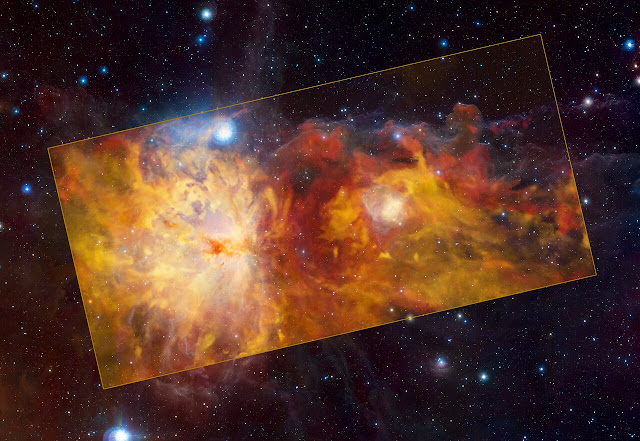
The Flame Nebula region as seen with APEX and VISTA
 
The Flame Nebula region as seen with APEX
 
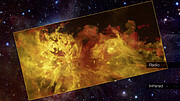
The Flame Nebula region as seen with APEX and the DSS2


Videos

Multiple views of the Flame Nebula region as seen with the DSS2, VISTA and APEX Multiple views of the Flame Nebula region as seen with the DSS2, VISTA and APEX


Orion offers you a spectacular firework display to celebrate the holiday season and the new year in this new image from the European Southern Observatory (ESO). But no need to worry, this iconic constellation is neither exploding nor burning. The “fire” you see in this holiday postcard is Orion’s Flame Nebula and its surroundings captured in radio waves — an image that undoubtedly does justice to the nebula’s name! It was taken with the ESO-operated Atacama Pathfinder Experiment (APEX), located on the cold Chajnantor Plateau in Chile’s Atacama Desert.

The newly processed image of the Flame Nebula, in which smaller nebulae like the Horsehead Nebula also make an appearance, is based on observations conducted by former ESO astronomer Thomas Stanke and his team a few years ago. Excited to try out the then recently installed SuperCam instrument at APEX, they pointed it towards the constellation Orion. “As astronomers like to say, whenever there is a new telescope or instrument around, observe Orion: there will always be something new and interesting to discover!” says Stanke. A few years and many observations later, Stanke and his team have now had their results accepted for publication in the journal Astronomy & Astrophysics.

One of the most famous regions in the sky, Orion is home to the giant molecular clouds closest to the Sun — vast cosmic objects made up mainly of hydrogen, where new stars and planets form. These clouds are located between 1300 and 1600 light-years away and feature the most active stellar nursery in the Solar System’s neighbourhood, as well as the Flame Nebula depicted in this image. This “emission” nebula harbours a cluster of young stars at its centre that emit high-energy radiation, making the surrounding gases shine. 

With such an exciting target, the team were unlikely to be disappointed. In addition to the Flame Nebula and its surroundings, Stanke and his collaborators were able to admire a wide range of other spectacular objects. Some examples include the reflection nebulae Messier 78 and NGC 2071 — clouds of interstellar gas and dust believed to reflect the light of nearby stars. The team even discovered one new nebula, a small object, remarkable in its almost perfectly circular appearance, which they named the Cow Nebula.

The observations were conducted as part of the APEX Large CO Heterodyne Orion Legacy Survey (ALCOHOLS), which looked at the radio waves emitted by carbon monoxide (CO) in the Orion clouds. Using this molecule to probe wide areas of the sky is the primary goal of SuperCam, as it allows astronomers to map large gas clouds that give birth to new stars. Unlike what the “fire” of this image might suggest, these clouds are actually cold, with temperatures typically just a few tens of degrees above absolute zero.  

Given the many secrets it can tell, this region of the sky has been scanned many times in the past at different wavelengths, each wavelength range unveiling different, unique features of Orion’s molecular clouds. One example are the infrared observations performed with ESO’s Visible and Infrared Survey Telescope for Astronomy (VISTA) at the Paranal Observatory in Chile that make up the peaceful background of this image of the Flame Nebula and its surroundings. Unlike visible light, infrared waves pass through the thick clouds of interstellar dust, allowing astronomers to spot stars and other objects which would otherwise remain hidden. 

So, this holiday season, bring in the new year with this spectacular multiwavelength firework show put on by the Orion’s Flame Nebula, presented by ESO!


More Information

The observations mentioned in this press release are presented in a paper accepted for publication in Astronomy & Astrophysics.

The team is composed of Th. Stanke (European Southern Observatory, Garching bei München, Germany [ESO]), H. G. Arce (Department of Astronomy, Yale University, New Haven, CT, USA), J. Bally (CASA, University of Colorado, Boulder, CO, USA), P. Bergman (Department of Space, Earth and Environment, Chalmers University of Technology, Onsala Space Observatory, Onsala, Sweden), J. Carpenter (Joint ALMA Observatory, Santiago, Chile [ALMA]), C. J. Davis (National Science Foundation, Alexandria, VA, USA), W. Dent (ALMA), J. Di Francesco (NRC Herzberg Astronomy and Astrophysics, Victoria, BC, Canada [HAA] and Department of Physics and Astronomy, University of Victoria, BC, Canada [UVic]), J. Eislöffel (Thüringer Landessternwarte, Tautenburg, Germany), D. Froebrich (School of Physical Sciences, University of Kent, Canterbury, UK), A. Ginsburg (Department of Astronomy, University of Florida, Gainesville, FL, USA), M. Heyer (Department of Astronomy, University of Massachusetts, Amherst, MA, USA), D. Johnstone (HAA and UVic), D. Mardones (Departamento de Astronomía, Universidad de Chile, Santiago, Chile), M. J. McCaughrean (European Space Agency, ESTEC, Noordwijk, The Netherlands), S. T. Megeath (Department of Physics and Astronomy, University of Toledo, OH, USA), F. Nakamura (National Astronomical Observatory, Tokyo, Japan), M. D. Smith (Centre for Astrophysics and Planetary Science, School of Physical Sciences, University of Kent, Canterbury, UK), A. Stutz (Departmento de Astronomía, Facultad de Ciencias Físicas y Matemáticas, Universidad de Concepción, Chile), K. Tatematsu (Nobeyama Radio Observatory, National Astronomical Observatory of Japan, National Institutes of Natural Sciences, Nagano, Japan), C. Walker (Steward Observatory, University of Arizona, Tucson, AZ, US [SO]), J. P. Williams (Institute for Astronomy, University of Hawai‘i at Manoa, HI, USA), H. Zinnecker (Universidad Autonoma de Chile, Santiago, Chile), B. J. Swift (SO), C. Kulesa (SO), B. Peters (SO), B. Duffy (SO), J. Kloosterman (University of Southern Indiana, Evansville, IN, USA), U. A. Yıldız (Jet Propulsion Laboratory, California Institute of Technology, Pasadena, CA, USA [JPL]), J. L. Pineda (JPL), C. De Breuck (ESO), and Th. Klein (European Southern Observatory, Santiago, Chile).

APEX is a collaboration between the Max Planck Institute for Radio Astronomy (MPIfR), the Onsala Space Observatory (OSO) and ESO. Operation of APEX at Chajnantor is entrusted to ESO.

SuperCAM is a project by the Steward Observatory Radio Astronomy Laboratory at the University of Arizona, US.

The European Southern Observatory (ESO) enables scientists worldwide to discover the secrets of the Universe for the benefit of all. We design, build and operate world-class observatories on the ground — which astronomers use to tackle exciting questions and spread the fascination of astronomy — and promote international collaboration in astronomy. Established as an intergovernmental organisation in 1962, today ESO is supported by 16 Member States (Austria, Belgium, the Czech Republic, Denmark, France, Finland, Germany, Ireland, Italy, the Netherlands, Poland, Portugal, Spain, Sweden, Switzerland and the United Kingdom), along with the host state of Chile and with Australia as a Strategic Partner. ESO’s headquarters and its visitor centre and planetarium, the ESO Supernova, are located close to Munich in Germany, while the Chilean Atacama Desert, a marvellous place with unique conditions to observe the sky, hosts our telescopes. ESO operates three observing sites: La Silla, Paranal and Chajnantor. At Paranal, ESO operates the Very Large Telescope and its Very Large Telescope Interferometer, as well as two survey telescopes, VISTA working in the infrared and the visible-light VLT Survey Telescope. Also at Paranal ESO will host and operate the Cherenkov Telescope Array South, the world’s largest and most sensitive gamma-ray observatory. Together with international partners, ESO operates APEX and ALMA on Chajnantor, two facilities that observe the skies in the millimetre and submillimetre range. At Cerro Armazones, near Paranal, we are building “the world’s biggest eye on the sky” — ESO’s Extremely Large Telescope. From our offices in Santiago, Chile we support our operations in the country and engage with Chilean partners and society.


Links


Contacts:

Thomas Stanke
European Southern Observatory
Garching bei München, Germany
Email:
tstanke049@gmail.com

Bárbara Ferreira
ESO Media Manager
Garching bei München, Germany
Tel: +49 89 3200 6670
Cell: +49 151 241 664 00
Email:
press@eso.org

Source: ESO/News


Wednesday, October 05, 2016

ESO’s Dustbuster Reveals Hidden Stars

VISTA views Messier 78

Messier 78: a reflection nebula in Orion

Comparisons between parts of the Messier 78 region in visible and infrared light 


Videos

Zooming into VISTA’s view of Messier 78

Panning across VISTA’s view of Messier 78

Infrared/visible-light cross-fade views of Messier 78


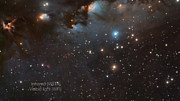
In this new image of the nebula Messier 78, young stars cast a bluish pall over their surroundings, while red fledgling stars peer out from their cocoons of cosmic dust. To our eyes, most of these stars would be hidden behind the dust, but ESO’s Visible and Infrared Survey Telescope for Astronomy (VISTA) sees near-infrared light, which passes right through dust. The telescope is like a giant dustbuster that lets astronomers probe deep into the heart of the stellar environment.

Messier 78, or M78, is a well-studied example of a reflection nebula. It is located approximately 1600 light-years away in the constellation of Orion (The Hunter), just to the upper left of the three stars that make up the belt of this familiar landmark in the sky. In this image, Messier 78 is the central, bluish haze in the centre; the other reflection nebula towards the right goes by the name of NGC 2071. The French astronomer Pierre Méchain is credited with discovering Messier 78 in 1780. However, it is today more commonly known as the 78th entry in French astronomer Charles Messier’s catalogue, added to it in December of 1780.

When observed with visible light instruments, like ESO’s Wide Field Imager at the La Silla Observatory, Messier 78 appears as a glowing, azure expanse surrounded by dark ribbons (see eso1105). Cosmic dust reflects and scatters the light streaming from the young, bluish stars in Messier 78’s heart, the reason it is known as a reflection nebula.

The dark ribbons are thick clouds of dust that block the visible light originating behind them. These dense, cold regions are prime locations for the formation of new stars. When Messier 78 and its neighbours are observed in the submillimetre light between radio waves and infrared light, for example with the Atacama Pathfinder Experiment (APEX) telescope, they reveal the glow of dust grains in pockets just barely warmer than their extremely cold surroundings (see eso1219). 

Eventually new stars will form out of these pockets as gravity causes them to shrink and heat up.
In between visible and submillimetre light lies the near-infrared part of the spectrum, where the Visible and Infrared Survey Telescope for Astronomy (VISTA) provides astronomers with crucial information. Beyond dusty reflections and through thinner portions of obscuring material, the luminous stellar sources within Messier 78 are visible to VISTA’s eyes. In the centre of this image, two blue supergiant stars, called HD 38563A and HD 38563B, shine brightly. Towards the right of the image, the supergiant star illuminating NGC 2071, called HD 290861, is also seen.

Besides big, blue, hot stars, VISTA can also see many stars that are just forming within the cosmic dust strewn about this region, their reddish and yellow colours shown clearly in this image. These colourful fledgling stars can be found in the dust bands around NGC 2071 and along the trail of dust running towards the left of the image. Some of these are T Tauri stars. Although relatively bright, they are not yet hot enough for nuclear fusion reactions to have commenced in their cores. In several tens of millions of years, they will attain full “starhood”, and will take their place alongside their stellar brethren lighting up the Messier 78 region.


More Information

ESO is the foremost intergovernmental astronomy organisation in Europe and the world’s most productive ground-based astronomical observatory by far. It is supported by 16 countries: Austria, Belgium, Brazil, the Czech Republic, Denmark, France, Finland, Germany, Italy, the Netherlands, Poland, Portugal, Spain, Sweden, Switzerland and the United Kingdom, along with the host state of Chile. ESO carries out an ambitious programme focused on the design, construction and operation of powerful ground-based observing facilities enabling astronomers to make important scientific discoveries. ESO also plays a leading role in promoting and organising cooperation in astronomical research. ESO operates three unique world-class observing sites in Chile: La Silla, Paranal and Chajnantor. At Paranal, ESO operates the Very Large Telescope, the world’s most advanced visible-light astronomical observatory and two survey telescopes. VISTA works in the infrared and is the world’s largest survey telescope and the VLT Survey Telescope is the largest telescope designed to exclusively survey the skies in visible light. ESO is a major partner in ALMA, the largest astronomical project in existence. And on Cerro Armazones, close to Paranal, ESO is building the 39-metre European Extremely Large Telescope, the E-ELT, which will become “the world’s biggest eye on the sky”.


Links


Contact

Richard Hook
ESO Public Information Officer
Garching bei München, Germany
Tel: +49 89 3200 6655
Cell: +49 151 1537 3591
Email:
rhook@eso.org

Source: ESO

Wednesday, May 02, 2012

Sifting through Dust near Orion's Belt

PR Image eso1219a
Cosmic dust clouds in Messier 78

Messier 78: a reflection nebula in Orion

Sifting through Dust near Orion’s Belt (data coverage)

Videos

PR Video eso1219a
Sifting through Dust near Orion’s Belt (zoom)

Sifting through Dust near Orion’s Belt (pan)

Image Comparisons

Image Comparison eso1219a
Sifting through Dust near Orion’s Belt (mouseover comparison)

A new image of the region surrounding the reflection nebula Messier 78, just to the north of Orion’s Belt, shows clouds of cosmic dust threaded through the nebula like a string of pearls. The observations, made with the Atacama Pathfinder Experiment (APEX) telescope[1], use the heat glow of interstellar dust grains to show astronomers where new stars are being formed.

Dust may sound boring and uninteresting — the surface grime that hides the beauty of an object. But this new image of Messier 78 and surroundings, which reveals the submillimetre-wavelength radiation from dust grains in space, shows that dust can be dazzling. Dust is important to astronomers as dense clouds of gas and dust are the birthplaces of new stars.

In the centre of the image is Messier 78, also known as NGC 2068. When seen in visible light, this region is a reflection nebula, meaning that we see the pale blue glow of starlight reflected from clouds of dust. The APEX observations are overlaid on the visible-light image in orange. Sensitive to longer wavelengths, they reveal the gentle glow of dense cold clumps of dust, some of which are even colder than -250ºC. In visible light, this dust is dark and obscuring, which is why telescopes such as APEX are so important for studying the dusty clouds in which stars are born.

One filament seen by APEX appears in visible light as a dark lane of dust cutting across Messier 78. This tells us that the dense dust lies in front of the reflection nebula, blocking its bluish light. Another prominent region of glowing dust seen by APEX overlaps with the visible light from Messier 78 at its lower edge. The lack of a corresponding dark dust lane in the visible light image tells us that this dense region of dust must lie behind the reflection nebula.

Observations of the gas in these clouds reveal gas flowing at high velocity out of some of the dense clumps. These outflows are ejected from young stars while the star is still forming from the surrounding cloud. Their presence is therefore evidence that these clumps are actively forming stars.

At the top of the image is another reflection nebula, NGC 2071. While the lower regions in this image contain only low-mass young stars, NGC 2071 contains a more massive young star with an estimated mass five times that of the Sun, located in the brightest peak seen in the APEX observations.

The APEX observations used in this image were led by Thomas Stanke (ESO), Tom Megeath (University of Toledo, USA), and Amy Stutz (Max Planck Institute for Astronomy, Heidelberg, Germany). For more information about this region as seen in visible light, including the recently discovered — and highly variable — McNeil’s Nebula, see eso1105.

Notes

[1] APEX is a collaboration between the Max Planck Institute for Radio Astronomy (MPIfR), the Onsala Space Observatory (OSO) and ESO. Operation of APEX at Chajnantor is entrusted to ESO. APEX is a pathfinder for the next-generation submillimetre telescope, the Atacama Large Millimeter/submillimeter Array (ALMA), which is being built and operated on the same plateau.

More information

The year 2012 marks the 50th anniversary of the founding of the European Southern Observatory (ESO). ESO is the foremost intergovernmental astronomy organisation in Europe and the world’s most productive astronomical observatory. It is supported by 15 countries: Austria, Belgium, Brazil, the Czech Republic, Denmark, France, Finland, Germany, Italy, the Netherlands, Portugal, Spain, Sweden, Switzerland and the United Kingdom. ESO carries out an ambitious programme focused on the design, construction and operation of powerful ground-based observing facilities enabling astronomers to make important scientific discoveries. ESO also plays a leading role in promoting and organising cooperation in astronomical research. ESO operates three unique world-class observing sites in Chile: La Silla, Paranal and Chajnantor. At Paranal, ESO operates the Very Large Telescope, the world’s most advanced visible-light astronomical observatory and two survey telescopes. VISTA works in the i>nfrared and is the world’s largest survey telescope and the VLT Survey Telescope is the largest telescope designed to exclusively survey the skies in visible light. ESO is the European partner of a revolutionary astronomical telescope ALMA, the largest astronomical project in existence. ESO is currently planning a 40-metre-class European Extremely Large optical/near-infrared Telescope, the E-ELT, which will become “the world’s biggest eye on the sky”.

Links

Contacts

Thomas Stanke
ESO
Garching, Germany
Tel: +49 89 3200 6116
Email: tstanke@eso.org

Douglas Pierce-Price
ESO ALMA/APEX Public Information Officer
Garching, Germany
Tel: +49 89 3200 6759
Email: dpiercep@eso.org

Wednesday, June 29, 2011

Making a Spectacle of Star Formation in Orion

Best known as Messier 78, the two round greenish nebulae are actually cavities carved out of the surrounding dark dust clouds. Image credit: NASA/JPL-Caltech. Full image and caption

Looking like a pair of eyeglasses only a rock star would wear, this nebula brings into focus a murky region of star formation. NASA's Spitzer Space Telescope exposes the depths of this dusty nebula with its infrared vision, showing stellar infants that are lost behind dark clouds when viewed in visible light.

Best known as Messier 78, the two round greenish nebulae are actually cavities carved out of the surrounding dark dust clouds. The extended dust is mostly dark, even to Spitzer's view, but the edges show up in mid-wavelength infrared light as glowing, red frames surrounding the bright interiors. Messier 78 is easily seen in small telescopes in the constellation of Orion, just to the northeast of Orion's belt, but looks strikingly different, with dominant, dark swaths of dust. Spitzer's infrared eyes penetrate this dust, revealing the glowing interior of the nebulae.

The light from young, newborn stars are starting to carve out cavities within the dust, and eventually, this will become a larger nebula like the "green ring" imaged by Spitzer (see http://www.jpl.nasa.gov/news/news.cfm?release=2011-183).

A string of baby stars that have yet to burn their way through their natal shells can be seen as red pinpoints on the outside of the nebula. Eventually these will blossom into their own glowing balls, turning this two-eyed eyeglass into a many-eyed monster of a nebula.

This is a three-color composite that shows infrared observations from two Spitzer instruments. Blue represents 3.6- and 4.5-micron light, and green shows light of 5.8 and 8 microns, both captured by Spitzer's infrared array camera. Red is 24-micron light detected by Spitzer's multiband imaging photometer.

Whitney Clavin (818) 354-4673
Jet Propulsion Laboratory, Pasadena, Calif.
whitney.clavin@jpl.nasa.gov

Wednesday, February 16, 2011

Reflected Glory

PR Image eso1105a
Messier 78: a reflection nebula in Orion

PR Image eso1105b
Messier 78: a reflection nebula in Orion

PR Image eso1105c
Highlights of Messier 78: a reflection nebula in Orion

PR Image eso1105d
McNeil's Nebula in Messier 78

PR Video eso1105a
Zooming in on Messier 78

PR Video eso1105b
Panning across the reflection nebula Messier 78

The nebula Messier 78 takes centre stage in this image taken with the Wide Field Imager on the MPG/ESO 2.2-metre telescope at the La Silla Observatory in Chile, while the stars powering the bright display take a backseat. The brilliant starlight ricochets off dust particles in the nebula, illuminating it with scattered blue light. Igor Chekalin was the overall winner of ESO’s Hidden Treasures 2010 astrophotography competition with his image of this stunning object.

Messier 78 is a fine example of a reflection nebula. The ultraviolet radiation from the stars that illuminate it is not intense enough to ionise the gas to make it glow — its dust particles simply reflect the starlight that falls on them. Despite this, Messier 78 can easily be observed with a small telescope, being one of the brightest reflection nebulae in the sky. It lies about 1350 light-years away in the constellation of Orion (The Hunter) and can be found northeast of the easternmost star of Orion’s belt.

This new image of Messier 78 from the MPG/ESO 2.2-metre telescope at the La Silla Observatory is based on data selected by Igor Chekalin in his winning entry to the Hidden Treasures competition [1].

The pale blue tint seen in the nebula in this picture is an accurate representation of its dominant colour. Blue hues are commonly seen in reflection nebulae because of the way the starlight is scattered by the tiny dust particles that they contain: the shorter wavelength of blue light is scattered more efficiently than the longer wavelength red light.

This image contains many other striking features apart from the glowing nebula. A thick band of obscuring dust stretches across the image from the upper left to the lower right, blocking the light from background stars. In the bottom right corner, many curious pink structures are also visible, which are created by jets of material being ejected from stars that have recently formed and are still buried deep in dust clouds.

Two bright stars, HD 38563A and HD 38563B, are the main powerhouses behind Messier 78. However, the nebula is home to many more stars, including a collection of about 45 low mass, young stars (less than 10 million years old) in which the cores are still too cool for hydrogen fusion to start, known as T Tauri stars. Studying T Tauri stars is important for understanding the early stages of star formation and how planetary systems are created.

Remarkably, this complex of nebulae has also changed significantly in the last ten years. In February 2004 the experienced amateur observer Jay McNeil took an image of this region with a 75 mm telescope and was surprised to see a bright nebula — the prominent fan shaped feature near the bottom of this picture — where nothing was seen on most earlier images. This object is now known as McNeil’s Nebula and it appears to be a highly variable reflection nebula around a young star.

This colour picture was created from many monochrome exposures taken through blue, yellow/green and red filters, supplemented by exposures through an H-alpha filter that shows light from glowing hydrogen gas. The total exposure times were 9, 9, 17.5 and 15.5 minutes per filter, respectively.
Notes

[1] Igor Chekalin from Russia uncovered the raw data for this image of Messier 78 in ESO’s archives in the competition Hidden Treasures (eso1102). He processed the raw data with great skill, claiming first prize in the contest for his final image (Flickr link). ESO’s team of in-house image processing experts then independently processed the raw data at full resolution to produce the image shown here.
More information

ESO, the European Southern Observatory, is the foremost intergovernmental astronomy organisation in Europe and the world’s most productive astronomical observatory. It is supported by 15 countries: Austria, Belgium, Brazil, the Czech Republic, Denmark, France, Finland, Germany, Italy, the Netherlands, Portugal, Spain, Sweden, Switzerland and the United Kingdom. ESO carries out an ambitious programme focused on the design, construction and operation of powerful ground-based observing facilities enabling astronomers to make important scientific discoveries. ESO also plays a leading role in promoting and organising cooperation in astronomical research. ESO operates three unique world-class observing sites in Chile: La Silla, Paranal and Chajnantor. At Paranal, ESO operates the Very Large Telescope, the world’s most advanced visible-light astronomical observatory and VISTA, the world’s largest survey telescope. ESO is the European partner of a revolutionary astronomical telescope ALMA, the largest astronomical project in existence. ESO is currently planning a 42-metre European Extremely Large optical/near-infrared Telescope, the E-ELT, which will become “the world’s biggest eye on the sky”.

Links

Photo of MPG/ESO 2.2-metre telescope
Photos of La Silla Observatory

Contacts

Richard Hook
ESO, La Silla, Paranal, E-ELT and Survey Telescopes Public Information Officer
Garching bei München, Germany
Tel: +49 89 3200 6655
Cell: +49 151 1537 3591
Email: rhook@eso.org