Showing posts with label NGC 4993. Show all posts

Monday, February 28, 2022

GW170817: The Unfolding Story of a Kilonova Told in X-rays

GW170817
Credit: X-ray: NASA/CXC/Northwestern Univ./A. Hajela et al.; Illustration: NASA/CXC/M.Weiss

JPEG (667.2 kb) - Large JPEG (9.5 MB) - Tiff (111.2 MB) -  More Images

Tour of GW170817 - More Animations


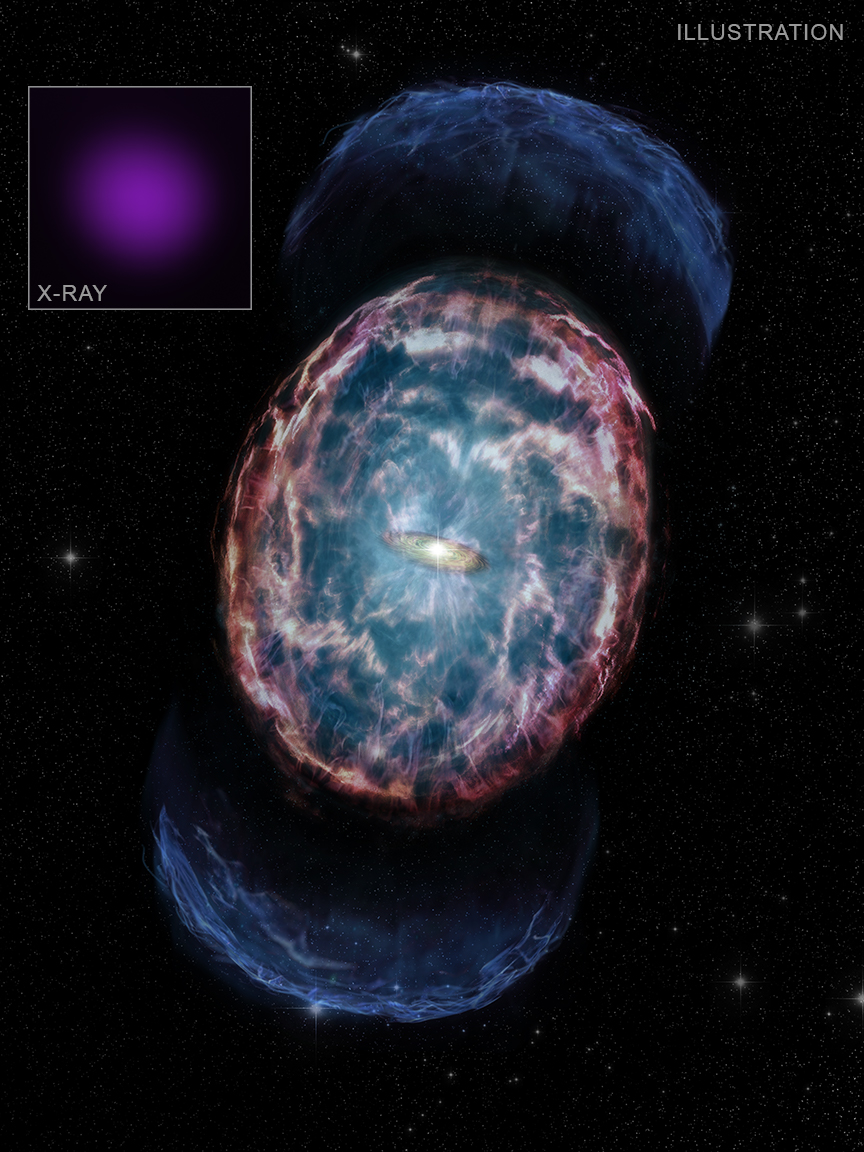
An artist’s conception illustrates the aftermath of a "kilonova," a powerful event that happens when two neutron stars merge. As described in our press release, NASA’s Chandra X-ray Observatory has been collecting data on the kilonova associated with GW170817 since shortly after it was first detected in gravitational waves by the Laser Interferometry Gravitational-wave Observatory (LIGO) and Virgo on August 17, 2017.

GW170817 was the first — and thus far the only — cosmic event where both gravitational waves and electromagnetic radiation, or light, were detected. This combination provides scientists with critical information about the physics of neutron star mergers and related phenomena, using observations at many different parts of the electromagnetic spectrum. Chandra is the only observatory still able to detect light from this extraordinary cosmic collision more than four years after the original event.

X-ray Credit: NASA/CXC/Northwestern Univ./A. Hajela et al.

Astronomers think that after neutron stars merge, the debris generates visible and infrared light from the decay of radioactive elements like platinum and gold formed in the debris from the merger. This burst of light is called a kilonova. Indeed, visible light and infrared emission were detected from GW170817 several hours after the gravitational waves.

Initially the neutron star merger likely produced a jet of high-energy particles that was not pointed directly at Earth, explaining an initial lack of X-rays seen by Chandra. The jet then slowed down and widened upon impact with surrounding gas and dust. These changes caused an increase in X-rays observed by Chandra followed by a decline in early 2018. However, since the end of 2020, the X-rays detected by Chandra have remained at a nearly constant level. The Chandra image from data taken in December 2020 and January 2021 shows X-ray emission from GW170817 and from the center of its host galaxy, NGC 4993.

A research team studying the Chandra data think this steadying of the X-ray emission comes from a shock — like a sonic boom from an airplane — as the merger debris responsible for the kilonova strikes gas around GW170817. Material heated by such a shock would glow steadily in X-rays giving a "kilonova afterglow", like Chandra has observed. The artist’s illustration shows the merger debris responsible for the kilonova in blue surrounded by a shock depicted in orange and red.

There is also an alternative explanation suggesting that the X-rays come from material falling towards a black hole that formed after the neutron stars merged. This material is depicted by a small disk in the center of the illustration. To avoid a coincidence, it is likely that only one of the two options — the kilonova afterglow or matter falling onto a black hole — is a significant source of the detected X-rays.

The two blue glowing arcs of material above and below the kilonova show where material from the now-faded jet has struck surrounding material.

To distinguish between the two explanations astronomers will keep monitoring GW170817 in X-rays and radio waves. If it is a kilonova afterglow, the radio emission is expected to get brighter over time and be detected again in the next few months or years. If the explanation involves matter falling onto a newly-formed black hole, then the X-ray output should stay steady or decline rapidly and no radio emission will be detected over time.

Researchers recently announced a source was detected in new Chandra observations performed in December 2021. Analysis of that data is ongoing. No radio detection has yet been reported.

A paper describing these results appears in the latest issue of The Astrophysical Journal Letters and is available online [link]. The authors are Aprajita Hajela (Northwestern University), Rafella Marguitti (University of California at Berkeley), Joe Bright (Berkeley), Kate Alexander (Northwestern), Brian Metzger (Columbia University), Vsevovold Nedora (University of Jena, Germany), Adithan Kathirgamarju (Berkeley), Ben Margalit (Berkeley), David Radice (Penn State University), Cristiano Guidorzi (University of Ferrara, Italy), Edo Berger (Center for Astrophysics I Harvard & Smithsonian (CfA)), Andrew MacFadyen (New York University), Dimitrios Giannios (Purdue University), Ryan Chornock (Berkeley), Ian Heywood (University of Oxford, UK), Lorenzo Sironi (Columbia), Ore Gottlieb (Tel Aviv University, Israel), Deanne Coppjans (Northwestern), Tanmoy Laskar (University of Bath, UK), Yvette Cendes (CfA), Rodolfo Barniol Duran (California State University, Sacramento), Tarraneh Eftekhari (CfA), Wen-fai Fong (Northwestern), Austin McDowell (NYU), Matt Nicholl (University of Birmingham, UK), Zhengtong Xie (University of Southampton, UK), Jonathan Zrake (Clemson University), Sebastiano Bernuzzi (University of Jena), Floor Broekgaarden (CfA), Charlie Kilpatrick (Northwestern), Giacomo Terreran (Northwestern), Ashley Villar (Columbia), Peter Blanchard (Northwestern), Sebastian Gomez (CfA), Griffin Hosseinzadeh (University of Arizona), David Jacob Matthews (Berkeley), and Jillian Rastinejad (Northwestern).

NASA's Marshall Space Flight Center manages the Chandra program. The Smithsonian Astrophysical Observatory's Chandra X-ray Center controls science operations from Cambridge, Massachusetts, and flight operations from Burlington, Massachusetts.

Fast Facts for GW170817:

Scale: Inset image is 30 arcsec across (19,000 light-years)
Category: Neutron Stars/X-ray Binaries
Coordinates (J2000): RA 13h 09m 48.1s | Dec -23° 22´ 53.4
Constellation: Hydra
Observation Date: 7 observations from Dec 9, 2020-Jan 27, 2021
Observation Time: 53 hours
Obs. ID: 22677, 24887-24889, 23870, 24923, 24924
Instrument:
ACIS
References: Hajela, A. et al., 2022, ApJL, accepted; arXiv:2104.02070
Color Code: X-ray: Purple
Distance Estimate: About 130 million light years


Tuesday, July 13, 2021

Science with a Single Merger Event


Artist’s impression of a binary neutron star merger
Credits: National Science Foundation/LIGO/Sonoma State University/A. Simonnet


Images of the galaxy NGC 4993 showing the electromagnetic counterpart to the gravitational wave-event GW170817. The image was taken by the Dark Energy Camera (DECam) on Blanco 4-meter telescope at the Cerro Tololo Inter-American Observatory. Credit: Adapted from M. Soares-Santos et al. 2017


Gravitational-wave events have allowed us to measure distances in space in a way that’s independent of previous techniques. By extension, we can also make independent measurements of the universe’s rate of expansion, expressed as the Hubble constant. Current measurements of the Hubble constant from gravitational-wave events still rely on electromagnetic information, but with new observatories on the horizon, it may be possible to make measurements of the Hubble constant with just a single gravitational-wave event.

Ways to Use Gravitational-Wave Events

The gravitational-wave event GW170817 was the first observation of a binary neutron star merger. With concurrent electromagnetic observations, we were able to use information from GW170817 to make an independent measurement of the Hubble constant. This measurement coupled the distance to the event host galaxy (as determined from the gravitational-wave event) with the redshift of the host galaxy, which is derived from electromagnetic information.

While the uncertainty on this measurement of the Hubble constant is relatively large, higher precision measurements will be possible in the near future with more advanced observatories. However, our interpretation of the gravitational-wave signal in this case is very dependent on the inclination of the merging system and the distance to the merger host galaxy as measured by electromagnetic observations — and we’re currently unable to separate the influence of these two quantities.

But what if we could disentangle these influences with a single gravitational-wave event? A recent study led by Juan Calderón Bustillo (Universidade de Santiago de Compostela, Spain) explores how we could use future observations of neutron star mergers like GW170817 to make higher precision measurements of the Hubble constant.


The spectrum of gravitational-wave signals from face-on and edge-on merging systems, with certain signal components highlighted. The black line shows the sensitivity of the planned Neutron star Extreme Matter Observatory (NEMO). Credits: Adapted from Bustillo et al. 2021


Picking Up Subtle Signals

Like most signals, a gravitational-wave signal can be broken down into multiple simpler signals. In the case of a neutron star merger, the components of a gravitational-wave signal are dependent on properties of the merging system, such as stellar mass and the orientation of the system relative to the observer.

With current observatories, we don’t have the ability to pick up the subtler component signals in a gravitational wave, including those that appear after the merger. But if we did — and we eventually will — Bustillo and collaborators show that we could use those subtle signals to disentangle the influences of system inclination and host galaxy distance. Then, we would also be able to make more precise measurements of the Hubble constant. Most notably, being able to pick up these subtler signals would allow us to make measurements of the Hubble constant with just a single merger event!

Future Prospects

The ability to make measurements of the Hubble constant based on single events enables us to test an interesting hypothesis: what if the universe’s rate of expansion is sensitive to direction? While those particular measurements are still a few decades in the future, Bustillo and collaborators show that their method will eventually be limited by our electromagnetic observing capabilities, rather than our ability to observe gravitational-wave signals!

Citation

“Mapping the Universe Expansion: Enabling Percent-level Measurements of the Hubble Constant with a Single Binary Neutron-star Merger Detection,” Juan Calderón Bustillo et al 2021 ApJL 912 L10. doi:10.3847/2041-8213/abf502


Friday, October 25, 2019

First identification of a heavy element born from neutron star collision

Artist’s impression of strontium emerging from a neutron star merger

X-shooter spectra montage of kilonova in NGC 4993

The galaxy NGC 4993 in the constellation of Hydra

The sky around the galaxy NGC 4993


Videos

ESOcast 210 Light: First identification of a heavy element born from neutron star collision

Neutron star merger animation and elements formed in these events

Animation of spectra of kilonova in NGC 4993


For the first time, a freshly made heavy element, strontium, has been detected in space, in the aftermath of a merger of two neutron stars. This finding was observed by ESO’s X-shooter spectrograph on the Very Large Telescope (VLT) and is published today in Nature. The detection confirms that the heavier elements in the Universe can form in neutron star mergers, providing a missing piece of the puzzle of chemical element formation.


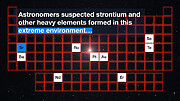
In 2017, following the detection of gravitational waves passing the Earth, ESO pointed its telescopes in Chile, including the VLT, to the source: a neutron star merger named GW170817. Astronomers suspected that, if heavier elements did form in neutron star collisions, signatures of those elements could be detected in kilonovae, the explosive aftermaths of these mergers. This is what a team of European researchers has now done, using data from the X-shooter instrument on ESO’s VLT.


Following the GW170817 merger, ESO’s fleet of telescopes began monitoring the emerging kilonova explosion over a wide range of wavelengths. X-shooter in particular took a series of spectra from the ultraviolet to the near infrared. Initial analysis of these spectra suggested the presence of heavy elements in the kilonova, but astronomers could not pinpoint individual elements until now. 

“By reanalysing the 2017 data from the merger, we have now identified the signature of one heavy element in this fireball, strontium, proving that the collision of neutron stars creates this element in the Universe,” says the study’s lead author Darach Watson from the University of Copenhagen in Denmark. On Earth, strontium is found naturally in the soil and is concentrated in certain minerals. Its salts are used to give fireworks a brilliant red colour. 

Astronomers have known the physical processes that create the elements since the 1950s. Over the following decades they have uncovered the cosmic sites of each of these major nuclear forges, except one. “This is the final stage of a decades-long chase to pin down the origin of the elements,” says Watson. “We know now that the processes that created the elements happened mostly in ordinary stars, in supernova explosions, or in the outer layers of old stars. But, until now, we did not know the location of the final, undiscovered process, known as rapid neutron capture, that created the heavier elements in the periodic table.”

Rapid neutron capture is a process in which an atomic nucleus captures neutrons quickly enough to allow very heavy elements to be created. Although many elements are produced in the cores of stars, creating elements heavier than iron, such as strontium, requires even hotter environments with lots of free neutrons. Rapid neutron capture only occurs naturally in extreme environments where atoms are bombarded by vast numbers of neutrons.

“This is the first time that we can directly associate newly created material formed via neutron capture with a neutron star merger, confirming that neutron stars are made of neutrons and tying the long-debated rapid neutron capture process to such mergers,” says Camilla Juul Hansen from the Max Planck Institute for Astronomy in Heidelberg, who played a major role in the study.

Scientists are only now starting to better understand neutron star mergers and kilonovae. Because of the limited understanding of these new phenomena and other complexities in the spectra that the VLT’s X-shooter took of the explosion, astronomers had not been able to identify individual elements until now.

“We actually came up with the idea that we might be seeing strontium quite quickly after the event. However, showing that this was demonstrably the case turned out to be very difficult. This difficulty was due to our highly incomplete knowledge of the spectral appearance of the heavier elements in the periodic table,” says University of Copenhagen researcher Jonatan Selsing, who was a key author on the paper. 

The GW170817 merger was the fifth detection of gravitational waves, made possible thanks to the NSF's Laser Interferometer Gravitational-Wave Observatory (LIGO) in the US and the Virgo Interferometer in Italy. Located in the galaxy NGC 4993, the merger was the first, and so far the only, gravitational wave source to have its visible counterpart detected by telescopes on Earth. 


With the combined efforts of LIGO, Virgo and the VLT, we have the clearest understanding yet of the inner workings of neutron stars and their explosive mergers.


More Information

This research was presented in a paper to appear in Nature on 24 October 2019.

The team is composed of D. Watson (Niels Bohr Institute & Cosmic Dawn Center, University of Copenhagen, Denmark), C. J. Hansen (Max Planck Institute for Astronomy, Heidelberg, Germany), J. Selsing (Niels Bohr Institute & Cosmic Dawn Center, University of Copenhagen, Denmark), A. Koch (Center for Astronomy of Heidelberg University, Germany), D. B. Malesani (DTU Space, National Space Institute, Technical University of Denmark, & Niels Bohr Institute & Cosmic Dawn Center, University of Copenhagen, Denmark), A. C. Andersen (Niels Bohr Institute, University of Copenhagen, Denmark), J. P. U. Fynbo (Niels Bohr Institute & Cosmic Dawn Center, University of Copenhagen, Denmark), A. Arcones (Institute of Nuclear Physics, Technical University of Darmstadt, Germany & GSI Helmholtzzentrum für Schwerionenforschung, Darmstadt, Germany), A. Bauswein (GSI Helmholtzzentrum für Schwerionenforschung, Darmstadt, Germany & Heidelberg Institute for Theoretical Studies, Germany), S. Covino (Astronomical Observatory of Brera, INAF, Milan, Italy), A. Grado (Capodimonte Astronomical Observatory, INAF, Naples, Italy), K. E. Heintz (Centre for Astrophysics and Cosmology, Science Institute, University of Iceland, Reykjavík, Iceland & Niels Bohr Institute & Cosmic Dawn Center, University of Copenhagen, Denmark), L. Hunt (Arcetri Astrophysical Observatory, INAF, Florence, Italy), C. Kouveliotou (George Washington University, Physics Department, Washington DC, USA & Astronomy, Physics and Statistics Institute of Sciences), G. Leloudas (DTU Space, National Space Institute, Technical University of Denmark, & Niels Bohr Institute, University of Copenhagen, Denmark), A. Levan (Department of Physics, University of Warwick, UK), P. Mazzali (Astrophysics Research Institute, Liverpool John Moores University, UK & Max Planck Institute for Astrophysics, Garching, Germany), E. Pian (Astrophysics and Space Science Observatory of Bologna, INAF, Bologna, Italy).

ESO is the foremost intergovernmental astronomy organisation in Europe and the world’s most productive ground-based astronomical observatory by far. It has 16 Member States: Austria, Belgium, the Czech Republic, Denmark, France, Finland, Germany, Ireland, Italy, the Netherlands, Poland, Portugal, Spain, Sweden, Switzerland and the United Kingdom, along with the host state of Chile and with Australia as a Strategic Partner. ESO carries out an ambitious programme focused on the design, construction and operation of powerful ground-based observing facilities enabling astronomers to make important scientific discoveries. ESO also plays a leading role in promoting and organising cooperation in astronomical research. ESO operates three unique world-class observing sites in Chile: La Silla, Paranal and Chajnantor. At Paranal, ESO operates the Very Large Telescope and its world-leading Very Large Telescope Interferometer as well as two survey telescopes, VISTA working in the infrared and the visible-light VLT Survey Telescope. Also at Paranal ESO will host and operate the Cherenkov Telescope Array South, the world’s largest and most sensitive gamma-ray observatory. ESO is also a major partner in two facilities on Chajnantor, APEX and ALMA, the largest astronomical project in existence. And on Cerro Armazones, close to Paranal, ESO is building the 39-metre Extremely Large Telescope, the ELT, which will become “the world’s biggest eye on the sky”.


Links


Contacts

Darach Watson
Cosmic Dawn Center (DAWN), Niels Bohr Institute, University of Copenhagen
Copenhagen, Denmark
Cell: +45 24 80 38 25
Email: darach@nbi.ku.dk

Camilla J. Hansen
Max Planck Institute for Astronomy
Heidelberg, Germany
Tel: +49 6221 528-358
Email: hansen@mpia.de

Jonatan Selsing
Cosmic Dawn Center (DAWN), Niels Bohr Institute, University of Copenhagen
Copenhagen, Denmark
Cell: +45 61 71 43 46
Email: jselsing@nbi.ku.dk

Bárbara Ferreira
ESO Public Information Officer
Garching bei München, Germany
Tel: +49 89 3200 6670
Email: pio@eso.org


Monday, January 22, 2018

Neutron-star merger yields new puzzle for astrophysicists

GW170817 - NGC 4993
Credit: NASA/CXC/McGill University/J. Ruan et al.


The afterglow from the distant neutron-star merger detected last August has continued to brighten – much to the surprise of astrophysicists studying the aftermath of the massive collision that took place about 138 million light years away and sent gravitational waves rippling through the universe.

New observations from NASA's orbiting Chandra X-ray Observatory, reported in Astrophysical Journal Letters, indicate that the gamma ray burst unleashed by the collision is more complex than scientists initially imagined.

"Usually when we see a short gamma-ray burst, the jet emission generated gets bright for a short time as it smashes into the surrounding medium – then fades as the system stops injecting energy into the outflow," says McGill University astrophysicist Daryl Haggard, whose research group led the new study. "This one is different; it's definitely not a simple, plain-Jane narrow jet."

Cocoon theory

The new data could be explained using more complicated models for the remnants of the neutron star merger. One possibility: the merger launched a jet that shock-heated the surrounding gaseous debris, creating a hot 'cocoon' around the jet that has glowed in X-rays and radio light for many months.

The X-ray observations jibe with radio-wave data reported last month by another team of scientists, which found that those emissions from the collision also continued to brighten over time.

While radio telescopes were able to monitor the afterglow throughout the fall, X-ray and optical observatories were unable to watch it for around three months, because that point in the sky was too close to the Sun during that period. "When the source emerged from that blind spot in the sky in early December, our Chandra team jumped at the chance to see what was going on," says John Ruan, a postdoctoral researcher at the McGill Space Institute and lead author of the new paper. "Sure enough, the afterglow turned out to be brighter in the X-ray wavelengths, just as it was in the radio."

Physics puzzlev

That unexpected pattern has set off a scramble among astronomers to understand what physics is driving the emission. "This neutron-star merger is unlike anything we've seen before," says Melania Nynka, another McGill postdoctoral researcher. "For astrophysicists, it's a gift that seems to keep on giving." Nynka also co-authored the new paper, along with astronomers from Northwestern University and the University of Leicester.

The neutron-star merger was first detected on Aug. 17 by the U.S.-based Laser Interferometer Gravitational-Wave Observatory (LIGO). The European Virgo detector and some 70 ground- and space-based observatories helped confirm the discovery.

The discovery opened a new era in astronomy. It marked the first time that scientists have been able to observe a cosmic event with both light waves -- the basis of traditional astronomy -- and gravitational waves, the ripples in space-time predicted a century ago by Albert Einstein's general theory of relativity. Mergers of neutron stars, among the densest objects in the universe, are thought to be responsible for producing heavy elements such as gold, platinum, and silver.

"Brightening X-ray Emission from GW170817/GRB170817A: Further Evidence for an Outflow," John J. Ruan et al, Astrophysical Journal Letters, Jan. 18, 2018. https://doi.org/10.3847/2041-8213/aaa4f3

Funding for the research was provided by the National Sciences and Engineering Research Council of Canada, the Fonds de recherche du Québec – Nature et technologies, the McGill Trottier Chair in Astrophysics and Cosmology, and the Canadian Institute for Advanced Research.


Media contacts:

Daryl Haggard
Assistant Professor of Physics
McGill University/McGill Space Institute
daryl.haggard@mcgill.ca

Chris Chipello
Media Relations
McGill University
514-398-4201
christopher.chipello@mcgill.ca


Wednesday, October 18, 2017

NASA Missions Catch First Light from a Gravitational-Wave Event

GW170817
Credit X-ray: NASA/CXC/Northwestern U./W. Fong & R. Margutti et al. & NASA/GSFC/E. Troja et al.; Optical:NASA/STScI


animation


Astronomers have used NASA's Chandra X-ray Observatory to make the first X-ray detection of a gravitational wave source. Chandra was one of multiple observatories to detect the aftermath of this gravitational wave event, the first to produce an electromagnetic signal of any type. This discovery represents the beginning of a new era in astrophysics.

The gravitational wave source, GW170817, was detected with the advanced Laser Interferometer Gravitational-Wave Observatory, or LIGO, at 8:41am EDT on Thursday August 17, 2017. Two seconds later NASA's Fermi Gamma-ray Burst Monitor (GBM) detected a weak pulse of gamma-rays. Later that morning, LIGO scientists announced that GW170817 had the characteristics of a merger of two neutron stars.

During the evening of August 17, multiple teams of astronomers using ground-based telescopes reported a detection of a new source of optical and infrared light in the galaxy NGC 4993, a galaxy located about 130 million light years from Earth. The position of the new optical and infrared source agreed with the position of the Fermi and the gravitational wave sources. The latter was refined by combining information from LIGO and its European counterpart, Virgo.

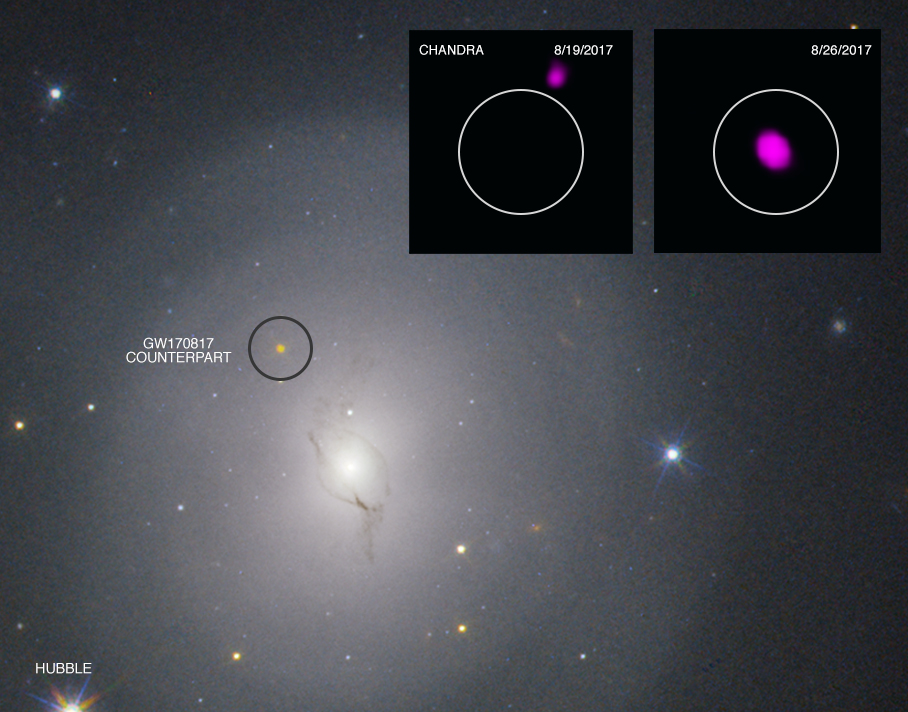
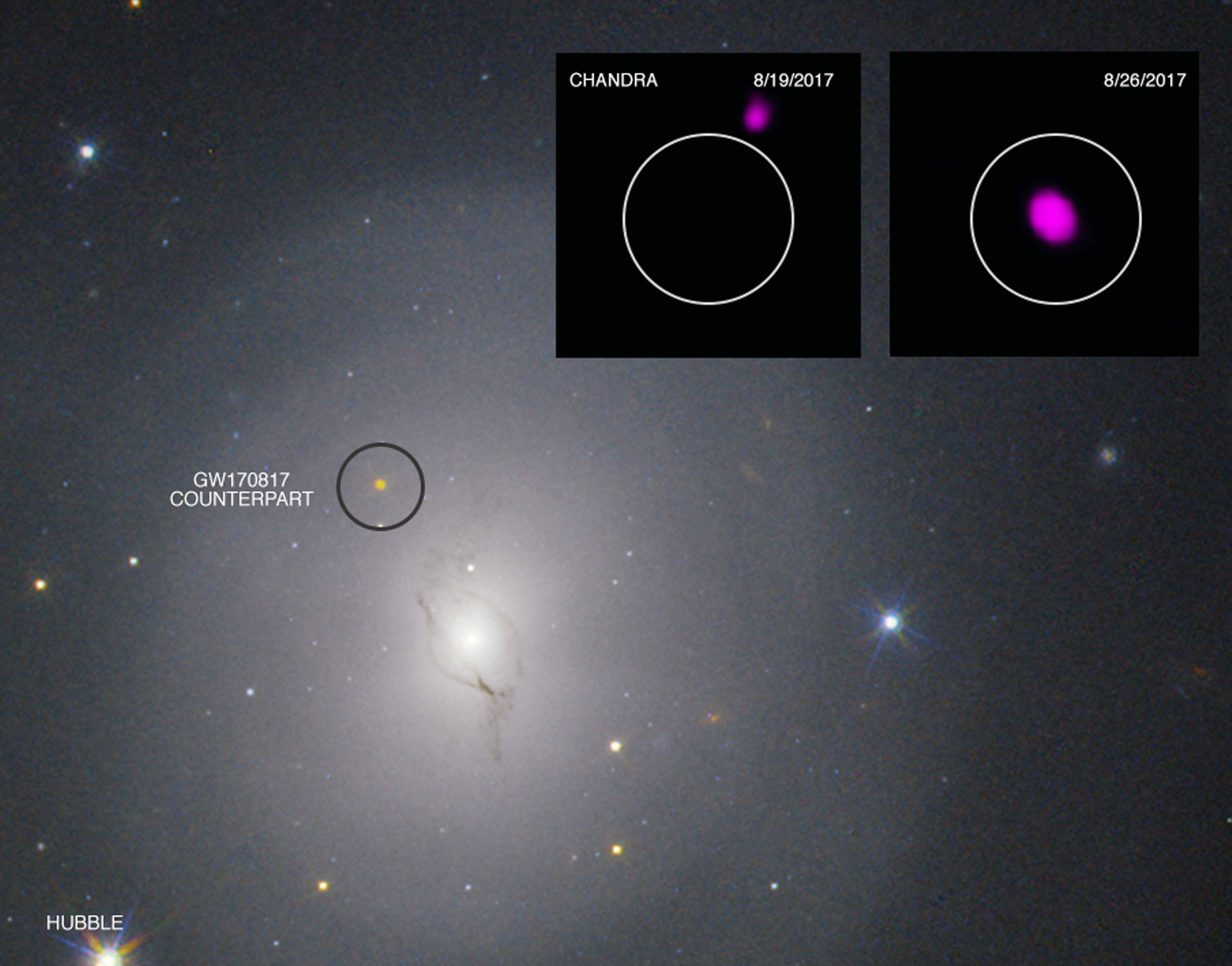
Over the following two weeks, Chandra observed NGC 4993 and the source GW170817 four separate times. In the first observation on August 19th (Principal Investigator: Wen-fai Fong from Northwestern University in Evanston, Illinois), no X-rays were detected at the location of GW170817. This observation was obtained remarkably quickly, only 2.3 days after the gravitational source was detected.

On August 26, Chandra observed GW170817 again and this time, X-rays were seen for the first time (PI: Eleonora Troja from Goddard Space Flight Center in Greenbelt, MD, and the University of Maryland, College Park). This new X-ray source was located at the exact position of the optical and infrared source.

"This Chandra detection is very important because it is the first evidence that sources of gravitational waves are also sources of X-ray emission," said Troja. "This detection is teaching us a great deal of information about the collision and its remnant. It helps to give us an important confirmation that gamma-ray bursts are beamed into narrow jets."

The accompanying graphic shows both the Chandra non-detection, or upper limit of X-rays from GW170817 on August 19th, and the subsequent detection on August 26th, in the two sides of the inset box. The main panel of the graphic is the Hubble Space Telescope image of NGC 4993, which includes data taken on August 22nd. The variable optical source corresponding to GW170817 is located in the center of the circle in the Hubble image.

Chandra observed GW170817 again on September 1st (PI Eleonora Troja) and September 2nd (PI: Daryl Haggard from McGill University in Montreal, Canada), when the source appeared to have roughly the same level of X-ray brightness as the August 26 observation.

The properties of the source's X-ray brightness with time matches that predicted by theoretical models of a short gamma-ray burst (GRB). During such an event, a burst of X-rays and gamma rays is generated by a narrow jet, or beam, of high-energy particles produced by the merger of two neutron stars. The initial non-detection by Chandra followed by the detections show that the X-ray emission from GW170817 is consistent with the afterglow from a GRB viewed "off-axis," that is, with the jet not pointing directly towards the Earth. This is the first time astronomers have ever detected an off-axis short GRB.

"After some thought, we realized that the initial non-detection by Chandra perfectly matches with what we expect," said Fong. "The fact that we did not see anything at first gives us a very good handle on the orientation and geometry of the system."

GW170817 Schematic
Credit: NASA/CXC/K.DiVona

The researchers think that initially the jet was narrow, with Chandra viewing it from the side. However, as time passed the material in the jet slowed down and widened as it slammed into surrounding material, causing the X-ray emission to rise as the jet came into direct view. The Chandra data allow researchers to estimate the angle between the jet and our line of sight. The three different Chandra observing teams each estimate angles between 20 and 60 degrees. Future observations may help refine these estimates.

The detection of this off-axis short GRB helps explain the weakness of the gamma-ray signal detected with Fermi GBM for a burst that is so close by. Because our telescopes are not looking straight down the barrel of the jet as they have for other short GRBs, the gamma-ray signal is much fainter.

The optical and infrared light is likely caused by the radioactive glow when heavy elements such as gold and platinum are produced in the material ejected by the neutron star merger. This glow had been predicted to occur after neutron stars merged.

By detecting an off-axis short GRB at the location of the radioactive glow, the Chandra observations provide the missing observational link between short GRBs and gravitational waves from neutron star mergers.

This is the first time astronomers have all of the necessary pieces of information of neutron stars merging — from the production of gravitational waves followed by signals in gamma rays, X-rays, optical and infrared light, that all agree with predictions for a short GRB viewed off-axis.

"This is a big deal because it's an entirely new level of knowledge," said Haggard. "This discovery allows us to link this gravitational wave source up to all the rest of astrophysics, stars, galaxies, explosions, growing massive black holes, and of course neutron star mergers."

Papers describing these results have been accepted for publication in Nature (Troja et al.), and The Astrophysical Journal Letters (Haggard et al. and Margutti et al.). Raffaella Margutti is a collaborator of Fong's, also from Northwestern.

NASA's Marshall Space Flight Center in Huntsville, Alabama, manages the Chandra program for NASA's Science Mission Directorate in Washington. The Smithsonian Astrophysical Observatory in Cambridge, Massachusetts, controls Chandra's science and flight operations.


Fast Facts for GW170817:

Scale: Full field optical is about 0.9 arcmin across (about 367,000 light years); X-ray inset is about 0.1 arcmin across (about 41,000 light years)
Category: Neutron Stars/X-ray Binaries
Coordinates (J2000): RA 13h 09m 48.1s | Dec -23° 22´ 53.4"
Constellation: Hydra
Observation Date: August 19, 2017, August 26, 2017, September 1, 2017, September 2, 2017 2017
Observation Time: 46 hours 23 minutes
Obs. ID: 18955, 19294, 20728, 18988
Instrument: ACIS
References: Margutti et al.: The Astrophysical Journal Letters, 848:L20 (7pp), 2017 October 20
Haggard et al.: The Astrophysical Journal Letters, 848:L25 (6pp), 2017 October 20
Troja et al. Nature (2017) Published online 16 October 2017
Color Code: X-rays (Purple); Optical (Red, Green, Blue)
Distance Estimate: About 130 million light years


Tuesday, October 17, 2017

NASA Missions Catch First Light From a Gravitational-Wave Event

Gravitational Wave Source in NGC 4993
Credits: NASA and ESA
Acknowledgment: A. Levan (U. Warwick), N. Tanvir (U. Leicester), and A. Fruchter and O. Fox (STScI)

Neutron Star Collision Creates Kilonova
Credits: NASA, ESA, and A. Feild (STScI)
 Release images


For the first time, NASA scientists have detected light tied to a gravitational-wave event, thanks to two merging neutron stars in the galaxy NGC 4993, located about 130 million light-years from Earth in the constellation Hydra. 

Shortly after 8:41 a.m. EDT on Aug. 17, NASA's Fermi Gamma-ray Space Telescope picked up a pulse of high-energy light from a powerful explosion, which was immediately reported to astronomers around the globe as a short gamma-ray burst. The scientists at the National Science Foundation’s Laser Interferometer Gravitational-Wave Observatory (LIGO) detected gravitational waves dubbed GW170817 from a pair of smashing stars tied to the gamma-ray burst, encouraging astronomers to look for the aftermath of the explosion. Shortly thereafter, the burst was detected as part of a follow-up analysis by ESA’s (European Space Agency’s) INTEGRAL satellite.

NASA's Swift, Hubble, Chandra, and Spitzer missions, along with dozens of ground-based observatories, including the NASA-funded PanSTARRS survey, later captured the fading glow of the blast's expanding debris. 

"This is extremely exciting science," said Paul Hertz, director of NASA’s Astrophysics Division at the agency’s headquarters in Washington. "Now, for the first time, we've seen light and gravitational waves produced by the same event. The detection of a gravitational-wave source’s light has revealed details of the event that cannot be determined from gravitational waves alone. The multiplier effect of study with many observatories is incredible."

Neutron stars are the crushed, leftover cores of massive stars that previously exploded as supernovas long ago. The merging stars likely had masses between 10 and 60 percent greater than that of our Sun, but they were no wider than Washington, D.C. The pair whirled around each other hundreds of times a second, producing gravitational waves at the same frequency. As they drew closer and orbited faster, the stars eventually broke apart and merged, producing both a gamma-ray burst and a rarely seen flare-up called a "kilonova."

"This is the one we've all been waiting for," said David Reitze, executive director of the LIGO Laboratory at Caltech in Pasadena, California. "Neutron star mergers produce a wide variety of light because the objects form a maelstrom of hot debris when they collide. Merging black holes — the types of events LIGO and its European counterpart, Virgo, have previously seen — very likely consume any matter around them long before they crash, so we don't expect the same kind of light show."

"The favored explanation for short gamma-ray bursts is that they're caused by a jet of debris moving near the speed of light produced in the merger of neutron stars or a neutron star and a black hole," said Eric Burns, a member of Fermi's Gamma-ray Burst Monitor team at NASA's Goddard Space Flight Center in Greenbelt, Maryland. "LIGO tells us there was a merger of compact objects, and Fermi tells us there was a short gamma-ray burst. Together, we know that what we observed was the merging of two neutron stars, dramatically confirming the relationship."

Within hours of the initial Fermi detection, LIGO and the Virgo detector at the European Gravitational Observatory near Pisa, Italy, greatly refined the event's position in the sky with additional analysis of gravitational wave data. Ground-based observatories then quickly located a new optical and infrared source — the kilonova — in NGC 4993. 

To Fermi, this appeared to be a typical short gamma-ray burst, but it occurred less than one-tenth as far away as any other short burst with a known distance, making it among the faintest known. Astronomers are still trying to figure out why this burst is so odd, and how this event relates to the more luminous gamma-ray bursts seen at much greater distances. 

NASA’s Swift, Hubble and Spitzer missions followed the evolution of the kilonova to better understand the composition of this slower-moving material, while Chandra searched for X-rays associated with the remains of the ultra-fast jet.

When Swift turned to the galaxy shortly after Fermi’s gamma-ray burst detection, it found a bright and quickly fading ultraviolet (UV) source. 

"We did not expect a kilonova to produce bright UV emission," said Goddard’s S. Bradley Cenko, principal investigator for Swift. "We think this was produced by the short-lived disk of debris that powered the gamma-ray burst."

Over time, material hurled out by the jet slows and widens as it sweeps up and heats interstellar material, producing so-called afterglow emission that includes X-rays. But the spacecraft saw no X-rays — a surprise for an event that produced higher-energy gamma rays. 

NASA’s Chandra X-ray Observatory clearly detected X-rays nine days after the source was discovered. Scientists think the delay was a result of our viewing angle, and it took time for the jet directed toward Earth to expand into our line of sight.

"The detection of X-rays demonstrates that neutron star mergers can form powerful jets streaming out at near light speed," said Goddard's Eleonora Troja, who led one of the Chandra teams and found the X-ray emission. "We had to wait for nine days to detect it because we viewed it from the side, unlike anything we had seen before."

On Aug. 22, NASA’s Hubble Space Telescope began imaging the kilonova and capturing its near-infrared spectrum, which revealed the motion and chemical composition of the expanding debris.

"The spectrum looked exactly like how theoretical physicists had predicted the outcome of the merger of two neutron stars would appear," said Andrew Levan at the University of Warwick in Coventry, England, who led one of the proposals for Hubble spectral observations. "It tied this object to the gravitational wave source beyond all reasonable doubt." 

Astronomers think a kilonova's visible and infrared light primarily arises through heating from the decay of radioactive elements formed in the neutron-rich debris. Crashing neutron stars may be the universe's dominant source for many of the heaviest elements, including platinum and gold.
Because of its Earth-trailing orbit, Spitzer was uniquely situated to observe the kilonova long after the Sun moved too close to the galaxy on the sky for other telescopes to see it. Spitzer's Sept. 30 observation captured the longest-wavelength infrared light from the kilonova, which unveils the quantity of heavy elements forged. 

"Spitzer was the last to join the party, but it will have the final word on how much gold was forged," says Mansi Kasliwal, Caltech assistant professor and principal investigator of the Spitzer observing program. 

Numerous scientific papers describing and interpreting these observations have been published in Science, Nature, Physical Review Letters and The Astrophysical Journal.

Gravitational waves were directly detected for the first time in 2015 by LIGO, whose architects were awarded the 2017 Nobel Prize in physics for the discovery.


NASA's Hubble Studies Source of Gravitational Waves

On August 17, 2017, weak ripples in the fabric of space-time known as gravitational waves washed over Earth. Unlike previously detected gravitational waves, these were accompanied by light, allowing astronomers to pinpoint the source. NASA’s Hubble Space Telescope turned its powerful gaze onto the new beacon, obtaining both images and spectra. The resulting data will help reveal details of the titanic collision that created the gravitational waves, and its aftermath.

The Laser Interferometer Gravitational-Wave Observatory (LIGO) detected gravitational waves at 8:41 a.m. EDT on August 17. Two seconds later, NASA’s Fermi Gamma-ray Space Telescope measured a short pulse of gamma rays known as a gamma-ray burst. Many observatories, including space telescopes, probed the suspected location of the source, and within about 12 hours several spotted their quarry.

In a distant galaxy called NGC 4993, about 130 million light-years from Earth, a point of light shone where nothing had been before. It was about a thousand times brighter than a variety of stellar flare called a nova, putting it in a class of objects astronomers call “kilonovae.” It also faded noticeably over 6 days of Hubble observations.

“This appears to be the trifecta for which the astronomical community has been waiting: Gravitational waves, a gamma-ray burst, and a kilonova all happening together,” said Ori Fox of the Space Telescope Science Institute, Baltimore, Maryland.

The source of all three was the collision of two neutron stars, the aged remains of a binary star system. A neutron star forms when the core of a dying massive star collapses, a process so violent that it crushes protons and electrons together to form subatomic particles called neutrons. The result is like a giant atomic nucleus, cramming several Suns’ worth of material into a ball just a few miles across.

In NGC 4993, two neutron stars once spiraled around each other at blinding speed. As they drew closer together, they whirled even faster, spinning as fast as a blender near the end. Powerful tidal forces ripped off huge chunks while the remainder collided and merged, forming a larger neutron star or perhaps a black hole. Leftovers spewed out into space. Freed from the crushing pressure, neutrons turned back into protons and electrons, forming a variety of chemical elements heavier than iron.

“We think neutron star collisions are a source of all kinds of heavy elements, from the gold in our jewelry to the plutonium that powers spacecraft, power plants, and bombs,” said Andy Fruchter of the Space Telescope Science Institute.

Several teams of scientists are using Hubble’s suite of cameras and spectrographs to study the gravitational wave source. Fruchter, Fox, and their colleagues used Hubble to obtain a spectrum of the object in infrared light. By splitting the light of the source into a rainbow spectrum, astronomers can probe the chemical elements that are present. The spectrum showed several broad bumps and wiggles that signal the formation of some of the heaviest elements in nature. 

“The spectrum looked exactly like how theoretical physicists had predicted the outcome of the merger of two neutron stars would appear. It tied this object to the gravitational wave source beyond all reasonable doubt,” said Andrew Levan at the University of Warwick in Coventry, England, who led one of the proposals for Hubble spectral observations. Additional spectral observations were led by Nial Tanvir of the University of Leicester, England.

Spectral lines can be used as fingerprints to identify individual elements. However, this spectrum is proving a challenge to interpret.

“Beyond the fact that two neutron stars flung a lot of matter out into space, we’re not yet sure what else the spectrum is telling us,” explained Fruchter. “Because the material is moving so fast, the spectral lines are smeared out. Also, there are all kinds of unusual isotopes, many of which are short-lived and undergo radioactive decay. The good news is that it’s an exquisite spectrum, so we have a lot of data to work with and analyze.”

Hubble also picked up visible light from the event that gradually faded over the course of several days. Astronomers believe that this light came from a powerful “wind” of material speeding outward. These observations hint that astronomers viewed the collision from above the orbital plane of the neutron stars. If seen from the side (along the orbital plane), matter ejected during the merger would have obscured the visible light and only infrared light would be visible.

“What we see from a kilonova might depend on our viewing angle. The same type of event would appear different depending on whether we’re looking at it face-on or edge-on, which came as a total surprise to us,” said Eleonora Troja of the University of Maryland, College Park, Maryland, and NASA’s Goddard Space Flight Center, Greenbelt, Maryland. Troja is also a principal investigator of a team using Hubble observations to study the object.

The gravitational wave source now is too close to the Sun on the sky for Hubble and other observatories to study. It will come back into view in November. Until then, astronomers will be working diligently to learn all they can about this unique event.

The launch of NASA’s James Webb Space Telescope also will offer an opportunity to examine the infrared light from the source, should that glow remain detectable in the months and years to come.


Contact

Christine Pulliam / Ray Villard
Space Telescope Science Institute, Baltimore, Maryland
410-338-4366 / 410-338-4514

cpulliam@stsci.edu / villard@stsci.edu

Felicia Chou
NASA Headquarters, Washington, D.C.
202-358-0257

felicia.chou@nasa.gov

Dewayne Washington
Goddard Space Flight Center, Greenbelt, Maryland
301-286-0040

dewayne.a.washington@nasa.gov


Links

This site is not responsible for content found on external links