ESOcast 169 Light: First Confirmed Image of Newborn Planet (4K UHD)
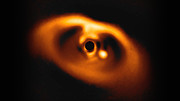
Zooming in on the orange dwarf star PDS 70 and its newly discovered planet
Spectrum reveals cloudy atmosphere
SPHERE, a planet-hunting instrument on
ESO’s Very Large Telescope, has captured the first confirmed image of a
planet caught in the act of forming in the dusty disc surrounding a
young star. The young planet is carving a path through the primordial
disc of gas and dust around the very young star PDS 70. The data suggest
that the planet’s atmosphere is cloudy.
Astronomers led by a group at the Max Planck Institute for
Astronomy in Heidelberg, Germany have captured a spectacular snapshot of
planetary formation around the young
dwarf star PDS 70. By using the
SPHERE instrument on
ESO’s Very Large Telescope
(VLT) — one of the most powerful planet-hunting instruments in
existence — the international team has made the first robust detection
of a young planet, named PDS 70b, cleaving a path through the
planet-forming material surrounding the young star
[1].
The SPHERE instrument also enabled the team to measure the
brightness of the planet at different wavelengths, which allowed
properties of its atmosphere to be deduced.
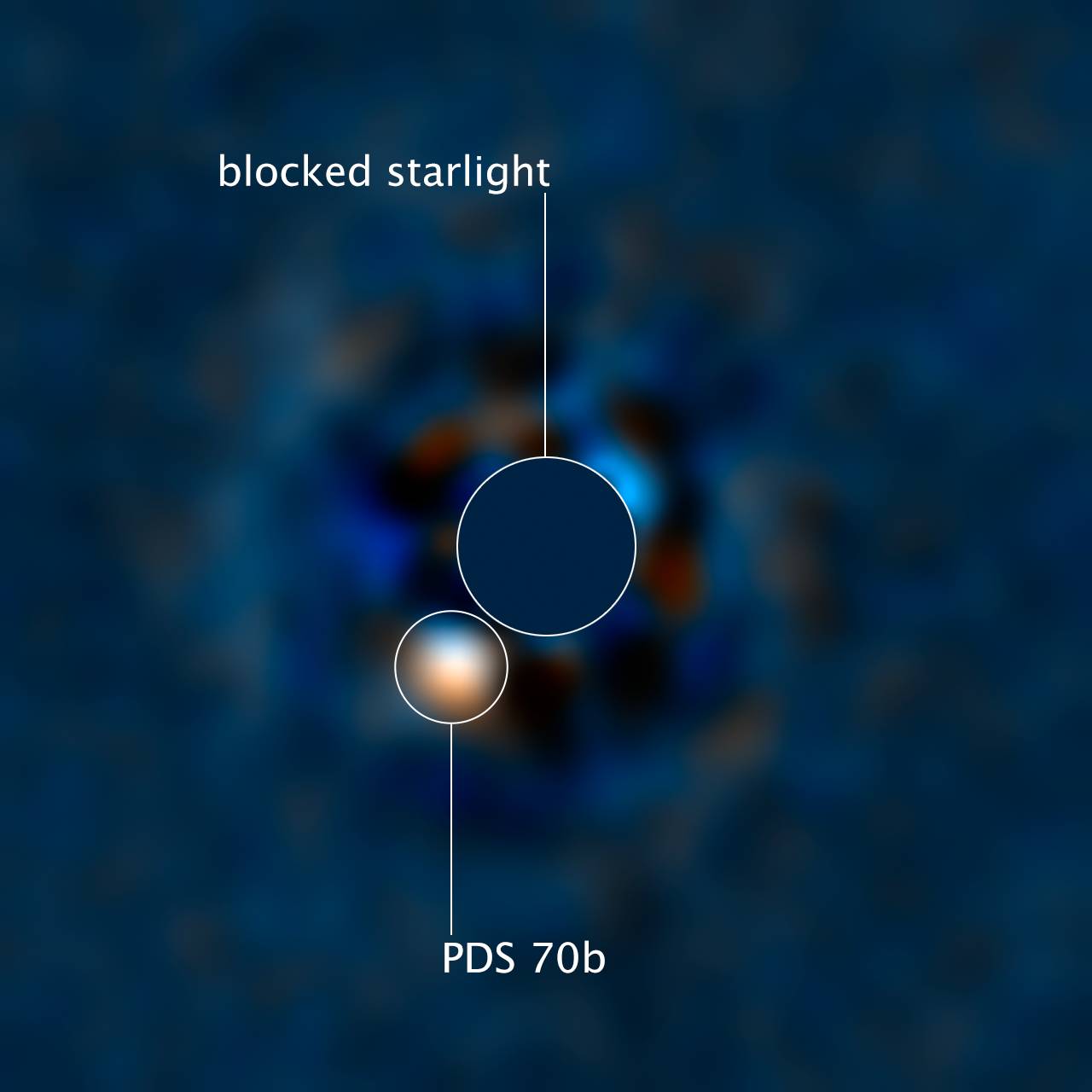
The planet stands out very clearly in the new observations, visible as a bright point to the right of
the blackened centre of the image. It is located roughly three billion
kilometres from the central star, roughly equivalent to the distance
between Uranus and the Sun. The analysis shows that PDS 70b is a giant
gas planet with a mass a few times that of Jupiter. The planet's surface
has a temperature of around 1000°C, making it much hotter than any
planet in our own Solar System.
The dark region at the centre of the image is due to a
coronagraph,
a mask which blocks the blinding light of the central star and allows
astronomers to detect its much fainter disc and planetary companion.
Without this mask, the faint light from the planet would be utterly
overwhelmed by the intense brightness of PDS 70.
“These discs around young stars are the birthplaces of
planets, but so far only a handful of observations have detected hints
of baby planets in them,” explains Miriam Keppler, who lead the team
behind the discovery of PDS 70’s still-forming planet. “The problem is
that until now, most of these planet candidates could just have been
features in the disc.”
The discovery of PDS 70’s young companion is an exciting
scientific result that has already merited further investigation. A
second team, involving many of the same astronomers as the discovery
team, including Keppler, has in the past months followed up the initial
observations to investigate PDS 70’s fledgling planetary companion in
more detail. They not only made the spectacularly clear image of the
planet shown here, but were even able to obtain a spectrum of the
planet. Analysis of this spectrum indicated that its atmosphere is
cloudy.
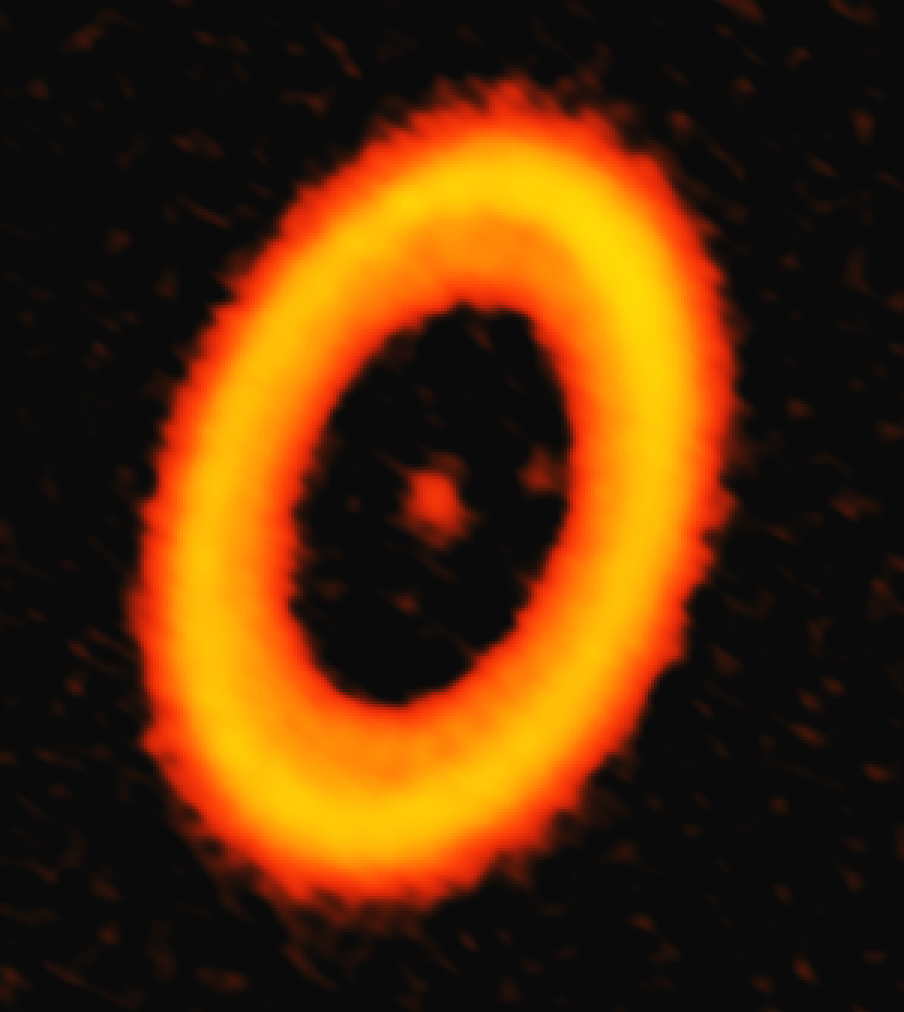
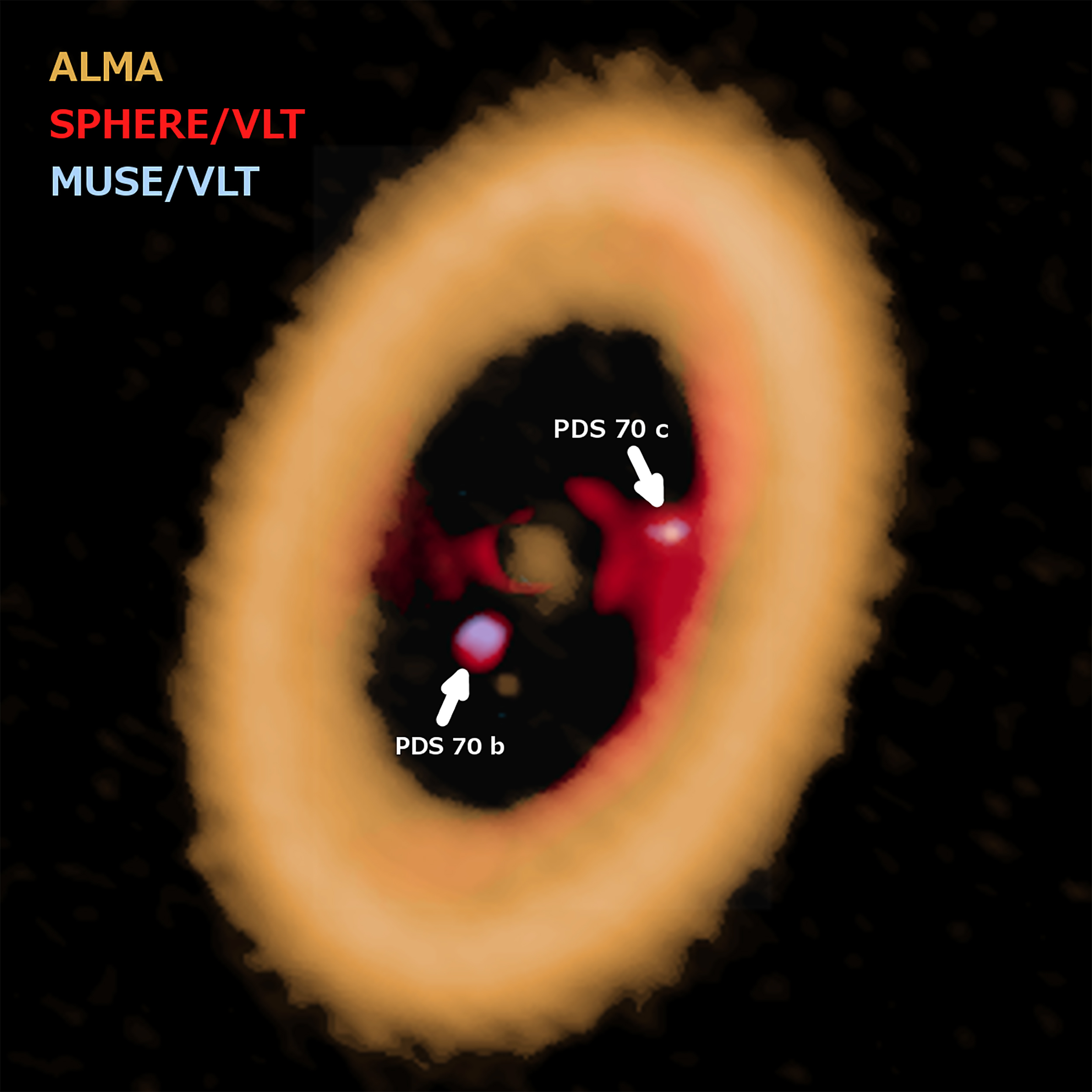
PDS 70’s planetary companion has sculpted a transition disc
— a protoplanetary disc with a giant “hole” in the centre. These inner
gaps have been known about for decades and it has been speculated that
they were produced by disc-planet interaction. Now we can see the planet
for the first time.
“Keppler’s results give us a new window onto the complex and poorly-understood early stages of planetary evolution,” comments André Müller, leader of the second team to investigate the young planet. “We needed to observe a planet in a young star’s disc to really understand the processes behind planet formation.”
By determining the planet’s atmospheric and physical properties, the
astronomers are able to test theoretical models of planet formation.
This glimpse of the dust-shrouded birth of a planet was
only possible thanks to the impressive technological capabilities of
ESO’s SPHERE instrument, which studies exoplanets and discs around
nearby stars using a technique known as high-contrast imaging — a
challenging feat. Even when blocking the light from a star with a
coronagraph, SPHERE still has to use cleverly devised observing
strategies and data processing techniques to filter out the signal of
the faint planetary companions around bright young stars [2] at multiple wavelengths and epochs.
Thomas Henning, director at the Max Planck Institute for Astronomy
and leader of the teams, summarises the scientific adventure: “After
more than a decade of enormous efforts to build this high-tech machine,
now SPHERE enables us to reap the harvest with the discovery of baby
planets!”
Notes
[1] The disc and planet images and the planet’s spectrum
have been captured in the course of the two survey programmes called
SHINE (SpHere INfrared survey for Exoplanets) and DISK (sphere survey
for circumstellar DISK). SHINE aims to image 600 young nearby stars in
the near-infrared using SPHERE’s high contrast and high angular
resolution to discover and characterise new exoplanets and planetary
systems. DISK explores known, young planetary systems and their
circumstellar discs to study the initial conditions of planetary
formation and the evolution of planetary architectures.
[2] In order to tease out
the weak signal of the planet next to the bright star, astronomers use a
sophisticated method that benefits from the Earth's rotation. In this
observing mode, SPHERE continuously takes images of the star over a
period of several hours, while keeping the instrument as stable as
possible. As a consequence, the planet appears to slowly rotate,
changing its location on the image with respect to the stellar halo.
Using elaborate numerical algorithms, the individual images are then
combined in such a way that all parts of the image that appear not to
move during the observation, such as the signal from the star itself,
are filtered. This leaves only those that do apparently move — making
the planet visible.
More Information
The team behind the discovery paper is composed of M.
Keppler (Max Planck Institute for Astronomy, Heidelberg, Germany), M.
Benisty (Univ. Grenoble, France and Unidad Mixta Internacional
Franco-Chilena de Astronomía, Chile), A. Müller (Max Planck Institute
for Astronomy, Heidelberg, Germany), Th. Henning (Max Planck Institute
for Astronomy, Heidelberg, Germany), R. van Boekel (Max Planck
Institute for Astronomy, Heidelberg, Germany), F. Cantalloube (Max
Planck Institute for Astronomy, Heidelberg, Germany), C. Ginski (Leiden
Observatory, The Netherlands), R.G. van Holstein (Leiden Observatory,
The Netherlands), A.-L. Maire (Max Planck Institute for Astronomy,
Heidelberg, Germany), A. Pohl (Max Planck Institute for Astronomy,
Heidelberg, Germany), M. Samland (Max Planck Institute for Astronomy,
Heidelberg, Germany), H. Avenhaus (Max Planck Institute for Astronomy,
Heidelberg, Germany), J.-L. Baudino (Department of Physics, University
of Oxford, Oxford, UK), A. Boccaletti (LESIA, Observatoire de Paris,
France), J. de Boer (Leiden Observatory, The Netherlands), M. Bonnefoy
(Univ. Grenoble, France), S. Desidera (INAF - Osservatorio Astronomico
di Padova, Italy), M. Langlois (Aix Marseille Univ, CNRS, LAM,
Marseille, France and CRAL, UMR 5574, CNRS, Université de Lyon, Ecole
Normale Supérieure de Lyon, France), C. Lazzoni (INAF - Osservatorio
Astronomico di Padova, Italy), N. Pawellek (Max Planck Institute for
Astronomy, Heidelberg, Germany), T. Stolker (Institute for Particle
Physics and Astrophysics, ETH Zurich, Switzerland), A. Vigan (Aix
Marseille Univ, CNRS, LAM, Marseille, France), T. Birnstiel (University
Observatory, Faculty of Physics, Ludwig-Maximilians- Universität
München, Germany), W. Brandner(Max Planck Institute for Astronomy,
Heidelberg, Germany), G. Chauvin (Univ. Grenoble, France and Unidad
Mixta Internacional Franco-Chilena de Astronomía, Chile), M. Feldt (Max
Planck Institute for Astronomy, Heidelberg, Germany), M. Flock (Jet
Propulsion Laboratory, California Institute of Technology, USA and Kavli
Institute For Theoretical Physics, University of California, USA), J.
Girard(Univ. Grenoble, France and ESO, Chile), R. Gratton (INAF -
Osservatorio Astronomico di Padova, Italy), J. Hagelberg (Univ.
Grenoble, France), A. Isella (Rice University, Department of Physics and
Astronomy, USA), M. Janson (Max Planck Institute for Astronomy,
Heidelberg, Germany and Department of Astronomy, Stockholm University,
Sweden), A. Juhasz (Institute of Astronomy, Cambridge, UK), J. Kemmer
(Max Planck Institute for Astronomy, Heidelberg, Germany), Q. Kral
(LESIA, Observatoire de Paris, PSL Research University, CNRS, Sorbonne
Universités, UPMC, Univ. Paris 06, Univ. Paris Diderot, Sorbonne Paris
Cité, France and Institute of Astronomy, Cambridge, UK), A.-M. Lagrange
(Univ. Grenoble, France), R. Launhardt (Max Planck Institute for
Astronomy, Heidelberg, Germany), G. Marleau (Institut für Astronomie und
Astrophysik, Eberhard Karls Universität Tübingen, Germany and Max
Planck Institute for Astronomy, Heidelberg, Germany) A. Matter
(Université Côte d’Azur, OCA, CNRS, France), F. Ménard (Univ. Grenoble,
France), J. Milli (ESO, Chile), P. Mollière (Leiden Observatory, The
Netherlands), C. Mordasini (Physikalisches Institut, Universität Bern,
Switzerland), J. Olofsson (Max Planck Institute for Astronomy,
Heidelberg, Germany, Instituto de Física y Astronomía, Facultad de
Ciencias, Universidad de Valparaíso, Chile, and Núcleo Milenio Formación
Planetaria - NPF, Universidad de Valparaíso, Chile), L. Pérez
(Max-Planck-Institute for Astronomy, Bonn, Germany and Universidad de
Chile, Departamento de Astronomia, Chile), P. Pinilla (Department of
Astronomy/Steward Observatory, University of Arizona, USA), C. Pinte
(Univ. Grenoble, France, UMI-FCA, CNRS/INSU, France (UMI 3386), and
Dept. de Astronomía, Universidad de Chile, Chile, and Monash Centre for
Astrophysics (MoCA) and School of Physics and Astronomy, Monash
University, Australia), S. Quanz (Institute for Particle Physics and
Astrophysics, ETH Zurich, Switzerland), T. Schmidt (LESIA, Observatoire
de Paris, PSL Research University, CNRS, Sorbonne Universités, UPMC,
Univ. Paris 06, Univ. Paris Diderot, France), S. Udry (Geneva
Observatory, University of Geneva, Switzerland), Z. Wahhaj (ESO, Chile),
J. Williams (Institute for Astronomy, University of Hawaii at Manoa,
Honolulu, USA), A. Zurlo (Aix Marseille Univ, CNRS, LAM, Laboratoire
d’Astrophysique de Marseille, France, Núcleo de Astronomía, Facultad de
Ingeniería y Ciencias, Universidad Diego Portales, Chile, Escuela de
Ingeniería Industrial, Facultad de Ingeniería y Ciencias, Universidad
Diego Portales, Chile), E. Buenzli (Institute for Particle Physics and
Astrophysics, ETH Zurich, Switzerland), M. Cudel (Univ. Grenoble,
France), R. Galicher (LESIA, Observatoire de Paris, PSL Research
University, CNRS, Sorbonne Universités, UPMC, Univ. Paris 06, Univ.
Paris Diderot, France), M. Kasper (ESO, Germany), J. Lannier (Univ.
Grenoble, France), D. Mesa (INAF - Osservatorio Astronomico di Padova,
Italy and INCT, Universidad De Atacama, Copiapó, Chile), D. Mouillet
(Univ. Grenoble, France), S. Peretti (Geneva Observatory, University of
Geneva, Switzerland), C. Perrot (LESIA, Observatoire de Paris, PSL
Research University, CNRS, Sorbonne Universités, UPMC, Univ. Paris 06,
Univ. Paris Diderot, Sorbonne Paris Cité, France), G. Salter (Aix
Marseille Univ, CNRS, LAM, Laboratoire d’Astrophysique de Marseille,
France), E. Sissa (INAF - Osservatorio Astronomico di Padova, Italy), F.
Wildi (Geneva Observatory, University of Geneva, Switzerland), L. Abe
(Université Côte d’Azur, OCA, CNRS, Lagrange, France), J. Antichi (INAF -
Osservatorio Astrofisico di Arcetri, Italy), J.-C. Augereau (Univ.
Grenoble, France), P. Baudoz (LESIA, Observatoire de Paris, PSL Research
University, CNRS, Sorbonne Universités, UPMC, Univ. Paris 06, Univ.
Paris Diderot, Sorbonne Paris Cité, France), J.-L. Beuzit (Univ.
Grenoble, France), P. Blanchard (Aix Marseille Univ, CNRS, LAM,
Laboratoire d’Astrophysique de Marseille, France), S. S. Brems
(Landessternwarte Königstuhl, Zentrum für Astronomie der Universität
Heidelberg, Germany), M. Carle (Aix Marseille Univ, CNRS, LAM,
Laboratoire d’Astrophysique de Marseille, France), A. Cheetham (Geneva
Observatory, University of Geneva, Switzerland), A. Costille (Aix
Marseille Univ, CNRS, LAM, Laboratoire d’Astrophysique de Marseille,
France), A. Delboulbé (Univ. Grenoble, France), C. Dominik (Anton
Pannekoek Institute for Astronomy, The Netherlands), P. Feautrier (Univ.
Grenoble, France), L. Gluck (Univ. Grenoble, France), D. Gisler
(Institute for Particle Physics and Astrophysics, ETH Zurich,
Switzerland), Y. Magnard (Univ. Grenoble, France), D. Maurel (Univ.
Grenoble, France), M. Meyer (Institute for Particle Physics and
Astrophysics, ETH Zurich, Switzerland), T. Moulin (Univ. Grenoble,
France), T. Buey (LESIA, Observatoire de Paris, PSL Research University,
CNRS, Sorbonne Universités, UPMC, Univ. Paris 06, Univ. Paris Diderot,
France), A. Baruffolo (INAF - Osservatorio Astronomico di Padova,
Italy), A. Bazzon (Institute for Particle Physics and Astrophysics, ETH
Zurich, Switzerland), V. De Caprio (INAF - Osservatorio Astronomico di
Capodimonte, Italy), M. Carbillet (Université Côte d’Azur, OCA, CNRS,
Lagrange, France), E. Cascone (INAF - Osservatorio Astronomico di
Capodimonte, Italy), R. Claudi (INAF - Osservatorio Astronomico di
Padova, Italy), K. Dohlen (Aix Marseille Univ, CNRS, LAM, Laboratoire
d’Astrophysique de Marseille, France), D. Fantinel (INAF - Osservatorio
Astronomico di Padova, Italy), T. Fusco (ONERA (Office National d’Etudes
et de Recherches Aérospatiales), France), E. Giro (INAF - Osservatorio
Astronomico di Padova, Italy), C. Gry (Aix Marseille Univ, CNRS, LAM,
Laboratoire d’Astrophysique de Marseille, France), N. Hubin (ESO,
Germany), E. Hugot (Aix Marseille Univ, CNRS, LAM, Laboratoire
d’Astrophysique de Marseille, France), M. Jaquet (Aix Marseille Univ,
CNRS, LAM, Laboratoire d’Astrophysique de Marseille, France), D. Le
Mignant (Aix Marseille Univ, CNRS, LAM, Laboratoire d’Astrophysique de
Marseille, France), M. Llored (Aix Marseille Univ, CNRS, LAM,
Laboratoire d’Astrophysique de Marseille, France), O. Möller-Nilsson
(Max Planck Institute for Astronomy, Heidelberg, Germany), F. Madec (Aix
Marseille Univ, CNRS, LAM, Laboratoire d’Astrophysique de Marseille,
France), P. Martinez (Université Côte d’Azur, OCA, CNRS, Lagrange,
France), L. Mugnier (ONERA (Office National d’Etudes et de Recherches
Aérospatiales), France), A. Origné (Aix Marseille Univ, CNRS, LAM,
Laboratoire d’Astrophysique de Marseille, France), P. Puget (Univ.
Grenoble, France), D. Perret (LESIA, Observatoire de Paris, PSL Research
University, CNRS, Sorbonne Universités, UPMC, Univ. Paris 06, Univ.
Paris Diderot, France), J. Pragt (NOVA Optical Infrared Instrumentation
Group, Dwingeloo, The Netherlands), F. Rigal (Anton Pannekoek Institute
for Astronomy, The Netherlands), R. Roelfsema (NOVA Optical Infrared
Instrumentation Group, Dwingeloo, The Netherlands), A. Pavlov (Max
Planck Institute for Astronomy, Heidelberg, Germany), C. Petit (ONERA
(Office National d’Etudes et de Recherches Aérospatiales), France), G.
Rousset (LESIA, Observatoire de Paris, PSL Research University, CNRS,
Sorbonne Universités, UPMC, Univ. Paris 06, Univ. Paris Diderot,
France), J. Ramos (Max Planck Institute for Astronomy, Heidelberg,
Germany), P. Rabou (Univ. Grenoble, France), S. Rochat (Univ. Grenoble,
France), A. Roux (Univ. Grenoble, France), B. Salasnich (INAF -
Osservatorio Astronomico di Padova, Italy),C. Soenke (ESO, Germany), E.
Stadler (Univ. Grenoble, France), J.-F. Sauvage (ONERA (Office National
d’Etudes et de Recherches Aérospatiales), France), M. Suarez ( INAF -
Osservatorio Astrofisico di Arcetri, Italy), A. Sevin (LESIA,
Observatoire de Paris, PSL Research University, CNRS, Sorbonne
Universités, UPMC, Univ. Paris 06, Univ. Paris Diderot, France), M.
Turatto (INAF - Osservatorio Astronomico di Padova, Italy), L. Weber
(Geneva Observatory, University of Geneva, Switzerland).
The team behind the characterisation paper consisted of A.
Müller (Max Planck Institute for Astronomy, Heidelberg, Germany), M.
Keppler (Max Planck Institute for Astronomy, Heidelberg, Germany), Th.
Henning (Max Planck Institute for Astronomy, Heidelberg, Germany), M.
Samland (Max Planck Institute for Astronomy, Heidelberg, Germany), G.
Chauvin (Univ. Grenoble Alpes, France and Unidad Mixta Internacional
Franco-Chilena de Astronomía, CNRS/INSU Universidad de Chile, Chile), H.
Beust (Univ. Grenoble Alpes, France), A.-L. Maire (Max Planck Institute
for Astronomy, Heidelberg, Germany), K. Molaverdikhani (Max Planck
Institute for Astronomy, Heidelberg, Germany), R. van Boekel (Max Planck
Institute for Astronomy, Heidelberg, Germany), M. Benisty (Univ.
Grenoble Alpes, France and Unidad Mixta Internacional Franco-Chilena de
Astronomía, CNRS/INSU Universidad de Chile, Chile), A. Boccaletti
(LESIA, Observatoire de Paris, PSL Research University, CNRS, Sorbonne
Universités, UPMC, Univ. Paris 06, Univ. Paris Diderot, France), M.
Bonnefoy (Univ. Grenoble Alpes, France), F. Cantalloube (Max Planck
Institute for Astronomy, Heidelberg, Germany), B. Charnay (LESIA,
Observatoire de Paris, PSL Research University, CNRS, Sorbonne
Universités, UPMC, Univ. Paris 06, Univ. Paris Diderot, France), J.-L.
Baudino (Department of Physics, University of Oxford, UK), M. Gennaro
(Space Telescope Science Institute, USA), Z. C. Long (Space Telescope
Science Institute, USA), A. Cheetham (Geneva Observatory, University of
Geneva, Switzerland), S. Desidera (INAF - Osservatorio Astronomico di
Padova, Italy), M. Feldt (Max Planck Institute for Astronomy,
Heidelberg, Germany), T. Fusco (DOTA, ONERA, Université Paris Saclay,
and Aix Marseille Université, CNRS, LAM Marseille, France), J. Girard
(Univ. Grenoble Alpes, France and Space Telescope Science Institute,
USA), R. Gratton (INAF - Osservatorio Astronomico di Padova, Italy), J.
Hagelberg (Institute for Particle Physics and Astrophysics, ETH Zurich,
Switzerland), M. Janson (Max Planck Institute for Astronomy, Heidelberg,
Germany and Department of Astronomy, Stockholm University, Sweden),
A.-M. Lagrange (Univ. Grenoble Alpes, France), M. Langlois (Aix
Marseille Univ, CNRS, LAM, Marseille, France and CRAL, UMR 5574, CNRS,
Université de Lyon, Ecole Normale Supérieure de Lyon, France), C.
Lazzoni (INAF - Osservatorio Astronomico di Padova, Italy), R. Ligi
(INAF-Osservatorio Astronomico di Brera, Italy), F. Ménard (Univ.
Grenoble Alpes, France), D. Mesa (INAF - Osservatorio Astronomico di
Padova, Italy and INCT, Universidad De Atacama, Copiapó, Atacama,
Chile), M. Meyer (Institute for Particle Physics and Astrophysics, ETH
Zurich, Switzerland and Department of Astronomy, University of Michigan,
USA), P. Mollière (Leiden Observatory, Leiden University, the
Netherlands), C. Mordasini (Physikalisches Institut, Universität Bern,
Switzerland), T. Moulin (Univ. Grenoble Alpes, France), A. Pavlov (Max
Planck Institute for Astronomy, Heidelberg, Germany), N. Pawellek (Max
Planck Institute for Astronomy, Heidelberg, Germany and Konkoly
Observatory, Research Centre for Astronomy and Earth Sciences, Hungarian
Academy of Sciences, Hungary), S. Quanz (Institute for Particle Physics
and Astrophysics, ETH Zurich, Switzerland), J. Ramos (Max Planck
Institute for Astronomy, Heidelberg, Germany), D. Rouan (LESIA,
Observatoire de Paris, PSL Research University, CNRS, Sorbonne
Universités, UPMC, Univ. Paris 06, Univ. Paris Diderot, France), E.
Sissa (INAF - Osservatorio Astronomico di Padova, Italy), E. Stadler
(Univ. Grenoble Alpes, France), A. Vigan (Aix Marseille Univ, CNRS, LAM,
Laboratoire d’Astrophysique de Marseille, France), Z. Wahhaj (ESO,
Chile), L. Weber (Geneva Observatory, University of Geneva,
Switzerland), A. Zurlo (Núcleo de Astronomía, Facultad de Ingeniería y
Ciencias, Universidad Diego Portales, Chile, Escuela de Ingeniería
Industrial, Facultad de Ingeniería y Ciencias, Universidad Diego
Portales, Chile).
ESO is the foremost intergovernmental astronomy
organisation in Europe and the world’s most productive ground-based
astronomical observatory by far. It has 15 Member States: Austria,
Belgium, the Czech Republic, Denmark, France, Finland, Germany, Italy,
the Netherlands, Poland, Portugal, Spain, Sweden, Switzerland and the
United Kingdom, along with the host state of Chile and with Australia as
a strategic partner. ESO carries out an ambitious programme focused on
the design, construction and operation of powerful ground-based
observing facilities enabling astronomers to make important scientific
discoveries. ESO also plays a leading role in promoting and organising
cooperation in astronomical research. ESO operates three unique
world-class observing sites in Chile: La Silla, Paranal and Chajnantor.
At Paranal, ESO operates the Very Large Telescope and its world-leading
Very Large Telescope Interferometer as well as two survey telescopes,
VISTA working in the infrared and the visible-light VLT Survey
Telescope. ESO is also a major partner in two facilities on Chajnantor,
APEX and ALMA, the largest astronomical project in existence. And on
Cerro Armazones, close to Paranal, ESO is building the 39-metre
Extremely Large Telescope, the ELT, which will become “the world’s
biggest eye on the sky”.
Links
Contacts:
Miriam Keppler
Max Planck Institute for Astronomy
Heidelberg, Germany
Tel: +49 6221 528 203
Email: keppler@mpia.de
André Müller
Max Planck Institute for Astronomy
Heidelberg, Germany
Tel: +49 6221 528 227
Email: amueller@mpia.de
Thomas Henning
Max Planck Institute for Astronomy
Heidelberg, Germany
Tel: +49 6221 528 200
Email: henning@mpia.de
Mariya Lyubenova
ESO Outreach Astronomer
Garching bei München, Germany
Tel: +49 89 3200 6188
Email: mlyubeno@eso.org