Showing posts with label PDS 70c. Show all posts

Thursday, October 02, 2025

ALMA pinpoints the radio signature of planetary growth

Multi-frequency imaging of PDS 70 with .a zoom on the forming protoplanet PDS 70c. From left to right are the ALMA bands 4, 7, and 9. PDS70c shines in Bands 4 and 7, ,brbut not in Band 9, which can be attributed to ionized gas emission. Credit: O. Domínguez et al. – N. Lira – ALMA (ESO/NAOJ/NRAO)


New multi-frequency observations reveal that the growing giant planet PDS 70c shines in radio waves not from dust, but from ionized gas in its environment.

Highlights

  • Unprecedented multi-frequency radio observation of a forming planet: ALMA observed PDS 70c in Bands 3, 4, 7, and 9, revealing new details about its environment.
  • Not dusty, but gaseous: The radio signal originates from ionized gas, not from the dusty disk astronomers anticipated.
  • Likely origin in a circumplanetary disk: The emission most likely comes from the surface of a small disk surrounding the planet, where mass from the environment is deposited.
  • Clues to planet and moon formation: These findings present the first radio spectral fingerprint of a circumplanetary environment, offering insights into how giant planets develop and how moons may form.

Astronomers using the Atacama Large Millimeter/submillimeter Array (ALMA) have obtained an unprecedented multi-frequency view of a forming planet in the nearby star system PDS 70. The new study, led by postgraduate student MsOriana Domínguez-Jamett (Universidad de Chile) and published in Astronomy & Astrophysics, shows that the planet PDS 70c emits radio signals produced by ionized gas rather than the dusty disk expected around such a young world.

PDS 70, a young star 370 light-years away in the constellation Centaurus, is famous for hosting two directly imaged protoplanets. Among them, PDS 70c is thought to be surrounded by a circumplanetary disk — a disk of gas and dust feeding the planet and possibly forming moons. Until now, the exact origin of its radio emission remained a mystery.

Using new ALMA observations in Bands 4 (145 GHz), 7 (343.5 GHz), and 9 (671 GHz), together with archival Band 3 data (97.5 GHz), the team detected a compact source at the position of PDS 70c in three of the bands. Intriguingly, they found no signal in the highest frequencies (Band 9). This “drop” in brightness challenges the idea that the emission originates solely from thermal dust. Instead, the results are best explained by partially optically thick free-free emission — radio light generated by the collisions of electrons and ions. In simple terms, the radio light from PDS 70c mainly comes from the surface of a small disk surrounding the planet. This gaseous disk shines because its surface is ionized by the impact of infalling material, making it appear as a faint, glowing veil around the young planet.

“Our observations suggest that a standard dusty disk does not surround PDS 70c,” says lead author Oriana Domínguez-Jamett. “Instead, the signal points to ionized gas, possibly heated in shocks as material falls onto the planet’s disk. This means the planet is depleted of dust by at least a factor of a thousand compared to expectations.”

By comparing the spectrum with simple models, the researchers demonstrate that a very low ionization fraction can explain the observed turnover in emission. This marks the first time the radio emission mechanism in a circumplanetary environment has been identified.

“This is a breakthrough in our ability to study how gas giant planets grow and how their moons may form,” adds advisor Simon Casassus (Universidad de Chile). “ALMA can now not only detect circumplanetary disks but also determine what powers their emission.”

“These results highlight ALMA’s unique ability to probe the environment of forming planets,” says John Carpenter, ALMA Observatory Scientist. “By distinguishing between dust and gas emission, we gain a direct view of how young planets gather material and how future moon systems begin to form.”

The findings provide key new constraints on the density, temperature, and ionization state of the material around forming gas giants. They also highlight the unique potential of ALMA to explore the final stages of planet growth.

Additional Information

The results of this study appear in the Astronomy & Astrophysics as "Multi-frequency observations of PDS70c: Radio emission mechanisms in the circumplanetary environment" by O. Domínguez et al.

The Atacama Large Millimeter/submillimeter Array (ALMA), an international astronomy facility, is a partnership of the European Southern Observatory (ESO), the U.S. National Science Foundation (NSF), and the National Institutes of Natural Sciences (NINS) of Japan in cooperation with the Republic of Chile. ALMA is funded by ESO on behalf of its Member States, by NSF in cooperation with the National Research Council of Canada (NRC) and the National Science and Technology Council (NSTC) in Taiwan, and by NINS in cooperation with the Academia Sinica (AS) in Taiwan and the Korea Astronomy and Space Science Institute (KASI).

ALMA construction and operations are led by ESO on behalf of its Member States; by the National Radio Astronomy Observatory (NRAO), managed by Associated Universities, Inc. (AUI), on behalf of North America; and by the National Astronomical Observatory of Japan (NAOJ) on behalf of East Asia. The Joint ALMA Observatory (JAO) provides the unified leadership and management of ALMA's construction, commissioning, and operation.

Scientific Paper


Contacts:

Nicolá Lira
Education and Public Outreach Officer
Joint ALMA Observatory, Santiago - Chile
Phone:
+56 2 2467 6519
Cel: +56 9 9445 7726
Email: nicolas.lira@alma.cl

Jill Malusky
Public Information Officer
NRAO
Phone:
+1 304-456-2236
Email: jmalusky@nrao.edu

Bárbara Ferreira
ESO Media Manager
Garching bei München, Germany
Phone:
+49 89 3200 6670
Email: press@eso.org

Yuichi Matsuda
Education and Public Outreach Officer
NAOJ
Email:
yuichi.matsuda@nao.ac.jp


Thursday, July 22, 2021

Astronomers make first clear detection of a moon-forming disc around an exoplanet

Wide and close-up views of a moon-forming disc as seen with ALMA
 
The PDS 70 system as seen with ALMA 
 
Moon-forming disc around the PDS 70c exoplanet as seen with ALMA 
 
The dwarf star PDS 70 in the constellation Centaurus 
 
Widefield image of the sky around PDS 70


Videos

Peeking at a Distant Moon-Forming Disc (ESOcast Light 240)
Peeking at a Distant Moon-Forming Disc (ESOcast Light 240) 
 
Artist’s animation of the PDS70 system
Artist’s animation of the PDS70 system 
 
Zooming in on the PDS 70 system


Using the Atacama Large Millimetre/submillimeter Array (ALMA), in which the European Southern Observatory (ESO) is a partner, astronomers have unambiguously detected the presence of a disc around a planet outside our Solar System for the first time. The observations will shed new light on how moons and planets form in young stellar systems.

“Our work presents a clear detection of a disc in which satellites could be forming,” says Myriam Benisty, a researcher at the University of Grenoble, France, and at the University of Chile, who led the new research published today in The Astrophysical Journal Letters. “Our ALMA observations were obtained at such exquisite resolution that we could clearly identify that the disc is associated with the planet and we are able to constrain its size for the first time,” she adds.

The disc in question, called a circumplanetary disc, surrounds the exoplanet PDS 70c, one of two giant, Jupiter-like planets orbiting a star nearly 400 light-years away. Astronomers had found hints of a “moon-forming” disc around this exoplanet before but, since they could not clearly tell the disc apart from its surrounding environment, they could not confirm its detection — until now.

In addition, with the help of ALMA, Benisty and her team found that the disc has about the same diameter as the distance from our Sun to the Earth and enough mass to form up to three satellites the size of the Moon.

But the results are not only key to finding out how moons arise. “These new observations are also extremely important to prove theories of planet formation that could not be tested until now,” says Jaehan Bae, a researcher from the Earth and Planets Laboratory of the Carnegie Institution for Science, USA, and author on the study.

Planets form in dusty discs around young stars, carving out cavities as they gobble up material from this circumstellar disc to grow. In this process, a planet can acquire its own circumplanetary disc, which contributes to the growth of the planet by regulating the amount of material falling onto it. At the same time, the gas and dust in the circumplanetary disc can come together into progressively larger bodies through multiple collisions, ultimately leading to the birth of moons.

But astronomers do not yet fully understand the details of these processes. “In short, it is still unclear when, where, and how planets and moons form,” explains ESO Research Fellow Stefano Facchini, also involved in the research. 

“More than 4000 exoplanets have been found until now, but all of them were detected in mature systems. PDS 70b and PDS 70c, which form a system reminiscent of the Jupiter-Saturn pair, are the only two exoplanets detected so far that are still in the process of being formed,” explains Miriam Keppler, researcher at the Max Planck Institute for Astronomy in Germany and one of the co-authors of the study [1].

“This system therefore offers us a unique opportunity to observe and study the processes of planet and satellite formation,” Facchini adds. 

PDS 70b and PDS 70c, the two planets making up the system, were first discovered using ESO’s Very Large Telescope (VLT) in 2018 and 2019 respectively, and their unique nature means they have been observed with other telescopes and instruments many times since [2].

The latest high resolution ALMA observations have now allowed astronomers to gain further insights into the system. In addition to confirming the detection of the circumplanetary disc around PDS 70c and studying its size and mass, they found that PDS 70b does not show clear evidence of such a disc, indicating that it was starved of dust material from its birth environment by PDS 70c.

An even deeper understanding of the planetary system will be achieved with ESO’s Extremely Large Telescope (ELT), currently under construction on Cerro Armazones in the Chilean Atacama desert. “The ELT will be key for this research since, with its much higher resolution, we will be able to map the system in great detail,” says co-author Richard Teague, a researcher at the Center for Astrophysics | Harvard & Smithsonian, USA. In particular, by using the ELT’s Mid-infrared ELT Imager and Spectrograph (METIS), the team will be able to look at the gas motions surrounding PDS 70c to get a full 3D picture of the system.       .


Notes

[1] Despite the similarity with the Jupiter-Saturn pair, note that the disc around PDS 70c is about 500 times larger than Saturn's rings.

[2] PDS 70b was discovered using the Spectro-Polarimetric High-contrast Exoplanet REsearch (SPHERE) instrument, while PDS 70c was found using the VLT’s Multi Unit Spectroscopic Explorer (MUSE). The two-planet system has been investigated using the X-shooter instrument too, also installed on ESO’s VLT.


More Information

This research was presented in the paper “A Circumplanetary Disk Around PDS 70c” to appear in The Astrophysical Journal Letters.

The team is composed of Myriam Benisty (Unidad Mixta Internacional Franco-Chilena de Astronomía, CNRS, Departamento de Astronomía, Universidad de Chile, Santiago de Chile, Chile and Université Grenoble Alpes, CNRS, Grenoble, France [UGA]), Jaehan Bae (Earth and Planets Laboratory, Carnegie Institution for Science, Washington DC, USA), Stefano Facchini (European Southern Observatory, Garching bei München, Germany), Miriam Keppler (Max Planck Institute for Astronomy, Heidelberg, Germany [MPIA]), Richard Teague (Center for Astrophysics | Harvard & Smithsonian, Cambridge, MA, USA [CfA]), Andrea Isella (Department of Physics and Astronomy, Rice University, Houston, TX, USA), Nicolas T. Kurtovic (MPIA), Laura M. Perez (Departamento de Astronomía, Universidad de Chile, Santiago de Chile, Chile [UCHILE]), Anibal Sierra (UCHILE), Sean M. Andrews (CfA), John Carpenter (Joint ALMA Observatory, Santiago de Chile, Chile), Ian Czekala (Department of Astronomy and Astrophysics, Pennsylvania State University, PA, USA, Center for Exoplanets and Habitable Worlds, Davey Laboratory, Pennsylvania State University, PA, USA, Center for Astrostatistics, Davey Laboratory, Pennsylvania State University, PA, USA and Institute for Computational & Data Sciences, Pennsylvania State University, PA, USA), Carsten Dominik (Anton Pannekoek Institute for Astronomy, University of Amsterdam, The Netherlands), Thomas Henning (MPIA), Francois Menard (UGA), Paola Pinilla (MPIA and Mullard Space Science Laboratory, University College London, Holmbury St Mary, Dorking, UK) and Alice Zurlo (Núcleo de Astronomía, Facultad de Ingeniería y Ciencias, Universidad Diego Portales, Santiago de Chile, Chile and Escuela de Ingeniería Industrial, Facultad de Ingeniería y Ciencias, Universidad Diego Portales, Santiago de Chile, Chile).

ESO is the foremost intergovernmental astronomy organisation in Europe and the world’s most productive ground-based astronomical observatory by far. It has 16 Member States: Austria, Belgium, the Czech Republic, Denmark, France, Finland, Germany, Ireland, Italy, the Netherlands, Poland, Portugal, Spain, Sweden, Switzerland and the United Kingdom, along with the host state of Chile and with Australia as a Strategic Partner. ESO carries out an ambitious programme focused on the design, construction and operation of powerful ground-based observing facilities enabling astronomers to make important scientific discoveries. ESO also plays a leading role in promoting and organising cooperation in astronomical research. ESO operates three unique world-class observing sites in Chile: La Silla, Paranal and Chajnantor. At Paranal, ESO operates the Very Large Telescope and its world-leading Very Large Telescope Interferometer as well as two survey telescopes, VISTA working in the infrared and the visible-light VLT Survey Telescope. Also at Paranal ESO will host and operate the Cherenkov Telescope Array South, the world’s largest and most sensitive gamma-ray observatory. ESO is also a major partner in two facilities on Chajnantor, APEX and ALMA, the largest astronomical project in existence. And on Cerro Armazones, close to Paranal, ESO is building the 39-metre Extremely Large Telescope, the ELT, which will become “the world’s biggest eye on the sky”. The Atacama Large Millimeter/submillimeter Array (ALMA), an international astronomy facility, is a partnership of ESO, the U.S. National Science Foundation (NSF) and the National Institutes of Natural Sciences (NINS) of Japan in cooperation with the Republic of Chile. ALMA is funded by ESO on behalf of its Member States, by NSF in cooperation with the National Research Council of Canada (NRC) and the Ministry of Science and Technology (MOST) and by NINS in cooperation with the Academia Sinica (AS) in Taiwan and the Korea Astronomy and Space Science Institute (KASI). ALMA construction and operations are led by ESO on behalf of its Member States; by the National Radio Astronomy Observatory (NRAO), managed by Associated Universities, Inc. (AUI), on behalf of North America; and by the National Astronomical Observatory of Japan (NAOJ) on behalf of East Asia. The Joint ALMA Observatory (JAO) provides the unified leadership and management of the construction, commissioning and operation of ALMA.


Links 

Myriam Benisty
Universidad de Chile and Université Grenoble Alpes
Santiago de Chile, Chile
Email:
myriam.benisty@univ-grenoble-alpes.fr

Jaehan Bae
Earth and Planets Laboratory, Carnegie Institution for Science
Washington DC, USA
Email:
jbae@carnegiescience.edu

Stefano Facchini
European Southern Observatory
Garching bei München, Germany
Email:
stefano.facchini@eso.org

Miriam Keppler
Max Planck Institute for Astronomy
Heidelberg, Germany
Email:
keppler@mpia.de

Richard Teague
Center for Astrophysics | Harvard & Smithsonian
Cambridge, MA, USA
Email:
richard.d.teague@cfa.harvard.edu

Bárbara Ferreira
ESO Media Manager
Garching bei München, Germany
Cell: +49 151 241 664 00
Email:
press@eso.org

Source:ESO/News


Friday, July 12, 2019

‘Moon-forming’ Circumplanetary Disk Discovered in Distant Star System

Artist impression of the circumplanetary disk recently discovered around a young planet in the PDS 70 star system. Credit: NRAO/AUI/NSF, S. Dagnello. Hi-Res File

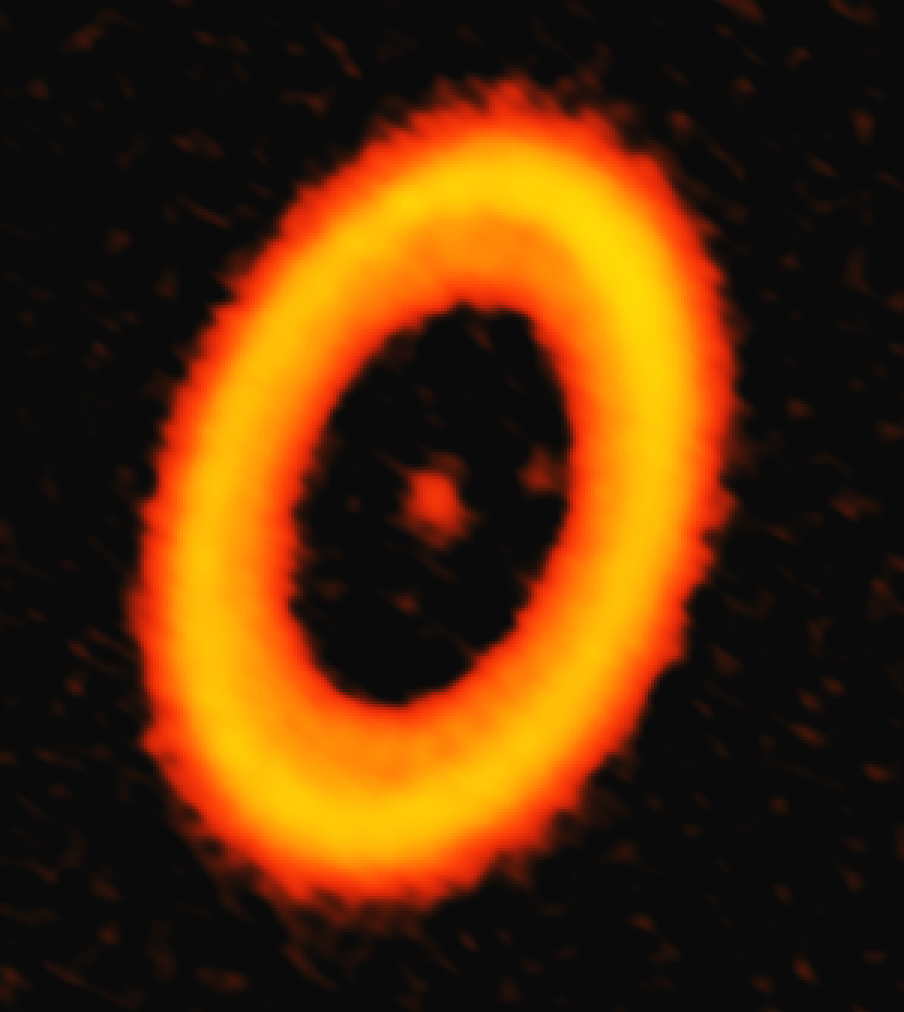
ALMA image of the dust in PDS 70, a star system located approximately 370 light-years from Earth. Two faint smudges in the gap region of this disk are associated with newly formed planets. One such concentration of dust is a circumplanetary disk, the first such feature ever detected around a distant star. Credit: ALMA (ESO/NAOJ/NRAO); A. Isella. Hi-Res File

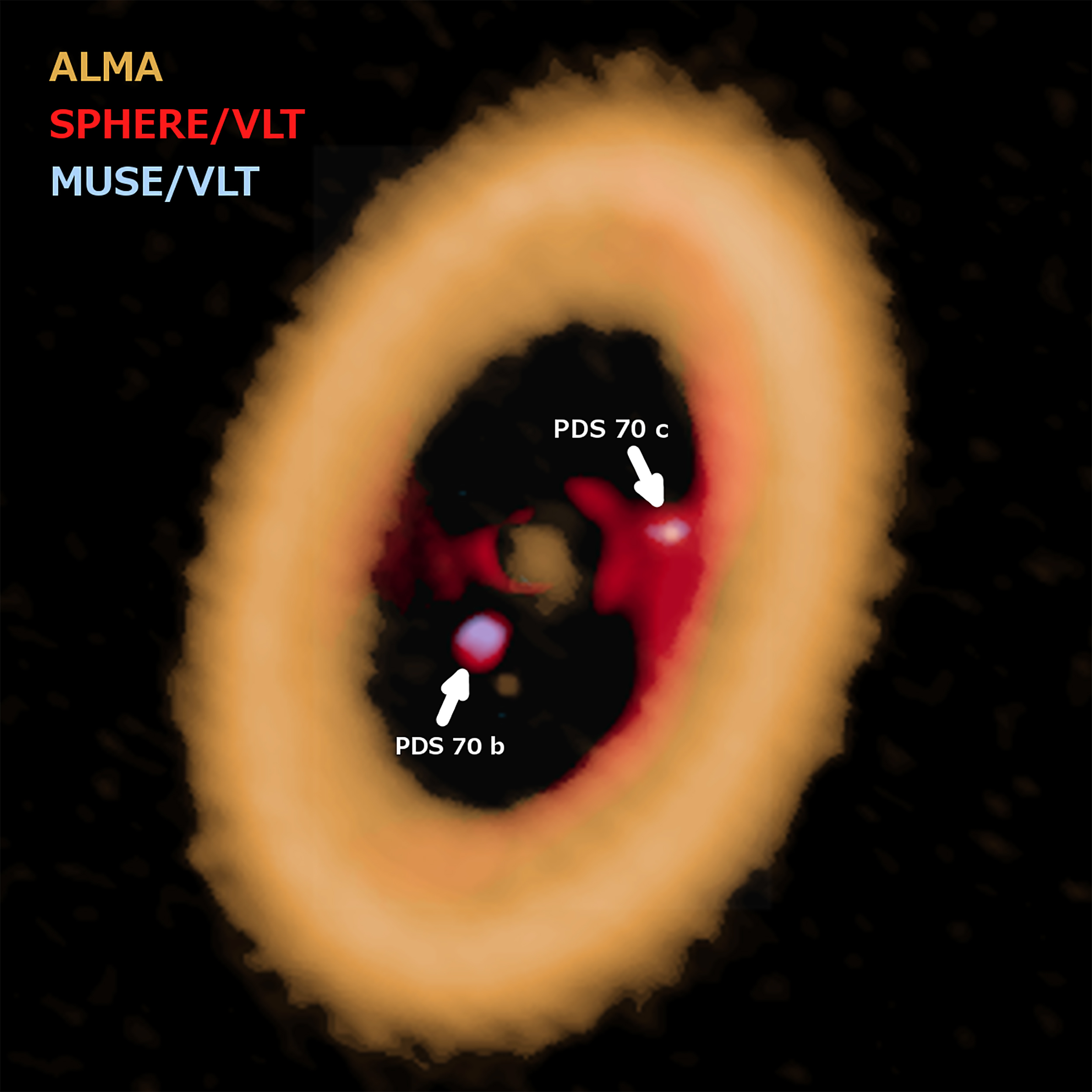
Composite image of PDS 70. Comparing new ALMA data to earlier VLT observations, astronomers determined that the young planet designated PDS 70 c has a circumplanetary disk, a feature that is strongly theorized to be the birthplace of moons. Credit: ALMA (ESO/NAOJ/NRAO) A. Isella; ESO. Hi-Res File


Astronomers using the Atacama Large Millimeter/submillimeter Array (ALMA) have made the first-ever observations of a circumplanetary disk, the planet-girding belt of dust and gas that astronomers strongly theorize controls the formation of planets and gives rise to an entire system of moons, like those found around Jupiter.

Atacama Large Millimeter/submillimeter Array (ALMA)Funded by the U.S. National Science Foundation and its international partners (NRAO/ESO/NAOJ), ALMA is among the most complex and powerful astronomical observatories on Earth or in space. The telescope is an array of 66 high-precision dish antennas in northern Chile.

This never-before-seen feature was discovered around one of the planets in PDS 70, a young star located approximately 370 light-years from Earth. Recently, astronomers confirmed the presence of two massive, Jupiter-like planets there. This earlier discovery was made with the European Southern Observatory’s Very Large Telescope (VLT), which detected the warm glow naturally emitted by hydrogen gas accreting onto the planets.

The new ALMA observations instead image the faint radio waves given off by the tiny (about one tenth of a millimeter across) particles of dust around the star.

The ALMA data, combined with the earlier optical and infrared VLT observations, provide compelling evidence that a dusty disk capable of forming multiple moons surrounds the outermost known planet in the system.

“For the first time, we can conclusively see the telltale signs of a circumplanetary disk, which helps to support many of the current theories of planet formation,” said Andrea Isella, an astronomer at Rice University in Houston, Texas, and lead author on a paper published in the Astrophysical Journal, Letters.

“By comparing our observations to the high-resolution infrared and optical images, we can clearly see that an otherwise enigmatic concentration of tiny dust particles is actually a planet-girding disk of dust, the first such feature ever conclusively observed,” he said. According to the researchers, this also is the first time that a planet has been clearly seen in these three distinct bands of light.

Unlike the icy rings of Saturn, which likely formed by the crashing together of comets and rocky bodies relatively recently in the history of our solar system, a circumplanetary disk is the lingering remains of the planet-formation process.

The ALMA data also revealed two distinct differences between the two newly discovered planets. The closer in of the two, PDS 70 b, which is about the same distance from its star as Uranus is from the Sun, has a trailing mass of dust behind it resembling a tail. “What this is and what it means for this planetary system is not yet known,” said Isella. “The only conclusive thing we can say is that it is far enough from the planet to be an independent feature.”

The second planet, PDS 70 c, resides in the exact same location as a clear knot of dust seen in the ALMA data. Since this planet is shining so brightly in the infrared and hydrogen bands of light, the astronomers can convincingly say that a fully formed planet is already in orbit there and that nearby gas continues to be syphoned onto the planet’s surface, finishing its adolescent growth spurt.

This outer planet is located approximately 5.3 billion kilometers from the host star, about the same distance as Neptune from our Sun. Astronomers estimate that this planet is approximately 1 to 10 times the mass of Jupiter. “If the planet is on the larger end of that estimate, it’s quite possible there might be planet-size moons in formation around it,” noted Isella.

The ALMA data also add one more important element to these observations.

Optical studies of planetary systems are notoriously challenging. Since the star is so much brighter than the planets, it is difficult to filter out the glare, much like trying to spot a firefly next to a search light. ALMA observations, however, don’t have that limitation since stars emit comparatively little light at millimeter and submillimeter wavelengths.

“This means we’ll be able to come back to this system at different time periods and more easily map the orbit of the planets and the concentration of dust in the system,” concluded Isella. “This will give us unique insights into the orbital properties of solar systems in their very earliest stages of development.”

The National Radio Astronomy Observatory is a facility of the National Science Foundation, operated under cooperative agreement by Associated Universities, Inc.


Contact:

Charles E. Blue: Public Information Officer
cblue@nrao.edu;
434-296-0314


Reference: 

“Detection of continuum submillimeter emission associated with candidate protoplanets,” A. Isella, et al., the Astrophysical Journal Letters: apjl.aas.org; Preprint: https://arxiv.org/abs/1906.06308

The Atacama Large Millimeter/submillimeter Array (ALMA), an international astronomy facility, is a partnership of the European Organisation for Astronomical Research in the Southern Hemisphere (ESO), the U.S. National Science Foundation (NSF) and the National Institutes of Natural Sciences (NINS) of Japan in cooperation with the Republic of Chile. ALMA is funded by ESO on behalf of its Member States, by NSF in cooperation with the National Research Council of Canada (NRC) and the Ministry of Science and Technology (MOST) and by NINS in cooperation with the Academia Sinica (AS) in Taiwan and the Korea Astronomy and Space Science Institute (KASI).

ALMA construction and operations are led by ESO on behalf of its Member States; by the National Radio Astronomy Observatory (NRAO), managed by Associated Universities, Inc. (AUI), on behalf of North America; and by the National Astronomical Observatory of Japan (NAOJ) on behalf of East Asia. The Joint ALMA Observatory (JAO) provides the unified leadership and management of the construction, commissioning and operation of ALMA.