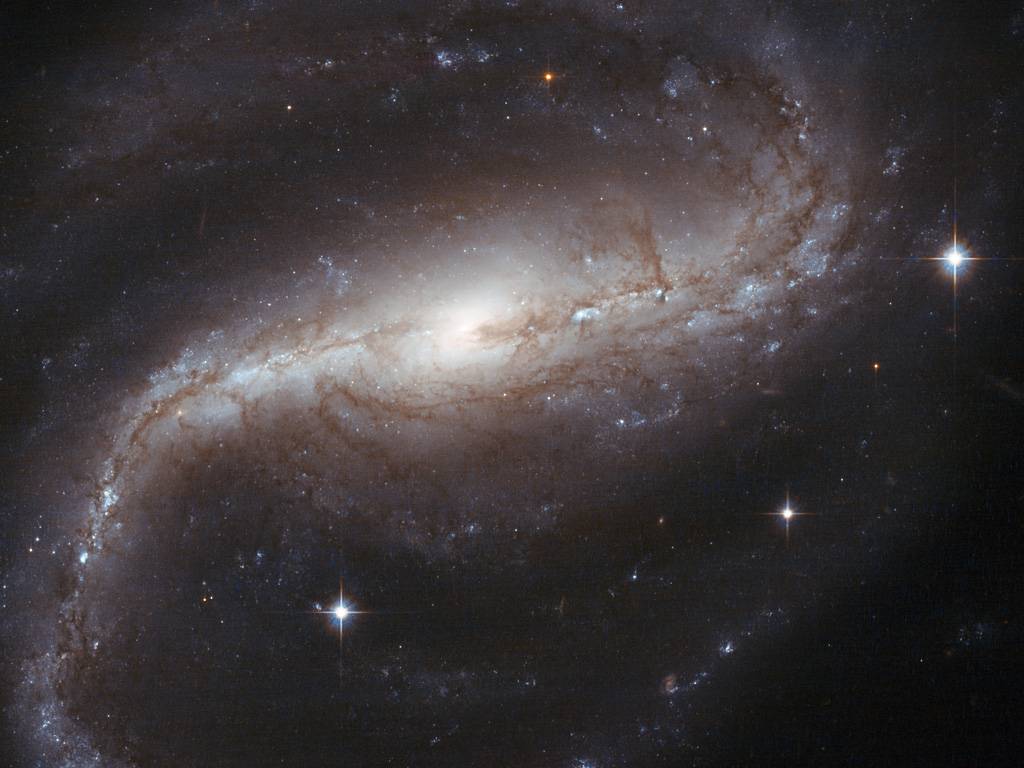
Hubble Space Telescope image of NGC 7479 created from observations at visible and near-infrared wavelengths with 20 cm radio continuum contours in yellow. The boxes highlight the ends of the lower and upper counter-arms; expanded versions of these regions are shown in the left and right panels where the circles depict the aperture of SOFIA’s FIFI-LS instrument. Credit: ESA/Hubble & NASA
Columbia, MD—November 29, 2021. NGC 7479, also known as Caldwell 44, is a barred spiral galaxy, with a bar-shaped center filled with stars (as is characteristic of a majority of spiral galaxies), and S- shaped arms. However, looking at features of NGC 7479 that are hidden from the naked eye reveals another pair of arms bending in an opposite direction to the visible galaxy. The Stratospheric Observatory for Infrared Astronomy (SOFIA) observed ionized carbon emissions to help confirm these counter-arms. The results were published in The Astrophysical Journal.
Radio wavelength emissions from these small, so-called “counter-arms” have been observed before, but with the help of SOFIA – along with observations by ALMA and archival data from a number of other observatories – their presence has now been confirmed by X-ray, ionized carbon, and carbon monoxide emissions as well. SOFIA’s new observations of the counter-arms can help reveal their origin.
Universities Space Research Association's Dario Fadda, the lead author of the paper, noted,“The really important thing in this galaxy are the two little counter-arms that go in the opposite direction of the optical arms that are seen in radio, but nobody had seen them in the X-ray. Seeing them in X-ray is important because it shows there’s energy coming out of the nucleus, something that comes out in jets that originate in the nucleus.”
The fact that these jets originate at the galaxy’s center implies the galaxy harbors an active nucleus – a supermassive black hole.
As the jet approaches the dense molecular clouds along the bar, some of its momentum is absorbed by the clouds, causing the jet to bend in the direction opposite to the rotation of the galaxy. This process is responsible for the orientation of the counter-arms.
By comparing the X-ray emissions of the jet to the ratio of ionized carbon and carbon dioxide emissions from the same area – both of which are considered indicators of star formation – the researchers discovered an anomaly. Certain hotspots within the counter-arms have too much ionized carbon, meaning the X-ray emission cannot entirely be explained by star formation.
“We knew about these counter-arms and tried to observe with SOFIA if ionized carbon is actually produced by star formation, or if there’s some extra component that can come from the energy injected by the active galactic nucleus,” said Fadda.
This calls into question the relationship between ionized carbon and star formation, and can have implications on the study of galaxies that are more distant than NGC 7479.
“This is where SOFIA becomes uniquely useful: Studying these cases of galaxies close to us to have an idea of what to encounter when we go to higher redshift to study galaxies and the farther universe,” Fadda said.NGC 7479
SOFIA’s role in these observations pushes the limits of its capabilities. Primarily suited for studying objects fairly close to our home galaxy, SOFIA’s spatial and spectral resolution were just enough to distinguish ionized carbon in NGC 7479’s region of interest. Specifically, SOFIA’s Far Infrared Field-Imaging Line Spectrometer (FIFI-LS) was used to map the ionized carbon in the area.
Columbia, MD—November 29, 2021. NGC 7479, also known as Caldwell 44, is a barred spiral galaxy, with a bar-shaped center filled with stars (as is characteristic of a majority of spiral galaxies), and S- shaped arms. However, looking at features of NGC 7479 that are hidden from the naked eye reveals another pair of arms bending in an opposite direction to the visible galaxy. The Stratospheric Observatory for Infrared Astronomy (SOFIA) observed ionized carbon emissions to help confirm these counter-arms. The results were published in The Astrophysical Journal.
Radio wavelength emissions from these small, so-called “counter-arms” have been observed before, but with the help of SOFIA – along with observations by ALMA and archival data from a number of other observatories – their presence has now been confirmed by X-ray, ionized carbon, and carbon monoxide emissions as well. SOFIA’s new observations of the counter-arms can help reveal their origin.
Universities Space Research Association's Dario Fadda, the lead author of the paper, noted,“The really important thing in this galaxy are the two little counter-arms that go in the opposite direction of the optical arms that are seen in radio, but nobody had seen them in the X-ray. Seeing them in X-ray is important because it shows there’s energy coming out of the nucleus, something that comes out in jets that originate in the nucleus.”
The fact that these jets originate at the galaxy’s center implies the galaxy harbors an active nucleus – a supermassive black hole.
As the jet approaches the dense molecular clouds along the bar, some of its momentum is absorbed by the clouds, causing the jet to bend in the direction opposite to the rotation of the galaxy. This process is responsible for the orientation of the counter-arms.
By comparing the X-ray emissions of the jet to the ratio of ionized carbon and carbon dioxide emissions from the same area – both of which are considered indicators of star formation – the researchers discovered an anomaly. Certain hotspots within the counter-arms have too much ionized carbon, meaning the X-ray emission cannot entirely be explained by star formation.
“We knew about these counter-arms and tried to observe with SOFIA if ionized carbon is actually produced by star formation, or if there’s some extra component that can come from the energy injected by the active galactic nucleus,” said Fadda.
This calls into question the relationship between ionized carbon and star formation, and can have implications on the study of galaxies that are more distant than NGC 7479.
“This is where SOFIA becomes uniquely useful: Studying these cases of galaxies close to us to have an idea of what to encounter when we go to higher redshift to study galaxies and the farther universe,” Fadda said.NGC 7479
SOFIA’s role in these observations pushes the limits of its capabilities. Primarily suited for studying objects fairly close to our home galaxy, SOFIA’s spatial and spectral resolution were just enough to distinguish ionized carbon in NGC 7479’s region of interest. Specifically, SOFIA’s Far Infrared Field-Imaging Line Spectrometer (FIFI-LS) was used to map the ionized carbon in the area.
About USRA
Founded in 1969, under the auspices of the National Academy of Sciences at the request of the U.S. Government, the Universities Space Research Association (USRA), is a nonprofit corporation chartered to advance space-related science, technology and engineering. USRA operates scientific institutes and facilities, and conducts other major research and educational programs. USRA engages the university community and employs in-house scientific leadership, innovative research and development, and project management expertise. More information about USRA is available at www.usra.edu
About SOFIA
Contact:
Suraiya Farukhi, Ph.D.
Director, External Communications
sfarukhi@usra.edu
443-812-6945
About SOFIA
SOFIA is a joint project of NASA and the German Space Agency at DLR. DLR provides the telescope, scheduled aircraft maintenance, and other support for the mission. NASA’s Ames Research Center in California’s Silicon Valley manages the SOFIA program, science, and mission operations in cooperation with the Universities Space Research Association, headquartered in Columbia, Maryland, and the German SOFIA Institute at the University of Stuttgart. The aircraft is maintained and operated by NASA’s Armstrong Flight Research Center Building 703, in Palmdale, California.
Contact:
Suraiya Farukhi, Ph.D.
Director, External Communications
sfarukhi@usra.edu
443-812-6945