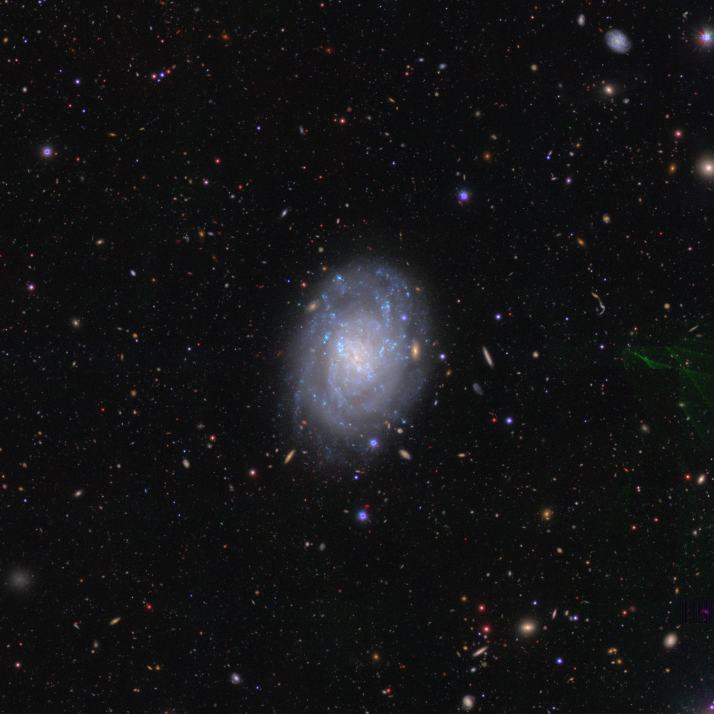
A spiral galaxy, seen face-on from
Earth. The spiral arms of the galaxy are bright but not well defined,
merging into a swirling disc with a faint halo of dimmer gas around it.
The core glows brightly in a lighter colour and has a bit of faint dust
crossing it. Two redder, visually smaller galaxies and a bright star are
prominent around the galaxy, with more tiny objects in the background. redit: ESA/Hubble & NASA, C. Kilpatrick
This image features the
spiral galaxy NGC 941, which lies about 55 million light-years from Earth. The data used for this image were collected by Hubble’s
Advanced Camera for Surveys (ACS).
The beautiful NGC 941 is undoubtedly the main attraction in this image;
however, this hazy-looking galaxy was not the motivation for the data
being collected. That distinction belongs to an astronomical event that
took place in the galaxy years before: the
supernova
SN 2005ad. The location of this faded supernova was observed as part of
a study of multiple hydrogen-rich supernovae, also known as type II
supernovae, in order to better understand the environments in which
certain types of supernovae take place. Whilst the study was conducted
by professional astronomers, SN 2005ad itself owes its discovery to a
distinguished amateur astronomer named Kōichi Itagaki, who has
discovered over 170 supernovae.
This might raise the question of how an amateur astronomer could spot
something like a supernova event before professional astronomers — who
have access to telescopes such as Hubble. The answer is in part that the
detection of supernovae is a mixture of skill, facilities and luck.
Most astronomical events happen over time spans that dwarf human
lifetimes, but supernova explosions are extraordinarily fast, appearing
very suddenly and then brightening and dimming over a period of days or
weeks. Another aspect is that professional astronomers often do not
spend that much time actually observing. There is a great deal of
competition for time on telescopes such as Hubble, and then data from a
few hours of observations might take weeks, months, or sometimes even
years to process and analyse to their full potential. Amateur
astronomers can spend much more time actually observing the skies, and
sometimes have extremely impressive systems of telescopes, computers and
software that they can put to use.
So many supernovae are spotted by skilful amateurs such as Itagaki
that there is actually an online system set up for reporting them (the
Transient Name Server). This is a big help to professional astronomers,
because with supernova events time is truly of the essence. After the
discovery of SN 2005ab was reported, professional astronomers were able
to follow up with spectroscopic studies and confirm it as a type II
supernova, which eventually led to its location being included in this
study with Hubble. Such a study wouldn’t be possible without a rich
library of previous supernovae, built with the keen eyes of amateur
astronomers.