Showing posts with label ESA’s XMM-Newton X-ray Observatory. Show all posts

Saturday, November 15, 2025

First confirmed sighting of explosive burst on nearby star


Artist's impression of an explosion on another star
Credit: Olena Shmahalo/Callingham et al.

A coronal mass ejection coming from the Sun on 27 May 2024
Credit: SOHO (ESA & NASA), NASA/SDO/AIA, JHelioviewer/D. Müller

XMM-Newton
Credit: ESA-C. Carreau


Astronomers using the European Space Agency’s XMM-Newton space observatory and the LOFAR telescope have definitively spotted an explosive burst of material thrown out into space by another star – a burst powerful enough to strip away the atmosphere of any unlucky planet in its path.

The burst was a coronal mass ejection (CME), eruptions we often see coming from the Sun. During a CME, massive amounts of material are flung out from our star, flooding the surrounding space. These dramatic expulsions shape and drive space weather, such as the dazzling auroras we see on Earth, and can chip away at the atmospheres of any nearby planets.

But while CMEs are commonplace at the Sun, we hadn’t convincingly spotted one on another star – until now.

“Astronomers have wanted to spot a CME on another star for decades,” says Joe Callingham of the Netherlands Institute for Radio Astronomy (ASTRON), author of the new research published in Nature. “Previous findings have inferred that they exist, or hinted at their presence, but haven’t actually confirmed that material has definitively escaped out into space. We’ve now managed to do this for the first time.”

As a CME travels through the layers of a star out into interplanetary space, it produces a shock wave and associated burst of radio waves (a type of light). This short, intense radio signal was picked up by Joe and colleagues and found to come from a star lying around 130 light-years away.

“This kind of radio signal just wouldn’t exist unless material had completely left the star’s bubble of powerful magnetism,” adds Joe. “In other words: it’s caused by a CME.”

A danger to any planets

The matter-flinging star is a red dwarf – a type of star far fainter, cooler, and smaller than the Sun. It is nothing like our own star: it has roughly half the mass, it rotates 20 times faster, and has a magnetic field 300 times more powerful. Most of the planets known to exist in the Milky Way orbit this kind of star.

The radio signal was spotted using the Low Frequency Array (LOFAR) radio telescope thanks to new data processing methods developed by co-authors Cyril Tasse and Philippe Zarka at the Observatoire de Paris-PSL. The team then used ESA’s XMM-Newton to determine the star’s temperature, rotation, and brightness in X-ray light. This was essential to interpret the radio signal and figure out what was actually going on.

We needed the sensitivity and frequency of LOFAR to detect the radio waves,” says co-author David Konijn, a PhD student working with Joe at ASTRON. “And without XMM-Newton, we wouldn’t have been able to determine the CME’s motion or put it in a solar context, both crucial for proving what we’d found. Neither telescope alone would have been enough – we needed both.”

The researchers determined the CME to be moving at a super-fast 2400 km per second, a speed only seen in 1 of every 2000 CMEs taking place on the Sun. The ejection was both fast and dense enough to completely strip away the atmospheres of any planets closely orbiting the star.

In search of life

The atmosphere-stripping ability of the CME is an exciting discovery for our hunt for life around other stars. A planet’s habitability for life as we know it is defined by its distance from its parent star – whether or not it sits within the star’s ‘habitable zone’, a region where liquid water can exist on the surface of planets with suitable atmospheres. This is a Goldilocks scenario: too close to the star is too hot, too far is too cold, and in between is just right.

But what if that star is especially active, regularly throwing out dangerous eruptions of material and triggering violent storms? A planet regularly bombarded by powerful coronal mass ejections may lose its atmosphere entirely, leaving a barren rock behind – an uninhabitable world, despite its orbit being ‘just right’.

“This work opens up a new observational frontier for studying and understanding eruptions and space weather around other stars,” adds Henrik Eklund, an ESA research fellow based at the European Space Research and Technology Centre (ESTEC) in Noordwijk, The Netherlands.uninhabitable world, despite its orbit being ‘just right’.
 
“We’re no longer limited to extrapolating our understanding of the Sun's CMEs to other stars. It seems that intense space weather may be even more extreme around smaller stars – the primary hosts of potentially habitable exoplanets. This has important implications for how these planets keep hold of their atmospheres and possibly remain habitable over time.”

The finding also informs our understanding of space weather, something that’s long been a focus for ESA missions and is currently being explored by SOHO, the Proba missions, Swarm, and Solar Orbiter.uninhabitable world, despite its orbit being ‘just right’.

XMM-Newton, meanwhile, is a leading explorer of the hot and extreme Universe. Launched in 1999, the space telescope has gazed into the cores of galaxies, studied stars to understand how they evolve, investigated the environs of black holes, and spotted intense bursts of energetic radiation from distant stars and galaxies.

“XMM-Newton is now helping us discover how CMEs vary by star, something that’s not only interesting in our study of stars and our Sun, but also our hunt for habitable worlds around other stars,” says ESA XMM-Newton Project Scientist Erik Kuulkers. “It also demonstrates the immense power of collaboration, which underpins all successful science. The discovery was a true team effort, and resolves the decades-long search for CMEs beyond the Sun.”

Notes for editors

The paper, “Radio Burst from a Stellar Coronal Mass Ejection” by Callingham et al., is published in Nature on 12 November. DOI: 10.1038/s41586-025-09715-3 https://www.nature.com/articles/s41586-025-09715-3

XMM-Newton is part of the portfolio of science missions in ESA’s Science Programme, which includes several missions dedicated to the detection and characterisation of exoplanets. ESA’s next generation X-ray mission – NewAthena – is poised to transform X-ray astronomy with pioneering European-developed optics, paving the way for groundbreaking discoveries for decades to come.

For more information, please contact:

ESA Media Relations, media@esa.int


Thursday, July 25, 2019

How black holes shape galaxies

Outflows from a black hole
Credit: ESA/ATG medialab

Data from ESA's XMM-Newton X-ray observatory has revealed how supermassive black holes shape their host galaxies with powerful winds that sweep away interstellar matter.

In a new study, scientists analysed eight years of XMM-Newton observations of the black hole at the core of an active galaxy known as PG 1114+445, showing how ultrafast winds – outflows of gas emitted from the accretion disk very close to the black hole – interact with the interstellar matter in central parts of the galaxy. These outflows have been spotted before but the new study clearly identifies, for the first time, three phases of their interaction with the host galaxy.

"These winds might explain some surprising correlations that scientists have known about for years but couldn't explain," said lead author Roberto Serafinelli of the National Institute of Astrophysics in Milan, Italy, who conducted most of the work as part of his PhD at University of Rome Tor Vergata.

"For example, we see a correlation between the masses of supermassive black holes and the velocity dispersion of stars in the inner parts of their host galaxies. But there is no way this could be due to the gravitational effect of the black hole. Our study for the first time shows how these black hole winds impact the galaxy on a larger scale, possibly providing the missing link."

Astronomers have previously detected two types of outflows in the X-ray spectra emitted by the active galactic nuclei, the dense central regions of galaxies known to contain supermassive black holes. The so-called ultra-fast outflows (UFOs), made of highly ionised gas, travel at speeds up to 40 per cent the speed of light and are observable in the vicinity of the central black hole.

Slower outflows, referred to as warm absorbers, travel at much lower speeds of hundreds of km/s and have similar physical characteristics – such as particle density and ionisation – to the surrounding interstellar matter. These slower outflows are more likely to be detected at greater distances from the galaxy centres.

In the new study, the scientists describe a third type of outflow that combines characteristics of the previous two: the speed of a UFO and the physical properties of a warm absorber.

"We believe that this is the point when the UFO touches the interstellar matter and sweeps it away like a snowplough," said Serafinelli. "We call this an 'entrained ultra-fast outflow' because the UFO at this stage is penetrating the interstellar matter. It's similar to wind pushing boats in the sea."

This entraining happens at a distance of tens to hundreds light years away from the black hole. The UFO gradually pushes the interstellar matter away from the central parts of the galaxy, clearing it from gas and slowing down the accretion of matter around the supermassive black hole.

While models have predicted this type of interaction before, the current study is the first to present actual observations of the three phases.

"In the XMM-Newton data, we can see material at larger distances from the centre of the galaxy that hasn't been disturbed yet by the inner UFO," said co-author Francesco Tombesi of University of Rome Tor Vergata and NASA's Goddard Space Flight Center. "We can also see clouds closer to the black hole, near the core of the galaxy, where the UFO has started interacting with the interstellar matter."

This first interaction happens many years after the UFO has left the black hole. But the energy of the UFO enables the relatively small black hole to impact material far beyond the reach of its gravitational force.

According to the scientists, supermassive black holes transfer their energy into the surrounding environment through these outflows and gradually clear the central regions of the galaxy from gas, which could then halt star formation. In fact, galaxies today produce stars far less frequently than they used to in the early stages of their evolution.

"This is the sixth time these outflows have been detected," said Serafinelli. "It's all very new science. These phases of the outflow have previously been observed separately but the connection between them wasn't clear up until now."

XMM-Newton's unprecedented energy resolution was key to differentiating between the three types of features corresponding to the three types of outflows. In the future, with new and more powerful observatories such as ESA's Advanced Telescope for High ENergy Astrophysics, Athena, astronomers will be able to observe hundreds of thousands of supermassive black holes, detecting such outflows more easily. Athena, which will be more than 100 times more sensitive than XMM-Newton, is scheduled for launch in the early 2030s.

"Finding one source is great but knowing that this phenomenon is common in the Universe would be a real breakthrough," said Norbert Schartel, XMM-Newton project scientist at ESA. "Even with XMM-Newton, we might be able to find more such sources in the next decade."

More data in the future will help unravel the complex interactions between the supermassive black holes and their host galaxies in detail and explain the decrease in star formation that astronomers observe to have taken place over billions of years.


Notes for Editors

"Multiphase quasar-driven outflows in PG 1114+445 – I. Entrained ultra-fast outflows" by R. Serafinelli et al. is published in Astronomy & Astrophysics.


For more information, please contact:

Roberto Serafinelli
National Institute of Astrophysics
Osservatorio Astronomico di Brera, Milan, Italy
and University of Rome Tor Vergata, Italy
Email: roberto.serafinelli@inaf.it

Francesco Tombesi
University of Rome Tor Vergata, Italy
NASA's Goddard Space Flight Center
Greenbelt, MD, USA
INAF - Astronomical Observatory of Rome, Italy
University of Maryland, College Park, USA
Email: francesco.tombesi@roma2.infn.it

Norbert Schartel
XMM-Newton Project Scientist
European Space Agency
Email: norbert.schartel@esa.int


Monday, February 25, 2019

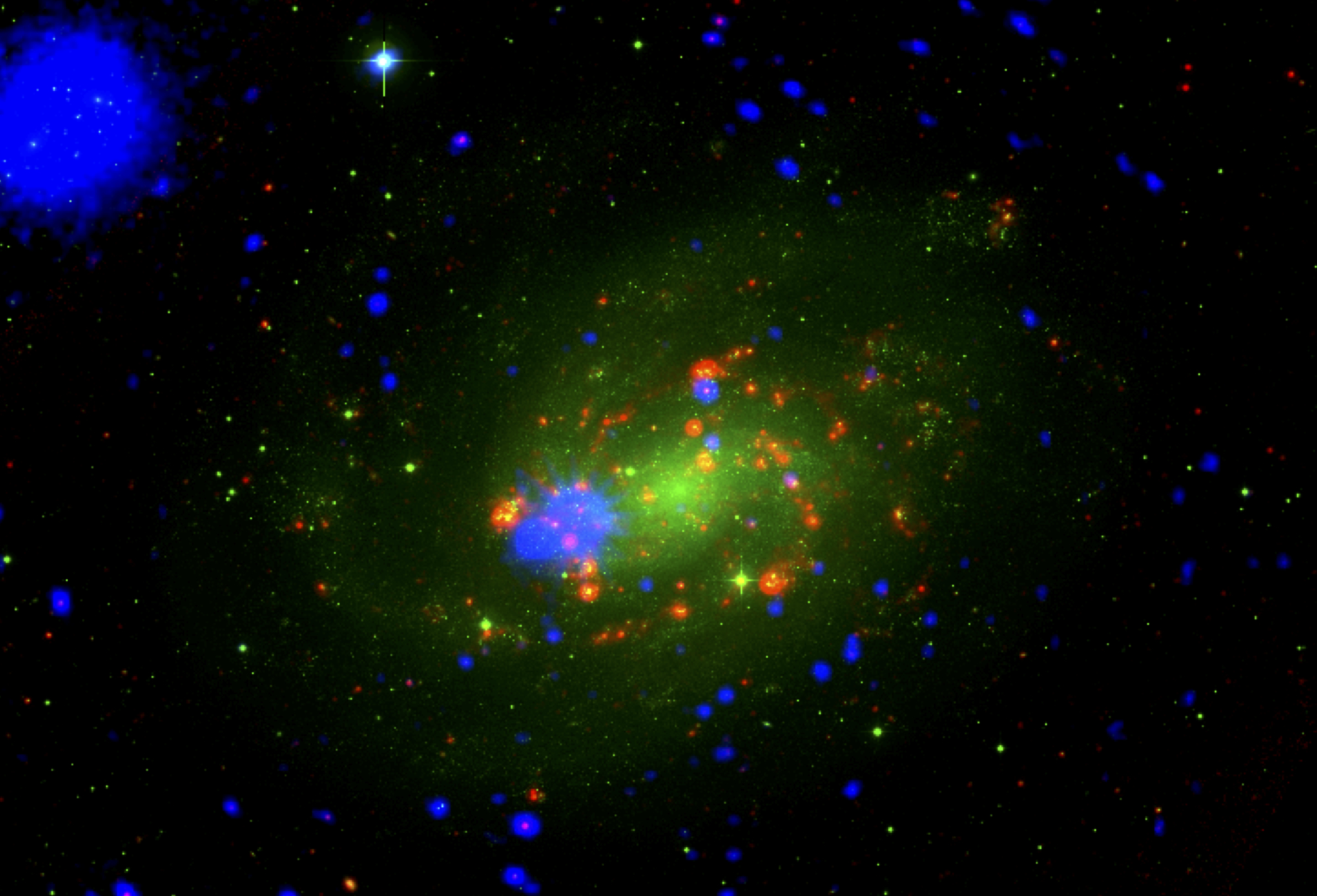
Past and future generations of stars in NGC 300

Past and future generations of stars in NGC 300
Copyright: ESA/XMM-Newton (X-rays); MPG/ESO (optical); NASA/Spitzer (infrared)
Acknowledgement: S. Carpano, Max-Planck Institute for Extraterrestrial Physics

JPG - (1.48 MB) / PNG - (7.99 MB)

This swirling palette of colours portrays the life cycle of stars in a spiral galaxy known as NGC 300.

Located some six million light-years away, NGC 300 is relatively nearby. It is one of the closest galaxies beyond the Local Group – the hub of galaxies to which our own Milky Way galaxy belongs. Due to its proximity, it is a favourite target for astronomers to study stellar processes in spiral galaxies.

The population of stars in their prime is shown in this image in green hues, based on optical observations performed with the Wide Field Imager (WFI) on the MPG/ESO 2.2-metre telescope at La Silla, Chile. Red colours indicate the glow of cosmic dust in the interstellar medium that pervades the galaxy: this information derives from infrared observations made with NASA’s Spitzer space telescope, and can be used to trace stellar nurseries and future stellar generations across NGC 300.

A complementary perspective on this galaxy’s composition comes from data collected in X-rays by ESA’s XMM-Newton space observatory, shown in blue. These represent the end points of the stellar life cycle, including massive stars on the verge of blasting out as supernovas, remnants of supernova explosions, neutron stars, and black holes. Many of these X-ray sources are located in NGC 300, while others – especially towards the edges of the image – are foreground objects in our own Galaxy, or background galaxies even farther away.

The sizeable blue blob immediately to the left of the galaxy’s centre is especially interesting, featuring two intriguing sources that are part of NGC 300 and shine brightly in X-rays.

One of them, known as NGC 300 X-1, is in fact a binary system, consisting of a Wolf-Rayet star – an ageing hot, massive and luminous type star that drives strong winds into its surroundings – and a black hole, the compact remains of what was once another massive, hot star. As matter from the star flows towards the black hole, it is heated up to temperatures of millions of degrees or more, causing it to shine in X-rays.

The other source, dubbed NGC 300 ULX1, was originally identified as a supernova explosion in 2010. However, later observations prompted astronomers to reconsider this interpretation, indicating that this source also conceals a binary system comprising a very massive star and a compact object – a neutron star or a black hole – feeding on material from its stellar companion.

Data obtained in 2016 with ESA’s XMM-Newton and NASA’s NuSTAR observatories revealed regular variations in the X-ray signal of NGC 300 ULX1, suggesting that the compact object in this binary system is a highly magnetized, rapidly spinning neutron star, or pulsar.

The large blue blob in the upper left corner is a much more distant object: a cluster of galaxies more than one billion light years away, whose X-ray glow is caused by the hot diffuse gas interspersed between the galaxies.

Explore NGC 300 in ESASky


Friday, August 10, 2018

Students digging into data archive spot mysterious X-ray source

Flaring source in NGC 6540
Copyright: ESA/XMM-Newton; A. De Carlo (INAF)


An enigmatic X-ray source revealed as part of a data-mining project for high-school students shows unexplored avenues hidden in the vast archive of ESA’s XMM-Newton X-ray Observatory.

When XMM-Newton was launched in 1999, most students who are finishing high school today were not even born. Yet ESA’s almost two-decade old X-ray observatory has many surprises to be explored by the next generation of scientists.

A taste of new discoveries was unveiled in a recent collaboration between scientists at the National Institute of Astrophysics (INAF) in Milan, Italy, and a group of twelfth-grade students from a secondary school in nearby Saronno.

The fruitful interaction was part of the Exploring the X-ray Transient and variable Sky project, EXTraS, an international research study of variable sources from the first 15 years of XMM-Newton observations.

“We recently published the EXTraS catalogue, which includes all the X-ray sources – about half a million – whose brightness changes over time as observed by XMM-Newton, and lists several observed parameters for each source,” says Andrea De Luca, one of the scientists who coordinated the student project.

“The next step was to delve into this vast dataset and find potentially interesting sources, and we thought this would be an exciting challenge for a student internship.”

Flaring source in NGC 6540
Copyright ESA/XMM-Newton; A. De Carlo (INAF)

High-school students
Copyright INAF
 
Scientists at INAF in Milan have been cooperating with local schools for a few years, hosting several groups of students at the institute for a couple of weeks and embedding them in the activities of the various research groups.

“For this particular project, the students received an introduction about astronomy and the exotic sources we study with X-ray telescopes, as well as a tutorial on the database and how to use it,” explains Ruben Salvaterra, another scientist involved in the programme.

“Once they were ready to explore the data archive, they proved very effective and resourceful.”

The six students analysed about 200 X-ray sources, looking at their light curve – a graph showing the object’s variability over time – and checking the scientific literature to verify whether they had been studied already.

Eventually, they identified a handful of sources exhibiting interesting properties – a powerful flare, for example – that had not been previously reported by other studies.

“One of the sources stood out as especially intriguing,” says Andrea.

Featuring the shortest flare of all analysed objects, this source appears to be located in the globular cluster NGC 6540 – a dense grouping of stars – and had not been studied before.

After presenting their findings to the scientists in a seminar, the students went back to school. But the work for Andrea, Ruben and collaborators had only just begun.

“The source identified by the students displays brightness changes like no other known objects, so we started looking more in detail,” says Ruben.

An otherwise low-luminosity source of X-rays, XMM-Newton saw it brighten by up to 50 times its normal level in 2005, and quickly fall again after about five minutes.

Stars like our Sun shine moderately in X-rays, and occasionally undergo flares that boost their brightness like the one observed in this source. However, such events normally last much longer – up to a few hours or even days.

On the other hand, short outbursts are observed in binary star systems hosting a dense stellar remnant such as neutron star, but these outpourings of X-rays are characterised by a much higher luminosity.
“This event is challenging our understanding of X-ray outbursts: too short to be an ordinary stellar flare, but too faint to be linked to a compact object,” explains collaborator Sandro Mereghetti, lead author of the paper presenting the results.

Another possibility is that the source is a so-called chromospherically active binary, a dual system of stars with intense X-ray activity caused by processes in their chromosphere, an intermediate layer in a star’s atmosphere. But even in this case, it does not closely match the properties of any known object of this class.

The scientists suspect that this peculiar source is not unique, and that other objects with similar properties are lurking in the XMM-Newton archive but have not yet been identified because of the combination of low luminosity and short duration of the flare.

“The systematic study of variability that led to the compilation of the EXTraS catalogue, together with this first attempt at data mining, suggests that we have opened a new, unexplored window on the X-ray Universe,” adds Sandro.

The team plans to study the newly identified source in greater detail to better understand its nature, while searching for more similar objects in the archive.

“It is exciting to find hidden jewels like this source in the XMM-Newton archive, and that young students are helping us find them while learning and having fun,” concludes Norbert Schartel, XMM-Newton project scientist at ESA.


Notes for Editors


“EXTraS discovery of a peculiar flaring X-ray source in the Galactic globular cluster NGC 6540” by S. Mereghetti et al. 2018 is published in Astronomy & Astrophysics, DOI: 10.1051/0004-6361/201833086.

The students involved in this project are Razvan Patrolea, Lorenzo Apollonio, Elena Pecchini, Cinzia Torrente, Bartolomeo Bottazzi-Baldi and Martino Giobbio from Liceo scientifico G.B. Grassi in Saronno, Italy. They discovered the peculiar source during a two-week internship at INAF, Milan, in September 2017, as part of an initiative supported by the Italian Ministry of Education, University and Research.

The discovery was made as a result of the Exploring the X-ray Transient and variable Sky (EXTraS) project, a EU/FP7 project devoted to a systematic variability study of the X-ray sources in the XMM-Newton public archive.


For further information, please contact:

Andrea De Luca
INAF, Istituto di Astrofisica Spaziale e Fisica Cosmica
Milano, Italy
INFN, Pavia, Italy
Email: andrea.deluca@inaf.it

Ruben Salvaterra
INAF, Istituto di Astrofisica Spaziale e Fisica Cosmica
Milano, Italy
Email: ruben.salvaterra@inaf.it

Sandro Mereghetti
INAF, Istituto di Astrofisica Spaziale e Fisica Cosmica
Milano, Italy
Email: sandro.mereghetti@inaf.it

Norbert Schartel
XMM-Newton Project Scientist
European Space Agency
Email: norbert.schartel@esa.it

Markus Bauer


ESA Science and Robotic Exploration Communication Officer


Tel: +31 71 565 6799


Mob: +31 61 594 3 954


Email: markus.bauer@esa.int