Showing posts with label NGC 1399. Show all posts

Tuesday, October 05, 2021

Plunging into the Furnace

Galaxies in the Fornax Cluster


Videos

CosmoView Episode 33: Plunging into the Furnace
CosmoView Episode 33: Plunging into the Furnace 
 
Zoom in to the Fornax Cluster
 
CosmoView Episodio 33: Tololo captura una galaxia condenada a desaparecer


The Víctor M. Blanco Telescope in Chile captures a doomed galaxy falling into the heart of the Fornax Cluster

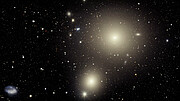
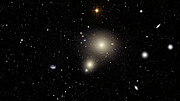
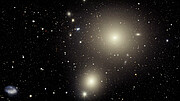
The denizens of the Fornax galaxy cluster populate this image from the Víctor M. Blanco 4-meter Telescope, located in Chile at Cerro Tololo Inter-American Observatory (CTIO), a Program of NSF’s NOIRLab. The irregular galaxy lurking in the bottom left corner of this Dark Energy Survey image is NGC 1427A, and its headlong plunge into the heart of the Fornax Cluster over millions of years will eventually result in the galaxy’s disruption.

The Fornax Cluster — which, as the name suggests, lies primarily in the constellation Fornax (the Furnace) — is a relatively nearby galaxy cluster, only about 60 million light-years from Earth. This means that it looms large in the night sky, stretching across an area more than 100 times larger than the full Moon. With over 600 member galaxies, the Fornax Cluster is the second “richest” (most populous) galaxy cluster within 100 million light-years of our galaxy (after the much larger Virgo Cluster).

Two elliptical galaxies dominate the center of this image — visible as the two large patches of diffuse light with bright cores. Such galaxies usually contain much older stars than the more picturesque spiral galaxies, and they tend to be found in galaxy clusters such as the Fornax Cluster. These elliptical galaxies — which are named NGC 1399 and NGC 1404 — are among the brightest members of the Fornax Cluster and are inexorably being drawn together by the force of gravity. This interaction is stripping gas from NGC 1404, the lower elliptical galaxy in this image.

In the bottom left corner of the image appears the irregular galaxy NGC 1427A. This ragged patch of light is a small, irregular collection of stars similar to the Large Magellanic Cloud. Similarly to NGC 1404, NGC 1427A is plunging toward the heart of the cluster at roughly 2.2 million kilometers (or 1.3 million miles) per hour. This headlong rush to destruction will eventually result in the galaxy being disrupted — pulled apart by gravitational interactions with other galaxies.

As with most astronomical observations, this image shows not only the intended target but also a menagerie of objects both close to home and at tremendous distances. The image is dotted with interloping objects from within our own Milky Way — bright stars with diffraction spikes [1]. At the other extreme, distant galaxies provide a colorful backdrop to this image: some are recognizable as spiral galaxies, while others are mere smudges. Despite appearing tiny in this image, each of the distant galaxies contains billions of stars.

This image was captured by the 570-megapixel Dark Energy Camera (DECam), one of the highest-performance, wide-field imagers in the world, as part of the Dark Energy Survey. Funded by the US Department of Energy (DOE) and built and tested at DOE’s Fermilab, DECam was operated by DOE and the National Science Foundation (NSF) between 2013 and 2019. Among its many accomplishments, DECam observations have helped astronomers discover nearly 300 previously unknown dwarf galaxies in the Fornax Cluster.

At present DECam is used for programs covering a huge range of science. Like other survey instruments, DECam captures images of large swaths of the night sky, allowing astronomers to understand structures in the Universe at large scales. Telescope surveys also help identify intriguing astronomical objects worthy of follow-up observation; the most powerful telescopes can only study a minute portion of the night sky at any given time, so astronomers often use surveys to find objects that are interesting enough to observe in detail. 

The analysis of data from the Dark Energy Survey is supported by DOE and the NSF, and the DECam science archive is curated by the Community Science and Data Center (CSDC) at NSF’s NOIRLab.


Notes

[1] Diffraction spikes are formed by light interacting with the inner structure of a telescope, and they can be used to tell something about the telescope that captured an image. Most professional telescopes have a secondary mirror suspended above the main mirror by several thin vanes. These vanes — which together form a structure known as a “spider” — interact with starlight to produce diffraction spikes, with the number of vanes determining the pattern of the resulting spikes.


More Information

NSF’s NOIRLab (National Optical-Infrared Astronomy Research Laboratory), the US center for ground-based optical-infrared astronomy, operates the international Gemini Observatory (a facility of NSF, NRC–Canada, ANID–Chile, MCTIC–Brazil, MINCyT–Argentina, and KASI–Republic of Korea), Kitt Peak National Observatory (KPNO), Cerro Tololo Inter-American Observatory (CTIO), the Community Science and Data Center (CSDC), and Vera C. Rubin Observatory (in cooperation with DOE’s SLAC National Accelerator Laboratory). It is managed by the Association of Universities for Research in Astronomy (AURA) under a cooperative agreement with NSF and is headquartered in Tucson, Arizona. The astronomical community is honored to have the opportunity to conduct astronomical research on Iolkam Du’ag (Kitt Peak) in Arizona, on Maunakea in Hawai‘i, and on Cerro Tololo and Cerro Pachón in Chile. We recognize and acknowledge the very significant cultural role and reverence that these sites have to the Tohono O'odham Nation, to the Native Hawaiian community, and to the local communities in Chile, respectively.

This work is supported in part by the US Department of Energy Office of Science. The Dark Energy Survey is a collaboration of more than 400 scientists from 26 institutions in seven countries. Funding for the DES Projects has been provided by the US Department of Energy Office of Science, US National Science Foundation, Ministry of Science and Education of Spain, Science and Technology Facilities Council of the United Kingdom, Higher Education Funding Council for England, ETH Zurich for Switzerland, National Center for Supercomputing Applications at the University of Illinois at Urbana-Champaign, Kavli Institute of Cosmological Physics at the University of Chicago, Center for Cosmology and AstroParticle Physics at Ohio State University, Mitchell Institute for Fundamental Physics and Astronomy at Texas A&M University, Financiadora de Estudos e Projetos, Fundação Carlos Chagas Filho de Amparo à Pesquisa do Estado do Rio de Janeiro, Conselho Nacional de Desenvolvimento Científico e Tecnológico and Ministério da Ciência e Tecnologia, Deutsche Forschungsgemeinschaft, and the collaborating institutions in the Dark Energy Survey.

NCSA at the University of Illinois at Urbana-Champaign provides supercomputing and advanced digital resources for the nation’s science enterprise. At NCSA, University of Illinois faculty, staff, students, and collaborators from around the globe use advanced digital resources to address research grand challenges for the benefit of science and society. NCSA has been advancing one-third of the Fortune 50® for more than 30 years by bringing industry, researchers, and students together to solve grand challenges at rapid speed and scale. 

Fermilab is America’s premier national laboratory for particle physics and accelerator research. A US Department of Energy Office of Science laboratory, Fermilab is located near Chicago, Illinois, and operated under contract by the Fermi Research Alliance LLC, a joint partnership between the University of Chicago and the Universities Research Association, Inc. 

The DOE Office of Science is the single largest supporter of basic research in the physical sciences in the United States and is working to address some of the most pressing challenges of our time.


Links


Contacts:

Vanessa Thomas
Public Information Officer
NSF’s NOIRLab
Tel: +1 520 318 8132

Email:
vanessa.thomas@noirlab.edu

Source: National Optical-Infrared Astronomy Research Laboratory (NFS'sNOIRLab)/News


Wednesday, April 13, 2016

Inside the Fiery Furnace

VST image of the Fornax Galaxy Cluster

PR Image eso1612b
Finding Chart for the Fornax Galaxy Cluster

PR Image eso1612c
The location of the Fornax Galaxy Cluster

PR Image eso1612d
Wide-field view of the Fornax Galaxy Cluster


Videos
 
Zooming in on the Fornax Galaxy cluster

VST image of the Fornax Galaxy Cluster


VLT Survey Telescope Captures the Fornax Cluster


This new image from the VLT Survey Telescope (VST) at ESO’s Paranal Observatory in Chile captures a spectacular concentration of galaxies known as the Fornax Cluster, which can be found in the southern hemisphere constellation of Fornax (The Furnace). The cluster plays host to a menagerie of galaxies of all shapes and sizes, some of which are hiding secrets.

Galaxies, it seems, are sociable animals and they like to gather together in large groups, known as clusters. Actually it’s gravity that holds the galaxies in the cluster close together as a single entity, with the pull of gravity arising from large amounts of dark matter, as well as from the galaxies we can see. Clusters can contain anything between about 100 and 1000 galaxies and can be between about 5 and 30 million light-years across.

Galaxy clusters do not come in neatly defined shapes so it is difficult to determine exactly where they begin and end. However, astronomers have estimated that the centre of the Fornax Cluster is in the region of 65 million light-years from Earth. What is more accurately known is that it contains nearly sixty large galaxies, and a similar number of smaller dwarf galaxies. Galaxy clusters like this one are commonplace in the Universe and illustrate the powerful influence of gravity over large distances as it draws together the enormous masses of individual galaxies into one region.

At the centre of this particular cluster, in the middle of the three bright fuzzy blobs on the left side of the image, is what is known as a cD galaxy — a galactic cannibal. cD galaxies like this one, called NGC 1399, look similar to elliptical galaxies but are bigger and have extended, faint envelopes [1]. This is because they have grown by swallowing smaller galaxies drawn by gravity towards the centre of the cluster [2].

Indeed, there is evidence that this process is happening before our eyes — if you look closely enough. Recent work by a team of astronomers led by Enrichetta Iodice (INAF – Osservatorio di Capodimonte, Naples, Italy)  [3], using data from ESO’s VST, has revealed a very faint bridge of light between NGC 1399 and the smaller galaxy NGC 1387 to its right. This bridge, which has not been seen before (and is too faint to show up in this picture), is somewhat bluer than either galaxy, indicating that it consists of stars created in gas that was drawn away from NGC 1387 by the gravitational pull of NGC 1399. Despite there being little evidence for ongoing interactions in the Fornax Cluster overall, it seems that NGC 1399 at least is still feeding on its neighbours.

Towards the bottom right of this image is the large barred spiral galaxy NGC 1365. This is a striking example of its type, the prominent bar passing through the central core of the galaxy, and the spiral arms emerging from the ends of the bar. In keeping with the nature of cluster galaxies, there is more to NGC 1365 than meets the eye. It is classified as a Seyfert Galaxy, with a bright active galactic nucleus also containing a supermassive black hole at its centre.

This spectacular image was taken by the VLT Survey Telescope (VST) at ESO’s Paranal Observatory in Chile. At 2.6 metres in diameter, the VST is by no means a large telescope by today’s standards, but it has been designed specifically to conduct large-scale surveys of the sky. What sets it apart is its huge corrected field of view and 256-megapixel camera, called OmegaCAM, which was specially developed for surveying the sky. With this camera the VST can produce deep images of large areas of sky quickly, leaving the really big telescopes — like ESO’s Very Large Telescope (VLT) — to explore the details of individual objects.


Notes

[1] The image captures only the central regions of the Fornax Cluster; it extends over a larger region of sky.

[2] The central galaxy is often the brightest galaxy in a cluster, but in this case the brightest galaxy, NGC 1316, is situated at the edge of the cluster, just outside the area covered by this image. Also known as Fornax A, it is one of the most powerful sources of radio waves in the sky. The radio waves, which can be seen by specialised telescopes sensitive to this kind of radiation, emanate from two enormous lobes extending far into space either side of the visible galaxy. The energy that powers the radio emission comes from a supermassive black hole lurking at the centre of the galaxy which is emitting two opposing jets of high-energy particles. These jets produce the radio waves when they plough into the rarefied gas which occupies the space between galaxies in the cluster.

[3] “The Fornax Deep Survey with VST. I. The extended and diffuse stellar halo of NGC1399 out to 192 kpc” by E. Iodice, M. Capaccioli , A. Grado , L. Limatola, M. Spavone, N.R. Napolitano, M. Paolillo, R. F. Peletier, M. Cantiello, T. Lisker, C. Wittmann, A. Venhola , M. Hilker , R. D’Abrusco, V. Pota, and P. Schipani has been published in the Astrophysical Journal.


More information

ESO is the foremost intergovernmental astronomy organisation in Europe and the world’s most productive ground-based astronomical observatory by far. It is supported by 16 countries: Austria, Belgium, Brazil, the Czech Republic, Denmark, France, Finland, Germany, Italy, the Netherlands, Poland, Portugal, Spain, Sweden, Switzerland and the United Kingdom, along with the host state of Chile. ESO carries out an ambitious programme focused on the design, construction and operation of powerful ground-based observing facilities enabling astronomers to make important scientific discoveries. ESO also plays a leading role in promoting and organising cooperation in astronomical research. ESO operates three unique world-class observing sites in Chile: La Silla, Paranal and Chajnantor. At Paranal, ESO operates the Very Large Telescope, the world’s most advanced visible-light astronomical observatory and two survey telescopes. VISTA works in the infrared and is the world’s largest survey telescope and the VLT Survey Telescope is the largest telescope designed to exclusively survey the skies in visible light. ESO is a major partner in ALMA, the largest astronomical project in existence. And on Cerro Armazones, close to Paranal, ESO is building the 39-metre European Extremely Large Telescope, the E-ELT, which will become “the world’s biggest eye on the sky”.


Links


Contacts

Richard Hook
ESO Public Information Officer
Garching bei München, Germany
Tel: +49 89 3200 6655
Cell: +49 151 1537 3591
Email:
rhook@eso.org


 Source: ESO

Monday, June 02, 2014

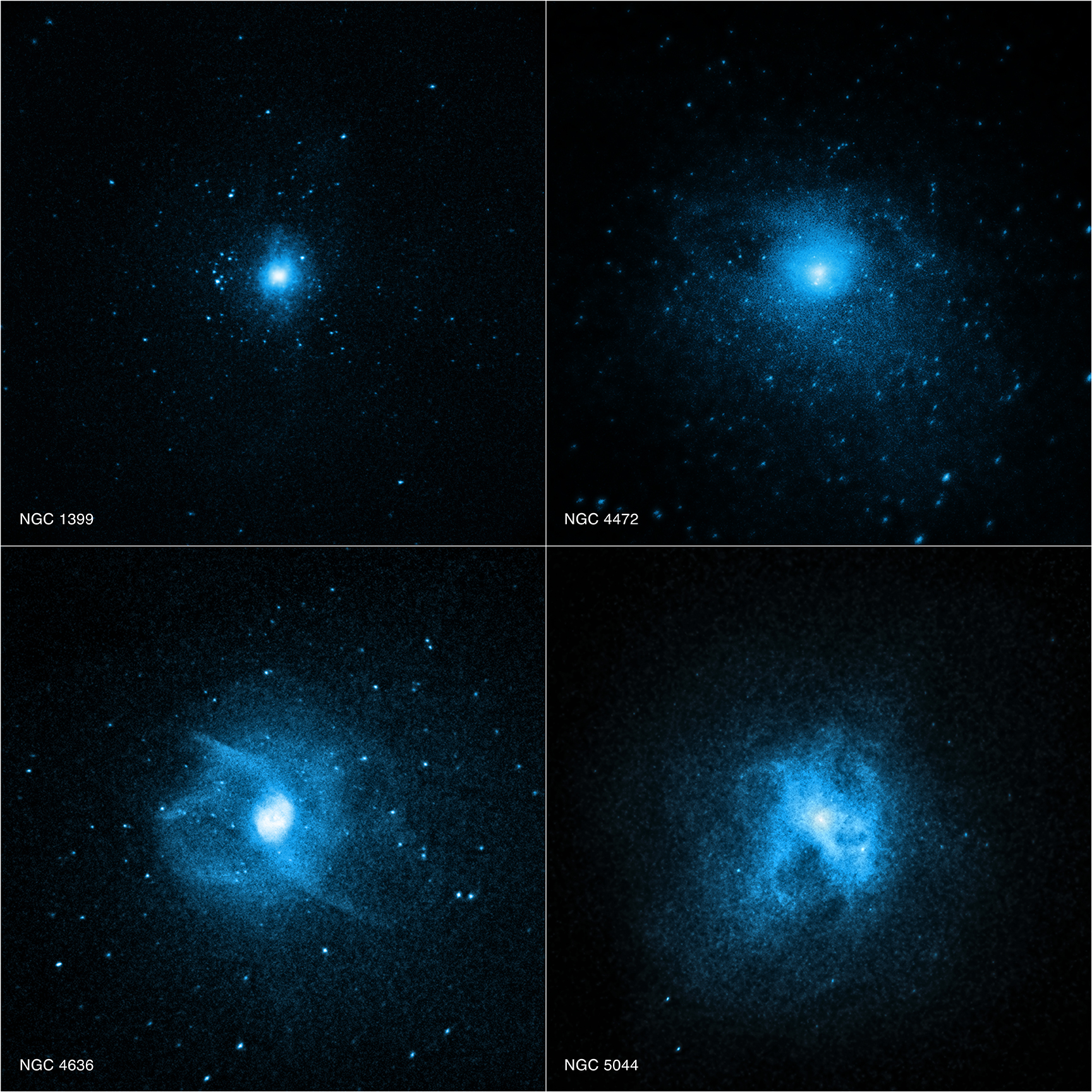
Elliptical Galaxies: Chandra Helps Explain "Red and Dead Galaxies"

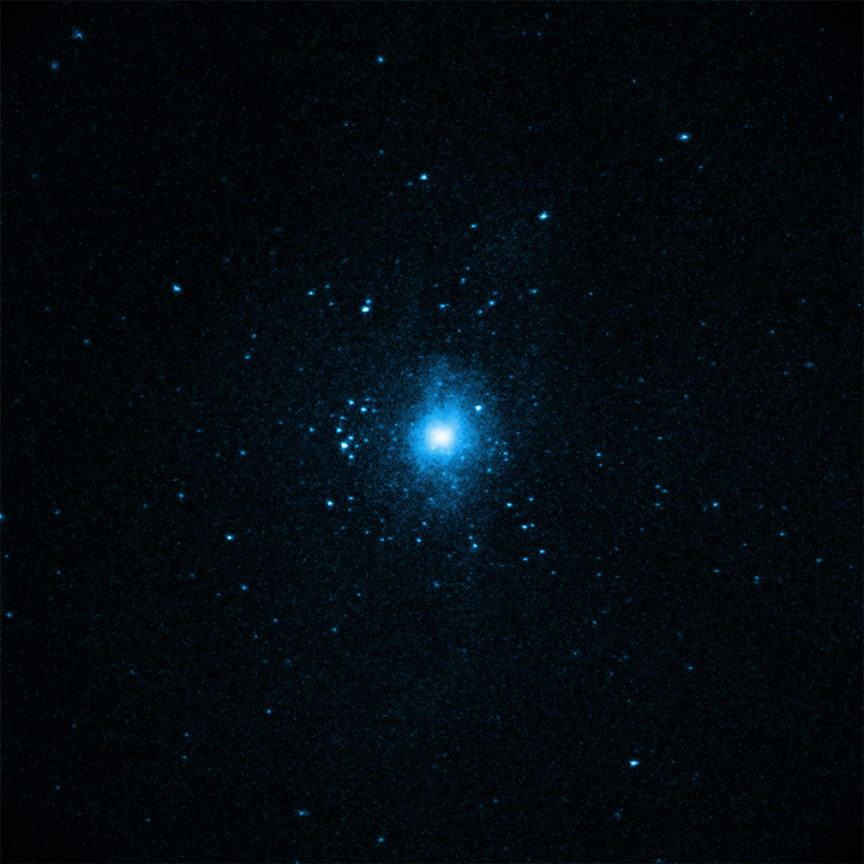
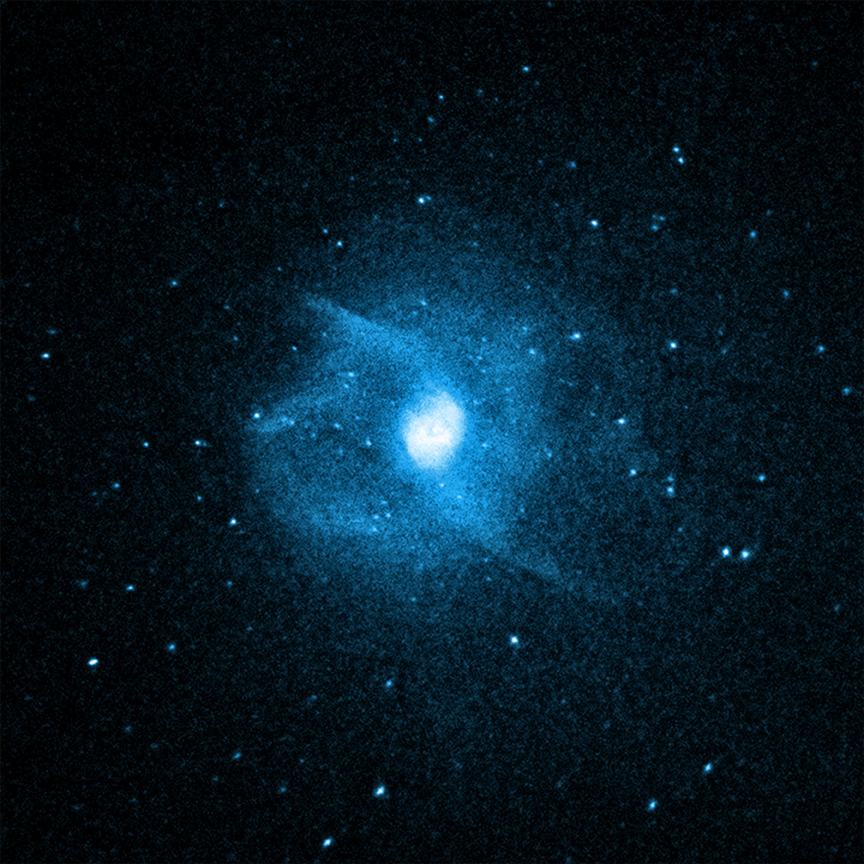
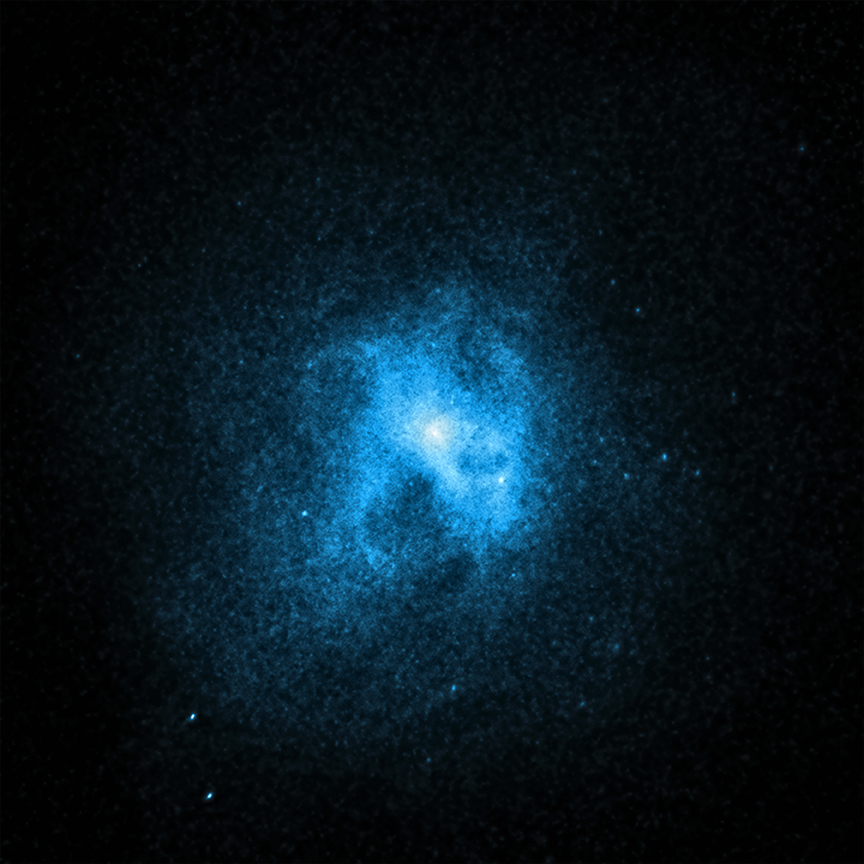
NGC 1399 - NGC 4472 - NGC 4636 - NGC 5044
Credit  X-ray: NASA/CXC/Stanford Univ/N.Werner et al.

JPEG (2.3 MB) - Large JPEG (14.9 MB) - Tiff (148.3 MB) - More Images 

NASA's Chandra X-ray Observatory has shed new light on the mystery of why giant elliptical galaxies have few, if any, young stars. This new evidence highlights the important role that supermassive black holes play in the evolution of their host galaxies.

Because star-forming activity in many giant elliptical galaxies has shut down to very low levels, these galaxies mostly house long-lived stars with low masses and red optical colors. Astronomers have therefore called these galaxies "red and dead".

Previously it was thought that these red and dead galaxies do not contain large amounts of cold gas - the fuel for star formation - helping to explain the lack of young stars. However, astronomers have used ESA's Herschel Space Observatory to find surprisingly large amounts of cold gas in some giant elliptical galaxies. In a sample of eight galaxies, six contain large reservoirs of cold gas. This is the first time that astronomers have seen large quantities of cold gas in giant elliptical galaxies that are not located at the center of a massive galaxy cluster.

With lots of cold gas, astronomers would expect many stars to be forming in these galaxies, contrary to what is observed. To try to understand this inconsistency, astronomers studied the galaxies at other wavelengths, including X-rays and radio waves. The Chandra observations map the temperature and density of hot gas in these galaxies. For the six galaxies containing abundant cold gas, including NGC 4636 and NGC 5044 shown here, the X-ray data provide evidence that the hot gas is cooling, providing a source for the cold gas observed with Herschel. However, the cooling process stops before the cold gas condenses to form stars. What prevents the stars from forming?

A strong clue comes from the Chandra images. The hot gas in the center of the six galaxies containing cold gas appears to be much more disturbed than in the cold gas-free systems. This is a sign that material has been ejected from regions close to the central black hole. These outbursts are possibly driven, in part, by clumpy, cold gas that has been pulled onto the black hole. The outbursts dump most of their energy into the center of the galaxy, where the cold gas is located, preventing the cold gas from cooling sufficiently to form stars.

The other galaxies in the sample, NGC 1399 and NGC 4472, are also forming few if any stars, but they have a very different appearance. No cold gas was detected in these galaxies, and the hot gas in their central regions is much smoother. Additionally, they have powerful jets of highly energetic particles, as shown in radio images from the National Science Foundation's Karl G. Jansky Very Large Array. These jets are likely driven by hot gas falling towards the central supermassive black holes. By pushing against the hot gas, the jets create enormous cavities that are observed in the Chandra images, and they may heat the hot, X-ray emitting gas, preventing it from cooling and forming cold gas and stars. The centers of NGC 1399 and NGC 4472 look smoother in X-rays than the other galaxies, likely because their more powerful jets produce cavities further away from the center, where the X-ray emission is fainter, leaving their bright cores undisturbed.

A paper describing these results was published in the February 25, 2014 issue of the Monthly Notices of the Royal Astronomical Society and is available online. The first author is Norbert Werner from Stanford University in California.

NASA's Marshall Space Flight Center in Huntsville, Ala., manages the Chandra program for NASA's Science Mission Directorate in Washington. The Smithsonian Astrophysical Observatory in Cambridge, Mass., controls Chandra's science and flight operations.

Fast Facts for NGC 1399:

Scale: Image is 6.5 arcmin across. (about 130,000 light years)
Category: Normal Galaxies & Starburst Galaxies
Coordinates (J2000): RA 03h 38m 29.08s | Dec -35º 27' 02.67"
Constelattion: Fornax
Observation Dates: 3 pointings between 18 Jan 2000 and 08 Jun 2008
Observation Time: 40 hours 32 min (1 day 16 hours 32 min)
Obs. IDs: 319, 4172, 9530
Instrument: ACIS
References: Werner, N. et al, 2014, MNRAS 439, 2291-2306; arXiv:1310.5450
Color Code: X-ray (Blue)
Distance Estimate: About 65 million light years


Fast Facts for NGC 4472:

Scale: Image is 6.5 arcmin across. (about 100,000 light years)
Category: Normal Galaxies & Starburst Galaxies
Coordinates (J2000: RA 12h 29m 46.90s | Dec +08º 00' 13.00
Constellation: Virgo
Observation Dates: 12 Jun 2000
Observation Time: 11 hours 6 min
Obs. IDs: 321
Instrument: ACIS
References: Werner, N. et al, 2014, MNRAS 439, 2291-2306; arXiv:1310.5450
Color Code: X-ray (Blue)
Distance Estimate: About 55 million light years


Fast Facts for NGC 4636:

Scale: Image is 6.5 arcmin across. (about 95,000 light years)
Category: Normal Galaxies & Starburst Galaxies
Coordinates (J2000): RA 12h 42m 49.87s | Dec +02° 41' 16.01"
Constellation: Virgo
Observation Dates: 3 pointings between 26 Jan 2000 and 15 Mar 2003
Observation Time: 55 hours 57 min (2 days 7 hours 57 min)
Obs. IDs: 323, 3926, 4415
Instrument: ACIS
References: Werner, N. et al, 2014, MNRAS 439, 2291-2306; arXiv:1310.5450
Color Code: X-ray (Blue)
Distance Estimate: About 50 million light years


Fast Facts for NGC 5044:

Scale: Image is 6.5 arcmin across. (about 190,000 light years)
Category: Normal Galaxies & Starburst Galaxies
Coordinates (J2000): RA 13h 15m 23.97s | Dec -16º 23' 08.00"
Constellation: Virgo
Observation Dates: 2 pointings on 19 Mar 2000 and 07 Mar 2008
Observation Time: 28 hours 39 min (1 day 4 hours 39 min)
Obs. IDs: 798, 9399
Instrument: ACIS
References: Werner, N. et al, 2014, MNRAS 439, 2291-2306; arXiv:1310.5450
Color Code: X-ray (Blue)
Distance Estimate: About 102 million light years


Monday, January 04, 2010

NGC 1399: Massive Black Hole Implicated in Stellar Destruction

Credit : X-ray: NASA/CXC/UA/J. Irwin;
Optical: NASA/STScI


Evidence from NASA's Chandra X-ray Observatory and the Magellan telescopes suggest a star has been torn apart by an intermediate-mass black hole in a globular cluster. In this image, X-rays from Chandra are shown in blue and are overlaid on an optical image from the Hubble Space Telescope. The Chandra observations show that this object is a so-called ultraluminous X-ray source (ULX). An unusual class of objects, ULXs emit more X-rays than any known stellar X-ray source, but less than the bright X-ray sources associated with supermassive black holes in the centers of galaxies. Their exact nature has remained a mystery, but one suggestion is that some ULXs are black holes with masses between about a hundred and a thousands times that of the Sun.

Data obtained in optical light with the Magellan I and II telescopes in Las Campanas, Chile, also provides intriguing information about this object, which is found in the elliptical galaxy NGC 1399 in the Fornax galaxy cluster. The spectrum reveals emission from oxygen and nitrogen but no hydrogen, a rare set of signals from within globular clusters. The physical conditions deduced from the spectra suggest that the gas is orbiting a black hole of at least 1,000 solar masses.

To explain these observations, researchers suggest that a white dwarf star strayed too close to an intermediate-mass black hole and was ripped apart by tidal forces. In this scenario the X-ray emission is produced by debris from the disrupted white dwarf star that is heated as it falls towards the black hole and the optical emission comes from debris further out that is illuminated by these X-rays.

Another interesting aspect of this object is that it is found within a globular cluster, a very old, very tight grouping of stars. Astronomers have long suspected globular clusters contained intermediate-mass black holes, but there has been no conclusive evidence of their existence there to date. If confirmed, this finding would represent the first such substantiation.

Fast Facts for NGC 1399:

Scale: Image is 3 arcmin across
Coordinates (J2000) RA 03h 38m 29.00s | Dec -35º 27' 01.40
Constellation: Fornax
Observation Date: 6/8/2008
Observation Time: 18 hours
Obs. ID: 9530
Color Code: Energy (X-ray: Blue; Optical: Yellow)
Instrument: ACIS
Distance Estimate: About 65 million light years