Showing posts with label NGC 4636. Show all posts

Friday, March 31, 2017

CDF-S Transient: Mysterious Cosmic Explosion Puzzles Astronomers

 
 CDF-S XT1
Credit X-ray: NASA/CXC/Universidad Católica de Chile/F.Bauer et al.
 

 CDF-S Transient - Video 

Tour of CDF-S XT1
 
animation


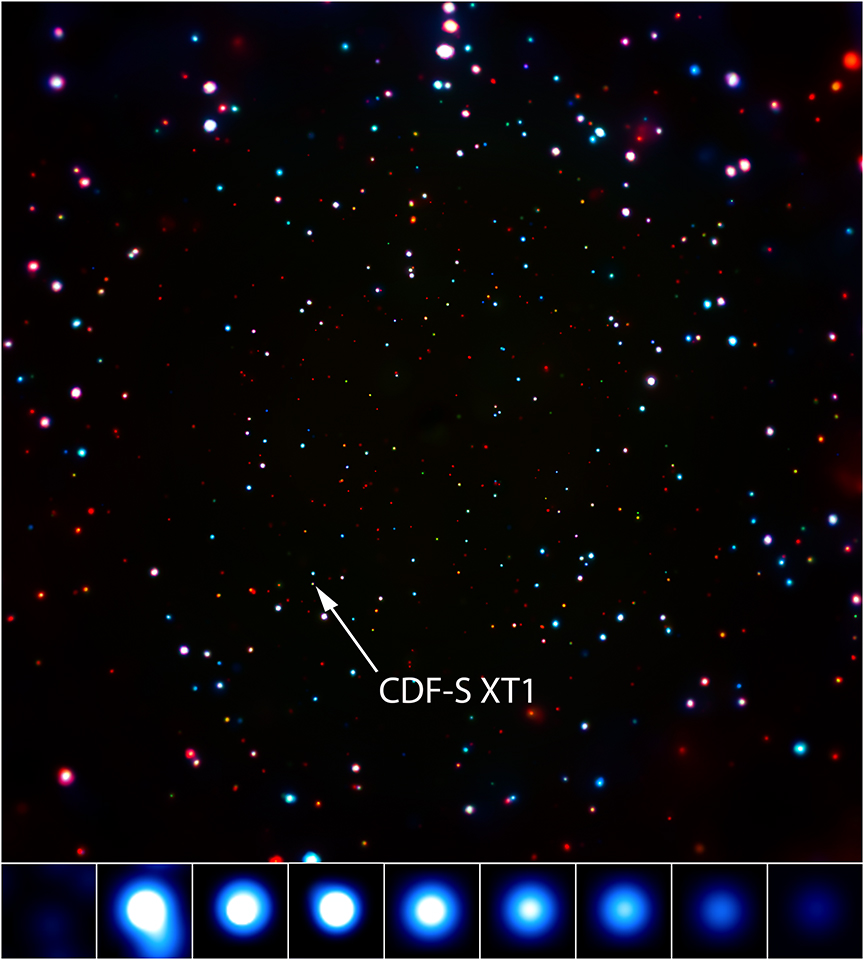
Scientists have discovered a mysterious flash of X-rays using NASA's Chandra X-ray Observatory, in the deepest X-ray image ever obtained, as reported in our latest press release. The X-ray source is located in a region of the sky known as the Chandra Deep Field-South (CDF-S), which is shown in the main panel of this graphic. Over the 17 years Chandra has been operating, the telescope has observed this field many times, resulting in a total exposure time of 7 million seconds, equal to two and a half months. In this CDF-S image, the colors represent different bands of X-ray energy, where red, green, and blue show the low, medium, and high-energy X-rays that Chandra can detect.

The mysterious source that scientists discovered, shown in the inset box, has remarkable properties. 

Prior to October 2014, this source was not detected in X-rays, but then it erupted and became at least a factor of 1,000 brighter in a few hours. After about a day, the source had faded completely below the sensitivity of Chandra.

Thousands of hours of legacy data from the Hubble and Spitzer Space Telescopes helped determine that the event came from a faint, small galaxy about 10.7 billion light years from Earth. For a few minutes, the X-ray source produced a thousand times more energy than all the stars in this galaxy.

While scientists think this source likely comes from some sort of destructive event, its properties do not match any known phenomenon. This means this source may be of a variety that scientists have never seen before.

The researchers do, however, have some ideas of what this source could be. Two of the three main possibilities to explain the X-ray source invoke gamma-ray burst (GRB) events, which are jetted explosions triggered either by the collapse of a massive star or by the merger of a neutron star with another neutron star or a black hole. If the jet is pointing towards the Earth, a burst of gamma-rays is detected. As the jet expands, it loses energy and produces weaker, more isotropic radiation at X-ray and other wavelengths.

Possible explanations for the CDF-S X-ray source, according to the researchers, are a GRB that is not pointed toward Earth, or a GRB that lies beyond the small galaxy. A third possibility is that a medium-sized black hole shredded a white dwarf star.

Thousands of hours of legacy data from the Hubble and Spitzer Space Telescopes helped determine that the event came from a faint, small galaxy about 10.7 billion light years from Earth. For a few minutes, the X-ray source produced a thousand times more energy than all the stars in this galaxy.

The mysterious X-ray source was not seen at any other time during the two and a half months of exposure time Chandra has observed the CDF-S region. Moreover, no similar events have yet been found in Chandra observations of other parts of the sky.

This X-ray source in the CDF-S has different properties from the as yet unexplained variable X-ray sources discovered in the elliptical galaxies NGC 5128 and NGC 4636 by Jimmy Irwin and collaborators. In particular, the CDF-S source is likely associated with the complete destruction of a neutron star or white dwarf, and is roughly 100,000 times more luminous in X-rays. It is also located in a much smaller and younger host galaxy, and is only detected during a single, several-hour burst.

Additional highly targeted searches through the Chandra archive and those of ESA's XMM-Newton and NASA's Swift satellite may uncover more examples of this type of variable object that have until now gone unnoticed. Future X-ray observations by Chandra and other X-ray telescopes may also reveal the same phenomenon from other objects.

A paper describing this result appears in the June 2017 issue of the Monthly Notices of the Royal Astronomical Society and is available online. NASA's Marshall Space Flight Center in Huntsville, Alabama, manages the Chandra program for NASA's Science Mission Directorate in Washington. The Smithsonian Astrophysical Observatory in Cambridge, Massachusetts, controls Chandra's science and flight operations. 

Fast Facts for CDF-S Transient:

Scale: Main Image is 16 arcmin across; Inset Image is 3.7 arcsec across
Category: Cosmology/Deep Fields/X-ray Background, Black Holes
Coordinates (J2000): RA 03h 32m 39s | Dec -27° 51' 34"
Constellation: Fornax
Observation Date: Inset Image: October 2, 2014
Observation Time: Inset Image: 26 hours 7 minutes.
Obs. ID: Inset Image: 16454
Instrument: ACIS
References: Bauer, F. et al., 2017, MNRAS (in press); arXiv:1702.04422
Color Code: Inset Image: X-ray (Blue)
Distance Estimate: About 10.7 billion light years


Monday, June 02, 2014

Elliptical Galaxies: Chandra Helps Explain "Red and Dead Galaxies"


NGC 1399 - NGC 4472 - NGC 4636 - NGC 5044
Credit  X-ray: NASA/CXC/Stanford Univ/N.Werner et al.

JPEG (2.3 MB) - Large JPEG (14.9 MB) - Tiff (148.3 MB) - More Images 

NASA's Chandra X-ray Observatory has shed new light on the mystery of why giant elliptical galaxies have few, if any, young stars. This new evidence highlights the important role that supermassive black holes play in the evolution of their host galaxies.
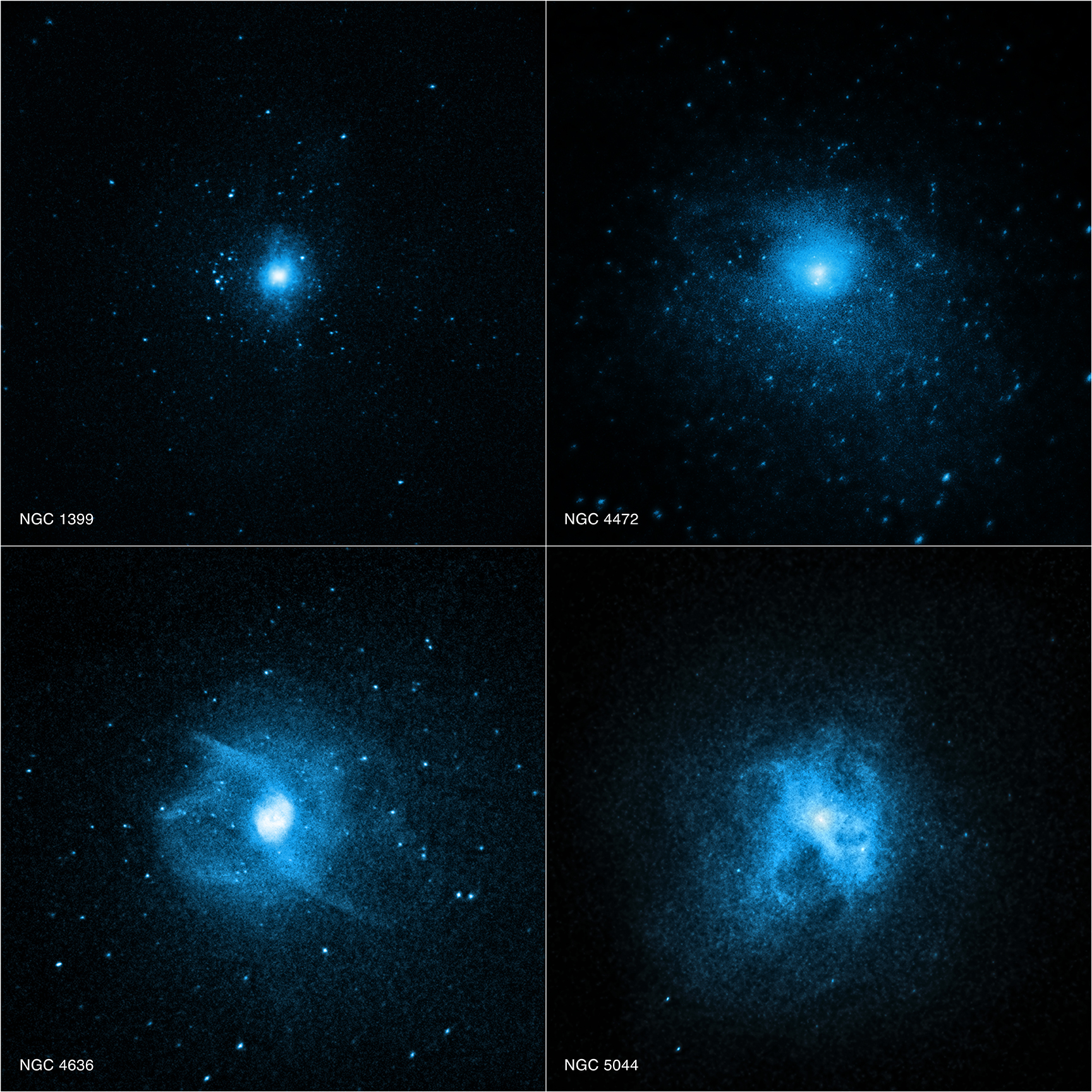
Because star-forming activity in many giant elliptical galaxies has shut down to very low levels, these galaxies mostly house long-lived stars with low masses and red optical colors. Astronomers have therefore called these galaxies "red and dead".

Previously it was thought that these red and dead galaxies do not contain large amounts of cold gas - the fuel for star formation - helping to explain the lack of young stars. However, astronomers have used ESA's Herschel Space Observatory to find surprisingly large amounts of cold gas in some giant elliptical galaxies. In a sample of eight galaxies, six contain large reservoirs of cold gas. This is the first time that astronomers have seen large quantities of cold gas in giant elliptical galaxies that are not located at the center of a massive galaxy cluster.

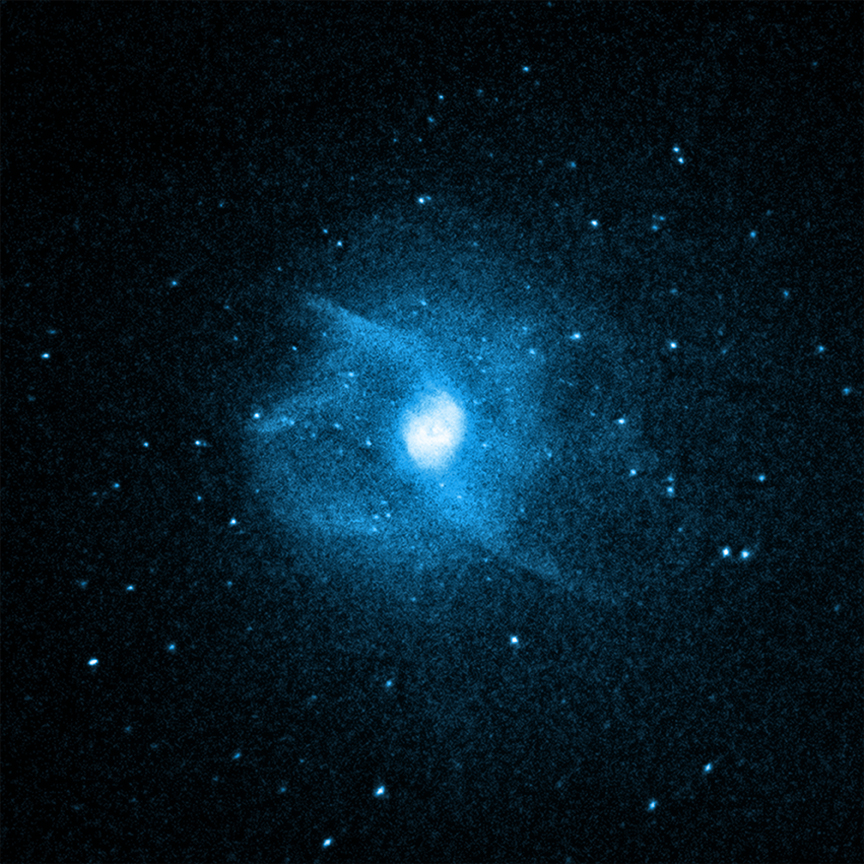
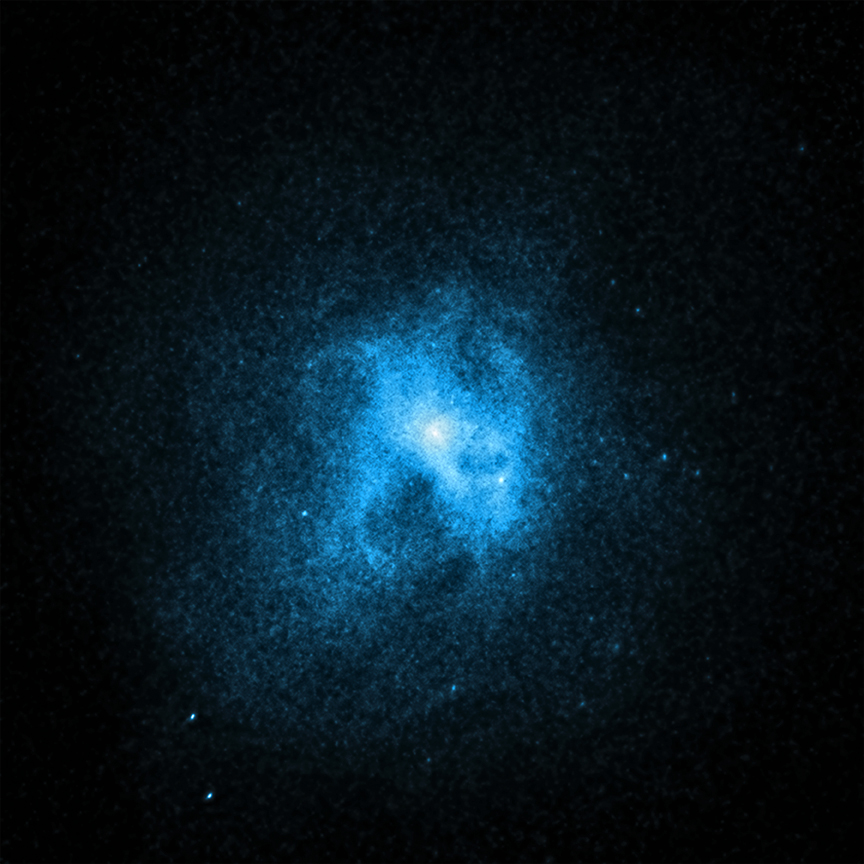
With lots of cold gas, astronomers would expect many stars to be forming in these galaxies, contrary to what is observed. To try to understand this inconsistency, astronomers studied the galaxies at other wavelengths, including X-rays and radio waves. The Chandra observations map the temperature and density of hot gas in these galaxies. For the six galaxies containing abundant cold gas, including NGC 4636 and NGC 5044 shown here, the X-ray data provide evidence that the hot gas is cooling, providing a source for the cold gas observed with Herschel. However, the cooling process stops before the cold gas condenses to form stars. What prevents the stars from forming?

A strong clue comes from the Chandra images. The hot gas in the center of the six galaxies containing cold gas appears to be much more disturbed than in the cold gas-free systems. This is a sign that material has been ejected from regions close to the central black hole. These outbursts are possibly driven, in part, by clumpy, cold gas that has been pulled onto the black hole. The outbursts dump most of their energy into the center of the galaxy, where the cold gas is located, preventing the cold gas from cooling sufficiently to form stars.

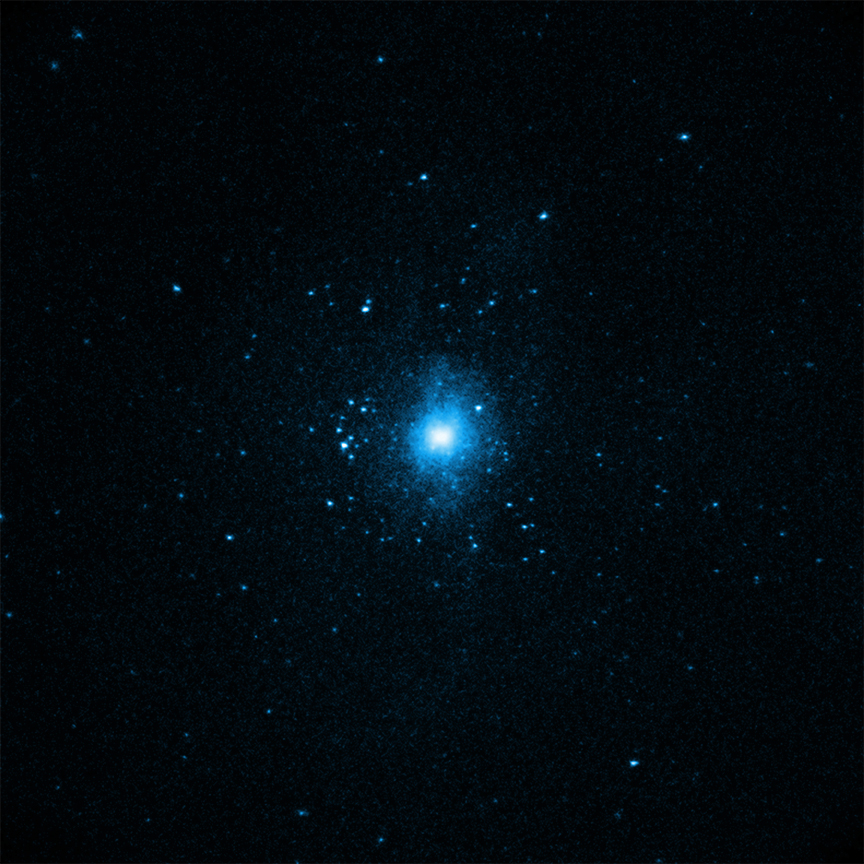
The other galaxies in the sample, NGC 1399 and NGC 4472, are also forming few if any stars, but they have a very different appearance. No cold gas was detected in these galaxies, and the hot gas in their central regions is much smoother. Additionally, they have powerful jets of highly energetic particles, as shown in radio images from the National Science Foundation's Karl G. Jansky Very Large Array. These jets are likely driven by hot gas falling towards the central supermassive black holes. By pushing against the hot gas, the jets create enormous cavities that are observed in the Chandra images, and they may heat the hot, X-ray emitting gas, preventing it from cooling and forming cold gas and stars. The centers of NGC 1399 and NGC 4472 look smoother in X-rays than the other galaxies, likely because their more powerful jets produce cavities further away from the center, where the X-ray emission is fainter, leaving their bright cores undisturbed.

A paper describing these results was published in the February 25, 2014 issue of the Monthly Notices of the Royal Astronomical Society and is available online. The first author is Norbert Werner from Stanford University in California.

NASA's Marshall Space Flight Center in Huntsville, Ala., manages the Chandra program for NASA's Science Mission Directorate in Washington. The Smithsonian Astrophysical Observatory in Cambridge, Mass., controls Chandra's science and flight operations.

Fast Facts for NGC 1399:

Scale: Image is 6.5 arcmin across. (about 130,000 light years)
Category: Normal Galaxies & Starburst Galaxies
Coordinates (J2000): RA 03h 38m 29.08s | Dec -35º 27' 02.67"
Constelattion: Fornax
Observation Dates: 3 pointings between 18 Jan 2000 and 08 Jun 2008
Observation Time: 40 hours 32 min (1 day 16 hours 32 min)
Obs. IDs: 319, 4172, 9530
Instrument: ACIS
References: Werner, N. et al, 2014, MNRAS 439, 2291-2306; arXiv:1310.5450
Color Code: X-ray (Blue)
Distance Estimate: About 65 million light years


Fast Facts for NGC 4472:

Scale: Image is 6.5 arcmin across. (about 100,000 light years)
Category: Normal Galaxies & Starburst Galaxies
Coordinates (J2000: RA 12h 29m 46.90s | Dec +08º 00' 13.00
Constellation: Virgo
Observation Dates: 12 Jun 2000
Observation Time: 11 hours 6 min
Obs. IDs: 321
Instrument: ACIS
References: Werner, N. et al, 2014, MNRAS 439, 2291-2306; arXiv:1310.5450
Color Code: X-ray (Blue)
Distance Estimate: About 55 million light years


Fast Facts for NGC 4636:

Scale: Image is 6.5 arcmin across. (about 95,000 light years)
Category: Normal Galaxies & Starburst Galaxies
Coordinates (J2000): RA 12h 42m 49.87s | Dec +02° 41' 16.01"
Constellation: Virgo
Observation Dates: 3 pointings between 26 Jan 2000 and 15 Mar 2003
Observation Time: 55 hours 57 min (2 days 7 hours 57 min)
Obs. IDs: 323, 3926, 4415
Instrument: ACIS
References: Werner, N. et al, 2014, MNRAS 439, 2291-2306; arXiv:1310.5450
Color Code: X-ray (Blue)
Distance Estimate: About 50 million light years


Fast Facts for NGC 5044:

Scale: Image is 6.5 arcmin across. (about 190,000 light years)
Category: Normal Galaxies & Starburst Galaxies
Coordinates (J2000): RA 13h 15m 23.97s | Dec -16º 23' 08.00"
Constellation: Virgo
Observation Dates: 2 pointings on 19 Mar 2000 and 07 Mar 2008
Observation Time: 28 hours 39 min (1 day 4 hours 39 min)
Obs. IDs: 798, 9399
Instrument: ACIS
References: Werner, N. et al, 2014, MNRAS 439, 2291-2306; arXiv:1310.5450
Color Code: X-ray (Blue)
Distance Estimate: About 102 million light years


Tuesday, November 05, 2013

Why do the most massive galaxies in the local Universe stand still?

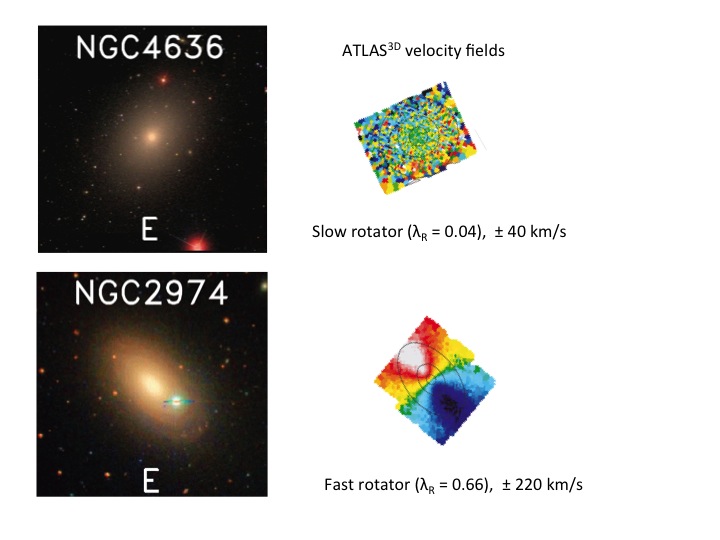
Fig. 1: Postage stamp of a slowly rotating galaxy (top, NGC4636) and a fast rotating galaxy (bottom, NGC2974) with the corresponding observed two-dimensional ATLAS3D velocity fields (right). NGC4636 has no rotation patterns and the measured velocities do not exceed 40 km/s. NGC2974 shows regular fast (~ 200 km/s) rotation (Krajnovic et al. 2011).

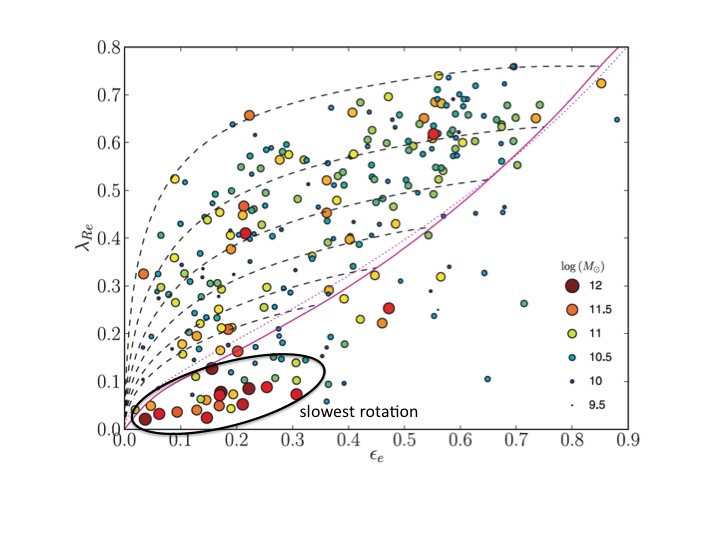
Fig. 2: Rotation properties of all early-type galaxies in the ATLAS3D sample measured by the spin parameter λR. This parameter measures the angular momentum of stellar components of the galaxies and is derived from the two-dimensional velocity fields (see Fig. 1). Most early-type galaxies rotate fast (high λR values) but the rare massive systems (largest symbols in the plot) are slow rotators (Emsellem et al. 2011).

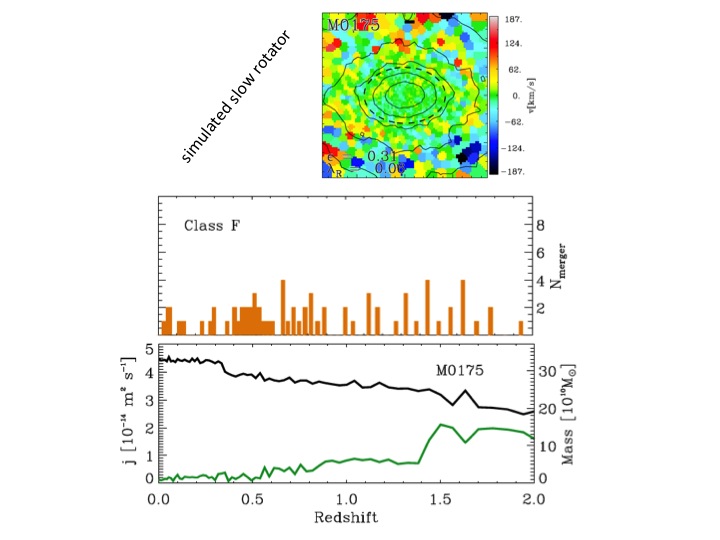
Fig. 3: Two dimensional velocity field of a non-rotating rotating galaxy from a cosmological simulation (top panel). These galaxies have special formation histories (class F in Naab et al. 2013). Since redshift z ~ 2 they have experienced repeated minor mergers (~ 100 in this case) with mass ratios larger than 4:1 (counted by the orange histogram, middle panel) and no late major mergers. The galaxies continuously grow in mass (black line, bottom panel) and loose angular momentum (green line) until they stand still. 

Over the last two years an international team of astronomers participating in the ATLAS3D project has presented the rotation properties of all early-type (elliptical and lenticular) galaxies in a well defined volume (42Mpc) of the nearby Universe. To the surprise of the team the stellar components of the most massive observed galaxies (~ 1011 Msun) in our neighbourhood show no global rotation signatures, in contrast to the regular rotation patterns observed for the majority of lower mass early-type galaxies. With the help of cosmological galaxy formation simulations performed by MPA scientists the team was now able to demonstrate that the giant non rotating galaxies might have special formation histories. Simulated galaxies most consistent with the rare class of non-rotating round early-type galaxies grow by gas-poor minor mergers alone. More than half of their stars were born in other galaxies which then have been eaten by the giants. The simulations indicate that over the last 10 Gyrs repeated minor mergers have continuously slowed these initially rotating giants down until they come to a halt. 

Within the ATLAS3D project (Cappellari et al. 2011) 260 nearby early-type galaxies within a local volume of 42 Mpc have been observed at optical, radio, and millimeter wavelengths. The multi-wavelength coverage enabled the team to determine the dynamics, the star-formation histories, ages and metallicities of the stellar populations as well as a full census of the gas phase (molecular, neutral and ionised) properties. The integral-field observations of the stellar kinematics (Emsellem et al. 2011, see Fig. 1) have revealed a surprising result. Whereas most early-type galaxies (~ 80 per cent) rotate quite regularly - similar to thick stellar disks - the most massive ones rotate very slowly (see Fig. 2) and some of them (7 out of 260) are very round and show no sign of ordered rotation at all (Krajnovic et al. 2011). They stand still. 

The absence of rotation is difficult to reconcile with current standard formation scenarios and has caused theorists quite a headache. Traditionally, it is assumed that early-type galaxies are burned out spiral galaxies or they formed and evolved by mergers of disk-like or even early-type galaxies of comparable mass. Many studies, however, have demonstrated that these formation paths mostly result in rotating or very elongated galaxies, inconsistent with properties of the observed non-rotating early-type galaxies. 

As part of the theoretical efforts within ATLAS3D a group of MPA scientists have carried out a number of high resolution computer simulations of the formation and evolution of massive galaxies (Naab et al. 2013). Analysing the stellar kinematics of the simulated galaxies in the same way as the observers made it possible to identify direct links between the formation history of the galaxies - as recorded by the simulations - and the resulting kinematic properties. The study reveals a surprising wealth of formation histories which are consistent with observations and the scientists were able to demonstrate that every formation history leaves its characteristic imprint on the observable two-dimensional kinematic properties. A most valuable result to interpret the observations. 

Similar to the real Universe most simulated galaxies of lower mass are fast rotating. They either form a thick stellar disk from accreted gas or are still rotating after collisions with companion galaxies of similar size. At higher galaxy masses (~ 1011 Msun), however, the majority of the stars in a typical simulated galaxy do not form in the galaxy itself but formed in other galaxies that have merged with the galaxy progenitor. Some of the major collision wrecks rotate slowly but their very elongated shapes do not agree with observed non-rotators. Only galaxies with a special formation history resemble the observed round and non-rotating galaxies. They acquire about half of their stars from many mergers with much smaller galaxies and experience not late major merger. The many repeated merger events over the last ~ 10 Gyrs slow the giant galaxies down continuously so that they stand sill today (Fig. 3).

Thorsten Naab (MPA), Ludwig Oser (MPA, Columbia University) and the ATLAS3D team

References

Cappellari et al., "The ATLAS3D project - I. A volume-limited sample of 260 nearby early-type galaxies: science goals and selection criteria", 2011, MNRAS, 413, 813, http://adsabs.harvard.edu/abs/2011MNRAS.413..813C

Krajnovic et al., "The ATLAS3D project - II. Morphologies, kinemetric features and alignment between photometric and kinematic axes of early-type galaxies", 2011, MNRAS, 414, 2923, http://adsabs.harvard.edu/abs/2011MNRAS.414.2923K

Emsellem et al., "The ATLAS3D project - III. A census of the stellar angular momentum within the effective radius of early-type galaxies: unveiling the distribution of fast and slow rotators", 2011, MNRAS, 414, 888, http://adsabs.harvard.edu/abs/2011MNRAS.414..888E

Naab et al., "The ATLAS3D project - XXV: Two-dimensional kinematic analysis of simulated galaxies and the cosmological origin of fast and slow rotators", 2013, astro-ph