NuSTAR is best known for observing some of the hottest, brightest, and most extreme phenomena in the Universe, such as supernovae explosions and the immediate surroundings of black holes. But did you know that it can also be used to search for some of the smallest and most elusive particles in existence?
For decades we've known that a large portion of the mass in the Universe—even more than all the stars and galaxies that we can see—consists of dark matter. We know it's there because we can see its gravitational effects on the matter we can observe—just like we can't see air but can see its effect on the world around us when trees sway in the wind. But dark matter itself, like its name suggests, is invisible to us, as it does not give off or interact with light. This makes trying to find out what it's actually made of incredibly difficult.
Axions
Many different kinds of particles and objects have been put forward
as possible candidates to be dark matter, one of which is the axion. If
you think that sounds a bit like the name of a cleaning product, you'd
be right—it was named after a laundry detergent brand because it 'cleans
up' a messy problem in particle physics called charge-parity violation.
Under the Standard Model of particle physics, the laws of physics apply
in the same way to particles and their corresponding anti-particles.
But if this were the case, why is there so much more matter in the
Universe than anti-matter? Axions present a possible solution to this
problem and would emerge naturally from the breaking of this
matter/anti-matter symmetry.
If axions were to exist, they would be extremely light and interact so weakly with normal matter that trillions could pass through you every second and you wouldn't even notice. This also makes them a compelling candidate for dark matter. However, if we are to demonstrate that this theorized particle exists, first we need to detect it. And that's no small feat, since there is a wide range of possible masses and degrees to which they interact with light or matter that could apply to an axion—in other words, they might be out there but we're not exactly sure what they look like. Axions are so elusive that all ground-based efforts to date have failed to detect them. So, scientists have turned to space to continue the search.
If axions were to exist, they would be extremely light and interact so weakly with normal matter that trillions could pass through you every second and you wouldn't even notice. This also makes them a compelling candidate for dark matter. However, if we are to demonstrate that this theorized particle exists, first we need to detect it. And that's no small feat, since there is a wide range of possible masses and degrees to which they interact with light or matter that could apply to an axion—in other words, they might be out there but we're not exactly sure what they look like. Axions are so elusive that all ground-based efforts to date have failed to detect them. So, scientists have turned to space to continue the search.
The Sun as a Particle Physics Laboratory
Inside our own Sun, high-energy X-ray photons released in the
thermonuclear core face a long, slow journey to the surface, repeatedly
absorbed and re-emitted by the densely packed matter inside, losing
energy along the way until they finally emerge as visible light
thousands to millions of years later. However, the interaction of a
high-energy photon with the electric fields of an atomic nucleus or
electron could also generate an axion, which then streams directly out
of the Sun. Once outside, the axion interacts again with the Sun's
magnetic field and can turn back into a photon. Depending on the
properties of the axion, this could be an X-ray photon.
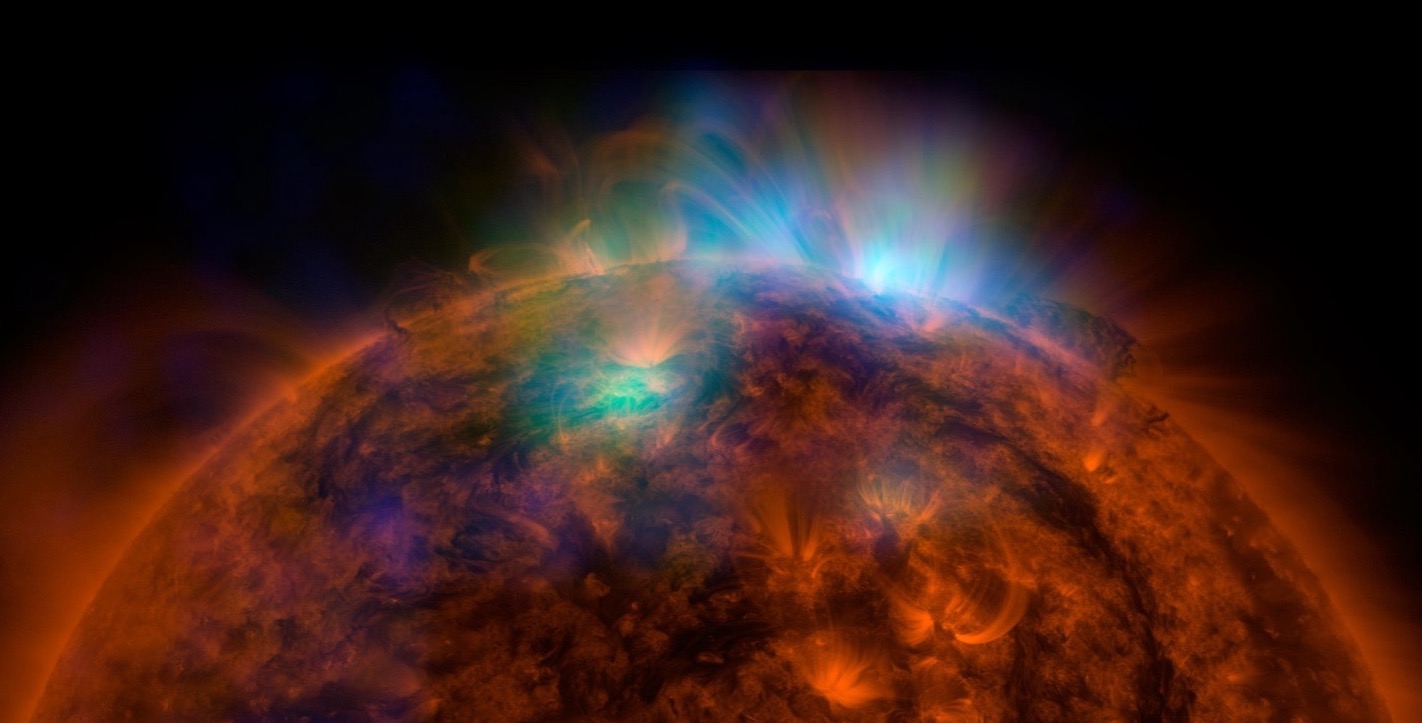
This is where NuSTAR comes in. Unlike most sensitive X-ray astrophysics observatories, NuSTAR is able to safely look at the Sun, making it useful for studying flares and hotspots on the Sun's surface. Scientists can also use this Solar data to look for the distinct predicted signatures of axions.
So far, NuSTAR has not detected an axion signal from the Sun. In science, a non-detection is not bad news! Since we know a lot about the Sun's properties, we know that if axions were larger or more interactive than certain values, we would have detected them. The fact that we haven't allows us to rule out certain possibilities for those properties. If axions exist, they must be sufficiently light and non-interactive that the signal from the Sun is too weak to detect.
The next step is to find somewhere that might produce a stronger axion signal than the Sun. Axion emission is directly related to the temperature inside a star. In other words, we're going to need a bigger, hotter star.
This is where NuSTAR comes in. Unlike most sensitive X-ray astrophysics observatories, NuSTAR is able to safely look at the Sun, making it useful for studying flares and hotspots on the Sun's surface. Scientists can also use this Solar data to look for the distinct predicted signatures of axions.
So far, NuSTAR has not detected an axion signal from the Sun. In science, a non-detection is not bad news! Since we know a lot about the Sun's properties, we know that if axions were larger or more interactive than certain values, we would have detected them. The fact that we haven't allows us to rule out certain possibilities for those properties. If axions exist, they must be sufficiently light and non-interactive that the signal from the Sun is too weak to detect.
The next step is to find somewhere that might produce a stronger axion signal than the Sun. Axion emission is directly related to the temperature inside a star. In other words, we're going to need a bigger, hotter star.
Let's go bigger!
On the left shoulder of Orion is an enormous red supergiant star
called Betelgeuse, the tenth-brightest star in our night sky. Hundreds
of times larger than the Sun, its radius would engulf the orbit of Mars
if it were in our Solar system. The temperature of its core is also far
higher than the Sun's, implying that it could be a far more efficient
source of axions. In 2019, NuSTAR observed Betelgeuse in search of signs
of a specific theorized axion production mechanism that Betelgeuse is
hot enough to achieve—the de-excitation of iron nuclei. This kind of
atomic transition happens at a very specific energy, meaning that the
axion-to-photon transformations in the Sun’s outer magnetic field would
result in a distinctive X-ray emission line at 14.4 keV.
While the 14.4 keV line was not detected from Betelgeuse, this doesn’t imply that axions cannot exist. Once more, the lack of a signal instead rules out certain possible properties of axions, providing orders of magnitude better constraints on their mass and the strength of their interactions with normal matter than we could achieve with the Sun.
Since axions weren't detected from Betelgeuse, can we find an even bigger, hotter laboratory than that? What if we didn't just look at one star, but a whole galaxy of hot massive stars?
M82, also known as the Cigar Galaxy for its narrow, edge-on shape, is a nearby galaxy undergoing intense star formation, meaning that it is full of newly formed, very massive and very hot stars. If each of these stars could potentially be giving off a very faint axion signal, then by observing the galaxy NuSTAR could pick up their combined signal. This would appear as a high-energy X-ray glow around the galaxy.
"By analyzing over a million seconds of NuSTAR X-ray observations of M82, we found no excess X-ray signal attributable to decaying axions," said Francisco Rodríguez Candón, PhD student at the University of Zaragoza in Spain and the first author of a paper on this new approach. "This null result enabled us to set some of the strictest limits to date on axion properties."
Once more, no signal was detected—which means that we can rule out further swaths of possible combinations of axion mass and photon coupling from the potential axion parameter space. Little by little, we are narrowing down the possibilities and, if axions are truly what makes up dark matter, closing in on their nature.
While the 14.4 keV line was not detected from Betelgeuse, this doesn’t imply that axions cannot exist. Once more, the lack of a signal instead rules out certain possible properties of axions, providing orders of magnitude better constraints on their mass and the strength of their interactions with normal matter than we could achieve with the Sun.
Since axions weren't detected from Betelgeuse, can we find an even bigger, hotter laboratory than that? What if we didn't just look at one star, but a whole galaxy of hot massive stars?
M82, also known as the Cigar Galaxy for its narrow, edge-on shape, is a nearby galaxy undergoing intense star formation, meaning that it is full of newly formed, very massive and very hot stars. If each of these stars could potentially be giving off a very faint axion signal, then by observing the galaxy NuSTAR could pick up their combined signal. This would appear as a high-energy X-ray glow around the galaxy.
"By analyzing over a million seconds of NuSTAR X-ray observations of M82, we found no excess X-ray signal attributable to decaying axions," said Francisco Rodríguez Candón, PhD student at the University of Zaragoza in Spain and the first author of a paper on this new approach. "This null result enabled us to set some of the strictest limits to date on axion properties."
Once more, no signal was detected—which means that we can rule out further swaths of possible combinations of axion mass and photon coupling from the potential axion parameter space. Little by little, we are narrowing down the possibilities and, if axions are truly what makes up dark matter, closing in on their nature.
In the meantime, the search for axion signals continues. These studies demonstrate the importance of using astronomical observations with X-ray telescopes to probe particle physics in environments and on scales that would be impossible to replicate on Earth. With the help of telescopes like NuSTAR, the Universe itself is our particle physics laboratory.