Showing posts with label SN 2014J. Show all posts

Sunday, August 03, 2025

NuSTAR Observes a Nearby Supernova

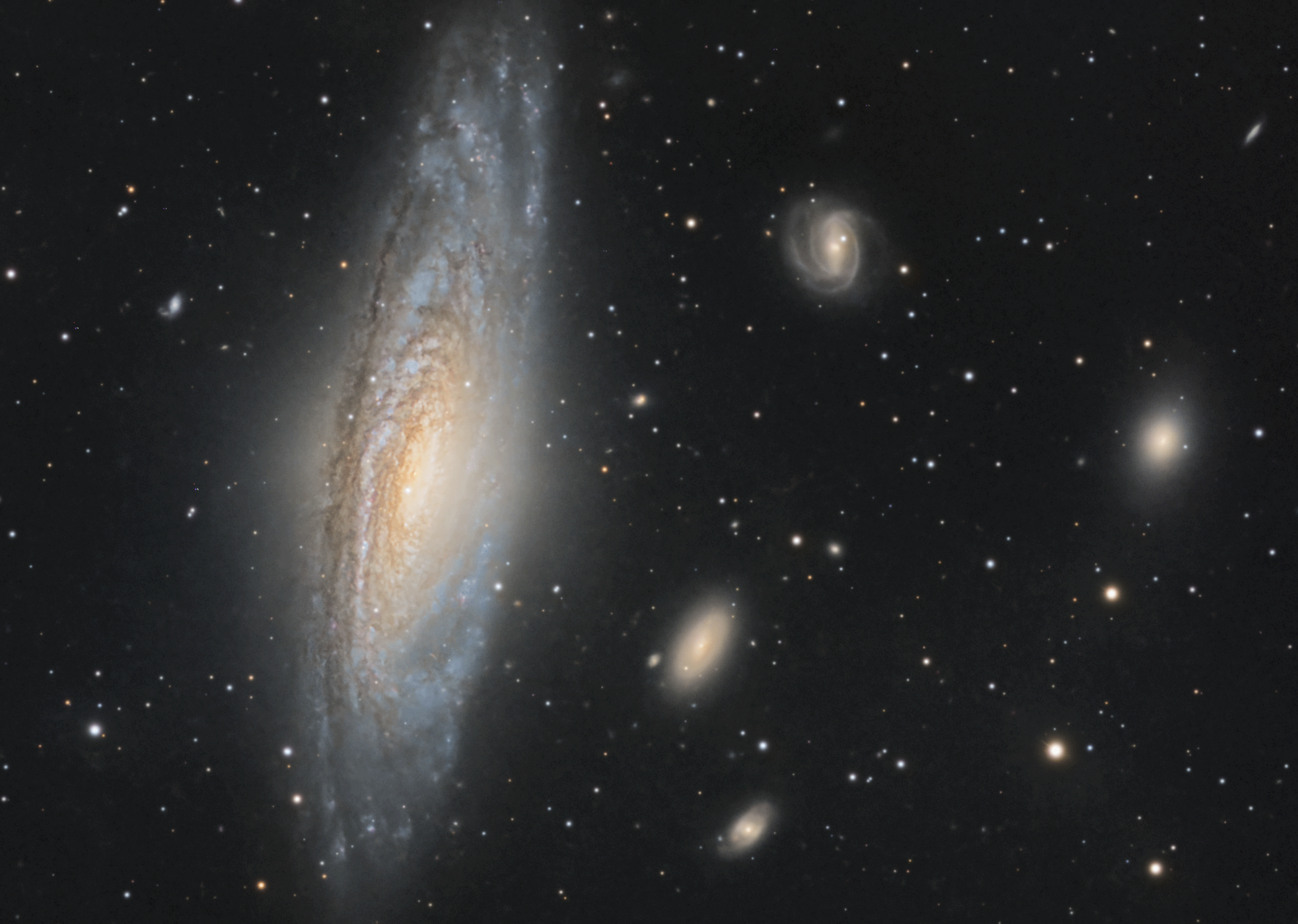
An astrophotographer's optical image of the supernova host galaxy NGC 7331. SN 2025rbs is visible as a bright point close to the galaxy center. An animated GIF showing the appearance of the supernova can be found at:
https://ssr.app.astrobin.com/i/pnplmb?r=C. Image credit: GalacticRAVE/M. Steinmetz. Download Image

During the past week, NuSTAR responded to a community target-of-opportunity (ToO) request to observe the young, Type Ia supernova SN 2025rbs, which is located in the galaxy NGC 7331. Type Ia supernovae are the result of a white dwarf accreting material from a companion star until it exceeds the Chandrasekhar mass and explodes. These explosions have regular enough time profiles and overall luminosity that they are regularly used to measure the distance scale of the Universe. However, their underlying physics is relatively poorly understood since there are few Type Ia supernovae that are close enough to study in detail. In their early lives, the supernovae are powered by radioactive decay of material (primarily 56Ni) that releases gamma-rays that thermalize into the supernova atmosphere so that the ejecta glows in optical light. NuSTAR provides a unique capability to study the hard X-ray (>50 keV) emission from these systems, which arises as the ejecta expands and becomes optically thin to the gamma-ray photons so that hard X-rays “leak out” of the ejecta. SN 2025rbs is the closest Type Ia supernova to the Earth since SN 2014J exploded in M82, which NuSTAR observed in January/February 2014 for nearly a month. The NuSTAR ToO observation of SN 2025rbs occurred prior to the optical peak of the emission, only six days after the supernova was classified as a Type Ia and a few days before the optical peak. An Astronomer’s Telegram (ATel) reporting early results was posted the same day the data were received at the NuSTAR Science Operations Center (SOC), thanks to the ability of the SOC to provide “quicklook” unprocessed data products to the community. These data will provide the most stringent limits on any high-energy emission from the supernova explosion.

Authors: Brian Grefenstette (NuSTAR Instrument Scientist, Caltech)


Thursday, November 09, 2017

Hubble Movie Shows Movement of Light Echo Around Exploded Star

Light Echo around SN 2014J in M82  
Credits: NASA, ESA, and Y. Yang (Texas A&M University and Weizmann Institute of Science, Israel)
Acknowledgment: M. Mountain (AURA) and The Hubble Heritage Team (STScI/AURA)


Voices reverberating off mountains and the sound of footsteps bouncing off walls are examples of an echo. Echoes happen when sound waves ricochet off surfaces and return to the listener. 

Space has its own version of an echo. It’s not made with sound but with light, and occurs when light bounces off dust clouds. 

The Hubble telescope has just captured one of these cosmic echoes, called a “light echo,” in the nearby starburst galaxy M82, located 11.4 million light-years away. A movie assembled from more than two years’ worth of Hubble images reveals an expanding shell of light from a supernova explosion sweeping through interstellar space three years after the stellar blast was discovered. The “echoing” light looks like a ripple expanding on a pond. The supernova, called SN 2014J, was discovered on Jan. 21, 2014.

A light echo occurs because light from the stellar blast travels different distances to arrive at Earth. Some light comes to Earth directly from the supernova blast. Other light is delayed because it travels indirectly. In this case, the light is bouncing off a huge dust cloud that extends 300 to 1,600 light-years around the supernova and is being reflected toward Earth.
So far, astronomers have spotted only 15 light echoes around supernovae outside our Milky Way galaxy. Light echo detections from supernovae are rarely seen because they must be nearby for a telescope to resolve them.


Related Links
This site is not responsible for content found on external links
 
Contact


Donna Weaver / Ray Villard
Space Telescope Science Institute, Baltimore, Maryland
410-338-4493 / 410-338-4514

dweaver@stsci.edu / villard@stsci.edu

Yi Yang
Weizmann Institute of Science, Rehovot, Israel
972-8-934-6505

yi.yang@weizmann.ac.il


Wednesday, August 20, 2014

Type Ia supernovae stem from the explosion of white dwarfs coupled with twin stars

Study discards possibility that type Ia supernovae might stem from explosions of white dwarfs nourished by normal stars. Were these conclusions to become generalized, type Ia supernovae might no longer serve as “standard candles” to measure astronomical distances

Type Ia supernovae happen when a white dwarf, the “corpse” of a star similar to the Sun, absorbs material from a twin star until it reaches a critical mass--1.4 times that of the Sun—and explodes. Because of their origin, all these explosions share a very similar luminosity. This uniformity made type Ia supernovae ideal objects to measure distances in the universe, but the study of supernova 2014J suggests a scenario that would invalidate them as “standard candles".

"Type Ia supernovae are considered standard candles because their constitution is very homogeneous and practically all of them reach the same maximum luminosity. They even allowed us to discover that the universe was expanding at an accelerating rate. However, we still don’t know what stellar systems give rise to this type of supernovae,” says Miguel Ángel Pérez Torres, researcher at the Institute of Astrophysics of Andalusia (IAA-CSIC) in charge of the study.

A new model postulating the fusion of two white dwarfs is now challenging the predominant one, consisting of a white dwarf and a normal star. The new scenario does not imply the existence of a maximum mass limit and will not, therefore, necessarily produce explosions of similar luminosity. Credit: NASA/CXC/M Weiss

Credit: NASA/CXC/M Weiss

SN 2014J, A SUPERNOVA VERY NEAR BY

The results mentioned above were obtained from the study of supernova 2014J, situated 11.4 million light years away from our planet, using the EVN and eMERLIN networks of radio telescopes. “It is a phenomenon that very seldom occurs in our immediate universe. 2014J has been the Ia type supernova closest to us since 1986, when the telescopes were much less sensitive, and it may well be the only one we’ll be able to observe in such vicinity in the next one hundred and fifty years,” says Pérez Torres (IAA-CSIC).

Radio observation makes it possible to reveal what stellar systems lie behind type Ia supernovae. If the explosion proceeds from a white dwarf being nourished by a twin star, for example, a great amount of gas should be present in the environment; after the explosion, the material ejected by the supernova will collide with this gas and produce an intense emission of X rays and radio waves. By contrast, a couple of white dwarfs will not generate this gaseous envelope and, therefore, there will be no emission of either X rays or radio waves.

"We have not detected radio emissions on SN 2014J, which favours the second scenario", says Pérez Torres. "If these results were to gain general acceptance, the cosmological consequences would be weighty, because the use of type Ia supernovae to measure distances would come into question,” the researcher concludes.

Reference
M. A. Perez-Torres, P. Lundqvist, R. J. Beswick, C. I. Bjornsson, T. W. B. Muxlow, Z. Paragi, S. Ryder, A. Alberdi, C. Fransson, J. M. Marcaide, I. Marti-Vidal, E. Ros, M. K. Argo, J. C. Guirado. Constraints on the progenitor system and the environs of SN 2014J from deep radio observations. The Astrophysical Journal. ApJ, vol. 792, pág. 38.
Contact:
Instituto de Astrofísica de Andalucía (IAA-CSIC)
Unidad de Divulgación y Comunicación
Silbia López de Lacalle - sll@iaa.es - 958230532
http://www.iaa.es
http://www-divulgacion.iaa.es


Thursday, August 14, 2014

NASA's Chandra Observatory Searches for Trigger of Nearby Supernova

The data gathered on the Jan. 21 explosion, a Type Ia supernova, allowed scientists to rule out one possible cause. These supernovas may be triggered when a white dwarf takes on too much mass from its companion star, immersing it in a cloud of gas that produces a significant source of X-rays after the explosion.

Astronomers used NASA's Swift and Chandra telescopes to search the nearby Messier 82 galaxy, the location of the explosion, for such an X-ray source. However, no source was found, revealing the region around the site of the supernova is relatively devoid of material.

"While it may sound a bit odd, we actually learned a great deal about this supernova by detecting absolutely nothing," said Raffaella Margutti of the Harvard-Smithsonian Center for Astrophysics (CfA) in Cambridge, Massachusetts, who led the study. "Now we can essentially rule out that the explosion was caused by a white dwarf continuously pulling material from a companion star."

This supernova, SN 2014J, could instead have been caused by the merger of two white dwarf stars, an event that should result in little or no X-rays after the explosion. Further observations could rule out or confirm other possible triggers.

"Being able to eliminate one of the main possible explanations for what caused SN 2014J to explode is a big step," said CfA's Atish Kamble, a co-author of the study. "The next step is to narrow things down even further."

Type Ia supernovas are used as cosmic distance-markers, and have played a key role in the discovery of the universe's accelerated expansion. At about 12 million light-years from Earth, SN 2014J and its host galaxy are close -- from a cosmic perspective. This offers scientists a chance to observe details that would be too hard to detect in more distant supernovas.

"It's crucial that we understand exactly how these stars explode because so much is riding on our observations of them for cosmology," said co-author Jerod Parrent also from CfA. "SN 2014J might be a chance of a lifetime to study one of these supernovas in detail as it happens."

The study of SN 2014J is similar to a study led by Margutti about another supernova, SN 2011fe, in the nearby galaxy M101.

This study was conducted by CfA's Supernova Forensics Team, led by Alicia Soderberg. The results were published online and in the July 20 print issue of The Astrophysical Journal.

NASA's Marshall Space Flight Center in Huntsville, Alabama, manages the Chandra program for NASA's Science Mission Directorate in Washington. The Smithsonian Astrophysical Observatory in Cambridge, Massachusetts, controls Chandra's science and flight operations.

For an additional interactive image, podcast, and video on the findings, visit: http://chandra.si.edu

For a preprint of the study results in The Astrophysical Journal, visit: http://arxiv.org/abs/1405.1488

For Chandra images, multimedia and related materials, visit: http://www.nasa.gov/chandra

Headquartered in Cambridge, Mass., the Harvard-Smithsonian Center for Astrophysics (CfA) is a joint collaboration between the Smithsonian Astrophysical Observatory and the Harvard College Observatory. CfA scientists, organized into six research divisions, study the origin, evolution and ultimate fate of the universe.

For more information, contact:

Megan Watzke
Chandra X-ray Center, Cambridge, Mass.
617-496-7998

mwatzke@cfa.harvard.edu

David A. Aguilar
Director of Public Affairs
Harvard-Smithsonian Center for Astrophysics
617-495-7462

daguilar@cfa.harvard.edu

Christine Pulliam
Public Affairs Specialist
Harvard-Smithsonian Center for Astrophysics
617-495-7463

cpulliam@cfa.harvard.edu


Friday, February 28, 2014

Hubble Monitors Supernova in Nearby Galaxy M82

Credit: NASA, ESA, A. Goobar (Stockholm University), 
and the Hubble Heritage Team (STScI/AURA)

This is a Hubble Space Telescope composite image of a supernova explosion designated SN 2014J in the galaxy M82. At a distance of approximately 11.5 million light-years from Earth it is the closest supernova of its type discovered in the past few decades. The explosion is categorized as a Type Ia supernova, which is theorized to be triggered in binary systems consisting of a white dwarf and another star — which could be a second white dwarf, a star like our Sun, or a giant star.

Astronomers using a ground-based telescope discovered the explosion on January 21, 2014. This Hubble photograph was taken on January 31, as the supernova approached its peak brightness. The Hubble data are expected to help astronomers refine distance measurements to Type Ia supernovae. In addition, the observations could yield insights into what kind of stars were involved in the explosion. Hubble's ultraviolet-light sensitivity will allow astronomers to probe the environment around the site of the supernova explosion and in the interstellar medium of the host galaxy.

Because of their consistent peak brightness, Type Ia supernovae are among the best tools to measure distances in the universe. They were fundamental to the 1998 discovery of the mysterious acceleration of the expanding universe. A hypothesized repulsive force, called dark energy, is thought to cause the acceleration.
The January 31 image, shown here as an inset, was taken in visible light with Hubble's Wide Field Camera 3. This image was superimposed into a photo mosaic of the entire galaxy taken in 2006 with Hubble's Advanced Camera for Surveys.

Among the other major NASA space-based observatories used in the M82 viewing campaign are Spitzer Space Telescope, Chandra X-ray Observatory, Nuclear Spectroscopic Telescope Array (NuSTAR), Fermi Gamma-ray Space Telescope, Swift Gamma-Ray Burst Explorer, and the Stratospheric Observatory for Infrared Astronomy (SOFIA).

Source: HubbleSite


Wednesday, February 05, 2014

Starbursting in the Galaxy M82

M82 - Zoom
Credit: Josh Marvil (NM Tech/NRAO), Bill Saxton (NRAO/AUI/NSF), NASAClick to Download High-Resolution TIFF 
Messier 82, seen in radio frequencies by the Karl G. Jansky Very Large Array. 
Credit: Josh Marvil (NM Tech/NRAO), Bill Saxton (NRAO/AUI/NSF), NASA 

Messier 82 (M82), the galaxy in which the nearest supernova in decades recently exploded, also is the closest galaxy that is undergoing a rapid burst of star formation, known as a starburst. About 12 million light-years away, it is seen nearly edge-on, as shown in the larger, visible-light image from the Hubble Space Telescope.

The inset is a new radio image, made with the Karl G. Jansky Very Large Array (VLA), that reveals fresh information about the central 5200 light-years of the galaxy. The radio emission seen here is produced by ionized gas and by fast-moving electrons interacting with the interstellar magnetic field.

The bright dots are a mix of star-forming regions and supernova remnants, the debris from stellar explosions; analysis of the VLA data tells scientists which of these are which. Scientists also are studying the faint, wispy features, many of which were previously unseen, to investigate their relationship with this galaxy's starburst-driven superwind. Supernova 2014J is located outside the inset, to the right. VLA observations to date show that, like all other supernovae of its particular type, SN 2014J has not yet been found to be emitting radio waves.

Contact:

Dave Finley, Public Information Officer
(575) 835-7302

dfinley@nrao.edu


The National Radio Astronomy Observatory is a facility of the National Science Foundation, operated under cooperative agreement by Associated Universities, Inc.