Showing posts with label NGC 7331. Show all posts

Sunday, August 03, 2025

NuSTAR Observes a Nearby Supernova

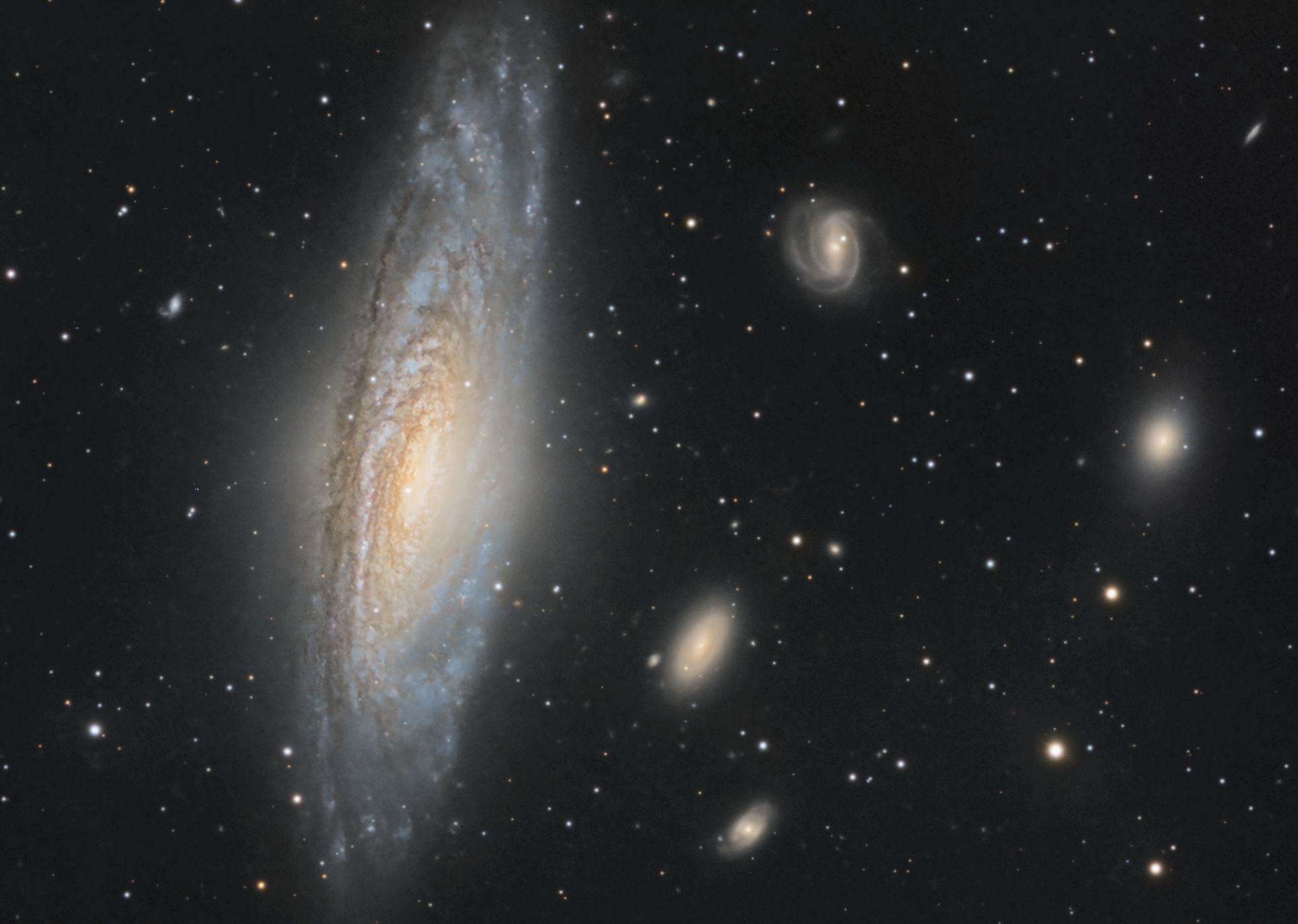
An astrophotographer's optical image of the supernova host galaxy NGC 7331. SN 2025rbs is visible as a bright point close to the galaxy center. An animated GIF showing the appearance of the supernova can be found at:
https://ssr.app.astrobin.com/i/pnplmb?r=C. Image credit: GalacticRAVE/M. Steinmetz. Download Image

During the past week, NuSTAR responded to a community target-of-opportunity (ToO) request to observe the young, Type Ia supernova SN 2025rbs, which is located in the galaxy NGC 7331. Type Ia supernovae are the result of a white dwarf accreting material from a companion star until it exceeds the Chandrasekhar mass and explodes. These explosions have regular enough time profiles and overall luminosity that they are regularly used to measure the distance scale of the Universe. However, their underlying physics is relatively poorly understood since there are few Type Ia supernovae that are close enough to study in detail. In their early lives, the supernovae are powered by radioactive decay of material (primarily 56Ni) that releases gamma-rays that thermalize into the supernova atmosphere so that the ejecta glows in optical light. NuSTAR provides a unique capability to study the hard X-ray (>50 keV) emission from these systems, which arises as the ejecta expands and becomes optically thin to the gamma-ray photons so that hard X-rays “leak out” of the ejecta. SN 2025rbs is the closest Type Ia supernova to the Earth since SN 2014J exploded in M82, which NuSTAR observed in January/February 2014 for nearly a month. The NuSTAR ToO observation of SN 2025rbs occurred prior to the optical peak of the emission, only six days after the supernova was classified as a Type Ia and a few days before the optical peak. An Astronomer’s Telegram (ATel) reporting early results was posted the same day the data were received at the NuSTAR Science Operations Center (SOC), thanks to the ability of the SOC to provide “quicklook” unprocessed data products to the community. These data will provide the most stringent limits on any high-energy emission from the supernova explosion.

Authors: Brian Grefenstette (NuSTAR Instrument Scientist, Caltech)


Monday, January 10, 2022

Measuring Carbon Emission from an Inclined Galaxy

Spiral Galaxy, NGC 7331
Image credit: Adam Block/Mount Lemmon SkyCenter/University of Arizona/Sutter et al., 2021.


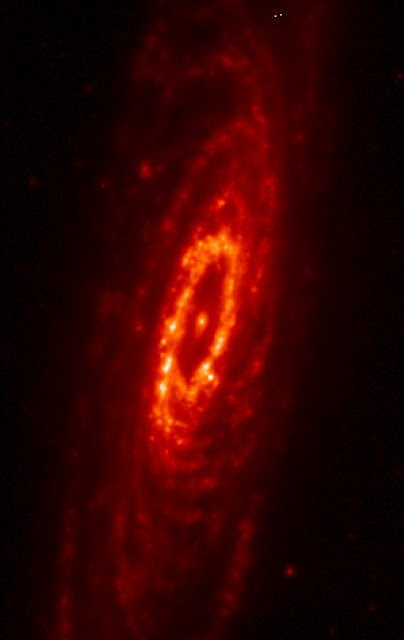
NGC 7331 taken in infrared light by the Spitzer Space Telescope. The central ring is the brightest feature of this galaxy in the infrared, indicating that it is permeated by dust that has been warmed by young stars. Image credit: NASA


Columbia, MD—January 10, 2022. Ionized carbon is an important tracer of astronomical processes, and understanding how the angle of a galaxy affects the observation of ionized carbon can be key for improving analyses of such processes.

Because the effects of observing perspective are complex, spiral galaxies tend to only be studied if their orientation is just right, that is, if telescopes can see them face-on rather than at an angle. Now, a study of the galaxy NGC 7331 with the Stratospheric Observatory for Infrared Astronomy (SOFIA), NASA's airborne observatory has begun to characterize these effects.

Universities Space Research Association’s Jessica Sutter, the lead author of the study, investigated the various factors that can affect ionized carbon emission from a galaxy, including the galaxy’s angle of inclination. Her presentation, “A Map of the Molecular Ring and Arms of a Spiral Galaxy,” at the American Astronomical Society’s Virtual Press Conference will take place on January 10 at 10:15 AM Mountain Time. A paper on this topic has been accepted for publication in The Astrophysical Journal.

“One of the reasons more people haven’t looked at ionized carbon emission from edge-on galaxies is because one can’t do it from ground observations. You need an observing platform at least from the stratosphere, if not in space,” Sutter said. “With SOFIA, we have some more opportunities to get these full maps, and we’re seeing how useful that may be.”

Ionized carbon is an important measurement in astronomy, as it can indicate the presence of star formation, the cooling of the space between stars, and other processes. Moreover, it tends to be quite bright, making it easily detectable in galaxies tens of billions of lightyears away, which is especially useful for galaxies with little other data available.

“Knowing where the ionized carbon emission is coming from – whether photodissociation regions, or ionized hydrogen regions, or diffuse ionized gas – is going to affect how we might use it to trace molecular gas, or star formation, or photodissociation conditions,” Sutter said. “Our observing angle may have an effect.”

Because NGC 7331 is an inclined galaxy, the fraction of ionized carbon observed varied depending on which side of the galaxy was being observed. This should be a significant consideration for researchers, especially if they aren’t sure of the inclination angle of the galaxy they are studying.

"With the help of SOFIA’s unique ability to study ionized carbon from within the Earth’s stratosphere, we hope to expand this analysis by mapping ionized carbon emission from an additional set of galaxies, " said Sutter. This will help uncover how inclination and other structural factors impact the charged atom’s importance in analyses, helping demystify the history of the universe.

Contact:

Suraiya Farukhi, Ph.D.
Director, External Communications

sfarukhi@usra.ed
443-812-6945


SOFIA is a joint project of NASA and the German Space Agency, DLR. DLR provides the telescope, scheduled aircraft maintenance, and other support for the mission. NASA’s Ames Research Center in California’s Silicon Valley manages the SOFIA program, science, and mission operations in cooperation with the Universities Space Research Association, headquartered in Columbia, Maryland, and the German SOFIA Institute at the University of Stuttgart. The aircraft is maintained and operated by NASA’s Armstrong Flight Research Center Building 703, in Palmdale, California.

About USRA

Founded in 1969, under the auspices of the National Academy of Sciences at the request of the U.S. Government, the Universities Space Research Association (USRA) is a nonprofit corporation chartered to advance space-related science, technology, and engineering. USRA operates scientific institutes and facilities, and conducts other major research and educational programs, under Federal funding. USRA engages the university community and employs in-house scientific leadership, innovative research and development, and project management expertise. More information about USRA is available at www.usra.edu.


Tuesday, January 24, 2017

NuSTAR Finds New Clues to 'Chameleon Supernova'

Supernova SN 2014C (X-ray) [annotated]
This image from NASA's Chandra X-ray Observatory shows spiral galaxy NGC 7331, center, in a three-color X-ray image. Red, green and blue colors are used for low, medium and high-energy X-rays, respectively. An unusual supernova called SN 2014C has been spotted in this galaxy, indicated by the white box in the image.  Credit: NASA/CXC/CIERA/R.Margutti et al. Annotated image

Supernova SN 2014C
This visible-light image from the Sloan Digital Sky Survey shows spiral galaxy NGC 7331, center, where astronomers observed the unusual supernova SN 2014C . The inset images are from NASA's Chandra X-ray Observatory, showing a small region of the galaxy before the supernova explosion (left) and after it (right). Red, green and blue colors are used for low, medium and high-energy X-rays, respectively. Credit: X-ray images: NASA/CXC/CIERA/R.Margutti et al; Optical image: SDS.  Hi-res image
Annotated image

We're made of star stuff," astronomer Carl Sagan famously said. Nuclear reactions that happened in ancient stars generated much of the material that makes up our bodies, our planet and our solar system. When stars explode in violent deaths called supernovae, those newly formed elements escape and spread out in the universe.

One supernova in particular is challenging astronomers' models of how exploding stars distribute their elements. The supernova SN 2014C dramatically changed in appearance over the course of a year, apparently because it had thrown off a lot of material late in its life. This doesn't fit into any recognized category of how a stellar explosion should happen. To explain it, scientists must reconsider established ideas about how massive stars live out their lives before exploding.

"This 'chameleon supernova' may represent a new mechanism of how massive stars deliver elements created in their cores to the rest of the universe," said Raffaella Margutti, assistant professor of physics and astronomy at Northwestern University in Evanston, Illinois. Margutti led a study about supernova SN 2014C published this week in The Astrophysical Journal.

A supernova mystery

Astronomers classify exploding stars based on whether or not hydrogen is present in the event. While stars begin their lives with hydrogen fusing into helium, large stars nearing a supernova death have run out of hydrogen as fuel. Supernovae in which very little hydrogen is present are called "Type I." Those that do have an abundance of hydrogen, which are rarer, are called "Type II."

But SN 2014C, discovered in 2014 in a spiral galaxy about 36 million to 46 million light-years away, is different. By looking at it in optical wavelengths with various ground-based telescopes, astronomers concluded that SN 2014C had transformed itself from a Type I to a Type II supernova after its core collapsed, as reported in a 2015 study led by Dan Milisavljevic at the Harvard-Smithsonian Center for Astrophysics in Cambridge, Massachusetts. Initial observations did not detect hydrogen, but, after about a year, it was clear that shock waves propagating from the explosion were hitting a shell of hydrogen-dominated material outside the star.

In the new study, NASA's NuSTAR (Nuclear Spectroscopic Telescope Array) satellite, with its unique ability to observe radiation in the hard X-ray energy range -- the highest-energy X-rays -- allowed scientists to watch how the temperature of electrons accelerated by the supernova shock changed over time. They used this measurement to estimate how fast the supernova expanded and how much material is in the external shell.

To create this shell, SN 2014C did something truly mysterious: it threw off a lot of material -- mostly hydrogen, but also heavier elements -- decades to centuries before exploding. In fact, the star ejected the equivalent of the mass of the sun. Normally, stars do not throw off material so late in their life.

"Expelling this material late in life is likely a way that stars give elements, which they produce during their lifetimes, back to their environment," said Margutti, a member of Northwestern's Center for Interdisciplinary Exploration and Research in Astrophysics.

NASA's Chandra and Swift observatories were also used to further paint the picture of the evolution of the supernova. The collection of observations showed that, surprisingly, the supernova brightened in X-rays after the initial explosion, demonstrating that there must be a shell of material, previously ejected by the star, that the shock waves had hit.

Challenging existing theories

Why would the star throw off so much hydrogen before exploding? One theory is that there is something missing in our understanding of the nuclear reactions that occur in the cores of massive, supernova-prone stars. Another possibility is that the star did not die alone -- a companion star in a binary system may have influenced the life and unusual death of the progenitor of SN 2014C. This second theory fits with the observation that about seven out of 10 massive stars have companions.
The study suggests that astronomers should pay attention to the lives of massive stars in the centuries before they explode. Astronomers will also continue monitoring the aftermath of this perplexing supernova.

"The notion that a star could expel such a huge amount of matter in a short interval is completely new," said Fiona Harrison, NuSTAR principal investigator based at Caltech in Pasadena. "It is challenging our fundamental ideas about how massive stars evolve, and eventually explode, distributing the chemical elements necessary for life."

NuSTAR is a Small Explorer mission led by Caltech and managed by JPL for NASA's Science Mission Directorate in Washington. NuSTAR was developed in partnership with the Danish Technical University and the Italian Space Agency (ASI). The spacecraft was built by Orbital Sciences Corp., Dulles, Virginia. NuSTAR's mission operations center is at UC Berkeley, and the official data archive is at NASA's High Energy Astrophysics Science Archive Research Center. ASI provides the mission's ground station and a mirror archive. JPL is managed by Caltech for NASA.