Showing posts with label Mapping Nearby Galaxies at APO (MaNGA). Show all posts

Wednesday, November 02, 2016

Studying diffuse, warm gas in the outskirts of galaxies

An optical image of galaxy M82 with the ionized gas of hydrogen (Hα) shown in pink flowing out of the galaxy. 
Image Credit: NASA, ESA, The Hubble Heritage Team, (STScI/AURA)


The diffuse gas around galaxies is hard to detect, but shows properties which are quite different to the star-forming gas inside a galaxy. Scientists at MPA have used observations from the recent MaNGA survey to study how the ionized gas changes with distance from the center of the galaxy. They have demonstrated the usefulness of adding spectra from multiple galaxies in order to analyze the gas in the outskirts of galaxies. Their study shows that the brightness of the gas decreases, while its temperature increases the further the gas is located from the center of the galaxy. The differences between star-forming and circumgalactic gas also seem to correlate with the star-formation rate and stellar mass of the galaxies.

Understanding gas in and around galaxies is crucial to understanding star formation. The gas within a galaxy is the main ingredient for forming stars, and these stars, in turn, enrich the gas with heavy elements, or “metals”. Continuous star formation needs a constant supply of gas, and most likely this comes from a reservoir of gas surrounding the galaxy in its outskirts, or halo, called the circum-galactic medium (CGM). Additionally, enriched gas flows out of the galaxies through supernova explosions, galactic winds, active galactic nuclei, etc. (see Fig 1 for an example of gas outflows). By studying the gas in the CGM and near the disk-halo boundary we can better understand these regulatory processes, gas properties and flows. 

Gas in the halo is difficult to study because it is very faint and diffuse. Cold neutral gas can be seen by looking for neutral hydrogen (HI), and through HI surveys it is known that most galaxies have large reservoirs of gas surrounding the galaxies. Warm ionized gas with temperatures around 1000 K can be detected with optical emission lines and in the outskirts of galaxies this is called extra-planar, diffuse ionized gas (eDIG). Most previous work has been done with long exposures of individual nearby galaxies, including our own Milky Way. 

With optical spectroscopy, only a few handfuls of galaxies have been studied, as it is difficult to obtain exposures deep enough to detect and analyze the diffuse gas. These studies find that the eDIG has different properties compared to gas in star-forming regions. Both the eDIG and star-forming gas are ionized mostly by energy from massive OB stars. As these stars are located in the disk of the galaxy, many of the differences arise because the eDIG is farther away from the OB stars than the gas in star-forming regions. Some other differences are not so easy to explain and vary from galaxy to galaxy. In some galaxies an additional source of energy may be needed to explain the properties of the eDIG, such as turbulence or shocks in the gas, or hot evolved stars in the outskirts of galaxies. 

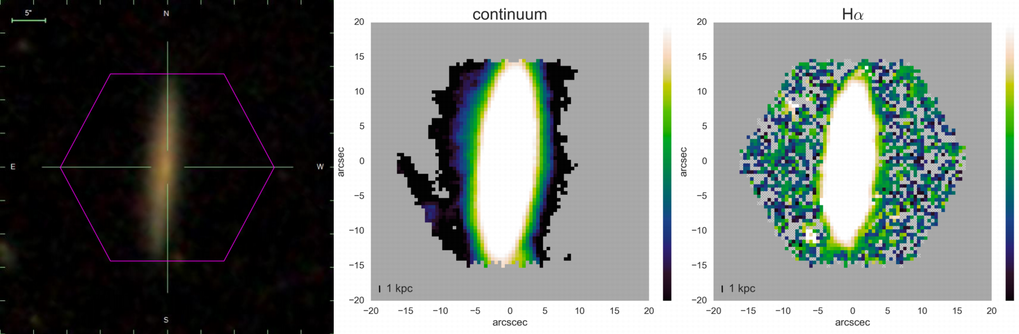
An example of one of the MaNGA galaxies. The left panel is an SDSS image with the MaNGA field of view overlaid.The middle panel shows a map of the brightness of the galaxy seen with MaNGA and the right panel shows a map of the ionized gas of hydrogen (Hα). The color bars are in logarithmic units. For an individual galaxy, the gas can barely be detected in the outskirts. Thus, for scientific analysis, spectra from many galaxies have to be added to increase the signal far enough above the noise level. © MPA. Hi-res image

With a new dataset from the survey Mapping Nearby Galaxies at APO (MaNGA), which is part of the Sloan Digital Sky Survey (SDSS) IV, a group of MPA scientists addressed these differences and questions about the eDIG. As an Integral Field Unit survey, MaNGA takes spectra at multiple spatial locations. The eDIG is faint and diffuse and in Fig 2 we show an example for the MaNGA observations of one particular galaxy. Adding multiple spectra taken at similar locations from similar edge-on, late-type galaxies, we can study the faint diffuse gas. 

The first year of MaNGA data includes a sample of 49 galaxies that are suitable for this study. We add the spectra from these 49 galaxies from 7 different locations off the disk of the galaxies to find how the eDIG varies with distance from the center of the galaxy. Our analysis shows that the brightness of the eDIG decreases logarithmically with distance and that most likely the temperature of the gas increases with distance from the center of the galaxies. 

For a more detailed analysis, e.g. to figure out which type of galaxies need an additional energy source and what type of source, we to split the sample by different properties of the galaxies, such as stellar mass or star formation. With the first year of data we split the full sample in half and find that in galaxies with a higher star formation rate, the eDIG is more similar to the star-forming gas inside the galaxies compared to low star-forming galaxies where the eDIG is markedly different. Moreover, galaxies with higher stellar mass have a steeper temperature gradient compared to those with lower stellar mass. In the future, with more data, we will be able to split the sample even further to better understand these questions.


Author:

Postdoc

Phone: 2215


Original Publication

1. A. Jones, G. Kauffmann, R. D'Souza, D. Bizyaev, D. Law, L. Haffner, Y. Bahe, B. Andrews, M. Bershady, J. Brownstein, B. Cherinka, A.Diamond-Stanic, N. Drory, R. A. Riffel, S. F. Sanchez, D. Thomas, D. Wake, R. Yan, K. Zhang.    

SDSS IV MaNGA: Deep observations of extra-planar, diffuse ionized gas around late-type galaxies from stacked IFU spectra
2016, submitted to A&A


Monday, July 28, 2014

Looking in all the right places: the Sloan Digital Sky Survey extends its reach

Fig. 1: The Milky Way Galaxy as seen in infrared light. The pink shaded region is not visible from the Northern Hemisphere, so has not been studied previously by the SDSS. The new phase of the SDSS will see the entire galaxy. Credit: The SDSS collaboration, Galaxy image credit: Two Micron All Sky Survey / Infrared Processing and Analysis Center / Caltech & University of Massachusetts

Fig. 2: MaNGA galaxy plate, showing the holes for the MaNGA IFUs and sky fibers. (credit: D.R. Law)

Fig. 3: SDSS images of the galaxies observed during the March 2014 MaNGA commissioning run at the Apache Point Observatory. (credit: K. Bundy) 

At the beginning of July, the Sloan Digital Sky Survey started a new phase with three major new programmes. eBOSS will work to extend precision cosmological measurements to a critical early phase of cosmic history; APOGEE-2 will expand the survey of the Galaxy across both the northern and southern hemispheres, and MaNGA (with participation of the Max Planck Institute for Astrophysics) will for the first time be using the Sloan spectrographs to make spatially resolved maps of individual galaxies. SDSS-IV will run from 2014 to 2020. 

Building on its past successes, the Sloan Digital Sky Survey (SDSS) has launched a major new program that will expand its census of the Universe into new areas it had been unable to explore before: 

- Exploring the compositions and motions of stars across the entire Milky Way in unprecedented detail, using a telescope in Chile.

- Making detailed maps of the internal structure of thousands of nearby galaxies to determine how they have grown and changed over billions of years, using a cutting-edge measurement device.

-Measuring the expansion of the Universe in a poorly-understood five-billion-year period of the Universe's history, using a new set of galaxies and quasars 

The new survey is a collaboration of more than 200 astronomers at more than 40 institutions on four continents, and incorporates telescopes in both the Northern and Southern Hemispheres. With these two telescopes, the SDSS will be able to see the entire sky for the first time. 

This new phase of the SDSS will provide a vast new database of observations that will significantly expand our understanding of the nature of the Universe at all scales, from our own galaxy to the distant universe. In our galaxy, the new SDSS will see hundreds of thousands of individual stars, including stars that were born at the birth of the Milky Way and stars that were born yesterday. Measuring the compositions, positions, and motions of individual stars will reveal how the Galaxy evolved from the distant past to today. 

In addition to the Sloan Foundation 2.5-meter Telescope in New Mexico, SDSS-IV will use the 2.5-meter Irenee du Pont Telescope at Las Campanas Observatory in La Serena, high in the Chilean Andes and home to the clearest skies on the planet. In addition to providing a 360-degree view of the Milky Way, the new telescope will also observe stars in the nearby Magellanic Clouds, giving astronomers a better understanding of the Milky Way's celestial environment.

But the Milky Way is far from the only galaxy that the new SDSS will examine. The new survey will employ innovative new technology to make detailed maps of thousands of nearby galaxies. Unlike nearly all previous astronomy surveys, which looked only at small areas in the centers of other galaxies, the new SDSS will measure light from all over. These better maps are made possible through a new technique of bundling sets of fiber optic cables into tightly-packed arrays. Those collect light from across the entire face of a galaxy, enabling detailed spectral measurements of more than 10,000 nearby galaxies in less than one-twentieth of the time. MPA scientist Guinevere Kauffmann was heavily involved in planning the "Mapping Nearby Galaxies at APO" (MaNGA) survey right from the beginning. MaNGA's goal is to understand the "life cycle" of present day galaxies from imprinted clues of their birth and assembly, through their ongoing growth via star formation and merging, to their death from quenching at late times. 

"MaNGA will be key to disentangling the physical processes important in the lives of galaxies," Guinevere Kauffmann points out. "In particular, we need to understand which aspects of galaxies are set by cosmological initial conditions and which are set by black holes." 

And the new SDSS will continue to improve our understanding of the Universe as a whole. It will precisely measure the expansion history of the universe through 80% of cosmic history, back to when the Universe was less than three billion years old. These new detailed measurements will help to improve constraints on the nature of dark energy, the most mysterious experimental result in modern physics. 

The new cosmology measurements will include a survey of nearly all the quasars, which will allow for precision measurements of the history of the Universe's expansion in ways never before possible. Other programs within the new SDSS will follow up on galaxies seen by prior X-ray surveys, and will conduct the first systematic spectral study of variable objects, yielding a critical resource astronomers can use to identify the nature of many types of time-varying light sources discovered in previous surveys. 

SDSS Press Officer:

Jordan Raddick, SDSS-III Public Information Officer, Johns Hopkins University
Email:
raddick@jhu.edu
Phone: 1-410-516-8889

Contact at MPA:

Guinevere Kauffmann
Director
Max-Planck-Institut für Astrophysik
Karl-Schwarzschild-Str. 1
D-85748 Garching
Phone: 089 30000-2013
E-mail:
gkauffmann@mpa-garching.mpg.de 

Hannelore Hämmerle
Presse- und Öffentlichkeitsarbeit
Max-Planck-Institut für Astrophysik
Tel: +49 (89) 30 000 3980
E-mail:
pr@mpa-garching.mpg.de 

ABOUT THE SLOAN DIGITAL SKY SURVEY

Funding for the Sloan Digital Sky Survey IV has been provided by the Alfred P. Sloan Foundation and the Participating Institutions. SDSS-IV acknowledges support and resources from the Center for High-Performance Computing at the University of Utah. The SDSS web site is
www.sdss.org.

SDSS-IV is managed by the Astrophysical Research Consortium for the Participating Institutions of the SDSS Collaboration including the Carnegie Institution for Science, Carnegie Mellon University, the Chilean Participation Group, Harvard-Smithsonian Center for Astrophysics, Instituto de Astrofisica de Canarias, The Johns Hopkins University, Kavli Institute for the Physics and Mathematics of the Universe (IPMU) / University of Tokyo, Lawrence Berkeley National Laboratory, Leibniz Institut für Astrophysik Potsdam (AIP),Max-Planck-Institut für Astrophysik (MPA Garching), Max-Planck-Institut für Extraterrestrische Physik (MPE), Max-Planck-Institut für Astronomie (MPIA Heidelberg), National Astronomical Observatory of China, New Mexico State University, New York University, The Ohio State University, Pennsylvania State University, Shanghai Astronomical Observatory, United Kingdom Participation Group, Universidad Nacional Autonoma de Mexico, University of Arizona, University of Colorado Boulder, University of Portsmouth, University of Utah, University of Washington, University of Wisconsin, Vanderbilt University, and Yale University.