


PR Image noirlab2608c
3D rendering of trans-Neptunian objects discovered by NSF–DOE Rubin Observatory
3D rendering of trans-Neptunian objects discovered by NSF–DOE Rubin Observatory


Videos
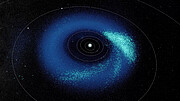
PR Video noirlab2608a
3D animation of asteroids discovered by NSF–DOE Rubin Observatory (close)
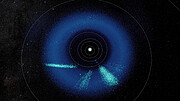
PR Video noirlab2608b
PR Video noirlab2608a
3D animation of asteroids discovered by NSF–DOE Rubin Observatory (close)
PR Video noirlab2608b
3D animation of asteroids discovered by NSF–DOE Rubin Observatory
Rubin’s largest asteroid haul yet, gathered before the Legacy Survey of Space and Time even begins, is just the “tip of the iceberg”
Scientists at NSF–DOE Vera C. Rubin Observatory, jointly funded by the U.S. National Science Foundation and the U.S. Department of Energy's Office of Science, have submitted an unprecedented set of asteroid detections to the IAU Minor Planet Center, including hundreds of distant worlds beyond Neptune and 33 previously unknown near-Earth asteroids.
Using preliminary data from NSF–DOE Vera C. Rubin Observatory, scientists have discovered over 11,000 new asteroids [1]. The data were confirmed by the International Astronomical Union’s Minor Planet Center (MPC), making this the largest single batch of asteroid discoveries submitted in the past year. The discoveries were made using data from Rubin’s early optimization surveys and offer a powerful preview of the observatory’s transformative impact on Solar System science.
Rubin Observatory is a joint program of NSF NOIRLab and DOE’s SLAC National Accelerator Laboratory, who cooperatively operate Rubin. NOIRLab is managed by the Association of Universities for Research in Astronomy (AURA).
The submission to MPC comprises approximately one million observations, taken over the span of a month and a half, of over 11,000 new asteroids and more than 80,000 already known asteroids, including some that had previously been observed but were later “lost” because their orbits were too uncertain to predict their future locations. You can interact with all of Rubin’s asteroid discoveries in the Rubin Orbitviewer, which uses real data to provide an intuitive way to explore the structure of our cosmic backyard in three dimensions and in real time. Also, visit the Rubin Asteroid Discoveries Dashboard to learn about the new objects Rubin has uncovered.
“This first large submission after Rubin First Look is just the tip of the iceberg and shows that the observatory is ready,” says Mario Juric, faculty at the University of Washington and Rubin Solar System Lead Scientist. “What used to take years or decades to discover, Rubin will unearth in months. We are beginning to deliver on Rubin’s promise to fundamentally reshape our inventory of the Solar System and open the door to discoveries we haven’t yet imagined.”
Among the newly identified objects are 33 previously unknown near-Earth objects (NEOs), which are small asteroids and comets whose closest approach to the Sun is less than 1.3 times the distance between Earth and the Sun. None of the newly discovered NEOs pose a threat to Earth, and the largest is about 500 meters wide. Objects larger than 140 meters are closely tracked as they could cause significant regional damage if they impact, yet scientists estimate that only about 40% of these mid-sized NEOs have been identified so far.
Once operating fully in survey mode, Rubin is expected to reveal an additional nearly 90,000 new NEOs, some of which may be potentially hazardous, and to nearly double the number of known NEOs larger than 140 meters to around 70%. By enabling early detection and continuous monitoring of these objects, Rubin will be a powerful tool for planetary defense.
The dataset also contains roughly 380 trans-Neptunian objects (TNOs) — icy bodies orbiting beyond Neptune. Two of the newly discovered TNOs — provisionally named 2025 LS2 and 2025 MX348 — have been found to be on extremely large and elongated, or stretched out, orbits. At their most distant points, these two objects reach roughly 1000 times farther away from the Sun than the Earth is, placing them among the 30 most distant minor planets known.
Scientists at NSF–DOE Vera C. Rubin Observatory, jointly funded by the U.S. National Science Foundation and the U.S. Department of Energy's Office of Science, have submitted an unprecedented set of asteroid detections to the IAU Minor Planet Center, including hundreds of distant worlds beyond Neptune and 33 previously unknown near-Earth asteroids.
Using preliminary data from NSF–DOE Vera C. Rubin Observatory, scientists have discovered over 11,000 new asteroids [1]. The data were confirmed by the International Astronomical Union’s Minor Planet Center (MPC), making this the largest single batch of asteroid discoveries submitted in the past year. The discoveries were made using data from Rubin’s early optimization surveys and offer a powerful preview of the observatory’s transformative impact on Solar System science.
Rubin Observatory is a joint program of NSF NOIRLab and DOE’s SLAC National Accelerator Laboratory, who cooperatively operate Rubin. NOIRLab is managed by the Association of Universities for Research in Astronomy (AURA).
The submission to MPC comprises approximately one million observations, taken over the span of a month and a half, of over 11,000 new asteroids and more than 80,000 already known asteroids, including some that had previously been observed but were later “lost” because their orbits were too uncertain to predict their future locations. You can interact with all of Rubin’s asteroid discoveries in the Rubin Orbitviewer, which uses real data to provide an intuitive way to explore the structure of our cosmic backyard in three dimensions and in real time. Also, visit the Rubin Asteroid Discoveries Dashboard to learn about the new objects Rubin has uncovered.
“This first large submission after Rubin First Look is just the tip of the iceberg and shows that the observatory is ready,” says Mario Juric, faculty at the University of Washington and Rubin Solar System Lead Scientist. “What used to take years or decades to discover, Rubin will unearth in months. We are beginning to deliver on Rubin’s promise to fundamentally reshape our inventory of the Solar System and open the door to discoveries we haven’t yet imagined.”
Among the newly identified objects are 33 previously unknown near-Earth objects (NEOs), which are small asteroids and comets whose closest approach to the Sun is less than 1.3 times the distance between Earth and the Sun. None of the newly discovered NEOs pose a threat to Earth, and the largest is about 500 meters wide. Objects larger than 140 meters are closely tracked as they could cause significant regional damage if they impact, yet scientists estimate that only about 40% of these mid-sized NEOs have been identified so far.
Once operating fully in survey mode, Rubin is expected to reveal an additional nearly 90,000 new NEOs, some of which may be potentially hazardous, and to nearly double the number of known NEOs larger than 140 meters to around 70%. By enabling early detection and continuous monitoring of these objects, Rubin will be a powerful tool for planetary defense.
The dataset also contains roughly 380 trans-Neptunian objects (TNOs) — icy bodies orbiting beyond Neptune. Two of the newly discovered TNOs — provisionally named 2025 LS2 and 2025 MX348 — have been found to be on extremely large and elongated, or stretched out, orbits. At their most distant points, these two objects reach roughly 1000 times farther away from the Sun than the Earth is, placing them among the 30 most distant minor planets known.
This animation shows the inner Solar System populated with known asteroids in dark blue and asteroids discovered by Rubin in light teal. Read morehere. Credit: NSF–DOE Vera C. Rubin Observatory/NOIRLab/SLAC/AURA/R. Proctor. Star map: NASA/Goddard Space Flight Center Scientific Visualization Studio. Gaia DR2: ESA/Gaia/DPAC. Image Processing: M. Zamani (NSF NOIRLab)
The discoveries were enabled by Rubin Observatory’s unique combination of a large mirror, the world’s most powerful astronomical digital camera, and highly sophisticated, software-driven pipelines designed to detect faint, fast-moving objects against a crowded sky. Rubin can survey the southern sky at roughly six times the sensitivity of most current asteroid searches, allowing it to detect smaller and more distant objects than ever before. These capabilities will allow Rubin to build the most detailed census of our Solar System ever, and all of the discoveries will help scientists work out the story of the Solar System’s history.
“Rubin’s unique observing cadence required a whole new software architecture for asteroid discovery,” says Ari Heinze, University of Washington, who, together with Jacob Kurlander, a graduate student at the University of Washington, built the software that detected them. “We built it, and it works. Even with just early, engineering-quality data, Rubin discovered 11,000 asteroids and measured more precise orbits for tens of thousands more. It seems pretty clear this observatory will revolutionize our knowledge of the asteroid belt.”
Particularly striking is the rapid growth of the TNO population. The 380 candidates discovered by Rubin in less than two months add to the 5000 discovered over the past three decades. As with less distant asteroids, finding the TNOs depended critically on developing new sophisticated algorithms.
“Searching for a TNO is like searching for a needle in a field of haystacks — out of millions of flickering sources in the sky, teaching a computer to sift through billions of combinations and identify those that are likely to be distant worlds in our Solar System required novel algorithmic approaches,” says Matthew Holman, a Senior Astrophysicist at the Center for Astrophysics | Harvard & Smithsonian and former Director of the Minor Planet Center, who spearheaded the work on the TNO discovery pipeline.
“Objects like these offer a tantalizing probe of the Solar System’s outermost reaches, from telling us how the planets moved early on in the Solar System’s history, to whether a hitherto undiscovered 9th large planet may still be out there,” says Kevin Napier, a research scientist at the Harvard-Smithsonian Center for Astrophysics who, with Holman, developed the algorithms to detect distant Solar System objects with Rubin data.
The MPC's verification of this large group of discoveries enables the entire global community to access the data, refine orbits, and begin analysis immediately. And these ~11,000 asteroids are just the start. Once the decade-long Legacy Survey of Space and Time (LSST) begins later this year, scientists expect Rubin to discover this many asteroids every two to three nights during the early years of the survey. This will ultimately triple the number of known asteroids and increase the number of known TNOs by nearly an order of magnitude.
Notes
More information
This research is available at the Rubin Asteroid Discoveries Dashboard.
Links
Contacts:
Mario Juric
Rubin Solar System Lead Scientist
University of Washington
Email: mjuric@uw.edu
Josie Fenske
Public Information Officer
NSF NOIRLab
Email: josie.fenske@noirlab.edu
The discoveries were enabled by Rubin Observatory’s unique combination of a large mirror, the world’s most powerful astronomical digital camera, and highly sophisticated, software-driven pipelines designed to detect faint, fast-moving objects against a crowded sky. Rubin can survey the southern sky at roughly six times the sensitivity of most current asteroid searches, allowing it to detect smaller and more distant objects than ever before. These capabilities will allow Rubin to build the most detailed census of our Solar System ever, and all of the discoveries will help scientists work out the story of the Solar System’s history.
“Rubin’s unique observing cadence required a whole new software architecture for asteroid discovery,” says Ari Heinze, University of Washington, who, together with Jacob Kurlander, a graduate student at the University of Washington, built the software that detected them. “We built it, and it works. Even with just early, engineering-quality data, Rubin discovered 11,000 asteroids and measured more precise orbits for tens of thousands more. It seems pretty clear this observatory will revolutionize our knowledge of the asteroid belt.”
Particularly striking is the rapid growth of the TNO population. The 380 candidates discovered by Rubin in less than two months add to the 5000 discovered over the past three decades. As with less distant asteroids, finding the TNOs depended critically on developing new sophisticated algorithms.
“Searching for a TNO is like searching for a needle in a field of haystacks — out of millions of flickering sources in the sky, teaching a computer to sift through billions of combinations and identify those that are likely to be distant worlds in our Solar System required novel algorithmic approaches,” says Matthew Holman, a Senior Astrophysicist at the Center for Astrophysics | Harvard & Smithsonian and former Director of the Minor Planet Center, who spearheaded the work on the TNO discovery pipeline.
“Objects like these offer a tantalizing probe of the Solar System’s outermost reaches, from telling us how the planets moved early on in the Solar System’s history, to whether a hitherto undiscovered 9th large planet may still be out there,” says Kevin Napier, a research scientist at the Harvard-Smithsonian Center for Astrophysics who, with Holman, developed the algorithms to detect distant Solar System objects with Rubin data.
The MPC's verification of this large group of discoveries enables the entire global community to access the data, refine orbits, and begin analysis immediately. And these ~11,000 asteroids are just the start. Once the decade-long Legacy Survey of Space and Time (LSST) begins later this year, scientists expect Rubin to discover this many asteroids every two to three nights during the early years of the survey. This will ultimately triple the number of known asteroids and increase the number of known TNOs by nearly an order of magnitude.
Notes
[1] The new asteroid discoveries reported here are in addition to the ~1500 asteroid discoveries announced as part of Rubin First Look. When originally announced, 2104 of the asteroids were registered as new. Since then, 600 of the asteroids have been connected to earlier observations by the IAU Minor Planet Center, and hence reclassified as “recovered asteroids” and not discoveries.
More information
This research is available at the Rubin Asteroid Discoveries Dashboard.
The team is composed (in alphabetical order) of P. H. Bernardinelli (UW and USP, Brazil), S. Eggl (UIUC), A. Heinze (UW), M. Holman (CfA), M. Juric (UW), J. Kurlander (UW), J. Moeyens (B612 Asteroid Institute), K. Napier (CfA), and E. Nourbakhsh (Princeton).
NSF–DOE Vera C. Rubin Observatory, funded by the U.S. National Science Foundation and the U.S. Department of Energy’s Office of Science, is a groundbreaking new astronomy and astrophysics observatory on Cerro Pachón in Chile. It is named after astronomer Vera Rubin, who provided the first convincing evidence for the existence of dark matter. Using the largest camera ever built, Rubin will repeatedly scan the sky for 10 years to create an ultra-wide, ultra-high-definition, time-lapse record of our Universe.
NSF–DOE Vera C. Rubin Observatory is a joint initiative of the U.S. National Science Foundation (NSF) and the U.S. Department of Energy’s Office of Science (DOE/SC). Its primary mission is to carry out the Legacy Survey of Space and Time, providing an unprecedented data set for scientific research supported by both agencies. Rubin is operated jointly by NSF NOIRLab and SLAC National Accelerator Laboratory. NSF NOIRLab is managed by the Association of Universities for Research in Astronomy (AURA) and SLAC is operated by Stanford University for the DOE. France provides key support to the construction and operations of Rubin Observatory through contributions from CNRS/IN2P3. Rubin Observatory is privileged to conduct research in Chile and gratefully acknowledges additional contributions from more than 40 international organizations and teams.
The U.S. National Science Foundation (NSF) is an independent federal agency created by Congress in 1950 to promote the progress of science. NSF supports basic research and people to create knowledge that transforms the future
The DOE’s Office of Science is the single largest supporter of basic research in the physical sciences in the United States and is working to address some of the most pressing challenges of our time.
NSF NOIRLab, the U.S. National Science Foundation center for ground-based optical-infrared astronomy, operates the International Gemini Observatory (a facility of NSF, NRC–Canada, ANID–Chile, MCTIC–Brazil, MINCyT–Argentina, and KASI–Republic of Korea), NSF Kitt Peak National Observatory (KPNO), NSF Cerro Tololo Inter-American Observatory (CTIO), the Community Science and Data Center (CSDC), and NSF–DOE Vera C. Rubin Observatory (in cooperation with DOE’s SLAC National Accelerator Laboratory). It is managed by the Association of Universities for Research in Astronomy (AURA) under a cooperative agreement with NSF and is headquartered in Tucson, Arizona.
The scientific community is honored to have the opportunity to conduct astronomical research on I’oligam Du’ag (Kitt Peak) in Arizona, on Maunakea in Hawai‘i, and on Cerro Tololo and Cerro Pachón in Chile. We recognize and acknowledge the very significant cultural role and reverence of I’oligam Du’ag (Kitt Peak) to the Tohono O’odham Nation, and Maunakea to the Kanaka Maoli (Native Hawaiians) community.
SLAC National Accelerator Laboratory explores how the Universe works at the biggest, smallest and fastest scales and invents powerful tools used by researchers around the globe. As world leaders in ultrafast science and bold explorers of the physics of the Universe, we forge new ground in understanding our origins and building a healthier and more sustainable future. Our discovery and innovation help develop new materials and chemical processes and open unprecedented views of the cosmos and life’s most delicate machinery. Building on more than 60 years of visionary research, we help shape the future by advancing areas such as quantum technology, scientific computing and the development of next-generation accelerators. SLAC is operated by Stanford University for the U.S. Department of Energy’s Office of Science.
NSF–DOE Vera C. Rubin Observatory, funded by the U.S. National Science Foundation and the U.S. Department of Energy’s Office of Science, is a groundbreaking new astronomy and astrophysics observatory on Cerro Pachón in Chile. It is named after astronomer Vera Rubin, who provided the first convincing evidence for the existence of dark matter. Using the largest camera ever built, Rubin will repeatedly scan the sky for 10 years to create an ultra-wide, ultra-high-definition, time-lapse record of our Universe.
NSF–DOE Vera C. Rubin Observatory is a joint initiative of the U.S. National Science Foundation (NSF) and the U.S. Department of Energy’s Office of Science (DOE/SC). Its primary mission is to carry out the Legacy Survey of Space and Time, providing an unprecedented data set for scientific research supported by both agencies. Rubin is operated jointly by NSF NOIRLab and SLAC National Accelerator Laboratory. NSF NOIRLab is managed by the Association of Universities for Research in Astronomy (AURA) and SLAC is operated by Stanford University for the DOE. France provides key support to the construction and operations of Rubin Observatory through contributions from CNRS/IN2P3. Rubin Observatory is privileged to conduct research in Chile and gratefully acknowledges additional contributions from more than 40 international organizations and teams.
The U.S. National Science Foundation (NSF) is an independent federal agency created by Congress in 1950 to promote the progress of science. NSF supports basic research and people to create knowledge that transforms the future
The DOE’s Office of Science is the single largest supporter of basic research in the physical sciences in the United States and is working to address some of the most pressing challenges of our time.
NSF NOIRLab, the U.S. National Science Foundation center for ground-based optical-infrared astronomy, operates the International Gemini Observatory (a facility of NSF, NRC–Canada, ANID–Chile, MCTIC–Brazil, MINCyT–Argentina, and KASI–Republic of Korea), NSF Kitt Peak National Observatory (KPNO), NSF Cerro Tololo Inter-American Observatory (CTIO), the Community Science and Data Center (CSDC), and NSF–DOE Vera C. Rubin Observatory (in cooperation with DOE’s SLAC National Accelerator Laboratory). It is managed by the Association of Universities for Research in Astronomy (AURA) under a cooperative agreement with NSF and is headquartered in Tucson, Arizona.
The scientific community is honored to have the opportunity to conduct astronomical research on I’oligam Du’ag (Kitt Peak) in Arizona, on Maunakea in Hawai‘i, and on Cerro Tololo and Cerro Pachón in Chile. We recognize and acknowledge the very significant cultural role and reverence of I’oligam Du’ag (Kitt Peak) to the Tohono O’odham Nation, and Maunakea to the Kanaka Maoli (Native Hawaiians) community.
SLAC National Accelerator Laboratory explores how the Universe works at the biggest, smallest and fastest scales and invents powerful tools used by researchers around the globe. As world leaders in ultrafast science and bold explorers of the physics of the Universe, we forge new ground in understanding our origins and building a healthier and more sustainable future. Our discovery and innovation help develop new materials and chemical processes and open unprecedented views of the cosmos and life’s most delicate machinery. Building on more than 60 years of visionary research, we help shape the future by advancing areas such as quantum technology, scientific computing and the development of next-generation accelerators. SLAC is operated by Stanford University for the U.S. Department of Energy’s Office of Science.
Links
- Check out Rubin’s current Solar System census in the Rubin Orbitviewer
- Explore the Rubin Asteroid Discoveries Dashboard
- Vera C. Rubin Observatory website
- Vera C. Rubin Observatory image gallery
- More Rubin images
- More Rubin videos
- Check out other NOIRLab Science Releases
Contacts:
Mario Juric
Rubin Solar System Lead Scientist
University of Washington
Email: mjuric@uw.edu
Josie Fenske
Public Information Officer
NSF NOIRLab
Email: josie.fenske@noirlab.edu


