Showing posts with label interstellar gas. Show all posts

Wednesday, November 14, 2018

NASA’s Webb Telescope Will Investigate Cosmic Jets From Young Stars

A pair of jets protrude outwards in this infrared image of Herbig-Haro 212 (HH 212), taken by the European Southern Observatory’s Very Large Telescope. Webb’s high resolution and sensitivity will allow astronomers to examine objects like this in greater detail than ever before. Credits: ESO/M. McCaughrean

The formation of a star sounds like a simple process: a cloud of gas collapses in on itself, growing denser and hotter until nuclear fusion ignites and a star begins to shine. The reality is more complex and dramatic.

Swirling gas spins faster and faster, threatening to rip the still-forming star into pieces. Clumps of matter are captured within a tangle of magnetic fields and squirt outward at supersonic speeds. All of it happens within a dusty shroud that blocks visible light. NASA’s James Webb Space Telescope will penetrate that dusty veil and reveal new secrets of star birth.

As an interstellar gas cloud contracts, it spins more rapidly, just as a twirling ice skater does when she draws in her arms. The only way for the gas to continue moving inward is for some of the spin (known as angular momentum) to be removed.

In a process that’s still not fully understood, magnetic fields funnel some of the swirling material into twin jets that shoot outward in opposite directions. These jets travel at speeds of hundreds of miles per second and spread across light-years of space.

“Jets are signposts of star formation,” said Tom Ray, an astronomer at the Dublin Institute for Advanced Studies. Ray and many other scientists are planning to use Webb to study these jets and stellar outflows. Their goals include learning more about how stars form, and how their jets interact with the surrounding interstellar medium of gas and dust.


Over the span of 14 years, the Hubble Space Telescope looked at a bright, clumpy jet known as HH 34 ejected from a young star. Several bright regions in the clumps signify where material is slamming into each other, heating up, and glowing. Credits: NASA, ESA, P. Hartigan (Rice University), and G. Bacon (STScI)

Shock Waves in Space

They will study objects like Herbig-Haro (HH) 212, located about 1,400 light-years away in the constellation Orion. At the center of HH 212 resides a still-forming star or protostar that will eventually grow to become about the mass of our Sun. Jets from the protostar extend across about 5 light-years of space.

The material in those jets is traveling at supersonic speeds. When it slams into surrounding material, it creates a shock wave, much like the “sonic boom” of a supersonic aircraft. The shock heats the interstellar gas, causing it to glow at specific wavelengths of light that depend on the conditions within the shock wave itself.

“With Webb, we’ll be able to dissect the interactions of the protostar with its surroundings that were previously blurred into a single blob,” said Ewine van Dishoeck of Leiden University.

Webb’s exquisite angular resolution will allow it to pick up the tiniest details. This will allow it to see solar-system-scale features at the distance of objects like HH 212. And since the farther along a jet you go from the protostar, the longer the time since the material was ejected, astronomers can probe the history of the star’s matter-gathering or accretion process.

“Webb has higher sensitivity and higher angular resolution at long infrared wavelengths than anything we could do previously. Webb will answer questions we can’t answer from the ground,” said Alberto Noriega-Crespo of the Space Telescope Science Institute.

Webb also will precisely discern different wavelengths of infrared light. This will allow it to detect infrared light from a variety of chemical elements associated with the shock wave, including iron, neon and sulfur.

When a jet of material traveling at supersonic speeds slam into interstellar gas and dust, it creates a shock wave that compresses and heats matter.  Credits: NASA and J. Olmsted (STScI). Hi-res image

A New Star Emerges

HH 212 is about 100,000 years old. Over the course of the next million years, its protostar will gather a sun’s worth of gas. The remainder of the surrounding material will either condense into planets or get swept away by outflows and other processes. Eventually, a fully formed star will emerge.

“By studying HH 212, and objects like it, we want to learn how jets and outflows help the star escape from its cocoon,” said Mark McCaughrean of the European Space Agency.

The observations described here will be taken as part of Webb’s Guaranteed Time Observation (GTO) program. The GTO program provides dedicated time to the scientists who have worked with NASA to craft the science and instrument capabilities of Webb throughout its development.

The James Webb Space Telescope will be the world's premier space science observatory when it launches in 2021. Webb will solve mysteries of our solar system, look beyond to distant worlds around other stars, and probe the mysterious structures and origins of our universe and our place in it. Webb is an international project led by NASA with its partners, the European Space Agency (ESA) and the Canadian Space Agency.

For more information about Webb, visit www.nasa.gov/webb

By Christine Pulliam
Space Telescope Science Institute, Baltimore, Md.

Editor: Lynn Jenner


Thursday, April 19, 2018

Hubble celebrates 28th anniversary with a trip through the Lagoon Nebula

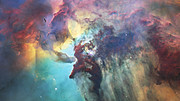
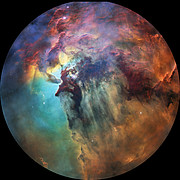
Hubble's 28th birthday picture: The Lagoon Nebula

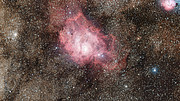
Infrared view of the Lagoon Nebula


Videos

Hubblecast 109: Diving into the Lagoon Nebula

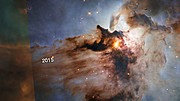
The centre of the Lagoon Nebula over time

Diving into the Lagoon Nebula

Swimming across the Lagoon Nebula

Fulldome view of the Lagoon Nebula

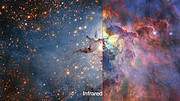
Lagoon Nebula in visible and infrared light


Image Comparisons

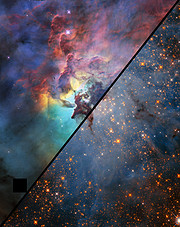
Comparison image of the Lagoon Nebula in optical and infrared


This colourful cloud of glowing interstellar gas is just a tiny part of the Lagoon Nebula, a vast stellar nursery. This nebula is a region full of intense activity, with fierce winds from hot stars, swirling chimneys of gas, and energetic star formation all embedded within a hazy labyrinth of gas and dust. Hubble used both its optical and infrared instruments to study the nebula, which was observed to celebrate Hubble’s 28th anniversary.

Since its launch on 24 April 1990, the NASA/ESA Hubble Space Telescope has revolutionised almost every area of observational astronomy. It has offered a new view of the Universe and has reached and surpassed all expectations for a remarkable 28 years. To celebrate Hubble’s legacy and the long international partnership that makes it possible, each year ESA and NASA celebrate the telescope’s birthday with a spectacular new image. This year’s anniversary image features an object that has already been observed several times in the past: the Lagoon Nebula.

The Lagoon Nebula is a colossal object 55 light-year wide and 20 light-years tall. Even though it is about 4000 light-years away from Earth, it is three times larger in the sky than the full Moon. It is even visible to the naked eye in clear, dark skies. Since it is relatively huge on the night sky, Hubble is only able to capture a small fraction of the total nebula. This image is only about four light-years across, but it shows stunning details.

The inspiration for this nebula’s name may not be immediately obvious in this image. It becomes clearer only in a wider field of view, when the broad, lagoon-shaped dust lane that crosses the glowing gas of the nebula can be made out. This new image, however, depicts a scene at the very heart of the nebula.

Like many stellar nurseries, the nebula boasts many large, hot stars. Their ultraviolet radiation ionises the surrounding gas, causing it to shine brightly and sculpting it into ghostly and other-worldly shapes. The bright star embedded in dark clouds at the centre of the image is Herschel 36. Its radiation sculpts the surrounding cloud by blowing some of the gas away, creating dense and less dense regions.

Among the sculptures created by Herschel 36 are two interstellar twisters — eerie, rope-like structures that each measure half a light-year in length. These features are quite similar to their namesakes on Earth — they are thought to be wrapped into their funnel-like shapes by temperature differences between the hot surfaces and cold interiors of the clouds. At some point in the future, these clouds will collapse under their own weight and give birth to a new generation of stars.

Hubble observed the Lagoon Nebula not only in visible light but also at infrared wavelengths. While the observations in the optical allow astronomers to study the gas in full detail, the infrared light cuts through the obscuring patches of dust and gas, revealing the more intricate structures underneath and the young stars hiding within it. Only by combining optical and infrared data can astronomers paint a complete picture of the ongoing processes in the nebula.


More Information

The Hubble Space Telescope is a project of international cooperation between ESA and NASA.
Image credit: NASA, ESA, STScI


Links


Contacts

Mathias Jäger
ESA/Hubble, Public Information Officer
Garching bei München, Germany
Tel: +49 176 62397500


Source: ESA/Hubble/News

Monday, January 25, 2016

Dark 'noodles' may lurk in the Milky Way


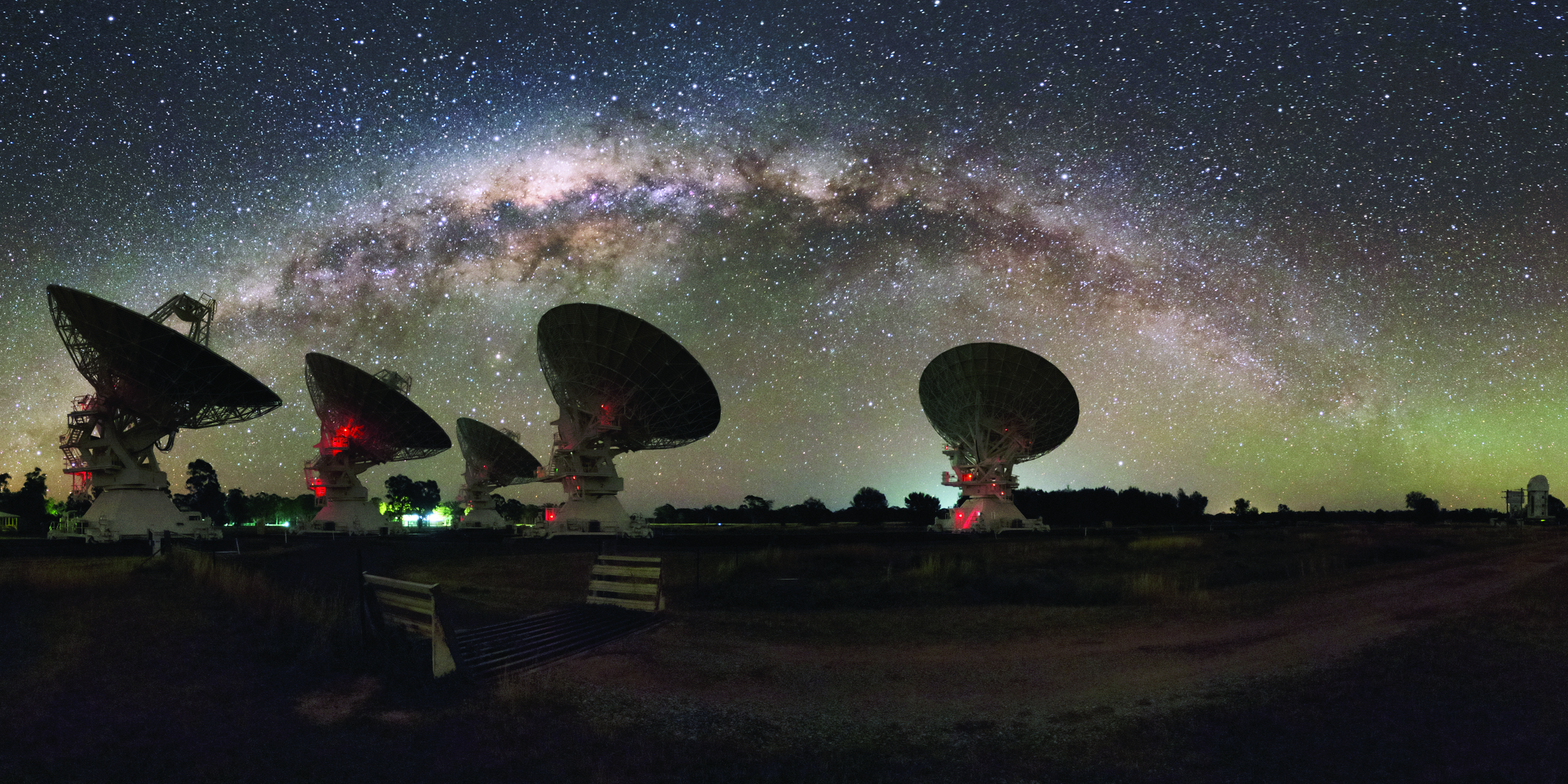
CSIRO's Compact Array in Australia under the night lights of the Milky Way


Invisible structures shaped like noodles, lasagne sheets or hazelnuts could be floating around in our Galaxy radically challenging our understanding of gas conditions in the Milky Way.

CSIRO astronomer and first author of a paper released in Science Dr Keith Bannister said the structures appear to be ‘lumps’ in the thin gas that lies between the stars in our Galaxy.

“They could radically change ideas about this interstellar gas, which is the Galaxy’s star recycling depot, housing material from old stars that will be refashioned into new ones,” Dr Bannister said.

Dr Bannister and his colleagues described breakthrough observations of one of these ‘lumps’ that have allowed them to make the first estimate of its shape.

The observations were made possible by an innovative new technique the scientists employed using CSIRO’s Compact Array telescope in eastern Australia.

Astronomers got the first hints of the mysterious objects 30 years ago when they saw radio waves from a bright, distant galaxy called a quasar varying wildly in strength.

They figured out this behaviour was the work of our Galaxy’s invisible ‘atmosphere’, a thin gas of electrically charged particles which fills the space between the stars. 

“Lumps in this gas work like lenses, focusing and defocusing the radio waves, making them appear to strengthen and weaken over a period of days, weeks or months,” Dr Bannister said.

These episodes were so hard to find that researchers had given up looking for them.

But Dr Bannister and his colleagues realised they could do it with CSIRO’s Compact Array.

Pointing the telescope at a quasar called PKS 1939–315 in the constellation of Sagittarius, they saw a lensing event that went on for a year.

Astronomers think the lenses are about the size of the Earth’s orbit around the Sun and lie approximately 3000 light-years away – 1000 times further than the nearest star, Proxima Centauri.

Until now they knew nothing about their shape, however, the team has shown this lens could not be a solid lump or shaped like a bent sheet.

“We could be looking at a flat sheet, edge on,” CSIRO team member Dr Cormac Reynolds said.

“Or we might be looking down the barrel of a hollow cylinder like a noodle, or at a spherical shell like a hazelnut.”

Getting more observations will “definitely sort out the geometry,” he said.

While the lensing event went on, Dr Bannister’s team observed it with other radio and optical telescopes.

The optical light from the quasar didn’t vary while the radio lensing was taking place. This is important, Dr Bannister said, because it means earlier optical surveys that looked for dark lumps in space couldn’t have found the one his team has detected.

So what can these lenses be? One suggestion is cold clouds of gas that stay pulled together by the force of their own gravity. That model, worked through in detail, implies the clouds must make up a substantial fraction of the mass of our Galaxy.

Nobody knows how the invisible lenses could form. “But these structures are real, and our observations are a big step forward in determining their size and shape,” Dr Bannister said.


News release contact

Mr Eamonn Bermingham
Communication Advisor · Communications 
Phone: +61 7 3833 5601  +61 477 317 235 (Mobile) 
Email: Eamonn.Bermingham@csiro.au

Dr Keith Bannister
Principal Research Engineer · Astronomy and Space Science
Phone: +61 2 9372 4295
Email: Keith.Bannister@csiro.au


Tuesday, February 09, 2010

A new 3D map of the interstellar gas within 300 parsecs from the Sun

Fig. 1 - Map of partially ionized interstellar gas within 300 parsecs around the Sun, as viewed in the Galactic plane. Triangles represent the sight-line positions of the stars used to produce the map. White to dark shading represents the low to high values of the gas density, and orange shading is for areas with no reliable measurement. The Local Cavity is shown as the white area of low density gas that surrounds the Sun at about 80 parsecs.

Astronomy & Astrophysics is publishing new 3D maps of the interstellar gas in the local area around our Sun. A French-American team of astronomers presents new absorption measurements towards more than 1800 stars. They were able to characterize the properties of the interstellar gas within each sight line.

This week, Astronomy & Astrophysics publishes new 3D maps of the interstellar gas situated in an area 300 parsecs around the Sun. A French-American team of astronomers presents new measurements of the absorption by the interstellar gas in the Sun's local area. Knowledge of the interstellar medium properties, including the spatial distribution, dynamics, and the chemical and physical characteristics, allow astronomers to better understand the interplay between the evolution of stars and their exchange of matter with the ambient interstellar medium. The local area around our Sun has been studied with many surveys at various wavelengths, but the whole picture is still far from being either complete or fully understood.

The team, led by Barry Y. Welsh and his colleagues R. Lallement and J.-L. Vergely, presents new, high spectral resolution measurements of the calcium (CaII) K line (at 3933 Å) and the sodium doublet (at 5889 and 5895 Å). These absorption lines have long been used to study the interstellar medium. The CaII K lines were first observed in 1904 by German astronomer J. Hartmann, in the spectrum of the star δ Orionis. This first detection of interstellar gas set the stage for the early studies of interstellar medium. The sodium (NaI) doublet was later discovered in 1919 toward δ Orionis and β Scorpii. The CaII K line and the NaI doublet are complementary: the first one is sensitive to partially ionized gas, and the second one traces cold and neutral interstellar gas.

The team combined their new data (mostly recorded at the European Southern Observatory in Chile) with previously published results. The new paper represents a catalog of absorption measurements towards 1857 stars located 800 parsecs from the Sun. Figure 1 shows the NaI map of the interstellar gas density within 300 parsecs. The white area surrounding the Sun (i.e., at the center of the map) corresponds to a very low-density area of neutral gas, known as the Local Cavity. It is about 80 parsecs in radius in most directions and is surrounded by a highly fragmented “wall” of dense neutral gas. The various gaps in the wall are termed “interstellar tunnels” and represent rarefied pathways into other surrounding interstellar cavities. Maps of the distribution of CaII have never been made before, and they reveal that the Local Cavity contains numerous filamentary structures of partially ionized gas that appear to form in a honeycomb-like pattern of small interstellar cells.

Theories of the general interstellar medium require that large rarefied cavities exist, having been formed by the combined action of energetic supernova events and the outflowing winds of clusters of hot and young stars. The history of our Local Cavity, within which the Sun resides, is still speculative, but many believe that it was created about 15 million years ago by a series of supernova outbursts, with the last re-heating happening about 3 million years ago.

[1] The team includes B. Y. Welsh (UCL Berkeley, USA), R. Lallement, S. Raimond (Université Versailles-St Quentin/CNRS, France), and J.-L. Vergely (ACRI-ST, France).

New 3D gas density maps of NaI and CaII interstellar absorption within 300 pc, by B. Y. Welsh, R. Lallement, J.-L. Vergely, and S. Raimond.

To be published in Astronomy & Astrophysics, 2010, vol. 510, A54
Free access to the article

Contacts:

Science:

Dr. Barry Y. Welsh
University of California
Space Sciences Laboratory
7 Gauss Way
Berkeley, CA 94720, USA
Email: bwelsh@ssl.berkeley.edu
Phone: +1 (510) 642 0305

Press office:

Dr. Jennifer Martin
Astronomy & Astrophysics
61, avenue de l'Observatoire
75014 Paris, France
Email: aanda.paris@obspm.fr
Phone: +33 1 43 29 05 41