Showing posts with label luminous blue variable stars. Show all posts

Friday, October 03, 2014

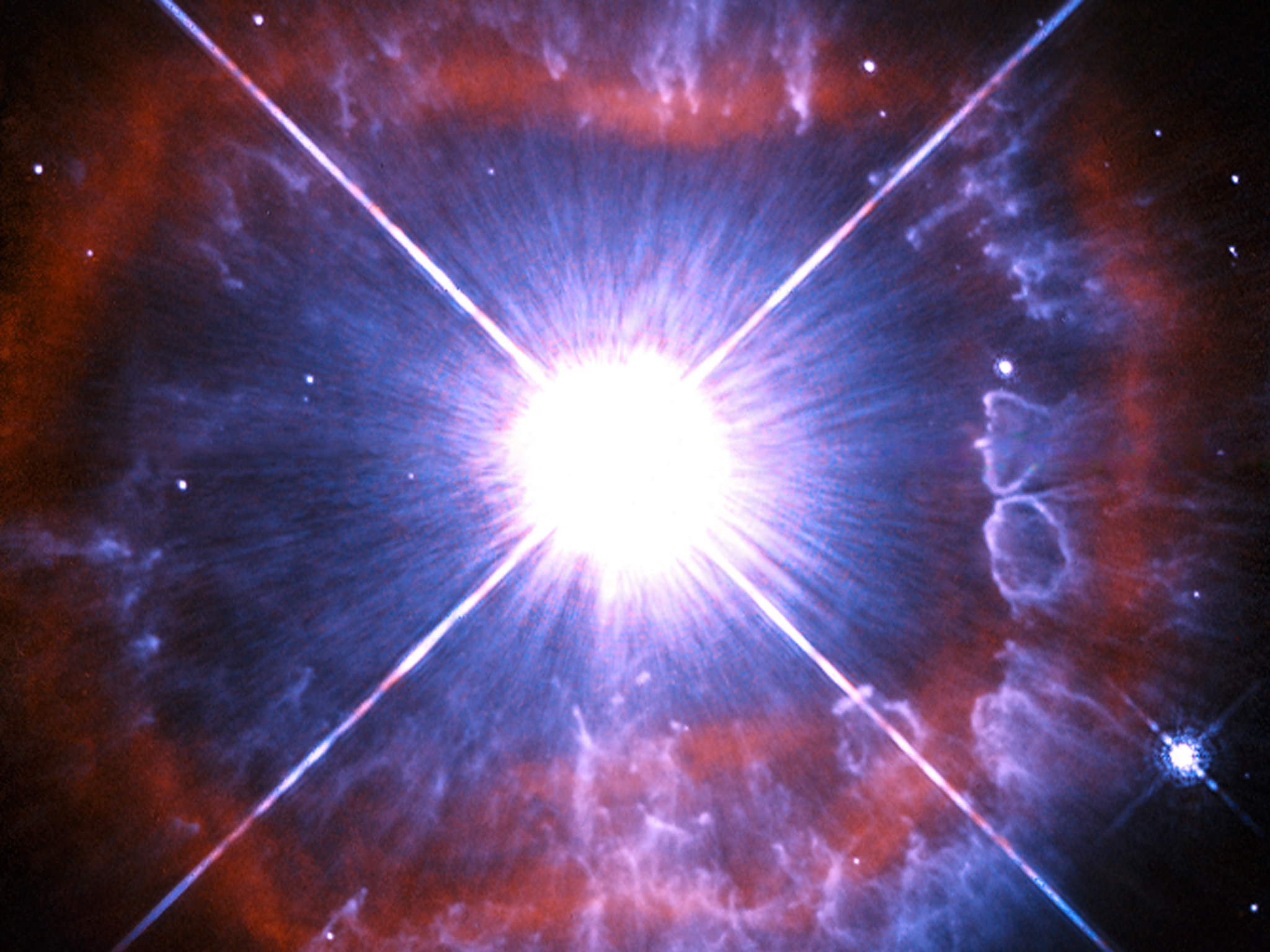
Snapshot of a shedding star

Credit: ESA/Hubble & NASA

In this new Hubble image, the strikingly luminous star AG Carinae — otherwise known as HD 94910 — takes centre stage. Found within the constellation of Carina in the southern sky, AG Carinae lies 20 000 light-years away, nestled in the Milky Way. 

AG Carinae is classified as a Luminous Blue Variable. These rare objects are massive evolved stars that will one day become Wolf-Rayet Stars — a class of stars that are tens of thousands to several million times as luminous as the Sun. They have evolved from main sequence stars that were twenty times the mass of the Sun.

Stars like AG Carinae lose their mass at a phenomenal rate. This loss of mass is due to powerful stellar winds with speeds of up to 7 million km/hour. These powerful winds are also responsible for the shroud of material visible in this image. The winds exert enormous pressure on the clouds of interstellar material expelled by the star and force them into this shape.

Despite HD 94910’s intense luminosity, it is not visible with the naked eye as much of its output is in the ultraviolet.

This image was taken with the Wide Field and Planetary Camera 2 (WFPC2), that was installed on Hubble during the Shuttle mission STS-61 and was Hubble’s workhorse for many years. It is worth noting that the bright glare at the centre of the image is not the star itself. The star is tiny at this scale and hidden within the saturated region. The white cross is also not an astronomical phenomenon but rather an effect of the telescope.

Source: ESA/Hubble - Space Telescope


Tuesday, April 22, 2014

A New Map of the Galaxy in the Light of Atomic Hydrogen

A new image of the Lagoon Nebula as seen with the VPHAS+ survey in the light of atomic hydrogen. The survey has just begun to return science results; there are roughly 300 million objects in its catalog. (Video link)


Atomic hydrogen is the lightest and by far most abundant element in the universe. When it is exposed to ultraviolet light, its single electron can be stripped from the atom, a situation that arises near stars that are hot. When a free electron then reunites with a proton to form a neutral atom it emits light including the visible H-alpha emission line. A region of H-alpha emission - a nebula - thus signals the presence of ionized gas near a hot star.

Typically stars are hot either because they are young and massive or because their nuclear burning has progressed to a hotter phase; they include O-stars, Be stars, supergiants, luminous blue variable stars, Wolf-Rayet stars, as well as very young stars of all masses and compact interacting binary stars. Surveys that take images in H-alpha emission are thus excellent detectors of hot stars and associated phenomena, not least because nebulae are comparatively larger in size and easier to spot than are the point-like stars that heat them.

In the southern hemisphere, the last time anyone published a systematic survey of H-alpha light was in 1971, and that study has been a standard astronomical resource ever since. But no longer. CfA astronomer Jeremy Drake has joined a large team of colleagues to make a new H-alpha study of the southern galactic plane, called VPHAS+ (the VST Photometric H-alpha Survey), with the plus indicating that four optical wavelengths are also surveyed in addition to the H-alpha wavelength.

The VPHAS+ catalog, which is soon to be completed, will have about 300 million stars, and will include stars and nebulae that are as much as 1500 times fainter than the ones in the older catalog, as well as much improved images of all objects. Because dust obscures optical light, the new survey will also be able to spot objects that previously were too obscured for detection. The first set of papers using this new catalog have started to appear, and as the data pipeline and calibration progresses the community expects this catalog to become a standard reference and a tool for exploration of the ultraviolet Milky Way.

Reference(s): 
"The VST Photometric Hα Survey of the Southern Galactic Plane and Bulge (VPHAS+)," J. E. Drew et al., MNRAS 440, 2036, 2014.