Showing posts with label massive black hole (MBH). Show all posts

Thursday, November 20, 2025

Astronomers Discover Fastest-Evolving Radio Signals Ever Observed from Black Hole Tearing Apart Star

Artist’s interpretation of two massive black holes (MBHs) within a galaxy. A tidal disruption event unfolds around the MBH that resides away from the galactic center and matter from a disrupted star swirls into a bright accretion disk, launching an energetic outflow and resulting in two bright radio flares. Credit: NSF/AUI/NSF NRAO/P.Vosteen


An international team of astronomers has discovered the first radio-bright tidal disruption event (TDE) occurring outside a galaxy's center, combining data from the Atacama Large Millimeter/submillimeter Array (ALMA) and from the Very Large Array (VLA) of the U.S. National Science Foundation National Radio Astronomy Observatory (NSF NRAO), along with several partner telescopes. The event, designated AT 2024tvd, revealed the fastest-evolving radio signals ever observed from this type of cosmic catastrophe.

The discovery, led by principal investigators Itai Sfaradi and Raffaella Margutti of the University of California, Berkeley, and others, represents a significant breakthrough in understanding how massive black holes can hide in unexpected places throughout the universe.

"This is truly extraordinary," said Sfaradi, lead author of the study. "Not only is this the first time we've observed such bright radio emission from a tidal disruption event happening away from a galaxy's center, but it's also evolving faster than anything we've seen before."

Tidal disruption events occur when a star ventures too close to a massive black hole and is torn apart by the black hole's immense gravitational forces. While these events typically occur at the centers of galaxies where supermassive black holes reside, AT 2024tvd was discovered approximately 0.8 kiloparsecs (about 2,600 light-years) away from its host galaxy's center.

The international team observed the event in great detail using a network of radio telescopes that covered a wide range of wavelengths, from centimeters to millimeters. Their data revealed an exceptionally fast and unusual evolution never before seen in this kind of phenomenon. The event produced two separate bursts of radio waves that brightened and faded far more rapidly than any known tidal disruption event. The first burst increased in brightness over a very short period of time and then dimmed almost as quickly, while the second flared up and faded even faster. These dramatic changes occurred on timescales many times shorter than those astronomers typically observe, showing that this was an extraordinarily dynamic and short-lived event.

"The radio emission from AT 2024tvd evolves so rapidly that it stands out even among the most extreme cosmic events we know," explained co-principal investigator Raffaella Margutti. "These observations are revealing new physics about how material behaves when launched from the vicinity of black holes," added Kate Alexander, PI of the VLA Program and professor at the University of Arizona.

The discovery utilized an extensive network of radio telescopes, including NSF NRAO's VLA and ALMA, the Arcminute Micro-Kelvin Imager Large Array (AMI-LA), the Allen Telescope Array (ATA), and the Submillimeter Array (SMA). This multi-telescope approach allowed the team to track the event's evolution across a wide range of radio frequencies over approximately 300 days.

The research suggests that the rapid radio evolution results from at least one—and possibly two—outflows launched significantly after the initial stellar disruption. The team's analysis indicates these outflows were likely launched 80 and 170 days after the optical discovery, challenging traditional models of how tidal disruption events unfold.

"What makes this discovery even more remarkable is that it reveals a massive black hole that would otherwise be invisible to us," said Raffaella Margutti, "The only reason we can detect this wandering black hole is because it happened to tear apart a star and produce these incredibly bright radio signals."

The off-nuclear position of this TDE provides crucial insights into the population of massive black holes that may be wandering through galaxies or recoiling from past interactions. Current theories suggest such black holes could result from triple black hole interactions or be remnants from galaxy mergers.

The team's sophisticated analysis also marks the first time that both free-free absorption and inverse-Compton cooling have been considered together in modeling TDE radio emission, providing new tools for understanding these extreme events.

"This discovery opens up entirely new possibilities for finding hidden black holes throughout the universe," noted Itai Sfaradi. "With upcoming sky surveys, we may discover that these off-nuclear tidal disruption events are more common than we thought."

The research also revealed a potential connection between the launch of radio-emitting outflows and changes in the event's X-ray emission, suggesting a link to accretion processes around the black hole.

AT 2024tvd was initially discovered by the Zwicky Transient Facility on August 25, 2024, at optical wavelengths before follow-up observations revealed its radio brightness and off-nuclear nature.


Additional Information

The findings are published in The Astrophysical Journal Letters,and you can read them
HERE.

This text is based on the press release by the National Radio Astronomy Observatory (NRAO), aALMA partner on behalf of North America.

The Atacama Large Millimeter/submillimeter Array (ALMA), an international astronomy facility, is a partnership of the European Southern Observatory (ESO), the U.S. National Science Foundation (NSF), and the National Institutes of Natural Sciences (NINS) of Japan in cooperation with the Republic of Chile. ALMA is funded by ESO on behalf of its Member States, by NSF in cooperation with the National Research Council of Canada (NRC) and the National Science and Technology Council (NSTC) in Taiwan, and by NINS in cooperation with the Academia Sinica (AS) in Taiwan and the Korea Astronomy and Space Science Institute (KASI).

ALMA construction and operations are led by ESO on behalf of its Member States; by the National Radio Astronomy Observatory (NRAO), managed by Associated Universities, Inc. (AUI), on behalf of North America; and by the National Astronomical Observatory of Japan (NAOJ) on behalf of East Asia. The Joint ALMA Observatory (JAO) provides the unified leaders,/divhip and management of ALMA's construction, commissioning, and operation.


Contacts:

Nicolás Lira
Education and Public Outreach Officer
Joint ALMA Observatory, Santiago - Chile
Phone:
+56 2 2467 6519
Cel: +56 9 9445 7726
Email: nicolas.lira@alma.cl

Jill Malusky
Public Information Officer
NRAO
Phone:
+1 304-456-2236
Email: jmalusky@nrao.edu

Yuichi Matsuda
Education and Public Outreach Officer
NAOJ
Email:
yuichi.matsuda@nao.ac.jp


Monday, May 12, 2025

NASA's Hubble Pinpoints Roaming Massive Black Hole

This six-panel illustration of a tidal disruption event around a supermassive black hole shows the following: 1) A supermassive black hole is adrift inside a galaxy, its presence only detectable by gravitational lensing; 2) A wayward star gets swept up in the black hole's intense gravitational pull; 3) The star is stretched or "spaghettified" by gravitational tidal effects; 4) The star's remnants form a disk around the black hole; 5) There is a period of black hole accretion, pouring out radiation across the electromagnetic spectrum, from X-rays to radio wavelengths; and 6) The host galaxy, seen from afar, contains a bright flash of energy that is offset from the galaxy's nucleus, where an even more massive black hole dwells. Artwork: NASA, ESA, STScI, Ralf Crawford (STScI)

Like a scene out of a sci-fi movie, astronomers using NASA telescopes have found “Space Jaws.”

Lurking 600 million light-years away, within the inky black depths between stars, there is an invisible monster gulping down any wayward star that plummets toward it. The sneaky black hole betrayed its presence in a newly identified tidal disruption event (TDE) where a hapless star was ripped apart and swallowed in a spectacular burst of radiation. These disruption events are powerful probes of black hole physics, revealing the conditions necessary for launching jets and winds when a black hole is in the midst of consuming a star, and are seen as bright objects by telescopes.

The new TDE, called AT2024tvd, allowed astronomers to pinpoint a wandering supermassive black hole using NASA’s Hubble Space Telescope, with similar supporting observations from NASA’s Chandra X-Ray Observatory and the NRAO Very Large Array telescope that also showed that the black hole is offset from the center of the galaxy.

The paper will be published in an upcoming issue of The Astrophysical Journal Letters.

Surprisingly, this one million-solar-mass black hole doesn’t reside exactly in the center of the host galaxy, where supermassive black holes are typically found, and actively gobble up surrounding material. Out of approximately 100 TDE events recorded by optical sky surveys so far, this is the first time an offset TDE has been identified. The rest are associated with the central black holes of galaxies.

In fact, at the center of the host galaxy there is a different supermassive black hole weighing 100 million times the mass of the Sun. Hubble’s optical precision shows the TDE was only 2,600 light-years from the more massive black hole at the galaxy’s center. That’s just one-tenth the distance between our Sun and the Milky Way’s central supermassive black hole.

This bigger black hole spews out energy as it accretes infalling gas, and it is categorized as an active galactic nucleus. Strangely, the two supermassive black holes co-exist in the same galaxy, but are not gravitationally bound to each other as a binary pair. The smaller black hole may eventually spiral into the galaxy’s center to merge with the bigger black hole. But for now, it is too far separated to be gravitationally bound.

A TDE happens when an infalling star is stretched or “spaghettified” by a black hole’s immense gravitational tidal forces. The shredded stellar remnants are pulled into a circular orbit around the black hole. This generates shocks and outflows with high temperatures that can be seen in ultraviolet and visible light.

“AT2024tvd is the first offset TDE captured by optical sky surveys, and it opens up the entire possibility of uncovering this elusive population of wandering black holes with future sky surveys,” said lead study author Yuhan Yao of the University of California at Berkeley. “Right now, theorists haven't given much attention to offset TDEs. “I think this discovery will motivate scientists to look for more examples of this type of event.”

This is a Hubble Space Telescope image of galaxy located 600 million light-years away that is host to the telltale signature of a roaming supermassive black hole. Visible in the Hubble image is a tidal disruption event (TDE), an intense flash of radiation caused by the supermassive black hole eating a star. The TDE appears as an isolated blue point source of ultraviolet light, while the galaxy is colored orange in visible light. The source is one of the first examples of a TDE significantly offset from the host galaxy's core by 2,600 light-years – where an even more massive active black resides. Hubble's precise angular resolution clearly shows this offset and confirms independent observations made with NASA's Chandra X-ray observatory. The photo taken on January 16, 2025 with Hubble's WFC3 detector in UV and visible light wavelengths. Science: NASA, ESA, STScI, Yuhan Yao (UC Berkeley); Image Processing: Joseph DePasquale (STScI)

A Flash in the Night

The star-snacking black hole gave itself away when several ground-based sky survey telescopes observed a flare as bright as a supernova. But unlike a supernova, astronomers know that this came from a black hole snacking on a star because the flare was very hot, and showed broad emission lines of hydrogen, helium, carbon, nitrogen, and silicon. The Zwicky Transient Facility at Caltech’s Palomar Observatory, with its 1.2-meter telescope that surveys the entire northern sky every two days, first observed the event.

“Tidal disruption events hold great promise for illuminating the presence of massive black holes that we would otherwise not be able to detect,” said Ryan Chornock, associate adjunct professor at UC Berkeley and a member of the ZTF team. “Theorists have predicted that a population of massive black holes located away from the centers of galaxies must exist, but now we can use TDEs to find them.”

The flare was seemingly offset from the center of a bright massive galaxy as cataloged by Pan-STARRS (Panoramic Survey Telescope and Rapid Response System), the Sloan Digital Sky Survey, and the DESI Legacy Imaging Survey. To better determine that it was not at the galactic center, Yao’s team used NASA’s Chandra X-ray Observatory to confirm that X-rays from the flare site were also offset.

It took the resolving power of Hubble to settle any uncertainties. Hubble’s sensitivity to ultraviolet light also allows it to pinpoint the location of the TDE, which is much bluer than the rest of the galaxy.

This is a combined Hubble Space Telescope/Chandra X-Ray Observatory image of galaxy located 600 million light-years away that is host to the telltale signature of a roaming supermassive black hole. Visible in the Hubble image is a tidbr> ultraviolet light, while the galaxy is colored orange in visible light. In addition, X-ray light is captured by Chandra as a blue haze that surrounds the TDE. Both Hub.ble and Chandra observations were combined to pinpoint the TDE's location, which is offset from the center of the galaxy, which appears as a bright orange-white blob.

Origin Unknown

The black hole responsible for the TDE is prowling inside the bulge of the massive galaxy. The black hole only becomes apparent every few tens of thousands of years when it “burps” from capturing a star, and then it goes quiet again until its next meal comes along.

How did the black hole get off-center? Previous theoretical studies have shown that black holes can be ejected out of the centers of galaxies because of three-body interactions, where the lowest-mass member gets kicked out. This may be the case here, given the stealthy black hole’s close proximity to the central black hole. “If the black hole went through a triple interaction with two other black holes in the galaxy’s core, it can still remain bound to the galaxy, orbiting around the central region,“ said Yao.

An alternative explanation is that the black hole is the surviving remnant of a smaller galaxy that merged with the host galaxy more than 1 billion years ago. If that is the case, the black hole might eventually spiral in to merge with the central active black hole sometime in the very far future. So at present, astronomers don’t know if it’s coming or going.

Erica Hammerstein, another UC Berkeley postdoctoral researcher, scrutinized the Hubble images as part of the study, but did not find any evidence of a past galaxy merger. But she explained, “There is already good evidence that galaxy mergers enhance TDE rates, but the presence of a second black hole in AT2024tvd’s host galaxy means that at some point in this galaxy’s past, a merger must have happened.”

Specialized for different kinds of light, observatories like Hubble and Chandra work together to pinpoint and better understand fleeting events like these. Future telescopes that will also be optimized for capturing transient events like this one include the National Science Foundation’s Vera C. Rubin Observatory and NASA’s upcoming Nancy Grace Roman Space Telescope. They will provide more opportunities for follow-up Hubble observations to zero in on a transient’s exact location.


Explore More:


The Hubble Space Telescope has been operating for over three decades and continues to make ground-breaking discoveries that shape our fundamental understanding of the universe. Hubble is a project of international cooperation between NASA and ESA (European Space Agency). NASA’s Goddard Space Flight Center in Greenbelt, Maryland, manages the telescope and mission operations. Lockheed Martin Space, based in Denver, also supports mission operations at Goddard. The Space Telescope Science Institute in Baltimore, which is operated by the Association of Universities for Research in Astronomy, conducts Hubble science operations for NASA.

ZTF is a public-private partnership, with equal support from the ZTF Partnership and from the U.S. National Science Foundation.


Monday, June 24, 2024

Massive black holes in low-mass galaxies: what happened to the X-ray Corona?

Two examples of X-ray-detected MBH candidates. On the top we show the eROSITA eRASS-4 X-ray images centered at the input optical coordinates, while on the bottom the optical image with overlayed X-ray contours. For the vast majority of MBH candidates, X-ray counterparts such those shown here were not found. © Legacy Surveys/D. Lang (Perimeter Institute); R. Arcodia.

Illustration of accretion disk corona.
Nahks Tr'Ehnl and Niel Brandt, Penn State University


Identifying massive black holes in low-mass galaxies is crucial for understanding black hole formation and growth over cosmic time but challenging due to their low accretion luminosities. Astronomers at MPE, led by Riccardo Arcodia, used the eROSITA X-ray telescope's all-sky survey to study massive black hole candidates selected based on variability in other wavelength ranges. Surprisingly, despite being flagged as accreting MBHs, the X-rays were weak and didn't match predictions from more massive AGN scaling relations. This discrepancy suggests either the absence of a canonical X-ray corona or the presence of unusual accretion modes and spectral energy distributions in these dwarf galaxy MBHs.

The centre of the Milky Way harbours a supermassive black hole – as do basically all galaxies of similar size and bigger than our Milky Way. But what about small galaxies? There is a hot debate in the astronomy community on whether all, or only some, low-mass galaxies are populated by “massive black holes”, anything between a few thousands to a few million solar masses. If these could be found and analysed, we could also learn something about the galaxies in the early Universe and how black holes grow over cosmic times, as the local dwarf galaxies closely resemble these first galaxies. So far, about 500 massive black holes have been found in the nearby Universe, as they need to be active and luminous enough to discern emission from their immediate vicinity from the host galaxy’s overall emission.

A team of astronomers has now used the all-sky survey with the eROSITA X-ray telescope to study massive black hole candidates selected by their variability in other wavelength ranges. “The variability at optical or infrared wavelengths indicates that there is some activity in the galactic nucleus. So, if there is a massive black hole accreting material, it should emit X-rays,” explains Riccardo Arcodia, who led the study at the Max Planck Institute for Extraterrestrial Physics (MPE) and is now working at the MIT Kavli Institute for Astrophysics and Space Research.

The only selection criterion for the sample was a cut on stellar mass to single out low-mass galaxies, leading to about 200 sources/MBHs. The team then looked for X-ray emission at the positions of these galaxies in the eROSITA all-sky survey and found only 17 sources, four of which had never been seen in X-rays before.

“The predicted X-ray luminosity of most of these candidates should be well above the detection limit of the eROSITA all-sky survey,” points out Andrea Merloni, eROSITA’s principal investigator. “Moreover, our stacking analysis of the non-detected sources shows that their emission is consistent with predictions for the X-ray emission of the galaxy alone.” While a possible X-ray weakness of massive black holes in dwarf galaxies was reported before for a few cases, this is the first confirmation on a large sample of homogeneous X-ray observations.

This means that the massive black holes in dwarf galaxies most likely behave differently than their supermassive counterparts. High-energy X-rays are typically produced in a region of hot plasma in the immediate vicinity of the black hole called the corona. In low-mass galaxies, the gravitational pull towards the centre is less strong and their interstellar medium is clumpier than in more massive ones, which might lead to differences in the magnetic field or the interplay between the accretion disk and the black hole corona. “This could be the reason why a classical corona was not found in these low-mass black holes”, says first author Riccardo Arcodia. “A different accretion mode in low-mass galaxies would also imply that selection techniques at different wavebands do not offer the same agreement seen at higher masses”, he adds. Future multi-wavelength studies on large samples are needed to test whether this is the case, or whether the X-ray emission alone is unusually low.

“This work serves as a pilot study for future synergies between eROSITA and VRO/LSST, which will perform a 10-year optical survey of the southern sky,” explains Mara Salvato, eROSITA Spokesperson and chair of the eROSITA followup working group. “We expect to find hundreds of LSST’s massive black hole candidates in eROSITA data, and hopefully learn a lot more about what is going on with the less-massive black holes at the centers of dwarf galaxies.”


Contact:

Riccardo Arcodia
Postdoc
tel:+49 (0)89 30000-3643

arcodia@mpe.mpg.de
Max Planck Institute for Extraterrestrial Physics, Garching

Dr. Andrea Merloni
tel:+49 89 30000-3893

am@mpe.mpg.de

Max Planck Institute for Extraterrestrial Physics, Garching


Original Publication

R. Arcodia, A.Merloni, J.Comparat et al
O Corona, where art thou? eROSITA’s view of UV-optical-IR variability-selected massive black holes in low-mass galaxies.
A&A, 681, A97 (2024)

Source | DOI


Further Information


eROSITA witnesses the awakening of massive black holes
April 29, 2021
Using the SRG/eROSITA all-sky survey data, scientists at the MPE have found two previously quiescent galaxies that now show quasi-periodic eruptions.

more


The X-ray sky opens to the world
January 31, 2024
First eROSITA sky-survey data release makes public the largest ever catalogue of high-energy cosmic sources


more


Friday, August 12, 2022

Not All Black Holes That Wander Are Lost — and Now, Some May Have Been Found


Dwarf galaxies, like NGC 5949 pictured here in this Hubble Space Telescope image, may be an excellent place to hunt for massive black holes. Credit:ESA/Hubble & NASA 

Title: Wandering Black Hole Candidates in Dwarf Galaxies at VLBI Resolution
Authors: Andrew J. Sargent et al.
First Author’s Institution: United States Naval Observatory and The George Washington University
Status: Published in ApJ

How do you make a black hole billions of times the mass of the Sun? Even for the planet-building Magratheans, this seems like a tall order. Plenty of mechanisms have been proposed to explain the formation of these supermassive black holes found at the centers of most galaxies. Some involve the mergers of “seeds” — massive black holes weighing in at merely hundreds to hundreds of thousands of solar masses. A simple way to test these theories is to search for relic massive black holes, and low-mass dwarf galaxies are excellent targets. Since dwarf galaxies haven’t undergone many mergers, any massive black holes they harbor should have avoided being gobbled up by growing supermassive black holes.

Today’s article studies 13 possible massive black hole candidates in dwarf galaxies, some of which may have wandered to the edges of their hosts. What’s up with that — and are they really massive black holes? Let’s dive in!

Here’s a question: since supermassive black holes are usually found near the center of their galaxies, why might we expect some massive black holes in dwarf galaxies to lie further out? The answer has to do with gravity: since dwarf galaxies are much less massive than the galaxies that host supermassive black holes, their gravitational potential is lower, making it easier for massive black holes to “wander” away from their centers. This means that if you see a radio source that appears far to the side of a dwarf galaxy’s center, it could be an massive black hole — or it could be an accreting supermassive black hole (an active galactic nucleus) in a galaxy far, far away that by chance simply happens to lie behind the dwarf galaxy. These unwanted interlopers can pose a challenge for identifying massive black holes.

Another issue with finding massive black holes is that they’re faint. While massive black holes go through periods of accretion like supermassive black holes, their low masses mean that they don’t accrete as quickly, reducing their luminosities. By the early 2000s, only two accreting black holes had been found in dwarf galaxies. Fortunately, this changed with the advent of sky surveys like the now famous Sloan Digital Sky Survey (SDSS), which has been running since 2000 and has amassed detections of close to a billion unique sources.

The 13 massive black hole candidates, shown in Figure 1, were assembled in an article from 2020 by some of the same astronomers who authored today’s article. In the 2020 article, the team sifted through 43,707 low-mass dwarf galaxies from SDSS, looking for sources that had been detected at radio frequencies by the Very Large Array. After keeping the matches and eliminating the radio sources that were background active galactic nuclei or could be explained by processes related to star formation, the team ended up with 13 massive black hole candidates, many of which aren’t aligned with the centers of their host galaxies.

Figure 1:The 13 dwarf galaxies hosting possible massive black hole candidates, as seen by the Dark Energy Camera Legacy Survey at optical wavelengths. The red crosses show the location of the compact radio sources that may be massive black holes. While some appear close to their host’s center, others are significantly farther away. Credit: Reines et al. 2020

In this more recent article, the authors performed follow-up observations using the Very Long Baseline Array (VLBA). The VLBA uses radio telescopes thousands of kilometers apart to reach high angular resolution and allow astronomers to see fine details. Unfortunately, the VLBA was only able to detect four of the 13 candidates — and those four, because of their luminosity and position, seemed most likely to be active galactic nuclei in galaxies far beyond the dwarfs the team was targeting. The detected candidates are shown in Figure 2. 


Figure 2: The four sources the team was able to detect with the VLBA. Here, S is flux density, a quantity that describes the intensity of radio emission. As these sources are actually background active galactic nuclei rather than massive black holes in the targeted dwarf galaxies, the physical scales in the lower right are inaccurate. Credit: Sargent et al. 2022

This seems like an enormous problem! Only four detections, all of which appear to be imposters? Fortunately, the situation isn’t as dire as it might seem. While the VLBA is good at resolving sources on small scales in the configuration the team used, it may not resolve large-scale sources — and the radio emission from accreting massive black holes might be in the form of larger structures like radio lobes, rather than central point sources.

Multiwavelength observations confirmed that two of the remaining nine candidates are likely accreting supermassive black holes near the center of their host galaxies, but the other seven remain unknown. Five of those seven candidates are too bright to be from star formation and, based on their positions, could be either more background active galactic nucleus interlopers or, tantalizingly, wandering massive black holes.

Where do we go next? Follow-up observations at other wavelengths could be useful. The group suggests the Hubble Space Telescope in particular as a means of figuring out what those seven sources truly are. Given the difficulties involved in detecting massive black holes, even one more could prove valuable as astronomers try to understand the formation of the largest black holes in the universe.

Original astrobite edited by Suchitra Narayanan.

ByAstrobites


About the author, Graham Doskoch:

I’m a graduate student at West Virginia University, pursuing a PhD in radio astronomy. My research focuses on pulsars and efforts to use them to detect gravitational waves as part of pulsar timing arrays like NANOGrav and the IPTA. I love running, hiking, reading, and just enjoying nature.


Thursday, January 20, 2022

Researchers uncover model for extremely luminous and fast rising supernova


Figure 1: Supernova AT 2018cow, nicknamed the COW. (Left) Following its explosion, COW reached peak luminosity on June 20, 2018, being much brighter than the galaxy’s center at upper left. (Right) By July 14, 2018, COW had become dimmer, becoming just as bright as the galaxy's center. Credit: Daniel Perley (Liverpool J. M. University), Kavli IPMU


Figure 2: Light curve of supernova SN 2018gep (GEP) shows it reaches a higher peak luminosity rapidly compared to ordinary Ic supernovae (solid lines). Credit: Anna Ho (Caltech), Kavli IPMU


Figure 3: Cartoon illustration of the shock-interaction picture. (Upper left) A massive star undergoes large pulsations due to electron-positron pair-creation and ejects some material to form dense circumstellar matter. (Upper right) The star explodes to form a shock wave, which propagates through the circumstellar matter. (Lower left) When the shock wave reaches the surface of the circumstellar matter, the kinetic energy is converted to the thermal and radiation energy. Then the surface of the circumstellar matter shines very brightly. Material ejected by supernova explosion expands at moderate speeds. (Lower right) Circumstellar matter rapidly expands and fades. Supernova ejecta also expands and fades. Credit: Shing-Chi Leung, Kavli IPMU


Figure 4: Theoretical shock-interaction models for the light curves and comparisons with observational data from the COW and the GEP. Solid lines are the models including the self-consistent CSM. Dashed line are the models assuming the CSM is artificially removed. Credit: Shing-Chi Leung, Kavli IPMU

Appearing ten to a hundred times brighter at its peak, and with a much faster rise toward the peak, stellar explosions AT 2018cow (nicknamed the COW) and SN 2018gep (nicknamed the GEP) represent a new type of supernova called Fast Blue Optical Transient (FBOT), reports two recent studies.

Thanks to recent extensive supernova observations by several telescopes worldwide, COW and GEP appeared in the night sky in 2018 and were well-observed from the early phase of their explosions (figure 1). But their origin was a mystery.

To find a theoretical model, Shing-Chi Leung, a former Kavli Institute for the Physics and Mathematics of the Universe (Kavli IPMU) Project Researcher (currently a postdoctoral scholar at the California Institute of Technology), and Kavli IPMU Senior Scientist Ken’ichi Nomoto, organized two international teams of researchers to study each explosion, and have now succeeded in explaining COW and GEP features.

Observational data showed the COW had the brightest peak and the shortest rising time (about 1 day) among FBOTs. The GEP had a slightly lower brightness and a longer rising time (about 3 days), compared to the COW (figure 2).

Both research groups then successfully modeled the light curve, uncovering a clear picture of a possible sequence of events in both explosions (figure 3).

First, the star would have ejected its surface materials just before the explosion. These ejected materials would have formed a dense and opaque circumstellar matter (CSM) around the star, making the radius of the star much larger than ordinary presupernova stars. Such a presupernova mass ejection mechanism might have been caused by the pulsational pair-instability of very massive stars, which Leung and Nomoto had previously seen while studying the origin of massive black holes (see the related article).

When the supernova explosion occurred in the star, a strong shock wave would have formed and propagated through the CSM. When it reached the CSM surface, its kinetic energy would have converted into thermal and radiation energy, causing a sudden and a very bright event to occur, which is consistent with the very fast rise of the observed brightness of the supernova.

The CSM surface became as bright as observed peak of COW because of the large "radius", but once CSM quickly lost most of its energy and faded, it became transparent, giving way to an ordinary supernova light.

The theoretical supernova light curves powered by the shock-heating of the CSM the researchers created were found to be in good agreement with the observational data of the COW and the GEP, respectively (figure 4).

The researchers also found that without CSM, the rising of the light curve was much slower and the maximum luminosity was much lower, indicating FBOTs can be linked to CSM-heating.

The research teams are now proposing that the variation the CSM mass formed from the pulsational pair-instability of very massive stars would cause variation among FBOTs. If the CSM mass is large enough, the resulting supernova would be observed as a so-called Superluminous Supernova which is bright but shows much slower rising.

The next step is to confirm this hypothesis with more observations.

The results of both studies were published online in The Astrophysical Journal on 3 November 2020 [1] and 8 July 2021 [2].


Paper details

Paper [1]

Journal: The Astrophysical Journal
Paper title: A Model for the Fast Blue Optical Transient AT2018cow: Circumstellar Interaction of a Pulsational Pair-instability Supernova
Authors: Shing-Chi Leung (2,1), Sergei Blinnikov (1,3,4), Ken'ichi Nomoto (1), Petr Blakanov (3,5,6), Elena Sorokina (3,7) and Alexey Tolstov (8,1)

Author affiliations

1 Kavli Institute for the Physics and Mathematics of the Universe (WPI), The University of Tokyo Institutes for Advanced Study, The University of Tokyo, Kashiwa, Chiba 277-8583, Japan;
2 TAPIR, Walter Burke Institute for Theoretical Physics, Mailcode 350-17, Caltech, Pasadena, CA 91125, USA
3 National Research Center “Kurchatov institute,” Institute for Theoretical and Experimental Physics (ITEP), 117218 Moscow, Russia
4 Dukhov Automatics Research Institute (VNIIA), Suschevskaya 22, 127055 Moscow, Russia
5 National Research Nuclear University MEPhI, Kashirskoe sh. 31, Moscow 115409, Russia
6 Space Research Institute (IKI), Russian Academy of Sciences, Profsoyuznaya 84/32, 117997 Moscow, Russia
7 Sternberg Astronomical Institute, M.V. Lomonosov Moscow State University, Universitetski pr. 13, 119234 Moscow, Russia
8 The Open University of Japan, 2-11, Wakaba, Mihama-ku, Chiba, Chiba 261-8586, Japan

DOI: 10.3847/1538-4357/abba33 (published 3 November, 2020)
Paper abstract (The Astrophysical Journal)
Preprint (arXiv.org)


Paper [2]

Journal: The Astrophysical Journal
Paper title: Fast Blue Optical Transients Due to Circumstellar Interaction and the Mysterious
Supernova SN 2018gep
Authors: Shing-Chi Leung (1), Jim Fuller (1), Ken’ichi Nomoto (2)
Author affiliations:
1 TAPIR, Walter Burke Institute for Theoretical Physics, Mailcode 350-17,
Caltech, Pasadena, CA 91125, USA
2 Kavli Institute for the Physics and Mathematics of the Universe (WPI),
The University of Tokyo Institutes for Advanced Study, The University of Tokyo, Kashiwa, Chiba 277-8583, Japan


DOI: 10.3847/1538-4357/abfcbe (published 8 July, 2021)
Paper abstract (The Astrophysical Journal)
Preprint (arXiv.org)


Research contact

Ken'ichi Nomoto
Senior Scientist
Kavli Institute for the Physics and Mathematics of the Universe (Kavli IPMU), The University of Tokyo
E-mail:
nomoto@astron.s.u-tokyo.ac.jp
Preprint (arXiv.org)


Media contact:

Motoko Kakubayashi
Press officer
Kavli Institute for the Physics and Mathematics of the Universe (Kavli IPMU), The University of Tokyo
E-mail:
press@ipmu.jp

Related article:


Researchers find the origin and the maximum mass of massive black holes observed by gravitational wave detectors.


Monday, February 22, 2021

First black hole ever detected is more massive than we thought

An artist’s impression of the Cygnus X-1 system. This system contains the most massive stellar-mass black hole ever detected without the use of gravitational waves, weighing in at 21 times the mass of the Sun. Credit: International Centre for Radio Astronomy Research. Credit: International Centre for Radio Astronomy Research. Hi-res image

New observations of the first black hole ever detected have led astronomers to question what they know aboeut the Universe’s most mysterious objects.

Published today in the journal Science, the research shows the system known as Cygnus X-1 contains the most massive stellar-mass black hole ever detected without the use of gravitational waves.

Cygnus X-1 is one of the closest black holes to Earth. It was discovered in 1964 when a pair of Geiger counters were carried on board a sub-orbital rocket launched from New Mexico.

The object was the focus of a famous scientific wager between physicists Stephen Hawking and Kip Thorne, with Hawking betting in 1974 that it was not a black hole. Hawking conceded the bet in 1990.

In this latest work, an international team of astronomers used the Very Long Baseline Array—a continent-sized radio telescope made up of 10 dishes spread across the United States—together with a clever technique to measure distances in space.

“If we can view the same object from different locations, we can calculate its distance away from us by measuring how far the object appears to move relative to the background,” said lead researcher, Professor James Miller-Jones from Curtin University and the International Centre for Radio Astronomy Research (ICRAR).

“If you hold your finger out in front of your eyes and view it with one eye at a time, you’ll notice your finger appears to jump from one spot to another. It’s exactly the same principle.”

Astronomers observed the Cygnus X-1 system from different angles using the orbit of the Earth around the Sun to measure the perceived movement of the system against the background stars. This allowed them to refine the distance to the system and therefore the mass of the black hole. Credit: International Centre for Radio Astronomy Research. Hi-res image

“Over six days we observed a full orbit of the black hole and used observations taken of the same system with the same telescope array in 2011,” Professor Miller-Jones said. “This method and our new measurements show the system is further away than previously thought, with a black hole that’s significantly more massive.”

Co-author Professor Ilya Mandel from Monash University and the ARC Centre of Excellence in Gravitational Wave Discovery (OzGrav) said the black hole is so massive it’s actually challenging how astronomers thought they formed.

An artist’s impression of the Cygnus X-1 system. A stellar-mass black hole orbits with a companion star located 7,200 light years from Earth. Credit: International Centre for Radio Astronomy Research. Hi-res image

“Stars lose mass to their surrounding environment through stellar winds that blow away from their surface. But to make a black hole this heavy, we need to dial down the amount of mass that bright stars lose during their lifetimes” he said.

“The black hole in the Cygnus X-1 system began life as a star approximately 60 times the mass of the Sun and collapsed tens of thousands of years ago,” he said. “Incredibly, it’s orbiting its companion star—a supergiant—every five and a half days at just one-fifth of the distance between the Earth and the Sun.

“These new observations tell us the black hole is more than 20 times the mass of our Sun—a 50 per cent increase on previous estimates.”

Recent observations show the black hole in the Cygnus X-1 system is 21 times the mass of the Sun—a 50 per cent increase on previous estimates. To form such a massive black hole, astronomers had to revise their estimates of how much mass stars lose via stellar winds. Credit: International Centre for Radio Astronomy Research. Hi-res image

Xueshan Zhao is a co-author on the paper and a PhD candidate studying at the National Astronomical Observatories—part of the Chinese Academy of Sciences (NAOC) in Beijing.

“Using the updated measurements for the black hole’s mass and its distance away from Earth, I was able to confirm that Cygnus X-1 is spinning incredibly quickly—very close to the speed of light and faster than any other black hole found to date,” she said.

“I’m at the beginning of my research career, so being a part of an international team and helping to refine the properties of the first black hole ever discovered has been a great opportunity.”

CYGNUS X-1: the most massive black hole near to Earth from ICRAR on Vimeo.

 
More Information:

The International Centre for Radio Astronomy Research (ICRAR) is a joint venture between Curtin University and The University of Western Australia with support and funding from the State Government of Western Australia.

Original Publication:

‘Cygnus X-1 contains a 21-solar mass black hole – implications for massive star winds’, published in Science on February 18th, 2021.

Companion Papers:

‘Reestimating the Spin Parameter of the Black Hole in Cygnus X-1’, published in The Astrophysical Journal on February 18th, 2021.

‘Wind mass-loss rates of stripped stars inferred from Cygnus X-1’, published in The Astrophysical Journal on February 18th, 2021.

Contacts:

Professor James Miller-Jones (ICRAR / Curtin University)

Ph: +61 488 484 825                        E: James.Miller-Jones@icrar.org

Professor Ilya Mandel (OzGrav / Monash University)

Ph: +61 8 466 710 590                     E: Ilya.Mandel@monash.edu

Pete Wheeler — Media Contact, ICRAR

Ph: +61 423 982 018                        E: Pete.Wheeler@icrar.org

Lauren Sydoruk (Media Contact, Curtin University)

Ph: +61 401 103 373                       E: Lauren.Sydoruk@curtin.edu.au

  
Source: International Centre for Radio Astronomy Research   ICRAR/News


Sunday, February 14, 2021

Hubble Uncovers Concentration of Small Black Holes

The amount of mass a black hole can pack away varies widely from less than twice the mass of our Sun to over a billion times our Sun's mass. Midway between are intermediate-mass black holes weighing roughly hundreds to tens of thousands of solar masses. So, black holes come small, medium, and large.   Image Credit: NASA, ESA, T. Brown, S. Casertano, and J. Anderson (STScI).  Science Credit: NASA, ESA, and E. Vitral and G. Mamon (Institut d'Astrophysique de Paris (IAP)).  Hi-res image

Astronomers found something they weren't expecting at the heart of the globular cluster NGC 6397: a concentration of smaller black holes lurking there instead of one massive black hole.

Globular clusters are extremely dense stellar systems, which host stars that are closely packed together. These systems are also typically very old — the globular cluster at the focus of this study, NGC 6397, is almost as old as the universe itself. This cluster resides 7,800 light-years away, making it one of the closest globular clusters to Earth. Due to its very dense nucleus, it is known as a core-collapsed cluster.

At first, astronomers thought the globular cluster hosted an intermediate-mass black hole. These are the long-sought "missing link" between supermassive black holes (many millions of times our Sun's mass) that lie at the cores of galaxies, and stellar-mass black holes (a few times our Sun's mass) that form following the collapse of a single massive star. Their mere existence is hotly debated. Only a few candidates have been identified to date.

"We found very strong evidence for an invisible mass in the dense core of the globular cluster, but we were surprised to find that this extra mass is not 'point-like' (that would be expected for a solitary massive black hole) but extended to a few percent of the size of the cluster," said Eduardo Vitral of the Paris Institute of Astrophysics (IAP) in Paris, France.

To detect the elusive hidden mass, Vitral and Gary Mamon, also of IAP, used the velocities of stars in the cluster to determine the distribution of its total mass, that is the mass in the visible stars, as well as in faint stars and black holes. The more mass at some location, the faster the stars travel around it.

The researchers used previous estimates of the stars' tiny proper motions (their apparent motions on the sky), which allow for determining their true velocities within the cluster. These precise measurements for stars in the cluster's core could only be made with Hubble over several years of observation. The Hubble data were added to well-calibrated proper motion measurements provided by the European Space Agency's Gaia space observatory which are less precise than Hubble's observations in the core.

"Our analysis indicated that the orbits of the stars are close to random throughout the globular cluster, rather than systematically circular or very elongated," explained Mamon. These moderate-elongation orbital shapes constrain what the inner mass must be.


Astronomers on the hunt for an intermediate-mass black hole at the heart of the globular cluster NGC 6397 found something they weren’t expecting: a concentration of smaller black holes lurking there instead of one massive black hole.
 
The researchers conclude that the invisible component can only be made of the remnants of massive stars (white dwarfs, neutron stars, and black holes) given its mass, extent, and location. These stellar corpses progressively sank to the cluster's center after gravitational interactions with nearby less massive stars. This game of stellar pinball is called "dynamical friction," where, through an exchange of momentum, heavier stars are segregated in the cluster's core and lower-mass stars migrate to the cluster's periphery.

"We used the theory of stellar evolution to conclude that most of the extra mass we found was in the form of black holes," said Mamon. Two other recent studies had also proposed that stellar remnants, in particular, stellar-mass black holes, could populate the inner regions of globular clusters. "Ours is the first study to provide both the mass and the extent of what appears to be a collection of mostly black holes in the center of a core-collapsed globular cluster," added Vitral.

The astronomers also note that this discovery raises the possibility that mergers of these tightly packed black holes in globular clusters may be an important source of gravitational waves, ripples through spacetime. Such phenomena could be detected by the Laser Interferometer Gravitational-Wave Observatory experiment, which is funded by the National Science Foundation and operated by Caltech in Pasadena, California and MIT in Cambridge, Massachusetts.

The Hubble Space Telescope is a project of international cooperation between NASA and ESA (European Space Agency). NASA's Goddard Space Flight Center in Greenbelt, Maryland, manages the telescope. The Space Telescope Science Institute (STScI) in Baltimore, Maryland, conducts Hubble science operations. STScI is operated for NASA by the Association of Universities for Research in Astronomy in Washington, D.C.


Media Contacts:

Claire Andreoli
NASA's Goddard Space Flight Center, Greenbelt, Md.
301-286-1940

claire.andreoli@nasa.gov

Ray Villard
Space Telescope Science Institute, Baltimore, Maryland
410-338-4514

villard@stsci.edu

Bethany Downer
ESA/Hubble Space Telescope

bethany.downer@esahubble.org

Science Contacts:

Eduardo Vitral
Institut d'Astrophysique de Paris (IAP), Paris, France

vitral@iap.fr

Dr. Gary A. Mamon
Institut d'Astrophysique de Paris (IAP), Paris, France

gam@iap.fr

Editor: Lynn Jenner


Monday, January 25, 2021

When galaxies collide: Models suggest galactic collisions can starve massive black holes

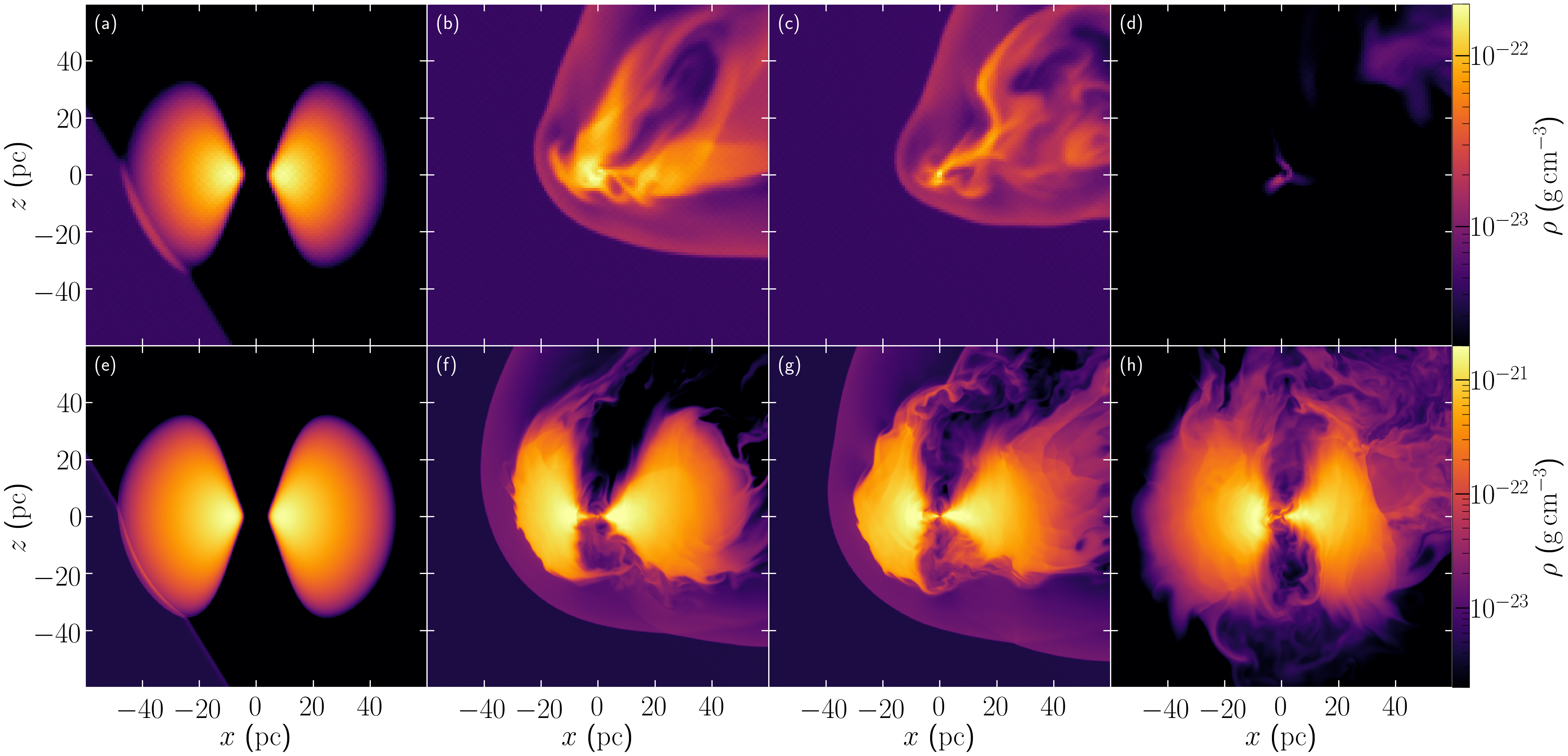
Visualizations of the dynamic model simulating two different scenarios. The top row shows a collision reducing core activity, the bottom row shows a collision increasing it. © 2021 Miki et al.
 
Artist's impression of gas being pulled away from a galactic nucleus. © 2021 Miki et al.

It was previously thought that collisions between galaxies would necessarily add to the activity of the massive black holes at their centers. However, researchers have performed the most accurate simulations of a range of collision scenarios and have found that some collisions can reduce the activity of their central black holes. The reason is that certain head-on collisions may in fact clear the galactic nuclei of the matter which would otherwise fuel the black holes contained within.

When you think about gargantuan phenomena such as the collision of galaxies, it might be tempting to imagine it as some sort of cosmic cataclysm, with stars crashing and exploding, and destruction on an epic scale. But actually it is closer to a pair of clouds combining, usually a larger one absorbing a smaller one. It’s unlikely any stars within them would collide themselves. But that said, when galaxies collide, the consequences can be enormous.

Galaxies collide in different ways. Sometimes a small galaxy will collide with the outer part of a larger one and either pass through or merge, in either case exchanging a lot of stars along the way. But galaxies can also collide head-on, where the smaller of the two will be torn apart by overpowering tidal forces of the larger one. It’s in this scenario that something very interesting can happen within the galactic nucleus.

“At the heart of most galaxies lies a massive black hole, or MBH,” said Research Associate Yohei Miki from the University of Tokyo. “For as long as astronomers have explored galactic collisions, it has been assumed that a collision would always provide fuel for an MBH in the form of matter within the nucleus. And that this fuel would feed the MBH, significantly increasing its activity, which we would see as ultraviolet and X-ray light amongst other things. However, we now have good reason to believe that this sequence of events is not inevitable and that in fact the exact opposite might sometimes be true.”

Galaxies collide (Animation)

Papers:

Yohei Miki, Masao Mori and Toshihiro Kawaguchi, "Destruction of the central black hole gas reservoir through head-on galaxy collisions," Nature Astronomy: January 25, 2021, doi:10.1038/s41550-020-01286-9.

Link (Publication)


Source: The University of Tokyo/Press Release