Showing posts with label HD 163296. Show all posts

Wednesday, May 24, 2023

A Potential New Character in the Saga of HD 163296

This image shows the dust (pink) and carbon monoxide gas (blue) making up HD 163296's disk.
Credit:
ALMA (ESO/NAOJ/NRAO); A. Isella; B. Saxton (NRAO/AUI/NSF)

Title: A Gap-Sharing Planet Pair Shaping the Crescent in HD 163296: a Disk Sculpted by a Resonant Chain
Authors: Juan Garrido-Deutelmoser et al.
First Author’s Institution: Pontifical Catholic University of Chile and the Millennium Nucleus for Planet Formation
Status: Published in ApJL


Figure 1: The observed structure of the disk around HD 163296, as reported in Isella et al. (2018). The crescent-shaped region is visible at the bottom left of the inner gap, as indicated by the white box and as shown in the zoomed-in image (a). It appears to be a cloud of gas and dust within the gap, distinct from the overdense ring around it. Credit: Adapted from Isella et al. 2018

An extra protoplanet might be lurking in the dust around a nearby star.

The pre-main-sequence star HD 163296 plays host to an extensive circumstellar disk, with gas reaching out beyond 500 astronomical units (au). Observations of this disk have revealed it to be quite the playground for the young planets forming within — and these authors claim there are more planets than previously thought.

HD 163926’s disk has a series of rings — bumps and dips in surface brightness, corresponding to over- and under-densities of material at different distances from the host star (Figure 1). Observations of this sort of ringed structure have become common fare since the advent of high-precision millimeter imaging in the last 15 years. These rings imply the presence of protoplanets or other large substellar bodies, which can clear out gaps through their growth and alter what would otherwise be a smooth(er) profile.

Trying to figure out the exact setup of bodies that gives a disk its observed structure is an interesting problem — and in the case of HD 163296, it’s a problem that has proven a bit tricky.

It only took low-resolution images of this particular disk (like those taken with the Hubble Space Telescope at the turn of the century) for Grady et al. to suggest that a giant planet might be present in the outer reaches of this system. Jumping ahead to 2018, Teague et al. used rotation curves of observed gas to claim that there were likely two planets out there — both roughly as massive as Jupiter, at 87 and 113 au. Just a few months later, high-precision observations by the Atacama Large Millimeter/submillimeter Array (ALMA) revealed that the disk contains not just a series of gaps but also an intriguing substructure within the innermost one.

Today’s article focuses on this innermost gap, which extends from 38 to 62 au, and the crescent-shaped region near the edge of it that appears to have more material than it should (Figure 1).

The standard idea that gaps form along the orbit of a protoplanet doesn’t allow for this sort of uneven, crescent-shaped structure; the protoplanet should clear the material evenly all the way around the orbit, but it seems to have missed a spot. Modeling this gap, and the substructure within, would complete our current understanding of the HD 163296 system.

Luckily, the crescent has a fairly straightforward explanation. To understand it, though, we need to talk about Lagrange points.


Figure 2: A diagram of the Lagrange points of a star–planet system. Smaller objects, like asteroids and dust, often accumulate at L4 and L5 due to the long-term stability of these points. Credit: Mark Dodici


If you’ve taken a class on classical mechanics, you might remember that Lagrange points are sort of like gravitational islands. For any pair of massive bodies (say, a star with a protoplanet), there are five points where the gravitational forces of the bodies balance nearly perfectly to keep much-less-massive things at those points, fixed relative to the more massive bodies. Two of these (L4 and L5) are stable against small displacements, meaning smaller things like asteroids and dust often accumulate at or around these two points. L4 lies almost exactly on the orbit of the less-massive body, in front of it by ~60 degrees. L5 trails behind the less-massive body by the same angle (Figure 2).

In the HD 163296 system, this crescent-shaped region with extra dust and gas could perhaps be explained as a build-up of material in the L4 or L5 of some massive protoplanet, which had otherwise cleared out the gap. In 2021, Rodenkirch et al. simulated the interactions between a gap-clearing planet and the dust around it, and they showed that this could work: a Jupiter-mass planet orbiting the star at 48 AU would both open up the observed gap and trap a significant amount of dust at its trailing L5.

And so the system was solved. The crescent-shaped substructure in HD 163296’s disk was the result of a Jupiter-mass planet. The other gaps were caused by two other planets farther out.

And yet, today’s featured article came out just recently. Why?

It turns out there were two problems with the Lagrange point idea. First, the crescent is centered at a radial distance of 55 au, which requires a lot of dynamical hoop-jumping-through to make sense for a Jupiter-mass planet at 48 au. Second, a Jupiter-mass planet would open up a deep gap in the gaseous disk. Less than a year after the first submission of Rodenkirch et al., observations by Zhang et al. of the disk’s carbon monoxide (CO) surface density — a great tracer for the overall gas density throughout a disk — showed that the gas gap between 38 and 62 au is ten times shallower than it would be if it were carved by a Jupiter-mass planet.

Enter Garrido-Deutelmoser et al. Last year, they studied the effects of having two planets in the same gap in a protoplanetary disk. Through hydrodynamical simulations, they showed that if two sub-Jupiter-mass planets are close enough to each other, their gravitational interactions would create relatively stable “vortices” at L4 and L5 of either of the planets. These vortices could maintain over-densities of dust and gas for thousands of orbits — plenty of time for us to have observed one of them.

In today’s featured article, Garrido-Deutelmoser (and a slightly different) et al. applied this concept to HD 163296. They set up simulations of the system mostly matching those of Rodenkirch et al., with the two proposed outer planets and a smooth disk of gas and dust. But in place of one Jupiter-mass planet at 48 au, they implanted two planets with a few times the mass of Neptune in that region. Since these two combine for a much smaller mass than Jupiter, they would create a much shallower gap in the gas density profile — ideally matching that found in Zhang et al.


Figure 3: The radial gas density profile of HD 163296. Dark Purple: observed profile from Zhang et al. (2021). Magenta: simulated profile with one planet opening the 38–62 AU gap (the Rodenkirch et al. (2021) model). Orange: simulated profile with two planets opening said gap (this paper). Neither model fits well beyond ~85 AU, but the two-planet model matches the CO gap depth much more closely up to that point. Credit: Garrido-Deutelmoser et al. 2023


Figure 4: The observed structure of the disk around HD 163296 (left) and the faux-observed structure from this simulation (right). The proposed locations of the four protoplanets are labeled on the left panel. While the simulated disk isn’t a perfect replica, it recreates most of the important details of the interior portions of the observed disk. Credit: Garrido-Deutelmoser et al. 2023


Through trial and error, they found that planets at 46 and 54 au could, in fact, carve out the appropriate density profile for this gap in both dust and gas (Figure 3) over the course of a half-million-year simulation. And in line with expectations from their previous work, material congregated at L5 for the outer super-Neptune (though they note that this ebbed and flowed over time). They do point out that neither their model nor the Rodenkirch et al. captured the density profile accurately beyond ~85 au, which they explain might be an issue with gas dynamics beyond that point. Regardless, their two-planet model for the gap of interest seems to be a winner.

They close the article with a final proposition, suggesting where in their orbits one might find each of the protoplanets, based largely on the fact that they seem to be close to a mean motion resonance chain — that is, they seem to have orbital periods that are roughly integer multiples of each other. Using a relationship for the orbital angles of objects in such a resonance, along with the location of the crescent and observations of kinematic features in the gas, the authors infer the precise locations of each of the protoplanets within the disk (Figure 4).

In the end, this might provide one final check for this finicky system. If the protoplanets are where they say they are, we’re golden. If not, the saga of HD 163296 will go on.

Original Astrobite edited by Lucie Rowland and Zili Shen.

About the author, Mark Dodici:

Mark is a first-year PhD student in astronomy and astrophysics at the University of Toronto. His space-based interests include planetary systems, from their births to their varied deaths, as well as the dynamics of just about anything else. His Earth-based interests include coffee, photography, and a little bit of singing now and again. You can follow him on Twitter @MarkDodici.

Thursday, August 25, 2022

Case Solved: Missing Carbon Monoxide was Hiding in the Ice

Credit Required: M.Weiss/Center for Astrophysics | Harvard & Smithsonian

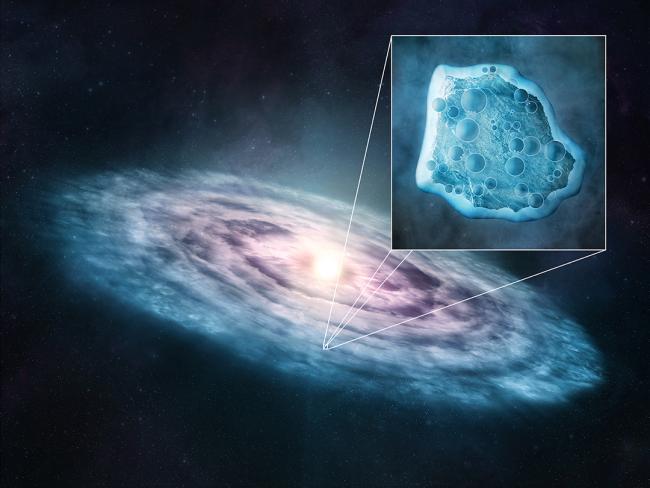
In planetary disks, carbon monoxide is lurking in large chunks of ice, solving the decade-old question, 'Where is the CO?'

Cambridge, MA – Astronomers frequently observe carbon monoxide in planetary nurseries. The compound is ultra-bright and extremely common in protoplanetary disks — regions of dust and gas where planets form around young stars — making it a prime target for scientists.

But for the last decade or so, something hasn't been adding up when it comes to carbon monoxide observations, says Diana Powell, a NASA Hubble Fellow at the Center for Astrophysics | Harvard & Smithsonian.

A huge chunk of carbon monoxide is missing in all observations of disks, if astronomers' current predictions of its abundance are correct.

Now, a new model — validated by observations with ALMA — has solved the mystery: carbon monoxide has been hiding in ice formations within the disks. The findings are described today in the journal Nature Astronomy.

"This may be one of the biggest unsolved problems in planet-forming disks," says Powell, who led the study. "Depending on the system observed, carbon monoxide is three to 100 times less than it should be; it's off by a really huge amount."

And carbon monoxide inaccuracies could have huge implications for the field of astrochemistry.

"Carbon monoxide is essentially used to trace everything we know about disks — like mass, composition and temperature," Powell explains. "This could mean many of our results for disks have been biased and uncertain because we don't understand the compound well enough."

Intrigued by the mystery, Powell put on her detective hat and leaned on her expertise in the physics behind phase changes — when matter morphs from one state to another, like a gas changing into a solid.

On a hunch, Powell made alterations to an astrophysical model that's currently used to study clouds on exoplanets, or planets beyond our solar system.

"What's really special about this model is that it has detailed physics for how ice forms on particles," she explains. "So how ice nucleates onto small particles and then how it condenses. The model carefully tracks where ice is, on what particle it's located on, how big the particles are, how small they are and then how they move around."

Powell applied the adapted model to planetary disks, hoping to generate an in-depth understanding of how carbon monoxide evolves over time in planetary nurseries. To test the model’s validity, Powell then compared its output to real ALMA observations of carbon monoxide in four well-studied disks — TW Hya, HD 163296, DM Tau and IM Lup.

The results and models worked really well, Powell says.

The new model lined up with each of the observations, showing that the four disks weren’t actually missing carbon monoxide at all — it had just morphed into ice, which is currently undetectable with a telescope.

Radio observatories like ALMA allow astronomers to view carbon monoxide in space in its gas phase, but ice is much harder to detect with current technology, especially large formations of ice, Powell says.

The model shows that unlike previous thinking, carbon monoxide is forming on large particles of ice — especially after one million years. Prior to a million years, gaseous carbon monoxide is abundant and detectable in disks.

"This changes how we thought ice and gas were distributed in disks," Powell says. "It also shows that detailed modelling like this is important to understand the fundamentals of these environments."

Powell hopes her model can be further validated using observations with NASA’s Webb Telescope — which may be powerful enough to finally detect ice in disks, but that remains to be seen.

Powell, who loves phase changes and the complicated processes behind them, says she is in awe of their influence. "Small-scale ice formation physics influences disk formation and evolution — now that’s really cool."


About the Center for Astrophysics | Harvard & Smithsonian

The Center for Astrophysics | Harvard & Smithsonian is a collaboration between Harvard and the Smithsonian designed to ask—and ultimately answer—humanity's greatest unresolved questions about the nature of the universe. The Center for Astrophysics is headquartered in Cambridge, MA, with research facilities across the U.S. and around the world.

Media Contact:

Nadia Whitehead
Public Affairs Officer
Center for Astrophysics | Harvard & Smithsonian

nadia.whitehead@cfa.harvard.edu
617-721-7371


Thursday, January 21, 2021

Cosmic brick factory

Saturday, October 19, 2019

Gas ‘Waterfalls’ Reveal Infant Planets around Young Star

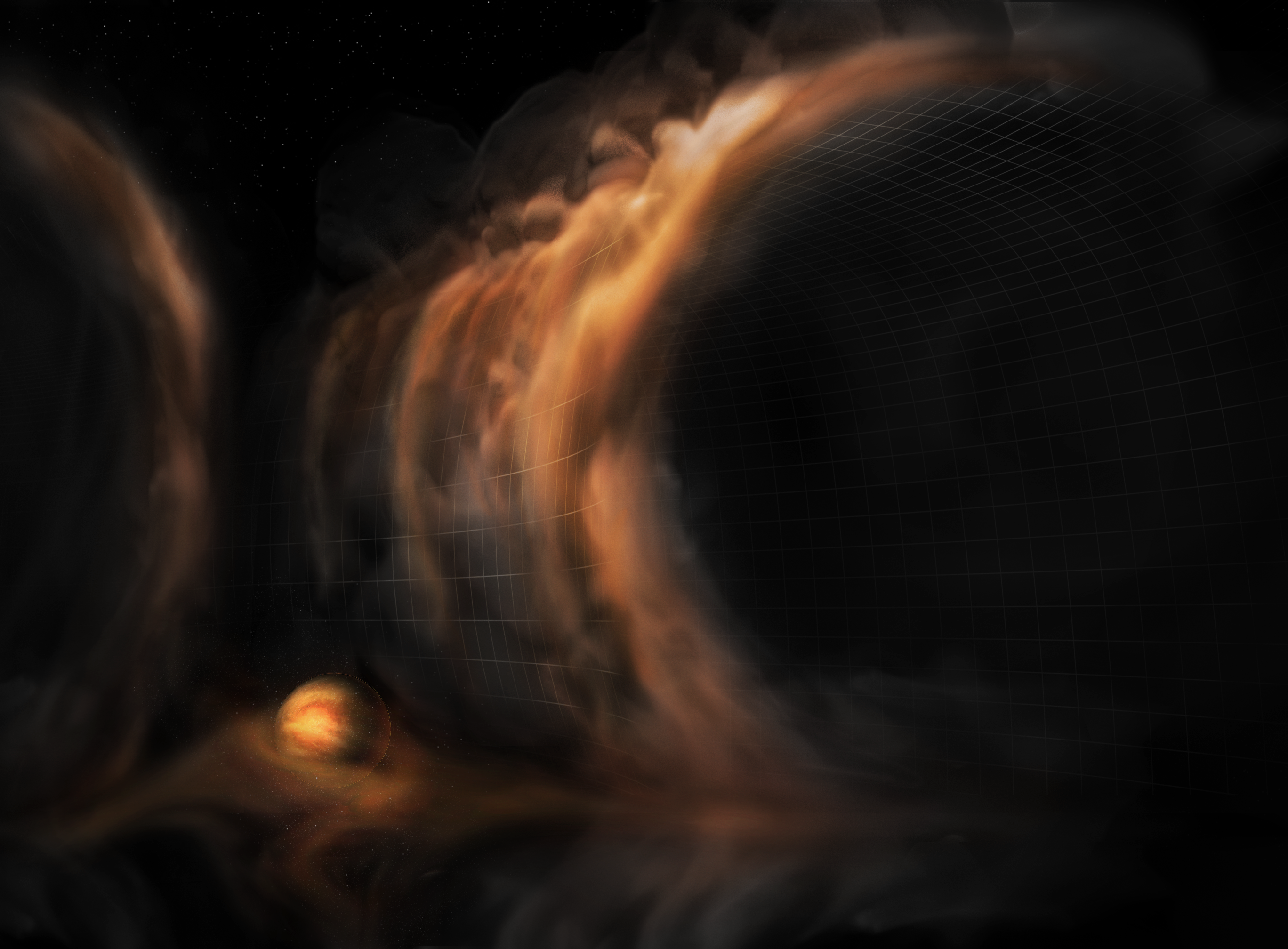
Artist impression of gas flowing like a waterfall into a protoplanetary disk gap, which is most likely caused by an infant planet. Credit: NRAO/AUI/NSF, S. Dagnello. Hi-Res File - Screensize File

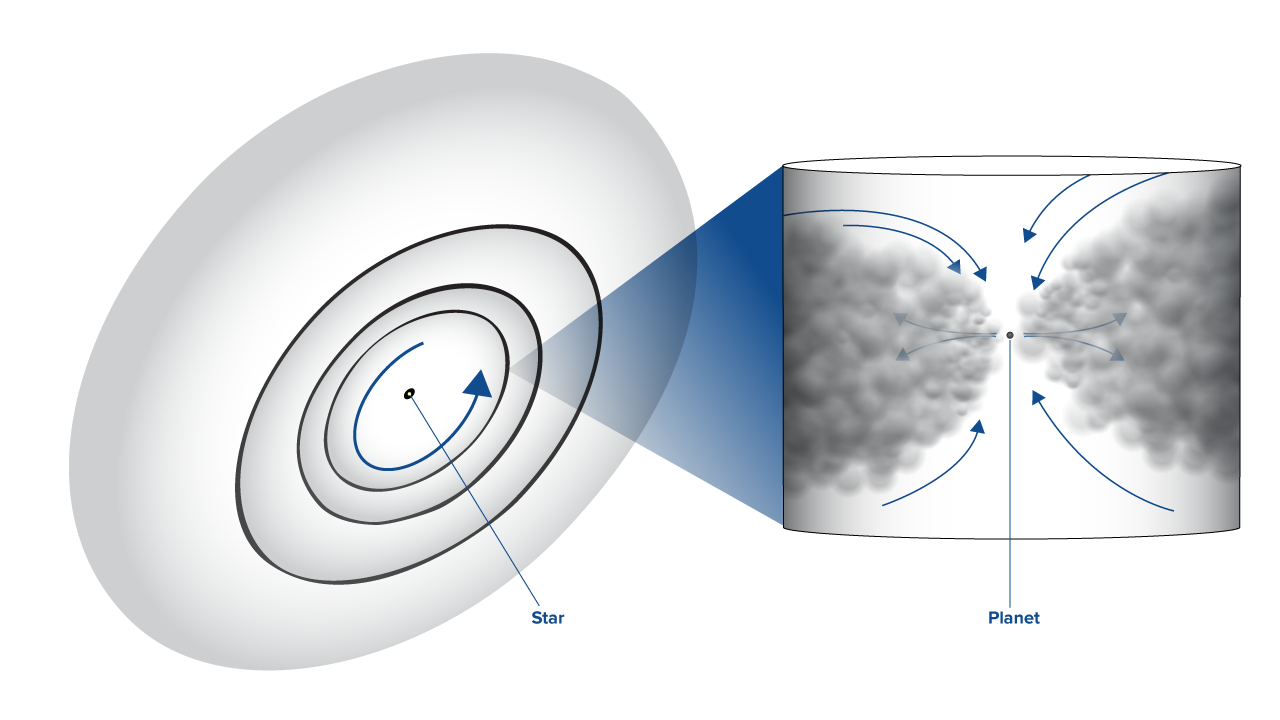
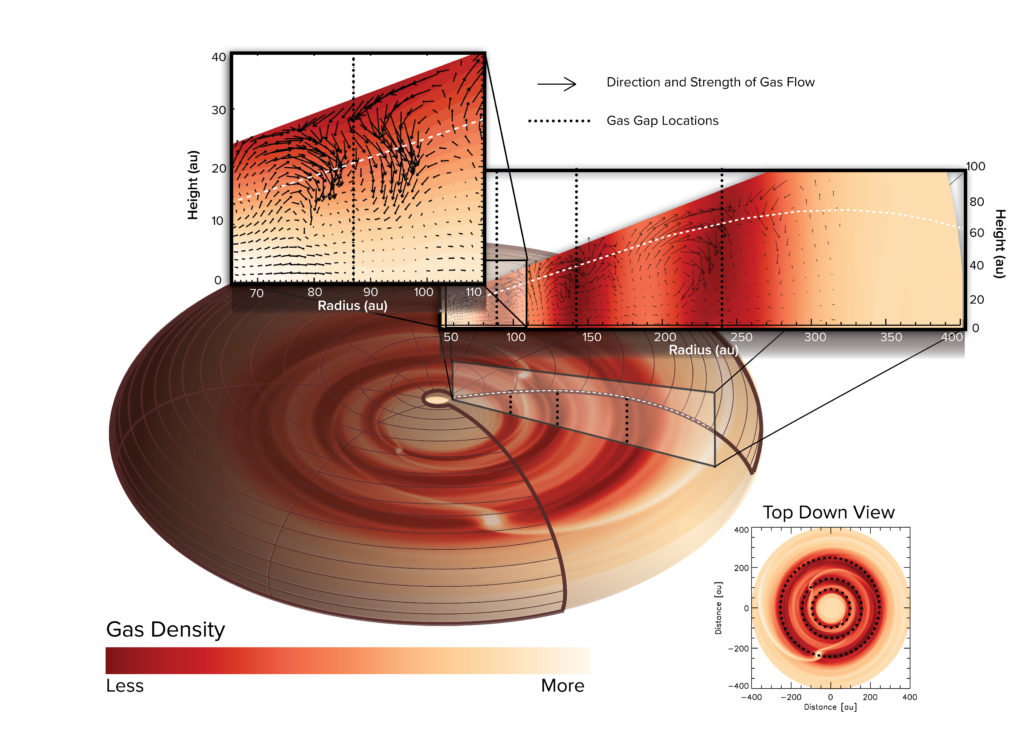
Scientists measured the motion of gas (arrows) in a protoplanetary disk in three directions: rotating around the star, towards or away from the star, and up- or downwards in the disk. The insert shows a close-up of where a planet in orbit around the star pushes the gas and dust aside, opening a gap. Credit: NRAO/AUI/NSF, B. Saxton.  Hi-Res File - Screensize File

A computer simulation showed that the patterns of gas flows are unique and are most likely caused by planets in three locations in the disk. Planets in orbit around the star push the gas and dust aside, opening gaps. The gas above the gaps collapses into it like a waterfall, causing a rotational flow of gas in the disk.Credit: ALMA (ESO/NAOJ/NRAO), J. Bae; NRAO/AUI/NSF, S. Dagnell.  Hi-Res File - Screensize File

This animation shows the computer simulation of how the gas flows in the disk as a result of three planets in formation. Credit: ALMA (ESO/NAOJ/NRAO), J. Bae; NRAO/AUI/NSF, S. Dagnello. Download Video

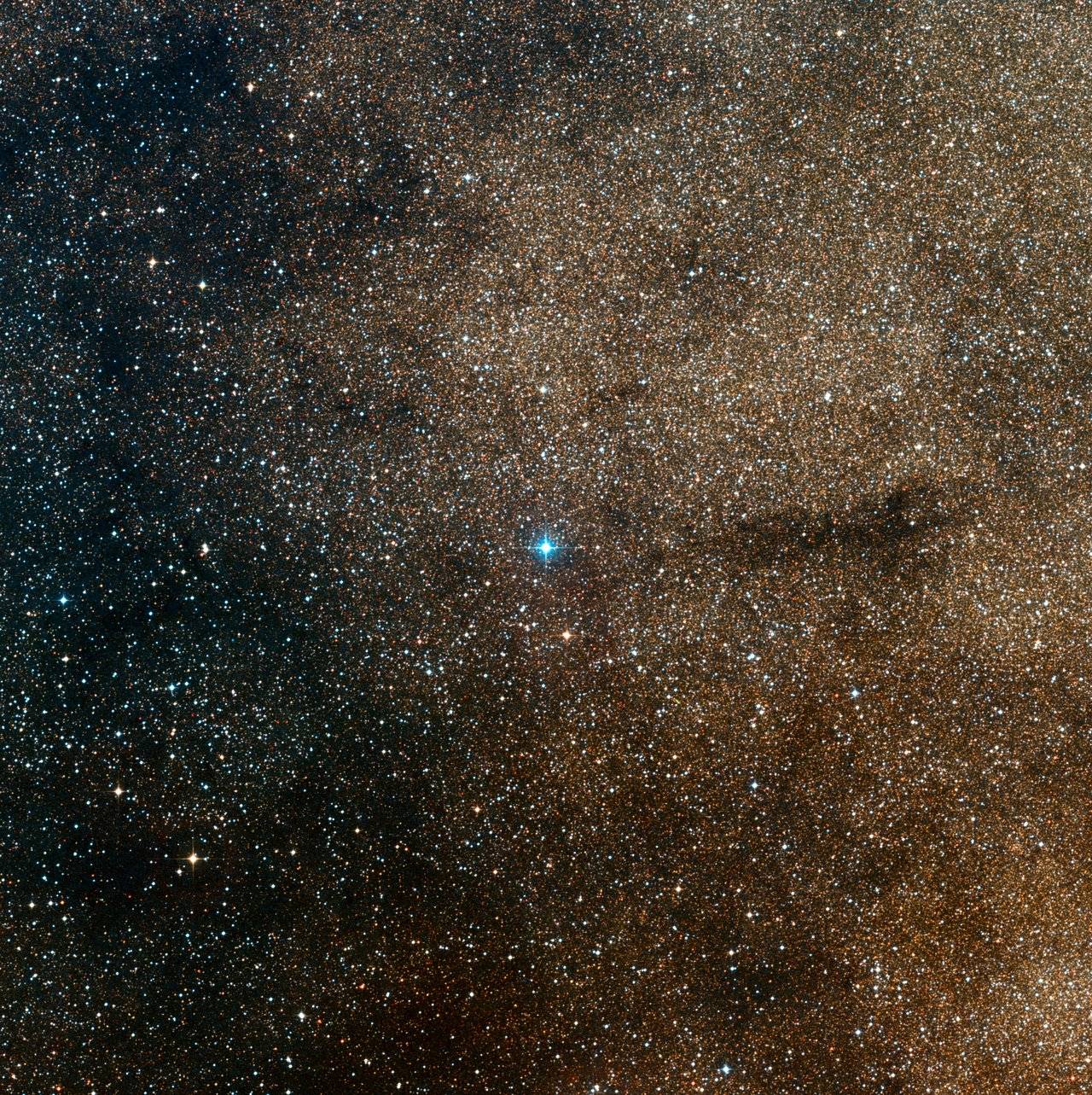
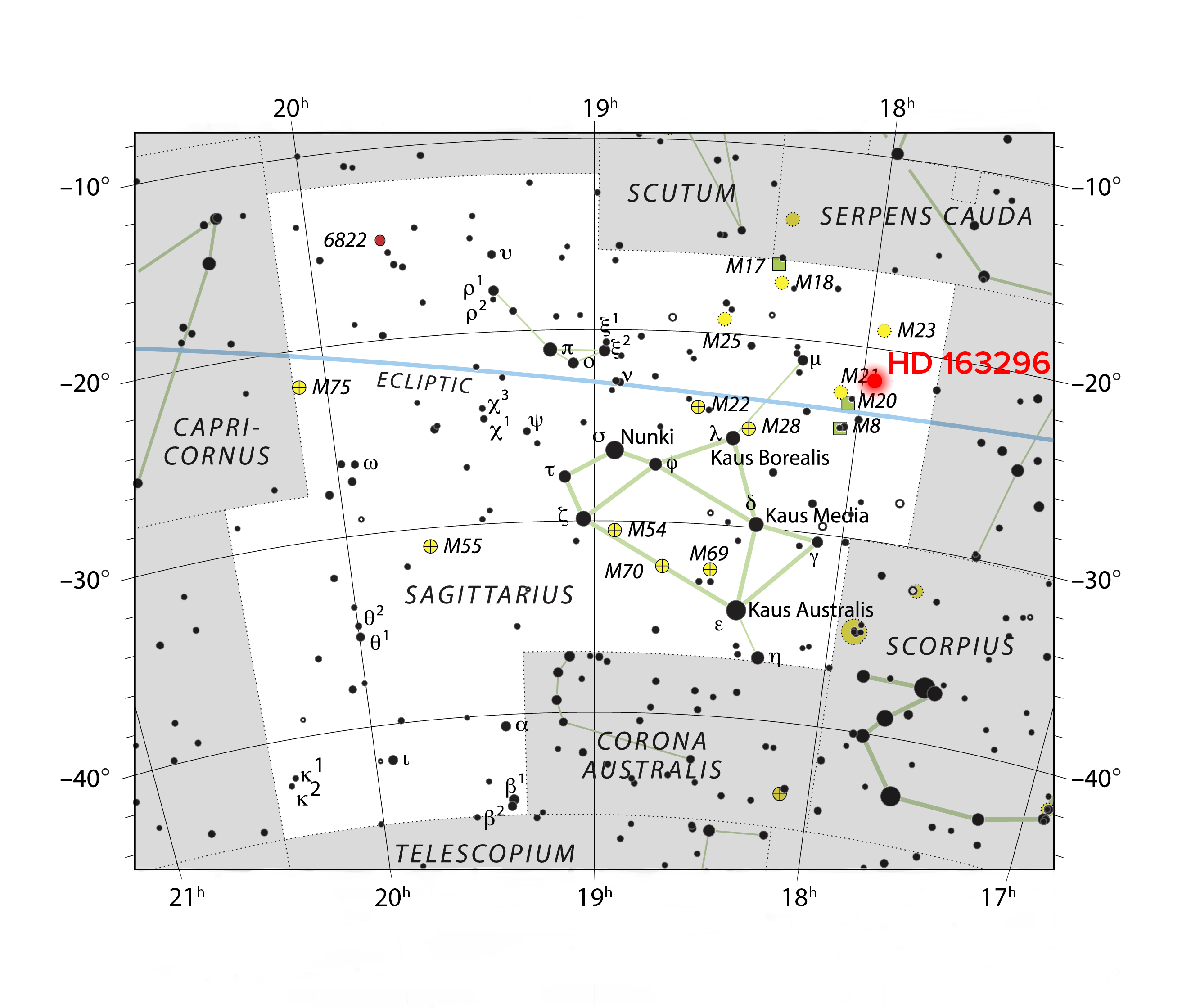
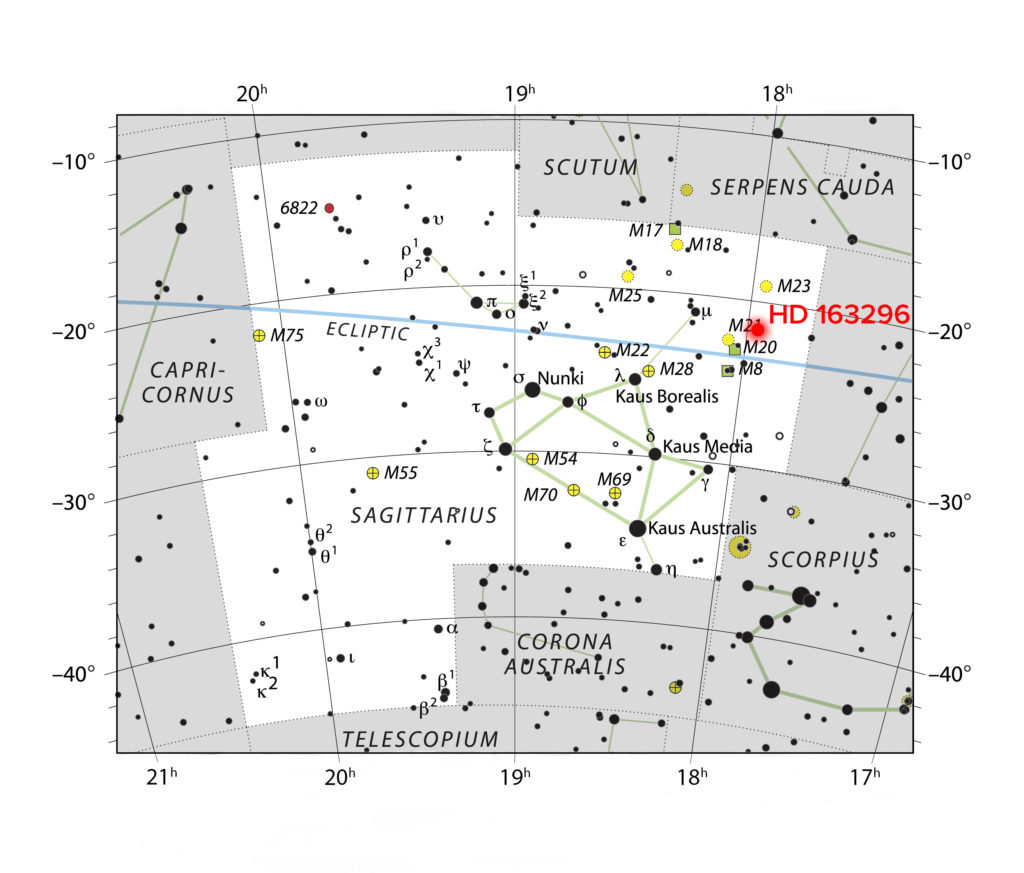
Star chart showing the location of the young star HD 163296, in the constellation Sagittarius. HD 163296 is located about 398 light-years away from our Solar System. Credit: IAU; Sky & Telescope magazine; NRAO/AUI/NSF, S. Dagnello. Hi-Res File - Screensize File


ALMA witnesses planet formation in action

The birthplaces of planets are disks made out of gas and dust. Astronomers study these so-called protoplanetary disks to understand the processes of planet formation. Beautiful images of disks made with the Atacama Large Millimeter/submillimeter Array (ALMA) show distinct gaps and ring features in dust, which may be caused by infant planets.

To get more certainty that these gaps are actually caused by planets, and to get a more complete view of planet formation, scientists study the gas in the disks in addition to dust. 99 percent of a protoplanetary disk’s mass is gas, of which carbon monoxide (CO) gas is the brightest component, emitting at a very distinctive millimeter-wavelength light that ALMA can observe.

Last year, two teams of astronomers demonstrated a new planet-hunting technique using this gas. They measured the velocity of CO gas rotating in the disk around the young star HD 163296. Localized disturbances in the movements of the gas revealed three planet-like patterns in the disk.

In this new study, lead author Richard Teague from the University of Michigan and his team used new high-resolution ALMA data from the Disk Substructures at High Angular Resolution Project (DSHARP) to study the gas’s velocity in more detail. “With the high fidelity data from this program, we were able to measure the gas’s velocity in three directions instead of just one,” said Teague. “For the first time, we measured the motion of the gas rotating around the star, towards or away from the star, and up- or downwards in the disk.”

Unique gas flows

Teague and his colleagues saw the gas moving from the upper layers towards the middle of the disk at three different locations. “What most likely happens is that a planet in orbit around the star pushes the gas and dust aside, opening a gap,” Teague explained. “The gas above the gap then collapses into it like a waterfall, causing a rotational flow of gas in the disk.”

This is the best evidence to date that there are indeed planets being formed around HD 163296. But astronomers cannot say with one hundred percent certainty that the gas flows are caused by planets. For example, the star’s magnetic field could also cause disturbances in the gas. “Right now, only a direct observation of the planets could rule out the other options. But the patterns of these gas flows are unique and it is very likely that they can only be caused by planets,” said co-author Jaehan Bae of the Carnegie Institution for Science, who tested this theory with a computer simulation of the disk.

The location of the three predicted planets in this study correspond to the results from last year: they are likely located at 87, 140 and 237 AU. (An astronomical unit – AU – is the average distance from the Earth to the Sun.) The closest planet to HD 163296 is calculated to be half the mass of Jupiter, the middle planet is Jupiter-mass, and the farthest planet is twice as massive as Jupiter.

Planet atmospheres

Gas flows from the surface towards the midplane of the protoplanetary disk have been predicted by theoretical models to exist since the late ‘90s, but this is the first time that they have been observed. Not only can they be used to detect infant planets, they also shape our understanding of how gas giant planets obtain their atmospheres.

“Planets form in the middle layer of the disk, the so-called midplane. This is a cold place, shielded from radiation from the star,” Teague explained. “We think that the gaps caused by planets bring in warmer gas from the more chemically active outer layers of the disk, and that this gas will form the atmosphere of the planet.”

Teague and his team did not expect that they would be able to see this phenomenon. “The disk around HD 163296 is the brightest and biggest disk we can see with ALMA,” said Teague. “But it was a big surprise to actually see these gas flows so clearly. The disks appears to be much more dynamic than we thought.”

“This gives us a much more complete picture of planet formation than we ever dreamed,” said co-author Ted Bergin of the University of Michigan. “By characterizing these flows we can determine how planets like Jupiter are born and characterize their chemical composition at birth. We might be able to use this to trace the birth location of these planets, as they can move during formation.”

The National Radio Astronomy Observatory is a facility of the National Science Foundation, operated under cooperative agreement by Associated Universities, Inc.


Iris Nijman
Interim Public Information Officer for ALMA
alma-pr@nrao.edu

This research is presented in a paper titled: “Meridional flows in the disk around a young star,” by R. Teague, et al. in Nature. Doi: 10.1038/s41586-019-1642-0 The Atacama Large Millimeter/submillimeter Array (ALMA), an international astronomy facility, is a partnership of the European Southern Observatory (ESO), the U.S. National Science Foundation (NSF) and the National Institutes of Natural Sciences (NINS) of Japan in cooperation with the Republic of Chile. ALMA is funded by ESO on behalf of its Member States, by NSF in cooperation with the National Research Council of Canada (NRC) and the Ministry of Science and Technology (MOST) in Taiwan and by NINS in cooperation with the Academia Sinica (AS) in Taiwan and the Korea Astronomy and Space Science Institute (KASI).

ALMA construction and operations are led by ESO on behalf of its Member States; by the National Radio Astronomy Observatory (NRAO), managed by Associated Universities, Inc. (AUI), on behalf of North America; and by the National Astronomical Observatory of Japan (NAOJ) on behalf of East Asia. The Joint ALMA Observatory (JAO) provides the unified leadership and management of the construction, commissioning and operation of ALMA.


Wednesday, June 13, 2018

ALMA Discovers Trio of Infant Planets around Newborn Star

ALMA Discovers Trio of Infant Planets

Planets in the making 

The young star HD 163296 in the constellation of Sagittarius

Surroundings of the young star HD 163296

ALMA Discovers Trio of Infant Planets


Videos

ESOcast 164 Light: ALMA Discovers Trio of Infant Planets (4K UHD)

Zooming in on the young star HD 163296


Two independent teams of astronomers have used ALMA to uncover convincing evidence that three young planets are in orbit around the infant star HD 163296. Using a novel planet-finding technique, the astronomers identified three disturbances in the gas-filled disc around the young star: the strongest evidence yet that newly formed planets are in orbit there. These are considered the first planets to be discovered with ALMA.

The Atacama Large Millimeter/submillimeter Array (ALMA) has transformed our understanding of protoplanetary discs — the gas- and dust-filled planet factories that encircle young stars. The rings and gaps in these discs provide intriguing circumstantial evidence for the presence of protoplanets [1]. Other phenomena, however, could also account for these tantalising features.

But now, using a novel planet-hunting technique that identifies unusual patterns in the flow of gas within a planet-forming disc around a young star, two teams of astronomers have each confirmed distinct, telltale hallmarks of newly formed planets orbiting an infant star [2].

“Measuring the flow of gas within a protoplanetary disc gives us much more certainty that planets are present around a young star,” said Christophe Pinte of Monash University in Australia and Institut de Planétologie et d'Astrophysique de Grenoble (Université de Grenoble-Alpes/CNRS) in France, and lead author on one of the two papers. “This technique offers a promising new direction to understand how planetary systems form.”

To make their respective discoveries, each team analysed ALMA observations of HD 163296, a young star about 330 light-years from Earth in the constellation of Sagittarius (The Archer) [3]. This star is about twice the mass of the Sun but is just four million years old — just a thousandth of the age of the Sun.

“We looked at the localised, small-scale motion of gas in the star’s protoplanetary disc. This entirely new approach could uncover some of the youngest planets in our galaxy, all thanks to the high-resolution images from ALMA,” said Richard Teague, an astronomer at the University of Michigan and principal author on the other paper.

Rather than focusing on the dust within the disc, which was clearly imaged in earlier ALMA observations, the astronomers instead studied carbon monoxide (CO) gas spread throughout the disc. Molecules of CO emit a very distinctive millimetre-wavelength light that ALMA can observe in great detail. Subtle changes in the wavelength of this light due to the Doppler effect reveal the motions of the gas in the disc.

The team led by Teague identified two planets located approximately 12 billion and 21 billion kilometres from the star. The other team, led by Pinte, identified a planet at about 39 billion kilometres from the star [4].

The two teams used variations on the same technique, which looks for anomalies in the flow of gas — as evidenced by the shifting wavelengths of the CO emission — that indicate the gas is interacting with a massive object [5].

The technique used by Teague, which derived averaged variations in the flow of the gas as small as a few percent, revealed the impact of multiple planets on the gas motions nearer to the star. The technique used by Pinte, which more directly measured the flow of the gas, is better suited to studying the outer portion of the disc. It allowed the authors to more accurately locate the third planet, but is restricted to larger deviations of the flow, greater than about 10%.

In both cases, the researchers identified areas where the flow of the gas did not match its surroundings — a bit like eddies around a rock in a river. By carefully analysing this motion, they could clearly see the influence of planetary bodies similar in mass to Jupiter.

This new technique allows astronomers to more precisely estimate protoplanetary masses and is less likely to produce false positives. “We are now bringing ALMA front and centre into the realm of planet detection,” said coauthor Ted Bergin of the University of Michigan.
Both teams will continue refining this method and will apply it to other discs, where they hope to better understand how atmospheres are formed and which elements and molecules are delivered to a planet at its birth.


Notes

[1] Although thousands of exoplanets have been discovered in the last two decades, detecting protoplanets remains at the cutting edge of science and there have been no unambiguous detections before now. The techniques currently used for finding exoplanets in fully formed planetary systems — such as measuring the wobble of a star or the dimming of starlight due to a transiting planet — do not lend themselves to detecting protoplanets.

[2] The motion of gas around a star in the absence of planets has a very simple, predictable pattern (Keplerian rotation) that is nearly impossible to alter both coherently and locally, so that only the presence of a relatively massive object can create such disturbances.

[3] ALMA’s stunning images of HD 163296 and other similar systems have revealed intriguing patterns of concentric rings and gaps within protoplanetary discs. These gaps may be evidence that protoplanets are ploughing the dust and gas away from their orbits, incorporating some of it into their own atmospheres. A previous study of this particular star’s disc shows that the gaps in the dust and gas overlap, suggesting that at least two planets have formed there.

These initial observations, however, merely provided circumstantial evidence and could not be used to accurately estimate the masses of the planets.

[4] These correspond to 80, 140 and 260 times the distance from the Earth to the Sun.

[5] This technique is similar to the one that led to the discovery of the planet Neptune in the nineteenth century. In that case anomalies in the motion of the planet Uranus were traced to the gravitational effect of an unknown body, which was subsequently discovered visually in 1846 and found to be the eighth planet in the Solar System.


More Information

This research was presented in two papers to appear in the same edition of the Astrophysical Journal Letters. The first is entitled “Kinematic evidence for an embedded protoplanet in a circumstellar disc”, by C. Pinte et al. and the second “A Kinematic Detection of Two Unseen Jupiter Mass Embedded Protoplanets”, by R. Teague et al.

The Pinte team is composed of: C. Pinte (Monash University, Clayton, Victoria, Australia; Univ. Grenoble Alpes, CNRS, IPAG, Grenoble, France), D. J. Price (Monash University, Clayton, Victoria, Australia), F. Ménard (Univ. Grenoble Alpes, CNRS, IPAG, Grenoble, France), G. Duchêne (University of California, Berkeley California, USA; Univ. Grenoble Alpes, CNRS, IPAG, Grenoble, France), W.R.F. Dent (Joint ALMA Observatory, Santiago, Chile), T. Hill (Joint ALMA Observatory, Santiago, Chile), I. de Gregorio-Monsalvo (Joint ALMA Observatory, Santiago, Chile), A. Hales (Joint ALMA Observatory, Santiago, Chile; National Radio Astronomy Observatory, Charlottesville, Virginia, USA) and D. Mentiplay (Monash University, Clayton, Victoria, Australia).

The Teague team is composed of: Richard D. Teague (University of Michigan, Ann Arbor, Michigan, USA), Jaehan Bae (Department of Terrestrial Magnetism, Carnegie Institution for Science, Washington, DC, USA), Edwin A. Bergin (University of Michigan, Ann Arbor, Michigan, USA), Tilman Birnstiel (University Observatory, Ludwig-Maximilians-Universität München, Munich, Germany) and Daniel Foreman- Mackey (Center for Computational Astrophysics, Flatiron Institute, New York, USA).

The Atacama Large Millimeter/submillimeter Array (ALMA), an international astronomy facility, is a partnership of ESO, the U.S. National Science Foundation (NSF) and the National Institutes of Natural Sciences (NINS) of Japan in cooperation with the Republic of Chile. ALMA is funded by ESO on behalf of its Member States, by NSF in cooperation with the National Research Council of Canada (NRC) and the National Science Council of Taiwan (NSC) and by NINS in cooperation with the Academia Sinica (AS) in Taiwan and the Korea Astronomy and Space Science Institute (KASI). ALMA construction and operations are led by ESO on behalf of its Member States; by the National Radio Astronomy Observatory (NRAO), managed by Associated Universities, Inc. (AUI), on behalf of North America; and by the National Astronomical Observatory of Japan (NAOJ) on behalf of East Asia. The Joint ALMA Observatory (JAO) provides the unified leadership and management of the construction, commissioning and operation of ALMA. ESO is the foremost intergovernmental astronomy organisation in Europe and the world’s most productive ground-based astronomical observatory by far. It has 15 Member States: Austria, Belgium, the Czech Republic, Denmark, France, Finland, Germany, Italy, the Netherlands, Poland, Portugal, Spain, Sweden, Switzerland and the United Kingdom, along with the host state of Chile and with Australia as a strategic partner. ESO carries out an ambitious programme focused on the design, construction and operation of powerful ground-based observing facilities enabling astronomers to make important scientific discoveries. ESO also plays a leading role in promoting and organising cooperation in astronomical research. ESO operates three unique world-class observing sites in Chile: La Silla, Paranal and Chajnantor. At Paranal, ESO operates the Very Large Telescope and its world-leading Very Large Telescope Interferometer as well as two survey telescopes, VISTA working in the infrared and the visible-light VLT Survey Telescope. ESO is also a major partner in two facilities on Chajnantor, APEX and ALMA, the largest astronomical project in existence. And on Cerro Armazones, close to Paranal, ESO is building the 39-metre Extremely Large Telescope, the ELT, which will become “the world’s biggest eye on the sky”.


Links


Contacts

Christophe Pinte
Monash University
Clayton, Victoria, Australia
Tel: +61 4 90 30 24 18
Email:
christophe.pinte@univ-grenoble-alpes.fr

Richard Teague
University of Michigan
Ann Arbor, Michigan, USA
Tel: +1 734 764 3440
Email:
rteague@umich.edu

Calum Turner
ESO Assistant Public Information Officer
Garching bei München, Germany
Tel: +49 89 3200 6670
Email: calum.turner@eso.org

Source: ESO/News