Comparison
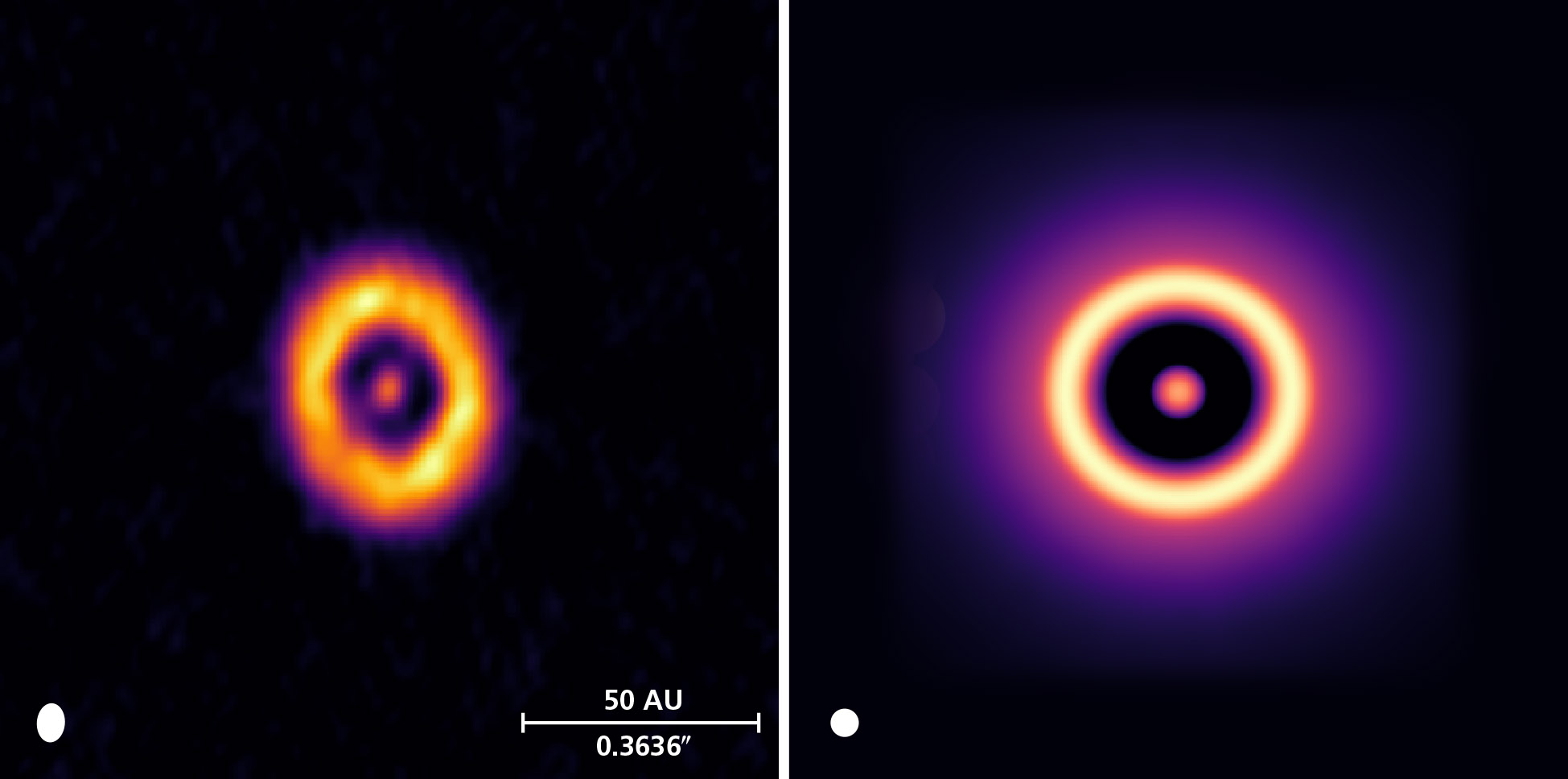
between observed and simulated dust distributions in transition disks.
Left: Image of the disk around the object CIDA1 at a wavelength of 0.9
mm obtained with the ALMA interferometer as published in Pinilla et al.,
A&A 649, A122 (2021), DOI: 10.1051/0004-6361/202140371. The disk is
slightly tilted with respect to the image plane. Right: Synthetic image
of the dust distribution from the simulations performed by Matías
Gárate and collaborators. Image: Pinilla et al./Gárate et al./MPIA
Progress in understanding the dispersal mechanisms of planet-forming disks
A group of astronomers, led by scientists from the Max Planck Institute
for Astronomy, propose and have tested a mechanism that explains most of
the properties observed in dispersing planet-forming disks around
newborn stars for the first time. The key ingredients to this new
physical concept are X-ray emissions from the central star and a calm
inner disk, well shielded from the incident radiation. This approach
explains the seemingly contradicting features observed in those
dwindling transition disks that previous models have been unable to
reconcile. This result, published in the journal “Astronomy & Astrophysics” today, is a big step to understanding the evolution from dusty disks to clean planetary systems like the Solar System
Planets form inside disks made of gas and dust. Each of those disks
already gave birth to a new star, or, for that matter, to a predecessor
that still has to ignite its nuclear fusion fire, called a protostar.
When we look at the Solar System, we recognise that most of that
material has long since disappeared. In recent years, research has
reached a basic understanding of how these circumstellar disks lose
their remnant gas and dust. With the advent of powerful telescopes,
astronomers have even identified and studied those dissolving disks
coined transition disks.
However, identifying the detailed
physical processes remained unsuccessful. The theoretical concepts
scientists have explored so far only reproduced a few of the observed
properties at a time. Now, a research group led by astronomers from the
Max Planck Institute for Astronomy (MPIA) in Heidelberg, Germany,
proposes a new scheme that overcomes most of the disadvantages of
previous approaches. “Earlier models failed to reproduce more than only a few of the observational results of transition disks,” says Matías Gárate, lead author of the underlying scientific article and scientist at MPIA. “However,
we are now able to explain most of the properties that seem to
contradict each other: a wide gap in the disk and a sustained accretion
of gas and dust from a long-lived inner disk onto the central star.”
Properties of transition disks seem contradictory
Intuitively, it is hard to understand why almost all observed
transition disks with a wide gap show signs of accretion. Accretion is
the process that feeds the central star with gas and dust from the
circumstellar disk. Before the gap opens, material from the thicker
outer disk replenishes the inner sectors, sustaining the subsequent
transport towards the central star. However, the reservoir is limited,
which, in time, reduces the matter flow.
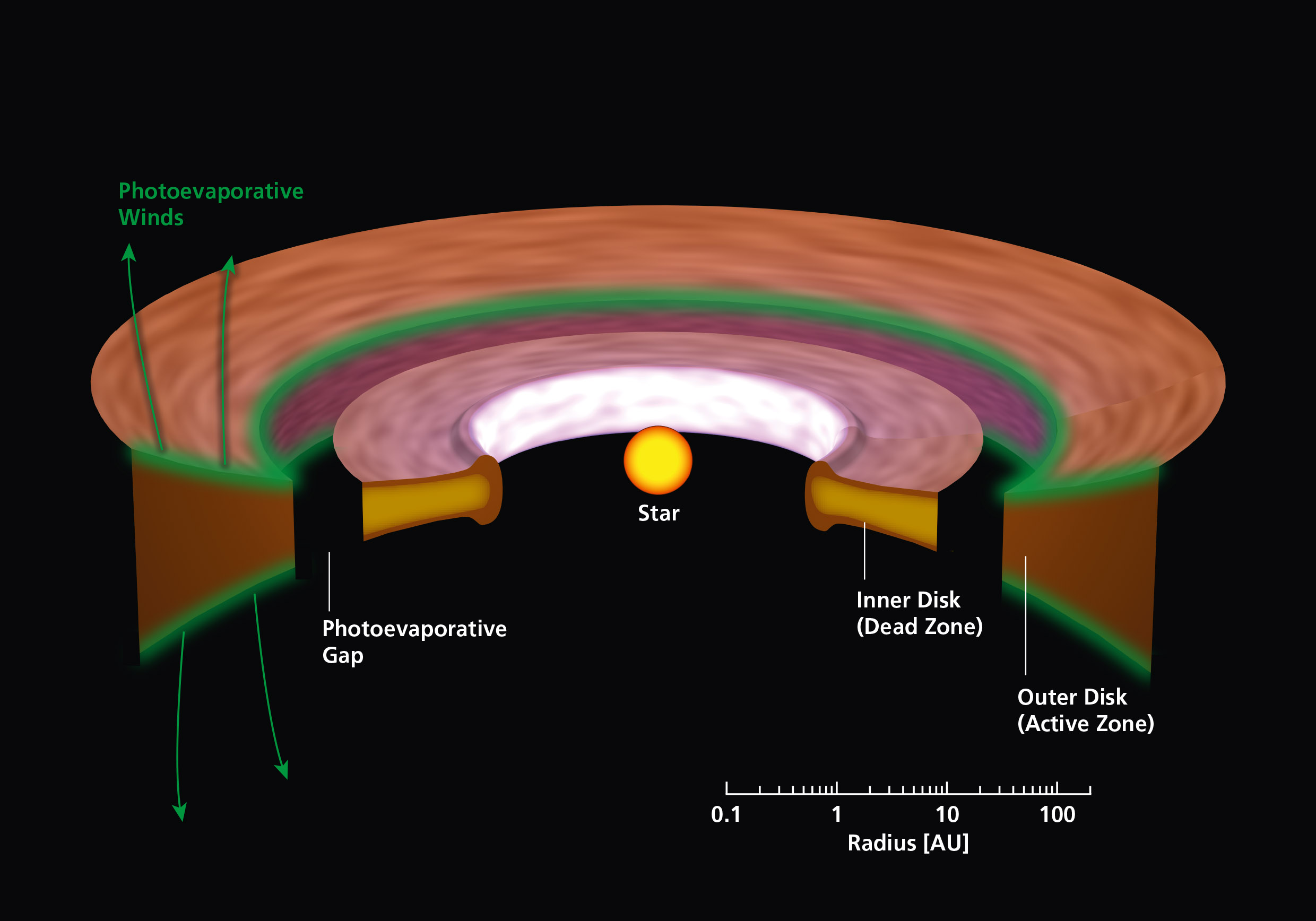
At the same time, X-ray
emission from the star hits and heats the disk surface. The radiation
gives rise to a wind that expels the then ionised gas into open space.
This process is called photoevaporation. As soon as it is more efficient
than the outside-in matter flow in the disk, a gap begins to open and
disconnects the inner disk from the outer reservoir. At this point, the
inner disk should empty very quickly via accretion and disappear
rapidly. Accretion onto the star comes to a halt.
A dead zone can keep the disk alive
“We realised that to extend the lifetime of the inner disk and
prolong accretion activity, we had to find a mechanism that reduces the
inward drift of the gas and the dust,” Paola Pinilla points out, who is the “Genesis of Planets” research group leader at MPIA and a co-author of the paper. “One way of doing this is to include a generally accepted component of circumstellar disks, a so-called dead zone,” Timmy Delage adds, who is a PhD student at MPIA and another co-author of the research article.
A
dead zone is a relatively calm annular region of a circumstellar disk
where the random gas motion is reduced compared to other disk
components. Consequently, friction between individual particles becomes
almost negligible, making it difficult to reduce their orbital
velocities, stabilising their orbits. Dead zones may manifest themselves
when gas is insufficiently ionised and only poorly affected by magnetic
fields. They can occur, for example, when the gas is dense enough to
protect the deeper disk layers from ionisation by radiation hitting the
disk.
Simulating the influence of dead zones
To verify if such a dead zone can explain the observational findings
of accreting transition disks with wide gaps, Matías Gárate and his
colleagues simulated their evolution in time. They constructed a
physical disk model while varying the initial conditions for the dead
zone and including X-ray irradiation to facilitate photoevaporation. “We
were thrilled when we saw the results. A large majority of the
simulated transition disks with a wide range of gap sizes retained a
detectable accretion flow to the central solar-type star,” Gárate
reports. This result demonstrates that dead zones can produce accreting
transition disks with wide gaps in large numbers.
Although the
result is a big leap in understanding what astronomers find with
telescopes when looking at actual transition disks, it still falls short
of reproducing the exact numbers. While observations appear to find
approximately 3% of the transition disks to be non-accreting, the
simulations produce more than ten times this fraction. Indeed, since
computing power is limited, the model used in this study only reflects a
simplified version of the real world and does not include all possible
mechanisms suspected to occur in such disks. Some of them may even
increase the longevity of the inner disk. On the other hand, it is well
possible astronomers have to revisit some of their conclusions drawn
from observations, and there may actually be more non-accreting disks
than previously thought.
Visualising simulated transition disks
During their study, the MPIA-led team explored the accretion activity
by focussing on the gas. Still, the dust can behave quite differently.
When astronomers take images of such planet-forming disks, it is often
the distribution of the dust they see radiating at millimetre
wavelengths, frequently shaped in the form of concentric rings.
Therefore, the MPIA astronomers investigated if their simulations also
treat the dust realistically.
“To compare our calculations
with highly resolved images of real transitions disks we had obtained
with the ALMA interferometer, we produced a synthetic picture of one of
the simulated dust disks,” says co-author Jochen Stadler, a master
student at MPIA and Heidelberg University. The result is a stunning
confirmation. The image of the computer-generated dust distribution
shows the elements typical of transition disks: a small inner disk and
an outer ring, both separated by a wide gap.
As often, the devil
is in the details. While the structures appear to be a good match, the
brightnesses disagree. The dust emission of the simulated transition
disks is considerably fainter than one would expect from observations.
Hence, the synthetic disks probably possess less dust than the real
ones. However, the authors have a reasonable solution for this
discrepancy. “We think this is a consequence of planet formation we have not included in our models,”
Gárate points out. Studies frequently show that newly formed planets
carve gaps along their orbits through the disk. Such rifts function like
barriers for the dust drifting radially. Gárate adds: “It is well
possible the planetary gaps escape detection by observation due to
insufficient spatial resolution. If planets form in the inner disk, that
may help prevent dust from accreting onto the central star. We will
extend our models accordingly and explore if we can also solve this
puzzle.”
Additional Information
The team consists of Matías Gárate (Max Planck Institute for Astronomy,
Heidelberg, Germany [MPIA] and University Observatory, Faculty of
Physics, Ludwig Maximilians University Munich, Germany [LMU]), Timmy N.
Delage (MPIA), Jochen Stadler (MPIA), Paola Pinilla (MPIA and Mullard
Space Science Laboratory, University College London, Dorking, United
Kingdom), Til Birnstiel (LMU and Exzellencluster ORIGINS, Garching,
Germany), Sebastian Markus Stammler (LMU), Giovanni Picogna (LMU),
Barbara Ercolano (LMU), Raphael Franz (LMU), and Christian Lenz (MPIA).
Original publication
1.
Matías Gárate, Timmy N. Delage, Jochen Stadler, Paola Pinilla, Til Birnstiel, Sebastian M. Stammler, Giovanni Picogna, Barbara Ercolano, Raphael Franz, Christian Lenz
Large gaps and high accretion rates in photoevaporative transition disks with a dead zone
Astronomy & Astrophysics (2021)
Source / DOI
Links:
The Genesis of Planets - Research group project website
ALMA Observatory - Website of the Atacama Large Millimetre/Submillimetre Array
Image download: