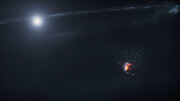
Artist interpretation depicts a hypothesized event known as a superkilonova. Initially, a massive star explodes in a supernova, which generates elements like carbon and iron (left). In the aftermath, two neutron stars are born, at least one of which is believed to be less massive than our Sun (middle). The neutron stars spiral together, sending gravitational waves rippling through the cosmos, before merging in a dramatic kilonova (right). Kilonovae seed the universe with the heaviest elements, such as gold at platinum, which glow in red light as depicted in the animation. Credit: Caltech/K. Miller and R. Hurt (IPAC)
Potential first-of-a-kind may have produced gravitational waves and light
Maunakea, Hawaiʻi – A team of astronomers using a variety of telescopes, including the W. M. Keck Observatory on Maunakea, Hawaiʻi Island, have discovered a possible “Superkilonova” that exploded not once but twice, evidence that this oddball event may be a first-of-a-kind superkilonova, or a kilonova spurred by a supernova. Such an event has been hypothesized but
never seen.
When the most massive stars reach the ends of their lives, they blow up in spectacular supernova explosions, which seed the universe with heavier elements such as carbon and iron. Another type of explosion—the kilonova—occurs when a pair of dense, dead stars called neutron stars smash together, forging even heavier elements, such as gold and uranium. The heavy elements created by both of these explosions are among the basic building blocks of stars and planets.
So far, only one kilonova has been unambiguously confirmed to date, a historic event known as GW170817, which took place in 2017. In that case, two neutron stars smashed together, sending ripples in space-time known as gravitational waves, as well as light waves, across the cosmos. The cosmic blast was detected in gravitational waves by the National Science Foundation’s Laser Interferometer Gravitational-Wave Observatory (LIGO) and its European partner, the Virgo gravitational-wave detector, and in
light waves by dozens of ground-based and space telescopes around the world.
The curious case of the kilonova candidate, AT2025ulz, is complex, and thought to have stemmed from a supernova blast that went
off hours before, ultimately obscuring astronomers’ view and making the case more complicated.
“At first, for about three days, the eruption looked just like the first kilonova in 2017,” said Mansi Kasliwal, professor of astronomy at The California Institute of Technology and director of Palomar Observatory. “Everybody was intensely
trying to observe and analyze it, but then it started to look more like a supernova, and some astronomers lost interest. Not us.”
The study, led by The California Institute of Technology, is published in
The Astrophysical Journal Letters.
In August 2025, a new gravitational-wave signal was picked up by The Laser Interferometer Gravitational-Wave Observatory (LIGO) and Virgo in Italy. Within minutes, an alert was issued to the astronomical community containing a rough map of the source signaling to researchers that gravitational waves had been registered from what appeared to be a merger between two objects, with at least one of them being unusually tiny.
After first being identified by the Zwicky Transient Facility at Palomar Observatory, Kasliwal coordinated with Keck Observatory staff astronomer Michael Lundquist to launch a rapid Target of Opportunity (ToO) observation of AT2025ulz, a process that allows scientists to request immediate access for short-lived cosmic events. Mansi’s ToO request enabled the immediate spectroscopic follow-up using the Low-Resolution Imaging Spectrograph (LRIS).
“Keck Observatory provided the imagery and spectroscopy via our Low-Resolution Imaging Spectrograph (LRIS) Instrument to measure the host extinction and redshift of the galaxy as well as looking at the spectroscopic evolution,” Lundquist said. “This highlights Keck Observatory’s Target of Opportunity capability to rapidly respond to transient alerts and deliver the spectroscopic data needed to explore potential multi-messenger associations.”
The observations confirmed that the eruption of light had faded fast and glowed at red wavelengths—just as GW170817 had done eight years earlier. In the case of the GW170817 kilonova, the red colors came from heavy elements like gold; these atoms have more electron energy levels than lighter elements, so they block blue light but let red light pass through.
Then, days after the blast, AT2025ulz started to brighten again, turn blue and show hydrogen in its spectra, all signs of a supernova not a kilonova (specifically a “stripped-envelope, core-collapse” supernova). Supernovae from distant galaxies are generally not expected to generate enough gravitational waves to be detectable by LIGO and Virgo, whereas kilonovae are. This led some astronomers to conclude that AT2025ulz was triggered by a typical, ho-hum supernova and not in fact related to the gravitational-wave signal.
What Might Be Going On?Kasliwal says that several clues tipped her off that something unusual had taken place. Though AT2025ulz did not resemble the classic kilonova GW170817, it also did not look like an average supernova. Additionally, the LIGO–Virgo gravitational-wave data had revealed that at least one of the neutron stars in the merger was less massive than our Sun, a hint that one or two small neutron stars might have merged to produce a kilonova.
Neutron stars are the leftover remains of massive stars that explode as supernovae. They are thought to be around the size of San Francisco (about 22 to 30 kilometers across) with masses that range from 1.2 to about 3 times that of our Sun. Some theorists have proposed ways in which neutron stars might be even smaller, with masses less than the Sun’s, but none have been observed so far.
Theorists invoke two scenarios to explain how a neutron star could be that small. In one, a rapidly spinning massive star goes supernova, then splits into two tiny, sub-solar neutron stars in a process termed fission. In the second scenario, called fragmentation, the rapidly spinning star again goes supernova, but this time a disk of material forms around the collapsing star. The lumpy disk material coalesces into a tiny neutron in a manner similar to how planets form.
With LIGO and Virgo having detected at least one sub-solar neutron star, it is possible, according to theories proposed by co-author Brian Metzger of Columbia University that two newly formed neutron stars could have crashed into each other, erupting as a kilonova that sent gravitational waves rippling through the cosmos. As the kilonova churned out heavy metals, it would have initially glowed in red light as ZTF and other telescopes observed. The expanding debris from the initial supernova blast would have obscured the astronomers’ view of the kilonova. In other words, a supernova may have birthed twin baby neutron stars that then merged to make a kilonova.
“The only way theorists have come up with to birth sub-solar neutron stars is during the collapse of a very rapidly spinning star,” Metzger says. “If these ‘forbidden’ stars pair up and merge by emitting gravitational waves, it is possible that such an event would be accompanied by a supernova rather than be seen as a bare kilonova.”
But while this theory is tantalizing and interesting to consider, the research team stresses that there is not enough evidence to make firm claims. The only way to test the superkilonovae theory is to find more.
“Future kilonovae events may not look like GW170817 and may be mistaken for supernovae,” Kasliwal says. “We can look for new possibilities in data like this, but we do not know with certainty that we found a superkilonova. The event, nevertheless, is eye o,brpening.”
.
About LRIS
The Low Resolution Imaging Spectrometer (LRIS) is a very versatile and ultra-sensitive visible-wavelength imager and spectrograph built at the California Institute of Technology by a team led by Prof. Bev Oke and Prof. Judy Cohen and commissioned in 1993. Since then it has seen two major upgrades to further enhance its capabilities: the addition of a second, blue arm optimized for shorter wavelengths of light and the installation of detectors that are much more sensitive at the longest (red) wavelengths. Each arm is optimized for the wavelengths it covers. This large range of wavelength coverage, combined with the instrument’s high sensitivity, allows the study of everything from comets (which have interesting features in the ultraviolet part of the spectrum), to the blue light from star formation, to the red light of very distant objects. LRIS also records the spectra of up to 50 objects simultaneously, especially useful for studies of clusters of galaxies in the most distant reaches, and earliest times, of the universe. LRIS was used in observing distant supernovae by astronomers who received the Nobel Prize in Physics in 2011 for research determining that the universe was speeding up in its expansion.
About W. M. Keck Observatory
The W. M. Keck Observatory telescopes are among the most scientifically productive on Earth. The two 10-meter optical/infrared telescopes atop Maunakea on the Island of Hawaiʻi feature a suite of advanced instruments including imagers, multi-object spectrographs, high-resolution spectrographs, integral-field spectrometers, and world-leading laser guide star adaptive optics systems. Some of the data presented herein were obtained at Keck Observatory, which is a private 501(c) 3 non-profit organization operated as a scientific partnership among the California Institute of Technology, the University of California, and the National Aeronautics and Space Administration. The Observatory was made possible by the generous financial support of the W. M. Keck Foundation. The authors wish to recognize and acknowledge the very significant cultural role and reverence that the summit of Maunakea has always had within the Native Hawaiian community. We are most fortunate to have the opportunity to conduct observations from this mountain. For more information, visit: www.keckobservatory.org