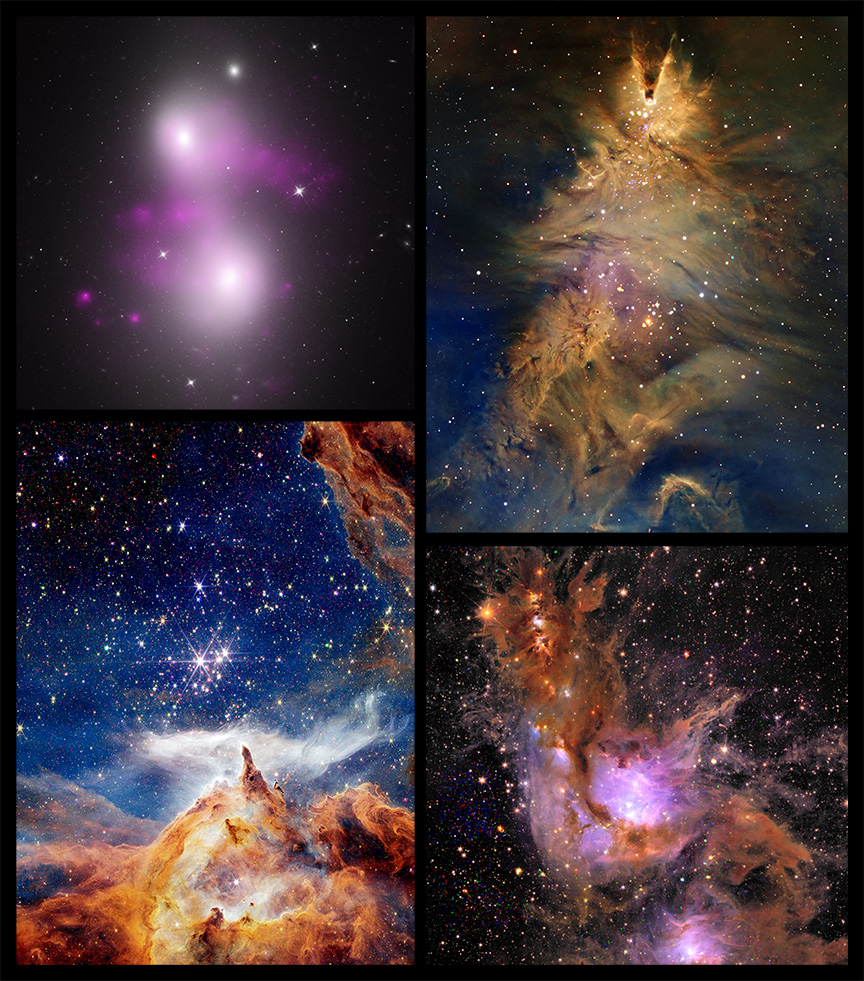
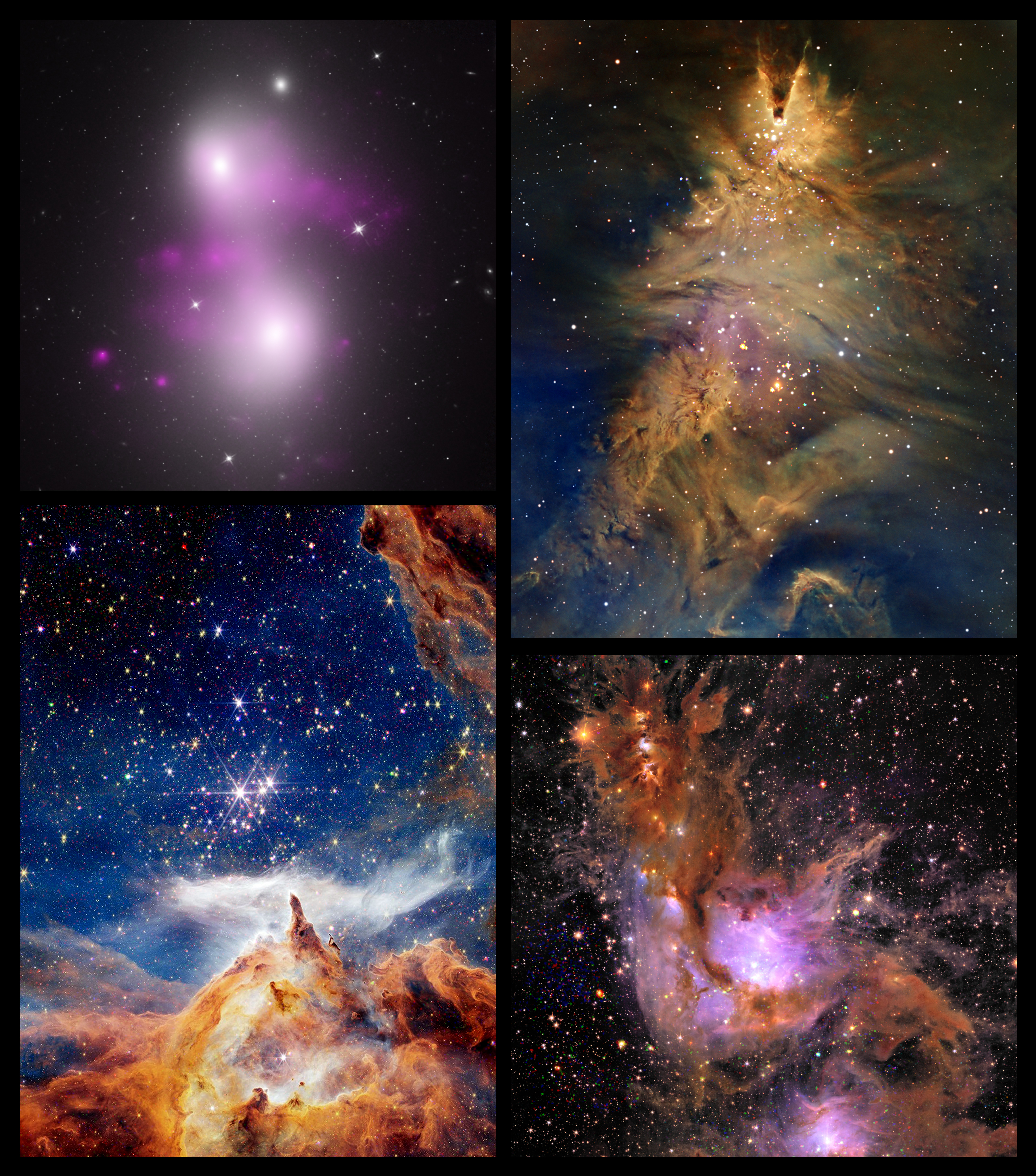
Four images with Chandra data that are connected to the winter season, labeled.
Credit: NASA/CXC/SAO
JPEG (468.4 kb) - Large JPEG (11.4 MB) - Tiff (49.1 MB) - More Images
A Quick Look: Cosmic Holiday Greetings From NASA's Chandra X-ray Observatory - More Videos
A Quick Look: Cosmic Holiday Greetings From NASA's Chandra X-ray Observatory - More Videos
NASA’s Chandra X-ray Observatory is sending out a holiday card with four new images of cosmic wonders. Each of the quartet of objects evokes the winter season or one of its celebratory days either in its name or shape.
Chandra’s seasonal greetings begin with NGC 4782 and NGC 4783, a pair of colliding galaxies when oriented in a certain way resembles a snowman. The top and bottom of the snowman are each elliptical galaxies, separated by a distance of about 170 million light-years. The galaxies, seen in an image from NASA’s Hubble Space Telescope (gray), are bound together through gravity. X-rays from Chandra (purple) show a bridge of hot gas between the two galaxies, like a winter scarf.
Chandra’s seasonal greetings begin with NGC 4782 and NGC 4783, a pair of colliding galaxies when oriented in a certain way resembles a snowman. The top and bottom of the snowman are each elliptical galaxies, separated by a distance of about 170 million light-years. The galaxies, seen in an image from NASA’s Hubble Space Telescope (gray), are bound together through gravity. X-rays from Chandra (purple) show a bridge of hot gas between the two galaxies, like a winter scarf.

Four images with Chandra data that are connected to the winter season, labeled.
Credit: NASA/CXC/SAOTo the right of the cosmic snowman is one of the most iconic symbols of the season, a Christmas tree. This celestial version takes an optical light image (red, gold, blue, and white) from an astrophotographer that shows the “branches” of NGC 2264, a relatively young nebula where new stars are forming. Within this cloud of gas and dust, baby stars appear as high-energy baubles in X-ray light from Chandra (red, green, and blue) plus some additional X-ray data from ESA’s XMM-Newton.
To the right of the cosmic snowman is one of the most iconic symbols of the season, a Christmas tree. This celestial version takes an optical light image (red, gold, blue, and white) from an astrophotographer that shows the “branches” of NGC 2264, a relatively young nebula where new stars are forming. Within this cloud of gas and dust, baby stars appear as high-energy baubles in X-ray light from Chandra (red, green, and blue) plus some additional X-ray data from ESA’s XMM-Newton.
NGC 2264, The Christmas Tree Nebula, in "twinkling" light.
Credit: X-ray: NASA/CXC/SAO and ESA/XMM-Newton; Optical: B. Vuk;
Image Processing: NASA/CXC/SAO/L. Frattare and K. Arcand
On the bottom left is the nebula NGC 6357 that contains Pismis 24, a young cluster of stars about 5,500 light-years from Earth. This stellar landscape is reminiscent of a winter vista in a view from NASA’s James Webb Space Telescope (red, green, and blue). Chandra data (red, green and blue) punctuate the scene with bursts of colored lights representing high-energy activity from the active stars.
The final image in this holiday card display is M78, a striking nebula in the Orion constellation that may also bring a partridge in the proverbial pear tree to mind. M78 is a reflection nebula, which is cloud interstellar dust that glows from the scattered light embedded within it. The bird-like structure is seen in infrared and optical light by Euclid (red, green and blue) while Chandra data provide speckled lights across the nebula (red, green, and blue).
NASA's Marshall Space Flight Center in Huntsville, Alabama, manages the Chandra program. The Smithsonian Astrophysical Observatory's Chandra X-ray Center controls science operations from Cambridge, Massachusetts, and flight operations from Burlington, Massachusetts.
The final image in this holiday card display is M78, a striking nebula in the Orion constellation that may also bring a partridge in the proverbial pear tree to mind. M78 is a reflection nebula, which is cloud interstellar dust that glows from the scattered light embedded within it. The bird-like structure is seen in infrared and optical light by Euclid (red, green and blue) while Chandra data provide speckled lights across the nebula (red, green, and blue).
NASA's Marshall Space Flight Center in Huntsville, Alabama, manages the Chandra program. The Smithsonian Astrophysical Observatory's Chandra X-ray Center controls science operations from Cambridge, Massachusetts, and flight operations from Burlington, Massachusetts.
Source: NASA’s Chandra X-ray Observatory
Visual Description:
This release features four colorful composite images presented in an irregular grid, each evoking an aspect of winter and the holiday season.
The first image, at our upper left, features a pair of colliding galaxies that resembles a snowman in optical light from Hubble when oriented vertically. The two galaxies, NGC 4782 and NGC 4783, appear as hazy white balls with solid white cores, one stacked above the other. Linking the two galaxies is a bridge of hot gas in X-ray light from Chandra depicted here as a string of fuzzy neon purple balls. The string of gas loosely zigzags back and forth between the two galaxies, like a cozy scarf worn by a snowman.
The second holiday image, at the upper right of the irregular grid, strongly resembles a golden Christmas tree bedecked with twinkling lights. The tree is actually NGC 2264, a relatively young nebula where new stars are forming. The tree's branches, which sweep back and forth in a roughly conical shape, are golden clouds of dust and gas, all from optical light captured by an astrophotographer. Tucked into these branches are colorful lights and glowing baubles in X-rays from Chandra and XMM-Newton, colored in green, blue, purple, and orange; baby stars growing inside the nebula.
At the lower lefthand corner of the grid is a winter scene fit for a holiday greeting card. Above what appears to be a fantastical snowy mountainscape, is a brilliant blue sky packed with colorful lights. The golden mountainscape is in fact part of the nebula NGC 6357, as captured by NASA's James Webb Space Telescope. The green, red, and golden lights in the blue sky above are bursts of high-energy X-rays from active stars, detected by Chandra.
The final holiday image, at the lower right of the grid, is a nebula which calls to mind the first gift in the Christmas carol 'The Twelve Days of Christmas'. Here, the wispy burnt orange nebula, M78, forms a tree, with a vertical trunk near the center of the image in infrared and optical light from the European Space Agency's Euclid mission. The tree's bushy branches reach toward our upper left, and its tail of roots drifts toward our lower right. The tree of interstellar dust is offset by a pink c,brloud, which resembles cotton candy, and is backed by a black sky packed with speckled lights. At the top of the tree, near the upper lefthand corner of the image, is a dusty orange cloud shape which strongly resembles a bird in profile; the proverbial pa,hrrtridge in the pear tree. Sprinkled across are tiny dots of colorful lights,showcasing X-rays captured by Chandra.
The first image, at our upper left, features a pair of colliding galaxies that resembles a snowman in optical light from Hubble when oriented vertically. The two galaxies, NGC 4782 and NGC 4783, appear as hazy white balls with solid white cores, one stacked above the other. Linking the two galaxies is a bridge of hot gas in X-ray light from Chandra depicted here as a string of fuzzy neon purple balls. The string of gas loosely zigzags back and forth between the two galaxies, like a cozy scarf worn by a snowman.
The second holiday image, at the upper right of the irregular grid, strongly resembles a golden Christmas tree bedecked with twinkling lights. The tree is actually NGC 2264, a relatively young nebula where new stars are forming. The tree's branches, which sweep back and forth in a roughly conical shape, are golden clouds of dust and gas, all from optical light captured by an astrophotographer. Tucked into these branches are colorful lights and glowing baubles in X-rays from Chandra and XMM-Newton, colored in green, blue, purple, and orange; baby stars growing inside the nebula.
At the lower lefthand corner of the grid is a winter scene fit for a holiday greeting card. Above what appears to be a fantastical snowy mountainscape, is a brilliant blue sky packed with colorful lights. The golden mountainscape is in fact part of the nebula NGC 6357, as captured by NASA's James Webb Space Telescope. The green, red, and golden lights in the blue sky above are bursts of high-energy X-rays from active stars, detected by Chandra.
The final holiday image, at the lower right of the grid, is a nebula which calls to mind the first gift in the Christmas carol 'The Twelve Days of Christmas'. Here, the wispy burnt orange nebula, M78, forms a tree, with a vertical trunk near the center of the image in infrared and optical light from the European Space Agency's Euclid mission. The tree's bushy branches reach toward our upper left, and its tail of roots drifts toward our lower right. The tree of interstellar dust is offset by a pink c,brloud, which resembles cotton candy, and is backed by a black sky packed with speckled lights. At the top of the tree, near the upper lefthand corner of the image, is a dusty orange cloud shape which strongly resembles a bird in profile; the proverbial pa,hrrtridge in the pear tree. Sprinkled across are tiny dots of colorful lights,showcasing X-rays captured by Chandra.
Fast Facts for NGC 4782/NGC 4783, The Snowman Galaxies:
Credit: X-ray: NASA/CXC/SAO; Optical: NASA/ESA/STScI/HST; Image Processing: NASA/CXC/SAO/J. Schmidt
Release Date: December 22, 2025
Scale: Image is about 1.4 arcmin (87,000 light-years) across.
Category: Groups and Clusters of Galaxies
Coordinates (J2000): RA: 12h 54m 35.6s | Dec: -12° 34' 07.4"
Constellation: Corvus
Observation Date(s): 1 observation June 16, 2002
Observation Time: 13 hours and 47 minutes
Obs. IDs: 3220
Instrument: ACIS
References: Machacek, M., et al., 2007, ApJ, 664, 804
Color Code: X-ray: purple; Optical: grayscale
Distance Estimate: About 210 million light-years from Earth
Fast Facts for NGC 2264, The Christmas Tree Nebula:
Credit: X-ray: NASA/CXC/SAO and ESA/XMM-Newton; Optical: B. Vuk; Image Processing: NASA/CXC/SAO/L. Frattare and K. Arcand
Release Date: December 22, 2025
Scale: Image is about 77 arcmin (56 light-years) across.
Category: Normal Stars & Star Clusters
Coordinates (J2000): RA: 06h 40m 42.8s | Dec: +09° 49' 03.6"
Constellation: Monoceros
Observation Date(s): 8 observations from February 2002 to December 2011
Observation Time: 137 hours 26 minutes (5 days 17 hours 26 minutes)
Obs. IDs: 2540, 2550, 9768, 9769, 13610, 13611, 14368, 14369
Instrument: ACIS
References: Ramirez, S., et al., 2004, AJ, 127, 2659
Instrument: ACIS
Color Code: X-ray: red, green, and blue; Optical: red, gold, blue, and white
Distance Estimate: About 2,500 light-years from Earth
Fast Facts for NGC 6357/Pismis 24:
Credit: X-ray: NASA/CXC/Penn State/G.Garmire; Infrared: NASA, ESA, CSA, and STScI; Image Processing: NASA/CXC/SAO/L. Frattare and NSA/ESA/CSA/STScI/A. Pagan
Release Date: December 22, 2025
Scale: Image is about 4.2 arcmin (6.7 light-years) across.
Category: Normal Stars and Star Clusters
Coordinates (J2000): RA: 17h 24m 44.4s | Dec: -34° 11' 35.9"
Constellation: Scorpius
Observation Date(s): 3 observations from July 2004 to Aug 2022
Observation Time: 30 hours 15 minutes (1 day 6 hours 15 minutes)
Obs. IDs: 4477, 18453, 26003
Instrument: ACIS
References: Townsley, L., et al., 2019, ApJS, 244, 28
Color Code: X-ray: red, green, and blue; Infrared: red, green, and blue
Distance Estimate: About 5,500 light-years from Earth
Fast Facts for M78:
Credit: X-ray: NASA/CXC/SAO; Infrared/Optical: ESA/Euclid/Euclid Consortium/NASA; Image Processing: NASA/CXC/SAO/L. Frattare
Release Date: December 22, 2025
Scale: Image is about 41 arcmin (19 light-years) across.
Category: Normal Stars and Star Clusters
Coordinates (J2000): RA: 5h 46m 45.8s | Dec: +0° 0′ 08.1"
Constellation: Orion
Observation Date(s): 2 observations: Oct 2000 and Aug 2021
Observation Time: 28 hours 56 minutes (1 day 4 hours 56 minutes)
Obs. IDs: 1872, 25686
Instrument: ACIS
References: Grosso, N et al., 2004, A&A, 419, 653
Color Code: X-ray: red, green, and blue; Infrared/Optical: red, green, and blue
Distance Estimate: About 1,600 light-years from Earth