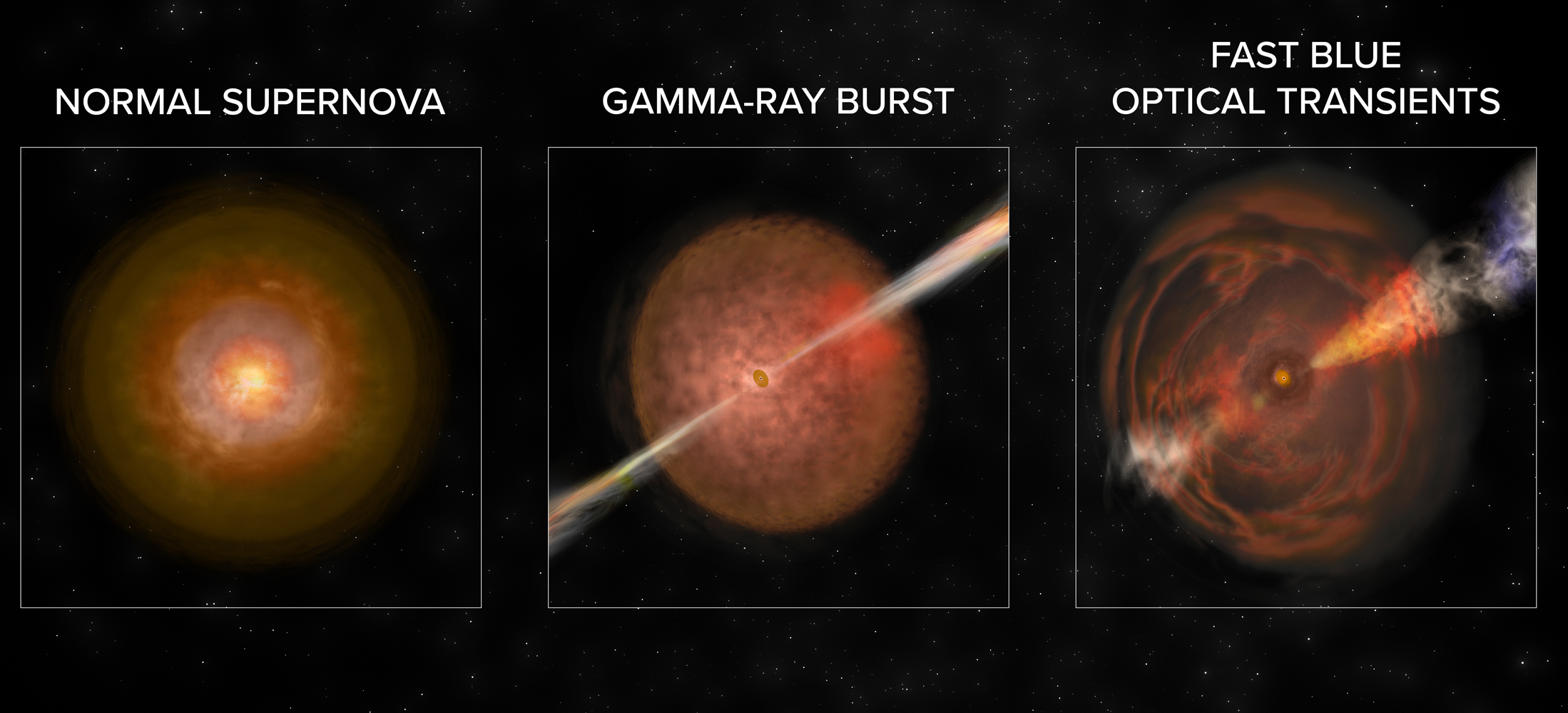
In 2024, astronomers discovered the brightest Luminous Fast Blue Optical Transient (LFBOT) ever observed. LFBOTs are extremely bright flashes of blue light that shine for brief periods before fading away. New analysis of this record-breaking burst, which includes observations from the International Gemini Observatory, funded in part by the U.S. National Science Foundation, challenges all prior understanding of these rare explosive events.
Among the more puzzling cosmic phenomena discovered over the past few decades are brief and very bright flashes of blue and ultraviolet light that gradually fade away, leaving behind faint X-ray and radio emissions. This curious class of objects is known as luminous fast blue optical transients (LFBOTs), and with slightly more than a dozen discovered so far, astronomers have debated whether they are produced by an unusual type of supernova or by interstellar gas falling into a black hole.
Analysis of the brightest LFBOT to-date, named AT 2024wpp and discovered last year, shows that they’re neither. Instead, a team led by researchers from the University of California, Berkeley, concluded that they are caused by an extreme tidal disruption, where a black hole of up to 100 times the mass of our Sun completely shreds its massive star companion within days.
This discovery resolves a decade-long conundrum but also illustrates the many varieties of stellar calamities that astronomers encounter, each with its characteristic spectrum of light that evolves over time. Figuring out the processes that produce these unique light signatures tests current knowledge of the physics of black holes and helps astronomers understand the evolution of stars in our Universe.
The team’s analysis of AT 2024wpp is presented in two papers recently accepted by The Astrophysical Journal Letters. The studies utilize data from a large collection of telescopes that measured the various wavelengths of light emitted by the LFBOT [2]. Crucial near-infared data was collected with the Flamingos-2 instrument on the Gemini South telescope in Chile, one half of the International Gemini Observatory, funded in part by the U.S. National Science Foundation and operated by NSF NOIRLab.
“The ongoing discovery of luminous fast blue optical transients shows that Gemini South and other ground-based astronomical facilities are primed to characterize these mysterious objects,” says Martin Still, NSF program director for the International Gemini Observatory. “We expect the NSF–DOE Vera C. Rubin Observatory will spot large numbers of these transient objects, giving Gemini and other telescopes unprecedented opportunities for detailed follow-up observations.”
LFBOTs got their name because they are bright — they’re visible over distances of hundreds of millions to billions of light years — and last for only a few days. They produce high-energy light ranging from the blue end of the optical spectrum through ultraviolet and X-ray. The first was seen in 2014, but the first with sufficient data to analyze was recorded in 2018 and, per the standard naming convention, was called AT 2018cow. The name led researchers to refer to it as the Cow, and subsequent LFBOTs have been called, tongue in cheek, the Koala (ZTF18abvkwla), the Tasmanian devil (AT 2022tsd) and the Finch (AT 2023fhn). Perhaps AT 2024wpp will be known as the Wasp.
The realization that AT 2024wpp could not have resulted from a supernova came after the researchers calculated the energy it emitted. It turned out to be 100 times greater than what would be produced in a normal supernova. The radiated energy would require the conversion of about 10% of the rest-mass of the Sun into energy over a very short time scale of weeks.
Specifically, the Gemini South observations revealed an excess of near-infrared light being emitted from the source. This is only the second time astronomers have observed such a phenomenon (the other case being AT 2018cow), which is clearly not present in ordinary stellar explosions. These observations establish the near-infrared excess as a hallmark feature of FBOTs, though no model can explain this occurrence.
“The sheer amount of radiated energy from these bursts is so large that you can't power them with a core collapse stellar explosion — or any other type of normal stellar explosion,” says Natalie LeBaron, UC Berkeley graduate student and first author on the paper presenting the Gemini data [1]. “The main message from AT 2024wpp is that the model that we started off with is wrong. It’s definitely not just an exploding star.”
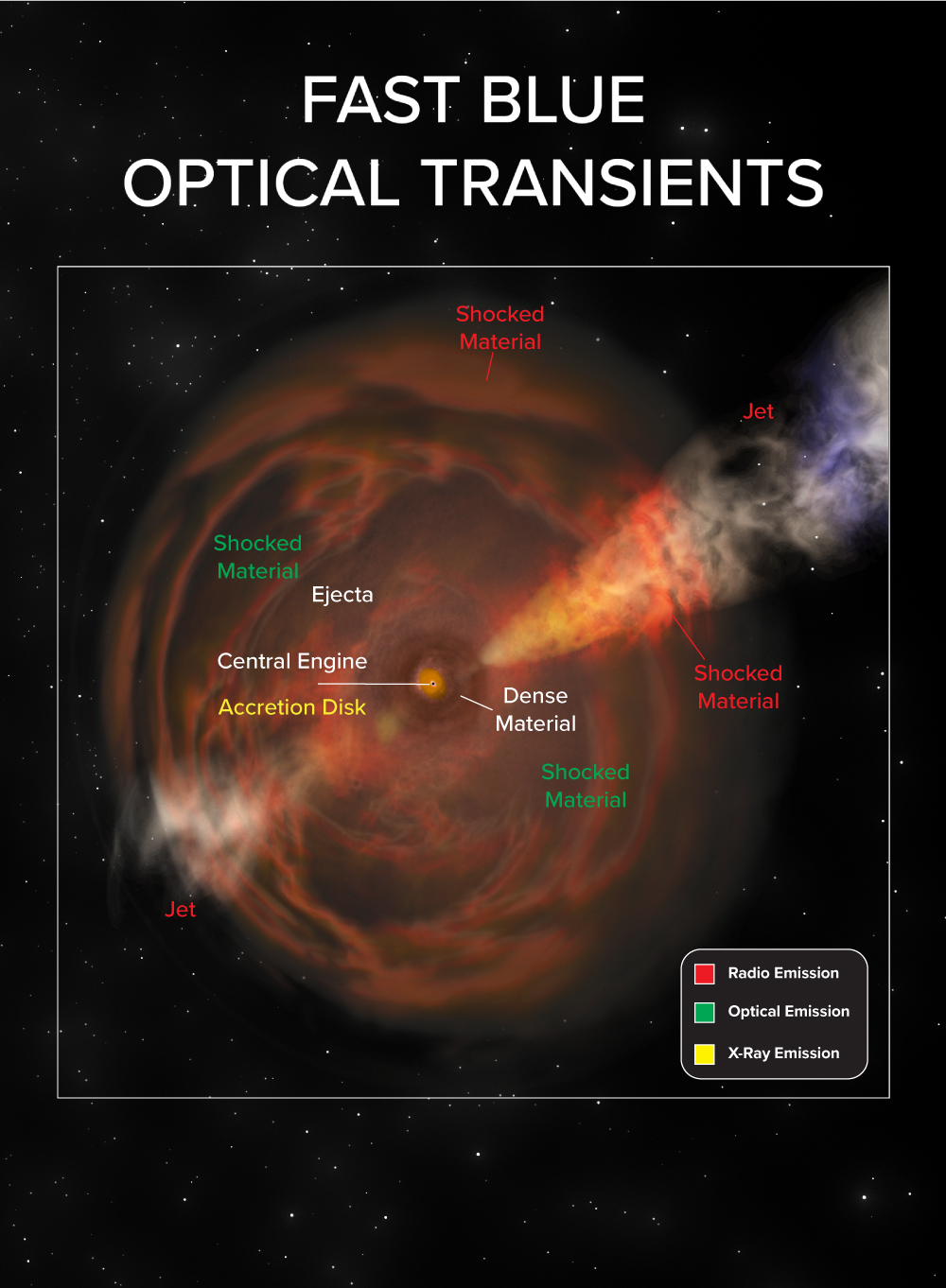
The researchers hypothesize that the intense, high-energy light emitted during this extreme tidal disruption was a consequence of the long parasitic history of the black hole binary system. As they reconstruct this history, the black hole had been sucking material from its companion for a long time, completely enshrouding itself in a halo of material too far from the black hole for it to swallow.
Then, when the companion star finally got too close and was torn apart, the new material became entrained into the rotating accretion disk and slammed against the existing material, generating X-ray, ultraviolet, and blue light. Much of the gas from the companion also ended up swirling toward the poles of the black hole, where it was ejected as a jet of material. The team calculated that the jets were traveling at about 40% of the speed of light and generated radio waves when they encountered surrounding gas.
Like most LFBOTs, AT 2024wpp is located in a galaxy with active star formation, so large stars like these are expected. AT 2024wpp is 1.1 billion light years away and between 5 and 10 times more luminous than AT 2018cow.
The estimated mass of the companion star that was shredded was more than 10 times the mass of the Sun. It may have been what’s known as a Wolf-Rayet star, which is a very hot and evolved star that has already used up much of its hydrogen. This would explain the weak hydrogen emission from AT 2024wpp.
Notes
[2] In addition to Gemini South, this study includes observations made with NASA’s Chandra X-ray Observatory, Swift-XRT, the Nuclear Spectroscopic Telescope Array (NuSTAR), the Atacama Large Millimeter/submillimeter Array (ALMA), the Australia Telescope Compact Array (ATCA), the Ultra-Violet/Optical Telescope (UVOT) on NASA’s Neil Gehrels Swift Observatory, the W.M. Keck Observatory, and Lick Observatory.
More information
The team is composed of N. LeBaron (UC Berkeley, USA), R. Margutti (UC Berkeley, USA), R. Chornock (UC Berkeley, USA), N. A. J. (UC Berkeley, USA), O. Aspegren (UC Berkeley, USA), W. Lu (UC Berkeley, USA), B. D. Metzger (Columbia University/Flatiron Institute, USA), D. Kasen (UC Berkeley/Lawrence Berkeley National Laboratory, USA), T. G. Brink (UC Berkeley, USA), S. Campana (INAF, Italy), P. D’Avanzo (INAF, Italy), J. T. Faber (California Institute of Technology, USA), M. Ferro (University of Insubria/INAF, Italy), A. V. Filippenko (UC Berkeley, USA), R. J. Foley (UC Santa Cruz, USA), X. Guo (UC Berkeley, USA), E. Hammerstein (UC Berkeley, USA), S. W. Jha (Rutgers University, USA), C. D. Kilpatrick (Northwestern University, USA), G. Migliori (INAF, Italy), D. Milisavljevic (Purdue University, USA), K. C. Patra (UC Santa Cruz, USA), H. Sears (Rutgers University, USA), J. J. Swift (The Thacher School, USA) , S. Tinyanont (NARIT, Thailand), V. Ravi (California Institute of Technology, USA), Y. Yao (UC Berkeley, USA), K. D. Alexander (Steward Observatory, USA), P. Arunachalam (UC Santa Cruz, USA), E. Berger (Center for Astrophysics | Harvard & Smithsonian, USA), J. S. Bright (University of Oxford, UK), C. Cynamon (Supra Solem Observatory, USA), K. W. Davis (UC Santa Cruz, USA), B. Garretson (Purdue University, USA), P. Guhathakurta (UC Santa Cruz, USA), W. V. Jacobson-Galán (California Institute of Technology, USA), D. O. Jones (Gemini Observatory/NSF NOIRLab, USA), R. Kaur (UC Santa Cruz, USA), S. Kimura (Willamette University, USA), T. Laskar (University of Utah, USA/Radboud University, The Netherlands), Morgan Nuñez (San Francisco State University, USA), M. Schwab (Rutgers University, USA), M. D. Soraisam (Gemini Observatory/NSF NOIRLab, USA), N. Suzuki (Lawrence Berkeley National Laboratory/Florida State University, USA), K. Taggart (UC Santa Cruz, USA), E. Wiston (UC Berkeley, USA), Y. Yang (Tsinghua University, China), and W. Zheng (UC Berkeley, USA).
NSF NOIRLab, the U.S. National Science Foundation center for ground-based optical-infrared astronomy, operates the International Gemini Observatory (a facility of NSF, NRC–Canada, ANID–Chile, MCTIC–Brazil, MINCyT–Argentina, and KASI–Republic of Korea), NSF Kitt Peak National Observatory (KPNO), NSF Cerro Tololo Inter-American Observatory (CTIO), the Community Science and Data Center (CSDC), and NSF–DOE Vera C. Rubin Observatory (in cooperation with DOE’s SLAC National Accelerator Laboratory). It is managed by the Association of Universities for Research in Astronomy (AURA) under a cooperative agreement with NSF and is headquartered in Tucson, Arizona.
The scientific community is honored to have the opportunity to conduct astronomical research on I’oligam Du’ag (Kitt Peak) in Arizona, on Maunakea in Hawai‘i, and on Cerro Tololo and Cerro Pachón in Chile. We recognize and acknowledge the very significant cultural role and reverence of I’oligam Du’ag to the Tohono O’odham Nation, and Maunakea to the Kanaka Maoli (Native Hawaiians) community.
Links
- Read the paper: The Most Luminous Known Fast Blue Optical Transient AT 2024wpp: Unprecedented Evolution and Properties in the Ultraviolet to the Near-Infrared
- UC Berkeley press release
- Read the companion paper: The Most Luminous Known Fast Blue Optical Transient AT 2024wpp: Unprecedented Evolution and Properties in the X-rays and Radio
- Chandra X-ray Observatory announcement
- Photos of the Gemini South telescope
- Videos of the Gemini South telescope
- Check out other NOIRLab Science Releases
Contacts:
Natalie LeBaron
Graduate student
UC Berkeley
Email: nlebaron@berkeley.edu
Josie Fenske
Public Information Officer
NSF NOIRLab
Email: josie.fenske@noirlab.edu