Showing posts with label NGC 2264. Show all posts

Sunday, December 28, 2025

Holiday Collection: Cosmic Holiday Greetings From NASA's Chandra X-ray Observatory

NGC 4782/NGC 4783,NGC 2264, The Christmas Tree Nebula,NGC 6357/Pismis 24 and M78
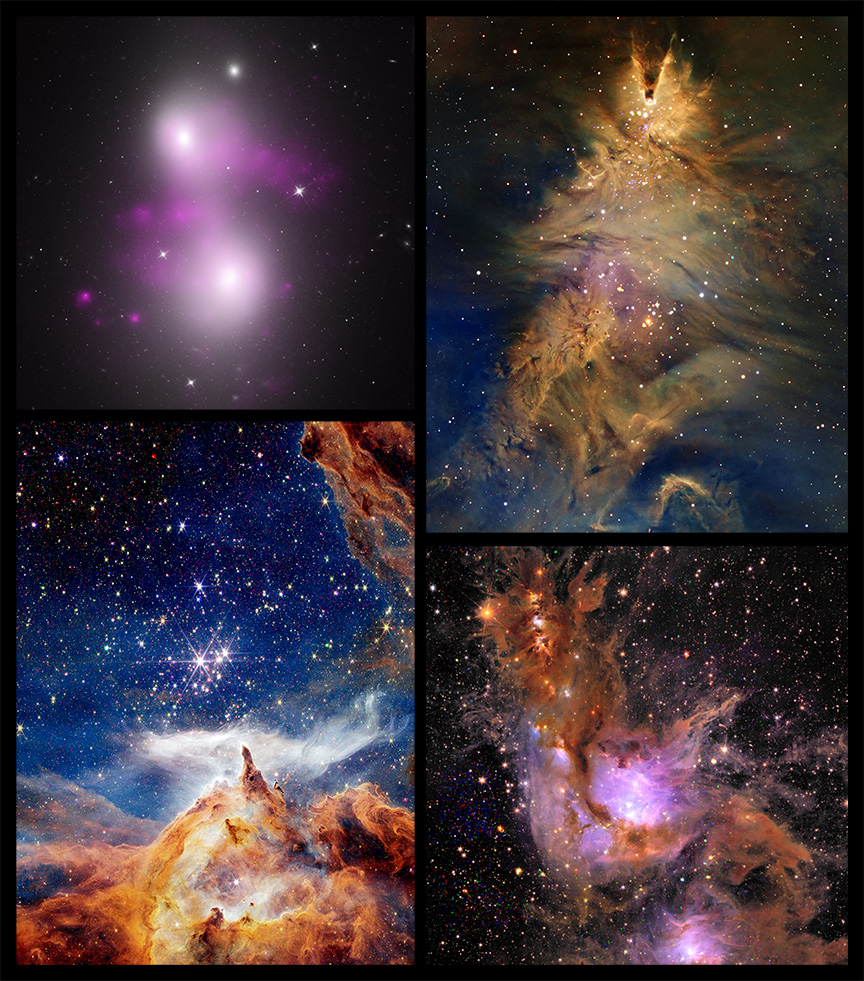
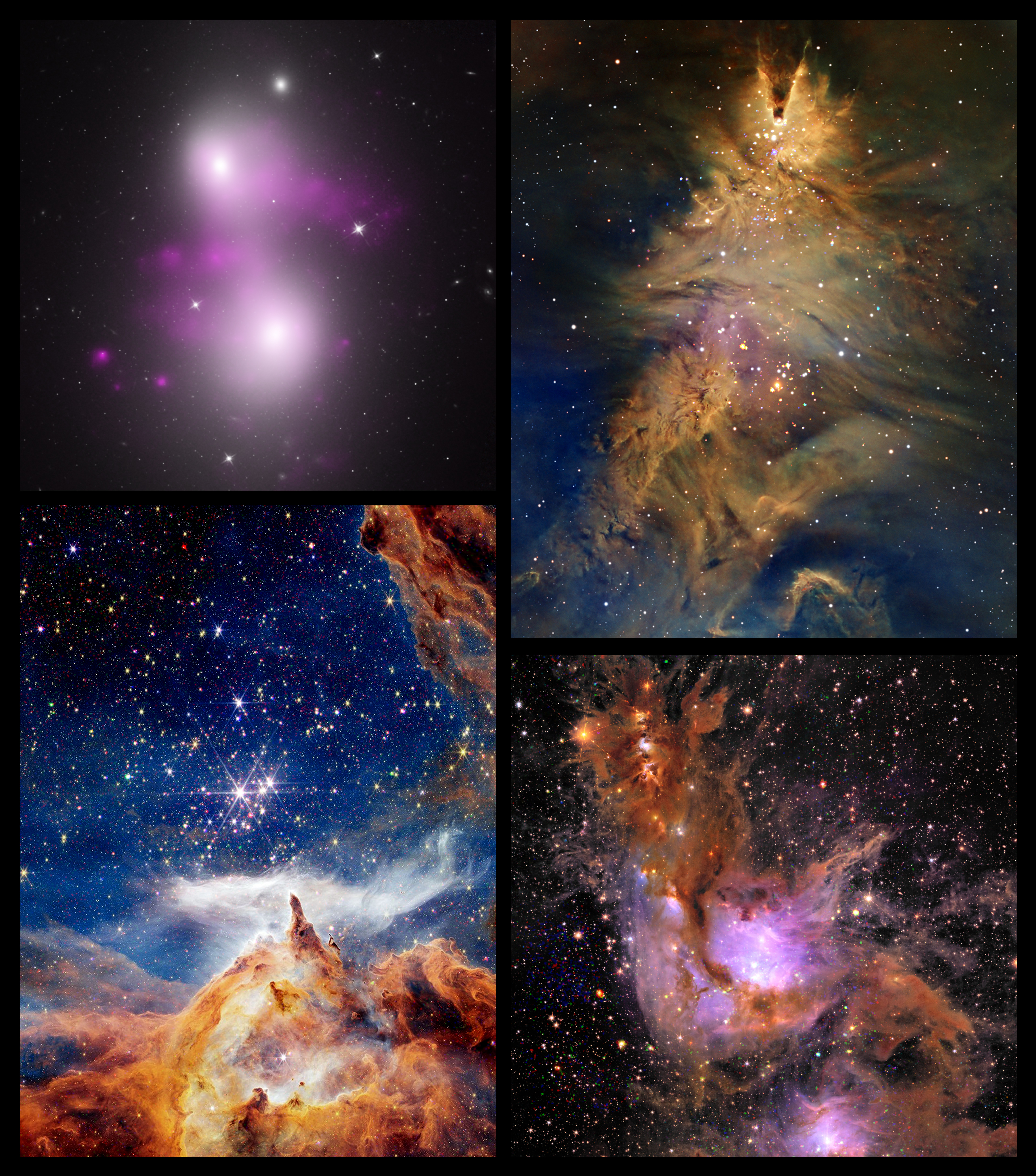
Four images with Chandra data that are connected to the winter season, labeled.
Credit: NASA/CXC/SAO


NASA’s Chandra X-ray Observatory is sending out a holiday card with four new images of cosmic wonders. Each of the quartet of objects evokes the winter season or one of its celebratory days either in its name or shape.

Chandra’s seasonal greetings begin with NGC 4782 and NGC 4783, a pair of colliding galaxies when oriented in a certain way resembles a snowman. The top and bottom of the snowman are each elliptical galaxies, separated by a distance of about 170 million light-years. The galaxies, seen in an image from NASA’s Hubble Space Telescope (gray), are bound together through gravity. X-rays from Chandra (purple) show a bridge of hot gas between the two galaxies, like a winter scarf.

Four images with Chandra data that are connected to the winter season, labeled.
Credit: NASA/CXC/SAOTo the right of the cosmic snowman is one of the most iconic symbols of the season, a Christmas tree. This celestial version takes an optical light image (red, gold, blue, and white) from an astrophotographer that shows the “branches” of NGC 2264, a relatively young nebula where new stars are forming. Within this cloud of gas and dust, baby stars appear as high-energy baubles in X-ray light from Chandra (red, green, and blue) plus some additional X-ray data from ESA’s XMM-Newton.

To the right of the cosmic snowman is one of the most iconic symbols of the season, a Christmas tree. This celestial version takes an optical light image (red, gold, blue, and white) from an astrophotographer that shows the “branches” of NGC 2264, a relatively young nebula where new stars are forming. Within this cloud of gas and dust, baby stars appear as high-energy baubles in X-ray light from Chandra (red, green, and blue) plus some additional X-ray data from ESA’s XMM-Newton.

NGC 2264, The Christmas Tree Nebula, in "twinkling" light.
Credit: X-ray: NASA/CXC/SAO and ESA/XMM-Newton; Optical: B. Vuk;
Image Processing: NASA/CXC/SAO/L. Frattare and K. Arcand
 
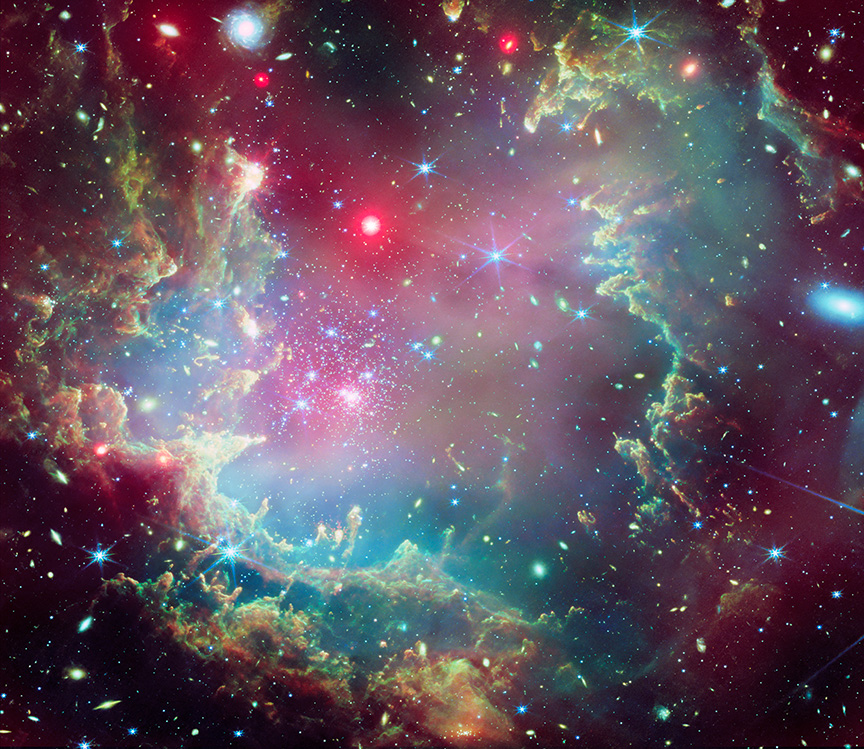
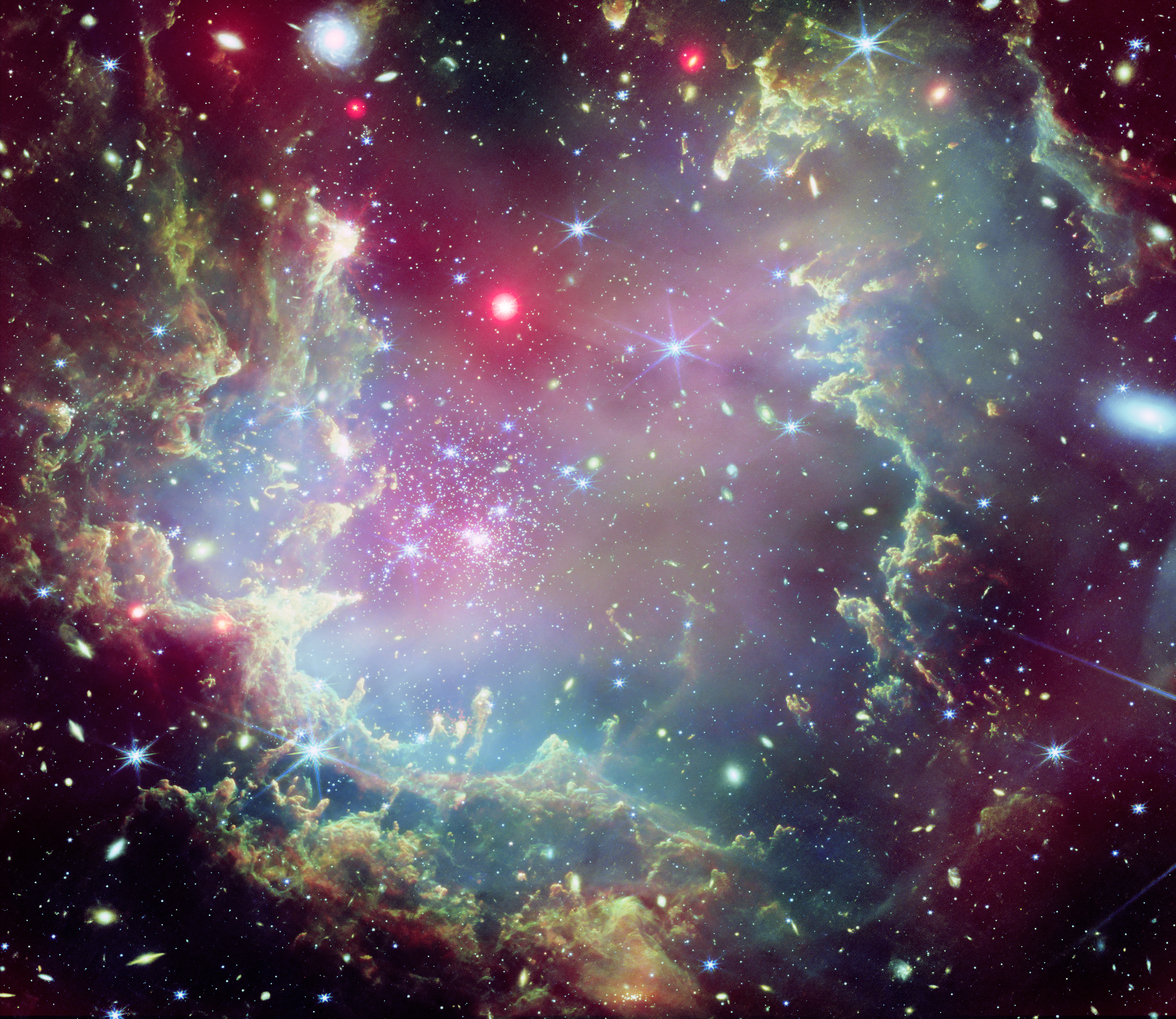
On the bottom left is the nebula NGC 6357 that contains Pismis 24, a young cluster of stars about 5,500 light-years from Earth. This stellar landscape is reminiscent of a winter vista in a view from NASA’s James Webb Space Telescope (red, green, and blue). Chandra data (red, green and blue) punctuate the scene with bursts of colored lights representing high-energy activity from the active stars.

The final image in this holiday card display is M78, a striking nebula in the Orion constellation that may also bring a partridge in the proverbial pear tree to mind. M78 is a reflection nebula, which is cloud interstellar dust that glows from the scattered light embedded within it. The bird-like structure is seen in infrared and optical light by Euclid (red, green and blue) while Chandra data provide speckled lights across the nebula (red, green, and blue).

NASA's Marshall Space Flight Center in Huntsville, Alabama, manages the Chandra program. The Smithsonian Astrophysical Observatory's Chandra X-ray Center controls science operations from Cambridge, Massachusetts, and flight operations from Burlington, Massachusetts.


Visual Description:

This release features four colorful composite images presented in an irregular grid, each evoking an aspect of winter and the holiday season.

The first image, at our upper left, features a pair of colliding galaxies that resembles a snowman in optical light from Hubble when oriented vertically. The two galaxies, NGC 4782 and NGC 4783, appear as hazy white balls with solid white cores, one stacked above the other. Linking the two galaxies is a bridge of hot gas in X-ray light from Chandra depicted here as a string of fuzzy neon purple balls. The string of gas loosely zigzags back and forth between the two galaxies, like a cozy scarf worn by a snowman.

The second holiday image, at the upper right of the irregular grid, strongly resembles a golden Christmas tree bedecked with twinkling lights. The tree is actually NGC 2264, a relatively young nebula where new stars are forming. The tree's branches, which sweep back and forth in a roughly conical shape, are golden clouds of dust and gas, all from optical light captured by an astrophotographer. Tucked into these branches are colorful lights and glowing baubles in X-rays from Chandra and XMM-Newton, colored in green, blue, purple, and orange; baby stars growing inside the nebula.

At the lower lefthand corner of the grid is a winter scene fit for a holiday greeting card. Above what appears to be a fantastical snowy mountainscape, is a brilliant blue sky packed with colorful lights. The golden mountainscape is in fact part of the nebula NGC 6357, as captured by NASA's James Webb Space Telescope. The green, red, and golden lights in the blue sky above are bursts of high-energy X-rays from active stars, detected by Chandra.

The final holiday image, at the lower right of the grid, is a nebula which calls to mind the first gift in the Christmas carol 'The Twelve Days of Christmas'. Here, the wispy burnt orange nebula, M78, forms a tree, with a vertical trunk near the center of the image in infrared and optical light from the European Space Agency's Euclid mission. The tree's bushy branches reach toward our upper left, and its tail of roots drifts toward our lower right. The tree of interstellar dust is offset by a pink c,brloud, which resembles cotton candy, and is backed by a black sky packed with speckled lights. At the top of the tree, near the upper lefthand corner of the image, is a dusty orange cloud shape which strongly resembles a bird in profile; the proverbial pa,hrrtridge in the pear tree. Sprinkled across are tiny dots of colorful lights,showcasing X-rays captured by Chandra.


Fast Facts for NGC 4782/NGC 4783, The Snowman Galaxies:

Credit: X-ray: NASA/CXC/SAO; Optical: NASA/ESA/STScI/HST; Image Processing: NASA/CXC/SAO/J. Schmidt
Release Date: December 22, 2025
Scale: Image is about 1.4 arcmin (87,000 light-years) across.
Category: Groups and Clusters of Galaxies
Coordinates (J2000): RA: 12h 54m 35.6s | Dec: -12° 34' 07.4"
Constellation: Corvus
Observation Date(s): 1 observation June 16, 2002
Observation Time: 13 hours and 47 minutes
Obs. IDs: 3220
Instrument: ACIS
References: Machacek, M., et al., 2007, ApJ, 664, 804
Color Code: X-ray: purple; Optical: grayscale
Distance Estimate: About 210 million light-years from Earth


Fast Facts for NGC 2264, The Christmas Tree Nebula:

Credit: X-ray: NASA/CXC/SAO and ESA/XMM-Newton; Optical: B. Vuk; Image Processing: NASA/CXC/SAO/L. Frattare and K. Arcand
Release Date: December 22, 2025
Scale: Image is about 77 arcmin (56 light-years) across.
Category: Normal Stars & Star Clusters
Coordinates (J2000): RA: 06h 40m 42.8s | Dec: +09° 49' 03.6"
Constellation: Monoceros
Observation Date(s): 8 observations from February 2002 to December 2011
Observation Time: 137 hours 26 minutes (5 days 17 hours 26 minutes)
Obs. IDs: 2540, 2550, 9768, 9769, 13610, 13611, 14368, 14369
Instrument: ACIS
References: Ramirez, S., et al., 2004, AJ, 127, 2659
Instrument: ACIS
Color Code: X-ray: red, green, and blue; Optical: red, gold, blue, and white
Distance Estimate: About 2,500 light-years from Earth


Fast Facts for NGC 6357/Pismis 24:

Credit: X-ray: NASA/CXC/Penn State/G.Garmire; Infrared: NASA, ESA, CSA, and STScI; Image Processing: NASA/CXC/SAO/L. Frattare and NSA/ESA/CSA/STScI/A. Pagan
Release Date: December 22, 2025
Scale: Image is about 4.2 arcmin (6.7 light-years) across.
Category: Normal Stars and Star Clusters
Coordinates (J2000): RA: 17h 24m 44.4s | Dec: -34° 11' 35.9"
Constellation: Scorpius
Observation Date(s): 3 observations from July 2004 to Aug 2022
Observation Time: 30 hours 15 minutes (1 day 6 hours 15 minutes)
Obs. IDs: 4477, 18453, 26003
Instrument: ACIS
References: Townsley, L., et al., 2019, ApJS, 244, 28
Color Code: X-ray: red, green, and blue; Infrared: red, green, and blue
Distance Estimate: About 5,500 light-years from Earth


Fast Facts for M78:

Credit: X-ray: NASA/CXC/SAO; Infrared/Optical: ESA/Euclid/Euclid Consortium/NASA; Image Processing: NASA/CXC/SAO/L. Frattare
Release Date: December 22, 2025
Scale: Image is about 41 arcmin (19 light-years) across.
Category: Normal Stars and Star Clusters
Coordinates (J2000): RA: 5h 46m 45.8s | Dec: +0° 0′ 08.1"
Constellation: Orion
Observation Date(s): 2 observations: Oct 2000 and Aug 2021
Observation Time: 28 hours 56 minutes (1 day 4 hours 56 minutes)
Obs. IDs: 1872, 25686
Instrument: ACIS
References: Grosso, N et al., 2004, A&A, 419, 653
Color Code: X-ray: red, green, and blue; Infrared/Optical: red, green, and blue
Distance Estimate: About 1,600 light-years from Earth


Sunday, December 22, 2024

NASA Missions Spot Cosmic 'Wreath' Displaying Stellar Circle of Life

NGC 602
Credit: X-ray: NASA/CXC; Infrared: ESA/Webb, NASA & CSA, P. Zeilder, E.Sabbi, A. Nota, M. Zamani; Image Processing: NASA/CXC/SAO/L. Frattare and K. Arcand


Since antiquity, wreaths have symbolized the cycle of life, death, and rebirth. It is fitting then that one of the best places for astronomers to learn more about the stellar lifecycle resembles a giant holiday wreath itself.

The star cluster NGC 602 lies on the outskirts of the Small Magellanic Cloud, which is one of the closest galaxies to the Milky Way, about 200,000 light-years from Earth. The stars in NGC 602 have fewer heavier elements compared to the Sun and most of the rest of the galaxy. Instead, the conditions within NGC 602 mimic those for stars found billions of years ago when the universe was much younger.

This new image combines data from NASA’s Chandra X-ray Observatory with a previously released image from the agency’s James Webb Space Telescope. The dark ring-like outline of the wreath seen in Webb data (represented as orange, yellow, green, and blue) is made up of dense clouds of filled dust.

Meanwhile, X-rays from Chandra (red) show young, massive stars that are illuminating the wreath, sending high-energy light into interstellar space. These X-rays are powered by winds flowing from the young, massive stars that are sprinkled throughout the cluster. The extended cloud in the Chandra data likely comes from the overlapping X-ray glow of thousands of young, low-mass stars in the cluster.

NGC 2264, the “Christmas Tree Cluster”
Credit: X-ray: NASA/CXC/SAO; Optical: Clow, M.; Image Processing: NASA/CXC/SAO/L. Frattare and K. Arcand);

View Animated Version

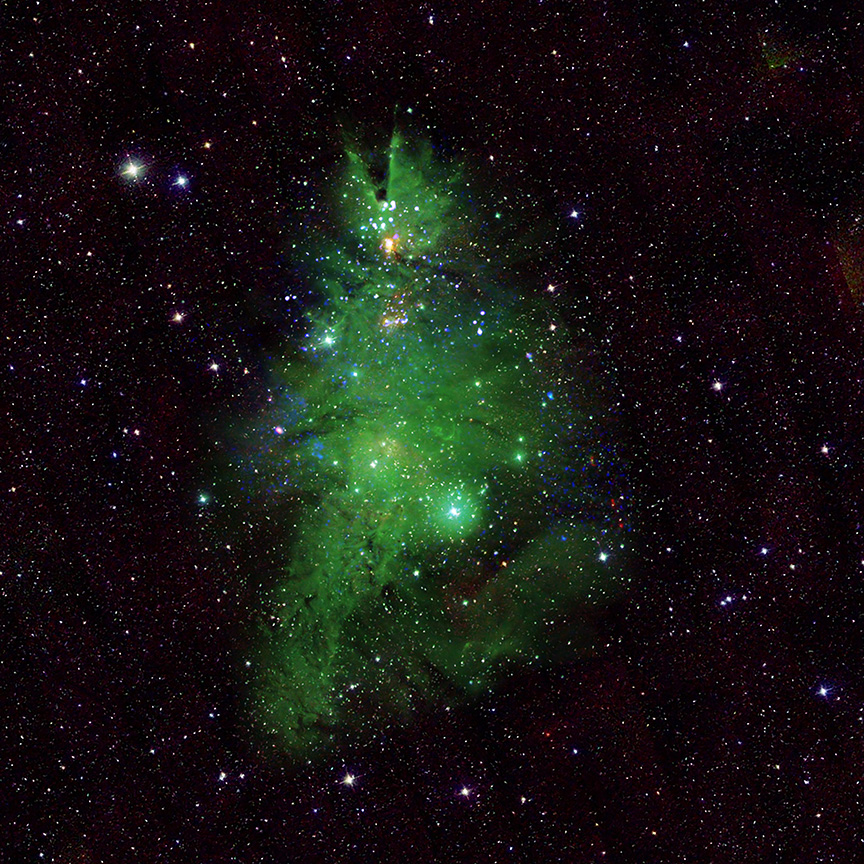
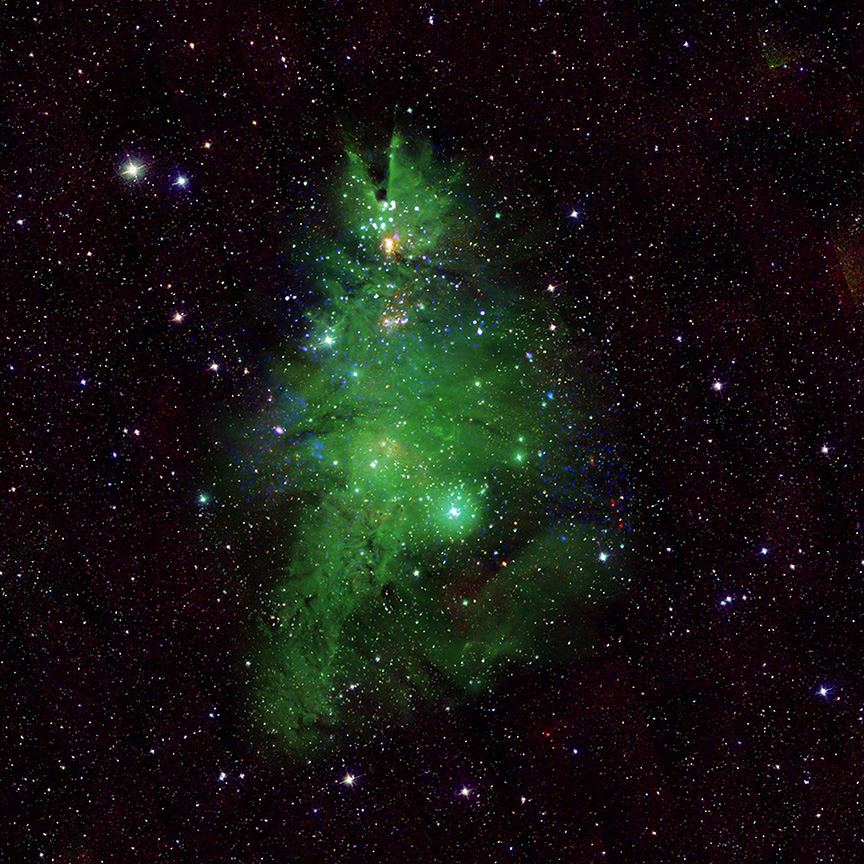
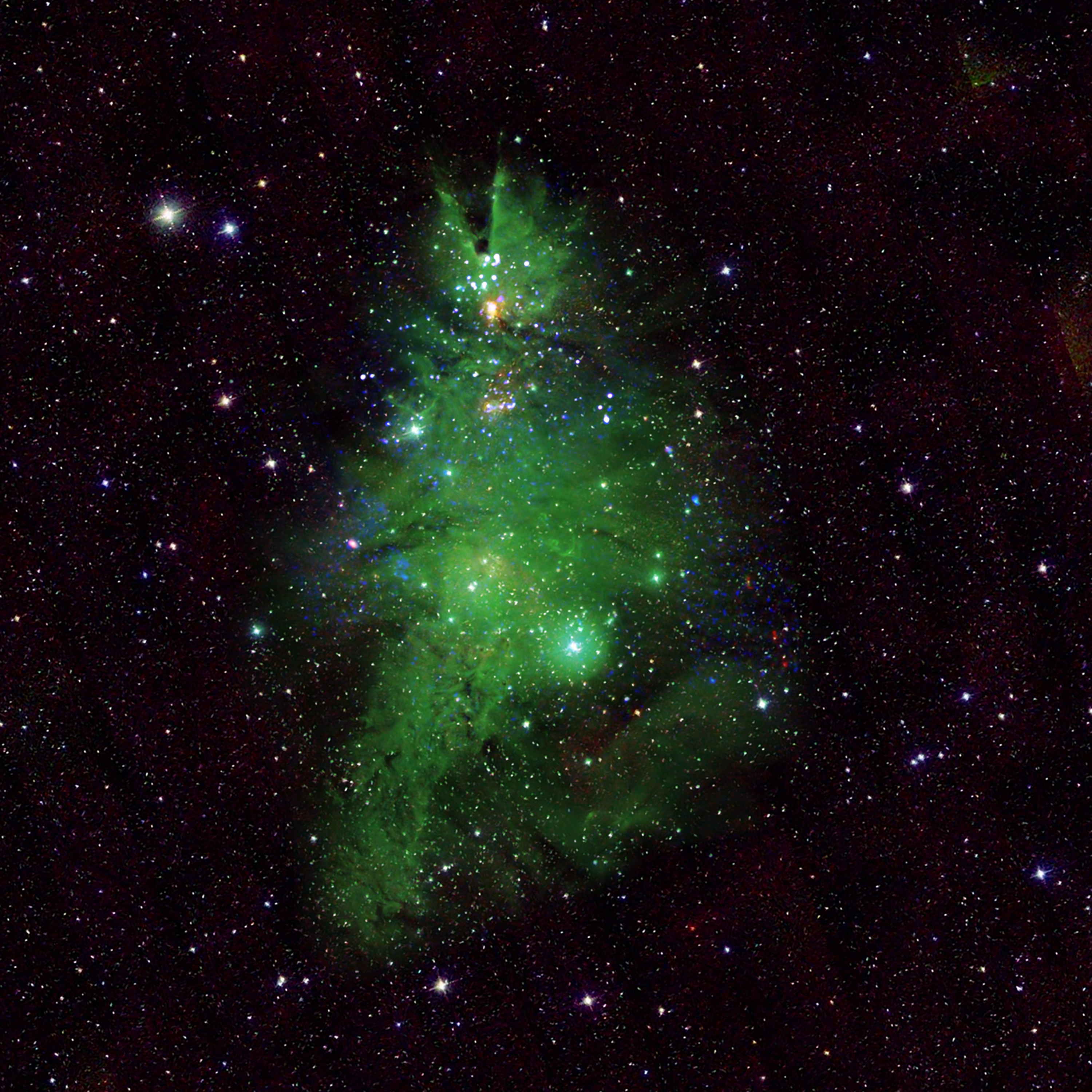
In addition to this cosmic wreath, a new version of the “Christmas tree cluster” is also now available. Like NGC 602, NGC 2264 is a cluster of young stars between one and five million years old. (For comparison, the Sun is a middle-aged star about 5 billion years old — about 1,000 times older.) In this image of NGC 2264, which is much closer than NGC 602 at a distance of about 2,500 light-years from Earth, Chandra data (red, purple, blue, and white) has been combined with optical data (green and violet) captured from by astrophotographer Michael Clow from his telescope in Arizona in November 2024.

NASA's Marshall Space Flight Center in Huntsville, Alabama, manages the Chandra program. The Smithsonian Astrophysical Observatory's Chandra X-ray Center controls science operations from Cambridge, Massachusetts, and flight operations from Burlington, Massachusetts.

Quick Look: NASA Missions Spot Cosmic 'Wreath' Displaying Stellar Circle of Life


Visual Description:

This release includes two composite images, each featuring a star cluster that strongly resembles holiday greenery.

The first image depicts star cluster NGC 602 in vibrant and festive colors. The cluster includes a giant dust cloud ring, shown in greens, yellows, blues, and oranges. The green hues and feathery edges of the ring cloud create the appearance of a wreath made of evergreen boughs. Hints of red representing X-rays provide shading, highlighting layers within the wreath-like ring cloud.

The image is aglow with specks and dots of colorful, festive light, in blues, golds, whites, oranges, and reds. These lights represent stars within the cluster. Some of the lights gleam with diffraction spikes, while others emit a warm, diffuse glow. Upon closer inspection, many of the glowing specks have spiraling arms, indicating that they are, in fact, distant galaxies.

The second image in today's release is a new depiction of NGC 2264, known as the "Christmas Tree Cluster". Here, wispy green clouds in a conical shape strongly resemble an evergreen tree. Tiny specks of white, blue, purple, and red light, stars within the cluster, dot the structure, turning the cloud into a festive, cosmic Christmas tree!


Fast Facts for NGC 602:

Credit: X-ray: NASA/CXC; Infrared: ESA/Webb, NASA & CSA, P. Zeilder, E.Sabbi, A. Nota, M. Zamani; Image Processing: NASA/CXC/SAO/L. Frattare and K. Arcand
Scale: Image is about 3 arcmin (175 light-years) across.
Category: Normal Stars & Star Clusters
Coordinates (J2000): RA 01h 29m 28.7s | Dec -73° 33´ 40.8"
Constellation: Hydrus
Observation Dates: 11 pointings between 31 March and 29 April, 2010
Observation Time: 80 hours 45 minutes (3 days 8 hours 45 minutes)
Obs. ID: 10985-10986, 11978-11979, 11988-11989, 12130-12131, 12134, 12136, 12207
Instrument: ACIS
References: Oskinova, L. et al, 2013, ApJ, 765 73; arXiv:1301.3500
Color Code: X-ray: red; Infrared: orange, yellow, green, and blue
Distance Estimate: About 200,000 light-years


Fast Facts for NGC 2264:

Credit: X-ray: NASA/CXC/SAO; Optical: Clow, M.; Image Processing: NASA/CXC/SAO/L. Frattare and K. Arcand
Scale: Image is about 77 arcmin (56 light-years) across.
Category: Normal Stars & Star Clusters
Coordinates (J2000): RA: 06h 40m 42.8s | Dec: +09° 49' 3.6"
Constellation: Monoceros
Observation Dates: 8 observations from February 2002 to December 2011
Observation Time: 137 hours 26 minutes ( 5 days 17 hours 26 mintues)
Obs. IDs: 2540, 2550, 9768, 9769, 13610, 13611, 14368, 14369
Instrument: ACIS
References: Ramirez, S.V., et al., 2004, AJ, 127,2659; arXiv:astro-ph:0401533
Color Code: X-ray: red, green, and blue; Optical: green and white
Distance Estimate: About 2,500 light-years


Thursday, December 21, 2023

NGC 2264: Sprightly Stars Illuminate 'Christmas Tree Cluster'

NGC 2264 (Video)
Credit: X-ray: NASA/CXC/SAO; Optical: T.A. Rector (NRAO/AUI/NSF and NOIRLab/NSF/AURA) and B.A. Wolpa (NOIRLab/NSF/AURA); Infrared: NASA/NSF/IPAC/CalTech/Univ. of Massachusetts; Image Processing: NASA/CXC/SAO/L. Frattare & J.Major


This new image of NGC 2264, also known as the “Christmas Tree Cluster,” shows the shape of a cosmic tree with the glow of stellar lights. NGC 2264 is, in fact, a cluster of young stars — with ages between about one and five million years old — in our Milky Way about 2,500 light-years away from Earth. The stars in NGC 2264 are both smaller and larger than the Sun, ranging from some with less than a tenth the mass of the Sun to others containing about seven solar masses.

This new composite image enhances the resemblance to a Christmas tree through choices of color and rotation. The blue and white lights (which blink in the animated version of this image) are young stars that give off X-rays detected by NASA’s Chandra X-ray Observatory. Optical data from the National Science Foundation-supported WIYN 0.9-meter telescope on Kitt Peak shows a nebula of gas in the cluster in green, corresponding to the “pine needles” of the tree. Finally infrared data from the Two Micron All Sky Survey shows foreground and background stars in white. This image has been rotated clockwise by 160 degrees from the astronomer’s standard of North pointing upward, so that it appears like the top of the tree is toward the top of the image.

NGC 2264 (Video)
Credit: X-ray: NASA/CXC/SAO; Optical: T.A. Rector (NRAO/AUI/NSF and NOIRLab/NSF/AURA) and B.A. Wolpa (NOIRLab/NSF/AURA); Infrared: NASA/NSF/IPAC/CalTech/Univ. of Massachusetts; Image Processing: NASA/CXC/SAO/L. Frattare & J.Major
 
Young stars, like those in NGC 2264, are volatile and produce strong flares in X-rays and other types of variations seen at different wavelengths of light. The coordinated, blinking variations shown in this animation, however, are artificial, to emphasize the locations of the stars seen in X-rays and highlight the similarity of this object to a Christmas tree. In reality the variations of the stars are not synchronized.

The variations observed by Chandra and other telescopes are caused by several different processes. Some of these are related to activity involving magnetic fields, including flares like those undergone by the Sun — but much more powerful — and hot spots and dark regions on the surfaces of the stars that go in and out of view as the stars rotate. There can also be changes in the thickness of gas obscuring the stars, and changes in the amount of material still falling onto the stars from disks of surrounding gas.

NASA's Marshall Space Flight Center manages the Chandra program. The Smithsonian Astrophysical Observatory's Chandra X-ray Center controls science operations from Cambridge, Massachusetts, and flight operations from Burlington, Massachusetts.


Visual Description:

This release features a composite image of a cluster of young stars looking decidedly like a cosmic Christmas tree! The cluster, known as NGC 2264, is in our Milky Way Galaxy, about 2,500 light-years from Earth. Some of the stars in the cluster are relatively small, and some are relatively large, ranging from one tenth to seven times the mass of our Sun.

In this composite image, the cluster's resemblance to a Christmas tree has been enhanced through image rotation and color choices. Optical data is represented by wispy green lines and shapes, which creates the boughs and needles of the tree shape. X-rays detected by Chandra are presented as blue and white lights and resemble glowing dots of light on the tree. Infrared data show foreground and background stars as gleaming specks of white against the blackness of space. The image has been rotated by 160 degrees from the astronomer's standard of North pointing upwards. This puts the peak of the roughly conical tree shape near the top of the image, though it doesn't address the slight bare patch in the tree's branches, at our lower right, which in a living room should probably be turned to the corner!

In this release, the festive cluster is presented as both a static image, and as a short animation. In the animation, blue and white X-ray dots from Chandra flicker and twinkle on the tree, like the lights on a Christmas tree.


Fast Facts for (NGC 2264):

Scale: Image is about 77 arcmin (56 light-years) across.
Category: Normal Stars & Star Clusters
Coordinates (J2000): RA 06h 40m 52s | Dec +09° 52´ 37"
Constellation: Monoceros
Observation Dates: 8 observations from February 2002 to December 2011
Observation Time: 137 hours 26 minutes (5 days, 17 hours, 26 mintues)
Obs. ID: 2540, 2550, 9768, 9769, 13610, 13611, 14368, 14369
Instrument: ACIS
Color Code: X-ray: blue, purple, white; Optical: green; Infrared: red, green, blue
Distance Estimate: About 2,500 light-years


Saturday, November 12, 2022

ESO images a wondrous star factory to mark 60 years of collaboration

PR Image eso2215a
ESO’s 60th anniversary image: the Cone Nebula as seen by the VLT

PR Image eso2215b
Location of the Cone Nebula in the constellation of Monoceros

Wide-field view of the Cone Nebula region of the sky


Videos

Zooming in on the Cone Nebula  
Zooming in on the Cone Nebula


For the past 60 years the European Southern Observatory (ESO) has been enabling scientists worldwide to discover the secrets of the Universe. We mark this milestone by bringing you a spectacular new image of a star factory, the Cone Nebula, taken with ESO’s Very Large Telescope (VLT).

On 5 October 1962 five countries signed the convention to create ESO. Now, six decades later and supported by 16 Member States and strategic partners, ESO brings together scientists and engineers from across the globe to develop and operate advanced ground-based observatories in Chile that enable breakthrough astronomical discoveries.​ 

On the occasion of ESO’s 60th anniversary we are releasing this remarkable new image of the Cone Nebula, captured earlier this year with one of ESO’s telescopes and selected by ESO staff. This is part of a campaign marking ESO's 60th anniversary and taking place in late 2022, both on social media under the #ESO60years hashtag, and with local events in the ESO Member States and other countries. 

In this new image, we see centre-stage the seven-light-year-long pillar of the Cone Nebula, which is part of the larger star-forming region NGC 2264 and was discovered in the late 18th century by astronomer William Herschel. In the sky, we find this horn-shaped nebula in the constellation Monoceros (The Unicorn), a surprisingly fitting name.

Located less than 2500 light-years away, the Cone Nebula is relatively close to Earth, making it a well-studied object. But this view is more dramatic than any obtained before, as it showcases the nebula’s dark and impenetrable cloudy appearance in a way that makes it resemble a mythological creature.

The Cone Nebula is a perfect example of the pillar-like shapes that develop in the giant clouds of cold molecular gas and dust, known for creating new stars. This type of pillar arises when massive, newly formed bright blue stars give off stellar winds and intense ultraviolet radiation that blow away the material from their vicinity. As this material is pushed away, the gas and dust further away from the young stars gets compressed into dense, dark and tall pillar-like shapes. This process helps create the dark Cone Nebula, pointing away from the brilliant stars in NGC 2264.

In this image, obtained with the FOcal Reducer and low dispersion Spectrograph 2 (FORS2) on ESO’s VLT in Chile, hydrogen gas is represented in blue and sulphur gas in red. The use of these filters makes the otherwise bright blue stars, that indicate the recent star formation, appear almost golden, contrasting with the dark cone like sparklers.

This image is just one example of the many stunning and awe-inspiring observations ESO telescopes have made in the past 60 years. While this one was obtained for outreach purposes, the overwhelming majority of ESO’s telescope time is dedicated to scientific observations that have allowed us to capture the first image of an exoplanet, study the black hole at the centre of our home galaxy, and find proof that the expansion of our Universe is accelerating.

Building on our 60 years of experience in astronomy development, discovery and cooperation, ESO continues to chart new territory for astronomy, technology and international collaboration. With our current facilities and ESO’s upcoming Extremely Large Telescope (ELT), we will keep on addressing humanity’s biggest questions about the Universe ​and enabling unimaginable discoveries.


More Information

The image in this release was created as part of the ESO Cosmic Gems programme, an outreach initiative to produce images of interesting, intriguing or visually attractive objects using ESO telescopes, for the purposes of education and public outreach. The programme makes use of telescope time that cannot be used for science observations. All data collected may also be suitable for scientific purposes, and are made available to astronomers through ESO’s science archive.

The European Southern Observatory (ESO) enables scientists worldwide to discover the secrets of the Universe for the benefit of all. We design, build and operate world-class observatories on the ground — which astronomers use to tackle exciting questions and spread the fascination of astronomy — and promote international collaboration in astronomy. Established as an intergovernmental organisation in 1962, today ESO is supported by 16 Member States (Austria, Belgium, the Czech Republic, Denmark, France, Finland, Germany, Ireland, Italy, the Netherlands, Poland, Portugal, Spain, Sweden, Switzerland and the United Kingdom), along with the host state of Chile and with Australia as a Strategic Partner. ESO’s headquarters and its visitor centre and planetarium, the ESO Supernova, are located close to Munich in Germany, while the Chilean Atacama Desert, a marvellous place with unique conditions to observe the sky, hosts our telescopes. ESO operates three observing sites: La Silla, Paranal and Chajnantor. At Paranal, ESO operates the Very Large Telescope and its Very Large Telescope Interferometer, as well as survey telescopes such as VISTA. Also at Paranal ESO will host and operate the Cherenkov Telescope Array South, the world’s largest and most sensitive gamma-ray observatory. Together with international partners, ESO operates APEX and ALMA on Chajnantor, two facilities that observe the skies in the millimetre and submillimetre range. At Cerro Armazones, near Paranal, we are building “the world’s biggest eye on the sky” — ESO’s Extremely Large Telescope. From our offices in Santiago, Chile we support our operations in the country and engage with Chilean partners and society.


Links


Contacts:

Juan Carlos Muñoz Mateos
ESO Media Officer
Garching bei München, Germany
Tel: +49 89 3200 6176
Email:
press@eso.org

Source: ESO/News


Wednesday, March 11, 2015

A Grand Extravaganza of New Stars

Star cluster NGC 6193 and nebula NGC 6188

 
The open star cluster NGC 6193 in the constellation of Ara


# # # # # # # # # # # # # # # # # # # # # # # # # # # # # # #  # # # # # # # # # # # # # # # # # # # # # # # # # # # # # # # 

Videos

Zooming in on the star cluster NGC 6193 and nebula NGC 6188

Close-up view of the star cluster NGC 6193 and nebula NGC 6188


This dramatic landscape in the southern constellation of Ara (The Altar) is a treasure trove of celestial objects. Star clusters, emission nebulae and active star-forming regions are just some of the riches observed in this region lying some 4000 light-years from Earth. This beautiful new image is the most detailed view of this part of the sky so far, and was taken using the VLT Survey Telescope at ESO’s Paranal Observatory in Chile.

At the centre of the image is the open star cluster NGC 6193, containing around thirty bright stars and forming the heart of the Ara OB1 association. The two brightest stars are very hot giant stars. Together, they provide the main source of illumination for the nearby emission nebula, the Rim Nebula, or NGC 6188, which is visible to the right of the cluster.

A stellar association is a large grouping of loosely bound stars that have not yet completely drifted away from their initial formation site. OB associations consist largely of very young blue–white stars, which are about 100 000 times brighter than the Sun and between 10 and 50 times more massive.

The Rim Nebula is the prominent wall of dark and bright clouds marking the boundary between an active star-forming region within the molecular cloud, known as RCW 108, and the rest of the association [1]. The area around RCW 108 is made up of mostly hydrogen — the primary ingredient in star formation. Such areas are also known as H II regions.

The ultraviolet radiation and intense stellar wind from the stars of NGC 6193 seem to be driving the next generation of star formation in the surrounding clouds of gas and dust. As cloud fragments collapse they heat up and eventually form new stars.

As the cloud creates new stars, it is simultaneously being eroded by the winds and radiation emitted by previous stars, and by violent supernova explosions. In this way, such star-forming H II regions tend to have a lifespan of just a few million years. Star formation is a very inefficient process, with only around 10% of the available material contributing to the process — the rest is blown off into space.

The Rim Nebula also shows signs of being in the early phase of “pillar formation”, meaning that in the future it could end up looking similar to other well-known star-forming regions, such as the Eagle Nebula (Messier 16, containing the famous Pillars of Creation) and the Cone Nebula (part of NGC 2264).

This single spectacular image was actually created from more than 500 individual pictures taken through four different colour filters with the VLT Survey Telescope. The total exposure time was more than 56 hours. It is the most detailed view of this region yet achieved.


Notes

[1] Furthermore, this nebula has additional modest fame among astronomers, as a previous image was used as the cover of the DVD distribution of the collection of software for astronomers assembled by ESO: Scisoft, whose newest version was released a few weeks ago. It is therefore also known as the Scisoft Nebula.

More Information

ESO is the foremost intergovernmental astronomy organisation in Europe and the world’s most productive ground-based astronomical observatory by far. It is supported by 16 countries: Austria, Belgium, Brazil, the Czech Republic, Denmark, France, Finland, Germany, Italy, the Netherlands, Poland, Portugal, Spain, Sweden, Switzerland and the United Kingdom, along with the host state of Chile. ESO carries out an ambitious programme focused on the design, construction and operation of powerful ground-based observing facilities enabling astronomers to make important scientific discoveries. ESO also plays a leading role in promoting and organising cooperation in astronomical research. ESO operates three unique world-class observing sites in Chile: La Silla, Paranal and Chajnantor. At Paranal, ESO operates the Very Large Telescope, the world’s most advanced visible-light astronomical observatory and two survey telescopes. VISTA works in the infrared and is the world’s largest survey telescope and the VLT Survey Telescope is the largest telescope designed to exclusively survey the skies in visible light. ESO is a major partner in ALMA, the largest astronomical project in existence. And on Cerro Armazones, close to Paranal, ESO is building the 39-metre European Extremely Large Telescope, the E-ELT, which will become “the world’s biggest eye on the sky”.

Links

Contacts

Richard Hook
ESO, Public Information Officer
Garching bei München, Germany
Tel: +49 89 3200 6655
Cell: +49 151 1537 3591
Email:
rhook@eso.org


Source: ESO

Saturday, August 30, 2014

Sonograms of Young Stars

An optical image of the region NGC 2264 containing a cluster of young stars. Astronomers have measured pulsations in the light of some of these stars and used them to infer the physical processes underway before they mature and begin to burn hydrogen fuel.Credit: ESO 

The evolution of a star depends crucially on its initial birth mass and composition, and developments in its early lifetime. These initial properties determine, for example, the production of the chemical elements forged later on in the star's nuclear furnace, and its early angular momentum affects the subsequent distribution of its internal energy. Astronomers are therefore working to understand the physical processes underway in the very earliest stages of a star’s life after a dense clump of interstellar matter has contracted, warmed, and begun the stellar gestation processes.

In the early stages of a star's life, its central temperature and density are not yet high enough to initiate significant nuclear burning; its energy comes from the release of gravitational energy, and it circulates via gas motions. As the internal temperatures rise and the hot gas becomes more transparent, this internal energy begins to redistribute itself through radiation as well through gas motions. Then, as these and related processes compete for primacy, the star starts to vibrate slightly, an effect which can be observed as periodic variations in the star's surface through the luminosity and temperature. In some young stars it is possible to use "asteroseismology" – the measurement of these acoustic patterns - to explore the star’s structure and evolution.

CfA astronomer Dimitar Sasslov has joined with a team of other investigators to study the surface vibrations in thirty-four young stars. Their ages are constrained by their emission spectra or by their being members of stellar clusters whose ages are known to be less than about ten million years, either signaling likely periodic vibrations in the young stars. The team finds a clear relation between seismic observables and evolutionary status, and in particular they are able to infer the internal stellar processes underway and the star’s corresponding evolutionary development. By analogy to a sonogram, this technique of asteroseismology is able to probe the unborn, and offers a new probe of the earliest stages of a star's life.

Reference(s): 
"Echography of Young Stars Reveals Their Evolution," K. Zwintz, L. Fossati, T. Ryabchikova, D. Guenther, C. Aerts, T. G. Barnes, N., Themes, D. Lorenz, C. Cameron, R. Kuschnig, S. Pollack-Drs, E. Moravveji, A. Baglin, J., M. Matthews, A. F. J. Moffat1, E. Poretti, M. Rainer, S. M. Rucinski, D. Sasselov, W. W. Weiss, Science, 345, 550, 2014.


Thursday, December 25, 2008

Fox Fur, a Unicorn, and a Christmas Tree

Credit & Copyright: R Jay Gabany

Clouds of glowing hydrogen gas fill this colorful skyscape in the faint but fanciful constellation Monoceros, the Unicorn. A star forming region cataloged as NGC 2264, the complex jumble of cosmic gas and dust is about 2,700 light-years distant and mixes reddish emission nebulae excited by energetic light from newborn stars with dark interstellar dust clouds.

Where the otherwise obscuring dust clouds lie close to the hot, young stars they also reflect starlight, forming blue reflection nebulae. The wide mosaic spans about 3/4 degree or nearly 1.5 full moons, covering 40 light-years at the distance of NGC 2264.

Its cast of cosmic characters includes the the Fox Fur Nebula, whose convoluted pelt lies at the upper left, bright variable star S Mon immersed in the blue-tinted haze just below the Fox Fur, and the Cone Nebula at the far right.

Of course, the stars of NGC 2264 are also known as the Christmas Tree star cluster. The triangular tree shape traced by the stars appears sideways here, with its apex at the Cone Nebula and its broader base centered near S Mon.

Tuesday, December 16, 2008

A Sparkling Spray of Stars

ESO PR Photo 48/08
NGC 2264 and the Christmas Tree cluster
Credit: ESO

The festive season has arrived for astronomers at the European Southern Observatory (ESO) in the form of this dramatic new image. It shows the swirling gas around the region known as NGC 2264 — an area of sky that includes the sparkling blue baubles of the Christmas Tree star cluster.

NGC 2264 lies about 2600 light-years from Earth in the obscure constellation of Monoceros, the Unicorn, not far from the more familiar figure of Orion, the Hunter. The image shows a region of space about 30 light-years across.

William Herschel discovered this fascinating object during his great sky surveys in the late 18th century. He first noticed the bright cluster in January 1784 and the brightest part of the visually more elusive smudge of the glowing gas clouds at Christmas nearly two years later. The cluster is very bright and can easily be seen with binoculars. With a small telescope (whose lenses will turn the view upside down) the stars resemble the glittering lights on a Christmas tree. The dazzling star at the top is even bright enough to be seen with the unaided eye. It is a massive multiple star system that only emerged from the dust and gas a few million years ago.

As well as the cluster there are many interesting and curious structures in the gas and dust. At the bottom of the frame, the dark triangular feature is the evocative Cone Nebula, a region of molecular gas flooded by the harsh light of the brightest cluster members. The region to the right of the brightest star has a curious, fur-like texture that has led to the name Fox Fur Nebula.

Much of the image appears red because the huge gas clouds are glowing under the intense ultra-violet light coming from the energetic hot young stars. The stars themselves appear blue as they are hotter, younger and more massive than our own Sun. Some of this blue light is scattered by dust, as can be seen occurring in the upper part of the image.

This intriguing region is an ideal laboratory for studying how stars form. The entire area shown here is just a small part of a vast cloud of molecular gas that is in the process of forming the next generation of stars. Besides the feast of objects in this picture there are many interesting objects hidden behind the murk of the nebulosity. In the region between the tip of the Cone Nebula and the brightest star at the top of the picture there are several stellar birthing grounds where young stars are forming. There is even evidence of the intense stellar winds from these youthful embryos blasting out from the hidden stars in the making.

This picture of NGC 2264, including the Christmas Tree Cluster, was created from images taken with the Wide Field Imager (WFI), a specialised astronomical camera attached to the 2.2-metre Max-Planck Society/ESO telescope at the La Silla observatory in Chile. Located nearly 2400 m above sea level, in the mountains of the Atacama Desert, ESO's La Silla enjoys some of the clearest and darkest skies on the whole planet, making the site ideally suited for studying the farthest depths of the Universe. To make this image, the WFI stared at the cluster for more than ten hours through a series of specialist filters to build up a full colour image of the billowing clouds of fluorescing hydrogen gas.

ESO La Silla - Paranal - ELT Press Officer
Dr. Henri Boffin
+49 89 3200 6222
offin@eso.org


ESO Press Officer in Chile
Valentina Rodriguez
+56 2 463 3123
vrodrigu@eso.org