Wednesday, December 14, 2016

Solar-Like Oscillations in Other Stars

The Hyades open star cluster in Taurus, one of the closest star clusters Astronomers using K2, the refurbished Kepler Space Telescope, studied solar-like oscillations in two stars in the cluster and used them to obtain stellar properties.APOD; Jerry Lodriguss


Our Sun vibrates due to pressure waves generated by turbulence in its upper layers (the layers dominated by convective gas motions). Helioseismology is the name given to the study of these oscillations, which can shed light on the inner workings of the Sun. Astronomers often detect brightness variations in other stars whose physical processes make them variable, like the Cepheid variable stars used to calibrate the cosmic distance scale, but it is much harder to detect solar-like oscillations in stars that are driven by convection near the star's surface ("astroseismology"). Open star clusters are well understood and provide benchmarks for studying stellar evolution, stellar rotation, stellar masses and ages, and many other properties, and so astroseismology would be a valuable addition by providing independent determinations of masses and ages for cluster members. But astronomers have not been able to perform such measurements on main sequence stars in an open cluster -- until now.

CfA astronomers Dave Latham, Allyson Bieryla, and Bob Stefanik were part of a team using K2, the refurbished Kepler Space Telescope to observe successfully these kinds of variations in main sequence stars. Kepler was designed to look for exoplanet transits through continuous and precise monitoring of a star's brightness. K2 stared at the stars in the Hyades cluster, about 155 light-years away, and took a brightness measurement roughly every minute for three months. The astronomers found small brightness variations across many timescales, but in two stars slightly larger than the Sun they found variations about every ten minutes that were particularly intense, signaling solar-like oscillations – the first ever such detections. Since the Hyades is an important standard cluster, the team had already been monitoring its stars for more than thirty-five years, and know that both of these two stars are single. The scientists conclude among other things that stars are very fast rotators (less than two days each; the Sun rotates in 26.2 days) which marks them as younger and quite different from the older, slower rotating population in the cluster. The new results illustrate the contribution that asteroseismology can make to the study of open star clusters, and the team plans to continue this work with future K2 observations.


Reference(s): 

"Asteroseismology of the Hyades with K2: First Detection of Main-Sequence Solar-Like Oscillations in an Open Cluster," Mikkel N. Lund,Sarbani Basu,Vıctor Silva Aguirre,William J. Chaplin, Aldo M. Serenelli, Rafael A. Garcıa,David W. Latham,Luca Casagrande,Allyson Bieryla,Guy R. Davies, Lucas S. Viani, Lars A. Buchhave, Andrea Miglio,David R. Soderblom, Jeff A. Valenti, Robert P. Stefanik, and Rasmus Handberg, MNRAS 463, 2600, 2016.


Tuesday, December 13, 2016

Spinning Black Hole Swallowing Star Explains Superluminous Event

Close-up of star near a supermassive black hole (artist’s impression) 

 PR Image eso1644b
Supermassive black hole with torn-apart star (artist’s impression)


Videos

Spinning supermassive black hole rips star apart (artist’s impression)

Supermassive black hole rips star apart (simulation)


ESO telescopes help reinterpret brilliant explosion

An extraordinarily brilliant point of light seen in a distant galaxy, and dubbed ASASSN-15lh, was thought to be the brightest supernova ever seen. But new observations from several observatories, including ESO, have now cast doubt on this classification. Instead, a group of astronomers propose that the source was an even more extreme and very rare event — a rapidly spinning black hole ripping apart a passing star that came too close.

In 2015, the All Sky Automated Survey for SuperNovae (ASAS-SN) detected an event, named ASASSN-15lh, that was recorded as the brightest supernova ever — and categorised as a superluminous supernova, the explosion of an extremely massive star at the end of its life. It was twice as bright as the previous record holder, and at its peak was 20 times brighter than the total light output of the entire Milky Way.

An international team, led by Giorgos Leloudas at the Weizmann Institute of Science, Israel, and the Dark Cosmology Centre, Denmark, has now made additional observations of the distant galaxy, about 4 billion light-years from Earth, where the explosion took place and they have proposed a new explanation for this extraordinary event.

We observed the source for 10 months following the event and have concluded that the explanation is unlikely to lie with an extraordinarily bright supernova. Our results indicate that the event was probably caused by a rapidly spinning supermassive black hole as it destroyed a low-mass star,” explains Leloudas.

In this scenario, the extreme gravitational forces of a supermassive black hole, located in the centre of the host galaxy, ripped apart a Sun-like star that wandered too close — a so-called tidal disruption event, something so far only observed about 10 times. In the process, the star was “spaghettified” and shocks in the colliding debris as well as heat generated in accretion led to a burst of light. This gave the event the appearance of a very bright supernova explosion, even though the star would not have become a supernova on its own as it did not have enough mass.

The team based their new conclusions on observations from a selection of telescopes, both on the ground and in space. Among them was the Very Large Telescope at ESO’s Paranal Observatory, the New Technology Telescope at ESO’s La Silla Observatory and the NASA/ESA Hubble Space Telescope [1]. The observations with the NTT were made as part of the Public ESO Spectroscopic Survey of Transient Objects (PESSTO).

There are several independent aspects to the observations that suggest that this event was indeed a tidal disruption and not a superluminous supernova,” explains coauthor Morgan Fraser from the University of Cambridge, UK (now at University College Dublin, Ireland).

In particular, the data revealed that the event went through three distinct phases over the 10 months of follow-up observations. These data overall more closely resemble what is expected for a tidal disruption than a superluminous supernova. An observed re-brightening in ultraviolet light as well as a temperature increase further reduce the likelihood of a supernova event. Furthermore, the location of the event — a red, massive and passive galaxy — is not the usual home for a superluminous supernova explosion, which normally occur in blue, star-forming dwarf galaxies.

Although the team say a supernova source is therefore very unlikely, they accept that a classical tidal disruption event would not be an adequate explanation for the event either. Team member Nicholas Stone from Columbia University, USA, elaborates: “The tidal disruption event we propose cannot be explained with a non-spinning supermassive black hole. We argue that ASASSN-15lh was a tidal disruption event arising from a very particular kind of black hole.

The mass of the host galaxy implies that the supermassive black hole at its centre has a mass of at least 100 million times that of the Sun. A black hole of this mass would normally be unable to disrupt stars outside of its event horizon — the boundary within which nothing is able to escape its gravitational pull. However, if the black hole is a particular kind that happens to be rapidly spinning — a so-called Kerr black hole — the situation changes and this limit no longer applies.

Even with all the collected data we cannot say with 100% certainty that the ASASSN-15lh event was a tidal disruption event,” concludes Leloudas. “But it is by far the most likely explanation.


Notes

[1] As well as the data from ESO’s Very Large Telescope, the New Technology Telescope and the NASA/ESA Hubble Space Telescope the team used observations from NASA’s Swift telescope, the Las Cumbres Observatory Global Telescope (LCOGT), the Australia Telescope Compact Array, ESA’s XMM-Newton, the Wide-Field Spectrograph (WiFeS) and the Magellan Telescope.


More Information


This research was presented in a paper entitled “The Superluminous Transient ASASSN-15lh as a Tidal Disruption Event from a Kerr Black Hole”, by G. Leloudas et al. to appear in the new Nature Astronomy magazine.

The team is composed of G. Leloudas (Weizmann Institute of Science, Rehovot, Israel; Niels Bohr Institute, Copenhagen, Denmark), M. Fraser (University of Cambridge, Cambridge, UK), N. C. Stone (Columbia University, New York, USA), S. van Velzen (The Johns Hopkins University, Baltimore, USA), P. G. Jonker (Netherlands Institute for Space Research, Utrecht, the Netherlands; Radboud University Nijmegen, Nijmegen, the Netherlands), I. Arcavi (Las Cumbres Observatory Global Telescope Network, Goleta, USA; University of California, Santa Barbara, USA), C. Fremling (Stockholm University, Stockholm, Sweden), J. R. Maund (University of Sheffield, Sheffield, UK), S. J. Smartt (Queen’s University Belfast, Belfast, UK), T. Krühler (Max-Planck-Institut für extraterrestrische Physik, Garching b. München, Germany), J. C. A. Miller-Jones (ICRAR - Curtin University, Perth, Australia), P. M. Vreeswijk (Weizmann Institute of Science, Rehovot, Israel), A. Gal-Yam (Weizmann Institute of Science, Rehovot, Israel), P. A. Mazzali (Liverpool John Moores University, Liverpool, UK; Max-Planck-Institut für Astrophysik, Garching b. München, Germany), A. De Cia (European Southern Observatory, Garching b. München, Germany), D. A. Howell (Las Cumbres Observatory Global Telescope Network, Goleta, USA; University of California Santa Barbara, Santa Barbara, USA), C. Inserra (Queen’s University Belfast, Belfast, UK), F. Patat (European Southern Observatory, Garching b. München, Germany), A. de Ugarte Postigo (Instituto de Astrofisica de Andalucia, Granada, Spain; Niels Bohr Institute, Copenhagen, Denmark), O. Yaron (Weizmann Institute of Science, Rehovot, Israel), C. Ashall (Liverpool John Moores University, Liverpool, UK), I. Bar (Weizmann Institute of Science, Rehovot, Israel), H. Campbell (University of Cambridge, Cambridge, UK; University of Surrey, Guildford, UK), T.-W. Chen (Max-Planck-Institut für extraterrestrische Physik, Garching b. München, Germany), M. Childress (University of Southampton, Southampton, UK), N. Elias-Rosa (Osservatoria Astronomico di Padova, Padova, Italy), J. Harmanen (University of Turku, Piikkiö, Finland), G. Hosseinzadeh (Las Cumbres Observatory Global Telescope Network, Goleta, USA; University of California Santa Barbara, Santa Barbara, USA), J. Johansson (Weizmann Institute of Science, Rehovot, Israel), T. Kangas (University of Turku, Piikkiö, Finland), E. Kankare (Queen’s University Belfast, Belfast, UK), S. Kim (Pontificia Universidad Católica de Chile, Santiago, Chile), H. Kuncarayakti (Millennium Institute of Astrophysics, Santiago, Chile; Universidad de Chile, Santiago, Chile), J. Lyman (University of Warwick, Coventry, UK), M. R. Magee (Queen’s University Belfast, Belfast, UK), K. Maguire (Queen’s University Belfast, Belfast, UK), D. Malesani (University of Copenhagen, Copenhagen, Denmark; DTU Space, Denmark), S. Mattila (University of Turku, Piikkiö, Finland; Finnish Centre for Astronomy with ESO (FINCA), University of Turku, Piikkiö, Finland; University of Cambridge, Cambridge, UK), C. V. McCully (Las Cumbres Observatory Global Telescope Network, Goleta, USA; University of California Santa Barbara, Santa Barbara, USA), M. Nicholl (Harvard-Smithsonian Center for Astrophysics, Cambridge, Massachusetts, USA), S. Prentice (Liverpool John Moores University, Liverpool, UK), C. Romero-Cañizales (Pontificia Universidad Católica de Chile, Santiago, Chile; Millennium Institute of Astrophysics, Santiago, Chile), S. Schulze (Pontificia Universidad Católica de Chile, Santiago, Chile; Millennium Institute of Astrophysics, Santiago, Chile), K. W. Smith (Queen’s University Belfast, Belfast, UK), J. Sollerman (Stockholm University, Stockholm, Sweden), M. Sullivan (University of Southampton, Southampton, UK), B. E. Tucker (Australian National University, Canberra, Australia; ARC Centre of Excellence for All-sky Astrophysics (CAASTRO), Australia), S. Valenti (University of California, Davis, USA), J. C. Wheeler (University of Texas at Austin, Austin, USA), and D. R. Young (Queen’s University Belfast, Belfast, UK).

ESO is the foremost intergovernmental astronomy organisation in Europe and the world’s most productive ground-based astronomical observatory by far. It is supported by 16 countries: Austria, Belgium, Brazil, the Czech Republic, Denmark, France, Finland, Germany, Italy, the Netherlands, Poland, Portugal, Spain, Sweden, Switzerland and the United Kingdom, along with the host state of Chile. ESO carries out an ambitious programme focused on the design, construction and operation of powerful ground-based observing facilities enabling astronomers to make important scientific discoveries. ESO also plays a leading role in promoting and organising cooperation in astronomical research. ESO operates three unique world-class observing sites in Chile: La Silla, Paranal and Chajnantor. At Paranal, ESO operates the Very Large Telescope, the world’s most advanced visible-light astronomical observatory and two survey telescopes. VISTA works in the infrared and is the world’s largest survey telescope and the VLT Survey Telescope is the largest telescope designed to exclusively survey the skies in visible light. ESO is a major partner in ALMA, the largest astronomical project in existence. And on Cerro Armazones, close to Paranal, ESO is building the 39-metre European Extremely Large Telescope, the E-ELT, which will become “the world’s biggest eye on the sky”.


Links


Contacts

Giorgos Leloudas
Niels Bohr Institute, University of Copenhagen
Copenhagen, Denmark
Tel: +972 89346511
Email:
giorgos@dark-cosmology.dk

Richard Hook
ESO Public Information Officer
Garching bei München, Germany
Tel: +49 89 3200 6655
Cell: +49 151 1537 3591
Email:
rhook@eso.org


Source: ESO

Monday, December 12, 2016

SOFIA Sees Super-Heated Gas Streams Churning up Possible Storm of New Stars

Map of Cepheus E emphasizing the jets of material flowing to the upper left and lower right from the protostar. The protostar itself is the central yellow-red 'blob" in the colored background map of hydrogen emission made at a wavelength of 4.5 microns by the Spitzer infrared space telescope. The contour curves show the strength of emission from cool carbon monoxide gas measured by the Plateau de Bure radio telescope located in the French Alps. Lefloch et al. used GREAT on SOFIA to measure the amount and velocity of hot carbon monoxide gas at multiple positions along both "wings" of the outflow jet. Credits: Lefloch et al. 2015. Figure 1


Scientists on board NASA’s flying telescope, the Stratospheric Observatory for Infrared Astronomy, or SOFIA, caught sight of roiling material streaming from a newly formed star, which could spark the birth of a new generation of stars in the surrounding gas clouds.

Many stars in the early stages of formation expel large amounts of super-heated material in two streams, known as bipolar outflows or jets, which flow in opposite directions. A team of scientists led by Bertrand Lefloch from the University of Grenoble Alpes, France, observed these jets coming from Cepheus E, a massive protostar at the earliest stage of star formation, located 2,400 light years from Earth in the constellation Cepheus. Lefloch’s team is studying how such outflows originate and the effects those jets have on star formation in the surrounding clouds.

“The SOFIA observations have unveiled new clues to how these jets powered by protostars actually form, and clarified the physical conditions reigning in these objects,” Lefloch said. Lefloch’s team has determined that the jets are less than 1,000 years old, making this process astronomically very young. The powerful jets are shown to extend out to a distance of 118 billion miles and the jet material is moving at speeds between 200,000 and 300,000 mph.

The team’s observations were made using SOFIA’s Upgraded German Receiver at Terhertz Frequencies, upGREAT, to make a map of the hottest and densest portions of the matter ejected from Cepheus E. The researchers identified three main parts of the outflow: the jet itself, regions of the surrounding gas and dust cloud through which the jets have plowed through, and the shock waves at the farthest ends of the jets affecting the surrounding cloud.

The last area is of particular interest, in that it could be the future birthplace of additional stars. The formation of new stars is thought to be triggered by these shocks. The team was able to map the hottest material because of the unique wavelength range available to SOFIA and the upGREAT instrument. The maps also contained more detail than other observatories because of the size of SOFIA’s telescope.

“The upGREAT instrument now has more detectors, allowing us to make more detailed maps of celestial gas molecules very rapidly,” said Universities Space Research Association’s SOFIA Science Mission Director Harold Yorke. “The physical conditions in the outflowing gas are still poorly known, and we are just now employing new instruments enabling us to study this process. These observations demonstrate that SOFIA is a powerful tool to map the areas around star-forming regions, providing data that are helping to develop a more comprehensive picture of star formation.”

Astronomers are excited about these SOFIA observations because they provide high-resolution data that are complemented by observations conducted by ground and space-based telescopes, including the Atacama Large Millimeter Array, ALMA, and the Herschel Space Observatory. Results from the Le Floch team’s observations were published in the journal Astronomy and Astrophysics. Further investigations of this target will be necessary to definitively determine how this violent activity impacts star formation.

SOFIA is a Boeing 747SP jetliner modified to carry a 100-inch diameter telescope. It is a joint project of NASA and the German Aerospace Center, DLR. NASA’s Ames Research Center in California’s Silicon Valley manages the SOFIA program along with science and mission operations in cooperation with the Universities Space Research Association headquartered in Columbia, Maryland, and the German SOFIA Institute (DSI) at the University of Stuttgart. The aircraft is based at NASA Armstrong Flight Research Center's Hangar 703, in Palmdale, California.


For More Information:


Observe more about SOFIA, at: http://www.nasa.gov/sofia • http://www.dlr.de/en/sofia

Study SOFIA's science mission and scientific instruments at: http://www.sofia.usra.edu • http://www.dsi.uni-stuttgart.de/index.en.html

Editor: Kassandra Bell


Source: NASA/SOFIA

Saturday, December 10, 2016

Home computers discover a record-breaking pulsar-neutron star system

The Pulsar PSR J1913+1102 was found with the Einstein@Home project on the computers of two of the participants in this project, Uwe Tittmar from Germany and Gerald Schrader from the US. © Max Planck Institute for Gravitational Physics/B. Knispel (photo), NASA (pulsar illustration).

Orbits of the two components of the double neutron star system PSR J1913+1102. 
The size of the sun is shown in comparison. 
© Paulo Freire, MPIfR


International science team finds most massive double neutron star system with distributed volunteer computing project Einstein@Home in data from the Arecibo radio telescope

Almost 25,000 light years away, two dead stars, each more massive than our Sun, but only 20 kilometers in diameter, orbit one another in less than five hours. This unusual pair of extreme objects, known as neutron stars, was discovered by an international team of scientists – including researchers from the Max Planck Institute for Gravitational Physics and the Max Planck Institute for Radio Astronomy – and by volunteers from the distributed computing project Einstein@Home. Their find is the latest addition to a short list of only 14 known similar binary systems, and it also is the most massive of those. Double neutron star systems are important cosmic laboratories that enable some of the most precise tests of Einstein’s theory of general relativity. They also play an important role as potential gravitational-wave sources for the LIGO detectors.

Neutron stars are the highly magnetized and extremely dense remnants of supernova explosions. Like a rapidly rotating cosmic lighthouse they emit beams of radio waves into space. If Earth happens to lie along one of the beams, large radio telescopes can detect the neutron star as a pulsating celestial source: a radio pulsar.

A rare pulsar breed

Most of the about 2500 known radio pulsars are isolated, i.e. spinning alone in space. Only 255 are in binary systems with a companion star, and only every 20th of those is in orbits with another neutron star.

“These rare double neutron star systems are unique laboratories for fundamental physics, enabling measurements that are impossible to obtain in any laboratory on Earth”, says Bruce Allen, director at the Max Planck Institute for Gravitational Physics in Hannover, director of Einstein@Home and co-author of the study published in The Astrophysical Journal. “That is why we need large telescopes like the Arecibo observatory and sensitive data analysis ‘machines’ like Einstein@Home to discover as many of these exciting objects as possible.”

The PALFA pulsar survey and Einstein@Home discover PSR J1913+1102 The new discovery was made in data from the Arecibo radio telescope. The PALFA consortium (PALFA: “Pulsar Surveys with the Arecibo L-Feed Array”), an international team of scientists, conducts a survey of the sky with the observatory to find new radio pulsars. The PALFA survey so far has discovered 171 radio pulsars. The data are also analyzed by the Einstein@Home distributed computing project, which has made 31 of these discoveries.

Einstein@Home aggregates the computing power provided by more than 40,000 volunteers from all around the world on their 50,000 laptops, PCs, and smartphones. The project is one of the largest distributed volunteer computing projects, and its computing power of 1.7 PetaFlop/s puts it among the 60 largest supercomputers in the world.

After the initial discovery of the binary system by Einstein@Home in February 2012, the PALFA researchers observed the system repeatedly with the Arecibo telescope to precisely measure the orbit of the radio pulsar, which spins once every 27.2 milliseconds (37 times each second). Their observations showed that the object called PSR J1913+1102 (this name encodes a sky position, the pulsar’s celestial “address”) consists of two stars orbiting one another in a little less than five hours in a slightly elliptical orbit.

From measuring how the pulsar rotates slightly slower over time, the scientists could also infer its magnetic field to be a few billion times that of our Earth. This is relatively weak for a neutron star and indicates an episode of matter accretion from the companion star in the distant past. This accretion episode, however, would have circularized the orbit, too. The observed ellipticity of the orbit is testament of the companion exploding in a supernova and leaving behind a second neutron star. The kick of the supernova explosion did not disrupt the binary system but made its orbits elliptical.

Record-breaking system shows Einstein’s relativity in action

Moreover, the research team measured an effect of Einstein’s general theory of relativity in the binary system. Like the orbit of Mercury around our Sun, the elliptical orbit of the radio pulsar rotates over time. But while Mercury’s orbit rotates by only 0.0001 degrees per year, J1913+1102’s orbit rotates 47,000 times faster: a full 5.6 degrees each year. The magnitude of this effect, known as relativistic periastron advance, depends on the combined mass of the radio pulsar and its companion, thereby allowing a measurement of this quantity.

“With a total mass of 2.88 times that of our Sun, our discovery breaks the current record for the total mass of the known double neutron star systems”, says Dr. Paulo Freire, researcher at the Max Planck Institute for Radio Astronomy in Bonn. “We expect that the pulsar is heavier than the companion star, but with our current observations we cannot yet determine the individual masses of the pulsar and its neutron star companion. However, continued observations will enable this measurement.”

If the pulsar indeed turns out to be substantially more massive than the companion, this system will be significantly different from all the other known double neutron star systems. In that case, it promises to become one of the best known laboratories for testing theories of gravitation alternative to Einstein's theory of general relativity.

Since the companion star also is a neutron star, it might also be detectable as a radio pulsar – provided its radio beam also sweeps over the Earth. But that does not seem to be the case for J1913+1102. The researchers painstakingly searched all their data for radio pulsations from the companion – but in vain. They did not find any sign of radio emission from the companion.

Potential LIGO sources

As the neutron stars orbit one another, their orbits shrink because the system emits gravitational waves. Measurements of this effect might allow to determine the individual masses of both the pulsar and its companion. Researchers hope to learn more about the little-known stellar evolution of such binary systems and the unknown properties of matter at the density of an atomic nucleus.

Discoveries like this one are also interesting for the era of gravitational-wave astronomy that began in September 2015 with the first direct detection of gravitational waves. “Finding double neutron stars systems similar to J1913+1102 is useful for the gravitational-wave science community. It helps us better understand how often these systems merge, and how often Advanced LIGO might detect the signals of merging neutron stars in the future”, concludes Prof. Michael Kramer, director at the Max Planck Institute for Radio Astronomy.

The team comprises P. Lazarus, P. C. C. Freire, B. Allen, S. Bogdanov, A. Brazier, F. Camilo, F. Cardoso, S. Chatterjee, J. M. Cordes, F. Crawford, J. S. Deneva, R. Ferdman, J. W. T. Hessels, F. A. Jenet, C. Karako-Argaman, V. M. Kaspi, B. Knispel, R. Lynch, J. van Leeuwen, E. Madsen, M. A. McLaughlin, C. Patel, S. M. Ransom, P. Scholz, A. Seymou, X. Siemens, L. G. Spitler, I. H. Stairs, K. Stovall, J. Swiggum, A. Venkataraman, W. W. Zhu. Authors from MPIfR are Patrick Lazarus, the first author, Paulo Freire, Laura Spitler and W.W. Zhu.


Contact


Dr. Paulo Freire
Phone:+49 228 525-396
Email: pfreire@mpifr-bonn.mpg.de
Max-Planck-Institut für Radioastronomie, Bonn  

Prof. Dr. Michael Kramer
Direktor und Leiter der Forschungsabteilung "Radioastronomische Fundamentalphysik"
>+49 228 525-278
Max-Planck-Institut für Radioastronomie, Bonn  

Prof. Dr. Bruce Allen
Direktor und Leiter der Forschungsabteilung "Beobachtungsbasierte Relativität und Kosmologie"
Phone:+49 511 762-17145  
Email: bruce.allen@aei.mpg.de
Max-Planck-Institut für Gravitationsphysik, Hannover

Dr. Benjamin Knispel
Pressekontakt
Phone:+49 511 762-19104
Email: benjamin.knispel@aei.mpg.de
Max-Planck-Institut für Gravitationsphysik, Teilinstitut Hannover, Hannover


Dr. Norbert Junkes
Press and Public Outreach

Phone:+49 228 525-399
Email: njunkes@mpifr-bonn.mpg.de
Max-Planck-Institut für Radioastronomie, Bonn


 Original Paper

Einstein@Home Discovery of a Double Neutron Star Binary in the PALFA Survey by P. Lazarus et al., in: The Astrophysical Journal, Volume 831, Issue 2, article id. 150, 8 pp. (2016).


Links

Friday, December 09, 2016

SPT 0346-52: Under Construction: Distant Galaxy Churning Out Stars at Remarkable Rate

SPT0346-52
Credit X-ray: NASA/CXC/Univ of Florida/J.Ma et al; Optical: NASA/STScI; Infrared: NASA/JPL-Caltech; Radio: ESO/NAOJ/NRAO/ALMA; Simulation: Simons Fdn./Moore Fdn./Flatiron Inst./Caltech/C. Hayward & P. Hopkins  


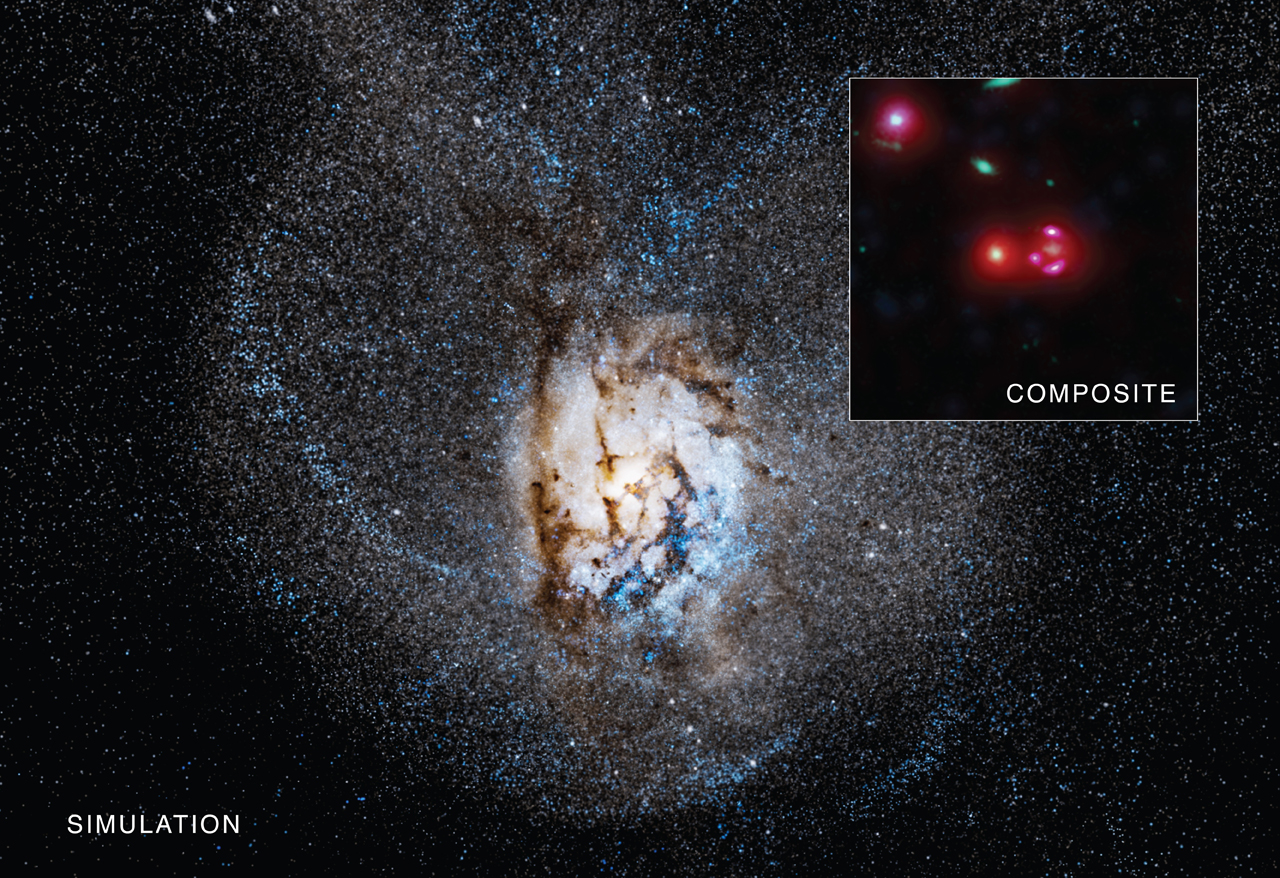
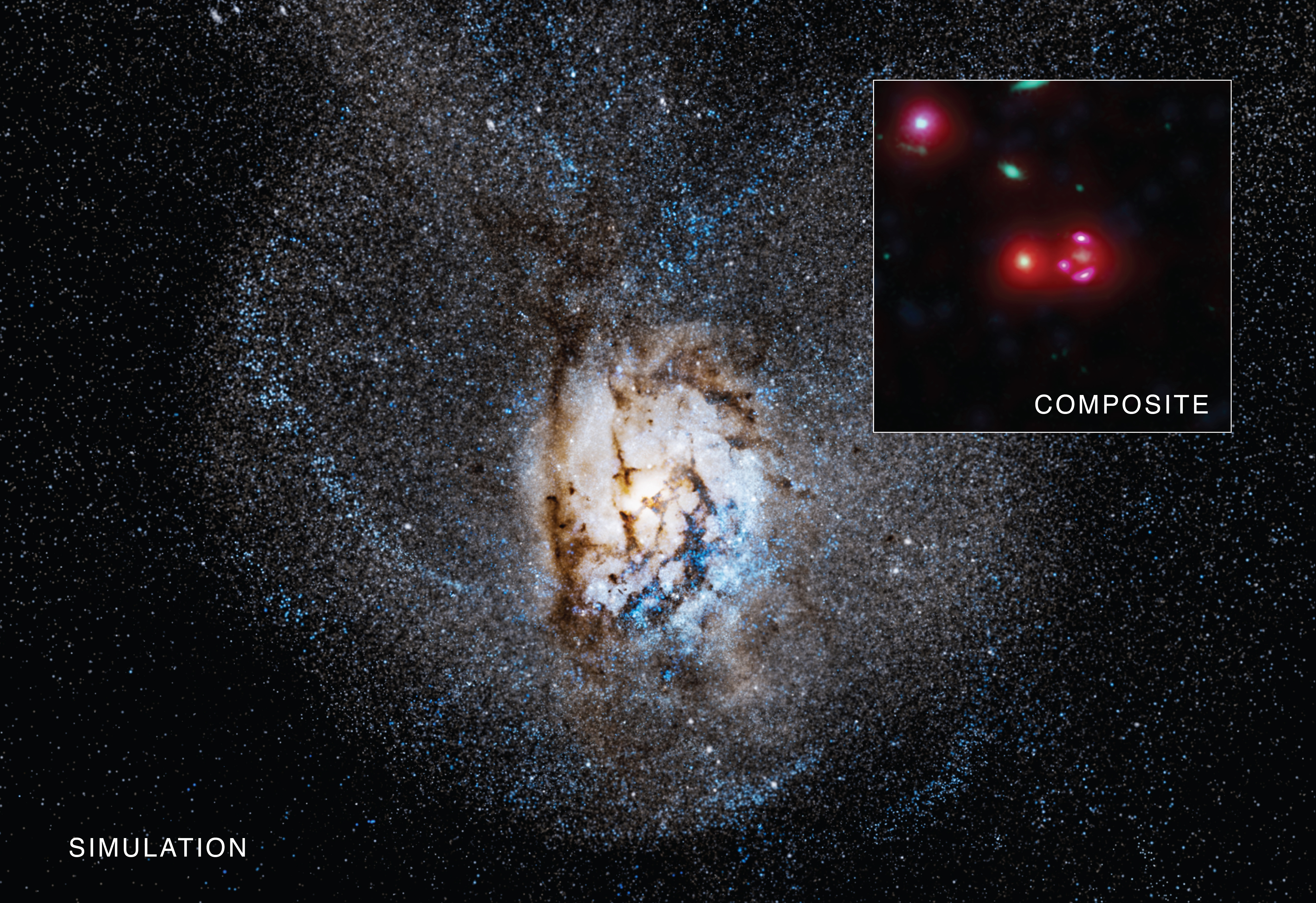
This graphic shows a frame from a computer simulation (main image) and astronomical data (inset) of a distant galaxy undergoing an extraordinary construction boom of star formation, as described in our press release. The galaxy, known as SPT0346-52, is 12.7 billion light years from Earth. This means that astronomers are observing it at a critical stage in the evolution of galaxies, about a billion years after the Big Bang.

Astronomers were intrigued by SPT0346-52 when data from the Atacama Large Millimeter/submillimeter Array (ALMA) revealed extremely bright infrared emission from this galaxy. This suggested that the galaxy is undergoing a tremendous explosion of star birth.

However, another possible explanation for the excess infrared emission was the presence of a rapidly growing supermassive black hole at the galaxy's center. In this scenario, gas falling towards the black hole would become much hotter and brighter, causing surrounding dust and gas to glow in infrared light.

To distinguish between these two possibilities, researchers used NASA's Chandra X-ray Observatory and CSIRO's Australia Telescope Compact Array (ATCA), a radio telescope. Neither X-rays nor radio waves were detected, so astronomers were able to rule out a growing black hole generating most of the bright infrared light. Therefore, they determined that SPT0346-52 is undergoing a tremendous amount of star formation, an important discovery for a galaxy found so early in the Universe.

The main panel of the graphic shows one frame of a simulation produced on a supercomputer. The distorted galaxy shown here results from a collision between two galaxies followed by them merging. 

Astronomers think such a merger could be the reason why SPT0346-52 is having such a boom of stellar construction. Once the two galaxies collide, gas near the center of the merged galaxy (shown as the bright region in the center of the simulation) is compressed, producing the burst of new stars seen forming in SPT0346-52. The dark regions in the simulation represent cosmic dust that absorbs and scatters starlight.

SPT0346-52 (Labeled)
Credit: X-ray: NASA/CXC/Univ of Florida/J.Ma et al; 
Optical: NASA/STScI; Infrared: NASA/JPL-Caltech; Radio: ESO/NAOJ/NRAO/ALMA)

The inset in this graphic contains a composite image with X-ray data from Chandra (blue), short wavelength infrared data from Hubble (green), infrared light from Spitzer (red) at longer wavelengths, and infrared data from ALMA (magenta) at even longer wavelengths. In the latter case the light from SPT0346-52 is distorted and magnified by the gravity of an intervening galaxy, producing three elongated images in the ALMA data located near the center of the image.

SPT0346-52 is not visible in the Hubble or Spitzer data, but the intervening galaxy causing the gravitational lensing is detected. The bright galaxy seen in the Hubble and Spitzer data slightly to the left of the image's center is unrelated to SPT0346-52.

There is no blue at the center of the image, showing that Chandra did not detect any X-rays that could have signaled the presence of a growing black hole. The ATCA data, not shown here, also involved the non-detection of a growing black hole. These data suggest that SPT0346-52 is forming at a rate of about 4,500 times the mass of the Sun every year, one of the highest rates seen in a galaxy. This is in contrast to a galaxy like the Milky Way that only forms about one solar mass of new stars per year.

A paper describing these results, with first author Jingzhe Ma (University of Florida), has been accepted for publication in The Astrophysical Journal and is available online. NASA's Marshall Space Flight Center in Huntsville, Alabama, manages the Chandra program for NASA's Science Mission Directorate in Washington. The Smithsonian Astrophysical Observatory in Cambridge, Massachusetts, controls Chandra's science and flight operations.


Fast Facts for SPT 0346-52:

Scale: Image is 46 arcsec across (about 900,000 light years)
Category: Normal Galaxies & Starburst Galaxies
Coordinates (J2000): RA 03h 46m 41.13s | Dec -52° 05' 02.11"
Constellation: Horologium
Observation Date: 29 Jul 2015
Observation Time: 13 hours 53 min.
Obs. ID: 17132
Instrument: ACIS
References: Ma, J. et al, 2016, ApJ (accepted); arXiv:1609.08553
Color Code: X-ray (Blue), Optical (Green), Infrared (Red), Radio (Purple)
Distance Estimate: About 12.7 billion light years (z=5.656)


A transformation in Virgo

Credit: ESA/Hubble & NASA


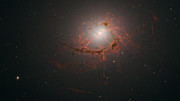
The constellation of Virgo (The Virgin) is especially rich in galaxies, due in part to the presence of a massive and gravitationally-bound collection of over 1300 galaxies called the Virgo Cluster. One particular member of this cosmic community, NGC 4388, is captured in this image, as seen by the NASA/ESA Hubble Space Telescope’s Wide Field Camera 3 (WFC3). 

Located some 60 million light-years away, NGC 4388 is experiencing some of the less desirable effects that come with belonging to such a massive galaxy cluster. It is undergoing a transformation, and has taken on a somewhat confused identity. 

While the galaxy’s outskirts appear smooth and featureless, a classic feature of an elliptical galaxy, its centre displays remarkable dust lanes constrained within two symmetric spiral arms, which emerge from the galaxy’s glowing core — one of the obvious features of a spiral galaxy. Within the arms, speckles of bright blue mark the locations of young stars, indicating that NGC 4388 has hosted recent bursts of star formation. 

Despite the mixed messages, NGC 4388 is classified as a spiral galaxy. Its unusual combination of features are thought to have been caused by interactions between NGC 4388 and the Virgo Cluster.

Gravitational interactions — from glancing blows to head-on collisions, tidal influencing, mergers, and galactic cannibalism — can be devastating to galaxies. While some may be lucky enough to simply suffer a distorted spiral arm or newly-triggered wave of star formation, others see their structure and contents completely and irrevocably altered.


Thursday, December 08, 2016

Cassini Beams Back First Images from New Orbit

This view from NASA's Cassini spacecraft was obtained about half a day before its first close pass by the outer edges of Saturn's main rings during its penultimate mission phase. NASA/JPL-Caltech/Space Science Institute.  › Full image and caption

This collage of images from NASA's Cassini spacecraft shows Saturn's northern hemisphere and rings as viewed with four different spectral filters. NASA/JPL-Caltech/Space Science Institute.  › Full image and caption


NASA's Cassini spacecraft has sent to Earth its first views of Saturn's atmosphere since beginning the latest phase of its mission. The new images show scenes from high above Saturn's northern hemisphere, including the planet's intriguing hexagon-shaped jet stream.

Cassini began its new mission phase, called its Ring-Grazing Orbits, on Nov. 30. Each of these weeklong orbits -- 20 in all -- carries the spacecraft high above Saturn's northern hemisphere before sending it skimming past the outer edges of the planet's main rings.

Cassini's imaging cameras acquired these latest views on Dec. 2 and 3, about two days before the first ring-grazing approach to the planet. Future passes will include images from near closest approach, including some of the closest-ever views of the outer rings and small moons that orbit there.

"This is it, the beginning of the end of our historic exploration of Saturn. Let these images -- and those to come -- remind you that we've lived a bold and daring adventure around the solar system's most magnificent planet," said Carolyn Porco, Cassini imaging team lead at Space Science Institute, Boulder, Colorado.

The next pass by the rings' outer edges is planned for Dec. 11. The ring-grazing orbits will continue until April 22, when the last close flyby of Saturn's moon Titan will once again reshape Cassini's flight path. With that encounter, Cassini will begin its Grand Finale, leaping over the rings and making the first of 22 plunges through the 1,500-mile-wide (2,400-kilometer) gap between Saturn and its innermost ring on April 26.

On Sept. 15, the mission's planned conclusion will be a final dive into Saturn's atmosphere. During its plunge, Cassini will transmit data about the atmosphere's composition until its signal is lost.
Launched in 1997, Cassini has been touring the Saturn system since arriving in 2004 for an up-close study of the planet, its rings and moons. Cassini has made numerous dramatic discoveries, including a global ocean with indications of hydrothermal activity within the moon Enceladus, and liquid methane seas on another moon, Titan.


For details about Cassini's ring-grazing orbits, visit: https://saturn.jpl.nasa.gov/news/2966/ring-grazing-orbits

The Cassini-Huygens mission is a cooperative project of NASA, ESA (European Space Agency) and the Italian Space Agency. NASA's Jet Propulsion Laboratory, a division of Caltech in Pasadena, manages the mission for NASA's Science Mission Directorate, Washington. JPL designed, developed and assembled the Cassini orbiter.


More information about Cassini is at:  http://www.nasa.gov/cassini - http://saturn.jpl.nasa.gov


News Media Contact

Preston Dyches
Jet Propulsion Laboratory, Pasadena, Calif.
818-394-7013

preston.dyches@jpl.nasa.gov


Wednesday, December 07, 2016

Dark Matter May be Smoother than Expected

Dark matter map of KiDS survey region (region G12)

Dark matter map of KiDS survey region (region G9)

Dark matter map of KiDS survey region (region G15)

Videos

Zooming in on one of the KiDS survey regions


Careful study of large area of sky imaged by VST reveals intriguing result

Analysis of a giant new galaxy survey, made with ESO’s VLT Survey Telescope in Chile, suggests that dark matter may be less dense and more smoothly distributed throughout space than previously thought. An international team used data from the Kilo Degree Survey (KiDS) to study how the light from about 15 million distant galaxies was affected by the gravitational influence of matter on the largest scales in the Universe. The results appear to be in disagreement with earlier results from the Planck satellite.

Hendrik Hildebrandt from the Argelander-Institut für Astronomie in Bonn, Germany and Massimo Viola from the Leiden Observatory in the Netherlands led a team of astronomers [1] from institutions around the world who processed images from the Kilo Degree Survey (KiDS), which was made with ESO’s VLT Survey Telescope (VST) in Chile. For their analysis, they used images from the survey that covered five patches of the sky covering a total area of around 2200 times the size of the full Moon [2], and containing around 15 million galaxies.

By exploiting the exquisite image quality available to the VST at the Paranal site, and using innovative computer software, the team were able to carry out one of the most precise measurements ever made of an effect known as cosmic shear. This is a subtle variant of weak gravitational lensing, in which the light emitted from distant galaxies is slightly warped by the gravitational effect of large amounts of matter, such as galaxy clusters.

In cosmic shear, it is not galaxy clusters but large-scale structures in the Universe that warp the light, which produces an even smaller effect. Very wide and deep surveys, such as KiDS, are needed to ensure that the very weak cosmic shear signal is strong enough to be measured and can be used by astronomers to map the distribution of gravitating matter. This study takes in the largest total area of the sky to ever be mapped with this technique so far.

Intriguingly, the results of their analysis appear to be inconsistent with deductions from the results of the European Space Agency’s Planck satellite, the leading space mission probing the fundamental properties of the Universe. In particular, the KiDS team’s measurement of how clumpy matter is throughout the Universe — a key cosmological parameter — is significantly lower than the value derived from the Planck data [3].

Massimo Viola explains: “This latest result indicates that dark matter in the cosmic web, which accounts for about one-quarter of the content of the Universe, is less clumpy than we previously believed.”
Dark matter remains elusive to detection, its presence only inferred from its gravitational effects. Studies like these are the best current way to determine the shape, scale and distribution of this invisible material.

The surprise result of this study also has implications for our wider understanding of the Universe, and how it has evolved during its almost 14-billion-year history. Such an apparent disagreement with previously established results from Planck means that astronomers may now have to reformulate their understanding of some fundamental aspects of the development of the Universe.

Hendrik Hildebrandt comments: “Our findings will help to refine our theoretical models of how the Universe has grown from its inception up to the present day.”

The KiDS analysis of data from the VST is an important step but future telescopes are expected to take even wider and deeper surveys of the sky.

The co-leader of the study, Catherine Heymans of the University of Edinburgh in the UK adds: “Unravelling what has happened since the Big Bang is a complex challenge, but by continuing to study the distant skies, we can build a picture of how our modern Universe has evolved.”

We see an intriguing discrepancy with Planck cosmology at the moment. Future missions such as the Euclid satellite and the Large Synoptic Survey Telescope will allow us to repeat these measurements and better understand what the Universe is really telling us,” concludes Konrad Kuijken (Leiden Observatory, the Netherlands), who is principal investigator of the KiDS survey.


Notes

[1] The international KiDS team of researchers includes scientists from Germany, the Netherlands, the UK, Australia, Italy, Malta and Canada.

[2] This corresponds to about 450 square degrees, or a little more than 1% of the entire sky.


[3] The parameter measured is called S8. Its value is a combination of the size of density fluctuations in, and the average density of, a section of the Universe. Large fluctuations in lower density parts of the Universe have an effect similar to that of smaller amplitude fluctuations in denser regions and the two cannot be distinguished by observations of weak lensing. The 8 refers to a cell size of 8 megaparsecs, which is used by convention in such studies.


More Information

This research was presented in the paper entitled “KiDS-450: Cosmological parameter constraints from tomographic weak gravitational lensing”, by H. Hildebrandt et al., to appear in Monthly Notices of the Royal Astronomical Society.


The team is composed of H. Hildebrandt (Argelander-Institut für Astronomie, Bonn, Germany), M. Viola (Leiden Observatory, Leiden University, Leiden, the Netherlands), C. Heymans (Institute for Astronomy, University of Edinburgh, Edinburgh, UK), S. Joudaki (Centre for Astrophysics & Supercomputing, Swinburne University of Technology, Hawthorn, Australia), K. Kuijken (Leiden Observatory, Leiden University, Leiden, the Netherlands), C. Blake (Centre for Astrophysics & Supercomputing, Swinburne University of Technology, Hawthorn, Australia), T. Erben (Argelander-Institut für Astronomie, Bonn, Germany), B. Joachimi (University College London, London, UK), D Klaes (Argelander-Institut für Astronomie, Bonn, Germany), L. Miller (Department of Physics, University of Oxford, Oxford, UK), C.B. Morrison (Argelander-Institut für Astronomie, Bonn, Germany), R. Nakajima (Argelander-Institut für Astronomie, Bonn, Germany), G. Verdoes Kleijn (Kapteyn Astronomical Institute, University of Groningen, Groningen, the Netherlands), A. Amon (Institute for Astronomy, University of Edinburgh, Edinburgh, UK), A. Choi (Institute for Astronomy, University of Edinburgh, Edinburgh, UK), G. Covone (Department of Physics, University of Napoli Federico II, Napoli, Italy), J.T.A. de Jong (Leiden Observatory, Leiden University, Leiden, the Netherlands), A. Dvornik (Leiden Observatory, Leiden University, Leiden, the Netherlands), I. Fenech Conti (Institute of Space Sciences and Astronomy (ISSA), University of Malta, Msida, Malta; Department of Physics, University of Malta, Msida, Malta), A. Grado (INAF – Osservatorio Astronomico di Capodimonte, Napoli, Italy), J. Harnois-Déraps (Institute for Astronomy, University of Edinburgh, Edinburgh, UK; Department of Physics and Astronomy, University of British Columbia, Vancouver, Canada), R. Herbonnet (Leiden Observatory, Leiden University, Leiden, the Netherlands), H. Hoekstra (Leiden Observatory, Leiden University, Leiden, the Netherlands), F. Köhlinger (Leiden Observatory, Leiden University, Leiden, the Netherlands), J. McFarland (Kapteyn Astronomical Institute, University of Groningen, Groningen, the Netherlands), A. Mead (Department of Physics and Astronomy, University of British Columbia, Vancouver, Canada), J. Merten (Department of Physics, University of Oxford, Oxford, UK), N. Napolitano (INAF – Osservatorio Astronomico di Capodimonte, Napoli, Italy), J.A. Peacock (Institute for Astronomy, University of Edinburgh, Edinburgh, UK), M. Radovich (INAF – Osservatorio Astronomico di Padova, Padova, Italy), P. Schneider (Argelander-Institut für Astronomie, Bonn, Germany), P. Simon (Argelander-Institut für Astronomie, Bonn, Germany), E.A. Valentijn (Kapteyn Astronomical Institute, University of Groningen, Groningen, the Netherlands), J.L. van den Busch (Argelander-Institut für Astronomie, Bonn, Germany), E. van Uitert (University College London, London, UK) and L. van Waerbeke (Department of Physics and Astronomy, University of British Columbia, Vancouver, Canada).


ESO is the foremost intergovernmental astronomy organisation in Europe and the world’s most productive ground-based astronomical observatory by far. It is supported by 16 countries: Austria, Belgium, Brazil, the Czech Republic, Denmark, France, Finland, Germany, Italy, the Netherlands, Poland, Portugal, Spain, Sweden, Switzerland and the United Kingdom, along with the host state of Chile. ESO carries out an ambitious programme focused on the design, construction and operation of powerful ground-based observing facilities enabling astronomers to make important scientific discoveries. ESO also plays a leading role in promoting and organising cooperation in astronomical research. ESO operates three unique world-class observing sites in Chile: La Silla, Paranal and Chajnantor. At Paranal, ESO operates the Very Large Telescope, the world’s most advanced visible-light astronomical observatory and two survey telescopes. VISTA works in the infrared and is the world’s largest survey telescope and the VLT Survey Telescope is the largest telescope designed to exclusively survey the skies in visible light. ESO is a major partner in ALMA, the largest astronomical project in existence. And on Cerro Armazones, close to Paranal, ESO is building the 39-metre European Extremely Large Telescope, the E-ELT, which will become “the world’s biggest eye on the sky”.


 Links


Contacts

Hendrik Hildebrandt
Argelander-Institut für Astronomie
Bonn, Germany
Tel: +49 228 73 1772
Email:
hendrik@astro.uni-bonn.de

Massimo Viola
Leiden Observatory
Leiden, The Netherlands
Tel: +31 (0)71 527 8442
Email:
viola@strw.leidenuniv.nl

Catherine Heymans
Institute for Astronomy, University of Edinburgh
Edinburgh, United Kingdom
Tel: +44 131 668 8301
Email:
heymans@roe.ac.uk

Konrad Kuijken
Leiden Observatory
Leiden, The Netherlands
Tel: +31 715275848
Cell: +31 628956539
Email:
kuijken@strw.leidenuniv.nl

Richard Hook
ESO Public Information Officer
Garching bei Munchen, Germany
Tel: +49 89 3200 6655
Cell: +49 151 1537 3591
Email:
rhook@eso.org

Source: ESO

Tuesday, December 06, 2016

Colliding Galaxy Clusters

The galaxy 3C438 and its cluster of galaxies as seen in the optical (left) and in X-rays by the Chandra X-ray Observatory (right). Astronomers have concluded that the hot gas is the result of a collision between two clusters of galaxies. Credit: X-ray: NASA/CXC/CfA/R.P.Kraft; Optical: Pal.Obs. DSS


Galaxy clusters contain a few to thousands of galaxies and are the largest bound structures in the Universe. Most galaxies are members of a cluster. Our Milky Way, for example, is a member of the "Local Group," a set of about fifty galaxies whose other large member is the Andromeda galaxy. The closest large cluster of galaxies to us, about fifty million light-years away, is the Virgo Cluster, with about 2000 members.

Clusters are believed to grow as the result of mergers between smaller galaxy groups and from the accretion of gas and dark matter. The energy released in these mergers is largely dissipated in the hot gas within the cluster, where X-ray observations can spot evidence for shocks and high temperatures. Mergers between two equally massive galaxy clusters provide particularly important diagnostics since these energetic collisions have the most dramatic and long-lasting effects. These major mergers are relatively rare events, however. The Bullet Cluster is one recently analyzed example, and because it also happens to act as a gravitational lens for background galaxies, it became famous for showing the distribution of its dark matter.

CfA astronomers Deanna Emery, Akos Bogdan, Ralph Kraft, Filipe Andrade-Santos, Bill Forman, and Christine Jones, and another colleague studied another major merger in the cluster around the galaxy 3C438. Members of the team used the Chandra X-ray Observatory to examine the hot cluster gas. Previous observations had concluded that activity was due either to a supermassive black hole or from a massive merger, but the two could not be distinguished. Using additional Chandra observations and new calibration procedures, the scientists re-reduced all the data. They found that the hot cluster gas extends over a distance of about 2.5 million light-years and has brightness features apparently caused by a merger bow shock. They are even able to calculate the estimated relative velocity of the merger as about 2600 kilometers per second. Since few observations of bow shocks in clusters have been made, this detection makes an important contribution to the study of the dynamics of cluster mergers and how massive clusters may have formed.


Reference(s):


"A Spectacular Bow Shock in the 11 keV Galaxy Cluster Around 3C 438," Deanna L. Emery, Akos Bogdan, Ralph P. Kraft, Felipe Andrade-Santos, William R. Forman, Martin J. Hardcastle, and Christine Jones, ApJ, 2016 (in press).


Monday, December 05, 2016

Embryonic Cluster Galaxy Immersed in Giant Cloud of Cold Gas

Artist's conception of the Spiderweb. In this image, the protogalaxies are shown in white and pink, and the blue indicates the location of the carbon monoxide gas in which the protogalaxies are immersed. CREDIT: ESO/M. Kornmesser. This figure is licensed under CC BY 4.0 International License.


Astronomers studying a cluster of still-forming protogalaxies seen as they were more than 10 billion years ago have found that a giant galaxy in the center of the cluster is forming from a surprisingly-dense soup of molecular gas.

"This is different from what we see in the nearby Universe, where galaxies in clusters grow by cannibalizing other galaxies. In this cluster, a giant galaxy is growing by feeding on the soup of cold gas in which it is submerged," said Bjorn Emonts of the Center for Astrobiology in Spain, who led an international research team.

The scientists studied an object called the Spiderweb Galaxy, which actually is not yet a single galaxy, but a clustering of protogalaxies more than 10 billion light-years from Earth. At that distance, the object is seen as it was when the Universe was only 3 billion years old. The astronomers used the Australia Telescope Compact Array (ATCA) and the National Science Foundation's Karl G. Jansky Very Large Array (VLA) to detect carbon monoxide (CO) gas.

The presence of the CO gas indicates a larger quantity of molecular hydrogen, which is much more difficult to detect. The astronomers estimated that the molecular gas totals more than 100 billion times the mass of the Sun. Not only is this quantity of gas surprising, they said, but the gas also must be unexpectedly cold, about minus-200 degrees Celsius. Such cold molecular gas is the raw material for new stars.

The CO in this gas indicates that it has been enriched by the supernova explosions of earlier generations of stars. The carbon and oxygen in the CO was formed in the cores of stars that later exploded.

The ATCA observations revealed the total extent of the gas, and the VLA observations, much more narrowly focused, provided another surprise. Most of the cold gas was found, not within the protogalaxies, but instead between them.

"This is a huge system, with this molecular gas spanning three times the size of our own Milky Way Galaxy," said Preshanth Jagannathan, of the National Radio Astronomy Observatory (NRAO) in Socorro, NM.

Earlier observations of the Spiderweb, made at ultraviolet wavelengths, have indicated that rapid star formation is ongoing across most of the region occupied by the gas.

"It appears that this whole system eventually will collapse into a single, gigantic galaxy," Jagannathan said.

"These observations give us a fascinating look at what we believe is an early stage in the growth of massive galaxies in clusters, a stage far different from galaxy growth in the current Universe," said Chris Carilli, of NRAO.

The astronomers reported their findings in the December 2 issue of the journal Science.

The National Radio Astronomy Observatory is a facility of the National Science Foundation, operated under cooperative agreement by Associated Universities, Inc.

###

Media Contact:

Dave Finley, Public Information Officer
(575) 835-7302
dfinley@nrao.edu


Friday, December 02, 2016

Spotlight on IC 3583

Credit: ESA/Hubble & NASA


This delicate blue group of stars — actually an irregular galaxy named IC 3583 — sits some 30 million light-years away in the constellation of Virgo (The Virgin).

It may seem to have no discernable structure, but IC 3583 has been found to have a bar of stars running through its centre. These structures are common throughout the Universe, and are found within the majority of spiral, many irregular, and some lenticular galaxies. Two of our closest cosmic neighbours, the Large and Small Magellanic Clouds, are barred, indicating that they may have once been barred spiral galaxies that were disrupted or torn apart by the gravitational pull of the Milky Way.

Something similar might be happening with IC 3583. This small galaxy is thought to be gravitationally interacting with one of its neighbours, the spiral Messier 90. Together, the duo form a pairing known as Arp 76. It’s still unclear whether these flirtations are the cause of IC 3583’s irregular appearance — but whatever the cause, the galaxy makes for a strikingly delicate sight in this NASA/ESA Hubble Space Telescope image, glimmering in the blackness of space.


Thursday, December 01, 2016

Tangled threads weave through cosmic oddity

Dusty filaments in NGC 4696 

Wide-field image of NGC 4696 (ground-based image)

Videos

Zoom in on NGC 4696
Zoom in on NGC 4696 

Pan across NGC 4696
Pan across NGC 4696


New observations from the NASA/ESA Hubble Space Telescope have revealed the intricate structure of the galaxy NGC 4696 in greater detail than ever before. The elliptical galaxy is a beautiful cosmic oddity with a bright core wrapped in system of dark, swirling, thread-like filaments.

NGC 4696 is a member of the Centaurus galaxy cluster, a swarm of hundreds of galaxies all sitting together, bound together by gravity, about 150 million light-years from Earth and located in the constellation of Centaurus.

Despite the cluster’s size, NGC 4696 still manages to stand out from its companions — it is the cluster’s brightest member, known for obvious reasons as the Brightest Cluster Galaxy . This puts it in the same category as some of the biggest and brightest galaxies known in the Universe.

Even if NGC 4696 keeps impressive company, it has a further distinction: the galaxy’s unique structure. Previous observations have revealed curling filaments that stretch out from its main body and carve out a cosmic question mark in the sky (heic1013), the dark tendrils encircling a brightly glowing centre.

An international team of scientists, led by astronomers from the University of Cambridge, UK, have now used new observations from the NASA/ESA Hubble Space Telescope to explore this thread-like structure in more detail. They found that each of the dusty filaments has a width of about 200 light-years, and a density some 10 times greater than the surrounding gas. These filaments knit together and spiral inwards towards the centre of NGC 4696, connecting the galaxy’s constituent gas to its core.

In fact, it seems that the galaxy’s core is actually responsible for the shape and positioning of the filaments themselves. At the centre of NGC 4696 lurks an active supermassive black hole. This floods the galaxy’s inner regions with energy, heating the gas there and sending streams of heated material outwards.

It appears that these hot streams of gas bubble outwards, dragging the filamentary material with them as they go. The galaxy’s magnetic field is also swept out with this bubbling motion, constraining and sculpting the material within the filaments.

At the very centre of the galaxy, the filaments loop and curl inwards in an intriguing spiral shape, swirling around the supermassive black hole at such a distance that they are dragged into and eventually consumed by the black hole itself.

Understanding more about filamentary galaxies such as NGC 4696 may help us to better understand why so many massive galaxies near to us in the Universe appear to be dead; rather than forming newborn stars from their vast reserves of gas and dust, they instead sit quietly, and are mostly populated with old and aging stars. This is the case with NGC 4696. It may be that the magnetic structure flowing throughout the galaxy stops the gas from creating new stars.


More Information

The Hubble Space Telescope is a project of international cooperation between ESA and NASA.
Image credit: NASA, ESA, Andy Fabian


Links


Contacts

Andy Fabian
University of Cambridge
Cambridge, United Kingdom
Tel: +44 1223 337509

Mathias Jäger
ESA/Hubble, Public Information Officer
Garching bei München, Germany
Tel: +49 176 62397500

Source: ESO/Hubble/News