Showing posts with label Saturnian atmosphere. Show all posts

Friday, August 31, 2018

Hubble observes energetic lightshow at Saturn’s north pole

PR Image heic1815a
Saturn’s northern auroras

PR Image heic1815b
Saturn’s northern auroras


Videos
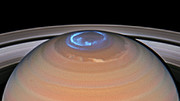
Animation of Saturn’s northern auroras
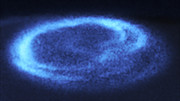

Closeup of Saturn's auroras


Astronomers using the NASA/ESA Hubble Space telescope have taken a series of spectacular images featuring the fluttering auroras at the north pole of Saturn. The observations were taken in ultraviolet light and the resulting images provide astronomers with the most comprehensive picture so far of Saturn’s northern aurora.

In 2017, over a period of seven months, the NASA/ESA Hubble Space Telescope took images of auroras above Saturn’s north pole region using the Space Telescope Imaging Spectrograph. The observations were taken before and after the Saturnian northern summer solstice. These conditions provided the best achievable viewing of the northern auroral region for Hubble.

On Earth, auroras are mainly created by particles originally emitted by the Sun in the form of solar wind. When this stream of electrically charged particles gets close to our planet, it interacts with the magnetic field, which acts as a gigantic shield. While it protects Earth’s environment from solar wind particles, it can also trap a small fraction of them. Particles trapped within the magnetosphere — the region of space surrounding Earth in which charged particles are affected by its magnetic field — can be energised and then follow the magnetic field lines down to the magnetic poles. There, they interact with oxygen and nitrogen atoms in the upper layers of the atmosphere, creating the flickering, colourful lights visible in the polar regions here on Earth [1].

However, these auroras are not unique to Earth. Other planets in our Solar System have been found to have similar auroras. Among them are the four gas giants Jupiter, Saturn, Uranus and Neptune.

Because the atmosphere of each of the four outer planets in the Solar System is — unlike the Earth — dominated by hydrogen, Saturn’s auroras can only be seen in ultraviolet wavelengths; a part of the electromagnetic spectrum which can only be studied from space.

Hubble allowed researchers to monitor the behaviour of the auroras at Saturn's north pole over an extended period of time. The Hubble observations were coordinated with the “Grand Finale” of the Cassini spacecraft, when the spacecraft simultaneously probed the auroral regions of Saturn [2]. The Hubble data allowed astronomers to learn more about Saturn’s magnetosphere, which is the largest of any planet in the Solar System other than Jupiter.

The images show a rich variety of emissions with highly variable localised features. The variability of the auroras is influenced by both the solar wind and the rapid rotation of Saturn, which lasts only about 11 hours. On top of this, the northern aurora displays two distinct peaks in brightness — at dawn and just before midnight. The latter peak, unreported before, seems specific to the interaction of the solar wind with the magnetosphere at Saturn’s solstice.

The main image presented here is a composite of observations made of Saturn in early 2018 in the optical and of the auroras on Saturn’s north pole region, made in 2017, demonstrating the size of the auroras along with the beautiful colours of Saturn.

Hubble has studied Saturn's auroras in the past. In 2004, it studied the southern auroras shortly after the southern solstice (heic0504) and in 2009 it took advantage of a rare opportunity to record Saturn when its rings were edge-on (heic1003). This allowed Hubble to observe both poles and their auroras simultaneously.


Notes

[1] The auroras here on Earth have different names depending on which pole they occur at. Aurora Borealis, or the northern lights, is the name given to auroras around the north pole and Aurora Australis, or the southern lights, is the name given for auroras around the south pole.


[2] Cassini was a collaboration between NASA, ESA and the Italian Space Agency. It spent 13 years orbiting Saturn, gathering information and giving astronomers a great insight into the inner workings of Saturn. Cassini took more risks at the end of its mission, travelling through the gap between Saturn and its rings. No spacecraft had previously done this, and Cassini gathered spectacular images of Saturn as well as new data for scientists to work with. On 15 September 2017 Cassini was sent on a controlled crash into Saturn.


More Information

The Hubble Space Telescope is a project of international cooperation between ESA and NASA.
Image credit: NASA, ESA & L. Lamy


Links


Contacts

Laurent Lamy
Observatoire de Paris
Paris, France
Tel: +33 145 077668
Email: laurent.lamy@obspm.fr

Mathias Jäger
ESA/Hubble, Public Information Officer
Garching, Germany
Tel: +49 176 62397500
Email: mjaeger@partner.eso.org


Thursday, December 08, 2016

Cassini Beams Back First Images from New Orbit

This view from NASA's Cassini spacecraft was obtained about half a day before its first close pass by the outer edges of Saturn's main rings during its penultimate mission phase. NASA/JPL-Caltech/Space Science Institute.  › Full image and caption

This collage of images from NASA's Cassini spacecraft shows Saturn's northern hemisphere and rings as viewed with four different spectral filters. NASA/JPL-Caltech/Space Science Institute.  › Full image and caption


NASA's Cassini spacecraft has sent to Earth its first views of Saturn's atmosphere since beginning the latest phase of its mission. The new images show scenes from high above Saturn's northern hemisphere, including the planet's intriguing hexagon-shaped jet stream.

Cassini began its new mission phase, called its Ring-Grazing Orbits, on Nov. 30. Each of these weeklong orbits -- 20 in all -- carries the spacecraft high above Saturn's northern hemisphere before sending it skimming past the outer edges of the planet's main rings.

Cassini's imaging cameras acquired these latest views on Dec. 2 and 3, about two days before the first ring-grazing approach to the planet. Future passes will include images from near closest approach, including some of the closest-ever views of the outer rings and small moons that orbit there.

"This is it, the beginning of the end of our historic exploration of Saturn. Let these images -- and those to come -- remind you that we've lived a bold and daring adventure around the solar system's most magnificent planet," said Carolyn Porco, Cassini imaging team lead at Space Science Institute, Boulder, Colorado.

The next pass by the rings' outer edges is planned for Dec. 11. The ring-grazing orbits will continue until April 22, when the last close flyby of Saturn's moon Titan will once again reshape Cassini's flight path. With that encounter, Cassini will begin its Grand Finale, leaping over the rings and making the first of 22 plunges through the 1,500-mile-wide (2,400-kilometer) gap between Saturn and its innermost ring on April 26.

On Sept. 15, the mission's planned conclusion will be a final dive into Saturn's atmosphere. During its plunge, Cassini will transmit data about the atmosphere's composition until its signal is lost.
Launched in 1997, Cassini has been touring the Saturn system since arriving in 2004 for an up-close study of the planet, its rings and moons. Cassini has made numerous dramatic discoveries, including a global ocean with indications of hydrothermal activity within the moon Enceladus, and liquid methane seas on another moon, Titan.


For details about Cassini's ring-grazing orbits, visit: https://saturn.jpl.nasa.gov/news/2966/ring-grazing-orbits

The Cassini-Huygens mission is a cooperative project of NASA, ESA (European Space Agency) and the Italian Space Agency. NASA's Jet Propulsion Laboratory, a division of Caltech in Pasadena, manages the mission for NASA's Science Mission Directorate, Washington. JPL designed, developed and assembled the Cassini orbiter.


More information about Cassini is at:  http://www.nasa.gov/cassini - http://saturn.jpl.nasa.gov


News Media Contact

Preston Dyches
Jet Propulsion Laboratory, Pasadena, Calif.
818-394-7013

preston.dyches@jpl.nasa.gov


Tuesday, June 16, 2015

Small thunderstorms may add up to massive cyclones on Saturn

The rings of Saturn and its north polar vortex
Image courtesy of Caltech/Space Science Institute


New model may predict cyclone activity on other planets.

For the last decade, astronomers have observed curious “hotspots” on Saturn’s poles. In 2008, NASA’s Cassini spacecraft beamed back close-up images of these hotspots, revealing them to be immense cyclones, each as wide as the Earth. Scientists estimate that Saturn’s cyclones may whip up 300 mph winds, and likely have been churning for years.

While cyclones on Earth are fueled by the heat and moisture of the oceans, no such bodies of water exist on Saturn. What, then, could be causing such powerful, long-lasting storms?

In a paper published today in the journal Nature Geoscience, atmospheric scientists at MIT propose a possible mechanism for Saturn’s polar cyclones: Over time, small, short-lived thunderstorms across the planet may build up angular momentum, or spin, within the atmosphere — ultimately stirring up a massive and long-lasting vortex at the poles.

The researchers developed a simple model of Saturn’s atmosphere, and simulated the effect of multiple small thunderstorms forming across the planet over time. Eventually, they observed that each thunderstorm essentially pulls air towards the poles — and together, these many small, isolated thunderstorms can accumulate enough atmospheric energy at the poles to generate a much larger and long-lived cyclone.

The team found that whether a cyclone develops depends on two parameters: the size of the planet relative to the size of an average thunderstorm on it, and how much storm-induced energy is in its atmosphere. Given these two parameters, the researchers predicted that Neptune, which bears similar polar hotspots, should generate transient polar cyclones that come and go, while Jupiter should have none.

Morgan O’Neill, the paper’s lead author and a former PhD student in MIT’s Department of Earth, Atmospheric and Planetary Sciences (EAPS), says the team’s model may eventually be used to gauge atmospheric conditions on planets outside the solar system. For instance, if scientists detect a cyclone-like hotspot on a far-off exoplanet, they may be able to estimate storm activity and general atmospheric conditions across the entire planet.

“Before it was observed, we never considered the possibility of a cyclone on a pole,” says O’Neill, who is now a postdoc at the Weizmann Institute of Science in Israel.

“Only recently did Cassini give us this huge wealth of observations that made it possible, and only recently have we had to think about why [polar cyclones] occur.”

O’Neill’s co-authors are Kerry Emanuel, the Cecil and Ida Green Professor of Earth, Atmospheric and Planetary Sciences, and Glenn Flierl, a professor of oceanography in EAPS.


Beta-drifting toward a cyclone

Polar cyclones on Saturn are a puzzling phenomenon, since the planet, known as a gas giant, lacks an essential ingredient for brewing up such storms: water on its surface.

“There’s no surface at all — it just gets denser as you get deeper,” O’Neill says. “If you lack choppy waters or a frictional surface that allows wind to converge, which is how hurricanes form on Earth, how can you possibly get something that looks similar on a gas giant?”

The answer, she found, may be something called “beta drift” — a phenomenon by which a planet’s spin causes small thunderstorms to drift toward the poles. Beta drift drives the motion of hurricanes on Earth, without requiring the presence of water. When a storm forms, it spins in one direction at the surface, and the opposite direction toward the upper atmosphere, creating a “dipole of vorticity.” (In fact, videos of hurricanes taken from space actually depict the storm’s spin as opposite to what’s observed on the ground.)

“The whole atmosphere is kind of being dragged by the planet as the planet rotates, so all this air has some ambient angular momentum,” O’Neill explains. “If you converge a bunch of that air at the base of a thunderstorm, you’re going to get a small cyclone.”

The combination of a planet’s rotation and a circulating storm generates secondary features called beta gyres that wrap around a storm and essentially split its dipole in half, tugging the top half toward the equator, and the bottom half toward the pole.

The team developed a model of Saturn’s atmosphere and ran hundreds of simulations for hundreds of days each, allowing small thunderstorms to pop up across the planet. The researchers observed that multiple thunderstorms experienced beta drift over time, and eventually accumulated enough atmospheric circulation to create a much larger cyclone at the poles.

“Each of these storms is beta-drifting a little bit before they sputter out and die,” O’Neill says. “This mechanism means that little thunderstorms — fast, abundant, but not very strong thunderstorms — over a long period of time can actually accumulate so much angular momentum right on the pole, that you get a permanent, wildly strong cyclone.”

Next stop: Jupiter

The team also explored conditions in which planets would not form polar cyclones, even though they may experience thunderstorms. The researchers found that whether a polar cyclone forms depends on two parameters: the energy within a planet’s atmosphere, or the total intensity of its thunderstorms; and the average size of its thunderstorms, relative to the size of the planet itself. Specifically, the larger an average thunderstorm compared to a planet’s size, the more likely a polar cyclone is to develop.

O’Neill applied this relationship to Saturn, Jupiter, and Neptune. In the case of Saturn, the planet’s atmospheric conditions and storm activity are within the range that would generate a large polar cyclone. In contrast, Jupiter is unlikely to host any polar cyclones, as the ratio of any storm to its overall size would be extremely small. The dimensions of Neptune suggest that polar cyclones may exist there, albeit on a fleeting basis.

“Saturn has an intense cyclone at each pole,” says Andrew Ingersoll, professor of planetary science at Caltech, who was not involved in the study. “The model successfully accounts for that. Jupiter doesn't seem to have polar cyclones like Saturn's, but Jupiter isn't tipped over as much as Saturn, so we don't get a good view of the poles. Thus the apparent absence of polar cyclones on Jupiter is still a mystery.”

The researchers are eager to see whether their predictions, particularly for Jupiter, bear out. Next summer, NASA’s Juno spacecraft is scheduled to enter into an orbit around Jupiter, kicking off a one-year mission to map and explore Jupiter’s atmosphere.

“If what we know about Jupiter currently is correct, we predict that we won’t see these wildly strong cyclones,” O’Neill says. “We’ll find out next year if our predictions are true.”

This research was funded in part by the National Science Foundation.


Jennifer Chu | MIT News Office

Press Contact

Abby Abazorius
Email:
abbya@mit.edu
Phone: 617-253-2709
MIT News Office


Source:  MIT News Office

Thursday, April 11, 2013

Blame it on the Rain (from Saturn's Rings)

This artist's concept illustrates how charged water particles flow into the Saturnian atmosphere from the planet's rings, causing a reduction in atmospheric brightness. The observations were made with the W.M. Keck Observatory on Mauna Kea, Hawaii, with NASA funding. The analysis was led by the University of Leicester, England. Image credit: NASA/JPL-Caltech/Space Science Institute/University of Leicester.  › Larger image

A new study tracks the "rain" of charged water particles into the atmosphere of Saturn and finds there is more of it and it falls across larger areas of the planet than previously thought. The study, whose observations were funded by NASA and whose analysis was led by the University of Leicester, England, reveals that the rain influences the composition and temperature structure of parts of Saturn's upper atmosphere. The paper appears in this week's issue of the journal Nature.

"Saturn is the first planet to show significant interaction between its atmosphere and ring system," said James O'Donoghue, the paper's lead author and a postgraduate researcher at Leicester. "The main effect of ring rain is that it acts to 'quench' the ionosphere of Saturn. In other words, this rain severely reduces the electron densities in regions in which it falls."

O'Donoghue explains that the ring's effect on electron densities is important because it explains why, for many decades, observations have shown those densities to be unusually low at certain latitudes on Saturn. The study also helps scientists better understand the origin and evolution of Saturn's ring system and changes in the planet's atmosphere.

"It turns out that a major driver of Saturn's ionospheric environment and climate across vast reaches of the planet are ring particles located some 36,000 miles [60,000 kilometers] overhead," said Kevin Baines, a co-author on the paper, based at NASA's Jet Propulsion Laboratory, Pasadena, Calif. "The ring particles affect both what species of particles are in this part of the atmosphere and where it is warm or cool."

In the early 1980s, images from NASA's Voyager spacecraft showed two to three dark bands on Saturn, and scientists theorized that water could have been showering down into those bands from the rings. Those bands were not seen again until this team observed the planet in near-infrared wavelengths with the W.M Keck Observatory on Mauna Kea, in Hawaii, in April 2011. The effect was difficult to discern because it involves looking for a subtle emission from bright parts of Saturn. It required an instrument like that on Keck, which can split up a large range of light.

The ring rain's effect occurs in Saturn's ionosphere, where charged particles are produced when the otherwise neutral atmosphere is exposed to a flow of energetic particles or solar radiation. When the scientists tracked the pattern of emissions of a particular hydrogen ion with three protons (triatomic hydrogen), they expected to see a uniform planet-wide infrared glow. What they observed instead was a series of light and dark bands - with areas of reduced emission corresponding to water-dense portions of Saturn's rings and areas of high emission corresponding to gaps in the rings.

They surmised that charged water particles from the planet's rings were being drawn towards the planet along Saturn's magnetic field lines and were neutralizing the glowing triatomic hydrogen ions. This leaves large "shadows" in what would otherwise be a planet-wide infrared glow. These shadows cover some 30 to 43 percent of the planet's upper atmosphere surface from around 25 to 55 degrees latitude. This is a significantly larger area than suggested by images from NASA's Voyager mission.

Both Earth and Jupiter have an equatorial region that glows very uniformly. Scientists expected this pattern at Saturn, too, but they instead saw dramatic differences at different latitudes.

"Where Jupiter is glowing evenly across its equatorial regions, Saturn has dark bands where the water is falling in, darkening the ionosphere," said Tom Stallard, a paper co-author at Leicester. "We're now also trying to investigate these features with an instrument on NASA's Cassini spacecraft. If we're successful, Cassini may allow us to view in more detail the way that water is removing ionized particles, such as any changes in the altitude or effects that come with the time of day."

Keck observing time was funded by NASA, with a letter of support from the Cassini mission to Saturn. The Cassini-Huygens mission is a cooperative project of NASA, the European Space Agency, and the Italian Space Agency. The mission is managed by JPL for NASA's Science Mission Directorate, Washington. JPL is a division of the California Institute of Technology in Pasadena, Calif.


Jia-Rui C. Cook 818-354-0850
Jet Propulsion Laboratory, Pasadena, Calif.

jccook@jpl.nasa.gov

Ather Mirza 011-44-116 252 3335
University of Leicester Press Office, England

am74@le.ac.uk