Showing posts with label NGC 4696. Show all posts

Wednesday, April 19, 2017

NGC 4696: The Arrhythmic Beating of a Black Hole Heart A Tour of NGC 4696

NGC 4696
Credit: X-ray: NASA/CXC/MPE/J.Sanders et al.; 
Optical: NASA/STScI; Radio: NSF/NRAO/VLA


At the center of the Centaurus galaxy cluster, there is a large elliptical galaxy called NGC 4696. Deeper still, there is a supermassive black hole buried within the core of this galaxy.

New data from NASA's Chandra X-ray Observatory and other telescopes has revealed details about this giant black hole, located some 145 million light years from Earth. Although the black hole itself is undetected, astronomers are learning about the impact it has on the galaxy it inhabits and the larger cluster around it.

In some ways, this black hole resembles a beating heart that pumps blood outward into the body via the arteries. Likewise, a black hole can inject material and energy into its host galaxy and beyond.

By examining the details of the X-ray data from Chandra, scientists have found evidence for repeated bursts of energetic particles in jets generated by the supermassive black hole at the center of NGC 4696. These bursts create vast cavities in the hot gas that fills the space between the galaxies in the cluster. The bursts also create shock waves, akin to sonic booms produced by high-speed airplanes, which travel tens of thousands of light years across the cluster.

This composite image contains X-ray data from Chandra (red) that reveals the hot gas in the cluster, and radio data from the NSF's Karl G. Jansky Very Large Array (blue) that shows high-energy particles produced by the black hole-powered jets. Visible light data from the Hubble Space Telescope (green) show galaxies in the cluster as well as galaxies and stars outside the cluster.

Cavity processing scale: This image shows a larger field of view than the main composite image above and is about 122,000 light years across. This image has also been rotated slightly clockwise to the main composite image above.

Astronomers employed special processing to the X-ray data (shown above) to emphasize nine cavities visible in the hot gas. These cavities are labeled A through I in an additional image, and the location of the black hole is labeled with a cross. The cavities that formed most recently are located nearest to the black hole, in particular the ones labeled A and B.

The researchers estimate that these black hole bursts, or "beats", have occurred every five to ten million years. Besides the vastly differing time scales, these beats also differ from typical human heartbeats in not occurring at particularly regular intervals.

Curved processing scale: This image also shows a larger field of view than the main composite image and is about 550,000 light years across. This image has also been rotated slightly clockwise to the main composite image.


A different type of processing of the X-ray data (shown above) reveals a sequence of curved and approximately equally spaced features in the hot gas. These may be caused by sound waves generated by the black hole's repeated bursts. In a galaxy cluster, the hot gas that fills the cluster enables sound waves — albeit at frequencies far too low for the human hear to detect — to propagate. (Note that both images showing the labeled cavities and this image are rotated slightly clockwise to the main composite.)
The features in the Centaurus Cluster are similar to the ripples seen in the Perseus cluster of galaxies. The pitch of the sound in Centaurus is extremely deep, corresponding to a discordant sound about 56 octaves below the notes near middle C. This corresponds to a slightly higher (by about one octave) pitch than the sound in Perseus. Alternative explanations for these curved features include the effects of turbulence or magnetic fields.

The black hole bursts also appear to have lifted up gas that has been enriched in elements generated in supernova explosions. The authors of the study of the Centaurus cluster created a map showing the density of elements heavier than hydrogen and helium. The brighter colors in the map show regions with the highest density of heavy elements and the darker colors show regions with a lower density of heavy elements. Therefore, regions with the highest density of heavy elements are located to the right of the black hole. A lower density of heavy elements near the black hole is consistent with the idea that enriched gas has been lifted out of the cluster's center by bursting activity associated with the black hole. The energy produced by the black hole is also able to prevent the huge reservoir of hot gas from cooling. This has prevented large numbers of stars from forming in the gas.

A paper describing these results was published in the March 21st 2016 issue of the Monthly Notices of the Royal Astronomical Society and is available online. The first author is Jeremy Sanders from the Max Planck Institute for Extraterrestrial Physics in Garching, Germany.

NASA's Marshall Space Flight Center in Huntsville, Alabama, manages the Chandra program for NASA's Science Mission Directorate in Washington. The Smithsonian Astrophysical Observatory in Cambridge, Massachusetts, controls Chandra's science and flight operations.


Fast Facts for NGC 4696:

Scale: Image is about 2.2 arcmin across (about 93,000 light years)
Category: Black Holes, Normal Galaxies & Starburst Galaxies
Coordinates (J2000): RA 12h 48m 48.90s | Dec -41° 18′ 44.40
Constellation: Centaurus
Observation Date: 15 pointings between May 2000 and June 2014
Observation Time: 216 hours 29 min (9 days 29 min)
Obs. ID: 504, 505, 4190, 4191, 4954, 4955, 5310, 16223-16225, 16534, 16607-16610
Instrument: ACIS
References: Sanders, J. et al., 2016, MNRAS, 457, 82; arXiv:1601.01489
Color Code: X-ray (Red); Optical (Green); Radio (Blue)
Distance Estimate: About 145 million light years


Thursday, December 01, 2016

Tangled threads weave through cosmic oddity

Dusty filaments in NGC 4696 

Wide-field image of NGC 4696 (ground-based image)

Videos

Zoom in on NGC 4696
Zoom in on NGC 4696 

Pan across NGC 4696
Pan across NGC 4696


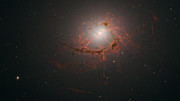
New observations from the NASA/ESA Hubble Space Telescope have revealed the intricate structure of the galaxy NGC 4696 in greater detail than ever before. The elliptical galaxy is a beautiful cosmic oddity with a bright core wrapped in system of dark, swirling, thread-like filaments.

NGC 4696 is a member of the Centaurus galaxy cluster, a swarm of hundreds of galaxies all sitting together, bound together by gravity, about 150 million light-years from Earth and located in the constellation of Centaurus.

Despite the cluster’s size, NGC 4696 still manages to stand out from its companions — it is the cluster’s brightest member, known for obvious reasons as the Brightest Cluster Galaxy . This puts it in the same category as some of the biggest and brightest galaxies known in the Universe.

Even if NGC 4696 keeps impressive company, it has a further distinction: the galaxy’s unique structure. Previous observations have revealed curling filaments that stretch out from its main body and carve out a cosmic question mark in the sky (heic1013), the dark tendrils encircling a brightly glowing centre.

An international team of scientists, led by astronomers from the University of Cambridge, UK, have now used new observations from the NASA/ESA Hubble Space Telescope to explore this thread-like structure in more detail. They found that each of the dusty filaments has a width of about 200 light-years, and a density some 10 times greater than the surrounding gas. These filaments knit together and spiral inwards towards the centre of NGC 4696, connecting the galaxy’s constituent gas to its core.

In fact, it seems that the galaxy’s core is actually responsible for the shape and positioning of the filaments themselves. At the centre of NGC 4696 lurks an active supermassive black hole. This floods the galaxy’s inner regions with energy, heating the gas there and sending streams of heated material outwards.

It appears that these hot streams of gas bubble outwards, dragging the filamentary material with them as they go. The galaxy’s magnetic field is also swept out with this bubbling motion, constraining and sculpting the material within the filaments.

At the very centre of the galaxy, the filaments loop and curl inwards in an intriguing spiral shape, swirling around the supermassive black hole at such a distance that they are dragged into and eventually consumed by the black hole itself.

Understanding more about filamentary galaxies such as NGC 4696 may help us to better understand why so many massive galaxies near to us in the Universe appear to be dead; rather than forming newborn stars from their vast reserves of gas and dust, they instead sit quietly, and are mostly populated with old and aging stars. This is the case with NGC 4696. It may be that the magnetic structure flowing throughout the galaxy stops the gas from creating new stars.


More Information

The Hubble Space Telescope is a project of international cooperation between ESA and NASA.
Image credit: NASA, ESA, Andy Fabian


Links


Contacts

Andy Fabian
University of Cambridge
Cambridge, United Kingdom
Tel: +44 1223 337509

Mathias Jäger
ESA/Hubble, Public Information Officer
Garching bei München, Germany
Tel: +49 176 62397500

Source: ESO/Hubble/News

Thursday, August 12, 2010

NGC 4696: a cosmic question mark

A cosmic question in NGC 4696

PR Video heic1013a
Zoom in on NGC 4696

PR Video heic1013b
Pan across NGC 4696

Curling around itself like a question mark, the unusual looking galaxy NGC 4696 itself begs many questions. Why is it such a strange shape? What are the odd, capillary-like filaments that stretch out of it? And what is the role of a large black hole in explaining its decidedly odd appearance?

This picture, taken by Hubble’s Advanced Camera for Surveys, is not just a beautiful snapshot of NGC 4696, the largest galaxy in the Centaurus Cluster (galaxy cluster Abell 3526). It is also an illustration of the rich variety of objects that astronomers can see with the NASA/ESA Hubble Space Telescope.

NGC 4696 is an elliptical galaxy with a difference. Lacking the complex structure and active star formation of their spiral brethren, elliptical galaxies are usually little more than shapeless collections of ageing stars.

Most likely formed by collisions between spiral galaxies, elliptical galaxies experience a brief burst of star formation triggered as the interstellar dust and gas crash into each other, but which quickly leaves the young elliptical galaxies exhausted. With no more gas to form new stars from, the galaxies gradually grow older and fainter.

But NGC 4696 is more interesting than most elliptical galaxies.

The huge dust lane, around 30 000 light-years across, that sweeps across the face of the galaxy is one way in which it looks different from most other elliptical galaxies. Viewed at certain wavelengths, strange thin filaments of ionised hydrogen are visible within it. In this picture, these structures are visible as a subtle marbling effect across the galaxy’s bright centre.

Looking at NGC 4696 in the optical and near-infrared wavelengths seen by Hubble gives a beautiful and dramatic view of the galaxy. But in fact, much of its inner turmoil is still hidden from view in this picture. At the heart of the galaxy, a supermassive black hole is blowing out jets of matter at nearly the speed of light. When looked at in X-ray wavelengths, such as those visible from NASA’s Chandra X-ray Observatory, huge voids within the galaxy become visible, telltale signs of these jets’ enormous power.

The picture was created from images taken using the NASA/ESA Hubble Space Telescope’s Advanced Camera for Surveys. A total of 5440 s of exposure through a blue filter (F435W, shown in blue) were combined with 2320 s through a near-infrared filter (F814W, shown in red).The field of view is 3.2 by 1.5 arcminutes.

Notes
The Hubble Space Telescope is a project of international cooperation between ESA and NASA

Links
Link to Chandra X-ray picture of NGC 4696

Contacts

Oli Usher
Junior Hubble/ESA Public Information Officer
Garching bei München, Germany
Tel: +49-89-3200-6855
Email: ousher@eso.org