Tuesday, September 22, 2015

Dark Energy Spectrometer for Kitt Peak Receives Funding Green Light

The Dark Energy Spectroscopic Instrument (DESI) will be mounted on the 4-meter Mayall telescope at Kitt Peak National Observatory. It will measure the redshifts of 30 million galaxies and quasars in order to study how dark energy and gravity shape the structure of the universe. Image Credit: P. Marenfeld & NOAO/AURA/NSF


The Dark Energy Spectroscopic Instrument (DESI), destined for the 4-meter Mayall telescope at Kitt Peak National Observatory (KPNO), will chart out the role of dark energy in the expansion history of the universe. The US Department of Energy has announced its approval of Critical Decision 2 (CD-2) for the DESI project, authorizing its scientific scope, schedule, and funding profile. The Mayall telescope is operated by the National Optical Astronomy Observatory (NOAO).

To carry out its mission, DESI will measure the redshifts of more than 30 million galaxies and quasars and create a three-dimensional map of the universe that extends from the nearby universe out to a distance of 10 billion light years. Probing a larger volume of the universe than any map yet made, the map will reveal how dark energy and gravity have competed over time to shape the structure of the universe.

DESI’s unique map-making ability is made possible by the massively parallel nature of its optical spectrometer. Lori Allen, NOAO Associate Director for KPNO explains, “DESI will measure 5000 spectra at a time over a huge 8 square degree field-of-view, or approximately 40 times the area of the full moon. DESI on the Mayall telescope will be a world-leading spectroscopic capability.”

Large optical lenses and speedy robotic fiber positioners are critical to DESI’s highly multiplexed spectroscopy. To attach the spectrometer to the telescope, the top end of the Mayall will be replaced with DESI’s optical corrector and focal-plane system. The six glass lenses of the corrector, each a meter across, will focus the light from the 4-meter diameter primary mirror onto the 0.8-meter diameter focal plane, which will consist of 5,000 tiny robots, each holding an optical fiber. The closely packed robots will position the fibers so that each captures the spectrum of a single galaxy or quasar. The robots are designed to position the fibers precisely and quickly, in under a minute, in order to survey the 14,000 square degrees of sky that DESI will study over five years. The fibers will feed ten 3-arm spectrographs.

“DESI will be a heavyweight, both scientifically and literally,” says David Sprayberry, NOAO Project Manager for DESI. “The instrument will weigh 5 tons.”

DESI’s scientific reach stretches beyond cosmology. It will be a powerful engine of discovery in many areas of astrophysics, and unanticipated discoveries are expected. “The DESI survey will venture into hitherto uncharted territory”, says Arjun Dey, NOAO’s Project Scientist for DESI. “In astronomy, the most interesting discoveries are often the ones we least expect!”

The DESI project team, which is responsible for the design, fabrication, installation and commissioning of the instrument, is comprised of technical staff from Lawrence Berkeley National Laboratory, Fermilab, NOAO, and the SLAC National Accelerator Laboratory, as well as technical teams from six US universities and five foreign institutions in the United Kingdom, France, Spain, and Switzerland.

DESI is the latest chapter in NOAO’s history of studying dark energy. In the late 1980s, NOAO and its facilities were involved in the unexpected discovery that the expansion of the universe is accelerating (Reiss et al. 1998, Perlmutter et al. 1999). The acceleration has been attributed to dark energy, the nature of which remains a mystery. Dark energy is currently estimated to make up approximately 70% of the universe. NOAO and its facilities are currently involved in two other projects in partnership with DOE that are designed to study the nature of dark energy, the Dark Energy Survey (DES), currently ongoing at Cerro Tololo Inter-American Observatory, and the Large Synoptic Survey Telescope (LSST), also sited in Chile, which is scheduled to begin science operations at the beginning of the next decade.

“NOAO is partnering with world-leading teams in wide-field survey-based astronomy and astrophysics,” says Robert Blum, Deputy Director of NOAO. “At a time when every federal research dollar must count, NOAO is embarking on programs that efficiently deliver huge data sets to the US astronomical community for exploration and experimentation alike.


NOAO DESI Contact

Dr. Robert Blum
National Optical Astronomy Observatory
950 N Cherry Ave
Tucson AZ 85719 USA
+1 520-318-8233
E-mail: rblum@noao.edu


Media Contact:

Dr. Joan Najita
National Optical Astronomy Observatory
950 N Cherry Ave
Tucson AZ 85719 USA
+1 520-318-8416
E-mail: najita@noao.edu


Cosmic optical illusions in Ursa Major

Cosmic optical illusions in Ursa Major
Copyright: NASA, ESA and the Hubble Heritage Team (STScI/AURA)


Some of the stunning views we have of the cosmos owe their beauty to a trick of perspective, as captured in this NASA/ESA Hubble Space Telescope image.

The galaxies at the top and bottom of the frame are named PGC 37639 and PGC 101374 respectively. 

Although it may look as if the two are in the middle of a galactic tug-of-war, connected by the prominent stream of blue through the centre of the image, PGC 37639 lies somewhat closer to Earth than its companion, and the two are not physically connected.

In another optical trick, this image does not contain two galaxies, but at least four. The upper left patch actually hosts two galaxies in the early stages of merging. Their bright centres can still be seen separately, glowing amid a maelstrom of gas and dust.

A smaller and relatively intact spiral galaxy, known as SDSSCGB 19.4, can be seen to the right of the merging duo. This trio of galaxies comprises Arp 194, a galaxy group just under 600 million light-years away from Earth in the constellation of Cepheus.

The blue stream is thought to have formed through the turbulent gravitational interactions occurring at the top of the frame — the uppermost galaxy clump is a whirl of flailing once-spiral arms. The stream is some 100 000 light-years long, and made up of gas, dust and many millions of newborn stars. These stars, which are clumped together to form star clusters, which in turn later accumulate as superclusters, are responsible for the striking blue hue visible here. They are mostly young, hot and massive, a combination that causes them to emit blue light.

This image was released in 2009, to commemorate the Hubble’s 9th year in space. The telescope has gone on to hit a quarter of a century orbiting Earth, a milestone it reached this April.


Monday, September 21, 2015

Mysterious, Massive, Magnetic Stars

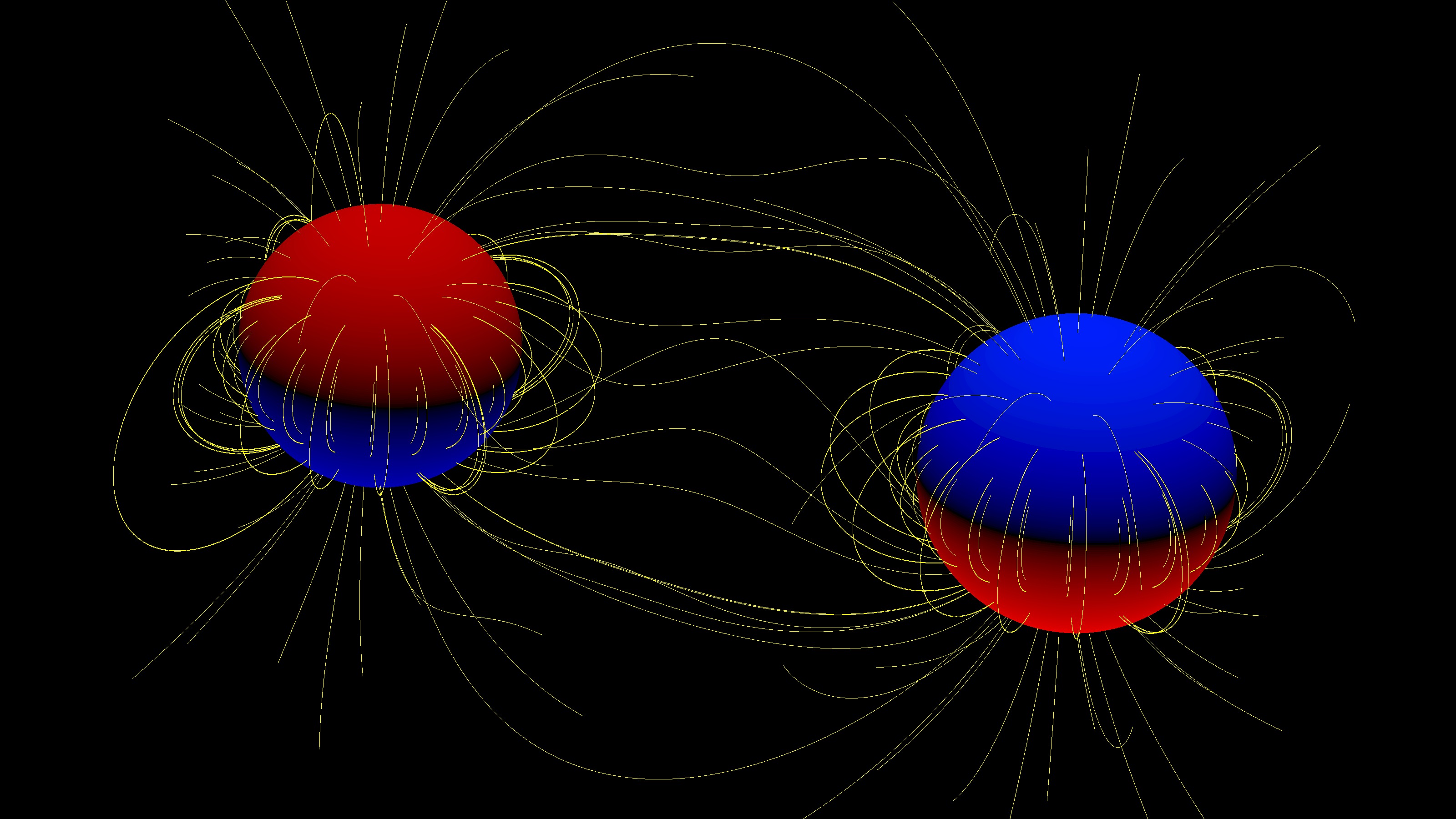
Caption: The polarity of the star's surface magnetic field, north or south, is indicated by red and blue respectively. Yellow lines indicate the magnetic field lines running from the stellar surfaces. Credit: Visualisation courtesy of Volkmar Holzwarth, KIS, Freiburg. Hi-res image


A Canadian PhD student has discovered a unique object – two massive stars with magnetic fields in a binary system. Matt Shultz of Queen’s University, Ontario, Canada found the system – Epsilon Lupi – and publishes the new result in Monthly Notices of the Royal Astronomical Society.

Around 1/3 of stars in our Galaxy are thought to be in binary systems, where two or more stars orbit around a common centre. They are invaluable for astronomers, as watching how they behave lets astronomers measure their mass and connect this with their brightness – a key way in which we understand how stars evolve.

Mr Shultz is a member of the Binarity and Magnetic Interactions in various classes of Stars - BinaMIcS - consortium led by Dr Evelyne Alecian of the University of Grenoble in France. The collaboration is studying the magnetic properties of close binary stars, and Mr Shultz made the discovery using CFHT.

Epsilon Lupi is the fourth brightest star system in the southern constellation of Lupus. The pair of stars is about 500 light years away, are both blue in colour, each have between 7 and 8 times the mass of the Sun, and combined together the pair is around 6000 times as luminous as the Sun. Astronomers have known for many years that Epsilon Lupi is a binary system, but had no idea that the two giant stars had magnetic fields.

Shultz comments: “The origin of magnetism amongst massive stars is something of a mystery and this discovery may help to shed some light on the question of why any of these stars have magnetic fields.”

In cool stars, such as the Sun, magnetic fields are generated by “dynamos” powered by strong convection in the outer layers of the star, where hot material rises, cools and falls back. But there is essentially no convection in the envelopes of massive stars, so there is no support for a magnetic dynamo. Nevertheless, approximately 10% of massive stars have strong magnetic fields.

Two explanations have been proposed for their origin, both variants on the idea of a so-called “fossil” magnetic field, a field generated at some point in the star's past and then locked into the star's surface.

The first hypothesis is that the magnetic field is generated while the star is being formed; a second is that the magnetic field originates in dynamos driven by the violent mixing of material when two already-formed stars in a close binary merge.

“This discovery allows us to rule out the binary merger scenario,” says Mr. Shultz, “However, it doesn't change the basic finding of the BinaMIcS collaboration: fewer than 2% of massive stars in close binaries have magnetic fields, and we still don't know why that is.”

The research shows the strengths of the magnetic fields are similar in the two stars, however their magnetic axes are anti-aligned, with the south magnetic pole of one star pointing in approximately the same direction as the north pole of the other. It may even be that the two stars share a single magnetic field.

“We're not sure why yet, but it probably points to something significant about how the stars are interacting with one another”, adds Shultz.

The stars are close enough that their magnetospheres are likely to be interacting during the whole of their orbit around each other. This means that their magnetic fields may act as a giant brake, slowing down the stars. As a result, in the long term, the two stars could even be spiralling in towards each other.


Additional information 


Media contacts:

Robert Massey
Royal Astronomical Society
Tel: +44 (0)20 7734 3307 x113
Mob: +44 (0)7802 877 699
Email: rm@ras.org.uk

Anne Craig
Queen's University
Tel: +1(1)613-533-2877
Email: anne.craig@queensu.ca


Science contact

Matt Shultz
Queen’s University
Tel: +1(1)613-387-3773
Email: matt.shultz@gmail.com


Friday, September 18, 2015

Evolution in slow motion

Credit: ESA/Hubble & NASA
Acknowledgement: Judy Schmidt (geckzilla.com)


It is known today that merging galaxies play a large role in the evolution of galaxies and the formation of elliptical galaxies in particular. However there are only a few merging systems close enough to be observed in depth. The pair of interacting galaxies picture seen here — known as NGC 3921 — is one of these systems.

NGC 3921 — found in the constellation of Ursa Major (The Great Bear) — is an interacting pair of disc galaxies in the late stages of its merger. Observations show that both of the galaxies involved were about the same mass and collided about 700 million years ago. You can see clearly in this image the disturbed morphology, tails and loops characteristic of a post-merger.

The clash of galaxies caused a rush of star formation and previous Hubble observations showed over 1000 bright, young star clusters bursting to life at the heart of the galaxy pair.

Thursday, September 17, 2015

Funky Light Signal From Colliding Black Holes Explained

Credit: Columbia University 

This simulation helps explain an odd light signal thought to be coming from a close-knit pair of merging black holes, PG 1302-102, located 3.5 billion light-years away. The close-up view at right shows that the smaller of the two black holes gives off more light (left side of picture). While the black holes themselves don't emit light, they accumulate and heat up surrounding gas, which then radiates light. The reason the smaller black hole gives off more light is that it is orbiting farther from the center of mass and closer to the surrounding gas disk, allowing it to gather up most of the gas as it orbits. The result is that the more massive central black hole is starved of gas and doesn't glow as brightly.

As these black holes orbit around each other, they are thought to send out a varying light signal. The signal was detected by astronomers using telescopes on the ground and in space.

The simulation comes from Brian Farris of Columbia University and New York University, both in New York City. Credit: Columbia University


Entangled by gravity and destined to merge, two candidate black holes in a distant galaxy appear to be locked in an intricate dance. Researchers using data from NASA's Galaxy Evolution Explorer (GALEX) and NASA's Hubble Space Telescope have come up with the most compelling confirmation yet for the existence of these merging black holes and have found new details about their odd, cyclical light signal.

The candidate black hole duo, called PG 1302-102, was first identified earlier this year using ground-based telescopes. The black holes are the tightest orbiting pair detected so far, with a separation not much bigger than the diameter of our solar system. They are expected to collide and merge in less than a million years, triggering a titanic blast with the power of 100 million supernovae.

Researchers are studying this pair to better understand how galaxies and the monstrous black holes at their cores merge -- a common occurrence in the early universe. But as common as these events were, they are hard to spot and confirm.

PG 1302-102 is one of only a handful of good binary black hole candidates. It was discovered and reported earlier this year by researchers at the California Institute of Technology in Pasadena, after they scrutinized an unusual light signal coming from the center of a galaxy. The researchers, who used telescopes in the Catalina Real-Time Transient Survey, demonstrated that the varying signal is likely generated by the motion of two black holes, which swing around each other every five years. 

While the black holes themselves don't give off light, the material surrounding them does.

In the new study, published in the Sept. 17 issue of Nature, researchers found more evidence to support and confirm the close-knit dance of these black holes. Using ultraviolet data from GALEX and Hubble, they were able to track the system's changing light patterns over the past 20 years.

"We were lucky to have GALEX data to look through," said co-author David Schiminovich of Columbia University in New York. "We went back into the GALEX archives and found that the object just happened to have been observed six times."
Hubble, which sees ultraviolet light in addition to visible and other wavelengths of light, had likewise observed the object in the past.

The ultraviolet light was important to test a prediction of how the black holes generate a cyclical light pattern. The idea is that one of the black holes in the pair is giving off more light -- it is gobbling up more matter than the other one, and this process heats up matter that emits energetic light. As this black hole orbits around its partner every five years, its light changes and appears to brighten as it heads toward us.

"It's as if a 60-Watt light bulb suddenly appears to be 100 Watts," explained Daniel D'Orazio, lead author of the study from Columbia University. "As the black hole light speeds away from us, it appears as a dimmer 20-Watt bulb."

What's causing the changes in light? One set of changes has to do with the "blue shifting" effect, in which light is squeezed to shorter wavelengths as it travels toward us in the same way that a police car's siren squeals at higher frequencies as it heads toward you. Another reason has to do with the enormous speed of the black hole.

The brighter black hole is, in fact, traveling at nearly seven percent the speed of light -- in other words, really fast. Though it takes the black hole five years to orbit its companion, it is traveling vast distances. It would be as if a black hole lapped our entire solar system from the outer fringes, where the Oort cloud of comets lies, in just five years. At speeds as high as this, which are known as relativistic, the light becomes boosted and brighter.

D'Orazio and colleagues modeled this effect based on a previous Caltech paper and predicted how it should look in ultraviolet light. They determined that, if the periodic brightening and dimming previously seen in the visible light is indeed due to the relativistic boosting effect, then the same periodic behavior should be present in ultraviolet wavelengths, but amplified 2.5 times. Sure enough, the ultraviolet light from GALEX and Hubble matched their predictions.

"We are strengthening our ideas of what's going on in this system and starting to understand it better," said Zoltan Haiman, a co-author from Columbia University who conceived the project.

The results will also help researchers understand how to find even closer-knit merging black holes in the future, what some consider the holy grail of physics and the search for gravitational waves. In the final moments before the ultimate union of two black holes, when they are tightly spinning around each other like ice skaters in a "death spiral," they are predicted to send out ripples in space and time. 

These so-called gravitational waves, whose existence follows from Albert Einstein's gravity theory published 100 years ago, hold clues about the fabric of our universe.

The findings are also a doorway to understanding other merging black holes across the universe, a widespread population that is only now beginning to yield its secrets.

The California Institute of Technology in Pasadena led the Galaxy Evolution Explorer mission, which ended in 2013 after more than a decade of scanning the skies in ultraviolet light. NASA's Jet Propulsion Laboratory, also in Pasadena, managed the mission and built the science instrument. JPL is managed by Caltech for NASA.

The Hubble Space Telescope is a project of international cooperation between NASA and ESA (European Space Agency). NASA's Goddard Space Flight Center in Greenbelt, Maryland, manages the telescope. The Space Telescope Science Institute (STScI) in Baltimore, Maryland, conducts Hubble science operations. STScI is operated for NASA by the Association of Universities for Research in Astronomy in Washington.


Wednesday, September 16, 2015

A Shy Galactic Neighbour

Sculptor Dwarf Galaxy

Location of the Sculptor Dwarf Galaxy 

Wide-field image of the sky around the Sculptor Dwarf Galaxy


Videos
 
A close-up look at the Sculptor Dwarf Galaxy


The Sculptor Dwarf Galaxy, pictured in this new image from the Wide Field Imager camera, installed on the 2.2-metre MPG/ESO telescope at ESO’s La Silla Observatory, is a close neighbour of our galaxy, the Milky Way. Despite their close proximity, both galaxies have very distinct histories and characters. This galaxy is much smaller and older than the Milky Way, making it a valuable subject for studying both star and galaxy formation in the early Universe. However, due to its faintness, studying this object is no easy task.

The Sculptor Dwarf Galaxy — also known as the Sculptor Dwarf Elliptical or the Sculptor Dwarf Spheroidal — is a dwarf spheroidal galaxy, and is one of the fourteen known satellite galaxies orbiting the Milky Way [1]. These galactic hitchhikers are located close by in the Milky Way’s extensive halo, a spherical region extending far beyond our galaxy’s spiral arms. As indicated by its name, this galaxy is located in the southern constellation of Sculptor and lies about 280 000 light-years away from Earth. Despite its proximity, the galaxy was only discovered in 1937, as its stars are faint and spread thinly across the sky.

Although difficult to pick out, the Sculptor Dwarf Galaxy was among the first faint dwarf galaxies found orbiting the Milky Way. The tiny galaxy’s shape intrigued astronomers at the time of its discovery, but nowadays dwarf spheroidal galaxies play a more important role in allowing astronomers to dig deeply into the Universe’s past.

The Milky Way, like all large galaxies, is thought to have formed from the build-up of smaller galaxies during the early days of the Universe. If some of these small galaxies still remain today, they should now contain many extremely old stars. The Sculptor Dwarf Galaxy fits the bill as a primordial galaxy, thanks to a large number of ancient stars, visible in this image.

Astronomers can determine the age of stars in the galaxy because their light carries the signatures of only a small quantity of heavy chemical elements. These heavy elements accumulate in galaxies with successive generations of stars. A low level of heavy elements thus indicates that the average age of the stars in the Sculptor Dwarf Galaxy is high.

This quantity of old stars makes the Sculptor Dwarf Galaxy a prime target for studying the earliest periods of star formation. In a recent study, astronomers combined all the data available for the galaxy to create the most accurate star formation history ever determined for a dwarf spheroidal galaxy. This analysis revealed two distinct groups of stars in the galaxy. The first, predominant group is the older population, which is lacking in heavier elements. The second, smaller population, in contrast, is rich with heavy elements. Like young people crowding into city centres, this youthful stellar population is concentrated toward the galaxy’s core.

The stars within dwarf galaxies like the Sculptor Dwarf Galaxy can exhibit complex star formation histories. But as most of these dwarf galaxies’ stars have been isolated from each other and have not interacted for billions of years, each collection of stars has charted its own evolutionary course. Studying the similarities in dwarf galaxies’ histories, and explaining the occasional outliers, will help to explain the development of all galaxies, from the most unassuming dwarf to the grandest spirals. There is indeed much for astronomers to learn from the Milky Way’s shy neighbours.


Notes 

[1] This faint galaxy should not be confused with the much brighter Sculptor Galaxy (NGC 253) in the same constellation.


More Information

ESO is the foremost intergovernmental astronomy organisation in Europe and the world’s most productive ground-based astronomical observatory by far. It is supported by 16 countries: Austria, Belgium, Brazil, the Czech Republic, Denmark, France, Finland, Germany, Italy, the Netherlands, Poland, Portugal, Spain, Sweden, Switzerland and the United Kingdom, along with the host state of Chile. ESO carries out an ambitious programme focused on the design, construction and operation of powerful ground-based observing facilities enabling astronomers to make important scientific discoveries. ESO also plays a leading role in promoting and organising cooperation in astronomical research. ESO operates three unique world-class observing sites in Chile: La Silla, Paranal and Chajnantor. At Paranal, ESO operates the Very Large Telescope, the world’s most advanced visible-light astronomical observatory and two survey telescopes. VISTA works in the infrared and is the world’s largest survey telescope and the VLT Survey Telescope is the largest telescope designed to exclusively survey the skies in visible light. ESO is a major partner in ALMA, the largest astronomical project in existence. And on Cerro Armazones, close to Paranal, ESO is building the 39-metre European Extremely Large Telescope, the E-ELT, which will become “the world’s biggest eye on the sky”.


Links

Contacts

Richard Hook
ESO education and Public Outreach Department
Garching bei München, Germany
Tel: +49 89 3200 6655
Cell: +49 151 1537 3591
Email:
rhook@eso.org

Source: ESO

ESA/NASA Solar Observatory Discovers Its 3,000th Comet


Before 1979, there were less than a dozen known sungrazing comets – comets that swing by incredibly close to the sun. But that was before the ESA/NASA Solar and Heliospheric Observatory launched in 2000. Since then, SOHO has become the greatest sungrazing comet hunter of all time with comet finds numbering in the thousands. Credits: NASA/Duberstein. Download video

A sun grazing comet as witnessed by the ESA/NASA Solar Heliospheric Observatory, or SOHO, as it dived toward the sun on July 5 and July 6, 2011. SOHO is the overwhelming leader in spotting sungrazers, with almost 3000 spotted to date. SOHO can see the faint light of a comet, because the much brighter light of the sun is blocked by what's known as a coronograph. Credits: ESA&NASA/SOHO

One of the more well-known comets observed by SOHO is Comet ISON, seen in the this time lapse photo from Nov. 28, 2013. Comet ISON comes in from the bottom right and moves out toward the upper right, getting fainter and fainter. The image of the sun at the center is from NASA's Solar Dynamics Observatory. Credits: ESA/NASA/SOHO/SDO/GSFC. Hi-res image


In 1995, a new solar observatory was launched. A joint project of ESA and NASA, the Solar and Heliospheric Observatory – SOHO – has been sending home images of our dynamic sun ever since. SOHO was planned to open up a new era of solar observations, dramatically extending our understanding of the star we live with. . . and it delivered.

But no one could have predicted SOHO's other observational triumph: In the last two decades, SOHO has become the greatest comet finder of all time. In August 2015, SOHO is expected to discover its 3000th comet. Prior to the SOHO launch, only a dozen or so comets had ever even been discovered from space, and some 900 had been discovered from the ground since 1761.

"SOHO has a view of about 12 and a half million miles beyond the sun," said Joe Gurman, the mission scientist for SOHO at NASA's Goddard Space Flight Center in Greenbelt, Maryland. "So we expected it might from time to time see a bright comet near the sun. But nobody dreamed we'd approach 200 a year."

More than just a celebrated bright vision in the night sky, comets can tell scientists a great deal about the place and time where they originated. Comets are essentially a clump of frozen gases mixed with dust. They are often pristine relics that can hold clues about the very formation of our solar system. On the other hand, if they have made previous trips around the sun, they can hold information about the distant reaches of the solar system through which they've traveled. We have a variety of tools to determine what comets are made of from afar. One is to watch how material evaporates off its surface when it comes close to the sun, and here's where SOHO can provide remarkable information.

SOHO is unique in that it is able to spot comets that skim extremely close to the sun, known as sungrazers. One of SOHO's instruments, called a coronagraph, specifically blocks out the bright light of the sun to examine its atmosphere – which is a billion times fainter than the star itself. To this day, SOHO is one of our best sources for views of the giant explosions regularly produced by the sun called coronal mass ejections, or CMEs, which can hurl a million tons of solar particles off into space. This field of view is large enough to see a sungrazing comet as it sling shots around the sun.

The overwhelming bulk – some 85% -- of SOHO's comet discoveries are what's called Kreutz comets. Scientists think a single extremely large sungrazing comet broke up thousands of years ago, leading to thousands of leftover fragments, which continue to follow the same Kreutz path. On average, a new member of the Kreutz family is discovered every three days. Unfortunately, the long journey for these fragments invariably ends as they pass the sun. If they're close enough to the sun to be seen by SOHO, they're too close to survive.

"They just disintegrate every time we observe one," said Karl Battams, a solar scientist at the Naval Research Labs in Washington, D.C., who has been in charge of running the SOHO comet-sighting website since 2003. "There's only one Kreutz comet that made it around the sun – Comet Lovejoy. And we are pretty confident it fell apart a couple of weeks afterwards."

Other, non-Kreutz comets have survived, however. One frequent visitor is comet 96P Machholz. Orbiting the sun approximately every 6 years, SOHO has now seen this comet four times. Such comets survive by virtue of the fact that they don't travel as close to the sun – so they experience less intense solar radiation and are not subject to gravitational stretching and pulling from the sun. Information about the composition of comets is something SOHO can help with. Depending on how a comet reacts to the sun gives clues about the very substance out of which these visitors from the outer solar system are made.

Watching these sungrazing comets also help us learn about the sun. Their tails of ionized gas illuminate magnetic fields around the sun, so they can act as a tracer that helps scientists observe these invisible fields. Such fields have even ripped off comet tails allowing astronomers to watch the lost tails blowing in the steady outpouring of solar particles streaming off the sun. The tails act as a giant windsock in this solar wind, showing researchers the details of the wind's movement.

SOHO's great success as a comet finder is, of course, dependent on the people who sift through SOHO's data – a task open to the world as the data is publicly available online in real time. A cadre of volunteer amateur astronomers dedicate themselves to searching the data via the NASA-funded Sungrazer Project. While scientists often search the imagery for very specific events, various members of the astronomy community choose to comb through all the imagery in fine detail. The result: 75% of SOHO comets have been found by these citizen scientists.

Whenever someone spots a comet, they report it to Battams. He goes over the imagery to confirm the sighting and then submits it to the Central Bureau for Astronomical Telegrams, which gives it an official name. While comets spotted from the ground are named after the person who first discovered them, comets first observed by a space-based telescope are named after the spacecraft.

"As I joined the team when we already had found 500 comets, I've been in charge of confirming 2,500 so far," said Battams. "I think it's safe to say I've looked at more images of comets than any other person in history. Each comet is visible in at least 15 images, so that's more than 40,000 images of comets."

SOHO has also helped provide images for comets discovered by others. In 2012, a sungrazer was found the old-fashioned way – from the ground. Known as Comet ISON, scientists quickly realized it would make a swing by the sun close enough to be spotted by a variety of solar telescopes including SOHO. A large campaign of observations was launched, as telescopes from around the world and across the solar system watched the comet -- a fossil from the original days of the solar system formation – sweep in. The final observatory to see Comet ISON was SOHO, which watched the comet curve in toward the sun. . . and disintegrate.

Observations from SOHO were key to helping describe ISON's last hours – something that no other observatory captured.

"When SOHO launched, its sensors were some 100 times more sensitive than previous imagers," said Gurman. "That was crucial to seeing the faint light from the solar particles in a CME. SOHO allowed us to see a range of brightness and details never before seen. It was great luck that the same exposures allowed us to see comets – not just extremely bright ones, but a whole range of fainter ones, too."

At almost 20 years old, the SOHO mission is a respected elder in NASA's Heliophysics System Observatory – the fleet of spacecraft that both watch the sun and measure its effects near Earth and throughout the solar system. SOHO is a cooperative effort between ESA and NASA. Mission control is based at NASA Goddard. The Large Angle and Spectrometric Coronagraph Experiment, or LASCO, which is the instrument that provides comet imagery, was built at the Naval Research Lab in Washington, D.C.

For more about SOHO: http://www.nasa.gov/soho

For more on the SOHO Sungrazer Project: http://sungrazer.nrl.navy.mil

Karen C. Fox
NASA's Goddard Space Flight Center, Greenbelt, Maryland

Editor: Holly Zell

Source: NASA/SOHO

Tuesday, September 15, 2015

Shocks in a Distant Gamma-Ray Burst

An optical image of the sky at the location of a faint galaxy (marked with the cross-hairs) where a gamma-ray burst (GRB) was seen last year. Followup studies of the burst and its afterglow find that it originated in a supernova - the death of a massive star - yet also shows signs of shocks more typically originating in GRBs from merging binary stars. Credit: Cano et al.


Gamma ray bursts (GRBs)--flashes of high-energy light occur about once a day, randomly, from around the sky--are the brightest events in the known universe. While a burst is underway, it is many millions of times brighter than an entire galaxy. Astronomers are anxious to decipher their nature not only because of their dramatic energetics, but also because their tremendous brightness enables them to be seen across cosmological distances and times, providing windows into the young universe.

There appear to be two general types of GRBs: those associated with the deaths of massive stars, and ones believed to originate from the coalescence of two extreme objects (neutron stars or black holes) that had been orbiting each other in a binary system. In general the two types can be distinguished by the lengths of their bursts, the former lasting longer than a few seconds, while the latter are briefer. Astronomers think that, despite the differences, both kinds of GRBs have hot discs accreting material leading to the production of bipolar jets of charged particles moving at relativistic speeds. In the standard model, shocks internal to the fireball produce the gamma-rays in the first (longer duration) case, while shocks from the jets' interactions with the external medium produce the initial burst of gamma-rays in the second case. Many details are similar in both scenarios, however, while some others vary according to the type, and astronomers have been trying to constrain these various parameters so that they can trace the origin of each GRB more precisely.

CfA astronomer Raffaella Margutti and her colleagues used several ground-based telescopes to follow-up a GRB event that went off in June of 2014, examining the afterglow from about three days after the detection to about one hundred and twenty days later. They conclude that the burst is associated with a massive star's death (a supernova), but find that some of its emission apparently results from shocks external to the fireball as are seen in the less luminous class of GRBs. The results are consistent with the predictions of supernova modeling, but the fact that this object spans both classes highlights the complexity of the sometimes-overlapping physical processes at work and the importance of observations at multiple wavelengths.

Reference(s):  

"c/iPTF14bfu: Detection of Shock-Breakout Emission from a Cosmological γ-Ray Burst," Zach Cano, A. de Ugarte Postigo, D. Perley, T. Kruhler, R. Margutti, M. Friis, D. Malesani, P. Jakobsson, J. P. U. Fynbo, J. Gorosabel, J. Hjorth, R. Sanchez-Ramırez, S. Schulze, N. R. Tanvir, C. C. Thone, and D. Xu, MNRAS 452, 1535, 2015. 


Monday, September 14, 2015

Astronomers Discover How Lowly Dwarf Galaxy Becomes Star-Forming Powerhouse

ALMA discovers an unexpected population of compact interstellar clouds inside the dwarf irregular galaxy WLM. These star-forming clouds provide the necessary nurturing environment to form star clusters. As seen in relation to an optical image of the galaxy taken with the Blanco 4-meter telescope, (box upper left) an overlaying blanket of hydrogen gas (red) imaged with NRAO's VLA telescope provides the pressure necessary to concentrate molecules of carbon monoxide (yellow) as seen with ALMA. These regions correspond to dense cores capable of forming clusters like those found in the Milky Way and other large galaxies. Credit: B. Saxton (NRAO/AUI/NSF); M. Rubio et al., Universidad de Chile, ALMA (NRAO/ESO/NAOJ); D. Hunter and A. Schruba, VLA (NRAO/AUI/NSF); P. Massey/Lowell Observatory and K. Olsen (NOAO/AURA/NSF)


Video explains how an irregular dwarf galaxy is able to form star clusters similar to those found in larger galaxies. Artist animation revealing an emerging star cluster in the WLM galaxy. The optical image of the galaxy was taken with the Blanco 4-meter telescope. ALMA data reveal the presence of dense clouds of star-forming dust and gas. The zoom-in illustrates how a collection of stars would appear within one such cloud. Credit: Animation by B. Saxton (NRAO/AUI/NSF), editing by J. Hellerman (NRAO/AUI/NSF); Optical data: P. Massey/Lowell Observatory and K. Olsen (NOAO/AURA/NSF); ALMA data: M. Rubio et al., Universidad de Chile, ALMA (NRAO/ESO/NAOJ); Fly-in animation: B. Kent (NRAO/AUI/NSF)


The ALMA telescope as seen at night. Its superior resolution and sensitivity allow it to detect and image the faint millimeter-wavelength light emitted by molecules in space. Credit: C. Padilla (NRAO/AUI/NSF)


A nearby dwarf galaxy poses an intriguing mystery: How is it able to form brilliant star clusters without the dusty, gas-rich environments found in larger galaxies? The answer, astronomers believe, lies in densely packed and previously unrecognized nuggets of star-forming material sprinkled throughout the galaxy.

An international team of astronomers [1] using the Atacama Large Millimeter/submillimeter Array (ALMA) has discovered an unexpected population of compact interstellar clouds hidden within the nearby dwarf irregular galaxy [2] Wolf—Lundmark—Melotte, more commonly known as WLM.

These clouds, which are nestled within a heavy blanket of interstellar material, help explain how dense star clusters [3] are able to form in the tenuous environs of a galaxy thousands of times smaller and far more diffuse than our own Milky Way.

"For many reasons, dwarf irregular galaxies like WLM are poorly equipped to form star clusters," noted Monica Rubio, an astronomer with the University of Chile and lead author on a paper to appear in the scientific journal Nature. "These galaxies are fluffy with very low densities. They also lack the heavy elements that contribute to star formation. Such galaxies should only form dispersed stars rather than concentrated clusters, but that is clearly not the case."

By studying this galaxy with ALMA, the astronomers were able to locate, for the first time, compact regions that appear able to emulate the nurturing environments found in larger galaxies.

These regions were discovered by pinpointing the almost imperceptible and highly localized millimeter wavelength light emitted by carbon monoxide (CO) molecules, which are typically associated with star-forming interstellar clouds.

Earlier, an affiliated team of astronomers led by Deidre Hunter at the Lowell Observatory in Flagstaff, Ariz., first detected CO in the WLM galaxy with the single-dish Atacama Pathfinder Experiment (APEX) telescope [4]. These initial, low-resolution observations could not resolve where the molecules reside, but they did confirm that WLM contains the lowest abundance of CO ever detected in any galaxy. This lack of CO and other heavy elements should put a serious damper on star formation, the astronomers note.

"Molecules, and carbon monoxide in particular, play an important role in star formation," said Rubio. "As gas clouds begin to collapse, temperatures and densities rise, pushing back against gravity. That's where these molecules and dust particles come to the rescue by absorbing some of the heat through collisions and radiating it into space at infrared and submillimeter wavelengths." This cooling effect enables gravity to continue the collapse until a star forms.

The problem previously was that in WLM and similar galaxies with very low abundances of heavy elements, astronomers simply didn't see enough of this material to account for the new star clusters they observed.

The reason the CO was initially so difficult to see, the researchers discovered, is that unlike in normal galaxies, the WLM clouds are very tiny compared to their overlying envelopes of molecular and atomic gas.

To become viable star factories, the concentrated CO clouds need these enormous envelopes of transitional gas to bear down on them, giving the cores of CO a high enough density to allow them to form a normal cluster of stars.

"Like a diver being squeezed at the bottom of a deep abyss, these bundles of star-forming gas are under tremendous pressure, even though the surrounding ocean of interstellar gas is much more shallow," said Bruce Elmegreen, a co-author on the paper and researcher at the IBM T.J. Watson Research Center in Yorktown Heights, N.Y. "By discovering that the carbon monoxide is confined to highly concentrated regions within a vast expanse of transitional gas, we could finally understand the mechanisms that led to the impressive stellar neighborhoods we see in the galaxy today."

Further studies with ALMA will also help determine the conditions that formed the globular clusters found in the halo of the Milky Way. Astronomers believe these much larger clusters may have originally formed in dwarf galaxies and later migrated to the halo after their host dwarf galaxies dispersed.

WLM is a relatively isolated dwarf galaxy located approximately 3 million light-years away on the outer edges of the Local Group: the collection of galaxies that includes the Milky Way, the Magellanic Clouds, Andromeda, M33, and dozens of smaller galaxies.

The National Radio Astronomy Observatory is a facility of the National Science Foundation, operated under cooperative agreement by Associated Universities, Inc.

# # #

[1] Collaborators in the present study include Monica Rubio, Universidad de Chile, Santiago; Bruce G. Elmegreen, IBM T.J. Watson Research Center, Yorktown Heights, N.Y.; Deidre A. Hunter, Lowell Observatory, Flagstaff, Ariz; Elias Brinks, University of Hertfordshire, UK; Juan R. Cortes, Joint ALMA Observatory and National Radio Astronomy Observatory, Santiago, Chile; and Phil Cigan, New Mexico Institute of Mining and Technology, Socorro.

[2] Irregular galaxies lack the distinctive shapes of spiral and elliptical galaxies. Dwarf irregulars, like WLM, are hundreds of times smaller than the larger variety and contain only a few hundred million stars instead of tens of billions. Though small, some are now known to harbor massive black holes at their centers.

[3] Star clusters, like the Pleiades found in our own Milky Way galaxy, are made up of hundreds of stars. Others, like globular clusters, can contain hundreds of thousands to a few million stars. Though many stars in the Milky Way originally form in clusters, some – like the Sun – drift away from their stellar nurseries and move freely throughout their home galaxy. Stars in the largest and densest clusters, like those observed in WLM, remain relatively close together.

[4] The APEX team was led by Deidre Hunter at the Lowell Observatory in Flagstaff, Ariz., and Elias Brinks at the University of Hertfordshire, U.K. It also included Monica Rubio; Bruce Elmegreen; Andreas Schruba, California Institute of Technology, Pasadena, Calif.; and Celia Verdugo, University of Chile.


The Atacama Large Millimeter/submillimeter Array (ALMA), an international astronomy facility, is a partnership of the European Organisation for Astronomical Research in the Southern Hemisphere (ESO), the U.S. National Science Foundation (NSF) and the National Institutes of Natural Sciences (NINS) of Japan in cooperation with the Republic of Chile. ALMA is funded by ESO on behalf of its Member States, by NSF in cooperation with the National Research Council of Canada (NRC) and the National Science Council of Taiwan (NSC) and by NINS in cooperation with the Academia Sinica (AS) in Taiwan and the Korea Astronomy and Space Science Institute (KASI).

ALMA construction and operations are led by ESO on behalf of its Member States; by the National Radio Astronomy Observatory (NRAO), managed by Associated Universities, Inc. (AUI), on behalf of North America; and by the National Astronomical Observatory of Japan (NAOJ) on behalf of East Asia. The Joint ALMA Observatory (JAO) provides the unified leadership and management of the construction, commissioning and operation of ALMA.


Contact: 

Charles Blue
(434) 296-0314;
Email: cblue@nrao.edu


Saturday, September 12, 2015

Neutral Hydrogen Gas in Galaxy Clusters

A composite image of the 'Sausage' merging cluster CIZA J2242.8+5310, made using data from the Subaru and Canada France Hawaii Telescopes. Yellow circles are cluster galaxies, where accelerated star formation is taking place; white circles indicate galaxies outside of the cluster; green marks regions of radio emission that traces shocks; purple marks the hot X-ray emitting gas. The cluster is one of the most massive in the Universe. Credit: Andra Stroe


Most galaxies are members of a cluster, a grouping of several to thousands of galaxies. Our Milky Way, for example, is a member of the "Local Group," a set of about fifty galaxies whose other large member is the Andromeda galaxy about 2.3 million light-years away. The closest large cluster of galaxies to us is the Virgo Cluster, with about 2000 members; its center is about 50 million light-years away. The clustering of galaxies influences how any particular member galaxy will evolve, but what happens and how it happens are not well understood. The cluster's influences on the star-formation activity within its galaxies is a particularly interesting question because the star formation rate helps set the luminosity of a galaxy, its supernovae activity, and the processing of its hydrogen gas into heavier elements.

Astronomers think that when clusters merge, whatever effects they have on star formation should be accentuated. Published results, however, have arrived at divergent conclusions on what these effects are. Most research finds that cluster mergers enhance the star formation activity, but a few studies have concluded that it quenches it, while at least one has argued there is little effect either way.

CfA astronomer Reinout van Weeren and his five colleagues used the Westerbork Synthesis Radio Telescope for very deep studies of the atomic hydrogen gas in the cluster CIZAJ2242.8+5301, nicknamed the "Sausage." Hydrogen gas is the fuel for star formation, and they find, contrary to previous results, that there are comparable amounts of it in star-forming cluster galaxies as in non-cluster galaxies, implying that the cluster merger does not reduce the amount of the gas. Moreover, the scientists find that supernova activity confirms that star formation has been underway in these galaxies for about one hundred million years (not an unusual span for a starburst) and that at the current rate of activity the gas would not be depleted for about a billion years. The new results mark an important milestone in the study of cluster mergers because they show that member galaxies are still gas rich and thus can form stars and stimulate the nuclear engine for a long time. The results also can exclude some previously viable models.

Reference(s):

"Neutral Hydrogen Gas, Past and Future Star Formation in Galaxies in and around the 'Sausage' Merging Galaxy Cluster," Andra Stroe, Tom Oosterloo, Huub J. A. Rottgering, David Sobral, Reinout van Weeren, and William Dawson, MNRAS 452, 2731, 2015.


Friday, September 11, 2015

A galactic sunflower

Credit: ESA/Hubble & NASA


The arrangement of the spiral arms in the galaxy Messier 63, seen here in a new image from the NASA/ESA Hubble Space Telescope, recall the pattern at the centre of a sunflower. So the nickname for this cosmic object — the Sunflower Galaxy — is no coincidence.

Discovered by Pierre Mechain in 1779, the galaxy later made it as the 63rd entry into fellow French astronomer Charles Messier’s famous catalogue, published in 1781. The two astronomers spotted the Sunflower Galaxy’s glow in the small, northern constellation Canes Venatici (the Hunting Dogs). We now know this galaxy is about 27 million light-years away and belongs to the M51 Group — a group of galaxies, named after its brightest member, Messier 51, another spiral-shaped galaxy dubbed the Whirlpool Galaxy.

Galactic arms, sunflowers and whirlpools are only a few examples of nature’s apparent preference for spirals. For galaxies like Messier 63 the winding arms shine bright because of the presence of recently formed, blue–white giant stars, readily seen in this Hubble image.


Thursday, September 10, 2015

NASA Telescopes Find Galaxy Cluster with Vibrant Heart

Credit: NASA, ESA, STScI, JPL-Caltech, and T. Webb (McGill University)

A massive cluster of galaxies, called SpARCS1049+56, can be seen in this two-panel, multi-wavelength view from NASA's Hubble and Spitzer space telescopes. At the middle of the picture is the largest, central member of the family of galaxies (upper right red dot of central pair). Unlike other central galaxies in clusters, this one is bursting with the birth of new stars.

Scientists say this star birth was triggered by a collision between a smaller galaxy and the giant, central galaxy. The smaller galaxy's wispy, shredded parts, called a tidal tail, can be seen coming out below the larger galaxy. Throughout this region are features called "beads on a string," which are areas where gas has clumped to form new stars.

This type of "feeding" mechanism for galaxy clusters — where gas from the merging of galaxies is converted to new stars — is rare.

The Hubble data in this image show infrared light with a wavelength of 1 micron in blue and 1.6 microns in green. The Spitzer data show infrared light of 3.6 microns in red.


Astronomers have discovered a rare beast of a galaxy cluster whose heart is bursting with new stars. The unexpected find, made with the help of NASA's Spitzer and Hubble space telescopes, suggests that behemoth galaxies at the cores of these massive clusters can grow significantly by feeding off gas stolen from other galaxies.

"Usually, the stars at the centers of galaxy clusters are old and dead, essentially fossils," said Tracy Webb of McGill University, Montreal, Canada, lead author of a new paper on the findings published in the Aug. 20 issue of The Astrophysical Journal. "But we think the giant galaxy at the center of this cluster is furiously making new stars after merging with a smaller galaxy."

Galaxy clusters are vast families of galaxies bound and grouped by the ties of gravity. Our own Milky Way resides in a small galaxy group, called the Local Group, which itself is on the periphery of the vast Laniakea supercluster of 100,000 galaxies. (Laniakea is Hawaiian for "immeasurable heaven.")

The cluster in the new study, referred to by astronomers as SpARCS1049+56, has at least 27 galaxy members, and a combined mass equal to nearly 400 trillion suns. It is located 9.8 billion light-years away in the Ursa Major constellation. The object was initially discovered using Spitzer and the Canada-France-Hawaii Telescope, located on Mauna Kea in Hawaii, and confirmed using the W.M. Keck Observatory, also on Mauna Kea.

What makes this cluster unique is its luminous heart of new stars. At the core of most massive galaxy clusters lies one hulking galaxy that usually doesn't produce new stars very quickly. The galaxy dominating the cluster SpARCS1049+56 is rapidly spitting out an enormous number of stars — about 860 new ones a year. For reference, our Milky Way makes only about one to two stars per year.

"With Spitzer's infrared camera, we can actually see the ferocious heat from all these hot young stars," said co-author Jason Surace from NASA's Spitzer Science Center at the California Institute of Technology in Pasadena, California. Spitzer detects infrared light, so it can see the warm glow of hidden, dusty regions where stars form.

Follow-up studies with Hubble in visible light helped confirm the source of the fuel, or gas, for the new stars. 

A smaller galaxy seems to have recently merged with the monster galaxy in the middle of the cluster, lending its gas to the larger galaxy and igniting a fury of new stars.

"Hubble found a train wreck of a merger at the center of this galaxy," said Webb.

Hubble specifically detected features in the smaller, merging galaxy called "beads on a string," which are pockets of gas that condense where new stars are forming. Beads on a string are telltale signs of collisions between gas-rich galaxies, a phenomenon known to astronomers as wet mergers, where "wet" refers to the presence of gas. In these smash-ups, the gas is quickly converted to new stars.

Dry mergers, by contrast, occur when galaxies with little gas collide and no new stars are formed. Typically, galaxies at the centers of clusters grow in mass through dry mergers at their core, or by siphoning gas into their centers.

The new discovery is one of the first known cases of a wet merger at the core of a distant galaxy cluster. Hubble previously discovered another, closer galaxy cluster containing a wet merger, but it wasn't forming stars as vigorously.

The researchers are planning more studies to find out how common galaxy clusters like SpARCS1049+56 are. The cluster may be an outlier — or it may represent an early time in our universe when gobbling up gas-rich galaxies was the norm.


Contact

Whitney Clavin
Jet Propulsion Laboratory, Pasadena, California
818-354-4673

whitney.clavin@jpl.nasa.gov

Ray Villard
Space Telescope Science Institute, Baltimore, Maryland
410-338-4514

villard@stsci.edu

Felicia Chou
NASA Headquarters, Washington, D.C.
202-358-0257

felicia.chou@nasa.gov

Source: HubbleSite

Hubble Uncovers Clues of Earliest Galaxies

The three panels show different components of near-infrared background light detected by the Hubble Space Telescope in deep-sky surveys. The one on the left is a mosaic of images taken over a 10-year period. When all the stars and galaxies are masked, the background signals can be isolated, as seen in the second and third panels. The middle panel reveals "intra-halo light" from rogue stars torn from their host galaxies, and the panel on the right captures the signature of the first galaxies formed in the universe. Credit: NASA, ESA, and K. Mitchell-Wynne (University of California, Irvine).  Released Images


Astronomers at the University of California at Irvine (UCI) and the Space Telescope Science Institute have made the most accurate statistical estimate of the number of faint, small galaxies that existed only 500 million years after the big bang. This was culled from an analysis of the deepest Hubble Space Telescope sky survey, CANDELS (Cosmic Assembly Near-Infrared Deep Extragalactic Legacy Survey). Previously, studies using Caltech's CIBER (the Cosmic Infrared Background Experiment) rocket-borne instrument and NASA's Spitzer Space Telescope images confirmed the presence of "intra-halo light" from stars distributed outside of galaxies. The Hubble data found a new component in the infrared background in addition to intra-halo light — the collective glow of entire galaxies that formed first in the universe. UCI's Asantha Cooray believes that these early galaxies are very different from the well-defined spiral and disk-shaped galaxies seen in the present-day universe. They were more diffuse and populated by giant stars. This discovery paves the way for NASA's James Webb Space Telescope to see these very faint galaxies individually, after its launch in 2018. 


Source: HubbleSite

Wednesday, September 09, 2015

Hot Jupiters courting baby stars?

Formation of stars and their planets in the Taurus nursery as seen at millimeter wavelengths by the APEX telescope in Chile 
Credits ESO/APEX


Star surface and planet (top) and magnetic field lines (bottom) at the surface of V830 Tau as reconstructed from ESPaDOnS observations.

ESPaDOnS observations of V830 Tau - a baby star in the Taurus nursery. Once the polluting effect of spots is removed, the residual shift of the spectrum (red dots and error bars) varies with time with a 6-day period. This spectral motion is compatible with that expected from a 1.4 Jupiter-mass planet orbiting at only 1/15 of the Sun-Earth distance (light blue curve). More densely-sampled observations are necessary to validate this preliminary result.

CFHT with a CAD view of SPIRou - the forthcoming spectropolarimeter in construction at OMP/IRAP
(not to scale - credit JC Cuillandre for the CFHT image)


Although first detected 20 years ago, hot Jupiters are still enigmatic bodies. These celestial objects are giant Jupiter-like exoplanets that orbit 20 times closer to their host stars than the Earth does to the Sun. Using the ESPaDOnS spectro-polarimeter on the Canada-France-Hawaii Telescope, the Matysse(1) team led by Dr J.-F. Donati (Toulouse, CNRS) reports the preliminary evidence that a hot Jupiter orbits a 2-My star of the Taurus star forming region. This planet, yet to be confirmed, has a mass of 1.4 Jupiter mass and a 6-day period orbit and is unveiled by the gravitational pull it imprints on its star(2), once the stellar activity features are modeled. This discovery(3) could help us better understand how planetary systems like (or unlike) the solar system form and evolve into maturity. This could also be the first exoplanet ever revealed by CFHT, a nice introduction to the coming SPIRou(4) planet search survey.

In our solar system, rocky planets like the Earth or Mars are found near the Sun whereas giant planets like Jupiter and Saturn orbit much further out. "Hence the surprise in 1995 when Mayor & Queloz first unveiled a giant planet sitting very close to its host star" says Dr C. Moutou, CNRS astronomer at CFHT and co-author of this new study. Since then, astronomers demonstrated that such planets must form in the outer regions of the protoplanetary disc, then migrate inwards and yet avoid falling into their host star. This could happen either very early in their lives, when still embedded within their primordial disc. Or much later, once multiple planets are formed and mutually interact in a rather unstable choreography - with some being pushed inwards at the immediate vicinity of their stars.

An international team of astronomers led by Dr J.-F. Donati just secured preliminary evidence supporting the first of these two scenarios. Using ESPaDOnS, a spectropolarimeter built by IRAP / OMP for the CFHT, they looked at newly-born stars in the Taurus stellar nursery about 450 light-years away from us. They showed that the latest baby star they scrutinized, nicknamed V830 Tau, exhibits signatures that closely resemble those caused by a 1.4 Jupiter-mass planet orbiting 15 times closer to its host star than the Earth does to the Sun. This discovery, published in MNRAS, provides preliminary evidence that hot Jupiters may be extremely young and far more frequent around very young stars than around mature Sun-like stars.

Although potentially very informative about planet formation, young stars are extremely challenging to observe. "Being enormously active and strongly magnetic, baby stars are covered with huge spots hundreds of times wider than those of our Sun, which generate perturbations in their spectra much larger than those caused by orbiting planets. As a result, their planets are quite tricky to detect, even in the case of hot Jupiters", outlines E. Hebrard, PhD student at IRAP / OMP and co-author of the study. To address this issue, the team initiated the MaTYSSE survey aimed at mapping the surfaces of baby stars and at looking for the potential presence of hot Jupiters. "By monitoring these stars and using tomographic techniques inspired from medical imaging, we can unveil how dark and bright features are distributed across their surfaces, and how their magnetic fields expand into space. This modeling allows us to compensate for the perturbations that spots and fields generate in the spectra of young stars, and thus to regain the power of diagnosing the presence of close-in giant planets", explains Dr G. Hussain (ESO, UFTMiP), co-author of the study. In the case of V830 Tau, the authors accurately modeled the surface field and spots in order to clean out their polluting effects, enabling them to discover the much weaker signal that hints at the presence of a giant planet. 

Although more data are required for a definite validation, this promising first result clearly demonstrates that the technique the team devised is powerful enough to solve the puzzling question of how hot Jupiters form. " SPIRou, the new instrument currently built for CFHT by our team and scheduled for first light in 2017, will offer vastly superior performances thanks to its operation at near infrared wavelengths, at which young stars are far brighter, and will allow us to address this long-standing problem with unprecedented accuracy", Dr J.-F. Donati concludes. 


Additional information 

- 1. Matysse (Magnetic Topologies of Young Stars and the Survival of close-in giant Exoplanets) is a CFHT Large Program started in 2013 with ESPaDOnS. Matysse is a collaboration led by J.F. Donati (IRAP, Obs Midi-Pyrenees, France) with astronomers from IPAG (Grenoble, F), ENS (Lyon, F), CEA (Saclay, F), LAM (Marseille, F), OCA (Nice, F), UdM (Montreal, C), UFMG (Belo Horizonte, B), ASIAA (Taipei, T), NAO (Beijing, C) and many associated scientists outside the CFHT community.


- 2. The radial-velocity method uses the gravitational pull on the star by the planet modulated by its orbital motion, and measures the resulting spectral shift of the star with respect to the observer using the Doppler effect. This effect is of the order of 100 m/s for a hot Jupiter as the putative V 830 b and is repeatable at the period of the orbit - here, about 6 days.


- 3. The full paper is accepted in the Monthly Notices of the Royal Astronomical Society (MNRAS, Oxford University Press); it is entitled: "Magnetic activity and hot Jupiters of young Suns: the weak-line T Tauri stars V819 Tau and V830 Tau", by J.-F. Donati, E. Hebrard, G. Hussain, C. Moutou, L. Malo, K. Grankin, A. Vidotto, S. Alencar, S.G. Gregory, MM. Jardine, G. Herczeg, J. Morin, R. Fares, F. Menard, J. Bouvier, X. Delfosse, R. Doyon, M. Takami, P. Figueira, P. Petit, I. Boisse and the MaTYSSE collaboration, and is accessible here.


- 4. SPIRou i is a near-infrared spectropolarimeter and a high-precision velocimeter optimized for both the detection of habitable Earth twins orbiting around nearby red dwarf stars, and the study of forming Sun-like stars and their planets. SPIRou is managed in the framework of an international consortium led by France and involving, in addition to the Canada-France-Hawaii Telescope (CFHT), Canada, Switzerland, Brazil, Taiwan and Portugal. The construction of SPIRou has started in 2015, with integration in Toulouse, France, scheduled for 2016 and first light at CFHT for 2017. 

- This press release is also available as a pdf file with complementary illustrations.


Contacts

Dr. Claire Moutou (CFHT, Hawaii)
moutou@cfht.hawaii.edu
1-808-885-7944
 
 
Dr. Lison Malo (CFHT, Hawaii)
malo@cfht.hawaii.edu
1-808-885-7944  
 

Dr. Jean-Francois Donati (IRAP, Toulouse, France)
jean-francois.donati@irap.omp.eu
33-561-332-917