Wednesday, December 15, 2021

Gaia finds fossil spiral arms in Milky Way


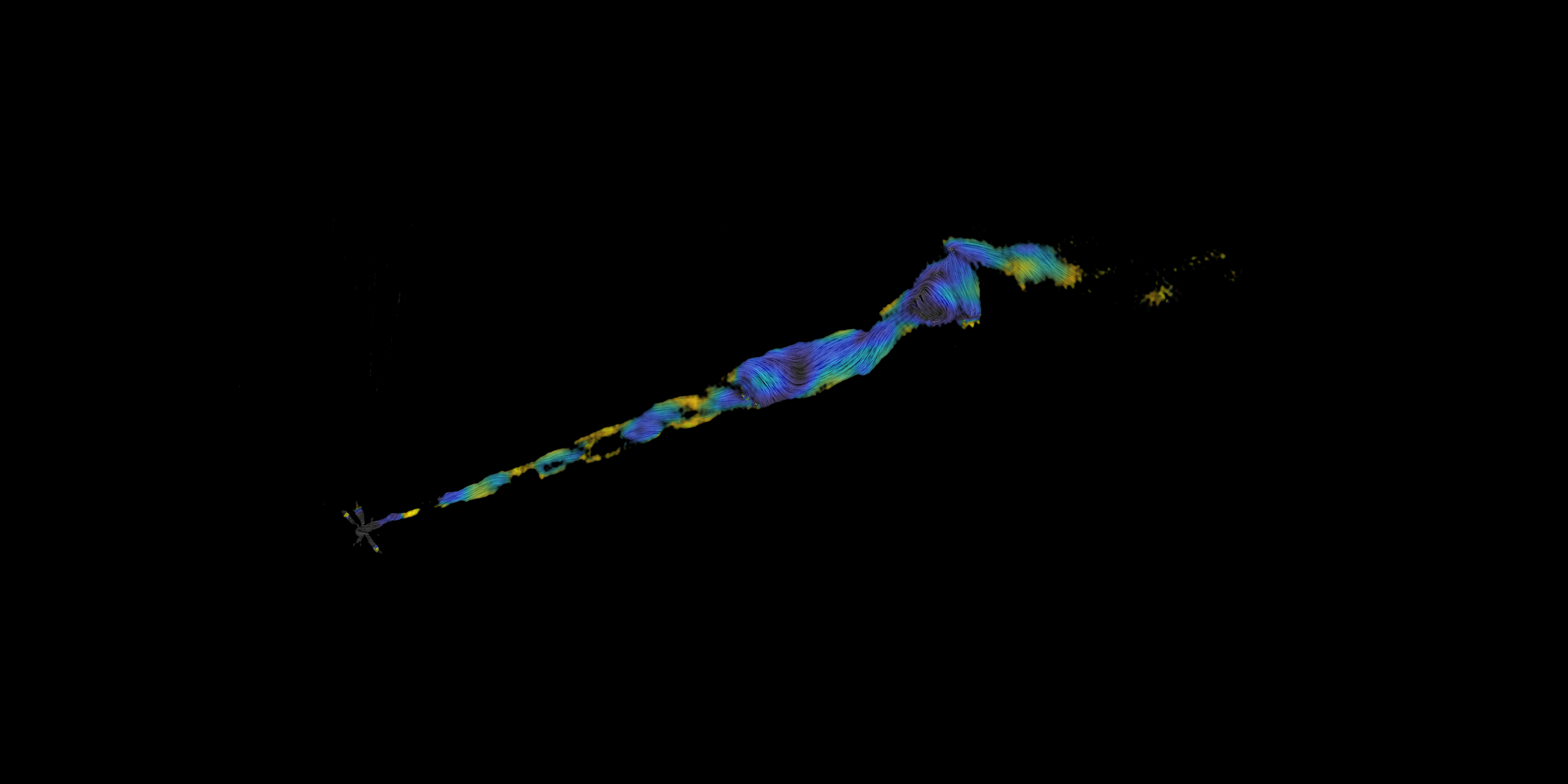
All-sky map of the Milky Way in motion using the Gaia data. Areas with significant motion are shown in black/purple and those with relatively low motion in yellow. A number of large scale filamentary disc structures are evident about the midplane. The map also shows the Magellanic Clouds and their connecting stellar bridge to left, while the Sgr dwarf galaxy currently being torn apart can be seen on the right (main body). Credit: Laporte et al. Licence type Attribution (
CC BY 4.0)

An international team of astronomers, led by researcher Chervin Laporte of the Institute of Cosmos Sciences of the University of Barcelona (ICCUB-IEEC), has used data from the Gaia space mission to create a new map of the Milky Way’s outer disc. Intriguingly, newly found structures include evidence for fossil spiral arms. The team published the new work in a paper in Monthly Notices of the Royal Astronomical Society: Letters.

The team analysed the Gaia motion data, available from December 2020, to identify coherent structures. Their resulting map revealed the existence of many previously unknown spinning filamentary structures at the edge of the disc. It also gave a sharper overall view of previously known structures. Numerical simulations predict such filamentary structures to form in the outer disc from past satellite interactions, but the sheer quantity of substructure revealed by this map was not expected and remains a mystery.

What could these structures possibly be? One possibility is that they are the remains of tidal arms from the Milky Way disc which were excited at different times by various satellite galaxies. Our Galaxy is now surrounded by 50 of these satellites and has engulfed numerous other galaxies in its past. At present, the Milky Way is thought to be being perturbed by the Sagittarius dwarf galaxy, But in its more distant past it interacted with another intruder, the Gaia Sausage, which has now dispersed its debris into the outskirts of our galaxy.

In an earlier study, the same team showed that one of the filamentary structures in the outer disc, the Anticenter Stream, had stars which were predominantly more than 8 billion years old. This makes it potentially too old to have been excited by Sagittarius alone and instead points to the Gaia Sausage.

Another possibility is that not all these structures are actual genuine fossil spiral arms but instead form the crests of large scale vertical distortions in the Milky Way disc. “We believe that discs respond to satellite impacts which set up vertical waves that propagate like ripples on a pond" says Laporte.

To try to distinguish between the two explanations, the team has now secured a dedicated follow-up programme with the William Herschel Telescope on the Canary Islands in order to study the properties of the stellar populations in each substructure. Future surveys will help shed light on the nature and origin of these heavenly wispy structures.

Laporte comments on their findings: “Typically this region of the Milky Way has remained poorly explored due to the intervening dust which severely obscures most of the Galactic midplane”. He adds, “While dust affects the luminosity of a star, its motion remains unaffected. We were certainly very excited to see that the Gaia motions data helped us uncover these filamentary structures! Now the challenge remains to figure what these things exactly are, how they came to be, why in such large numbers, and what they can tell us about the Milky Way, its formation and evolution."


Media Contacts:

Dr Robert Massey
Royal Astronomical Society
Mob: +44 (0)7802 877 699

press@ras.ac.uk

Gurjeet Kahlon
Royal Astronomical Society
Mob: +44 (0) 7802 877 700

press@ras.ac.uk

Science Contacts:

Dr Chervin F. P. Laporte
Distinguished Researcher / ERC Group Leader
Institute of Cosmos Sciences, University of Barcelona

chervin.laporte@icc.ub.edu

Professor Sergey E. Koposov
Reader in Observational Astronomy, University of Edinburgh
Affiliated Associate Professor, University of Cambridge
Royal Observatory, Edinburgh

sergey.koposov@ed.ac.uk

Professor Vasily Belokurov
Professor of Astronomy
Institute of Astronomy, University of Cambridge

vasily@ast.cam.ac.uk


Further information

The research appears in ‘Kinematics beats dust: unveiling nested substructure in the perturbed outer disc of the Milky Way’, Monthly Notices of the Royal Astronomical Society: Letters, C. F. P. Laporte, S. E. Koposov, V. Belokurov


Notes for Editors

The Royal Astronomical Society (RAS), founded in 1820, encourages and promotes the study of astronomy, solar-system science, geophysics and closely related branches of science. The RAS organises scientific meetings, publishes international research and review journals, recognises outstanding achievements by the award of medals and prizes, maintains an extensive library, supports education through grants and outreach activities and represents UK astronomy nationally and internationally. Its more than 4,000 members (Fellows), a third based overseas, include scientific researchers in universities, observatories and laboratories as well as historians of astronomy and others.

The RAS accepts papers for its journals based on the principle of peer review, in which fellow experts on the editorial boards accept the paper as worth considering. The Society issues press releases based on a similar principle, but the organisations and scientists concerned have overall responsibility for their content.


Tuesday, December 14, 2021

Stellar “Ashfall” Could Help Distant Planets Grow


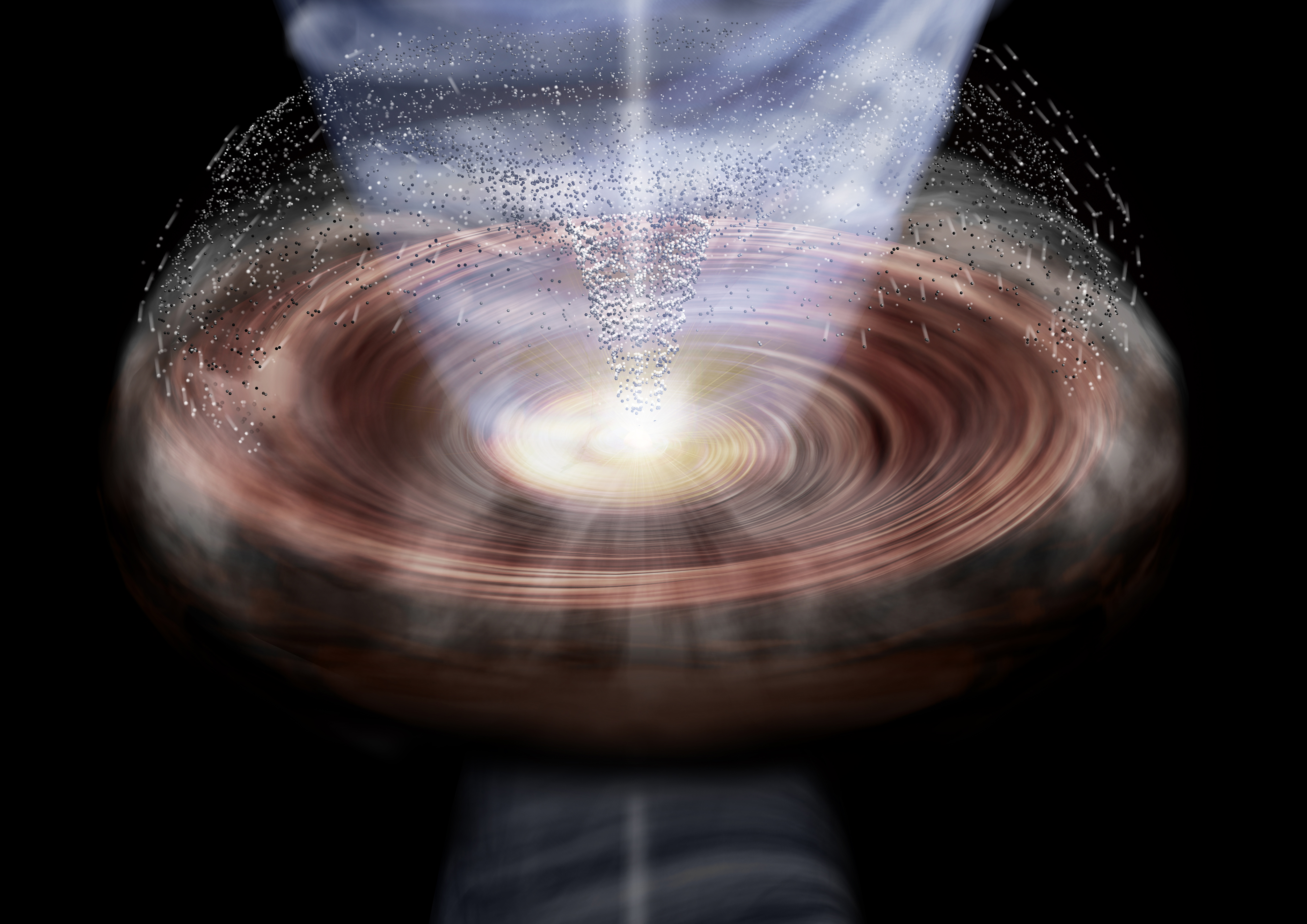
Artist’s impression of the “Ashfall” in a protoplanetary disk. The dust particles swept up by the bipolar outflow from the center of the protoplanetary disk are piled up on the outer edge of the disk. (Credit: Kagoshima University)
Original size (2.9MB)

The world’s first 3D simulation simultaneously considering dust motion and growth in a disk around a young star has shown that large dust from the central region can be entrained by and then ejected by gas outflows, and eventually fall back onto the outer regions of the disk where it may enable planetesimal formation. This process can be likened to volcanic “ashfall” where ash carried up by gas during an eruption falls back on the area around the volcano. These results help to explain observed dust structures around young protostars.

Observations by ALMA (Atacama Large Millimeter/submillimeter Array) have revealed gaps in protoplanetary disks of gas and dust around young stars. The gravitational effects of planets are thought to be one of the reasons for the formation of these rings. However, some rings are seen even further out than the position of Neptune in the Solar System. At these distances, dust, a vital component to planet formation, should be scarce. Furthermore, the dust is expected to move in towards the central region of the disk as it grows. So how planets can form in the outer regions has been a mystery.

A research team led by Yusuke Tsukamoto at Kagoshima University used ATERUI II, the world’s most powerful supercomputer dedicated to astronomy calculations at the National Astronomical Observatory of Japan, to perform the world’s first 3D simulation of dust motion and growth in a protoplanetary disk. The team found that large dust particles grown in the central region can be carried out perpendicular to the disk by streams of gas, called bipolar outflow, erupting out from the disk. This dust then drifts out from the outflow and gravity pulls it back down to the outer part of the disk. Tsukamoto comments, “Living in Kagoshima, in the shadow of the active volcano Mt. Sakurajima, I naturally thought of volcanic ashfall when I saw the simulation results.”

The simulation shows that this “stellar ashfall” can enrich large dust in the outer region of the protoplanetary disk and facilitate planetesimal formation, which may eventually cause planet formation.

These results appeared as Yusuke Tsukamoto et al. Yusuke Tsukamoto et al. ““Ashfall” induced by molecular outflow in protostar evolution” in the Astrophysical Journal Letters on October 15, 2021.


Related Links:


Monday, December 13, 2021

Mini-Jet found near Milk Way's Supermassive Black Hole


This is a composite view of X-rays, molecular gas, and warm ionized gas near the galactic center. The graphic of a translucent, vertical white fan is added to show the suggested axis of a mini-jet from the supermassive black hole at the galaxy’s heart. The orange-colored features are of glowing hydrogen gas. One such feature, at the top tip of the jet is interpreted as a hydrogen cloud that has been hit by the outflowing jet. The jet scatters off the cloud into tendrils that flow northward. Farther down near the black hole are X-ray observations of superheated gas colored blue and molecular gas in green. These data are evidence that the black hole occasionally accretes stars or gas clouds, and ejects some of the superheated material along its spin axis. Credits: Science: NASA, ESA, Gerald Cecil (UNC-Chapel Hill). Image Precessing:Joseph DePasquale (STScI)


This schematic is based on multiwavelength observations of a suspected jet from the massive black hole at the center of our Milky Way galaxy. The wide view shows our galaxy edge-on, with two huge bubbles of plasma glowing in gamma-rays and X-rays. These are evidence for an explosive outburst from the black hole about 2 million years ago. Probing deep into the galaxy's core (inset), astronomers using the Hubble Space Telescope have captured a glowing cloud of hydrogen near the black hole. The interpretation is that the cloud is being hit by a narrow, columnated jet of material that was blasted out of the black hole merely 2,000 years ago. The black hole is still active, but on a smaller scale of energy output than previously known outbursts. When the jet slams into the hydrogen knot the outflow scatters into octopus-like tendrils that continue along a trajectory out of our galaxy. Credits: Illustration: NASA, ESA, Gerald Cecil (UNC-Chapel Hill), Dani Player (STScI)


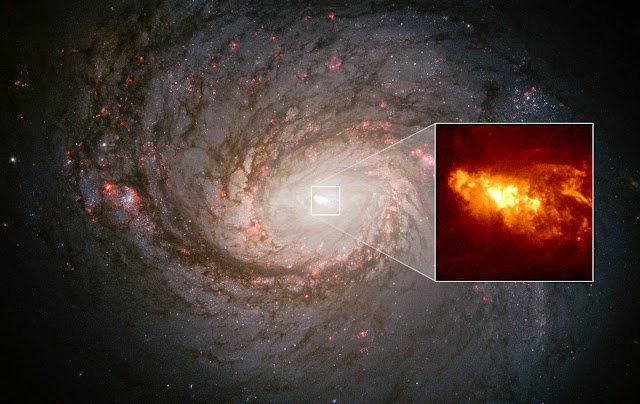
The nearby barred-spiral galaxy NGC 1068 serves as a proxy for helping astronomers understand the fireworks taking place at the center of our Milky Way galaxy, driven by eruptions from a supermassive black hole. Because we live inside the Milky Way, much of our view of the galaxy’s center is blocked by intervening clouds of gas and dust. But, looking 45 million light-years away at NGC 1068 gives astronomers a birds-eye view of similar black hole outbursts. The inset Hubble Space Telescope image resolves hydrogen clouds as small as 10 light-years across within 150 light-years of the core. The clouds are glowing because they are caught in a "searchlight" of radiation beamed out of the galaxy's black hole, which is larger and more active than the black hole in the heart of our galaxy. Credits: Science: NASA, ESA, Alex Filippenko (UC Berkeley), William Sparks (STScI), Luis C. Ho (KIAA-PKU), Matthew A Malkan (UCLA), Alessandro Capetti (STScI). Image Processing: Alyssa Pagan (STScI).  
Release Images


Our Milky Way's central black hole has a leak. This supermassive black hole looks like it still has the vestiges of a blowtorch-like jet dating back several thousand years. NASA's Hubble Space Telescope hasn't photographed the phantom jet but has helped find circumstantial evidence that it is still pushing feebly into a huge hydrogen cloud and then splattering, like the narrow stream from a hose aimed into a pile of sand.

This is further evidence that the black hole, with a mass of 4.1 million Suns, is not a sleeping monster but periodically hiccups as stars and gas clouds fall into it. Black holes draw some material into a swirling, orbiting accretion disk where some of the infalling material is swept up into outflowing jets that are collimated by the black hole's powerful magnetic fields. The narrow "searchlight beams" are accompanied by a flood of deadly ionizing radiation.

"The central black hole is dynamically variable and is currently powered down," said Gerald Cecil of the University of North Carolina in Chapel Hill. Cecil pieced together, like a jigsaw puzzle, multiwavelength observations from a variety of telescopes that suggest the black hole burps out mini-jets every time it swallows something hefty, like a gas cloud. His multinational team's research has just been published in the Astrophysical Journal.

In 2013 evidence for a stubby southern jet near the black hole came from X-rays detected by NASA's Chandra X-ray Observatory and radio waves detected by the Jansky Very Large Array telescope in Socorro, New Mexico. This jet too appears to be plowing into gas near the black hole.

Cecil was curious if there was a northern counter-jet as well. He first looked at archival spectra of such molecules as methyl alcohol and carbon monosulfide from the ALMA Observatory in Chile (Atacama Large Millimeter/submillimeter Array), which uses millimeter wavelengths to peer through the veils of dust between us and the galactic core. ALMA reveals an expanding, narrow linear feature in molecular gas that can be traced for 15 light-years back towards the black hole.

By connecting the dots, Cecil next found in Hubble infrared-wavelength images a glowing, inflating bubble of hot gas that aligns to the jet at a distance of at least 35 light-years from the black hole. His team suggests that the black hole jet has plowed into it, inflating the bubble. These two residual effects of the fading jet are the only visual evidence of it impacting molecular gas.

As it blows through the gas the jet hits material and bends along multiple streams. "The streams percolate out of the Milky Way's dense gas disk," said co-author Alex Wagner of Tsukuba University in Japan. "The jet diverges from a pencil beam into tendrils, like that of an octopus." This outflow creates a series of expanding bubbles that extend out to at least 500 light-years. This larger "soap bubble" structure has been mapped at various wavelengths by other telescopes.

Wagner and Cecil next ran supercomputer models of jet outflows in a simulated Milky Way disk, which reproduced the observations. "Like in archeology, you dig and dig to find older and older artifacts until you come upon remnants of a grand civilization," said Cecil. Wagner's conclusion: "Our central black hole clearly surged in luminosity at least 1 millionfold in the last million years. That sufficed for a jet to punch into the Galactic halo."

Previous observations by Hubble and other telescopes found evidence that the Milky Way's black hole had an outburst about 2-4 million years ago. That was energetic enough to create an immense pair of bubbles towering above our galaxy that glow in gamma-rays. They were first discovered by NASA's Fermi Gamma-ray Space Telescope in 2010 and are surrounded by X-ray bubbles that were discovered in 2003 by the ROSAT satellite and mapped fully in 2020 by the eROSITA satellite.

Hubble ultraviolet-light spectra have been used to measure the expansion velocity and composition of the ballooning lobes. Hubble spectra later found that the burst was so powerful that it lit up a gaseous structure, called the Magellanic stream, at about 200,000 light-years from the galactic center. Gas is glowing from that event even today.

To get a better idea of what's going on, Cecil looked at Hubble and radio images of another galaxy with a black hole outflow. Located 47 million light-years away, the active spiral galaxy NGC 1068 has a string of bubble features aligned along an outflow from the very active black hole at its center. Cecil found that the scales of the radio and X-ray structures emerging from both NGC 1068 and our Milky Way are very similar. "A bow shock bubble at the top of the NGC 1068 outflow coincides with the scale of the Fermi bubble start in the Milky Way. NGC 1068 may be showing us what the Milky Way was doing during its major power surge several million years ago."

The residual jet feature is close enough to the Milky Way's black hole that it would become much more prominent only a few decades after the black hole powers up again. Cecil notes that "the black hole need only increase its luminosity by a hundredfold over that time to refill the jet channel with emitting particles. It would be cool to see how far the jet gets in that outburst. To reach into the Fermi gamma-ray bubbles would require that the jet sustain for hundreds of thousands of years because those bubbles are each 50,000 light years across!"

The anticipated images of the black hole's shadow made with the National Science Foundation's Event Horizon Telescope may reveal where and how the jet is launched.

The Hubble Space Telescope is a project of international cooperation between NASA and ESA (European Space Agency). NASA's Goddard Space Flight Center in Greenbelt, Maryland, manages the telescope. The Space Telescope Science Institute (STScI) in Baltimore, Maryland, conducts Hubble science operations. STScI is operated for NASA by the Association of Universities for Research in Astronomy in Washington, D.C.

Credits:

Media Contact: 

Ray Villard
Space Telescope Science Institute, Baltimore, Maryland


Science Contact:

Gerald Cecil
University of North Carolina–Chapel Hill, Chapel Hill, North Carolina

Contact us: Direct inquiries to the News Team. 
 

Friday, December 10, 2021

Scouting Ancient Supermassive Black Holes with NASA’s Webb


Researchers will use all four instruments aboard the James Webb Space Telescope to study the three most distant quasars yet discovered. They will obtain new measurements of the masses of their central supermassive black holes, detail the stars and composition of their host galaxies, and observe nearby galaxies to learn more about their “neighborhoods” in the early universe.


The three targets of this research program at a glance: J0313-1806 dates back to 670 million years after the big bang and is 1.6 billion times more massive than our Sun. J1007+2115, or Pōniuāʻena, was detected approximately 700 million years after the big bang and is 1.5 billion times more massive than our Sun. The third target, J1342+0928, dates back to 690 million years after the big bang and is 800 million times the mass of our Sun. Credits: Artwork: NASA, ESA, CSA, Joseph Olmsted (STScI).


Researchers will study the galaxies that surround three bright quasars in detail for the first time with the James Webb Space Telescope. First, they will take images of each target with Webb’s Near-Infrared Camera (NIRCam), like the simulated image shown at left. Next, they will remove the quasar’s light to reveal the galaxy and its stars, simulated at right. These observations will reveal the makeup of three galaxies in the early universe and add to what is understood about this time period, known as the Era of Reionization. Credits: Ilustration: NASA, ESA, CSA, Joseph Olmsted (STScI ).
Release images


Very distant, active supermassive black holes are the brightest beacons in the universe. Known as quasars, these behemoths are surrounded by equally distant galaxies. In recent decades, researchers have gone on a cosmic treasure hunt and identified the three most distant quasars known over the last three years – each more than 13 billion light-years from Earth. Astronomers theorize that it can take billions of years for supermassive black holes and their accompanying galaxies to form. How is it possible that these quasars became so gigantic, with billions of solar masses, in the first 700 million years of the universe? Once you can see past their glare, what do their accompanying galaxies look like? And what do their “neighborhoods” look like?

These are questions Xiaohui Fan and Jinyi Yang, both of the University of Arizona, and Eduardo Bañados, of the Max Planck Institute for Astronomy in Heidelberg, Germany, with an international team of astronomers, will pursue with observations taken by the James Webb Space Telescope. “These are really valuable objects,” Fan said. “We structured this program to learn everything we could think of so our team and the greater astronomical community can fully explore these quasars.”

Webb’s sensitivity to infrared light – including mid-infrared wavelengths that can only be captured from space – will allow the team to observe these objects, whose light has traveled for 13 billion years and has had its wavelengths stretched from ultraviolet and visible light into infrared light. Webb has unmatched sensitivity and spatial resolution, which will reveal complex structures in these distant objects.

The team plans to observe and analyze the data on three scales: closely examining the quasars themselves, studying the stars in the surrounding host galaxies after removing the quasars’ light, and classifying the galaxies that lie nearby. “These quasars are very special objects,” explained Bañados. “That is why we want to provide the best characterization possible of each with Webb.”

‘Zooming’ in – and out

Fan, Yang, and Bañados are wasting no opportunity: They will use almost every available instrument on Webb to observe these quasars. First, they will refine the measurements of the mass of each supermassive black hole. “The existence of these black holes challenges theoretical models,” Yang said. “We want to obtain more accurate measurements of their masses to improve our understanding of how they formed and grew so quickly.”

To increase the precision of existing measurements from other observatories, they’ll turn to spectra – data that detail an object’s physical properties, including mass and chemical composition, delivered by Webb’s Near-Infrared Spectrograph (NIRSpec). This will allow the team to produce more accurate black hole masses.

Next, they will focus on revealing the galaxies behind the quasars’ bright light. They will take very deep, detailed images of each target with Webb’s Near-Infrared Camera (NIRCam) and then use computer models to remove the quasars’ light from each. The final, processed images will give them the first views of the light from the stars in the host galaxies. The team will also obtain spectra with Webb’s Mid-Infrared Instrument (MIRI). No one can fully predict what they’ll learn. Were these ancient galaxies more compact? Do their stars contain more than hydrogen and helium? Webb will certainly yield new insights!

The team will also obtain spectra of both the quasars and their host galaxies to trace how gas is moving in the host galaxies and determine if the active supermassive black holes are sending out hot winds that heat the galaxies’ gas. Although no one can watch a complete feedback loop in real time (it takes millions of years!), they can sample what’s present with NIRSpec and begin to observe the connections between the quasars and their host galaxies.

They will also “zoom out” to see galaxies near these quasars. Webb’s expansive, high-resolution observations will help the team characterize the galaxies that are in the neighborhood by employing Webb’s Near-Infrared Imager and Slitless Spectrograph (NIRISS) and NIRCam.

Finally, the researchers will also sample the large-scale environments around the quasars – the characteristics of the gas and dust. What was the universe like 700 or 800 million years after the big bang? This was a period known as the Era of Reionization, when the gas between galaxies was largely opaque. Only after the first billion years of the universe did the gas become fully transparent, allowing light to travel more easily. The team will measure everything that is between us and the quasars with NIRSpec. “We know that these quasars exist when the universe was about fifty percent neutral,” Bañados explained. “These targets represent an important age of the universe – essentially the peak of this transition. Webb will provide new constraints about what this period was like.”

Fan, Yang, and Bañados will share the riches of this thorough observation program by releasing data and tools to the astronomical community to accelerate overall research of quasars in the early universe. “Webb will help us make the next quantum leap in understanding these objects,” said Fan.

This research will be conducted as part of Webb’s General Observer (GO) programs, which are competitively selected using a dual-anonymous review system, the same system that is used to allocate time on the Hubble Space Telescope.

The James Webb Space Telescope will be the world's premier space science observatory when it launches in 2021. Webb will solve mysteries in our solar system, look beyond to distant worlds around other stars, and probe the mysterious structures and origins of our universe and our place in it. Webb is an international program led by NASA with its partners, ESA (European Space Agency) and the Canadian Space Agency.

Source: Webb Space Telescope/News


Related Links and Documents:

Credits: Release: NASA, ESA, CSA

Media Contact:

Claire Blome
Space Telescope Science Institute, Baltimore, Maryland

Christine Pulliam
Space Telescope Science Institute, Baltimore, Maryland

Contact Us:  Direct inquiries to the
News Team


Thursday, December 09, 2021

ESO telescope images planet around most massive star pair to date

Image of the most massive planet-hosting star pair observed to date
 
Image of the most massive planet-hosting star pair observed to date (with annotations)
 
Artist impression showing b Centauri and its giant planet b Centauri b
 
Location of b Centauri in the constellation of Centaurus


Videos

Surprise planet found around extreme star pair (ESOcast 247 Light)
Surprise planet found around extreme star pair (ESOcast 247 Light) 
 
A “fly to” b Centauri


The European Southern Observatory’s Very Large Telescope (ESO’s VLT) has captured an image of a planet orbiting b Centauri, a two-star system that can be seen with the naked eye. This is the hottest and most massive planet-hosting star system found to date, and the planet was spotted orbiting it at 100 times the distance Jupiter orbits the Sun. Some astronomers believed planets could not exist around stars this massive and this hot — until now.

“Finding a planet around b Centauri was very exciting since it completely changes the picture about massive stars as planet hosts,” explains Markus Janson, an astronomer at Stockholm University, Sweden and first author of the new study published online today in Nature.

Located approximately 325 light-years away in the constellation Centaurus, the b Centauri two-star system (also known as HIP 71865) has at least six times the mass of the Sun, making it by far the most massive system around which a planet has been confirmed. Until now, no planets had been spotted around a star more than three times as massive as the Sun.

Most massive stars are also very hot, and this system is no exception: its main star is a so-called B-type star that is over three times as hot as the Sun. Owing to its intense temperature, it emits large amounts of ultraviolet and X-ray radiation.  

The large mass and the heat from this type of star have a strong impact on the surrounding gas, that should work against planet formation. In particular, the hotter a star is, the more high-energy radiation it produces, which causes the surrounding material to evaporate faster. “B-type stars are generally considered

The European Southern Observatory’s Very Large Telescope (ESO’s VLT) has captured an image of a planet orbiting b Centauri, a two-star system that can be seen with the naked eye. This is the hottest and most massive planet-hosting star system found to date, and the planet was spotted orbiting it at 100 times the distance Jupiter orbits the Sun. Some astronomers believed planets could not exist around stars this massive and this hot — until now.

“Finding a planet around b Centauri was very exciting since it completely changes the picture about massive stars as planet hosts,” explains Markus Janson, an astronomer at Stockholm University, Sweden and first author of the new study published online today in Nature.

Located approximately 325 light-years away in the constellation Centaurus, the b Centauri two-star system (also known as HIP 71865) has at least six times the mass of the Sun, making it by far the most massive system around which a planet has been confirmed. Until now, no planets had been spotted around a star more than three times as massive as the Sun.

Most massive stars are also very hot, and this system is no exception: its main star is a so-called B-type star that is over three times as hot as the Sun. Owing to its intense temperature, it emits large amounts of ultraviolet and X-ray radiation.  

The large mass and the heat from this type of star have a strong impact on the surrounding gas, that should work against planet formation. In particular, the hotter a star is, the more high-energy radiation it produces, which causes the surrounding material to evaporate faster. “B-type stars are generally considered as quite destructive and dangerous environments, so it was believed that it should be exceedingly difficult to form large planets around them,” Janson says.

But the new discovery shows planets can in fact form in such severe star systems. “The planet in b Centauri is an alien world in an environment that is completely different from what we experience here on Earth and in our Solar System,” explains co-author Gayathri Viswanath, a PhD student at Stockholm University. “It’s a harsh environment, dominated by extreme radiation, where everything is on a gigantic scale: the stars are bigger, the planet is bigger, the distances are bigger.”

Indeed, the planet discovered, named b Centauri (AB)b or b Centauri b, is also extreme. It is 10 times as massive as Jupiter, making it one of the most massive planets ever found. Moreover, it moves around the star system in one of the widest orbits yet discovered, at a distance a staggering 100 times greater than the distance of Jupiter from the Sun. This large distance from the central pair of stars could be key to the planet’s survival.

These results were made possible thanks to the sophisticated Spectro-Polarimetric High-contrast Exoplanet REsearch instrument (SPHERE) mounted on ESO’s VLT in Chile. SPHERE has successfully imaged several planets orbiting stars other than the Sun before, including taking the first ever-image of two planets orbiting a Sun-like star.

However, SPHERE was not the first instrument to image this planet. As part of their study, the team looked into archival data on the b Centauri system and discovered that the planet had actually been imaged more than 20 years ago by the ESO 3.6-m telescope, though it was not recognised as a planet at the time.

With ESO’s Extremely Large Telescope (ELT), due to start observations later this decade, and with upgrades to the VLT, astronomers may be able to unveil more about this planet’s formation and features. “It will be an intriguing task to try to figure out how it might have formed, which is a mystery at the moment,” concludes Janson.


More Information

This research was presented in a paper tilted "A wide-orbit giant planet in the high-mass b Centauri binary system" to appear in Nature (DOI: 10.1038/s41586-021-04124-8).

The team is composed of Markus Janson (Department of Astronomy, Stockholm University, Sweden [SU]), Raffaele Gratton (INAF Osservatorio Astronomico di Padova, Italy [INAF-Padova]), Laetitia Rodet (Cornell Center for Astrophysics and Planetary Science, Department of Astronomy, Cornell University, USA), Arthur Vigan (Aix-Marseille Université, CNRS, CNES, Laboratoire d’Astrophysique de Marseille, France [LAM]), Mickaël Bonnefoy (Univ. Grenoble Alpes, CNRS, Institute for Planetary sciences and Astrophysics, France [IPAG] and LAM), Philippe Delorme (IPAG), Eric E. Mamajek (Jet Propulsion Laboratory, California Institute of Technology, USA [JPL]), Sabine Reffert (Landessternwarte, Zentrum für Astronomie der Universität Heidelberg, Germany [ZAH]), Lukas Stock (ZAH and IPAG), Gabriel-Dominique Marleau (Institut für Astronomie und Astrophysik, Universität Tübingen, Germany; Physikalisches Institut, Universität Bern, Switzerland [UNIBE]; Max-Planck-Institut für Astronomie, Heidelberg, Germany), Maud Langlois (Centre de Recherche Astrophysique de Lyon [CRAL], CNRS, Université Lyon, France), Gaël Chauvin (Unidad Mixta Internacional Franco-Chilena de Astronomía, CNRS/INSU and Departamento de Astronomía, Universidad de Chile, Santiago, Chile, and Institute of Planetology and Astrophysics, Grenoble, France), Silvano Desidera (INAF-Padova), Simon Ringqvist (SU), Lucio Mayer (Center for Theoretical Physics and Cosmology, Institute for Computational Science, University of Zurich, Switzerland [CTAC]), Gayathri Viswanath (SU), Vito Squicciarini (INAF-Padova, Department of Physics and Astronomy “Galileo Galilei”, University of Padova, Italy), Michael R. Meyer (Department of Astronomy, University of Michigan, USA), Matthias Samland (SU and MPIA), Simon Petrus (IPAG), Ravit Helled (CTAC), Matthew A. Kenworthy (Leiden Observatory, Leiden University, Netherlands), Sascha P. Quanz (ETH Zurich, Institute for Particle Physics and Astrophysics, Switzerland [ETH Zurich]), Beth Biller (Scottish Universities Physics Alliance, Institute for Astronomy, Royal Observatory, University of Edinburgh, UK), Thomas Henning (MPIA), Dino Mesa (INAF-Padova), Natalia Engler (ETH Zurich), Joseph C. Carson (College of Charleston, Department of Physics & Astronomy, USA).

The European Southern Observatory (ESO) enables scientists worldwide to discover the secrets of the Universe for the benefit of all. We design, build and operate world-class observatories on the ground — which astronomers use to tackle exciting questions and spread the fascination of astronomy — and promote international collaboration in astronomy. Established as an intergovernmental organisation in 1962, today ESO is supported by 16 Member States (Austria, Belgium, the Czech Republic, Denmark, France, Finland, Germany, Ireland, Italy, the Netherlands, Poland, Portugal, Spain, Sweden, Switzerland and the United Kingdom), along with the host state of Chile and with Australia as a Strategic Partner. ESO’s headquarters and its visitor centre and planetarium, the ESO Supernova, are located close to Munich in Germany, while the Chilean Atacama Desert, a marvellous place with unique conditions to observe the sky, hosts our telescopes. ESO operates three observing sites: La Silla, Paranal and Chajnantor. At Paranal, ESO operates the Very Large Telescope and its Very Large Telescope Interferometer, as well as two survey telescopes, VISTA working in the infrared and the visible-light VLT Survey Telescope. Also at Paranal ESO will host and operate the Cherenkov Telescope Array South, the world’s largest and most sensitive gamma-ray observatory. Together with international partners, ESO operates APEX and ALMA on Chajnantor, two facilities that observe the skies in the millimetre and submillimetre range. At Cerro Armazones, near Paranal, we are building “the world’s biggest eye on the sky” — ESO’s Extremely Large Telescope. From our offices in Santiago, Chile we support our operations in the country and engage with Chilean partners and society.


Links


Contacts:

Markus Janson
Department of Astronomy, Stockholm University
Stockholm, Sweden
Tel: +46 8-553 785 48
Email:
markus.janson@astro.su.se

Gayathri Viswanath
Department of Astronomy, Stockholm University
Stockholm, Sweden
Email:
gayathri.viswanath@astro.su.se

Matthias Samland
Max Planck Institute for Astronomy
Heidelberg, Germany
Email:
samland@mpia.de

Gaël Chauvin
Unidad Mixta Internacional Franco-Chilena de Astronomía, Departamento de Astronomía, Universidad de Chile, and Institute of Planetology and Astrophysics of Grenoble
Santiago/Grenoble, Chile/France
Email:
gael.chauvin@univ-grenoble-alpes.fr

Raffaele Gratton
INAF Osservatorio Astronomico di Padova
Padova, Italy
Tel: +39 049 8293442
Email:
raffaele.gratton@inaf.it

Sascha Quanz
ETH Zurich, Institute for Particle Physics and Astrophysics
Zurich, Switzerland
Tel: +39 049 8293442
Email:
sascha.quanz@phys.ethz.ch

Beth Biller
Scottish Universities Physics Alliance, Institute for Astronomy, Royal Observatory, University of Edinburgh
Edinburgh, UK
Email:
bb@roe.ac.uk

Matthew Kenworthy
Leiden Observatory, Leiden University
Leiden, Netherlands
Tel: +31 64 172 0331
Email:
kenworthy@strw.leidenuniv.nl

Bárbara Ferreira
ESO Media Manager
Garching bei München, Germany
Tel: +49 89 3200 6670
Cell: +49 151 241 664 00
Email:
press@eso.org

 Source: ESO/News


Wednesday, December 08, 2021

VLA Reveals Double-Helix Structure in Massive Galaxy’s Jet


VLA image of the M87 radio jet, made at multiple radio frequencies. The jet seen in this image is about 8,000 light-years long. This image clearly shows the corkscrew-like helical structure in the inner part of the jet, which originates at the bright spot at the left, at the core of the galaxy, where a supermassive black hole resides. Credit: Pasetto et al., Sophia Dagnello, NRAO/AUI/NSF.
Hi-Res File


VLA image of the M87 radio jet using polarization properties to trace the magnetic field lines in the jet. These lines follow the double-helix structure. Additional analysis shows the direction of the magnetic fields is different at opposite edges of the jet, supporting the conclusion that the magnetic field is helical, like a corkscrew. Credit: Pasetto et al., Sophia Dagnello, NRAO/AUI/NSF.
Hi-Res File

Astronomers using the National Science Foundation’s Karl G. Jansky Very Large Array (VLA) have shown that a jet of material propelled from the core of a giant galaxy is channeled by a corkscrew-shaped magnetic field out to nearly 3,300 light-years from the galaxy’s central supermassive black hole. That is much farther than such a magnetic field previously had been detected in a galactic jet.

“By making high-quality VLA images at several different radio wavelengths of the galaxy Messier 87 (M87), we were able to reveal the 3-dimensional structure of the magnetic field in this jet for the first time,” said Alice Pasetto of the National Autonomous University of Mexico, leader of the team. “The material in this jet traces a double helix, similar to the structure of DNA,” she added.

M87 is a giant elliptical galaxy about 55 million light-years from Earth. A supermassive black hole some 6.5 billion times more massive than the Sun lurks at the center of M87. That black hole is the first one ever to be imaged — an achievement done with the world-wide Event Horizon Telescope (EHT) collaboration and announced in 2019. Earlier this year, new EHT images traced the magnetic field in the vicinity of the black hole event horizon.

Pasetto and her colleagues used the VLA to reveal details of the magnetic field by tracing the polarization, or alignment, of radio waves emitted from it, and by measuring the field’s strength across different parts of the jet. Their observations, made using the VLA’s widest configuration that provides the highest resolution, produced very detailed images of the galaxy’s jet.

“Helical magnetic fields are expected close to the black hole, and are thought to play a highly important role in channeling the material into a narrow jet, but we didn’t expect to find such a strong helical field extending so far outward,” said Jose M. Marti, of the University of Valencia.

The magnetic field is expected to weaken with its distance from the black hole. However, the scientists suggested that instabilities in the flow of material within the jet could make the magnetic field more ordered at the distances seen in the new VLA images. The instabilities produce regions of higher pressure which also compress the magnetic field lines.

The astronomers think that this interaction between instabilities in the flow and the magnetic field is what produces the double-helix structure shown by the VLA images. If this is happening in the M87 jet, it likely also is happening in similar jets from galaxies throughout the Universe, they said.

“M87 is relatively near to us and its jet is very powerful, making it an excellent target for study. The clues it gives us can help us understand this very important and ubiquitous phenomenon in the Universe,” said Jose L. Gomez, of IAA-CSIC, Granada.

The scientists are reporting their findings in the Astrophysical Journal Letters.

The National Radio Astronomy Observatory is a facility of the National Science Foundation, operated under cooperative agreement by Associated Universities, Inc.

Media Contact:

Dave Finley, Public Information Officer
(575) 835-7302
dfinley@nrao.edu

Link to Scientific Paper


Tuesday, December 07, 2021

Tails Tell the Tale of Galaxy Evolution


Figure: Conceptual image of the evolutionary path from a normal dwarf galaxy to an UDG/dE in a cluster. (a) An unperturbed galaxy falls near, but not directly through, the cluster. (b) Collision with intercluster gas triggers star formation and gas stripping, creating a “jellyfish” galaxy. (c) Star formation and stripping remove all of the gas, quenching further star formation. (d) The galaxy evolves into an UDG or dwarf elliptical (dE). (Credit: Kirill Grishin, Legacy Surveys / D. Lang (Perimeter Institute), NAOJ, CFHT, ESO )


An international team of astronomers has found tails of gas and/or stars trailing behind a sample of young galaxies without current star formation. Based on this result, the team concludes that about half of the ultra-diffuse galaxies in the Coma cluster are likely to have evolved through collisions with external gas. Ultra-diffuse galaxies together with similar dwarf elliptical galaxies account for about 80% of the members of galaxy clusters, so understanding their evolution is an important part of modeling the evolution of the Universe.

Extended galaxies sparely populated by stars and exhibiting little current star formation are commonly found in galaxy clusters. It is thought that these ultra-diffuse galaxies (UDG) started as more normal dwarf galaxies, but some event removed most of the gas from the galaxies, preventing them from forming new stars, and causing them to puff up in size. But precisely because these ultra-diffuse galaxies are faint and diffuse, they are difficult to study, so their evolution remains poorly understood.

To work around this problem, an international team of astronomers from Russia, the USA, Japan, France, and the UAE, used archive data from the 8.2 m Subaru Telescope and new observations with the 6.5 m MMT to study galaxies which are currently bright, but expected to evolve into UDGs. The sample includes 9 galaxies in the Coma cluster (320 million light-years away in the direction of the constellation Coma Berenices) and 2 galaxies in the Abell 2147 cluster (510 million light-years away in the direction of the constellation Hercules). The team found that every galaxy in the sample exhibits a tail of gas and/or stars, indicating that they have recently collided with outside gas.

The space between galaxies in a cluster is not a perfect vacuum; there is very hot, thin intracluster gas. When a small galaxy passes through it, the gas inside the galaxy collides with this intracluster gas. This triggers a burst of rapid star formation, and the pressure from the intracluster gas pushes the original gas out of the galaxy. During this phase, the galaxy exhibits a bright tail or tails of gas streaming behind it, earning it the nickname “jellyfish galaxy.” The loss of gas prevents further star formation and changes the dynamics of the galaxy, causing it to puff up in size. In this way, collision with intracluster gas provides an all-in-one explanation for the evolution of UDGs. From the number of galaxies studied in this sample, the team estimates that approximately half of the UDGs in the Coma cluster have experienced this kind of gas stripping.

These results appeared as Grishin et al. "Transforming gas-rich low-mass disky galaxies into ultra-diffuse galaxies by ram pressure" in Nature Astronomy on November 1, 2021.


About the Subaru Telescope

The Subaru Telescope is a large optical-infrared telescope operated by the National Astronomical Observatory of Japan, National Institutes of Natural Sciences with the support of the MEXT Project to Promote Large Scientific Frontiers. We are honored and grateful for the opportunity of observing the Universe from Maunakea, which has cultural, historical, and natural significance in Hawai`i.

Relevant Links


Monday, December 06, 2021

Giant planets could reach “maturity” much earlier than previously thought

Credit: Gabriel Pérez Díaz, SMM (IAC)

Credit: Gabriel Pérez Díaz, SMM (IAC)

An international team of scientists has successfully measured the masses of the giant planets of the V1298 Tau system, which is just 20 million years old. For this result they have used radial velocity measurements from telescopes on La Palma, in southern Spain and on Tenerife, including the STELLA II telescope from the Leibniz Institute for Astrophysics Potsdam (AIP). Masses for such young giant planets had not been obtained previously. The study now published in Nature Astronomy delivers the first evidence that these objects can reach their final size within their first millions of years of evolution.

The study reports the measurement of the masses of two giant planets that orbit the young solar-type star V1298 Tau,whose total lifetime is about 10 billion years. They were discovered in 2019 using data from NASA's Kepler space telescope, which allowed the measurement of their sizes, slightly smaller than Jupiter, and of their orbital periods, 24 and 40 days for V1298 Tau b and e, respectively.

“The characterization of very young planets is extraordinarily difficult,” says the first author of the study Dr Alejandro Suárez Mascareño from the Instituto de Astrofísica de Canarias (IAC). “The parent stars have very high levels of activity and until very recently it was unthinkable to even try”. He adds: “Only thanks to detections made with space telescopes, combined with intense radial velocity campaigns from Earth-based observatories and the use of the most advanced analysis techniques, it was possible to begin to see what is happening in such early stages of the evolution of planetary systems”. In fact, for the new measurements of the planetary masses, it was necessary to separate the signals generated by these planets from the signal generated by the star's activity, which is almost ten times larger. At this point, the specialisation of STELLA (STELLar Activity) comes into play. “With its large wavelength coverage from ultraviolet to infrared radiation at a high spectral resolution, STELLA can track the magnetic activity of a star,” adds Professor Klaus Strassmeier, director of the research branch Cosmic Magnetic Fields at AIP and PI for STELLA.

The study shows that the masses and radii of the planets V1298 Tau b and c are surprisingly similar to those of the giant planets of the Solar System or in other old extrasolar systems. These measurements, which are the first to be obtained of such young giant planets, allow scientists to test current ideas about the formation of planetary systems. “For many years, theoretical models have indicated that giant planets begin their evolution as bodies with a larger size, and that they later contract over hundreds of million or even billions of years,” explains Dr Víctor J. Sánchez Béjar, researcher at the IAC and co-author of the work. “We now know that they can actually reach a size similar to that of the planets in the solar system in a very short time,” he notes.

The study of young systems gives researchers clues about what happened during the infancy of our solar system. “We still do not know if V1298 Tau and its planets are a normal case and whether their evolution is similar to that of most planets or if we are facing an exceptional case; if this were the normal scenario, it would mean that the evolution of planets like Jupiter and Saturn could have been very different from what we think,” comments Dr Nicolas Lodieu, a researcher at the IAC, former PhD student at AIP and also a co-author of the work. The results of this work thus help to build a more solid idea of the early evolution of planetary systems like ours.

To achieve the measurement of these masses, the study has required a significant observational effort and the collaboration of multiple observatories and institutions from different countries. It was necessary to combine radial velocity measurements from various instruments such as the high-resolution HARPS-N ultrastable spectrograph at the Roque de los Muchachos Observatory's (ORM) Telescopio Nazionale Galileo (TNG); the CARMENES high resolution spectrograph at the Calar Alto observatory; the HERMES spectrograph on the Mercator telescope, also at the ORM; and the SES spectrograph at AIP’s STELLA telescopes at the Teide Observatory. Observations taken from the Las Cumbres Observatory have been used to continuously monitor the variations of the star's activity.


Further information:

Original publication

Rapid contraction of giant planets orbiting the 20 million-years old star V1298 Tau


https://www.nature.com/articles/s41550-021-01533-7

IAC press release

https://www.iac.es/en/outreach/news/study-reveals-giant-planets-could-reach-maturity-much-earlier-previously-thought

More about STELLA

https://www.aip.de/en/stella/


Contacts:

Prof. Dr. Klaus Strassmeier
Science contact
Phone: +49 331 7499 295

kstrassmeier@aip.de

Friday, December 03, 2021

Stellar Cocoon with Organic Molecules at the Edge of our Galaxy


Top: Radio spectrum of a protostar in the extreme outer Galaxy discovered with ALMA. Bottom: Distributions of radio emissions from the protostar. Emissions from dust, formaldehyde (H2CO), ethynylradical (CCH), carbon monosulfide (CS), sulfur monoxide (SO), silicon monoxide (SiO), acetonitrile (CH3CN), formamide (NH2CHO), propanenitrile (C2H5CN), methyl formate (HCOOCH3), ethanol (C2H5OH), acetaldehyde (CH3CHO), deuterated water (HDO), and methanol (CH3OH) are shown as examples. In the bottom right panel, an infrared 2-color composite image of the surrounding region is shown (red: 2.16 m and blue: 1.25 m, based on 2MASS data). Credit: ALMA (ESO/NAOJ/NRAO), T. Shimonishi (Niigata University)

Artist’s conceptual image of the protostar discovered in the extreme outer Galaxy
Credit: Niigata University

For the first time, astronomers have detected a newborn star and the surrounding cocoon of complex organic molecules at the edge of our Galaxy, which is known as the extreme outer Galaxy. The discovery, which revealed the hidden chemical complexity of our Universe, appears in a paper in The Astrophysical Journal.

The scientists from Niigata University (Japan), Academia Sinica Institute of Astronomy and Astrophysics (Taiwan), and the National Astronomical Observatory of Japan, used the Atacama Large Millimeter/submillimeter Array (ALMA) in Chile to observe a newborn star (protostar) in the WB89-789 region, located in the extreme outer Galaxy. A variety of carbon-, oxygen-, nitrogen-, sulfur-, and silicon-bearing molecules, including complex organic molecules containing up to nine atoms, were detected. Such a protostar, as well as the associated cocoon of chemically-rich molecular gas, were for the first time detected at the edge of our Galaxy.

The ALMA observations reveal that various kinds of complex organic molecules, such as methanol (CH3OH), ethanol (C2H5OH), methyl formate (HCOOCH3), dimethyl ether (CH3OCH3), formamide (NH2CHO), propanenitrile (C2H5CN), etc., are present even in the primordial environment of the extreme outer Galaxy. Such complex organic molecules potentially act as the feedstock for larger prebiotic molecules.

Interestingly, the relative abundances of complex organic molecules in this newly discovered object resemble remarkably well what is found in similar objects in the inner Galaxy. The observations suggest that complex organic molecules are formed with similar efficiency even at the edge of our Galaxy, where the environment is very different from the solar neighborhood.

It is believed that the outer part of our Galaxy still harbors a primordial environment that existed in the early epoch of galaxy formation. The environmental characteristics of the extreme outer Galaxy, e.g., low abundance of heavy elements, small or no perturbation from Galactic spiral arms, are very different from those seen in the present-day solar neighborhood. Because of its unique characteristics, the extreme outer Galaxy is an excellent laboratory to study star formation and the interstellar medium in the past Galactic environment.

“With ALMA we were able to see a forming star and the surrounding molecular cocoon at the edge of our Galaxy,” says Takashi Shimonishi, an astronomer at Niigata University, Japan, and the paper’s lead author. “To our surprise, a variety of abundant complex organic molecules exists in the primordial environment of the extreme outer Galaxy. The interstellar conditions to form the chemical complexity might have persisted since the early history of the Universe,” Shimonishi adds.

“These observations have revealed that complex organic molecules can be efficiently formed even in low-metallicity environments like the outermost regions of our Galaxy. This finding provides an important piece of the puzzle to understand how complex organic molecules are formed in the Universe,” says Kenji Furuya, an astronomer at the National Astronomical Observatory of Japan, and the paper’s co-author.

It is not yet clear, however, if such a chemical complexity is common in the outer part of the Galaxy. Complex organic molecules are of special interest, because some of them are connected to prebiotic molecules formed in space. The team is planning to observe a larger number of star-forming regions in the future, and hopes to clarify whether chemically-rich systems, as seen in our Solar System, are ubiquitous through the history of the Universe.


Additional Information

These observation results were published as Takashi Shimonishi et al. “The detection of a hot molecular core in the extreme outer Galaxy” in the Astrophysical Journal on December 1, 2021 (doi: 10.3847/1538-4357/ac289b).

This work is supported by a Grant-in-Aid from the Japan Society for the Promotion of Science (19H05067, 21H00037, 21H01145).

The original image release was published by the National Astronomical Observatory of Japan (NAOJ) an ALMA partner on behalf of East Asia.

The Atacama Large Millimeter/submillimeter Array (ALMA), an international astronomy facility, is a partnership of the European Organisation for Astronomical Research in the Southern Hemisphere (ESO), the U.S. National Science Foundation (NSF) and the National Institutes of Natural Sciences (NINS) of Japan in cooperation with the Republic of Chile. ALMA is funded by ESO on behalf of its Member States, by NSF in cooperation with the National Research Council of Canada (NRC) and the Ministry of Science and Technology (MOST) in Taiwan and by NINS in cooperation with the Academia Sinica (AS) in Taiwan and the Korea Astronomy and Space Science Institute (KASI). ALMA construction and operations are led by ESO on behalf of its Member States; by the National Radio Astronomy Observatory (NRAO), managed by Associated Universities, Inc. (AUI), on behalf of North America; and by the National Astronomical Observatory of Japan (NAOJ) on behalf of East Asia. The Joint ALMA Observatory (JAO) provides the unified leadership and management of the construction, commissioning and operation of ALMA.


Contacts:

Nicolás Lira
Education and Public Outreach Coordinator
Joint ALMA Observatory, Santiago - Chile
Phone: tel+56 2 2467 6519
Cell phone: +56 9 9445 7726
Email:
nicolas.lira@alma.cl

Masaaki Hiramatsu
Education and Public Outreach Officer, NAOJ Chile
Observatory, Tokyo - Japan
Phone: tel+81 422 34 3630
Email:
hiramatsu.masaaki@nao.ac.jp

Amy C. Oliver
Public Information & News Manager
National Radio Astronomical Observatory (NRAO), USA
Phone: tel+1 434 242 9584
Email:
aoliver@nrao.edu

Bárbara Ferreira
ESO Public Information Officer
Garching bei München, Germany
Phone: tel+49 89 3200 6670
Email:
pio@eso.org


Thursday, December 02, 2021

Texas Astronomers Discover Strangely Massive Black Hole in Milky Way Satellite Galaxy


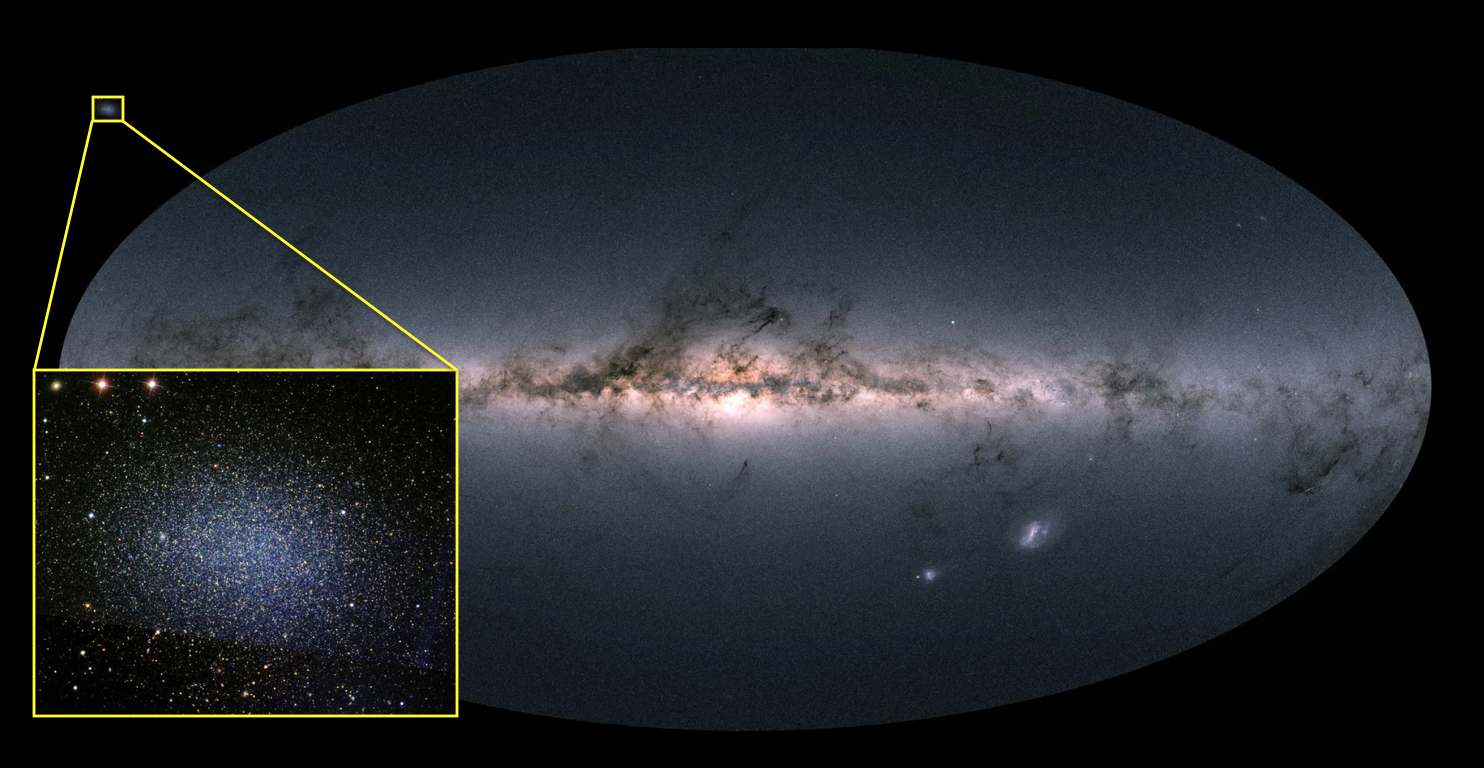
McDonald Observatory astronomers have found that Leo I (inset), a tiny satellite galaxy of the Milky Way (main image), has a black hole nearly as massive as the Milky Way's. Leo I is 30 times smaller than the Milky Way. The result could signal changes in astronomers' understanding of galaxy evolution. Credit: ESA/Gaia/DPAC; SDSS (inset).
Hi-res image

FORT DAVIS, Texas — Astronomers at The University of Texas at Austin’s McDonald Observatory have discovered an unusually massive black hole at the heart of one of the Milky Way’s dwarf satellite galaxies, called Leo I. Almost as massive as the black hole in our own galaxy, the finding could redefine our understanding of how all galaxies — the building blocks of the universe — evolve. The work is published in a recent issue of The Astrophysical Journal.

The team decided to study Leo I because of its peculiarity. Unlike most dwarf galaxies orbiting the Milky Way, Leo I does not contain much dark matter. Researchers measured Leo I’s dark matter profile — that is, how the density of dark matter changes from the outer edges of the galaxy all the way into its center. They did this by measuring its gravitational pull on the stars: The faster the stars are moving, the more matter there is enclosed in their orbits. In particular, the team wanted to know whether dark matter density increases toward the galaxy’s center. They also wanted to know whether their profile measurement would match previous ones made using older telescope data combined with computer models.

Led by recent UT Austin doctoral graduate María José Bustamante, the team includes UT astronomers Eva Noyola, Karl Gebhardt and Greg Zeimann, as well as colleagues from Germany’s Max Planck Institute for Extraterrestrial Physics (MPE).

For their observations, they used a unique instrument called VIRUS-W on McDonald Observatory’s 2.7-meter Harlan J. Smith Telescope.

When the team fed their improved data and sophisticated models into a supercomputer at UT Austin’s Texas Advanced Computing Center, they got a startling result.

“The models are screaming that you need a black hole at the center; you don’t really need a lot of dark matter,” Gebhardt said. “You have a very small galaxy that is falling into the Milky Way, and its black hole is about as massive as the Milky Way’s. The mass ratio is absolutely huge. The Milky Way is dominant; the Leo I black hole is almost comparable.” The result is unprecedented.

The researchers said the result was different from the past studies of Leo I due to a combination of better data and the supercomputer simulations. The central, dense region of the galaxy was mostly unexplored in previous studies, which concentrated on the velocities of individual stars. The current study showed that for those few velocities that were taken in the past, there was a bias toward low velocities. This, in turn, decreased the inferred amount of matter enclosed within their orbits.

The new data is concentrated in the central region and is unaffected by this bias. The amount of inferred matter enclosed within the stars’ orbits skyrocketed.

The finding could shake up astronomers’ understanding of galaxy evolution, as “there is no explanation for this kind of black hole in dwarf spheroidal galaxies,” Bustamante said.

The result is all the more important as astronomers have used galaxies such as Leo I, called “dwarf spheroidal galaxies,” for 20 years to understand how dark matter is distributed within galaxies, Gebhardt added. This new type of black hole merger also gives gravitational wave observatories a new signal to search for.

“If the mass of Leo I’s black hole is high, that may explain how black holes grow in massive galaxies,” Gebhardt said. That’s because over time, as small galaxies like Leo I fall into larger galaxies, the smaller galaxy’s black hole merges with that of the larger galaxy, increasing its mass.

Built by a team at MPE in Germany, VIRUS-W is the only instrument in the world now that can do this type of dark matter profile study. Noyola pointed out that many southern hemisphere dwarf galaxies are good targets for it, but no southern hemisphere telescope is equipped for it. However, the Giant Magellan Telescope (GMT) now under construction Chile was, in part, designed for this type of work. UT Austin is a founding partner of the GMT.


Notes to editors:

The published research paper is available at: https://iopscience.iop.org/article/10.3847/1538-4357/ac0c79/pdf and for free download at: https://arxiv.org/abs/2111.04770.


Media Contact:

Rebecca Johnson, Communications Mgr.
McDonald Observatory
The University of Texas at Austin
512-475-6763


Science Contacts:

Dr. María José Bustamante Rosell
Postdoctoral Scholar
The University of California, Santa Cruz
512-576-3501


Dr. Eva Noyola
McDonald Observatory Research Fellow
The University of Texas at Austin
512-736-8172


Dr. Karl Gebhardt
Herman and Joan Suit Professor of Astrophysics
The University of Texas at Austin
512-590-5206


Wednesday, December 01, 2021

SOFIA Confirms a Spiral Galaxy's Invisible, Opposing Arms


Hubble Space Telescope image of NGC 7479 created from observations at visible and near-infrared wavelengths with 20 cm radio continuum contours in yellow. The boxes highlight the ends of the lower and upper counter-arms; expanded versions of these regions are shown in the left and right panels where the circles depict the aperture of SOFIA’s FIFI-LS instrument. Credit: ESA/Hubble & NASA

Columbia, MD—November 29, 2021. NGC 7479, also known as Caldwell 44, is a barred spiral galaxy, with a bar-shaped center filled with stars (as is characteristic of a majority of spiral galaxies), and S- shaped arms. However, looking at features of NGC 7479 that are hidden from the naked eye reveals another pair of arms bending in an opposite direction to the visible galaxy. The Stratospheric Observatory for Infrared Astronomy (SOFIA) observed ionized carbon emissions to help confirm these counter-arms. The results were published in The Astrophysical Journal.

Radio wavelength emissions from these small, so-called “counter-arms” have been observed before, but with the help of SOFIA – along with observations by ALMA and archival data from a number of other observatories – their presence has now been confirmed by X-ray, ionized carbon, and carbon monoxide emissions as well. SOFIA’s new observations of the counter-arms can help reveal their origin.

Universities Space Research Association's Dario Fadda, the lead author of the paper, noted,“The really important thing in this galaxy are the two little counter-arms that go in the opposite direction of the optical arms that are seen in radio, but nobody had seen them in the X-ray. Seeing them in X-ray is important because it shows there’s energy coming out of the nucleus, something that comes out in jets that originate in the nucleus.”

The fact that these jets originate at the galaxy’s center implies the galaxy harbors an active nucleus – a supermassive black hole.

As the jet approaches the dense molecular clouds along the bar, some of its momentum is absorbed by the clouds, causing the jet to bend in the direction opposite to the rotation of the galaxy. This process is responsible for the orientation of the counter-arms.

By comparing the X-ray emissions of the jet to the ratio of ionized carbon and carbon dioxide emissions from the same area – both of which are considered indicators of star formation – the researchers discovered an anomaly. Certain hotspots within the counter-arms have too much ionized carbon, meaning the X-ray emission cannot entirely be explained by star formation.

“We knew about these counter-arms and tried to observe with SOFIA if ionized carbon is actually produced by star formation, or if there’s some extra component that can come from the energy injected by the active galactic nucleus,” said Fadda.

This calls into question the relationship between ionized carbon and star formation, and can have implications on the study of galaxies that are more distant than NGC 7479.

“This is where SOFIA becomes uniquely useful: Studying these cases of galaxies close to us to have an idea of what to encounter when we go to higher redshift to study galaxies and the farther universe,” Fadda said.NGC 7479

SOFIA’s role in these observations pushes the limits of its capabilities. Primarily suited for studying objects fairly close to our home galaxy, SOFIA’s spatial and spectral resolution were just enough to distinguish ionized carbon in NGC 7479’s region of interest. Specifically, SOFIA’s Far Infrared Field-Imaging Line Spectrometer (FIFI-LS) was used to map the ionized carbon in the area.


About USRA

Founded in 1969, under the auspices of the National Academy of Sciences at the request of the U.S. Government, the Universities Space Research Association (USRA), is a nonprofit corporation chartered to advance space-related science, technology and engineering. USRA operates scientific institutes and facilities, and conducts other major research and educational programs. USRA engages the university community and employs in-house scientific leadership, innovative research and development, and project management expertise. More information about USRA is available at www.usra.edu

About SOFIA

SOFIA is a joint project of NASA and the German Space Agency at DLR. DLR provides the telescope, scheduled aircraft maintenance, and other support for the mission. NASA’s Ames Research Center in California’s Silicon Valley manages the SOFIA program, science, and mission operations in cooperation with the Universities Space Research Association, headquartered in Columbia, Maryland, and the German SOFIA Institute at the University of Stuttgart. The aircraft is maintained and operated by NASA’s Armstrong Flight Research Center Building 703, in Palmdale, California.


Contact:

Suraiya Farukhi, Ph.D.
Director, External Communications

sfarukhi@usra.edu
443-812-6945