Thursday, August 07, 2014

Triangulum Galaxy Snapped by VST

VST snaps a very detailed view of the Triangulum Galaxy
Messier 33 in the northern constellation of Triangulum
Wide-field view of the sky around Messier 33

* * * * * * * * * * * *  * * * * * *

Videos

Zooming in on the Triangulum Galaxy

A close-up look at the Triangulum Galaxy

The VLT Survey Telescope (VST) at ESO’s Paranal Observatory in Chile has captured a beautifully detailed image of the galaxy Messier 33. This nearby spiral, the second closest large galaxy to our own galaxy, the Milky Way, is packed with bright star clusters, and clouds of gas and dust. The new picture is amongst the most detailed wide-field views of this object ever taken and shows the many glowing red gas clouds in the spiral arms with particular clarity.

Messier 33, otherwise known as NGC 598, is located about three million light-years away in the small northern constellation of Triangulum (The Triangle). Often known as the Triangulum Galaxy it was observed by the French comet hunter Charles Messier in August 1764, who listed it as number 33 in his famous list of prominent nebulae and star clusters. However, he was not the first to record the spiral galaxy; it was probably first documented by the Sicilian astronomer Giovanni Battista Hodierna around 100 years earlier.

Although the Triangulum Galaxy lies in the northern sky, it is just visible from the southern vantage point of ESO’s Paranal Observatory in Chile. However, it does not rise very high in the sky. This image was taken by the VLT Survey Telescope (VST), a state-of-the-art 2.6-metre survey telescope with a field of view that is twice as broad as the full Moon. This picture was created from many individual exposures, including some taken through a filter passing just the light from glowing hydrogen, which make the red gas clouds in the galaxies spiral arms especially prominent.

Among the many star formation regions in Messier 33’s spiral arms, the giant nebula NGC 604 stands out. With a diameter of nearly 1500 light-years, this is one of the largest nearby emission nebulae known. It stretches over an area 40 times the size of the visible portion of the much more famous — and much closer — Orion Nebula.

The Triangulum Galaxy is the third-largest member of the Local Group of galaxies, which includes the Milky Way, the Andromeda Galaxy, and about 50 other smaller galaxies. On an extremely clear, dark night, this galaxy is just visible with the unaided eye, and is considered to be the most distant celestial object visible without any optical help. Viewing conditions for the very patient are only set to improve in the long-term: the galaxy is approaching our own at a speed of about 100 000 kilometres per hour.

A closer look at this beautiful new picture not only allows a very detailed inspection of the star-forming spiral arms of the galaxy, but also reveals the very rich scenery of the more distant galaxies scattered behind the myriad stars and glowing clouds of NGC 598.

More information

ESO is the foremost intergovernmental astronomy organisation in Europe and the world’s most productive ground-based astronomical observatory by far. It is supported by 15 countries: Austria, Belgium, Brazil, the Czech Republic, Denmark, France, Finland, Germany, Italy, the Netherlands, Portugal, Spain, Sweden, Switzerland and the United Kingdom. ESO carries out an ambitious programme focused on the design, construction and operation of powerful ground-based observing facilities enabling astronomers to make important scientific discoveries. ESO also plays a leading role in promoting and organising cooperation in astronomical research. ESO operates three unique world-class observing sites in Chile: La Silla, Paranal and Chajnantor. At Paranal, ESO operates the Very Large Telescope, the world’s most advanced visible-light astronomical observatory and two survey telescopes. VISTA works in the infrared and is the world’s largest survey telescope and the VLT Survey Telescope is the largest telescope designed to exclusively survey the skies in visible light. ESO is the European partner of a revolutionary astronomical telescope ALMA, the largest astronomical project in existence. ESO is currently planning the 39-metre European Extremely Large optical/near-infrared Telescope, the E-ELT, which will become “the world’s biggest eye on the sky”.

Links

Contacts


Richard Hook
ESO Public Information Officer
Garching bei München, Germany

Tel: +49 89 3200 6655
Cell: +49 151 1537 3591
Email:
rhook@eso.org

Source: ESO


Wednesday, August 06, 2014

Rosetta arrives at comet destination

Comet 67P/Churyumov-Gerasimenko by Rosetta’s OSIRIS narrow-angle camera on 3 August from a distance of 285 km. The image resolution is 5.3 metres/pixel. Copyright: ESA/Rosetta/MPS for OSIRIS Team MPS/UPD/LAM/IAA/SSO/INTA/UPM/DASP/IDA

After a decade-long journey chasing its target, ESA’s Rosetta has today become the first spacecraft to rendezvous with a comet, opening a new chapter in Solar System exploration. 

Comet 67P/Churyumov–Gerasimenko and Rosetta now lie 405 million kilometres from Earth, about half way between the orbits of Jupiter and Mars, rushing towards the inner Solar System at nearly 55 000 kilometres per hour. 

The comet is in an elliptical 6.5-year orbit that takes it from beyond Jupiter at its furthest point, to between the orbits of Mars and Earth at its closest to the Sun. Rosetta will accompany it for over a year as they swing around the Sun and back out towards Jupiter again. 

Comets are considered to be primitive building blocks of the Solar System and may have helped to ‘seed’ Earth with water, perhaps even the ingredients for life. But many fundamental questions about these enigmatic objects remain, and through a comprehensive,in situstudy of the comet, Rosetta aims to unlock the secrets within. 

 Comet on 3 August 2014

The journey to the comet was not straightforward, however. Since its launch in 2004, Rosetta had to make three gravity-assist flybys of Earth and one of Mars to help it on course to its rendezvous with the comet. This complex course also allowed Rosetta to pass by asteroids Šteins and Lutetia, obtaining unprecedented views and scientific data on these two objects. 

“After ten years, five months and four days travelling towards our destination, looping around the Sun five times and clocking up 6.4 billion kilometres, we are delighted to announce finally ‘we are here’,” says Jean-Jacques Dordain, ESA’s Director General. 

“Europe’s Rosetta is now the first spacecraft in history to rendezvous with a comet, a major highlight in exploring our origins. Discoveries can start.” 

Today saw the last of a series of ten rendezvous manoeuvres that began in May to adjust Rosetta’s speed and trajectory gradually to match those of the comet. If any of these manoeuvres had failed, the mission would have been lost, and the spacecraft would simply have flown by the comet. 

“Today’s achievement is a result of a huge international endeavour spanning several decades,” says Alvaro Giménez, ESA’s Director of Science and Robotic Exploration. 

“We have come an extraordinarily long way since the mission concept was first discussed in the late 1970s and approved in 1993, and now we are ready to open a treasure chest of scientific discovery that is destined to rewrite the textbooks on comets for even more decades to come.”

Comet activity on 2 August 2014
 
6 August 2014 - The comet began to reveal its personality while Rosetta was on its approach. Images taken by the OSIRIS camera between late April and early June showed that its activity was variable. The comet’s ‘coma’ – an extended envelope of gas and dust – became rapidly brighter and then died down again over the course of those six weeks. 

In the same period, first measurements from the Microwave Instrument for the Rosetta Orbiter, MIRO, suggested that the comet was emitting water vapour into space at about 300 millilitres per second.
Meanwhile, the Visible and Infrared Thermal Imaging Spectrometer, VIRTIS, measured the comet’s average temperature to be about –70ºC, indicating that the surface is predominantly dark and dusty rather than clean and icy. 

Then, stunning images taken from a distance of about 12 000 km began to reveal that the nucleus comprises two distinct segments joined by a ‘neck’, giving it a duck-like appearance. Subsequent images showed more and more detail – the most recent, highest-resolution image was downloaded from the spacecraft earlier today and will be available this afternoon.
“Our first clear views of the comet have given us plenty to think about,” says Matt Taylor, ESA’s Rosetta project scientist.
“Is this double-lobed structure built from two separate comets that came together in the Solar System’s history, or is it one comet that has eroded dramatically and asymmetrically over time? Rosetta, by design, is in the best place to study one of these unique objects.”

Today, Rosetta is just 100 km from the comet’s surface, but it will edge closer still. Over the next six weeks, it will describe two triangular-shaped trajectories in front of the comet, first at a distance of 100 km and then at 50 km. 

At the same time, more of the suite of instruments will provide a detailed scientific study of the comet, scrutinising the surface for a target site for the Philae lander. 

Eventually, Rosetta will attempt a close, near-circular orbit at 30 km and, depending on the activity of the comet, perhaps come even closer. 

“Arriving at the comet is really only just the beginning of an even bigger adventure, with greater challenges still to come as we learn how to operate in this unchartered environment, start to orbit and, eventually, land,” says Sylvain Lodiot, ESA’s Rosetta spacecraft operations manager. 

Arriving at a comet
 
As many as five possible landing sites will be identified by late August, before the primary site is identified in mid-September. The final timeline for the sequence of events for deploying Philae – currently expected for 11 November – will be confirmed by the middle of October. 

“Over the next few months, in addition to characterising the comet nucleus and setting the bar for the rest of the mission, we will begin final preparations for another space history first: landing on a comet,” says Matt. 

“After landing, Rosetta will continue to accompany the comet until its closest approach to the Sun in August 2015 and beyond, watching its behaviour from close quarters to give us a unique insight and realtime experience of how a comet works as it hurtles around the Sun.” 

Notes for Editors:
 
Rosetta woke up from deep space hibernation at 18:18 GMT on 20 January 2014, nine million kilometres from comet 67P/Churyumov–Gerasimenko. Following wake-up, the orbiter’s 11 science instruments and 10 lander instruments were reactivated and readied for science observations. Ten orbital correction manoeuvres were carried out between 7 May and 6 August, reducing the spacecraft’s velocity with respect to the comet from 775 m/s to 1 m/s, equivalent to walking pace. Each of these manoeuvres was critical: if any had failed, no rendezvous would have been possible. More information about these manoeuvres can be found on the Rosetta blog

The latest ‘arrival’ image will be presented in the science session of today’s ‘Rosetta comet rendezvous’ event at ESA’s Space Operations Centre, ESOC, in Darmstadt, Germany, and in parallel will be published online on the ESA Portal. 

About the European Space Agency
 
The European Space Agency (ESA) is Europe’s gateway to space. It is an intergovernmental organisation, created in 1975, with the mission to shape the development of Europe’s space capability and ensure that investment in space delivers benefits to the citizens of Europe and the world. 

ESA has 20 Member States: Austria, Belgium, the Czech Republic, Denmark, Finland, France, Germany, Greece, Ireland, Italy, Luxembourg, the Netherlands, Norway, Poland, Portugal, Romania, Spain, Sweden, Switzerland and the United Kingdom, of whom 18 are Member States of the EU. 

ESA has Cooperation Agreements with eight other Member States of the EU. Canada takes part in some ESA programmes under a Cooperation Agreement. 

ESA is also working with the EU on implementing the Galileo and Copernicus programmes. 

By coordinating the financial and intellectual resources of its members, ESA can undertake programmes and activities far beyond the scope of any single European country. 

ESA develops the launchers, spacecraft and ground facilities needed to keep Europe at the forefront of global space activities. 

Today, it launches satellites for Earth observation, navigation, telecommunications and astronomy, sends probes to the far reaches of the Solar System and cooperates in the human exploration of space. 

For further information, please contact:

ESA Media Relations Office
Tel: + 33 1 53 69 72 99
Email:
media@esa.int
 
Markus Bauer
ESA Science and Robotic Exploration Communications Officer
Tel: +31 71 565 6799
Mob: +31 61 594 3 954
Email:
markus.bauer@esa.int

Source: ESA


ALMA Pinpoints Pluto to Help Guide NASA’s New Horizons Spacecraft

The cold surface of Pluto and its largest moon Charon as seen with ALMA on July 15, 2014. 
Credit: NRAO/AUI/NSF

Animated image of ALMA data showing the motion of the moon Charon around the icy dwarf planet Pluto. 
Credit: B. Saxton (NRAO/AUI/NSF)

Astronomers using the Atacama Large Millimeter/submillimeter Array (ALMA) are making high-precision measurements of Pluto's location and orbit around the Sun to help NASA’s New Horizons spacecraft accurately home in on its target when it nears Pluto and its five known moons in July 2015.

Though observed for decades with ever-larger optical telescopes on Earth and in space, astronomers are still working out Pluto's exact position and path around our Solar System. This lingering uncertainty is due to Pluto's extreme distance from the Sun (approximately 40 times farther out than the Earth) and the fact that we have been studying it for only about one-third of its orbit. Pluto was discovered in 1930 and takes 248 years to complete one revolution around the Sun.

“With these limited observational data, our knowledge of Pluto’s position could be wrong by several thousand kilometers, which compromises our ability to calculate efficient targeting maneuvers for the New Horizons spacecraft,” said New Horizons Project Scientist Hal Weaver, from the Johns Hopkins University Applied Physics Laboratory in Laurel, Maryland.

The New Horizons team made use of the ALMA positioning data, together with newly analyzed visible light measurements stretching back to Pluto's discovery, to determine how to perform the first such scheduled course correction for targeting, known as a Trajectory Correction Maneuver (TCM), in July. This maneuver helped ensure that New Horizons uses the minimum fuel to reach Pluto, saving as much as possible for a potential extended mission to explore Kuiper Belt objects after the Pluto system flyby is complete.

To prepare for this first TCM, astronomers needed to pinpoint Pluto's position using the most distant and most stable reference points possible. Finding such a reference point to accurately calculate trajectories of such small objects at such vast distances is incredibly challenging. Normally, stars at great distances are used by optical telescopes for astrometry (the positioning of things on the sky) since they change position only slightly over many years. For New Horizons, however, even more precise measurements were necessary to ensure its encounter with Pluto would be as on-target as possible.

The most distant and most apparently stable objects in the Universe are quasars, galaxies more than 10 billion light-years away. Though quasars appear very dim to optical telescopes, they are incredibly bright at radio wavelengths, particularly the millimeter wavelengths that ALMA can see.

“The ALMA astrometry used a bright quasar named J1911-2006 with the goal to cut in half the uncertainty of Pluto's position,” said Ed Fomalont, an astronomer with the National Radio Astronomy Observatory in Charlottesville, Virginia, and currently assigned to ALMA’s Operations Support Facility in Chile.

ALMA was able to study Pluto and its largest moon Charon by picking up the radio emission from their cold surfaces, which are about 43 degrees Kelvin (-230 degrees Celsius).

The team first observed these two icy worlds in November 2013, and then three more times in 2014 -- once in April and twice in July. Additional observations are scheduled for October 2014.

"By taking multiple observations at different dates, we allow Earth to move along its orbit, offering different vantage points in relation to the Sun," said Fomalont. "Astronomers can then better determine Pluto's distance and orbit." This astronomical technique is called measuring Pluto's parallax.

"We are very excited about the state-of-the-art capabilities that ALMA brings to bear to help us better target our historic exploration of the Pluto system," said New Horizons Principal Investigator Alan Stern of the Southwest Research Institute in Boulder, Colorado. "We thank the entire ALMA team for their support and for the beautiful data they are gathering for New Horizons."

The National Radio Astronomy Observatory is a facility of the National Science Foundation, operated under cooperative agreement by Associated Universities, Inc.

ALMA, an international astronomy facility, is a partnership of Europe, North America and East Asia in cooperation with the Republic of Chile. ALMA construction and operations are led on behalf of Europe by the European Southern Observatory (ESO), on behalf of North America by the National Radio Astronomy Observatory (NRAO), and on behalf of East Asia by the National Astronomical Observatory of Japan (NAOJ). The Joint ALMA Observatory (JAO) provides the unified leadership and management of the construction, commissioning and operation of ALMA.

New Horizons is the first mission to the Pluto system and the Kuiper Belt of rocky, icy objects beyond. The Johns Hopkins University Applied Physics Laboratory (APL) manages the mission for NASA’s Science Mission Directorate; Alan Stern, of the Southwest Research Institute (SwRI), is the principal investigator and leads the mission. SwRI leads the science team, payload operations and encounter science planning; APL designed, built and operates the New Horizons spacecraft. New Horizons is part of the New Frontiers Program managed by NASA's Marshall Space Flight Center in Huntsville, Ala. 

For more information, visit http://pluto.jhuapl.edu.

Contact: 

Charles Blue,
NRAO Public Information Officer
(434) 296-0314;
cblue@nrao.edu


The National Radio Astronomy Observatory is a facility of the National Science Foundation, operated under cooperative agreement by Associated Universities, Inc.


Tuesday, August 05, 2014

Planet-like Object May Have Spent Its Youth as Hot as a Star

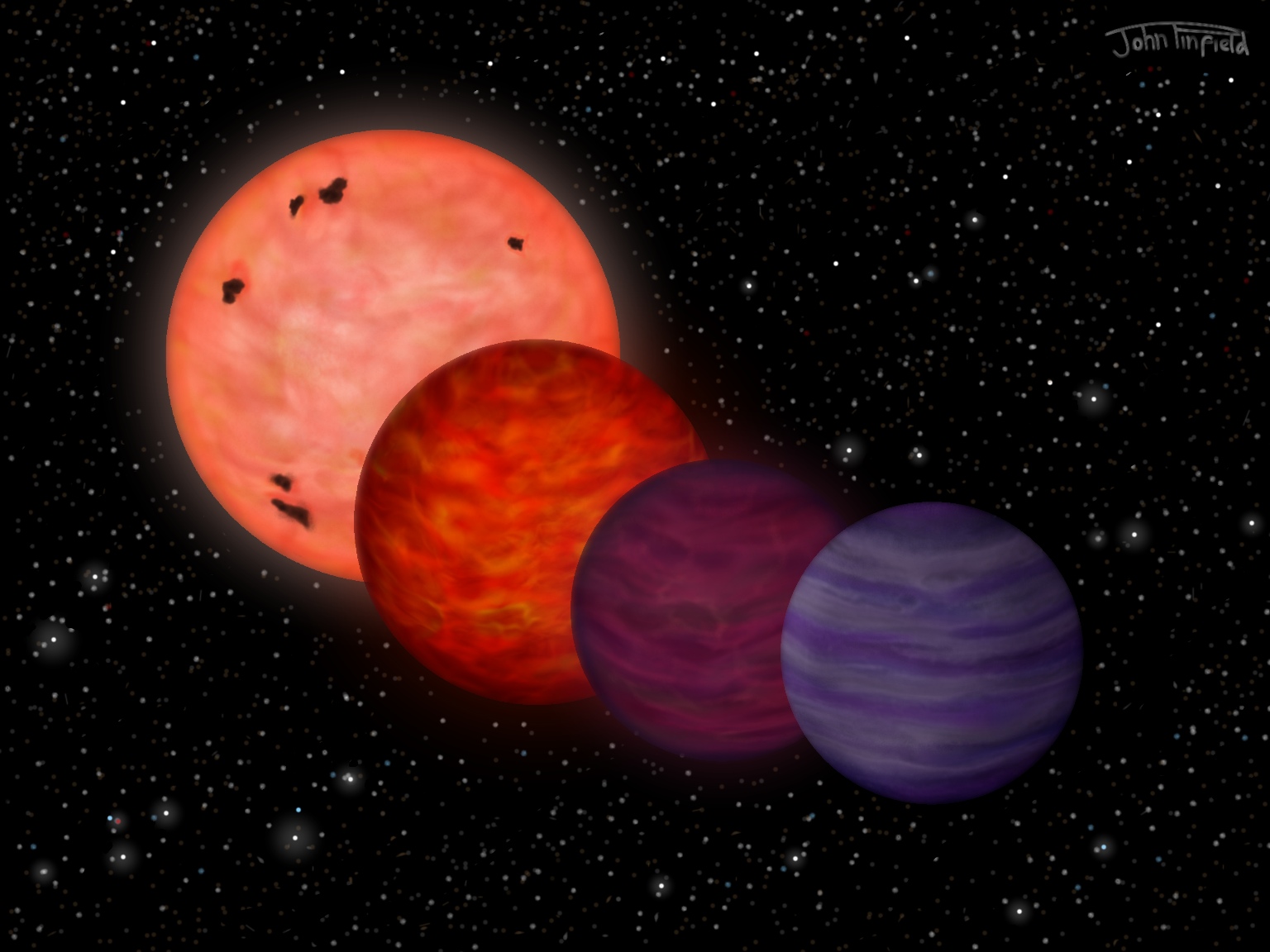
A four-stage sequence (left to right) showing the possible extreme temperature evolution for WISE J0304-2705. For about 20 million years, the object was as hot as a star, shining with a temperature of at least 5,100 degrees Fahrenheit (2800 degrees Celsius). After about 100 million years it had cooled to about 2,700 degrees Fahrenheit (1500 degrees Celsius), and by a billion years its temperature was about 1,800 degrees Fahrenheit (1000 degrees Celsius). The final stage is billions of years later, when WISE J0304-2705 has cooled to its current planetary temperature of 100-150 C. Artwork credit: John Pinfield.  Full Resolution JPEG

The following is duplicated from the Carnegie Institution for Science press release, distributed on August 5, 2014.

Astronomers have discovered an extremely cool object that could have a particularly diverse history—although it is now as cool as a planet, it may have spent much of its youth as hot as a star.

The current temperature of the object is 200 to 300 degrees Fahrenheit (100 to 150 degrees Celsius), which is intermediate between that of the Earth and of Venus. However, the object shows evidence of a possible ancient origin, implying that a large change in temperature has taken place. In the past this object would have been as hot as a star for many millions of years.

Called WISE J0304-2705, the object is a member of the recently established "Y dwarf" class—the coolest stellar temperature class yet defined, following the other classes O, B, A, F, G, K, M, L, and T. Although the temperature is similar to that of the planets, the object is dissimilar to the rocky Earth-like planets, and instead is a giant ball of gas like Jupiter.

The international discovery team, led by David Pinfield from the University of Hertfordshire and including Carnegie’s Yuri Beletsky, identified the Y dwarf using the WISE observatory—a NASA space telescope that has imaged the entire sky in the mid-infrared. The team also measured the spectrum of light emitted by the Y dwarf, which allowed them to determine its current temperature and better understand its history. Their work is published by Monthly Notices of the Royal Astronomical Society.

Only 20 other Y dwarfs have been discovered to-date, and amongst these WISE J0304-2705 is defined as “peculiar” due to unusual features in its emitted light spectrum.

"Our measurements suggest that this Y dwarf may have a composition and/or age characteristic of one of the Galaxy's older members,” Pinfield explained. "This would mean its temperature evolution could have been rather extreme."

The reason that WISE J0304-2705 undergoes such extensive evolutionary cooling is because it is "sub-stellar,” meaning its interior never gets hot enough for hydrogen fusion, the process that has kept our Sun hot for billions of years, and without an energy source maintaining a stable temperature, cooling and fading is inevitable.

If WISE J0304-2705 is an ancient object, then its temperature evolution would have followed through an understood series of stages (as depicted below in the illustration): During its first approximately 20 million years it would have a temperature of at least 5,100 degrees Fahrenheit (2800 degrees Celsius), the same as red dwarf stars like Proxima Centauri (the nearest star to the Sun). After 100 million years it would have cooled to about 2,700 degrees Fahrenheit (1,500 degrees Celsius), with silicate clouds condensing out in its atmosphere. At a billion years of age it would have cooled to about 1,800 degrees Fahrenheit (1,000 degrees Celsius), so cool that methane gas and water vapor would dominate its appearance. And since then it would have continued to cool to its current temperature, barely enough to boil water for a cup of tea.

WISE J0304-2705 is as massive as 20-30 Jupiters combined, which is intermediate between the more massive stars and typical planets. But in terms of temperature it may have actually "taken the journey" from star-like to planet-like conditions.

Having identified WISE 0304-2705, Pinfield's team made crucial ground-based observations with some of the world's largest telescopes—the 8-meter Gemini South Telescope, the 6.5-meter Magellan Telescope and the European Southern Observatory's 3.6-meter New Technology Telescope, all located in the Chilean Andes.

Team member Mariusz Gromadzki said: "The ground based measurements were very challenging, even with the largest telescopes. It was exciting when the results showed just how cool this object was, and that it was unusual".

"The discovery of WISE J0304-2705, with its peculiar light spectrum, poses ongoing challenges for the most powerful modern telescopes that are being used for its detailed study" remarked Maria Teresa Ruiz, team member from the Universidad de Chile.

WISE J0304-2705 is located in the Fornax (Furnace) constellation, belying its cool temperature.

There is currently no lower limit for Y dwarf temperatures, and there could be many even cooler and more diverse objects un-detected in the solar neighborhood. WISE went into hibernation in February 2011 after carrying out its main survey mission. However, by popular demand it was revived in December 2013, and is continuing to observe as part of a three-year mission extension.

"WISE gives us wonderful sensitivity to the coolest objects" said Pinfield, "and with three more years of observations we will be able to search the sky for more Y dwarfs, and more diverse Y dwarfs."

The paper, to be published by Monthly Notices of the Royal Astronomical Society, is available on astro-ph.


Igniting a supernova explosion

Fig. 1: Artist's conception of a binary system, where a mass overflow from a donor star onto a white dwarf star may occur. Once enough accreted matter has accumulated on the surface of the dwarf star, this may initiate a nuclear explosion, which in turn would ignite the catastrophic nuclear burning and disruption of the dwarf star: a supernova of type Ia. Credit: ESA Noordwijk

Abb. 2: The INTEGRAL Space Observatory for gamma-rays from cosmic sources (up).   Credit: ESA Noordwijk.  The Spectrometer (SPI) instrument is optimized for spectroscopy of gamma-ray lines.  Credit: CNES Toulouse


Fig. 3: Detection of a nickel line in the Supernova SN2014J, some two weeks after the explosion. The position of the signal agrees within the measurement error with the position of the supernova (indicated by the cross). Adapted from R. Diehl,Th. Siegert,W. Hillebrandt et al. Science 31 July 2014.

High-energy observations with the INTEGRAL space observatory have revealed a surprising signal of gamma-rays from the surface of material ejected by a recent supernova explosion. This result challenges the prevailing explosion model for type Ia supernovae, indicating that such energetic events might be ignited from the outside as well rather than from the exploding dwarf star's centre. The scientists from the Max Planck Institutes for Extraterrestrial Physics and for Astrophysics present their findings in the current edition of Science to the astronomical community.

In January, a supernova explosion, called SN2014J, was reported in a nearby starburst galaxy, called M82. Just two weeks later, astronomers were able to take data with the INTEGRAL space telescope, revealing two characteristic gamma-ray lines from a radioactive nickel isotope (56Ni).

Supernovae are giant nuclear fusion furnaces, and the atomic nuclei of nickel are believed to be the main product of nuclear fusion inside the supernova. Presumably this radioactive element is created mainly in the centre of the exploding white dwarf star and therefore occulted from direct observation. As the explosion dilutes the entire stellar material, the outer layers get more and more transparent, and after several weeks to months also gamma-rays from the nickel decay chain are expected to be accessible to observation.

As the astronomers scrutinized the new data, however, they found traces of the decay of radioactive nickel just 15 days after the presumable explosion date. This implies that the observed material was near the surface of the explosion, which was a surprise.

"For quite a while, we were puzzled by this surprising signal", says Roland Diehl from the Max Planck Institute for Extraterrestrial Physics, the lead author of the study and Principal Investigator of the INTEGRAL spectrometer instrument. “But we could not find anything wrong, rather the gamma-ray lines from 56Ni faded away as expected after a few days, and clearly came from the direction of the supernova”, he explains the outcome of their analysis of the observations. At MPE, an expert analysis team has been developing special methods for high-resolution spectroscopy of gamma-ray lines for many years. This has been successfully applied to the study of nucleosynthesis throughout our Galaxy as well as for the Cassiopeia A supernova remnant - and now to the recent supernova observations.

"We know that the supernova burns an entire white dwarf star within a second, but we are not sure how the explosion is ignited in the first place", explains Wolfgang Hillebrandt, a co-author of the study from the Max Planck Institute for Astrophysics. "A companion star's action seems required", he continues, "and for a while, we believed that only those white dwarfs explode, which are loaded with material from the companion star until they reach a critical limiting mass." But then, the explosion would be ignited in the core of the white dwarf, and no nuclear fusion products should be seen on the outside.

Diehl, Hillebrandt, and their colleagues had argued over the result for a while, challenging the methods of data analysis as well as ideas about supernova explosion scenarios. They now report their finding, supported by statistical arguments, and their descriptions of their methods to help scientists judge this important discovery. They conclude that those gamma-rays shed new light on how a binary companion’s material flow can ignite such a supernova from outside, and without demand for exceeding a critical mass limit for white dwarf stars.

From the early appearance of the nickel gamma-rays it seems that some modest amount of outer material accreted from the companion star ignited, and was processed to fusion ashes including the observed nickel. This primary explosion then must have triggered the main supernova, which was also observed with a variety of telescopes at many other wavelength bands, and appears as a rather normal supernova in these observations.

Gamma-rays from radioactive decay directly trace nuclear fusion ashes, and thus make a unique contribution to what we can learn about such explosions. The scenario that the astrophysicists describe ties in with recent belief that rather rapid material flows such as they occur in merging white dwarfs may often be the origins of supernovae of this type. 


About INTEGRAL

The INTEGRAL gamma-ray space observatory was launched in 2002 for a nominal 3-year mission, and now, after almost 12 years, is still in good shape for many more years of observations. Together with the partner institute IRAP/CESR in Toulouse, MPE was responsible for one of the two main telescopes, the SPI spectrometer. INTEGRAL has discovered many new sources of the violent high-energy universe, among them active galaxies, new classes of accreting binary systems and pulsars, gamma-ray bursters, and surveys of nucleosynthesis gamma-rays from different sources plus a puzzling signal from annihilation of antimatter.

INTEGRAL is a mission of the European Space Agency ESA in cooperation with Russia and the United States.  Website: http://sci.esa.int/integral/ 

Original publication: ScienceXpress Online-Publikation 31Jul 2014
R. Diehl,Th. Siegert,W. Hillebrandt et al. Early 56Ni decay γ-rays from SN2014J suggest an unusual explosion Science 31 July 2014

Contact at MPE
 
Prof. Dr. Roland Diehl
Max-Planck-Institut für extraterrestrische Physik
E-Mail:
rod@mpe.mpg.de
Tel. +49 89 30000 3850 

Contact at MPA

Prof. Dr. Wolfgang Hillebrandt
Max-Planck-Institut für Astrophysik
E-Mail:
wfh@mpa-garching.mpg.de
Tel. +49 89 30000 2200 

Monday, August 04, 2014

Observations Reveal Massive Eruptions on Jupiter’s Moon Io

Images of Io obtained at different infrared wavelengths (in microns, μm, or millionths of a meter) with the W. M. Keck Observatory's 10-meter Keck II telescope on Aug. 15, 2013 (a-c) and the Gemini North telescope on Aug. 29, 2013 (d). The bar on the right of each image indicates the intensity of the infrared emission. Note that emissions from the large volcanic outbursts on Aug. 15 at Rarog and Heno Paterae have substantially faded by Aug. 29. A second bright spot is visible to the north of the Rarog and Heno eruptions in c and to the west of the outburst in d. This hot spot was identified as Loki Patera, a lava lake that appeared to be particularly active at the same time. An even brighter outburst is seen to the lower right in panel (d), labeled “201308C” and is one of the most powerful outbursts ever seen on Io. Credit: Imke de Pater and Katherine de Kleer, UC Berkeley.

Mauna Kea, Hawaii — Three massive volcanic eruptions occurred on Jupiter's moon Io within a two-week period, leading astronomers to speculate that these presumed rare "outbursts," which can send material hundreds of miles above the surface, might be much more common than previously thought. The observations were made using the W. M. Keck Observatory and Gemini Observatory, both near the summit of Mauna Kea, Hawaii.

"We typically expect one huge outburst every one or two years, and they're usually not this bright," said Imke de Pater, professor and chair of astronomy at the University of California, Berkeley, and lead author of one of two papers describing the eruptions. "Here we had three extremely bright outbursts, which suggest that if we looked more frequently we might see many more of them on Io."

Io, the innermost of Jupiter's four large "Galilean" moons, is about 2,300 miles across, and, aside from Earth, is the only known place in the solar system with volcanoes erupting extremely hot lava like that seen on Earth. Because of Io's low gravity, large volcanic eruptions produce an umbrella of debris that rises high into space.

De Pater's long-time colleague and coauthor Ashley Davies, a volcanologist with NASA's Jet Propulsion Laboratory at the California Institute of Technology in Pasadena, Calif., said that the recent eruptions resemble past events that spewed tens of cubic miles of lava over hundreds of square miles in a short period of time.

"These new events are in a relatively rare class of eruptions on Io because of their size and astonishingly high thermal emission," he said. "The amount of energy being emitted by these eruptions implies lava fountains gushing out of fissures at a very large volume per second, forming lava flows that quickly spread over the surface of Io."

All three events, including the largest, most powerful eruption of the trio on 29 Aug. 2013, were likely characterized by “curtains of fire," as lava blasted out of fissures perhaps several miles long.

The papers, one with lead author Katherine de Kleer, a UC Berkeley graduate student, and coauthored by UC Berkeley research astronomer Máté Ádámkovics, and the other coauthored by Ádámkovics and David R. Ciardi of Caltech's NASA Exoplanet Science Institute, have been accepted for publication in the journal Icarus.

Lava fountains on Io

De Pater discovered the first two massive eruptions on Aug. 15, 2013, using the near-infrared camera (NIRC2) coupled to the adaptive optics system on the Keck II telescope, one of two 10-meter telescopes operated by the W. M. Keck Observatory in Hawaii. The brightest, at a caldera named Rarog Patera, was calculated to have produced a 50 square-mile, 30-foot thick lava flow, while the other, close to another caldera called Heno Patera, produced flows covering 120 square miles. Both were located in Io's southern hemisphere, near its limb, and were nearly gone when imaged five days later.

De Pater discovered a third and even brighter eruption — one of the brightest ever seen on Io — on Aug. 29 at the start of a year-long series of Io observations led by de Kleer, using both the Near-Infrared Imager with adaptive optics on the Gemini North telescope on Mauna Kea, and the SpeX near-infrared spectrometer on NASA's nearby Infrared Telescope Facility (IRTF). De Kleer used the fortuitous detection of this outburst simultaneously at Gemini and the IRTF to show that the eruption temperature is likely much higher than typical eruption temperatures on Earth today, "indicative of a composition of the magma that on Earth only occurred in our planet’s formative years," de Kleer said.

At the time of the observation, the thermal source had an area of up to 32 square miles. The modelled temperature of the lava indicated it had barely had time to cool, suggesting that the event was dominated by lava fountains.

"We are looking at several cubic miles of lava in rapidly emplaced flows," said Davies, who has developed models to predict the volume of magma erupted based on spectroscopic observations. "This will help us understand the processes that helped shape the surfaces of all the terrestrial planets, including Earth, and the moon."

The team tracked the heat of the third outburst for almost two weeks after its discovery to investigate how volcanoes influence Io’s atmosphere and how these eruptions feed a doughnut of ionized gas - the Io plasma torus - that surrounds Jupiter near Io’s orbit. De Kleer timed her Gemini and IRTF observations to coincide with observations of the plasma torus by the Japanese HISAKI (SPRINT-A) spacecraft, which is in orbit around Earth, so she can correlate the different data sets.

A volcanic laboratory

Volcanoes were first noted on Io in 1979, and subsequent studies by the Galileo spacecraft, which first flew by Io in 1996, and ground-based telescopes show that eruptions and lava fountains occur constantly, creating rivers and lakes of lava. But large eruptions, creating vast lava flows in some cases thousands of square miles in area, were thought to be rare. Only 13 were observed between 1978 and 2006, in part because only a handful of astronomers, de Pater among them, regularly scan the moon.

Davies' interest in Io's volcanoes arises from the moon's resemblance to an early Earth when heat from the decay of radioactive elements — much more intense than radiogenic heating today — created exotic, high-temperature lavas. Io remains volcanically active for a different reason — Jupiter and the moons Europa and Ganymede constantly tug on it — but the current eruptions on Io are likely similar to those that shaped the surfaces of inner solar system planets such as Earth and Venus in their youth.

"We are using Io as a volcanic laboratory, where we can look back into the past of the terrestrial planets to get a better understanding of how these large eruptions took place, and how fast and how long they lasted," Davies said.

In a third paper accepted by Icarus, de Pater, Davies and their colleagues summarize a decade of Io observations with the Keck II and Gemini telescopes. Their map of the surface of Io pinpointed more than two dozen hot spots whose spatial distribution changed significantly between 2001 and 2010. In 2010 the hot spots were dominated by two volcanic centers: Loki Patera, an extremely large active lava lake on Io, and Kanehekili Fluctus, an area of continuing pahoehoe lava flows. 

The team hopes that monitoring Io's surface annually will reveal the style of volcanic eruptions on the moon, constrain the composition of the magma, and accurately map the spatial distribution of the heat flow and potential variations over time. This information is essential to get a better understanding of the physical processes involved in the heating and cooling processes on Io, de Pater said.

The work is funded by the National Science Foundation and NASA's Outer Planets Research and Planetary Geology and Geophysics Programs.

The W. M. Keck Observatory operates the largest, most scientifically productive telescopes on Earth. The two, 10-meter optical/infrared telescopes on the summit of Mauna Kea on the Island of Hawaii feature a suite of advanced instruments including imagers, multi-object spectrographs, high-resolution spectrographs, integral-field spectroscopy and world-leading laser guide star adaptive optics systems.

NIRC2 (the Near-Infrared Camera, second generation) works in combination with the Keck II adaptive optics system to obtain very sharp images at near-infrared wavelengths, achieving spatial resolutions comparable to or better than those achieved by the Hubble Space Telescope at optical wavelengths. NIRC2 is probably best known for helping to provide definitive proof of a central massive black hole at the center of our galaxy. Astronomers also use NIRC2 to map surface features of solar system bodies, detect planets orbiting other stars, and study detailed morphology of distant galaxies.

Keck Observatory is a private 501(c) 3 non-profit organization and a scientific partnership of the California Institute of Technology, the University of California and NASA.

Related Information


Media Contact:

Steve Jefferson
Communications Officer
W. M. Keck Observatory
808-881-3827

sjefferson@keck.hawaii.edu

Science Contacts:
Imke de Pater
510-643-7673

mke@berkeley.edu

Ashley Davies
818-393-1775

ashley.davies@jpl.nasa.gov

Katherine de Kleer
kdekleer@astro.berkeley.edu


NASA's Fermi Space Telescope Reveals New Source of Gamma Rays

These images show Fermi data centered on each of the four gamma-ray novae observed by the LAT. Colors indicate the number of detected gamma rays with energies greater than 100 million electron volts (blue indicates lowest, yellow highest). Image Credit: NASA/DOE/Fermi LAT Collaboration. Hi-Res Image
 
Observations by NASA's Fermi Gamma-ray Space Telescope of several stellar eruptions, called novae, firmly establish these relatively common outbursts almost always produce gamma rays, the most energetic form of light.

"There's a saying that one is a fluke, two is a coincidence, and three is a class, and we're now at four novae and counting with Fermi," said Teddy Cheung, an astrophysicist at the Naval Research Laboratory in Washington, and the lead author of a paper reporting the findings in the Aug. 1 edition of the journal Science.
A nova is a sudden, short-lived brightening of an otherwise inconspicuous star caused by a thermonuclear explosion on the surface of a white dwarf, a compact star not much larger than Earth. Each nova explosion releases up to 100,000 times the annual energy output of our sun. Prior to Fermi, no one suspected these outbursts were capable of producing high-energy gamma rays, emission with energy levels millions of times greater than visible light and usually associated with far more powerful cosmic blasts.

Fermi's Large Area Telescope (LAT) scored its first nova detection, dubbed V407 Cygni, in March 2010. The outburst came from a rare type of star system in which a white dwarf interacts with a red giant, a star more than a hundred times the size of our sun. Other members of the same unusual class of stellar system have been observed "going nova" every few decades.


The white dwarf star in V407 Cygni, shown here in an artist's concept, went nova in 2010. Scientists think the outburst primarily emitted gamma rays (magenta) as the blast wave plowed through the gas-rich environment near the system's red giant star. Image Credit:  NASA's Goddard Space Flight Center/S. Wiessinger. Hi-Res Image
 
Novae typically originate in binary systems containing sun-like stars, as shown in this artist's rendering. A nova in a system like this likely produces gamma rays (magenta) through collisions among multiple shock waves in the rapidly expanding shell of debris.Image Credit: NASA's Goddard Space Flight Center/S. Wiessinger. Hi-Res Image
 
In 2012 and 2013, the LAT detected three so-called classical novae which occur in more common binaries where a white dwarf and a sun-like star orbit each other every few hours.

"We initially thought of V407 Cygni as a special case because the red giant's atmosphere is essentially leaking into space, producing a gaseous environment that interacts with the explosion's blast wave," said co-author Steven Shore, a professor of astrophysics at the University of Pisa in Italy. "But this can't explain more recent Fermi detections because none of those systems possess red giants."

Fermi detected the classical novae V339 Delphini in August 2013 and V1324 Scorpii in June 2012, following their discovery in visible light. In addition, on June 22, 2012, the LAT discovered a transient gamma-ray source about 20 degrees from the sun. More than a month later, when the sun had moved farther away, astronomers looking in visible light discovered a fading nova from V959 Monocerotis at the same position.

Astronomers estimate that between 20 and 50 novae occur each year in our galaxy. Most go undetected, their visible light obscured by intervening dust and their gamma rays dimmed by distance. All of the gamma-ray novae found so far lie between 9,000 and 15,000 light-years away, relatively nearby given the size of our galaxy.

Novae occur because a stream of gas flowing from the companion star piles up into a layer on the white dwarf's surface. Over time -- tens of thousands of years, in the case of classical novae, and several decades for a system like V407 Cygni -- this deepening layer reaches a flash point. Its hydrogen begins to undergo nuclear fusion, triggering a runaway reaction that detonates the accumulated gas. The white dwarf itself remains intact.

One explanation for the gamma-ray emission is that the blast creates multiple shock waves that expand into space at slightly different speeds. Faster shocks could interact with slower ones, accelerating particles to near the speed of light. These particles ultimately could produce gamma rays.

"This colliding-shock process must also have been at work in V407 Cygni, but there is no clear evidence for it," said co-author Pierre Jean, a professor of astrophysics at the University of Toulouse in France. This is likely because gamma rays emitted through this process were overwhelmed by those produced as the shock wave interacted with the red giant and its surroundings, the scientists conclude.

NASA's Fermi Gamma-ray Space Telescope is an astrophysics and particle physics partnership managed by the agency's Goddard Space Flight Center in Greenbelt, Maryland. It was developed in collaboration with the U.S. Department of Energy, with contributions from academic institutions and partners in France, Germany, Italy, Japan, Sweden and the United States.


Related Links:

CONTACT:
 
J.D. Harrington
Headquarters, Washington
202-358-5241

j.d.harrington@nasa.gov

Lynn Chandler
Goddard Space Flight Center, Greenbelt, Md.
301-286-2806

lynn.chandler-1@nasa.gov

For more information about Fermi, visit:  http://www.nasa.gov/fermi


Saturday, August 02, 2014

Best Evidence Yet For Coronal Heating Theory Detected by NASA Sounding Rocket

Scientists have recently gathered some of the strongest evidence to date to explain what makes the sun's outer atmosphere so much hotter than its surface. The new observations of the small-scale extremely hot temperatures are consistent with only one current theory: something called nanoflares – a constant peppering of impulsive bursts of heating, none of which can be individually detected -- provide the mysterious extra heat.

NASA's EUNIS sounding rocket mission spotted evidence to explain why the sun's atmosphere is so much hotter than its surface. Image Credit: NASA/Goddard/Duberstein.  Download video

The EUNIS experiment undergoing tests before launch.
Image Credit: NASA

The sounding rocket carrying the EUNIS experiment launches from the White Sands Missile Range in New Mexico on April 23, 2013. Image Credit: NASA

What’s even more surprising is these new observations come from just six minutes worth of data from one of NASA's least expensive type of missions, a sounding rocket. The EUNIS mission, short for Extreme Ultraviolet Normal Incidence Spectrograph, launched on April 23, 2013, gathering a new snapshot of data every 1.3 seconds to track the properties of material over a wide range of temperatures in the complex solar atmosphere.

The sun's visible surface, called the photosphere, is some 6,000 Kelvins, while the corona regularly reaches temperatures which are 300 times as hot.

"That's a bit of a puzzle," said Jeff Brosius, a space scientist at Catholic University in Washington, D.C., and NASA's Goddard Space Flight Center in Greenbelt, Maryland. "Things usually get cooler farther away from a hot source. When you're roasting a marshmallow you move it closer to the fire to cook it, not farther away."

Brosius is the first author of a paper on these results appearing in the Aug. 1, 2014, edition of The Astrophysical Journal.

Several theories have been offered for how the magnetic energy coursing through the corona is converted into the heat that raises the temperature. Different theories make different predictions about what kind of – and what temperature – material might be observable, but few observations have high enough resolution over a large enough area to distinguish between these predictions.

The EUNIS rocket, however, was equipped with a very sensitive version of an instrument called a spectrograph. Spectrographs gather information about how much material is present at a given temperature, by recording different wavelengths of light. To observe the extreme ultraviolet wavelengths necessary to distinguish between various coronal heating theories, such an instrument can only work properly in space, above the atmosphere surrounding Earth that blocks that ultraviolet light. So EUNIS flew up nearly 200 miles above the ground aboard a sounding rocket, a type of NASA mission that flies for only 15 minutes or so, and gathered about six minutes worth of observations from above the planet's air.

During its flight, EUNIS scanned a pre-determined region on the sun known to be magnetically complex, a so-called active region, which can often be the source of larger flares and coronal mass ejections. As light from the region streamed into its spectrograph, the instrument separated the light into its various wavelengths. Instead of producing a typical image of the sun, the wavelengths with larger amounts of light are each represented by a vertical line called an emission line. Each emission line, in turn, represents material at a unique temperature on the sun. Further analysis can identify the density and movement of the material as well.

The EUNIS spectrograph was tuned into a range of wavelengths useful for spotting material at temperatures of 10 million Kelvin – temperatures that are a signature of nanoflares. Scientists have hypothesized that a myriad of nanoflares could heat up solar material in the atmosphere to temperatures of up to 10 million Kelvins. This material would cool very rapidly, producing ample solar material at the 1 to 3 million degrees regularly seen in the corona.

However, the faint presence of that extremely hot material should remain. Looking over their six minutes of data, the EUNIS team spotted a wavelength of light corresponding to that 10 million degree material. To spot this faint emission line was a triumph of the EUNIS instrument's resolution. The spectrograph was able to clearly and unambiguously distinguish the observations representing the extremely hot material.

"The fact that we were able to resolve this emission line so clearly from its neighbors is what makes spectroscopists like me stay awake at night with excitement," said Brosius. "This weak line observed over such a large fraction of an active region really gives us the strongest evidence yet for the presence of nanoflares."

There are a variety of theories for what mechanisms power these impulsive bursts of heat, the nanoflares. Moreover, other explanations have been offered for what is heating the corona. Scientists will continue to explore these ideas further, gathering additional observations as their tools and instruments improve. However, no other theory predicts material of this temperature in the corona, so this is a strong piece of evidence in favor of the nanoflare theory.

"This is a real smoking gun for nanoflares," said Adrian Daw, the current principal investigator for EUNIS at Goddard. "And it shows that these smaller, less expensive sounding rockets can produce truly robust science."

NASA's Solar Dynamics Observatory captured this image of what the sun looked like on April 23, 2013, at 1:30 p.m. EDT when the EUNIS mission launched. EUNIS focused on an active region of the sun, seen as bright loops in the upper right in this picture. Image Credit: NASA/SDO

In addition to having a lower cost, sounding rockets offer a valuable test bed for new technology that may subsequently be flown on longer-term space missions. Another advantage of sounding rockets is that the instruments parachute back to the ground so they can be recovered and re-used. The EUNIS mission will be re-tuned to focus on a different set of solar wavelengths – ones that can also spot the extremely high temperature material representative of nanoflares -- and fly again sometime in 2016.

EUNIS was supported through NASA’s Sounding Rocket Program at the Goddard Space Flight Center’s Wallops Flight Facility in Virginia. NASA’s Heliophysics Division manages the sounding rocket program. EUNIS launched from the White Sands Missile Range in New Mexico. At the time of flight, the principal investigator for EUNIS was Doug Rabin at Goddard.

Related Links:


Friday, August 01, 2014

The Mysterious Center of our Galaxy

A near-infrared image of the Galactic Center - SagA* region taken with the Keck Telescope NIRC2 camera using adaptive optics. SagA* is not visible among its many bright neighboring stars. The central green square shows the size and position of the prime Spitzer IRAC pixel; the second square looks at a reference position. Spitzer’s pointing stability and very long duration observing sessions allowed astronomers to measure for the first time small fluctuations in the SagA* flux over 23 continuous hours. Later this year the cloud G-2 is expected to encounter the SagA* supermassive black hole and power much more luminous outbursts.  Credit: J. Hora, IRAC, and NASA.

The center of our Milky Way galaxy is located about twenty-five thousand light years from Earth, in the direction of the constellation of Sagittarius. It is invisible to us in optical light because of extensive amounts of absorbing, intervening dust, but radiation at other wavelengths, including the infrared and radio, can penetrate the veiling material. At the heart of the galactic center is a supermassive black hole, SagA*, containing about four million solar-masses of material. The region is actively studied by astronomers because the origin, evolution, and perhaps future of the Milky Way (including the solar system, which orbits the center every few hundred million years) are determined in part by the properties of the Galactic Center. Moreover it is the closest galactic nucleus to us by far, enabling scientists interested in the bizarre nature of black holes to watch in detail, at least in principle, the physical activities underway in its immediate environment.

One problem – if you can call it that – is that SagA* is relatively passive and dim, with only slight flickering seen and thought to be the result of small blobs of material randomly accreting onto a disk around it. This passivity distinguishes SagA* from many other supermassive black holes that actively accrete and heat large amounts of material and eject powerful bipolar jets of fast-moving charged particles. Astronomers a few years ago were extremely excited, therefore, to spot a large cloud of gas (about three Earth-masses) moving quickly towards SagA*. Estimates projected that the cloud (known as G-2) might be “eaten” sometime around this summer, with the consequent accretion lighting up the region and permitting detailed modeling of black hole feeding mechanisms. Numerous groups began campaigns to monitor the activity of SagA*.

CfA astronomers Joe Hora, Matt Ashby, Giovanni Fazio, Howard Smith and Steve Willner joined with seven colleagues to perform pioneering infrared observations of SagA* using the IRAC camera on the Spitzer Space Telescope. Ground-based studies can only watch SagA* during the nights and so can never follow its activity for longer than about ten hours at a stretch. Moreover, SagA* lies in a very crowded field of bright stars that must be spatially resolved to distinguish SagA*. The latter problem has been successfully solved with large telescopes using adaptive optics techniques to ameliorate the effects of atmospheric twinkling, but the timing constraint remains. Spitzer, unlike ground telescopes, has no day or night, and can track a source for as long as it can store data onboard before transmission, as long as about 50 hours. The issue for the IRAC camera is the crowded field: as it stares at SagA* even tiny telescope pointing wobbles will jostle the image of the field of stars slightly and so vary the total light falling on the prime pixel in a way that can be confused with accretion activity.

The astronomers were able to take advantage of the fact that,after nearly eleven years after launch, today's well-characterized Spitzer facility can reduce pointing errors principally to those induced by the spacecraft battery heater, corresponding to motions of only about five percent of one pixel width. The tiny oscillations associated with this movement were readily detected by the team in the ripples of the pixel output, modeled, and resulted in their detecting variations of the SagA* flux at roughly the few percent level. In their paper, which reports the first results of a multi-epoch observing program, the team did not see any evidence for G-2 accretion. However, they do see the normal small variations and for the first time were able to follow them for 23 hours. They were even able to determine some longer-term effects that indicate a deviation from random behavior. The implications, which are still being modeled, provide a baseline against which the G-2 encounter can be compared. Meanwhile the team is currently working on six more observing sequences and associated papers.

Reference(s): 
"Spitzer/IRAC Observations of the Variability of Sgr A* AND THE OBJECT G-2 AT 4.5 um," J. L. Hora, G. Witzel, M. L. N. Ashby, E. E. Becklin, S. Carey, G. G. Fazio, A. Ghez, J. Ingalls, L.Meyer, M. R. Morris, H. A. Smith, and S. P. Willner, ApJ, 2014 (in press)


Galaxy gets a cosmic hair ruffling

Acknowledgement: Luca Limatola

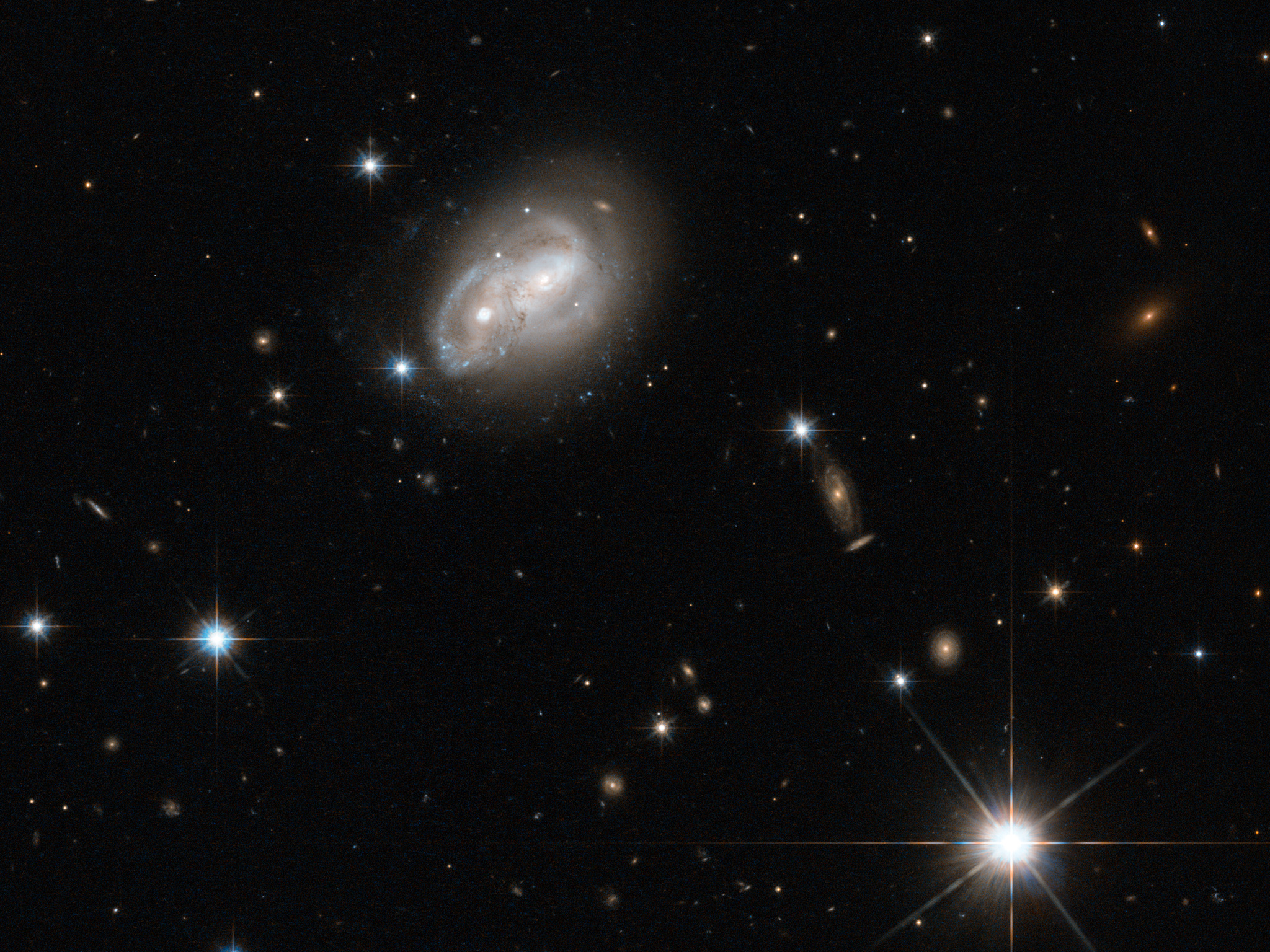
From objects as small as Newton's apple to those as large as a galaxy, no physical body is free from the stern bonds of gravity, as evidenced in this stunning picture captured by the Wide Field Camera 3 and Advanced Camera for Surveys onboard the NASA/ESA Hubble Space Telescope.

Here we see two spiral galaxies engaged in a cosmic tug-of-war — but in this contest, there will be no winner. The structures of both objects are slowly distorted to resemble new forms, and in some cases, merge together to form new, super galaxies. This particular fate is similar to that of the Milky Way Galaxy, when it will ultimately merge with our closest galactic partner, the Andromeda Galaxy. There is no need to panic however, as this process takes several hundreds of millions of years.

Not all interacting galaxies result in mergers though. The merger is dependent on the mass of each galaxy, as well as the relative velocities of each body. It is quite possible that the event pictured here, romantically named 2MASX J06094582-2140234, will avoid a merger event altogether, and will merely distort the arms of each spiral without colliding — the cosmic equivalent of a hair ruffling!

These galactic interactions also trigger new regions of star formation in the galaxies involved, causing them to be extremely luminous in the infrared part of the spectrum. For this reason, these types of galaxies are referred to as LIRGs, or Luminous Infrared Galaxies. This image was taken as part of as part of a Hubble survey of the central regions of LIRGs in the local Universe, which also used the NICMOS instrument.

A version of this image was entered into the Hubble's Hidden Treasures image processing competition by contestant Luca Limatola. 2MASX J06094582-2140234
 
Source: ESA/Hubble - Space Telescope