Supernova explosion (annotated)
Astronomers studying SN2014J, a Type Ia supernova discovered in
January 2014, have found proof that this type of supernova is caused by a
white dwarf star reigniting and exploding.
This finding was made
by using ESA’s Integral observatory to detect gamma rays from the
radioactive elements created during the explosion.
This sequence shows some of the steps leading up to and following the explosion.
A
white dwarf, a star that contain up to 1.4 times the mass of the Sun
squeezed into a volume about the same size as the Earth, leeches matter
from a companion star (image 1). The Integral measurements suggest that
a belt of gas from the companion star builds up around the equator of
the white dwarf (image 2). This belt detonates (image 3) and triggers
the internal explosion that becomes the supernova (image 4). Material
from the explosion expands (image 5) and eventually becomes transparent
to gamma rays (image 6). Copyright: ESA/ATG medialab. Hi-Res Image

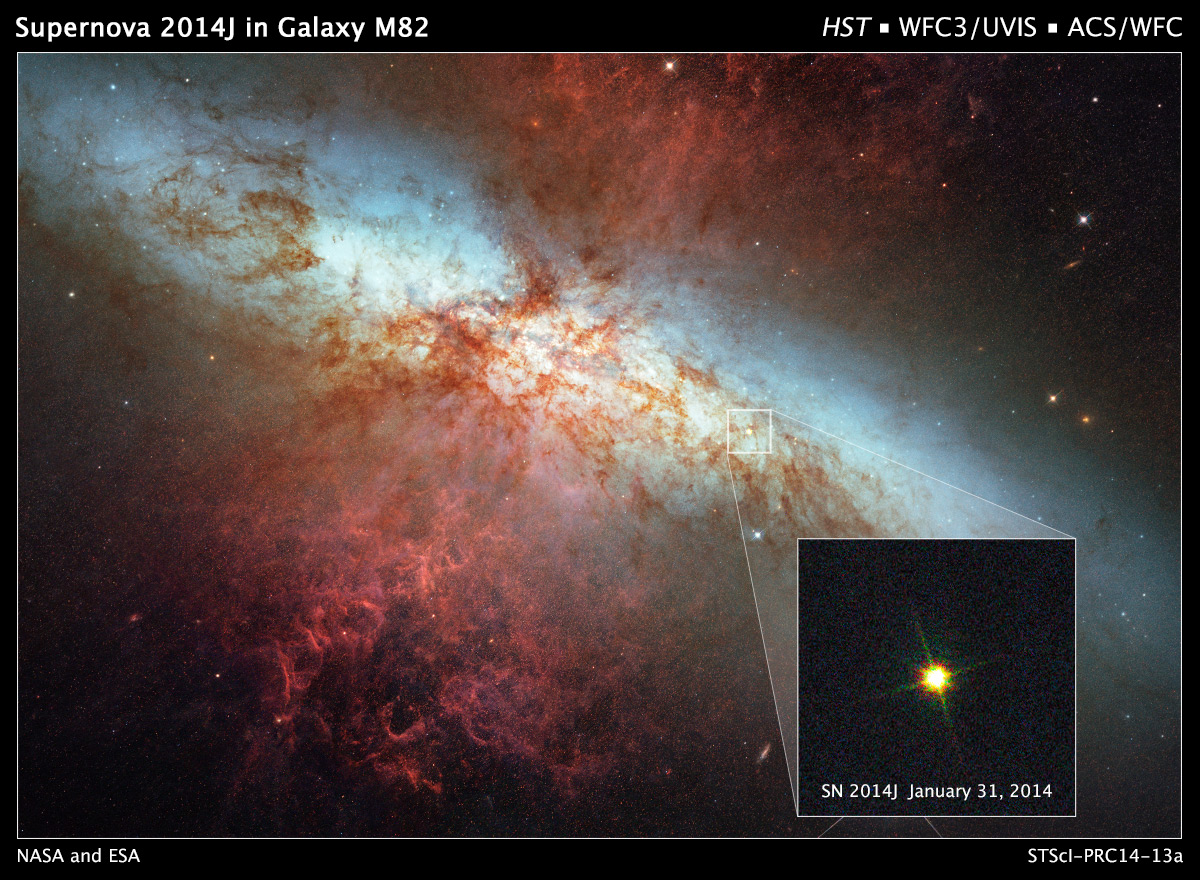
Supernova SN2014J in nearby galaxy M82
In January 2014, a supernova was discovered in the nearby galaxy M82.
At a distance of about 11.5 million light-years from Earth, SN2014J as
it is known, is the closest of its type to be detected in decades.
This composite Hubble image shows the supernova in visible light, obtained on 31 January with Hubble’s Wide Field Camera 3, superimposed on a mosaic of the entire galaxy taken in 2006 with Hubble’s Advanced Camera for Surveys. Copyright: NASA, ESA, A. Goobar (Stockholm University), and the Hubble Heritage Team (STScI/AURA). Hi-Res Image
Astronomers using ESA’s INTEGRAL gamma-ray observatory have demonstrated beyond doubt that dead stars known as white dwarfs can reignite and explode as supernovae. The finding came after the unique signature of gamma rays from the radioactive elements created in one of these explosions was captured for the first time.
The explosions in question are known as Type Ia supernovae, long suspected to be the result of a white dwarf star blowing up because of a disruptive interaction with a companion star. However, astronomers have lacked definitive evidence that a white dwarf was involved until now. The ‘smoking gun’ in this case was evidence for radioactive nuclei being created by fusion during the thermonuclear explosion of the white dwarf star.
“INTEGRAL has all the capabilities to detect the signature of this fusion, but we had to wait for more than ten years for a once-in-a-lifetime opportunity to catch a nearby supernova,” says Eugene Churazov, from the Space Research Institute (IKI) in Moscow, Russia and the Max Planck Institute for Astrophysics,in Garching, Germany.
Although Type Ia supernovae are expected to occur frequently across the Universe they are rare occurrences in any one galaxy, with typical rates of one every few hundred years.
INTEGRAL’s chance came on 21 January 2014, when students at the
University College London’s teaching observatory at Mill Hill, UK
detected a type Ia supernova, later named SN2014J, in the nearby galaxy
M82.
According to the theory of such explosions, the carbon and oxygen found
in a white dwarf should be fused into radioactive nickel during the
explosion. This nickel should then quickly decay into radioactive
cobalt, which would itself subsequently decay, on a somewhat longer
timescale, into stable iron.
Because of its proximity – at a distance of about 11.5 million
light-years from Earth, SN2014J is the closest of its type to be
detected in decades – INTEGRAL stood a good chance of seeing the gamma
rays produced by the decay. Within one week of the initial discovery, an
observing plan to use INTEGRAL had been drawn-up and approved.
Using INTEGRAL to study the aftermath of the supernova explosion,
scientists looked for the signature of cobalt decay – and they found it,
in exactly the quantities that the models predicted.
“The consistency of the spectra, obtained by INTEGRAL 50 days after the
explosion, with that expected from cobalt decay in the expanding debris
of the white dwarf was excellent,” says Churazov, who is lead author of a
paper describing this study and reported in the journal Nature.
With that confirmation in hand, other astronomers could begin to look
into the details of the process. In particular, how the white dwarf is
detonated in the first place.
White dwarfs are inert stars that contain up to 1.4 times the mass of
the Sun squeezed into a volume about the same size as the Earth. Being
inert, they can’t simply blow themselves up. Instead, astronomers
believe that they leech matter from a companion star, which builds up on
the surface until a critical total mass is reached. At that point, the
pressure in the heart of the white dwarf triggers a catastrophic
thermonuclear detonation.
Early INTEGRAL observations of SN2014J tell a somewhat different story,
and have been the focus of a separate study, reported online in Science Express by Roland Diehl from the Max Planck Institute for Extraterrestrial Physics, Germany, and colleagues.
Diehl and his colleagues detected gamma rays from the decay of
radioactive nickel just 15 days after the explosion. This was
unexpected, because during the early phase of a Type Ia supernova, the
explosion debris is thought to be so dense that the gamma rays from the
nickel decay should be trapped inside.
“We were puzzled by this surprising signal, and some from the group even
thought it must be wrong,” says Diehl. “We had long and ultimately very
fruitful discussions about what might explain these data.”
A careful examination of the theory showed that the signal would have
been hidden only if the explosion had begun in the heart of the white
dwarf. Instead, Diehl and colleagues think that what they are seeing is
evidence for a belt of gas from the companion star that must have built
up around the equator of the white dwarf. This outer layer detonated,
forming the observed nickel and then triggering the internal explosion
that became the supernova.
“Regardless of the fine details of how these supernovae are triggered,
INTEGRAL has proved beyond doubt that a white dwarf is involved in these
stellar cataclysms,” says Erik Kuulkers, ESA’s INTEGRAL Project
Scientist. “This clearly demonstrates that even after almost twelve
years in operation, INTEGRAL is still playing a crucial role in
unraveling some of the mysteries of the high-energy Universe.”
Notes for editors
“56Co gamma-ray emission lines from the type Ia supernova
SN2014J” by E. Churazov et al., is published in the 28 August 2014 issue
of Nature; DOI: 10.1038/nature13672
“Early 56Ni decay γ rays from SN2014J suggest an unusual explosion” by R. Diehl et al., appeared online in Science Express on 31 July 2014; DOI: 10.1126/science.1254738
Some of the observations of SN2014J were obtained as part of an INTEGRAL
Target of Opportunity programme led by Principal Investigator Jordi
Isern (ICE-CSIC/IEEC, Spain). The INTEGRAL Project Scientist, Erik
Kuulkers, made additional observing time available, on request of the
INTEGRAL supernova community, to maximise the scientific return. This
was supplemented by a contribution from the Russian guaranteed time on
the recommendation of the Russian INTEGRAL Advisory Committee.
Type Ia supernovae are particularly important because they are used to
gauge distances across much of the visible Universe. In the 1990s, their
study led to the discovery of the cosmic acceleration that is now
thought to be powered by a mysterious form of energy called ‘dark
energy’. The Nobel Prize for Physics in 2011 was awarded to Saul
Perlmutter, Adam Riess, and Brian Schmidt for their role in the
discovery of dark energy.
The International Gamma-ray Astrophysics Laboratory (INTEGRAL) was
launched on 17 October 2002. It is an ESA project with the instruments
and a science data centre funded by ESA Member States (especially the
Principal Investigator countries: Denmark, France, Germany, Italy,
Spain, Switzerland), and with the participation of Russia and the USA.
The mission is dedicated to the fine spectroscopy (E/∆E = 500) and fine
imaging (angular resolution: 12 arcmin FWHM) of celestial gamma-ray
sources in the energy range 15 keV to 10 MeV with concurrent source
monitoring in the X-ray (4-35 keV) and optical (V-band, 550 nm)
wavelengths.
Markus Bauer
ESA Science and Robotic Exploration Communication Officer
Phone: +31 71 565 6799
Mobile: +31 61 594 3 954
Email: markus.bauer@esa.int
Eugene Churazov
Space Research Institute (IKI), Moscow, Russia
Phone: +7-495-3333377
Email: churazov@hea.iki.rssi.ru
and Max Planck Institute for Astrophysics, Germany
Phone: +49-89-30000-2219
Email: churazov@mpa-garching.mpg.de
Roland Diehl
Max Planck Institute for Extraterrestrial Physics, Germany
Phone: +49-89-30000-3850
Email: rodmpe.mpg.de
Erik Kuulkers
INTEGRAL Project Scientist
Directorate of Science and Robotic Exploration
European Space Agency
Phone: +34-91-8131-358
Email: Erik.Kuulkers@sciops.esa.int
Source: ESA