Saturday, November 10, 2012

Interstellar Dust and the Sun


An artist’s concept of the heliosphere (seen in blue, including a shocked region). The Earth is at 1 AU, and the two Voyager spacecraft are seen beyond 100 AU (the Cassini spacecraft at Saturn is also shown). A new study investigates what happens to interstellar dust that encounters the solar system and the Sun's heliosphere.  Credit: NASA and JHU/APL.  Low Resolution Image (jpg)


The space between stars is not empty. It contains copious but diffuse amounts of gas and dust; in fact about 5-10% of the total mass of our Milky Way galaxy is in interstellar gas. About 1% of the mass of this interstellar material, quite a lot in astronomical terms, is in the form of tiny dust grains made predominantly of silicates (sand too is made of silicates), though some grains are also composed of carbon and other elements. Dust grains are important. They block visible light while emitting infrared light, and thus help determine what astronomers can see while controlling much of the energy balance in the interstellar medium (ISM) by virtue of the absorption and subsequent re-emission at longer wavelengths of light from stars. Dust is also essential to the chemistry that takes place in the ISM because it provides gas molecules with a surface on which to react with other molecules. Not least, dust contains a large fraction of many important elements in the universe like silicon, carbon, and iron. Moreover, astronomers think that at some stage in the evolution of new stars the dust around them will coagulate into large clumps -- the first step towards forming planets. 

CfA astronomer Jonathan Slavin and a team of six other astronomers wondered what happens to interstellar dust when it wanders into the solar system and gets close enough to the Sun to fall under the influence of its radiation, winds, and gravity. They note that the Sun (and its planets) is moving through a low density cloud of partially ionized gas. This motion, together with the wind of particles that the Sun emits, produces a bow-shaped region called the heliosphere, the bow-shaped end of which is about 100 AU from the Sun (one AU is the average distance of the Earth from the Sun). 

Writing in the latest issues of the Astrophysical Journal, the scientists report on the results of their theoretical models of the behavior of interstellar dust grains as the Sun moves through space. They build on in-situ observations of the heliosphere taken when the Voyager 1 and Voyager 2 spacecraft on their outward journey encountered the edges of the heliosphere, results that constrain its size and shape. Assuming typical grains made of olivine silicates, the team finds that the small grains (less than the wavelength of ultraviolet light) stay far away from the Sun, that gravity helps the large grains collect near the Sun, but that intermediate-sized grains - about the size of the wavelength of optical light - can actually pile up in diffuse structures at the edges of the heliosphere. The new results, besides providing important new information on dust grains in the solar system, suggest that radiation from these intermediate-sized grain structures could contaminate the images of the sky used to measure the cosmic backgrounds.


Friday, November 09, 2012

Discovery of a Giant Gap in the Disk of a Sun-like Star May Indicate Multiple Planets

A large international team of astronomers led by Jun Hashimoto (National Astronomical Observatory of Japan) and Ruobing Dong (Princeton University) has used the High Contrast Instrument for the Subaru Next Generation Adaptive Optics (HiCIAO) to observe and examine PDS 70 (Note 1), a young star about 10 million years old with a mass similar to that of the Sun. Images captured from the observations clearly show a giant gap inside the protoplanetary disk, the largest ever found among lower mass stars similar to the Sun. A protoplanetary disk is where planets form, and the gravitational force of newborn planets may account for the huge gap between the inner edge of the disk and the central star. No single planet, regardless of how heavy or efficient it is in its formation, is sufficient to create such a giant gap. The researchers think that the gap in PDS 70's protoplanetary disk may have resulted from the birth of multiple planets. The high contrast images from the observations allowed the researchers to study the details of the disk, which then enabled them to directly reveal the site of formation of one and possibly more planets. The research team is now attempting to detect those planets. 


Protoplanetary disks occur around many Sun-like stars; they are composed of gas and dust that surround the stars and provide the materials out of which planets like the Earth form. Researchers conduct observations of protoplanetary disks to understand their evolution and the formation of planets within them. Disks around heavier stars tend to be more extended and brighter, hence easier to study in detail; those around less massive stars pose more of a challenge to research. The goal of the Strategic Exploration of Exoplanets and Disks with Subaru (SEEDS, Note 2) Project, begun in 2009, is to study the disks around less massive stars like the Sun.

As part of the SEEDS Project, the current team chose to target PDS 70, which is located in the constellation Centaurus; is about 460 light years from Earth; and has a mass 90% that of the Sun. Estimated to be about 10 million years old, this is a very young star relative to the 10 billion year life span of Sun-like stars and the 4.6 billion year age of our Sun. Previous observations of the spectral energy distribution and direct imaging by the Very Large Telescope in Chile suggested the presence of a disk, but were not able to determine the details of its structure.

The observations with HiCIAO mounted on the Subaru Telescope clearly show a low-density space between PDS 70 and the inner edge of the disk surrounding it, with a radius as large as 70 astronomical units (AU, the distance between Earth and Sun). Figure 1 shows a darker area in the vicinity of the star, which means there is less material in the area. The high contrast images from HiCIAO enabled this discovery.


Figure 1:  HiCIAO mounted on the Subaru Telescope captured this near infrared image of the protoplanetary disk around PDS 70. A software mask blocked out the light in the immediate vicinity of the central star. The colors in the image indicate the luminosity of the infrared light; the white area has stronger infrared radiation while that of the bluer area is weaker. The black area near PDS 70, outside of the software mask, is the gap referred to in the text. For high resolution versions of the above image, click on the following links: Image only or Image with labels. (Credit: NAOJ)

The huge size of the gap in the disk around PDS 70 led the team to question how the gap formed. By studying the details of the spectral energy distribution (plotting the brightness of light vs. wavelength) of the star itself and the disk, they found another disk at a distance of only 1 AU. Figure 2 illustrates the double disk structure. The inner, much smaller disk is very close to the star, but the current observation does not clearly show that part of the disk because it is behind HiCIAO's mask that blocks the bright light from the central star. Gravitational forces from the planet(s) embedded in the disk might account for this kind of gap in the disk, because they could pull away the material from the disk, and the clearing of the material means less infrared radiation from that area. It would be very difficult for a single planet to create the giant gap in the disk around PDS 70. The research team thinks that more than one planet could be responsible for creating the gap. However, conducting observations to detect such planets is difficult, because the scattered light from the disk can obscure the very faint light emitted from planets.


Figure 2: Artist's rendition of PDS 70 and its two protoplanetary disks, showing the large gap between them. The gravitational force of several newborn planets is probably responsible for the development of such a huge gap between the two disks. (Credit: NAOJ)

The high contrast images made possible by observations with HiCIAO revealed the surprising details of PDS 70's protoplanetary disk. Team leader Jun Hashimoto (NAOJ) commented, "Thanks to the powerful combination of the Subaru Telescope and HiCIAO, we are able to probe the disks around Sun-like stars. PDS 70 shows how our solar system may have looked in its infancy. I want to continue this kind of research to understand the history of planetary formation." Team member Ruobing Dong (Princeton University) agreed and added, "Direct imaging of planets in the process of forming in protoplanetary disks would be ideal so that we can learn when, where, and how planets form." 

The team is aware of the challenge posed by the contrast between very faint planets and their bright host stars. In addition, the high activity and variability of the light of young stars makes observations even more difficult. The detection of giant planets is easier, because they cause more gravitational perturbation in the disks. Because big planets create wider gaps in disks, their planet-induced structures are easier to observe. "Our SEEDS study of systems like PDS 70, which has a giant gap that may have been carved out by multiple giant planets, opens up a promising path for directly studying planet formation in disks," Ruobing remarked.


References: 
Hashimoto et al. "Polarimetric Imaging -- PDS 70: Observations of the Disk" was published in ApJ Letters on October 10, 2012 (ApJ 758, L19).
Dong et al 2012 "The Structure -- PDS 70 System" is in press in ApJ.


Acknowledgements:

This research was partially supported by funding from the following: 
Grant-in-Aid for Science Research in a Priority Area from the Japanese Ministry of Education, Culture, Sports, Science and Technology (MEXT), Japan
The Mitsubishi Foundation, Japan
National Science Foundation awards (No. 1009203 and No. 1009314), U.S.A.


Core members of this research group are: 


Jun Hashimoto (National Astronomical Observatory of Japan)
Ruobing Dong (Princeton University)
Tomoyuki Kudo (Subaru Telescope, NAOJ)
Roman Rafikov (Princeton University)
Mitsuhiko Honda (Kanagawa University)
Zhaohuan Zhu (Princeton University)
Takayuki Muto (Kogakuin University)
Barbara Whitney (Wisconsin University)
Timothy Brandt (Princeton University)
Melissa McClure (The University of Michigan)
John Wisniewski (University of Oklahoma)


Notes: 

PDS is an abbreviation for "Pico dos Dias Survey", a catalog name based on the 1990s large-scale survey at Pico dos Dias Observatory in Brazil. About a hundred objects were listed in the catalog. The 70th object on the list was the target of this research. Therefore, it is referred to as PDS 70.
The Strategic Exploration of Exoplanets and Disks with the Subaru Telescope (SEEDS) group used its high performance planet and disk imager, HiCIAO, mounted on the Subaru Telescope to conduct its research. The SEEDS Project began in 2009 for a five-year period using 120 observing nights at Subaru Telescope. Project leader Motohide Tamura is the director of the Extra-Solar Planet Detection Project at the National Astronomical Observatory of Japan (NAOJ).

Cosmic Sprinklers Explained

The planetary nebula Fleming 1 seen with ESO’s Very Large Telescope

The planetary nebula Fleming 1 in the constellation of Centaurus (The Centaur)

Wide-field view of the sky around the planetary nebula Fleming 1

Artist’s view of how a planetary nebula’s wobbling jets are sculpted

Videos

Zooming in on the planetary nebula Fleming 1

A close-up view of the planetary nebula Fleming 1 seen with ESO’s Very Large Telescope

Artist’s view of how a planetary nebula’s wobbling jets are sculpted

Astronomers using ESO’s Very Large Telescope have discovered a pair of stars orbiting each other at the centre of one of the most remarkable examples of a planetary nebula. The new result confirms a long-debated theory about what controls the spectacular and symmetric appearance of the material flung out into space. The results are published in the 9 November 2012 issue of the journal Science.

Planetary nebulae [1] are glowing shells of gas around white dwarfs — Sun-like stars in the final stages of their lives. Fleming 1 is a beautiful example that has strikingly symmetric jets [2] that weave into knotty, curved patterns. It is located in the southern constellation of Centaurus (The Centaur) and was discovered just over a century ago by Williamina Fleming [3], a former maid who was hired by Harvard College Observatory after showing an aptitude for astronomy.

Astronomers have long debated how these symmetric jets could be created, but no consensus has been reached. Now, a research team led by Henri Boffin (ESO, Chile) has combined new Very Large Telescope (VLT) observations of Fleming 1 with existing computer modelling to explain in detail for the first time how these bizarre shapes came about.

The team used ESO’s VLT to study the light coming from the central star. They found that Fleming 1 is likely to have not one but two white dwarfs at its centre, circling each other every 1.2 days. Although binary stars have been found at the hearts of planetary nebulae before, systems with two white dwarfs orbiting each other are very rare [4].

“The origin of the beautiful and intricate shapes of Fleming 1 and similar objects has been controversial for many decades,” says Henri Boffin. “Astronomers have suggested a binary star before, but it was always thought that in this case the pair would be well separated, with an orbital period of tens of years or longer. Thanks to our models and observations, which let us examine this unusual system in great detail and peer right into the heart of the nebula, we found the pair to be several thousand times closer.”

When a star with a mass up to eight times that of the Sun approaches the end of its life, it blows off its outer shells and begins to lose mass. This allows the hot, inner core of the star to radiate strongly, causing this outward-moving cocoon of gas to glow brightly as a planetary nebula.

While stars are spherical, many of these planetary nebulae are strikingly complex, with knots, filaments, and intense jets of material forming intricate patterns. Some of the most spectacular nebulae — including Fleming 1 — present point-symmetric structures [5]. For this planetary nebula it means that the material appears to shoot from both poles of the central region in S-shaped flows. This new study shows that these patterns for Fleming 1 are the result of the close interaction between a pair of stars — the surprising swansong of a stellar couple.

“This is the most comprehensive case yet of a binary central star for which simulations have correctly predicted how it shaped the surrounding nebula — and in a truly spectacular fashion,” explains co-author Brent Miszalski, from SAAO and SALT (South Africa).

The pair of stars in the middle of this nebula is vital to explain its observed structure. As the stars aged, they expanded, and for part of this time, one acted as a stellar vampire, sucking material from its companion. This material then flowed in towards the vampire, encircling it with a disc known as an accretion disc [6]. As the two stars orbited one another, they both interacted with this disc and caused it to behave like a wobbling spinning top — a type of motion called precession. This movement affects the behaviour of any material that has been pushed outwards from the poles of the system, such as outflowing jets. This study now confirms that precessing accretion discs within binary systems cause the stunningly symmetric patterns around planetary nebulae like Fleming 1.

The deep images from the VLT have also led to the discovery of a knotted ring of material within the inner nebula. Such a ring of material is also known to exist in other families of binary systems, and appears to be a telltale signature of the presence of a stellar couple.

“Our results bring further confirmation of the role played by interaction between pairs of stars to shape, and perhaps even form, planetary nebulae,” concludes Boffin.

Notes

[1] Planetary nebulae have nothing to do with planets. The name arose in the eighteenth century as some of these objects resembled the discs of the distant planets when seen through small telescopes.

[2] Jets are outflows of very fast-moving gas that are ejected from the core regions of planetary nebulae. They are often collimated — the material comes out in parallel streams — meaning that they spread out only very slightly as they propagate through space.

[3] Fleming 1 is named after Scottish astronomer Williamina Fleming, who discovered it in 1910. Initially working as a maid to the director of the Harvard College Observatory in the 1880s, Fleming was later hired to process astronomical data at the observatory as one of the Harvard Computers, a group of skilled female workers carrying out mathematical calculations and clerical work. During her time she discovered — and was credited for — numerous astronomical objects, including 59 gaseous nebulae, over 310 variable stars, and 10 novae. This object also has many other names, including PN G290.5+07.9, ESO 170-6 and Hen 2-66. 

[4] The team studied the stars using the FORS instrument on the Very Large Telescope at ESO’s Paranal Observatory in Chile. As well as taking images of the object they also split the light up into its component colours to obtain information about the motions as well as the temperature and chemical composition of the central object.

The primary and secondary stars were found to have approximately 0.5 to 0.86 and 0.7 to 1.0 times the mass of the Sun, respectively. The team was able to rule out the possibility of there being a “normal” star like our Sun in the binary by analysing the light from the two stars, and studying the system’s brightness. As the system rotates its brightness only changes by tiny amounts. A normal star would have been heated by its hot white dwarf, and because it would be always presenting the same face to its companion (as the Moon does with the Earth), it would present a “hot and luminous” and “cold and dark” side, easily seen as a regular variation in brightness. The central object is thus very likely a pair of white dwarfs — a rare and exotic find.

[5] In this case each part of the nebula has an exact counterpart at the same distance from the star, but in the opposite direction — the kind of symmetry shown by the court cards in a conventional pack of playing cards.

[6] Such a disc is formed when the stream of material escaping from a star overflows a certain boundary, known as the Roche lobe. Within this lobe, all matter is bound to its host star by gravity and cannot escape. When this lobe fills up and the boundary is exceeded, mass tumbles away from the star and transfers to a nearby body, for example the second star in a binary system, forming an accretion disc.

More information

This research was presented in a paper “An Interacting Binary System Powers Precessing Outflows of an Evolved Star”, H. M. J. Boffin et al., to appear in the journal Science on 9 November 2012.

The team is composed of H. M. J. Boffin (European Southern Observatory, Chile), B. Miszalski (South African Astronomical Observatory; Southern African Large Telescope Foundation, South Africa), T. Rauch (Institute for Astronomy and Astrophysics, University of Tübingen, Germany), D. Jones (European Southern Observatory, Chile), R. L. M. Corradi (Instituto de Astrofísica de Canarias; Departamento de Astrofísica, Universidad de La Laguna, Spain), R. Napiwotzki (University of Hertfordshire, United Kingdom), A. C. Day-Jones (Universidad de Chile, Chile), and J. Köppen (Observatoire de Strasbourg, France).

To obtain a copy of the Science paper please contact the Science Press Package office at either scipak@aaas.org (email), or +1 202 326 6440 (phone). 

The year 2012 marks the 50th anniversary of the founding of the European Southern Observatory (ESO). ESO is the foremost intergovernmental astronomy organisation in Europe and the world’s most productive ground-based astronomical observatory by far. It is supported by 15 countries: Austria, Belgium, Brazil, the Czech Republic, Denmark, France, Finland, Germany, Italy, the Netherlands, Portugal, Spain, Sweden, Switzerland and the United Kingdom. ESO carries out an ambitious programme focused on the design, construction and operation of powerful ground-based observing facilities enabling astronomers to make important scientific discoveries. ESO also plays a leading role in promoting and organising cooperation in astronomical research. ESO operates three unique world-class observing sites in Chile: La Silla, Paranal and Chajnantor. At Paranal, ESO operates the Very Large Telescope, the world’s most advanced visible-light astronomical observatory and two survey telescopes. VISTA works in the infrared and is the world’s largest survey telescope and the VLT Survey Telescope is the largest telescope designed to exclusively survey the skies in visible light. ESO is the European partner of a revolutionary astronomical telescope ALMA, the largest astronomical project in existence. ESO is currently planning the 39-metre European Extremely Large optical/near-infrared Telescope, the E-ELT, which will become “the world’s biggest eye on the sky”.

Links


Contacts


 Henri Boffin

 ESO

 Santiago, Chile

 Tel: +56 2 463 3126

 Email: hboffin@eso.org


 David Jones

 ESO

 Santiago, Chile

 Tel: +56 2 463 3086

 Email: djones@eso.org


Richard Hook

ESO, La Silla, Paranal, E-ELT & Survey Telescopes Press Officer

 Garching bei München, Germany

 Tel: +49 89 3200 6655

 Cell: +49 151 1537 3591

 Email: rhook@eso.org


A galaxy colourfully on the wane ain't dead yet


NGC 5010
C

The NASA/ESA Hubble Space Telescope has captured a beautiful galaxy that, with its reddish and yellow central area, looks rather like an explosion from a Hollywood movie. The galaxy, called NGC 5010, is in a period of transition. The aging galaxy is moving on from life as a spiral galaxy, like our Milky Way, to an older, less defined type called an elliptical galaxy. In this in-between phase, astronomers refer to NGC 5010 as a lenticular galaxy, which has features of both spirals and ellipticals.

NGC 5010 is located around 140 million light-years away in the constellation of Virgo (The Virgin). The galaxy is oriented sideways to us, allowing Hubble to peer into it and show the dark, dusty, remnant bands of spiral arms. NGC 5010 has notably started to develop a big bulge in its disc as it takes on a more rounded shape.

Most of the stars in NGC 5010 are red and elderly. The galaxy no longer contains all that many of the fast-lived blue stars common in younger galaxies that still actively produce new populations of stars.

Much of the dusty and gaseous fuel needed to create fresh stars has already been used up in NGC 5010. Overt time, the galaxy will grow progressively more "red and dead”, as astronomers describe elliptical galaxies.

Hubble's Advanced Camera for Surveys (ACS) snapped this image in violet and infrared light.


Source: ESA/Hubble - Space Telescope

Thursday, November 08, 2012

New Habitable Zone Super-Earth Found in ExoSolar System


Video prepared by Guillem Anglada-Escude using Celestia (www.shatters.net)

Washington, D.C.—Astronomers have discovered a new super-Earth in the habitable zone, where liquid water and a stable atmosphere could reside, around the nearby star HD 40307. It is one of three new super-Earths found around the star that has three other low-mass planets orbiting it. 
  
HD 40307 is a dwarf star that is somewhat smaller and less luminous than the Sun that is about 42 light years away (12.88 parsecs). The previously discovered planets around it are called hot super-Earths because they orbit too close to the star to support life.
  
The international team, including Carnegie co-author Paul Butler, was led by Mikko Tuomi of the University of Hertfordshire and Guillem Anglada-Escudé of the University of Göttingen. The researchers used newly developed software that is able to process the signals more thoroughly and thereby reveal the presence of the three additional planets. The team reanalyzed spectra taken with the HARPS spectrograph through the European Southern Observatory public archive.
  
Butler explained: “With Guillem Anglada-Escudé’s new velocity reduction package, we are able to extract more information from the HARPS spectra, and thus make a more precise measurement. This coupled with the innovative Bayesian orbital searching algorithm, primarily written by Mikko Tuomi, allows us to search deeper into the data and to find smaller Earth-sized planets around the nearest stars. This, of course, increases our chances of finding more in that orbital sweet spot that we call the habitable zone—the zone where it is not too cold, nor too hot for liquid water to exist.” Anglada-Escudé wrote the velocity reduction package while he was a postdoctoral fellow at Carnegie.
  
The most interesting of the new planets is in the outermost orbit from the star, a distance that is similar to the distance between the Earth and our Sun. Its mass is at least seven times the mass of the Earth. The team said the planet is likely to be rotating on its axis while in orbit, possibly creating a day/night cycle and an Earth-like environment.
  
“The star HD 40307 is a perfectly quiet old dwarf star, so there is no reason why such a planet could not sustain an Earth-like climate,” said Anglada-Escudé. The research will be published in Astronomy & Astrophysics and posted online at arxiv.org/archive/astro-ph.
  
 ------------------------------------------
The coauthors of the paper include R. Paul Butler of the Carnegie Institution for Science, Tuomi, Anglada-Escudé, and Vogt, as well as Eugenio Rivera of UC Santa Cruz, Hugh Jones of the University of Hertfordshire, Enrico Gerlach of the Technical University of Dresden, and Ansgar Reiners of the University of Göttingen. This research was funded in part by RoPACS (Rocky Planets Around Cool Stars), a Marie Curie Initial Training Network funded by the European Commission; the German Ministry of Education and Research; the German Research Foundation (DFG); and the U.S. National Science Foundation (NSF grant AST-0307493). The researchers acknowledged the significant efforts of the HARPS-ESO team in improving the instrument and its data reduction pipelines and obtaining the observations that made this work possible.

A burst of activity in the middle of the Milky Way

Researchers detect the brightest flare ever observed in our galaxy’s black hole.Researchers detect the brightest flare ever observed in our galaxy’s black hole.


This false-color image shows the central region of our Milky Way Galaxy as seen by Chandra. The bright, point-like source at the center of the image was produced by a huge X-ray flare that occurred in the vicinity of the supermassive black hole at the center of our galaxy. Image: NASA/MIT/F. Baganoff et al.


Sgr A* Giant Flare
Feb.9, 2012

As black holes go, Sagittarius A* is relatively low-key. The black hole at the center of our galaxy emits very little energy for its size, giving off roughly as much energy as the sun, even though it is 4 million times as massive. 

However, astronomers have observed that nearly once a day, the black hole rouses to action, emitting a brief burst of light before settling back down. It’s unclear what causes such flare-ups, and scientists have sought to characterize these periodic bursts in order to better understand how black holes evolve. 

Now a team of scientists from MIT, the University of Amsterdam, the University of Michigan and elsewhere have used NASA’s Chandra X-Ray Observatory to detect the brightest flare ever observed from Sagittarius A*. The flare, recorded from 26,000 light years away, is 150 times brighter than the black hole's normal X-ray luminosity. Scientists observed the flare for more than one hour before it faded away. This brief burst of activity, they say, may be a clue to how mature black holes like Sagittarius A* behave. 

“We’re learning what black holes do when they’re old,” says Joey Neilsen, a postdoc at MIT’s Kavli Institute for Astrophysics and Space Research. “They’re no young whippersnappers like quasars, but they’re still active, and how they’re active is an interesting question.”

Neilsen and his colleagues published their results recently in The Astrophysical Journal

A finicky eater

Astronomers detect black holes by the light energy given off as they swallow nearby matter. The centers of newborn galaxies and quasars can appear extremely bright, giving off massive amounts of energy as they devour their surroundings. As black holes age, they tend to slow down, consuming less and appearing fainter in the sky. 

“Everyone has this picture of black holes as vacuum sweepers, that they suck up absolutely everything,” says Frederick K. Baganoff, a research scientist at MIT Kavli. “But in this really low-accretion-rate state, they’re really finicky eaters, and for some reason they actually blow away most of the mass available for them to consume.”

To detect such a faint signal, the team reserved observing time on NASA’s Chandra X-Ray Observatory, a giant space-based telescope designed to detect extremely faint objects. The team obtained images of the black hole from Chandra, and utilized the telescope’s High Energy Transmission Gratings Spectrometer (HETGS), an instrument built by MIT physics professor Claude Canizares (now the Institute’s vice president for research and associate provost), to analyze the incoming light. 

The onboard spectrometer split the black hole’s X-rays into various wavelengths, much like light passed through a prism. The researchers analyzed the data, and found a spike of 700 photons — which, while small compared with more active galaxies, was 150 times brighter than the black hole’s normal luminosity.  

“Suddenly, for whatever reason, Sagittarius A* is eating a lot more,” says Michael Nowak, a research scientist at MIT Kavli. “One theory is that every so often, an asteroid gets close to the black hole, the black hole stretches and rips it to pieces, and eats the material and turns it into radiation, so you see these big flares.”

The great escape

While such events appear to be relatively rare, Nowak suspects that flare-ups may occur more frequently than scientists expect. The team has reserved more than a month of time on the Chandra Observatory to study Sagittarius A* in hopes of identifying more flares, and possibly what’s causing them. 

Mark Morris, a professor of astronomy at the University of California at Los Angeles, says that while less luminous flares occur daily, scientists have detected very few events from the black hole as bright as this recent flare-up.

“These bright flares give information on the flaring process that isn't available with the weaker ones, such as how they fluctuate in time during the flare, how the spectrum changes, and how fast they rise and fall,” Morris says. “The greatest importance of this bright flare may be that it builds up the statistics on the characteristics of strong flares that can eventually be used to [identify] the cause of such flares.”

Even more intriguing to Baganoff is why the black hole emits so little energy. In 2003, he ran the very first observations with the then-new Chandra Observatory, and calculated that, given the amount of gas in its surroundings, Sagittarius A* should be about a million times brighter than it is — a finding that suggested the black hole throws away most of the matter it would otherwise consume. The physics underlying such a phenomenon remain a puzzle that Baganoff and others hope to tease out with future observations.

“We’re really studying the great escape, because most of the gas escapes, and that’s not what we expect,” Baganoff says. “So we’re piecing out the history of the activity of the center of our galaxy.”

Jennifer Chu, MIT News Office

Wednesday, November 07, 2012

Cygnus OB2: Probing a Nearby Stellar Cradle


Cygnus OB2 (Composite)
Credit X-ray: NASA/CXC/SAO/J.Drake et al, 
Optical: Univ. of Hertfordshire/INT/IPHAS, I
nfrared: NASA/JPL-Caltech


Videos


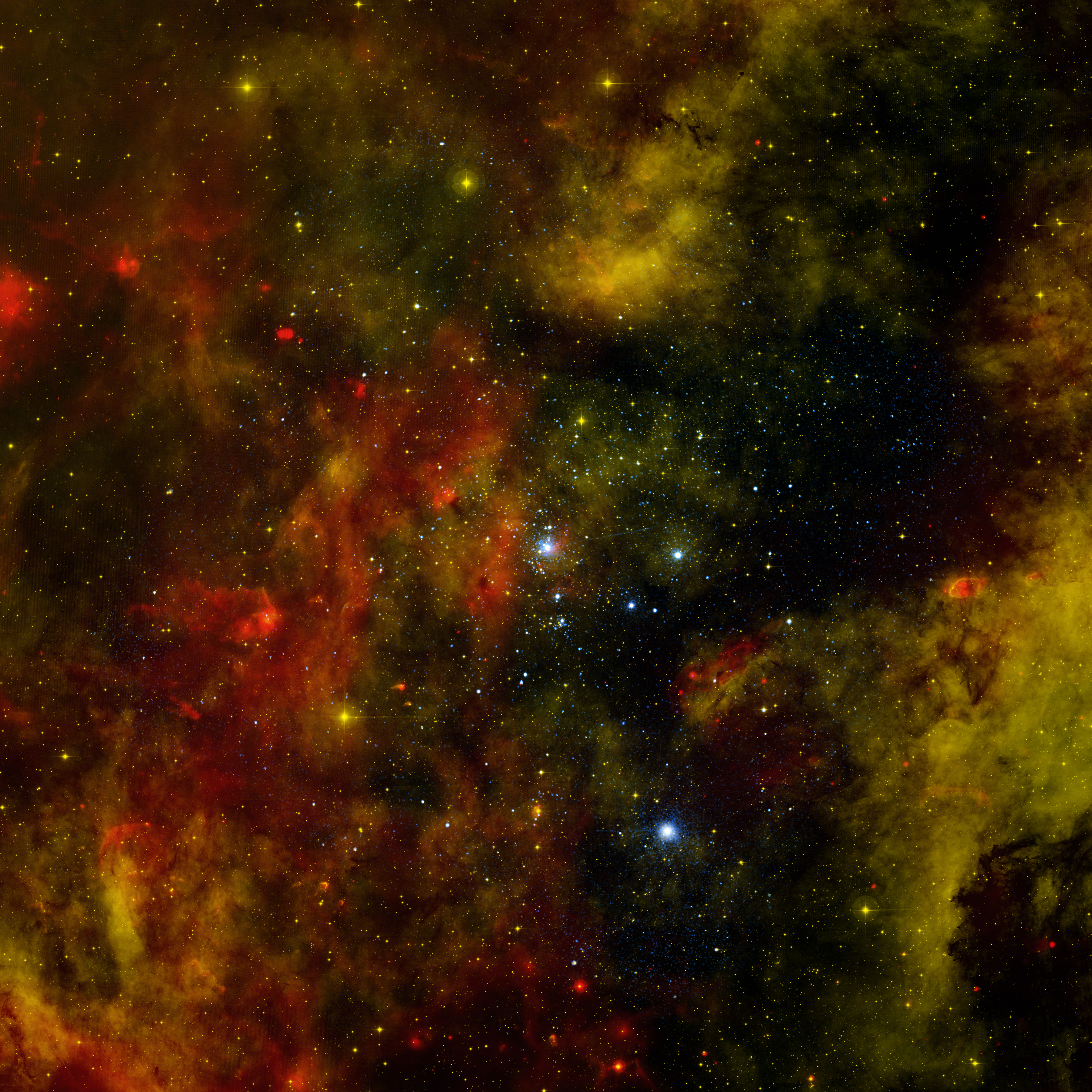
The Milky Way and other galaxies in the universe harbor many young star clusters and associations that each contain hundreds to thousands of hot, massive, young stars known as O and B stars. The star cluster Cygnus OB2 contains more than 60 O-type stars and about a thousand B-type stars. At a relatively nearby distance to Earth of about 5,000 light years, Cygnus OB2 is the closest massive cluster. Deep observations with NASA's Chandra X-ray Observatory of Cygnus OB2 have been used to detect the X-ray emission from the hot outer atmospheres, or coronas, of young stars in the cluster and to probe how these great star factories form and evolve. About 1,700 X-ray sources were detected, including about 1,450 thought to be stars in the cluster. In this image, X-rays from Chandra (blue) have been combined with infrared data from NASA's Spitzer Space Telescope (red) and optical data from the Isaac Newton Telescope (orange). 

Young stars ranging in age from one million to seven million years were detected. The infrared data indicates that a very low fraction of the stars have circumstellar disks of dust and gas. Even fewer disks were found close to the massive OB stars, betraying the corrosive power of their intense radiation that leads to early destruction of their disks. Evidence is also seen that the older population of stars has lost its most massive members because of supernova explosions. Finally, a total mass of about 30,000 times the mass of the sun is derived for Cygnus OB2, similar to that of the most massive star forming regions in our Galaxy

NASA's Marshall Space Flight Center in Huntsville, Ala., manages the Chandra program for NASA's Science Mission Directorate in Washington. The Smithsonian Astrophysical Observatory controls Chandra's science and flight operations from Cambridge, Mass.

Fast Facts for Cygnus OB2:

Credit X-ray: NASA/CXC/SAO/J.Drake et al, Optical: Univ. of Hertfordshire/INT/IPHAS, Infrared: NASA/JPL-Caltech
Release Date:  November 7, 2012
Scale:  Image is 11.8 arcmin across (16 light years)
Category:  Normal Stars & Star Clusters
Coordinates (J2000):  RA 20h 37m 11.00s | Dec +38° 41' 52.00"
Constellation:  Cygnus
Observation Date:  39 pointings between January 2004 and March 2010 
Observation Time:  341 hours 40 min (14 days 5 hours 40 min)
Obs. ID:  4501, 4511, 10939-10974, 12099 
Instrument: ACIS 
Color Code:  X-ray (Blue), Optical (Yellow), Infrared (Red)

‘Cosmic GDP’ crashes 97% as star formation slumps

This schematic diagram shows how the Universe is thought to have evolved from the Big Bang to the present day. Data from the UKIRT, VLT and Subaru observatories allowed the astronomers to take four precise and comparable snapshots of the Universe when it was, 2, 4, 6 and 9 billion years old, each containing hundreds of star-forming galaxies. By comparing the different snapshots, astronomers were able to accurately track what has changed over the last 11 billion years. Credit: Chandra / NASA / NOAO / KIPAC


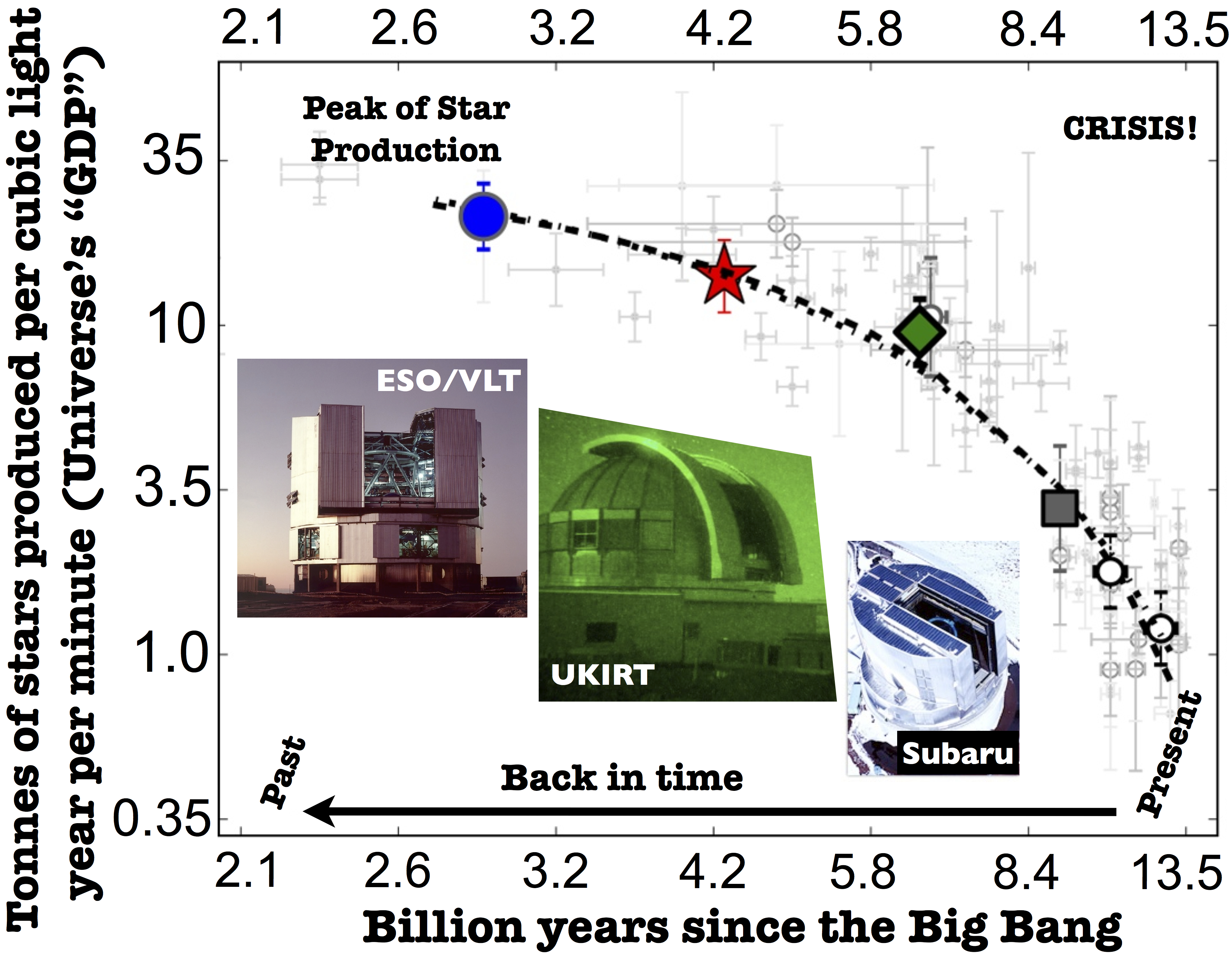
This diagram indicates the changing 'GDP' of the Universe over time. The new results indicate that, measured by mass, the production rate of stars has dropped by 97% since its peak 11 billion years ago. Credit: D. Sobral.


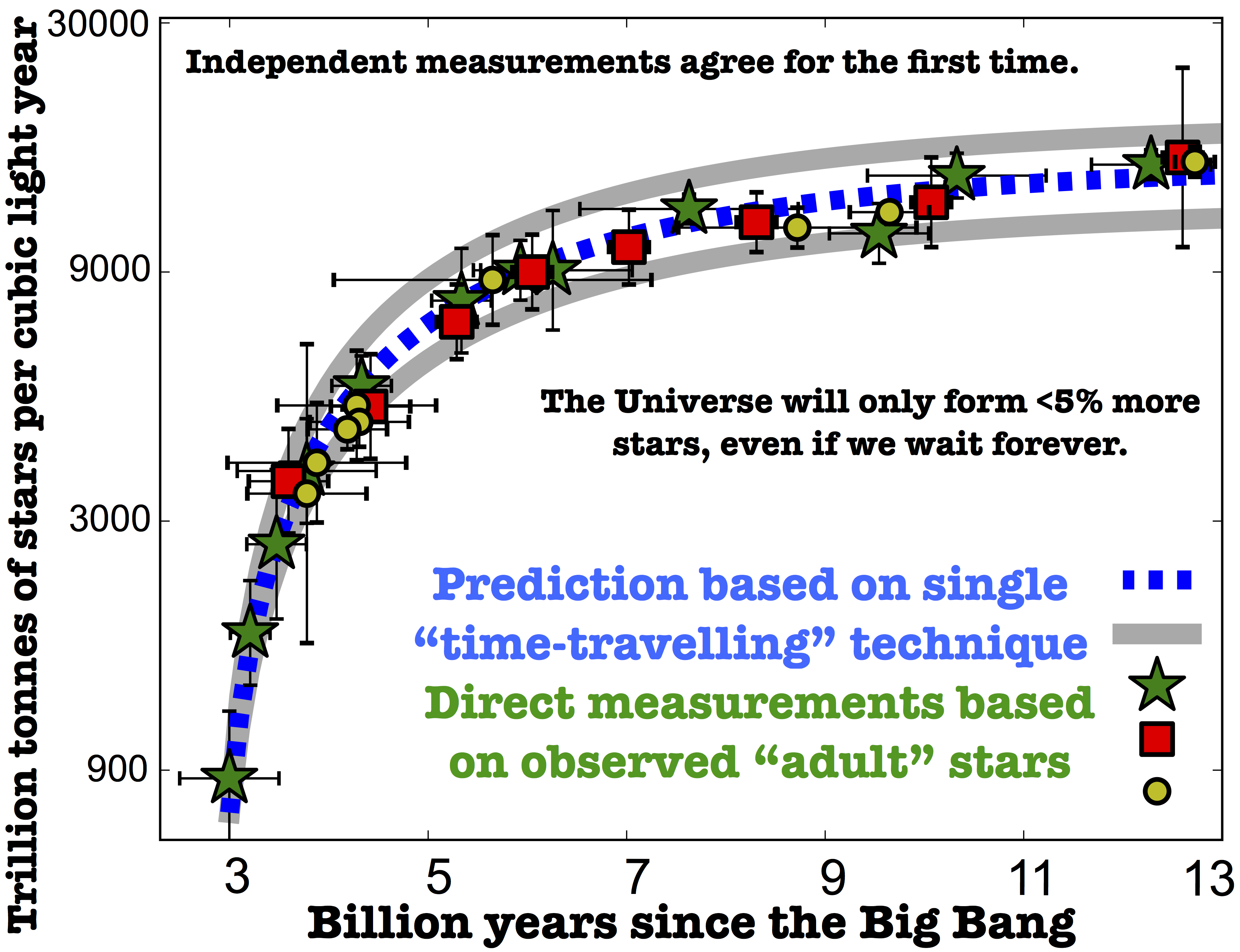
This diagram shows how the total mass of stars in the Universe should have changed over the last 11 billion years based on the new observations (lines) and how it actually did (symbols; different measurements by other teams). This provides an excellent agreement between both and strengthens the prediction of the new results that no more than a further 5% of stars will come into existence, even if we wait forever. Credit: D. Sobral.

While parts of the world experience economic hardship, a team of Portuguese, UK, Japanese, Italian and Dutch astronomers has found an even bigger slump happening on a cosmic scale. In the largest ever study of its kind, the international team of astronomers has established that the rate of formation of new stars in the Universe is now only 1/30th of its peak and that this decline is only set to continue. The team, led by David Sobral of the University of Leiden in the Netherlands, publish their results in the journal Monthly Notices of the Royal Astronomical Society.

The accepted model for the evolution of the Universe suggests that stars began to form about 13.4 billion years ago, or around three hundred million years after the Big Bang. Many of these first stars are thought to have been monsters by today's standards, and were probably hundreds of times more massive than our Sun. Such beasts aged very quickly, exhausted their fuel, and exploded as supernovae within a million years or so. Lower mass stars in contrast have much longer lives and last for billions of years.

Much of the dust and gas from stellar explosions was (and is still) recycled to form newer and newer generations of stars. Our Sun, for example, is thought to be a third generation star, and has a very typical mass by today's standards. But regardless of their mass and properties, stars are key ingredients of galaxies like our own Milky Way. Unveiling the history of star formation across cosmic time is fundamental to understanding how galaxies form and evolve.

In the new study, scientists used the UK Infrared Telescope (UKIRT), the Very Large Telescope (VLT) and the Subaru telescope to carry out the most complete survey ever made of star-forming galaxies at different distances, with around ten times the data of any previous effort. With the range of distances, the time taken for the light to reach us means that we see identically selected galaxies at different periods in the history of the universe, so we can really understand how conditions change over time.

By looking at the light from clouds of gas and dust in these galaxies where stars are forming, the team are able to assess the rate at which stars are being born. They find that the production of stars in the universe as a whole has been continuously declining over the last 11 billion years, being 30 times lower today than at its likely peak, 11 billion years ago.

Dr Sobral comments: "You might say that the universe has been suffering from a long, serious "crisis": cosmic GDP output is now only 3% of what it used to be at the peak in star production!"

'If the measured decline continues, then no more than 5% more stars will form over the remaining history of the cosmos, even if we wait forever. The research suggests that we live in a universe dominated by old stars. Half of these were born in the 'boom' that took place between 11 and 9 billion years ago and it took more than five times as long to produce the rest. "The future may seem rather dark, but we're actually quite lucky to be living in a healthy, star-forming galaxy which is going to be a strong contributor to the new stars that will form.

'Moreover, while these measurements provide a sharp picture of the decline of star-formation in the Universe, they also provide ideal samples to unveil an even more fundamental mystery which is yet to be solved: why?"


Science Contact

David Sobral
Tel: +31715278421
Mob: +351916700769 / +31652492051

sobral@strw.leidenuniv.nl


Media contact

Robert Massey
Royal Astronomical Society
Burlington House
Piccadilly
London W1J 0BQ
Tel: + 44 (0)20 7734 3307 x214
Mob: +44 (0)794 124 8035

rm@ras.org.uk

Tuesday, November 06, 2012

The Most Massive Galaxies in the Universe

Optical images of six quasars - massive galaxies whose light is dominated by their central black hole engines and, in some cases, by huge bursts of star formation as well. New studies of distant massive quasars find both processes can proceed simultaneously. The quasars shown here (not from the study) are the bright star-like objects; the center and right-hand images reveal disrupted material from a galaxy-galaxy collision/merger. Credit: NASA-Hubble, J. Bahcall (IAS, Princeton), M. Disney (Univ. Wales). Low Resolution Image (jpg)

The most massive galaxies in the universe (as far as astronomers know) contain about five hundred billion solar-masses of material; our Milky Way galaxy, for comparison, has a total mass of roughly about one hundred billion solar masses. Typically about 80% of the mass in a galaxy is in the form of stars and most of the rest is gas. (In addition, galaxies are inferred to have halos of dark matter of unknown composition containing much more matter, perhaps ten times more.)

Astronomers trying to understand how galaxies of all kinds form are keenly interested in the giants because they appear to exist in the early universe. The cosmos is about thirteen billion years old, and the Milky Way and other galaxies in our neighborhood no doubt benefited from having all that time to grow larger. But some of the most massive galaxies have been found back when the universe was only a few billion years old: how did they get to be so big so fast?

Part of the answer to this question can be found by looking at the production of new stars in a galaxy, as well as the growth of its central massive black hole. Both of these processes can be studied in distant objects because they produce bright radiation in the infrared, with the latter process also producing strong radio and X-ray emission. CfA astronomer Belinda Wilkes and her three colleagues studied these phenomena in three massive galaxies whose light has been traveling towards us for about eleven billion years. They used the Herschel Space Telescope’s infrared sensors, combined with data from the Chandra X-Ray Observatory and ground-based radio results. They find their sources are making stars at a rate of nearly 800 per year, hundreds of times faster than does the Milky Way, and moreover they do so while copiously accreting material onto their nuclear black holes, something that had previously been deemed unlikely. The new paper shows that activity in both the nucleus and star forming regions of a galaxy can occur simultaneously, even in the early universe. The results suggests that although such dramatic combined activity highlights atypical, massive galaxies, physically it may be playing a fundamental role in their growth and development.


Monday, November 05, 2012

Swinburne Team on Keck Discovers Farthest Supernova Ever


High-resolution simulation of a galaxy hosting a super-luminous supernova and its chaotic environment in the early Universe.  Credit: Adrian Malec and Marie Martig (Swinburne University)


Kamuela, Hawaii – Two ‘super-luminous’ supernovae — stellar explosions 10–100 times brighter than other supernova types — have been detected in the distant Universe, using the W.M. Keck Observatory on the top of Mauna Kea in Hawaii. The discovery, reported online in Nature this week, sets a record for the most distant supernova yet detected, and offers the rare possibility of observing the explosions of the first stars to form after the Big Bang.

“The type of supernovae we’ve found are extremely rare,” said Jeff Cooke, astrophysicist at Swinburne University of Technology, whose team made the discovery. “In fact, only one has been discovered prior to our work. This particular type of supernova results from the death of a very massive star (about 100 - 250 times the mass of our Sun) and explodes in a completely different way compared to other supernovae. Discovering and studying these events provides us with observational examples to better understand them and the chemicals they eject into the Universe when they die.”

Super-luminous supernovae were discovered only a few years ago, and are rare in the nearby Universe. Their origins are not well understood, but a small subset of them is thought to occur when extremely massive stars undergo a nuclear explosion triggered by the conversion of photons into electron–positron pairs. Such events are expected to have occurred more frequently in the early Universe (at high redshift), when massive stars were more common. This, and the extreme brightness of these events, encouraged Cooke and colleagues to search for super-luminous supernovae at redshifts, z, greater than 2, when the Universe was less than one-quarter of its present age.

“We used LRIS (Low Resolution Imaging Spectrometer) on Keck I to get the deep spectroscopy to confirm the host redshifts and to search for late-time emission from the supernovae,” Cooke said. “The initial detections were found in the CFHT Legacy Survey Deep fields. The light from the supernovae arrived here on Earth 4 to 6 years ago. To confirm their distances, we need to get a spectrum of their host galaxies which are very faint because of their extreme distance.  The large aperture of Keck and the high sensitivity of LRIS made this possible. In addition, some supernovae have bright enough emission features that persist for years after they explode. The deep Keck spectroscopy is able to detect these lines as a further means of confirmation and study.”

Cooke and co-workers searched through a large volume of the Universe at z greater than or equal to 2, and found two super-luminous supernovae, at redshifts of 2.05 and 3.90 — breaking the previous supernova redshift record of 2.36, and implying a production rate of super-luminous supernovae at these redshifts at least 10 times higher than in the nearby Universe. Although the spectra of these two objects make it unlikely that their progenitors were among the first generation of stars, the present results suggest that detection of those stars may not be far from our grasp.

Detecting the first stars allows us much greater understanding of the first stars in the Universe, Cooke said. “Shortly after the Big Bang, there was only hydrogen and helium in the Universe,” he said. “All the other elements that we see around us today, such as carbon, oxygen, iron, and silicon, were manufactured in the cores of stars or during supernova explosions. The first stars to form after the Big Bang laid the framework for the long process of enriching the Universe that eventually produced the diverse set of galaxies, stars, and planets we see around us today. Our discoveries probe an early time in the Universe that overlaps with the time we expect to see the first stars.”

The W. M. Keck Observatory operates two, 10-meter optical/infrared telescopes on the summit of Mauna Kea on the Island of Hawaii. The twin telescopes feature a suite of advanced instruments including imagers, multi-object spectrographs, high-resolution spectrographs, integral-field spectroscopy and a world-leading laser guide star adaptive optics system. The Observatory is a private 501(c) 3 non-profit organization and a scientific partnership of the California Institute of Technology, the University of California and NASA.

Media Contact: 

Steve Jefferson
Communications Officer, Advancement
W.M. Keck Observatory 
E-mail: sjefferson@keck.hawaii.edu
(808)881-3827

Science Contact:

Jeff Cooke (Swinburne University of Technology, Hawthorn, Australia)
Tel: +61 3 9214 5392
E-mail: jcooke@astro.swin.edu.au


Friday, November 02, 2012

NASA'S Fermi Measures Cosmic 'Fog' Produced by Ancient Starlight

This animation tracks several gamma rays through space and time, from their emission in the jet of a distant blazar to their arrival in Fermi's Large Area Telescope (LAT). During their journey, the number of randomly moving ultraviolet and optical photons (blue) increases as more and more stars are born in the universe. Eventually, one of the gamma rays encounters a photon of starlight and the gamma ray transforms into an electron and a positron. The remaining gamma-ray photons arrive at Fermi, interact with tungsten plates in the LAT, and produce the electrons and positrons whose paths through the detector allows astronomers to backtrack the gamma rays to their source.  (Credit: NASA's Goddard Space Flight Center/Cruz deWilde) .  Download video clip in high-resolution

This plot shows the locations of 150 blazars (green dots) used in the EBL study. The background map shows the entire sky and was constructed from four years of gamma rays with energies above 10 billion electron volts (GeV) detected by Fermi. The plane of our Milky Way galaxy runs along the middle of the plot. The Fermi LAT instrument is the first to detect more than 500 sources in this energy range. (Credit: NASA/DOE/Fermi LAT Collaboration) .  Larger image  -  Image without blazar positions

Fermi measured the amount of gamma-ray absorption in blazar spectra produced by ultraviolet and visible starlight at three different epochs in the history of the universe. (Credit: NASA's Goddard Space Flight Center) .   Larger image

This illustration places the Fermi measurements in perspective with other well-known features of cosmic history. Star formation reached a peak when the universe was about 3 billion years old and has been declining ever since. (Credit: NASA's Goddard Space Flight Center) .   Larger image

Click here for press briefing multimedia associated with this story.

Astronomers using data from NASA's Fermi Gamma-ray Space Telescope have made the most accurate measurement of starlight in the universe and used it to establish the total amount of light from all of the stars that have ever shone, accomplishing a primary mission goal.

"The optical and ultraviolet light from stars continues to travel throughout the universe even after the stars cease to shine, and this creates a fossil radiation field we can explore using gamma rays from distant sources," said lead scientist Marco Ajello, a postdoctoral researcher at the Kavli Institute for Particle Astrophysics and Cosmology at Stanford University in California and the Space Sciences Laboratory at the University of California at Berkeley.
 
Gamma rays are the most energetic form of light. Since Fermi's launch in 2008, its Large Area Telescope (LAT) observes the entire sky in high-energy gamma rays every three hours, creating the most detailed map of the universe ever known at these energies.

The total sum of starlight in the cosmos is known to astronomers as the extragalactic background light (EBL). To gamma rays, the EBL functions as a kind of cosmic fog. Ajello and his team investigated the EBL by studying gamma rays from 150 blazars, or galaxies powered by black holes, that were strongly detected at energies greater than 3 billion electron volts (GeV), or more than a billion times the energy of visible light.

"With more than a thousand detected so far, blazars are the most common sources detected by Fermi, but gamma rays at these energies are few and far between, which is why it took four years of data to make this analysis," said team member Justin Finke, an astrophysicist at the Naval Research Laboratory in Washington.
As matter falls toward a galaxy's supermassive black hole, some of it is accelerated outward at almost the speed of light in jets pointed in opposite directions. When one of the jets happens to be aimed in the direction of Earth, the galaxy appears especially bright and is classified as a blazar.

Gamma rays produced in blazar jets travel across billions of light-years to Earth. During their journey, the gamma rays pass through an increasing fog of visible and ultraviolet light emitted by stars that formed throughout the history of the universe.

Occasionally, a gamma ray collides with starlight and transforms into a pair of particles -- an electron and its antimatter counterpart, a positron. Once this occurs, the gamma ray light is lost. In effect, the process dampens the gamma ray signal in much the same way as fog dims a distant lighthouse.

From studies of nearby blazars, scientists have determined how many gamma rays should be emitted at different energies. More distant blazars show fewer gamma rays at higher energies -- especially above 25 GeV -- thanks to absorption by the cosmic fog.

The farthest blazars are missing most of their higher-energy gamma rays.

The researchers then determined the average gamma-ray attenuation across three distance ranges between 9.6 billion years ago and today.

From this measurement, the scientists were able to estimate the fog's thickness. To account for the observations, the average stellar density in the cosmos is about 1.4 stars per 100 billion cubic light-years, which means the average distance between stars in the universe is about 4,150 light-years.

A paper describing the findings was published Thursday on Science Express.

"The Fermi result opens up the exciting possibility of constraining the earliest period of cosmic star formation, thus setting the stage for NASA's James Webb Space Telescope," said Volker Bromm, an astronomer at the University of Texas, Austin, who commented on the findings. "In simple terms, Fermi is providing us with a shadow image of the first stars, whereas Webb will directly detect them."

Measuring the extragalactic background light was one of the primary mission goals for Fermi.

"We're very excited about the prospect of extending this measurement even farther," said Julie McEnery, the mission's project scientist at NASA's Goddard Space Flight Center in Greenbelt, Md.

Goddard manages the Fermi astrophysics and particle physics research partnership. Fermi was developed in collaboration with the U.S. Department of Energy with contributions from academic institutions and partners in France, Germany, Italy, Japan, Sweden and the United States.

Francis Reddy
NASA's Goddard Space Flight Center, Greenbelt, Md.

Thursday, November 01, 2012

Asteroid Belts of Just the Right Size are Friendly to Life

Scenarios for the Evolution of Asteroid Belts
Illustration Credit: NASA, ESA, and A. Feild (STScI)
Science Credit: NASA, ESA, R. Martin and M. Livio (STScI)

Solar systems with life-bearing planets may be rare if they are dependent on the presence of asteroid belts of just the right mass, according to a study by Rebecca Martin, a NASA Sagan Fellow from the University of Colorado in Boulder, and astronomer Mario Livio of the Space Telescope Science Institute in Baltimore, Md.

They suggest that the size and location of an asteroid belt, shaped by the evolution of the Sun's protoplanetary disk and by the gravitational influence of a nearby giant Jupiter-like planet, may determine whether complex life will evolve on an Earth-like planet.

This might sound surprising because asteroids are considered a nuisance due to their potential to impact the Earth and trigger mass extinctions. But an emerging view proposes that asteroid collisions with planets may provide a boost to the birth and evolution of complex life.

Asteroids may have delivered water and organic compounds to the early Earth. According to the theory of punctuated equilibrium, occasional asteroid impacts might accelerate the rate of biological evolution by disrupting a planet's environment to the point where species must try new adaptation strategies.

The astronomers based their conclusion on an analysis of theoretical models and archival observations of extrasolar Jupiter-sized planets and debris disks around young stars. "Our study shows that only a tiny fraction of planetary systems observed to date seem to have giant planets in the right location to produce an asteroid belt of the appropriate size, offering the potential for life on a nearby rocky planet," said Martin, the study's lead author. "Our study suggests that our solar system may be rather special."

The findings will appear today in the Monthly Notices of the Royal Astronomical Society: Letters (published by Oxford University Press).

Martin and Livio suggest that the location of an asteroid belt relative to a Jupiter-like planet is not an accident. The asteroid belt in our solar system, located between Mars and Jupiter, is a region of millions of space rocks that sits near the "snow line," which marks the border of a cold region where volatile material such as water ice are far enough from the Sun to remain intact. At the time when the giant planets in our solar system were forming, the region just beyond the snow line contained a dense mix of ices, rock, and metals that provided enough material to build giant planets like Jupiter.

When Jupiter formed just beyond the snow line, its powerful gravity prevented nearby material inside its orbit from coalescing and building planets. Instead, Jupiter's influence caused the material to collide and break apart. These fragmented rocks settled into an asteroid belt around the Sun.

"To have such ideal conditions you need a giant planet like Jupiter that is just outside the asteroid belt [and] that migrated a little bit, but not through the belt," Livio explained. "If a large planet like Jupiter migrates through the belt, it would scatter the material. If, on the other hand, a large planet did not migrate at all, that, too, is not good because the asteroid belt would be too massive. There would be so much bombardment from asteroids that life may never evolve."

In fact, during the solar system's infancy, the asteroid belt probably had enough material to make another Earth, but Jupiter's presence and its small migration towards the Sun caused some of the material to scatter. Today, the asteroid belt contains less than one percent of its original mass. Using our solar system as a model, Martin and Livio proposed that asteroid belts in other solar systems would always be located approximately at the snow line. To test their proposal, Martin and Livio created models of protoplanetary disks around young stars and calculated the location of the snow line in those disks based on the mass of the central star.

They then looked at all the existing space-based infrared observations from NASA's Spitzer Space Telescope of 90 stars having warm dust, which could indicate the presence of an asteroid belt-like structure. The temperature of the warm dust was consistent with that of the snow line. "The warm dust falls right onto our calculated snow lines, so the observations are consistent with our predictions," Martin said.

The duo then studied observations of the 520 giant planets found outside our solar system. Only 19 of them reside outside the snow line, suggesting that most of the giant planets that may have formed outside the snowline have migrated too far inward to preserve the kind of slightly-dispersed asteroid belt needed to foster enhanced evolution of life on an Earth-like planet near the belt. Apparently, less than four percent of the observed systems may actually harbor such a compact asteroid belt.

"Based on our scenario, we should concentrate our efforts to look for complex life in systems that have a giant planet outside of the snow line," Livio said.

CONTACT

Donna Weaver / Ray Villard

Space Telescope Science Institute, Baltimore, Md.
410-338-4493 / 410-338-4514
dweaver@stsci.edu / villard@stsci.edu

Rebecca Martin
University of Colorado, Boulder, Colo.
rebecca.martin@jila.colorado.edu

Mario Livio
Space Telescope Science Institute, Baltimore, Md.
410-338-4439
mlivio@stsci.edu