Tuesday, August 17, 2010

Eclipsing Pulsar Promises Clues to Crushed Matter

Astronomers using NASA's Rossi X-ray Timing Explorer (RXTE) have found the first fast X-ray pulsar to be eclipsed by its companion star. Further studies of this unique stellar system will shed light on some of the most compressed matter in the universe and test a key prediction of Einstein's relativity theory.

The pulsar is a rapidly spinning neutron star -- the crushed core of a massive star that long ago exploded as a supernova. Neutron stars pack more than the sun's mass into a ball nearly 60,000 times smaller. With estimated sizes between 10 and 15 miles across, a neutron star would just span Manhattan or the District of Columbia.

"It's difficult to establish precise masses for neutron stars, especially toward the higher end of the mass range theory predicts," said Craig Markwardt at NASA's Goddard Space Flight Center in Greenbelt. "As a result, we don't know their internal structure or sizes as well as we'd like. This system takes us a step closer to narrowing that down."

J1749 is the first accreting millisecond pulsar to undergo eclipses. The pulsar and its companion star are separated by 1.22 million miles, or about five times the distance between Earth and the moon. Irradiated by the pulsar's intense X-rays, the star's outer layers puff up to make it about 20 percent larger than a star of its mass and age should be. This artist's rendering includes additional data about the system. Credit: NASA/GSFC

Known as Swift J1749.4-2807 -- J1749 for short -- the system erupted with an X-ray outburst on April 10. During the event, RXTE observed three eclipses, detected X-ray pulses that identified the neutron star as a pulsar, and even recorded pulse variations that indicated the neutron star's orbital motion.

J1749 was discovered in June 2006, when a smaller eruption brought it to the attention of NASA's Swift satellite. Observations by Swift, RXTE and other spacecraft revealed that the source was a binary system located 22,000 light-years away in the constellation Sagittarius and that the neutron star was actively capturing, or accreting, gas from its stellar partner. This gas gathers into a disk around the neutron star.

"Like many accreting binary systems, J1749 undergoes outbursts when instabilities in the accretion disk allow some of the gas to crash onto the neutron star," said Tod Strohmayer, RXTE's project scientist at Goddard.

The pulsar's powerful magnetic field directs infalling gas onto the star's magnetic poles. This means that the energy release occurs in hot spots that rotate with the neutron star, producing fast X-ray pulses. How fast? J1749 is spinning 518 times a second -- a city-sized sphere rotating as fast as the blades of a kitchen blender.

In addition, the pulsar's orbital motion imparts small but regular changes in the frequency of the X-ray pulses. These changes indicate that the stars revolve around each other every 8.8 hours.

During the week-long outburst, RXTE observed three periods when J1749's X-ray emission briefly disappeared. Each eclipse, which lasts 36 minutes, occurs whenever the neutron star passes behind the normal star in the system.

"This is the first time we've detected X-ray eclipses from a fast pulsar that is also accreting gas," Markwardt said. "Using this information, we now know the size and mass of the companion star with unprecedented accuracy."

By comparing RXTE observations across the theoretical mass range for neutron stars, the astronomers determined that J1749's normal star weighs in with about 70 percent of the sun's mass -- but the eclipses indicate that the star is 20 percent larger than it should be for its mass and apparent age.

"We believe that the star's surface is 'puffed up' by radiation from the pulsar, which is only about a million miles away from it," Markwardt explained. "This additional heating probably also makes the star's surface especially disturbed and stormy."

Writing about their findings in the July 10 issue of The Astrophysical Journal Letters, Markwardt and Strohmayer note that they have all but one orbital variable needed to nail down the mass of the pulsar, which is estimated to be between about 1.4 and 2.2 times the sun's mass.

"We need to detect the normal star in the system with optical or infrared telescopes," Strohmayer said. "Then we can measure its motion and extract the same information about the pulsar that the pulsar's motion told us about the star."

However, a pioneering X-ray measurement well within the capability of RXTE may make a hunt for the star irrelevant.

One consequence of relativity is that a signal -- such as a radio wave or an X-ray pulse -- experiences a slight timing delay when it passes very close to a massive object. First proposed by Irwin Shapiro at the Massachusetts Institute of Technology (MIT) in Cambridge, Mass., in 1964 as a new test for predictions of Einstein's relativity, the delay has been demonstrated repeatedly using radio signals bounced off of Mercury and Venus and experiments involving spacecraft communications.

"High-precision measurements of the X-ray pulses just before and after an eclipse would give us a detailed picture of the entire system," Strohmayer said. For J1749, the predicted Shapiro delay is 21 microseconds, or 10,000 times faster than the blink of an eye. But RXTE's superior timing resolution allows it to record changes 7 times faster.

With only three eclipses observed during the 2010 outburst, RXTE didn't capture enough data to reveal a large delay. However, the measurements set a limit on how massive the normal star can be. The study shows that if the star's mass was greater than 2.2 times the sun's, RXTE would have seen the delay.

"We believe this is the first time anyone has set realistic limits for this effect at X-ray wavelengths outside of our solar system," Markwardt noted. "The next time J1749 has an outburst, RXTE absolutely could measure its Shapiro delay."

Launched in late 1995, RXTE is second only to Hubble as the longest serving of NASA's currently operating astrophysics missions. RXTE discovered the first accreting millisecond pulsar -- SAX J1808.4-3658 -- in 1998 and continues to provide a unique observing window into the extreme environments of neutron stars and black holes.

Related links:

Discovery of First Trojan Asteroid in a Stable Zone near Neptune

Figure 1: Discovery images of the L5 trailing Neptune Trojan 2008 LC18, taken at the Subaru telescope on June 7, 2008 Universal Time. The Neptune Trojan is seen moving from right to left near the center of the image. Each image is separated by about one hour in time. The background stars are stationary. This image only shows about 1 percent of the area of one image from the telescope.

Astronomers Scott Sheppard (Carnegie Institution, Washington, D.C.) and Chad Trujillo (Gemini Observatory, Hilo, Hawaii) have discovered the first Trojan asteroid, 2008 LC18, at a difficult-to-detect stable spot near Neptune, the so-called Lagrangian point L5. In their quest to find out whether Neptune Trojans at L5 exist, they used the 8.2 meter Subaru Telescope's camera at prime focus (Suprime-Cam) to locate the asteroid, and the Carnegie 6.5 meter Magellan Telescope to determine its orbit.

Lagrangian points are five places in space where the gravitational tugs from two relatively massive bodies, for example, the Sun and a planet, balance out and where smaller bodies like asteroids can remain essentially fixed with respect to the planet. Three Lagrangian points (L1, L2, and L3) are unstable, such that slight displacement of an object may result in its rapid exit. The other two points (L4 and L5), 60 degrees ahead of and behind the planet, are stable, so dust grains and other objects remain in the vicinity and tend to collect there.

Just as the Trojan horse protected the Greeks hiding inside its huge wooden structure, so too are Trojan asteroids found in these relatively protected areas along a planet's orbit around the Sun. Trojans share their planet's orbit but do not collide with it because they stay safely near the Lagrangian points. Sheppard and Trujillo found three of the six known Neptune Trojans in the L4 region in the last several years, but Neptune's L5 region is very difficult to observe.

Since Neptune Trojans are very faint and scattered over large areas of the sky, the astronomers used the Subaru Telescope to search for them. The Subaru Telescope is the only 8-meter-class telescope in the world with the ability to mount an instrument at prime focus. Fitted with the Subaru Prime-Focus Camera (Suprime-Cam), it can survey large regions of the sky and efficiently discover very faint objects. The astronomers' observations showed that at least one Trojan asteroid exists in the L5 region of Neptune.

Sheppard commented on the significance of the discovery: "We estimate that the new Neptune Trojan has a diameter of about 100 kilometers, and that there are about 150 Neptune Trojans of similar size at L5. It matches the population estimates for the L4 Neptune stability regions. This makes Neptune Trojans larger than about 50 km more numerous than those bodies of similar size in the main asteroid belt between Mars and Jupiter. There are fewer Neptune Trojans known simply because they are very faint, since they are so far from the Earth and Sun."

Sheppard and Trujillo's research suggests that these stable regions may have captured Neptune Trojans during a very early phase of the Solar System, when Neptune was moving in a much different orbit that it is now. A slow, smooth planetary migration process may account for their location in this area. Or, gravitational attraction may have caught and "frozen" asteroids into these spots as the giant planets settled into their orbits. The Solar System may have been a much more chaotic place then, and many objects may have been stirred up onto unusual orbits. In any case, Trojans help astronomers understand how the planets formed and how the Solar System evolved.

Friday, August 13, 2010

‘Citizen scientists’ discover new pulsar in Arecibo telescope data

The Einstein@Home radio pulsar search screensaver.
copyright: AEI Hannover
Caption to image: screenshot of Einstein@Home [B. Knispel]
Einstein@Home web site: http://einstein.phys.uwm.edu/
Idle computers are the astronomers' playground: Three citizen scientists - a German and an American couple - have discovered a new radio pulsar hidden in data gathered by the Arecibo Observatory. This is the first deep-space discovery by Einstein@Home, which uses donated time from the home and office computers of 250,000 volunteers from 192 different countries. (Science Express, Aug. 12, 2010.)
The citizens credited with the discovery are Chris and Helen Colvin, of Ames, Iowa and Daniel Gebhardt, of Universität Mainz, Musikinformatik, Germany. Their computers, along with 500,000 others from around the world, analyze data for Einstein@Home (on average, donors contribute about two computers each).

The new pulsar - called PSR J2007+2722 - is a neutron star that rotates 41 times per second. It is in the Milky Way, approximately 17,000 light years from Earth in the constellation Vulpecula. Unlike most pulsars that spin as quickly and steadily, PSR J2007+2722 sits alone in space, and has no orbiting companion star. Astronomers consider it especially interesting since it is likely a recycled pulsar that lost its companion. However they can not rule out that it may be a young pulsar born with an lower-than-usual magnetic field.

Einstein@Home, based at the Center for Gravitation and Cosmology at the University of Wisconsin -- Milwaukee, and at the Max Planck Institute for Gravitational Physics (Albert Einstein Institute, Hannover), has been searching for gravitational waves in data from the US LIGO Observatory since 2005. Starting in March 2009, Einstein@Home also began searching for signals from radio pulsars in astronomical observations from the Arecibo Observatory in Puerto Rico. Arecibo is the world's largest and most sensitive radio telescope, and is managed by Cornell University. About one-third of Einstein@Home's computing capacity is used to search Arecibo data.

"This is a thrilling moment for Einstein@Home and our volunteers. It proves that public participation can discover new things in our universe. I hope it inspires more people to join us to help find other secrets hidden in the data," says Bruce Allen, leader of the Einstein@Home project, Director at the Max Planck Institute for Gravitational Physics (Albert Einstein Institute), and Adjunct Professor of Physics at the University of Wisconsin - Milwaukee.

The paper, "Pulsar Discovery by Global Volunteer Computing," is authored by Allen's graduate student Benjamin Knispel, from the Albert Einstein Institute, Germany; Bruce Allen; James M. Cordes, Cornell professor of astronomy and chair of the Pulsar ALFA Consortium, and a team of collaborators. It announces the first genuine astronomical discovery by a public volunteer distributed computing project.
"No matter what else we find out about it, this pulsar is bound to be extremely interesting for understanding the basic physics of neutron stars and how they form. Its discovery has required a complex system that includes the Arecibo Telescope and computing resources at the Albert Einstein Institute, at the Cornell Center for Advanced Computing, and at the U. of Wisconsin - Milwaukee to be able to send data out worldwide to Einstein@Home volunteers," Cordes said.
The Arecibo Observatory is funded by the National Science Foundation, which collaborates with the Max Planck Gesellschaft to support Einstein@Home.

Additional background material

Gravitational waves were first predicted by Einstein in 1916 as a consequence of his general theory of relativity, but have not yet been directly detected. Einstein@Home was developed as part of the World Year of Physics 2005 activities of the American Physical Society. For the past five years, Einstein@Home has been searching for gravitational waves in data from the U.S. LIGO detectors.

Radio pulsars are rapidly spinning neutron stars that emit lighthouse-like beams of radio waves that can sweep past the Earth as often as 716 times per second. They were discovered in 1967 by Jocelyn Bell and Antony Hewish. (Coincidentally, the first one to be discovered was also in the constellation of Vulpecula.) Pulsars that have orbiting companions are called binary pulsars. They have been used to verify Einstein's theory of general relativity to very high precision.

Disrupted Recycled Pulsar: When two massive stars are born close together from the same cloud of gas, they can form a binary system and orbit each other from birth. If those two stars are at least a few times as massive as our Sun, their lives will both end in supernova explosions. The more massive star explodes first leaving behind a neutron star. If the explosion does not kick the second star away, the binary system survives. The neutron star can now be visible as a radio pulsar, and slowly loses energy and spins down. Later, the second star can swell up, allowing the neutron star to suck up its matter. The matter falling onto the neutron star spins it up and reduces its magnetic field. This is called "recycling" because it returns the neutron star to a quickly-spinning state. Finally, the second star also explodes in a supernova, producing another neutron star. If this second explosion also fails to disrupt the binary, a double neutron star binary is formed. Otherwise, the spun-up neutron star is left with no companion and becomes a "disrupted recycled pulsar", spinning between a few and 50 times per second.

Arecibo Observatory is the largest single-dish radio telescope on the planet and is used for studies of pulsars, galaxies, solar system objects, and the Earth's atmosphere. The first binary pulsar was discovered at Arecibo in 1974 and led to Hulse and Taylor's 1993 Nobel Prize in Physics, because of its stringent test of general relativity. The Pulsar ALFA (PALFA) survey now being conducted at Arecibo uses a specialized radio camera, the Arecibo L-band Feed Array, and is conducted by the PALFA Consortium of astronomers. The large data sets from the Arecibo survey are archived and processed initially at Cornell and other PALFA institutions. For the Einstein@Home project, data are sent from the Cornell Center for Advanced Computing to the Albert Einstein Institute in Hannover via high-bandwidth Internet links, pre-processed and then distributed to computers around the world. The results are returned to AEI and Cornell for further investigation.

The Pulsar ALFA (PALFA) Consortium was formed in 2003 to conduct a large scale pulsar survey with the Arecibo telescope. It includes astronomers at twenty universities, institutes and observatories worldwide.

The Max Planck Institute for Gravitational Physics (Albert Einstein Institute) is the largest research institute in the world devoted to the study of general relativity. Its two branches in Potsdam and Hannover support research in astrophysics, theoretical physics, mathematics, and experimental physics. The AEI Hannover is a joint undertaking of the Max Planck Society and the Leibniz Universität Hannover. Together with British partners it operates the GEO600 gravitational wave detector near Hannover, Germany, is a partner in the American LIGO project, and plays a major role in the analysis of the data from all existing gravitational wave detectors, including the VIRGO detector in Italy. The software that is used in the Einstein@Home radio searches was developed by the AEI in Hannover.

The Center for Gravitation and Cosmology at the University of Wisconsin-Milwaukee hosts the Einstein@Home project and plays a major role in the data analysis activities of the LIGO Scientific Collaboration. It also carries out Arecibo radio observations as an Arecibo Remote Control Center (ARCC).

BOINC is the Berkeley Open Infrastructure for Network Computing used by Einstein@Home and many other volunteer computing projects like SETI@Home. It was developed at the University of California at Berkeley's Space Sciences Laboratory,
in an effort led by Dr. David Anderson.

Funding
The U.S. National Science Foundation supports this work through grants to the Einstein@Home project, to the PALFA project, to the BOINC project at the University of California, Berkeley, and through a cooperative agreement with Cornell University to operate the Arecibo Observatory. The Max Planck Institute for Gravitational Physics (Albert Einstein Institute) is supported by the Max Planck Society and the Leibniz Universität Hannover.

Contact information

Prof. Dr. Bruce Allen, Director
Max Planck Institute for Gravitational Physics (Albert Einstein Institute) and
Institute for Gravitational Physics at Leibniz Universität Hannover
Callinstraße 38,
30826 Hannover Germany
+49 511 762 17145
bruce.allen@aei.mpg.de or

Prof. Bruce Allen
Physics Department
University of Wisconsin - Milwaukee
1900 East Kenwood Blvd.
Milwaukee WI 53211 USA
+1 414 229 4474
ballen@gravity.phys.uwm.edu

Prof. Jim Cordes
Department of Astronomy
Cornell University
Ithaca, NY 14853 USA
+1 607 255-0608
cordes@astro.cornell.edu

Dr. David Anderson
U.C. Berkeley Space Sciences Laboratory
7 Gauss Way
Berkeley, CA 94720
+1 510 642-4921
davea@ssl.berkeley.edu

Useful links

Max Planck Institute for Gravitational Physics (Albert Einstein Institute): http://www.aei.mpg.de/
Arecibo Observatory: http://www.naic.edu/
Einstein@Home: http://einstein.phys.uwm.edu/
Einstein@Home Arecibo Radio Pulsar search: http://einstein.phys.uwm.edu/radiopulsar/html/index.php
BOINC: http://boinc.berkeley.edu/
Cornell Center for Advanced Computing: http://www.cac.cornell.edu/
LIGO Scientific Collaboration: http://www.ligo.org/
Pulsar Arecibo L-band Feed Array (PALFA) Consortium: http://arecibo.tc.cornell.edu/PALFA/
LIGO Group, University of Wisconsin - Milwaukee: http://www.lsc-group.phys.uwm.edu/
Center for Gravitational and Cosmology, University of Wisconsin - Milwaukee: http://www.gravity.phys.uwm.edu/

Press contacts

Max Planck Institute for Gravitational Physics
(Albert Einstein Institute)
Felicitas Mokler
felicitas.mokler@aei.mpg.de
+49.511.762.17098

Milde Marketing Science Communication
Susanne Milde
milde@mildemarketing.de
+49.331.583.9355

Arecibo Observatory
and Cornell University
Blaine Friedlander
bpf2@cornell.edu
+1.607.254.8093

University of Wisconsin-Milwaukee
Laura Hunt
llhunt@uwm.edu
+1.414.229.6447

University of California, Berkeley
Robert Sanders
+1.510.643.6998
rlsanders@berkeley.edu

American Physical Society
James Riordon
+1.301.209.3238
riordon@aps.org

National Science Foundation
Lisa-Joy Zgorski
+1.703.292.8311
lisajoy@nsf.gov

Thursday, August 12, 2010

NGC 4696: a cosmic question mark

A cosmic question in NGC 4696

PR Video heic1013a
Zoom in on NGC 4696

PR Video heic1013b
Pan across NGC 4696

Curling around itself like a question mark, the unusual looking galaxy NGC 4696 itself begs many questions. Why is it such a strange shape? What are the odd, capillary-like filaments that stretch out of it? And what is the role of a large black hole in explaining its decidedly odd appearance?

This picture, taken by Hubble’s Advanced Camera for Surveys, is not just a beautiful snapshot of NGC 4696, the largest galaxy in the Centaurus Cluster (galaxy cluster Abell 3526). It is also an illustration of the rich variety of objects that astronomers can see with the NASA/ESA Hubble Space Telescope.

NGC 4696 is an elliptical galaxy with a difference. Lacking the complex structure and active star formation of their spiral brethren, elliptical galaxies are usually little more than shapeless collections of ageing stars.

Most likely formed by collisions between spiral galaxies, elliptical galaxies experience a brief burst of star formation triggered as the interstellar dust and gas crash into each other, but which quickly leaves the young elliptical galaxies exhausted. With no more gas to form new stars from, the galaxies gradually grow older and fainter.

But NGC 4696 is more interesting than most elliptical galaxies.

The huge dust lane, around 30 000 light-years across, that sweeps across the face of the galaxy is one way in which it looks different from most other elliptical galaxies. Viewed at certain wavelengths, strange thin filaments of ionised hydrogen are visible within it. In this picture, these structures are visible as a subtle marbling effect across the galaxy’s bright centre.

Looking at NGC 4696 in the optical and near-infrared wavelengths seen by Hubble gives a beautiful and dramatic view of the galaxy. But in fact, much of its inner turmoil is still hidden from view in this picture. At the heart of the galaxy, a supermassive black hole is blowing out jets of matter at nearly the speed of light. When looked at in X-ray wavelengths, such as those visible from NASA’s Chandra X-ray Observatory, huge voids within the galaxy become visible, telltale signs of these jets’ enormous power.

The picture was created from images taken using the NASA/ESA Hubble Space Telescope’s Advanced Camera for Surveys. A total of 5440 s of exposure through a blue filter (F435W, shown in blue) were combined with 2320 s through a near-infrared filter (F814W, shown in red).The field of view is 3.2 by 1.5 arcminutes.

Notes
The Hubble Space Telescope is a project of international cooperation between ESA and NASA

Links
Link to Chandra X-ray picture of NGC 4696

Contacts

Oli Usher
Junior Hubble/ESA Public Information Officer
Garching bei München, Germany
Tel: +49-89-3200-6855
Email: ousher@eso.org

Wednesday, August 11, 2010

Giant Ultraviolet Rings Found in Resurrected Galaxies

Credit: NASA/ESA/JPL-Caltech/STScI/UCLA

Astronomers have found mysterious, giant loops of ultraviolet light in aged, massive galaxies, which seem to have a second lease on life. Somehow these "over-the-hill galaxies" have been infused with fresh gas to form new stars that power these truly gargantuan rings, some of which could encircle several Milky Way galaxies.

The discovery of these rings implies that bloated galaxies presumed "dead" and devoid of star-making can be reignited with star birth, and that galaxy evolution does not proceed straight from the cradle to the grave.

"In a galaxy's lifetime, it must make the transition from an active, star-forming galaxy to a quiescent galaxy that does not form stars," said Samir Salim, lead author of a recent study and a research scientist in the department of astronomy at Indiana University, Bloomington. "But it is possible this process goes the other way, too, and that old galaxies can be rejuvenated."

A One-Two Observational Punch

The findings come courtesy of the combined power of two orbiting observatories, NASA's Galaxy Evolution Explorer and Hubble Space Telescope. First, the Galaxy Evolution Explorer surveyed a vast region of the sky in ultraviolet light. The satellite picked out 30 elliptical and lens-shaped "early" galaxies with puzzlingly strong ultraviolet emissions but no signs of visible star formation. Early-type galaxies, so the scientists' thinking goes, have already made their stars and now lack the cold gas necessary to build new ones.

The Galaxy Evolution Explorer could not discern the fine details of these large, rounded galaxies gleaming in the ultraviolet, so to get a closer look, researchers turned to the Hubble Space Telescope. What they saw shocked them: three-quarters of the galaxies were spanned by great, shining rings of ultraviolet light, with some ripples stretching 250,000 light-years. A few galaxies even had spiral-shaped ultraviolet features.

"We haven't seen anything quite like these rings before," said Michael Rich, co-author of the paper and a research astronomer at UCLA. "These beautiful and very unusual objects might be telling us something very important about the evolution of galaxies."

Colors of the Ages

Astronomers can tell a galaxy's approximate age just by the color of its collective starlight. Lively, young galaxies look bluish to our eyes due to the energetic starlight of their new, massive stars. Elderly galaxies instead glow in the reddish hues of their ancient stars, appearing "old, red and dead," as astronomers bluntly say. Gauging by the redness of their constituent stars, the galaxies seen by the Galaxy Evolution Explorer and Hubble are geezers, with most stars around 10 billion years old.

But relying on the spectrum of light visible to the human eye can be deceiving, as some of us have found out after spending a day under the sun's invisible ultraviolet rays and getting a sunburn. Sure enough, when viewed in the ultraviolet part of the spectrum, these galaxies clearly have more going on than meets the eye.

Some ultraviolet starlight in a few of the observed galaxies might just be left over from an initial burst of star formation. But in most cases, new episodes of star birth must be behind the resplendent rings, meaning that fresh gas has somehow been introduced to these apparently ancient galaxies. Other telltale signs of ongoing star formation, such as blazing hydrogen gas clouds, might be on the scene as well, but have so far escaped detection.

The Lord of the Ultraviolet Rings

Just where the gas for this galactic resurrection came from and how it has created rings remains somewhat perplexing. A merging with a smaller galaxy would bring in fresh gas to spawn hordes of new stars, and could in rare instances give rise to the ring structures as well.

But the researchers have their doubts about this origin scenario. "To create a density shock wave that forms rings like those we've seen, a small galaxy has to hit a larger galaxy pretty much straight in the center," said Salim. "You have to have a dead-on collision, and that's very uncommon."

Rather, the rejuvenating spark more likely came from a gradual sopping-up of the gas in the so-called intergalactic medium, the thin soup of material between galaxies. This external gas could generate these rings, especially in the presence of bar-like structures that span some galaxies' centers.

Ultimately, more observations will be needed to show how these galaxies began growing younger and lit up with humongous halos. Salim and Rich plan to search for more evidence of bars, as well as faint structures that might be the remnants of stellar blooms that occurred in the galaxies' pasts. Rather like recurring seasons, it may be that galaxies stirred from winter can breed stars again and then bask in another vibrant, ultraviolet-soaked summer.

The study detailing the findings appeared in the April 21 issue of the Astrophysical Journal.

Written by Adam Hadhazy
Source: Galex

INTEGRAL completes the deepest all-sky survey in hard X-rays

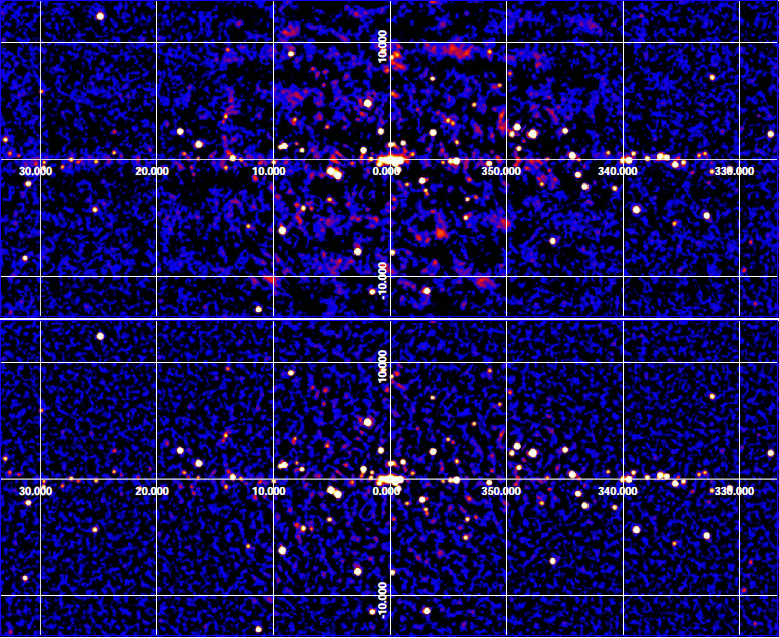
A newly developed image analysis technique has significantly improved the sensitivity limits reached by the IBIS imager on board INTEGRAL, resulting in the deepest survey ever compiled of the entire sky in the energy range between 17 and 60 keV. Pushing the instrument towards its very limits, the novel method discloses a vast number of previously undetected faint sources, galactic and extragalactic alike.

For more than seven years, the INTEGRAL observatory has been surveying the entire X-ray and gamma-ray sky and has accumulated a copious amount of exposure time, targeting both the crowded regions along the Galactic Plane and the high-latitude portions of the sky, this latter region being dominated by extragalactic sources. Theoretically, a longer exposure time translates into an improvement in sensitivity, but this connection is not always straightforward: a number of systematic effects plague the observations and limit the sensitivity of the instruments despite the increased exposure time. Hence, new techniques are sought, and implemented, in order to overcome these systematic effects and to fully exploit the instrument performance.

A successful example of this synergy is a novel image analysis algorithm, recently developed to improve the sensitivity achieved by IBIS, the Imager on Board the INTEGRAL Satellite.


Region near the Galactic Plane in the INTEGRAL/IBIS 7-year All-Sky Hard X-ray Survey. This alternating image shows the difference in results achieved by using a) the previous sky reconstruction method and b) the improved, newly developed image analysis algorithm. Credit: Krivonos, et al. 2010, A&A, in press

Since high-energy photons, such as hard X-rays and gamma rays, cannot be focussed using traditional lenses and mirrors, IBIS is a coded-mask telescope, consisting of a metal plate (or mask) with a pattern of holes, which is placed on top of a detector. Photons coming from an astronomical source pass through the holes and, depending on their incoming direction, cast a series of shadows on the detector. "The principle is very similar to that of a pinhole camera," explains INTEGRAL Project Scientist Chris Winkler. "From the pattern of dark and bright pixels, or shadowgram, recorded by the detector, it is possible to reconstruct the position in the sky and the intensity of the sources that produced the shadowgram. The reconstruction relies on complex image analysis techniques, which are unfortunately prone to a variety of systematic effects, especially along the Galactic Plane," adds Winkler. The so-called Galactic Ridge emission, a strong, diffuse X-ray radiation coming from the Galactic Plane, represents a serious problem in this process, which is further complicated by the vast number of sources in the crowded field of the Galactic Centre.

"In order to isolate individual sources on the sky, images have to be cleaned by removing the background signal, which in turn has to be properly modelled," says Roman Krivonos, a researcher at the Max Planck Institute for Astrophysics and at the Space Research Institute of the Russian Academy of Science, who led the study. In this case, the background includes emission from the Cosmic X-Ray Background, instrumental noise and, depending on the galactic latitude of the observed fields, additional Ridge emission from the Galactic Plane.


Galactic Bulge region in the INTEGRAL/IBIS 7-year map. The overlaid COBE/DIRBE 4.9 μm brightness contours trace the Galaxy's disk/bulge structure. Credit: R. Krivonos

"The main source of systematic effects is the mismatch between the model of the background, used in the image analysis, and the true background, actually present in the images," Krivonos explains. "Our new method contains an improved model of the Ridge emission based on near-infrared observations, a good tracer of the galactic X-ray emission; this enables us to remove this particular source of systematic effects," he adds. The algorithm also contains a further cleaning step, through which all large-scale artefacts, due to residual systematic effects and mimicking extended structures on the sky, are removed.

The newly developed method suppresses systematic effects almost completely in extragalactic, high-latitude fields, and yields a significant, albeit not total, removal also in the portion of the sky dominated by the Galaxy. Observations have now a more-or-less uniform sky background, enabling the detection of previously unnoticeable faint sources.


The improved sky reconstruction method at work in the sky region around the Seyfert-1 galaxy NGC 4151 in the INTEGRAL/IBIS 7-year All-Sky Hard X-ray Survey. Left: image created using the previous sky reconstruction method. Right: image created using the improved, newly developed algorithm, which allowed the detection of a new hard X-ray source, IGR J11203+4531 (highlighted by the green circle). Credit: Krivonos, et al. 2010, A&A, in press

The result is the deepest all-sky survey compiled to date in hard X-rays, covering the energy range between 17 and 60 keV. The sensitivity has reached instrumental limits on extragalactic observations, where the IBIS imager aboard INTEGRAL is working at its maximum efficiency; on galactic fields, observations do not reach, but significantly approach, the instrumental limits, delivering a survey of the Galaxy with the best currently available sensitivity in this energy band. "After 7 years of operations, IBIS has collected data over very long exposure times, and we can thus finally profit from the instrument's full capabilities. At this point in the mission's lifetime, such a technique, pushing the instrument towards its limits, is especially valuable," comments Winkler.

The catalogue of extragalactic sources detected in the study, mostly Active Galactic Nuclei (AGN), benefits enormously from the newly developed method, resulting in a much deeper survey than previously achieved. The higher sensitivity of the new observations enables a significant number of sources up to a redshift of z~0.1 to be detected, thus probing how the properties of hard X-ray emitting AGN evolved over the last thousand million years of cosmic history. The sample of galactic sources, comprising compact sources of X-ray radiation such as accreting black holes and neutron stars, is also considerably larger than previous comparable catalogues. "It represents a prototype of the compact source samples that will be detected in nearby galaxies by future hard X-ray missions," says Krivonos.
Notes for editors:

INTEGRAL is an ESA project with instruments and science data centre funded by ESA Member States (especially the PI countries: Denmark, France, Germany, Italy, Spain, Switzerland) and Poland, and with the participation of Russia and the USA.

The INTEGRAL/IBIS 7-year All-Sky Hard X-Ray Survey is based on observations performed with the IBIS coded mask telescope in the energy band 17-60 keV.

The survey covers 90% of the sky down to the flux limit of 6.2 × 10⁻¹¹ erg/s/cm2, and 10% of the sky down to the flux limit of 8.6 × 10⁻¹² erg/s/cm2. The faintest galactic source detected is the type-I X-ray burster AX J1754.2-2754, with a flux of 4.6 × 10⁻¹² erg/s/cm2. For comparison, the brightest source in the hard X-ray band is the Crab Nebula, with a flux of 1.43 × 10⁻⁸ erg/s/cm2.

Most of the exposures were collected in the region of the Galactic Plane, where the maximum available exposure is an approximately 20 million second deep field of the Galactic Centre. The newly implemented algorithm decrease the systematic noise by about 44% in this field, and practically removes it from high-latitude sky images.

The data used in this study were obtained from the European and Russian INTEGRAL Science Data Centres.

Related publications:

Krivonos, R., et al. [2010], INTEGRAL/IBIS 7-year All-Sky Hard X-Ray Survey – Part I: Image Reconstruction, A&A accepted – http://dx.doi.org/10.1051/0004-6361/200913814

Krivonos, R., et al. [2010], INTEGRAL/IBIS 7-year All-Sky Hard X-Ray Survey – Part II: Catalog of Sources, A&A accepted - http://arxiv.org/abs/1006.4437

Contacts:

Chris Winkler, INTEGRAL Project Scientist
Research and Scientific Support Department
Directorate of Science and Robotic Exploration, ESA, The Netherlands
Email:
cwinkler@rssd.esa.int
Phone: +31 71 565 3591

Roman Krivonos
Max Planck Institute for Astrophysics, Germany &
Space Research Institute, Russian Academy of Science, Moscow, Russia
Email:
krivonos@mpa-garching.mpg.de, krivonos@iki.rssi.ru
Phone: +49 (89) 30000-2275

Ambitious Survey Spots Stellar Nurseries

PR Image eso1033a
VISTA Magellanic Cloud Survey view of the Tarantula Nebula

PR Image eso1033b
Extracts from the VISTA Magellanic Cloud Survey view of the Tarantula Nebula

PR Image eso1033c
VISTA Magellanic Cloud Survey view of the Tarantula Nebula (annotated version)

PR Image eso1033d
Infrared/visible comparison of the VISTA Tarantula Nebula image

PR Video eso1033a
Zooming in on the VISTA view of the Tarantula Nebula

Panning across the VISTA view of the Tarantula Nebula

PR Video eso1033c
Infrared/visible cross-fade of the VISTA Tarantula Nebula image

Astronomers scanning the skies as part of ESO’s VISTA Magellanic Cloud survey have now obtained a spectacular picture of the Tarantula Nebula in our neighbouring galaxy, the Large Magellanic Cloud. This panoramic near-infrared view captures the nebula itself in great detail as well as the rich surrounding area of sky. The image was obtained at the start of a very ambitious survey of our neighbouring galaxies, the Magellanic Clouds, and their environment.

The leader of the survey team, Maria-Rosa Cioni (University of Hertfordshire, UK) explains: "This view is of one of the most important regions of star formation in the local Universe — the spectacular 30 Doradus star-forming region, also called the Tarantula Nebula. At its core is a large cluster of stars called RMC 136, in which some of the most massive stars known are located."

ESO’s VISTA telescope [1] is a new survey telescope at the Paranal Observatory in Chile (eso0949). VISTA is equipped with a huge camera that detects light in the near-infrared part of the spectrum, revealing a wealth of detail about astronomical objects that gives us insight into the inner workings of astronomical phenomena. Near-infrared light has a longer wavelength than visible light and so we cannot see it directly for ourselves, but it can pass through much of the dust that would normally obscure our view. This makes it particularly useful for studying objects such as young stars that are still enshrouded in the gas and dust clouds from which they formed. Another powerful aspect of VISTA is the large area of the sky that its camera can capture in each shot.

This image is the latest view from the VISTA Magellanic Cloud Survey (VMC). The project will scan a vast area — 184 square degrees of the sky (corresponding to almost one thousand times the apparent area of the full Moon) including our neighbouring galaxies the Large and Small Magellanic Clouds. The end result will be a detailed study of the star formation history and three-dimensional geometry of the Magellanic system.

Chris Evans from the VMC team adds: “The VISTA images will allow us to extend our studies beyond the inner regions of the Tarantula into the multitude of smaller stellar nurseries nearby, which also harbour a rich population of young and massive stars. Armed with the new, exquisite infrared images, we will be able to probe the cocoons in which massive stars are still forming today, while also looking at their interaction with older stars in the wider region.”

The wide-field image shows a host of different objects. The bright area above the centre is the Tarantula Nebula itself, with the RMC 136 cluster of massive stars in its core. To the left is the NGC 2100 star cluster. To the right is the tiny remnant of the supernova SN1987A (eso1032). Below the centre are a series of star-forming regions including NGC 2080 — nicknamed the “Ghost Head Nebula” — and the NGC 2083 star cluster.

The VISTA Magellanic Cloud Survey is one of six huge near-infrared surveys of the southern sky that will take up most of the first five years of operations of VISTA.

Notes

[1] VISTA ― the Visible and Infrared Survey Telescope for Astronomy ― is the newest telescope at ESO’s Paranal Observatory in northern Chile. VISTA is a survey telescope working at near-infrared wavelengths and is the world’s largest survey telescope. Its large mirror, wide field of view and very sensitive detectors will reveal a completely new view of the southern sky.

The telescope is housed on the peak adjacent to the one hosting ESO’s Very Large Telescope (VLT) and shares the same exceptional observing conditions. VISTA has a main mirror that is 4.1 m across. In photographic terms it can be thought of as a 67-megapixel digital camera with a 13 000 mm f/3.25 mirror lens.

More information

ESO, the European Southern Observatory, is the foremost intergovernmental astronomy organisation in Europe and the world’s most productive astronomical observatory. It is supported by 14 countries: Austria, Belgium, the Czech Republic, Denmark, France, Finland, Germany, Italy, the Netherlands, Portugal, Spain, Sweden, Switzerland and the United Kingdom. ESO carries out an ambitious programme focused on the design, construction and operation of powerful ground-based observing facilities enabling astronomers to make important scientific discoveries. ESO also plays a leading role in promoting and organising cooperation in astronomical research. ESO operates three unique world-class observing sites in Chile: La Silla, Paranal and Chajnantor. At Paranal, ESO operates the Very Large Telescope, the world’s most advanced visible-light astronomical observatory and VISTA, the world’s largest survey telescope. ESO is the European partner of a revolutionary astronomical telescope ALMA, the largest astronomical project in existence. ESO is currently planning a 42-metre European Extremely Large optical/near-infrared Telescope, the E-ELT, which will become “the world’s biggest eye on the sky”.

Links

More information about VISTA
The VMC survey

Contacts

Maria-Rosa Cioni
University of Hertfordshire
UK
Tel: +44 1707 28 5189
Email: M.Cioni@herts.ac.uk

Richard Hook
ESO La Silla/Paranal & E-ELT Public Information Officer
Garching, Germany
Tel: +49 89 3200 6655
Email: rhook@eso.org

Tuesday, August 10, 2010

WISE Spacecraft Warming Up

Artist's concept of the Wide-field Infrared Survey Explorer
Image credit: NASA/JPL-Caltech

Wide-Field Infrared Survey Explorer Mission Status

NASA's Wide-field Infrared Survey Explorer, or WISE, is warming up. Team members say the spacecraft is running out of the frozen coolant needed to keep its heat-sensitive instrument chilled.

The telescope has two coolant tanks that keep the spacecraft's normal operating temperature at 12 Kelvin (minus 438 degrees Fahrenheit). The outer, secondary tank is now depleted, causing the temperature to increase. One of WISE's infrared detectors, the longest-wavelength band most sensitive to heat, stopped producing useful data once the telescope warmed to 31 Kelvin (minus 404 degrees Fahrenheit). The primary tank still has a healthy supply of coolant, and data quality from the remaining infrared detectors remains high.

WISE completed its primary mission, a full scan of the entire sky in infrared light, on July 17, 2010. The mission has taken more than 1.5 million snapshots so far, uncovering hundreds of millions of objects, including asteroids, stars and galaxies. It has discovered more than 29,000 new asteroids to date, more than 100 near-Earth objects and 15 comets.

WISE is continuing a second survey of about one-half the sky as originally planned. It’s possible the remaining coolant will run out before that scan is finished. Scientists say the second scan will help identify new and nearby objects, as well as those that have changed in brightness. It could also help to confirm oddball objects picked up in the first scan.

NASA's Jet Propulsion Laboratory, Pasadena, Calif., manages the Wide-field Infrared Survey Explorer for NASA's Science Mission Directorate, Washington. The principal investigator, Edward Wright, is at UCLA. The mission was competitively selected under NASA's Explorers Program, managed by the Goddard Space Flight Center, Greenbelt, Md. The science instrument was built by the Space Dynamics Laboratory, Logan, Utah, and the spacecraft was built by Ball Aerospace & Technologies Corp., Boulder, Colo. Science operations and data processing take place at the Infrared Processing and Analysis Center at the California Institute of Technology in Pasadena. Caltech manages JPL for NASA.

More information is online at http://www.nasa.gov/wise and http://wise.astro.ucla.edu

An "Island Universe" in the Coma Cluster

Spiral Galaxy NGC 4911 in the Coma Cluster
Credit: NASA, ESA, and the Hubble Heritage Team (STScI/AURA)
Acknowledgment: K. Cook (Lawrence Livermore National Laboratory)

Compass and Scale Image for NGC 4911
Credit: NASA, ESA, and Z. Levay (STScI)

A long-exposure Hubble Space Telescope image shows a majestic face-on spiral galaxy located deep within the Coma Cluster of galaxies, which lies 320 million light-years away in the northern constellation Coma Berenices.

The galaxy, known as NGC 4911, contains rich lanes of dust and gas near its center. These are silhouetted against glowing newborn star clusters and iridescent pink clouds of hydrogen, the existence of which indicates ongoing star formation. Hubble has also captured the outer spiral arms of NGC 4911, along with thousands of other galaxies of varying sizes. The high resolution of Hubble's cameras, paired with considerably long exposures, made it possible to observe these faint details.

NGC 4911 and other spirals near the center of the cluster are being transformed by the gravitational tug of their neighbors. In the case of NGC 4911, wispy arcs of the galaxy's outer spiral arms are being pulled and distorted by forces from a companion galaxy (NGC 4911A), to the upper right. The resultant stripped material will eventually be dispersed throughout the core of the Coma Cluster, where it will fuel the intergalactic populations of stars and star clusters.

The Coma Cluster is home to almost 1,000 galaxies, making it one of the densest collections of galaxies in the nearby universe. It continues to transform galaxies at the present epoch, due to the interactions of close-proximity galaxy systems within the dense cluster. Vigorous star formation is triggered in such collisions.

Galaxies in this cluster are so densely packed that they undergo frequent interactions and collisions. When galaxies of nearly equal masses merge, they form elliptical galaxies. Merging is more likely to occur in the center of the cluster where the density of galaxies is higher, giving rise to more elliptical galaxies.

This natural-color Hubble image, which combines data obtained in 2006, 2007, and 2009 from the Wide Field Planetary Camera 2 and the Advanced Camera for Surveys, required 28 hours of exposure time.

For additional information, contact:

Ray Villard
Space Telescope Science Institute, Baltimore, Md.
410-338-4514

villard@stsci.edu

Mario Livio
Space Telescope Science Institute, Baltimore, Md.
410-338-4439

mlivio@stsci.edu

Michael Gregg
University of California, Davis, Institute for Geophysics and Planetary Physics, Livermore, Calif.
925-423-8946

gregg@igpp.ucllnl.org

Thursday, August 05, 2010

A Galactic Spectacle

NGC 4038/4039 - Antennae Galaxies
Credit: NASA, ESA, SAO, CXC, JPL-Caltech, and STScI
Acknowledgment: G. Fabbiano and Z. Wang (Harvard-Smithsonian CfA),
and B. Whitmore (STScI)

A beautiful new image of two colliding galaxies has been released by NASA's Great Observatories. The Antennae galaxies, located about 62 million light-years from Earth, are shown in this composite image from the Chandra X-ray Observatory (blue), the Hubble Space Telescope (gold and brown), and the Spitzer Space Telescope (red). The Antennae galaxies take their name from the long antenna-like "arms," seen in wide-angle views of the system. These features were produced by tidal forces generated in the collision.

The collision, which began more than 100 million years ago and is still occurring, has triggered the formation of millions of stars in clouds of dusts and gas in the galaxies. The most massive of these young stars have already sped through their evolution in a few million years and exploded as supernovas.

The X-ray image from Chandra shows huge clouds of hot, interstellar gas that have been injected with rich deposits of elements from supernova explosions. This enriched gas, which includes elements such as oxygen, iron, magnesium, and silicon, will be incorporated into new generations of stars and planets. The bright, point-like sources in the image are produced by material falling onto black holes and neutron stars that are remnants of the massive stars. Some of these black holes may have masses that are almost one hundred times that of the Sun.

The Spitzer data show infrared light from warm dust clouds that have been heated by newborn stars, with the brightest clouds lying in the overlapping region between the two galaxies.

The Hubble data reveal old stars and star-forming regions in gold and white, while filaments of dust appear in brown. Many of the fainter objects in the optical image are clusters containing thousands of stars.

The Chandra image was taken in December 1999. The Spitzer image was taken in December 2003. The Hubble image was taken in July 2004, and February 2005.

For additional information, contact:

Megan Watzke
Chandra X-ray Center, Cambridge, Mass.
617-496-7998

mwatzke@cfa.harvard.edu

Whitney Clavin
Jet Propulsion Laboratory, Pasadena, Calif.
818-354-4673

whitney.clavin@jpl.nasa.gov

Cheryl Gundy
Space Telescope Science Institute, Baltimore, Md.
410-338-4707

gundy@stsci.edu

Wednesday, August 04, 2010

Seeing a Stellar Explosion in 3D

The material around SN 1987A (artist’s impression)

The material around SN 1987A (artist’s impression)

Zoom on SN1987A

Astronomers using ESO’s Very Large Telescope have for the first time obtained a three-dimensional view of the distribution of the innermost material expelled by a recently exploded star. The original blast was not only powerful, according to the new results. It was also more concentrated in one particular direction. This is a strong indication that the supernova must have been very turbulent, supporting the most recent computer models.

Unlike the Sun, which will die rather quietly, massive stars arriving at the end of their brief life explode as supernovae, hurling out a vast quantity of material. In this class, Supernova 1987A (SN 1987A) in the rather nearby Large Magellanic Cloud occupies a very special place. Seen in 1987, it was the first naked-eye supernova to be observed for 383 years (eso8704), and because of its relative closeness, it has made it possible for astronomers to study the explosion of a massive star and its aftermath in more detail than ever before. It is thus no surprise that few events in modern astronomy have been met with such an enthusiastic response by scientists.

SN 1987A has been a bonanza for astrophysicists (eso8711 and eso0708). It provided several notable observational ‘firsts’, like the detection of neutrinos from the collapsing inner stellar core triggering the explosion, the localisation on archival photographic plates of the star before it exploded, the signs of an asymmetric explosion, the direct observation of the radioactive elements produced during the blast, observation of the formation of dust in the supernova, as well as the detection of circumstellar and interstellar material (eso0708).

New observations making use of a unique instrument, SINFONI [1], on ESO’s Very Large Telescope (VLT) have provided even deeper knowledge of this amazing event, as astronomers have now been able to obtain the first-ever 3D reconstruction of the central parts of the exploding material.

This view shows that the explosion was stronger and faster in some directions than others, leading to an irregular shape with some parts stretching out further into space.

The first material to be ejected from the explosion travelled at an incredible 100 million km per hour, which is about a tenth of the speed of light or around 100 000 times faster than a passenger jet. Even at this breakneck speed it has taken 10 years to reach a previously existing ring of gas and dust puffed out from the dying star. The images also demonstrate that another wave of material is travelling ten times more slowly and is being heated by radioactive elements created in the explosion.

"We have established the velocity distribution of the inner ejecta of Supernova 1987A,” says lead author Karina Kjær. “Just how a supernova explodes is not very well understood, but the way the star exploded is imprinted on this inner material. We can see that this material was not ejected symmetrically in all directions, but rather seems to have had a preferred direction. Besides, this direction is different to what was expected from the position of the ring.”

Such asymmetric behaviour was predicted by some of the most recent computer models of supernovae, which found that large-scale instabilities take place during the explosion. The new observations are thus the first direct confirmation of such models.

SINFONI is the leading instrument of its kind, and only the level of detail it affords allowed the team to draw their conclusions. Advanced adaptive optics systems counteracted the blurring effects of the Earth's atmosphere while a technique called integral field spectroscopy allowed the astronomers to study several parts of the supernova’s chaotic core simultaneously, leading to the build-up of the 3D image.

“Integral field spectroscopy is a special technique where for each pixel we get information about the nature and velocity of the gas,” says Kjær. “This means that besides the normal picture we also have the velocity along the line of sight. Because we know the time that has passed since the explosion, and because the material is moving outwards freely, we can convert this velocity into a distance. This gives us a picture of the inner ejecta as seen straight on and from the side.”

Notes

[1] The team used the SINFONI (Spectrograph for INtegral Field Observations in the Near Infrared) instrument mounted on ESO's Very Large Telescope (VLT). SINFONI is a near-infrared (1.1–2.45 µm) integral field spectrograph fed by an adaptive optics module.
More information

This research will appear in Astronomy and Astrophysics (“The 3-D Structure of SN 1987A’s inner Ejecta”, by K. Kjær et al.).

The team is composed of Karina Kjær (Queen’s University Belfast, UK), Bruno Leibundgut and Jason Spyromilio (ESO), and Claes Fransson and Anders Jerkstrand (Stockholm University, Sweden).

ESO, the European Southern Observatory, is the foremost intergovernmental astronomy organisation in Europe and the world’s most productive astronomical observatory. It is supported by 14 countries: Austria, Belgium, the Czech Republic, Denmark, France, Finland, Germany, Italy, the Netherlands, Portugal, Spain, Sweden, Switzerland and the United Kingdom. ESO carries out an ambitious programme focused on the design, construction and operation of powerful ground-based observing facilities enabling astronomers to make important scientific discoveries. ESO also plays a leading role in promoting and organising cooperation in astronomical research. ESO operates three unique world-class observing sites in Chile: La Silla, Paranal and Chajnantor. At Paranal, ESO operates the Very Large Telescope, the world’s most advanced visible-light astronomical observatory and VISTA, the world’s largest survey telescope. ESO is the European partner of a revolutionary astronomical telescope ALMA, the largest astronomical project in existence. ESO is currently planning a 42-metre European Extremely Large optical/near-infrared Telescope, the E-ELT, which will become “the world’s biggest eye on the sky”.

Links
Research paper
More information about SN 1987A
Astronomy & Astrophysics article

Contacts

Karina Kjær
Queen’s University
Belfast, UK
Tel: +44 28 9028 8662
Cell: +44 79 1608 0702
Email:
karina.kjaer@gmail.com

Bruno Leibundgut
ESO
Garching bei München, Germany
Tel: +49 89 3200 6295
Email:
bleibund@eso.org

Richard Hook
ESO, La Silla, Paranal, E-ELT and Survey telescopes Press Officer
Garching bei München, Germany
Tel: +49 89 3200 6655
Email:
rhook@eso.org

Tuesday, August 03, 2010

NASA Reveals Key to Unlock Mysterious Red Glow in Space

Above image combines visible-infrared Spitzer Space Telescope images of the galaxy Messier-82. The red streaming away from the galaxy into intergalactic space traces the infrared emission from PAHs.

Above image is an interstellar nebula, showing the emission from PAHs in red, some PAH molecular structures and the interstellar PAH infrared signature. Full-resolution

MOFFETT FIELD, Calif. -- NASA scientists created a unique collection of polycyclic aromatic hydrocarbon (PAH) spectra to interpret mysterious emission from space. Because PAHs are a major product of combustion, remain in the environment, and are carcinogenic, the value of this PAH spectral collection extends far beyond NASA and astronomical applications.

For years, scientists have been studying a mysterious infrared glow from the Milky Way and other galaxies, radiating from dusty regions in deep space. By duplicating the harsh conditions of space in their laboratories and computers, scientists have identified the mystifying infrared emiters as PAHs. PAHs are flat, chicken-wire shaped, nano-sized molecules that are very common on Earth.

“PAHs in space are probably produced by carbon-rich, giant stars. A similar process produces soots here on Earth,” said Louis Allamandola, an astrochemistry researcher at NASA’s Ames Research Center, Moffett Field, Calif. “Besides astronomical applications, this PAH database and software can be useful as a new research tool for scientists, educators, policy makers, and consultants working in the fields of medicine, health, chemistry, fuel composition, engine design, environmental assessment, environmental monitoring, and environmental protection.”

To manage the research data, NASA built a database that now can be shared over the internet. It’s the world’s largest collection of PAH infrared data, and the website contains nearly 700 spectra of PAHs in their neutral and electrically charged states. In addition, it has tools to download PAH spectra ranging in temperature from minus 470 to 2000 degrees Fahrenheit. Thanks to these spectra, PAHs are now known to be abundant throughout the universe, but in exotic forms not readily found on Earth.

This mysterious infrared radiation from interstellar space was discovered in the 1970’s and 1980’s. While the infrared signature hinted that PAHs might be responsible, laboratory spectra of only a handful of small, individual PAHs were available to test this idea. To make matters worse, these were only for neutral, solid PAHs, not representive for PAHs as they would be in space, where they’d be electrically charged, very cold, individual molecules floating in the gas.

By the mid-1990's, observations showed this infrared emission as surprisingly common and widespread across the universe, implying that the unknown carrier was abundant and important. To better understand PAHs, then thought to be too complex to be present in space, their spectra were measured under astronomical conditions.

To capture their spectra, Allamandola led a team of scientists to measure PAH spectra under simulated astronomical conditions and with computer software. This team consisted of experts in many different fields. "This group made a tremendous effort to make this a reality," said Allamandola. "There are now nearly 700 spectra in the database. Six hundred of these have been theoretically computed, and sixty have been measured in the laboratory. The theoretical spectra span the range from two to 2000 microns, the experimental spectra cover two to 25 microns."

The spectra have given insights into the PAHs in space that were impossible to get any other way. Scientists predict that in the near future these spectra will be especially valuable for interpreting observations made with NASA's new airborne observatory, the Stratospheric Observatory for Infrared Astronomy (SOFIA) and the recently launched European Space Agency's (ESA) Herschel Telescope.

They tried to make the website user friendly for researchers. One can explore the database by charge, composition and spectral signatures. Tools allow users to do analyses online. For example, spectra can be combined to create a `composite' signature that can be compared directly to the spectrum of ‘unknown’ material.

"We will expand the database and tools,” said Christiaan Boersma, a NASA postdoctoral fellow at Ames, who designed and developed many parts of the website and tools. "We now use the database to interpret astronomical observations from star and planet forming regions in our galaxy, the Milky Way, and even other galaxies."

“Initially, our hope was to help interpret the experimental spectra, but over time, our computational capabilities made it possible to study molecules much larger than can be studied in the laboratory,” said Charles Bauschlicher, Jr., a world renowned computational chemist at NASA Ames.

"Thanks to the great sensitivity of the Spitzer Telescope, PAHs are seen across the universe, removing any doubt of the importance of these species,” said Allamandola.

The database is available at http://www.astrochem.org/pahdb. More information about the database and graphics are available at http://www.astrochem.org/pahdb/pressrelease

Ruth Dasso Marlaire
Ames Research Center, Moffett Field, Calif.
650.604.4709

ruth.marlaire@nasa.gov