Showing posts with label little red dots (LRDs). Show all posts

Saturday, August 01, 2026

NASA Webb Explores Family Tree of Newly Discovered Distant Objects

Scientists have proposed one pathway little red dots can follow as the universe matures based on their analysis of spiral galaxy WISEA J123635.56+621424.2, nicknamed the “Saguaro.” They suggest little red dots may be a temporary phase of highly active supermassive black holes. Credit Image: NASA, ESA, CSA, STScI, Pierluigi Rinaldi (Steward Observatory); Image Processing: Alyssa Pagan (STScI)


Scientists synthetically shifted the Saguaro, a lower-redshift spiral galaxy, to a higher redshift to find out how it would appear if it was in the early universe. Its compact red appearance suggests that little red dots are a phase of highly active supermassive black holes. Credit Image: NASA, ESA, CSA, Pierluigi Rinaldi (Steward Observatory); Image Processing: Alyssa Pagan (STScI); Illustration: Leah Hustak (STScI)


Since their discovery by NASA’s James Webb Space Telescope in 2022, little red dots (LRDs) have been the subject of great interest to astronomers. Understanding the nature of these extremely distant, compact red sources has been a puzzling scientific endeavor.

One popular theory is that little red dots are supermassive black holes known as active galactic nuclei, although they display characteristics unlike nearby active galactic nuclei. While they appear abundant at high redshift early in the universe, they rapidly decrease in number at lower redshifts. (The higher the redshift, the greater the distance the light has traveled across the universe.) This perplexing shift in number raises the question: What happens to little red dots as the universe matures?

A team of researchers led by Pierluigi Rinaldi of the University of Arizona’s Steward Observatory, now at the Space Telescope Science Institute (STScI) in Baltimore, has built upon their previous research in a new study published on July 29 in The Astrophysical Journal and proposed one pathway LRDs can follow as the universe ages: Though they may look like a unique galaxy population, these dots are affected by observational bias — some features just don’t appear at higher redshifts with current technology.

Their conclusions are based on their analysis of lower-redshift spiral galaxy WISEA J123635.56+621424.2, nicknamed the “Saguaro” for its prominent arms, like the cactus native to the Sonoran Desert in the Southwestern United States. A particularly intriguing feature of this redshift 2 galaxy, which corresponds to approximately 3.3 billion years after the big bang, is its little red dot-like center that is reminiscent of the ruby red fruit produced by the desert plant.

“Everything created in the early universe must evolve into something around us. We have had little idea of what LRDs become, but these results finally show us how to find their progeny,” said co-author George Rieke of the University of Arizona. Previous studies by NASA’s retired Spitzer Space Telescope provided the first hint of the dust-obscured, compact galaxy population in the lower-redshift universe that the Saguaro belongs to, paving the way for NASA’s Hubble and James Webb space telescopes’ high-resolution analyses.

“The Saguaro is important because it’s a prototypical little red dot and is one of the few we have found at lower redshift. It can be used to study the pathway of these dots throughout cosmic time,” said Fabio Pacucci of the Harvard-Smithsonian Center for Astrophysics in Cambridge, Massachusetts, and a co-author of the study.

Among the thousands of sources Rinaldi looked at across several surveys, the Saguaro was an example of the right place — with one of Webb’s microshutter arrays perfectly framed over the galaxy’s core to take spectroscopic data — and right time — being at lower redshift. To get as broad a view of the spiral galaxy as possible across the electromagnetic spectrum, the team used Hubble’s ultraviolet- and Webb’s infrared-imaging and spectroscopic archival data, respectively.

“Because the Saguaro is at lower redshift, we can see the very beautiful and bright host galaxy in high resolution and detail with Webb and Hubble,” said Zihao Wu of the Harvard-Smithsonian Center for Astrophysics, and a co-author of the study. “Webb’s observations can help us understand how the galaxy and its little red dot-like nucleus are connected.”

The team took multiple approaches to verify that the Saguaro’s compact red nucleus matched the characteristics of a prototypical LRD. In particular, the Hubble and Webb data showed that the nucleus is brighter in both ultraviolet and infrared light than in visible light, just like distant LRDs. The team also carefully disentangled the light emitted from the host and nucleus, and considered the presence of X-ray emission from the source.

Although the majority of little red dots at high redshift are not detectable in X-ray light, NASA’s Chandra X-ray Observatory detected weak X-ray emission from the Saguaro.

“What the X-ray light observations show is that this galaxy has an active galactic nucleus, and a very obscured one at that,” said Carys Gilbert, a Master’s student at the University of Cape Town in South Africa and a co-author of the paper. “It’s not only obscured but also X-ray weak. That kind of combination could explain the lack of X-ray emission that we see from all other little red dots. It fits the puzzle of little red dots nicely.”

In addition to demonstrating how the Saguaro’s central compact red source fits the little red dot criteria, the team synthetically shifted the galaxy to a higher redshift to explore how this galactic environment would appear to observers if located in the early universe. As expected, the Saguaro’s surrounding galactic structure fades so that only the bright, LRD-like source at its center is visible.

“Our theory is that most of these distant sources are affected by this cosmological effect, creating an observational bias,” said Rinaldi. “We simply are not able to sample the immediate environment of high-redshift little red dots because their surroundings are just too faint to be observed even with Webb. Little red dots are far more complex than just being a dot. They’re just the tip of the iceberg — of a supermassive black hole interacting with its nearby surroundings.”

Considering the Saguaro case study, the team believes that LRDs may not be a unique galaxy population, but instead a temporary phase of highly active supermassive black holes. Could this theory be the link between the populous high-redshift little red dots seen by Webb and the local universe?c While the Saguaro is not representative of all LRDs, the team proposes that this is one phase of these compact red sources. To build more confidence, further study of the Saguaro is necessary, as well as seeking other Saguaro-like galaxies at lower redshift. The team also intends to comb through Webb’s bountiful archival data to build a census of little red dots to study how their environments may impact how they mature. These different approaches are all geared to helping uncover the family tree of little red dots.

The James Webb Space Telescope is the world’s premier space science observatory. Webb is solving mysteries in our solar system, looking beyond to distant worlds around other stars, and probing the mysterious structures and origins of our universe and our place in it. Webb is an international program led by NASA with its partners, ESA (European Space Agency) and CSA (Canadian Space Agency).

The Hubble Space Telescope has been operating for over three decades and continues to make ground-breaking discoveries that shape our fundamental understanding of the universe. Hubble is a project of international cooperation between NASA and ESA (European Space Agency). NASA’s Goddard Space Flight Center in Greenbelt, Maryland, manages the telescope and mission operations. Lockheed Martin Space, based in Denver, also supports mission operations at Goddard. The Space Telescope Science Institute in Baltimore, which is operated by the Association of Universities for Research in Astronomy, conducts Hubble science operations for NASA.


Details:

Last Updated: Jul 29, 2026
Location:
NASA Goddard Space Flight Center

Contact Media:

Laura Betz
NASA’s Goddard Space Flight Center
Greenbelt, Maryland

laura.e.betz@nasa.gov

Abigail Major
Space Telescope Science Institute
Baltimore, Maryland


Hannah Braun
Space Telescope Science Institute
Baltimore, Maryland


Saturday, June 13, 2026

Galaxy Roasts Clouds, Makes "BBQ Sauce"

Figure: Schematic illustration of an evolutionary scenario connecting LRDs (left), BBQSORS (center), and ordinary QSOs (right). In LRDs, a supermassive black hole is thought to be surrounded by thick gas clouds. In BBQSORS, the surrounding clouds are being roasted off, and the region around the black hole may be partially emerging into view. In a QSO, the region around the black hole is visible. (Credit: Illustration generated by ChatGPT [OpenAI]; edited by Kohei Ichikawa)


Galaxies in the early Universe which shine brightly due to gas falling into a supermassive blackhole at the galaxy center were originally regarded as puzzling Quazi-Stellar Objects, abbreviated as QSO. Even though we now know that they are not stars, but entire galaxies, the abbreviation QSO, now pronounced as "quasar," is still used. QSOs are some of the brightest objects in the Universe, but the recipe nature uses to create them has remained a secret.

Now, thanks to data from the new wide-field multi-object spectrograph, ʻŌnohiʻula PFS, on the Subaru Telescope, astronomers think that they have discovered the special sauce needed to understand the secret recipe. The data comes from observations of an object known as "BBQSORS," which is an abbreviation for "Blackbody QSO and Radio Source," and is pronounced "barbecue sauce."

As the name implies, BBQSORS seems to be a QSO, but has some idiosyncrasies. It was originally identified as a radio-bright QSO candidate. Follow-up observations to determine the true nature of the candidate were conducted as part of ʻŌnohiʻula PFS’s filler observations program. Under this program, astronomers can request observations of an object when ʻŌnohiʻula PFS is scheduled to observe other targets in the same area of the sky. This filler observation program allows astronomers to make simultaneous observations, which use the instrument more efficiently without detracting from the main observations. The PFS observations revealed that BBQSORS shows the characteristic of high-speed gas around a black hole, but, unlike ordinary QSOs, also has features similar to black body emission from gas at around 10,000 degrees.

A research team including researchers from the Japanese institutions Tohoku University, Ehime University, and Ritsumeikan University analyzed data for BBQSORS from other observations and found that it has properties similar to those of a class of objects called "Little Red Dots" (LRDs). Researchers think that in LRDs, a growing supermassive black hole may be obscured by very dense clouds of gas which absorb the intense light from the center and re-emit it at different wavelengths. From this early "cloudy stage," LRDs are thought to change into QSOs.

BBQSORS seems to be shrouded in gas clouds, similar to LRDs, but the gas may be hotter than that surrounding LRDs. In other words, BBQSORS may be roasting off its surrounding clouds in the process of cooking up a QSR. If this interpretation is correct, BBQSORS is a valuable candidate object capturing the transition from a thick-gas-enshrouded stage to an ordinary quasar.

This research result was published on June 3, 2026, in The Astrophysical Journal Letters (Zhong, Chen, Ichikawa et al., "Blackbody Quasar and Radio Source (BBQSORS): A Candidate of Transitional Little Red Dots with a T ~ 104 K Blackbody Spectrum").

This research was supported by JSPS KAKENHI (Grant No. 25K01043), JST FOREST Program (JPMJFR2466), and the Inamori Foundation Research Grant.


Relevant Links


About the Subaru Telescope

The Subaru Telescope is a large optical-infrared telescope operated by the National Astronomical Observatory of Japan, National Institutes of Natural Sciences with the support of the MEXT Project to Promote Large Scientific Frontiers. We are honored and grateful for the opportunity of observing the Universe from Maunakea, which has cultural, historical, and natural significance in Hawai`i.


Monday, May 04, 2026

Radiative Transfer Shapes Hydrogen Lines in Little Red Dots

Schematic illustration of resonance scattering in a hydrogen atom. Interactions with electrons in the ground state (1s–2p) are called Lyman-α (green), whereas excited electrons on n=2 contribute to the Balmer series (Hα and Hβ, red and blue). The next higher excitation level is then called the Paschen series (yellow). © MPA

Due to distinctive features in the spectra of the 'Little Red Dots', a new class of objects spotted by the James Webb Space Telescope, it was thought that these were distant galaxies with massive black holes at their centres. However, new research suggests that the light from these galaxies is shaped not only by the motion of gas near the central black hole, but also by the effects of radiation. MPA scientists have modelled three key processes – resonance, Raman, and Thomson scattering – and found that these, acting together, can explain the formation of hydrogen emission lines in the Little Red Dots.

Little Red Dots (LRDs) are among the most surprising discoveries of the James Webb Space Telescope. These compact, reddish sources appear in the early universe, within the first billion years of cosmic history, and exhibit unusual hydrogen spectra. Their light shows broad hydrogen emission lines, Balmer absorption features, and a pronounced break between ultraviolet and optical wavelengths. At first glance, these properties seem to point to active galactic nuclei, where broad hydrogen lines are typically interpreted as signatures of rapidly moving gas surrounding a supermassive black hole.

Yet this interpretation creates a major puzzle. If the widths of these hydrogen lines are directly interpreted as tracers of gas motion around a black hole, many Little Red Dots appear to host black holes that are unexpectedly massive compared to their young host galaxies. Such enormous black holes would challenge current ideas of how quickly black holes and galaxies could have formed and grown in the early universe. This tension raises an important question: do these spectral features truly provide a direct measure of black hole mass, or are they significantly shaped by the dense environments through which the radiation propagates?

This work explores a new possibility. Rather than assuming that hydrogen line widths primarily trace gas dynamics near a black hole, it investigates how radiative transfer through dense surrounding gas can fundamentally alter the observed spectrum. The presence of Balmer absorption and strong spectral breaks already hints that light in these systems may undergo substantial scattering and reprocessing. If so, some of the broad and complex hydrogen features in Little Red Dots may arise not only from fast-moving gas, but also from the way photons interact with thick, hydrogen-rich environments before escaping.

Understanding how radiative transfer shapes these spectral signatures therefore offers more than an alternative explanation for broad lines: it provides a new tool for probing the physical conditions, structure, and nature of Little Red Dots themselves, revealing how gas, radiation, and black hole growth interact in some of the earliest galaxies. Our focus is on three key processes:
  1. Resonance scattering, where photons interact with hydrogen atoms in the excited n=2 state.
  2. Raman scattering, where ultraviolet photons are converted into optical emission through inelastic scattering by atomic hydrogen.
  3. Thomson scattering, where photons scatter off free electrons. Each process contributes differently to the observed spectral features.
Resonance scattering: shaping line profiles and ratios

Resonance scattering plays a crucial role when hydrogen atoms populate the n=2 or Balmer state, as indicated by Balmer absorption features and strong Balmer breaks. In this regime, Balmer photons can undergo multiple scatterings before escaping, which significantly modifies the emerging line profiles. These repeated interactions can produce asymmetric line shapes, particularly in the presence of gas motions such as outflows.

Notably, the radiative transfer of Hα and Hβ differs due to the atomic structure of hydrogen. While Hα photons predominantly remain in the same transition, Hβ photons can be converted into other lines, such as Paschen-α and Hα, through cascades involving the n=3 state. Consequently, Hβ photons are efficiently depleted in optically thick gas, while more Hα photons are produced. This leads to enhanced Hα emission and naturally increases the Hα/Hβ flux ratio beyond its intrinsic value.


Left: schematic illustration of Raman scattering of far-ultraviolet photons and the energy levels involved in neutral hydrogen. An UV photon excites the atom near the n=3 or n=4 state (green). If the electron drops down again to the ground state, it emits a Rayleigh photon (blue). If it drops down to an intermediate energy level, it emits a Raman photon (yellow or red). Right: The width of the emission line around Hα and Hβ depends on the column density (coloured lines), with the Hα wings being approximately three times broader than the Hβ wings for the same column density.© MPA

Raman scattering: generating broad wings

Raman scattering introduces a distinct spectral signature. Ultraviolet (UV) photons near the hydrogen Lyman series can be inelastically scattered by neutral hydrogen into optical wavelengths, producing broad wings around emission lines and showing systematic differences between certain hydrogen transitions. In particular, Raman scattering predicts that the wings of Hα should be significantly broader than those of Hβ.

Although broad emission lines are a defining feature of the Little Red Dots, such strong differences between lines are not always observed. This suggests that, although Raman scattering may contribute to the observed spectra, it is unlikely to be the dominant origin of the broad emission features. than those of Hβ.
Thomson-scattered line profiles for different electron temperatures. The line width increases with electron temperature.
© MPA

Thomson scattering: similar broad wings in hydrogen emission lines

Among the processes considered, Thomson scattering by free electrons provides a particularly compelling explanation for the broad components observed. Since electrons move thermally, the scattering introduces a symmetric broadening that depends on the electron temperature rather than on the motion of the bulk gas. Under typical conditions, this naturally produces line widths of around 1000 km/s, which is consistent with observations of the Little Red Dots. than those of Hβ.

The resulting profiles often exhibit exponential wings — a distinctive feature of electron scattering that has also been identified in other astrophysical environments. Importantly, this mechanism affects all emission lines in a similar way, which is consistent with the observed spectra. than those of Hβ.

Simulated spectra of the Hα, Hβ and Paα lines (red, blue and yellow) in a model combining an inner ionised region producing Thomson scattering (green) and an outer neutral region producing resonance scattering (grey). The resulting profiles illustrate how multiple scattering processes shape the observed line features together. © MPA

Implications for interpreting the Little Red Dots

The combined effects of resonance, Raman and Thomson scattering demonstrate that the Little Red Dots' diverse spectral features can naturally arise from radiative transfer in dense gas. Broad wings, absorption features and differences between hydrogen lines do not necessarily require extreme gas velocities or a classical broad-line region.

This has important consequences. If line widths are interpreted purely as indicators of gas motion, the mass of black holes may be significantly overestimated. Instead, the spectra of Little Red Dots encode the physical properties of their surrounding gas, such as density, temperature and ionisation state, through radiative processes.

These results provide a new framework for interpreting the spectra of Little Red Dots and similar systems in the early universe, offering a new perspective on early galaxy evolution. Rather than being straightforward indicators of black hole dynamics, hydrogen emission lines can reflect the complex interplay between radiation and dense gas.

Understanding this interplay is essential for correctly inferring the physical properties of galaxies and black holes at high redshifts and for developing a consistent model of their co-evolution during the first billion years of cosmic history. Current work focuses on analysing observed line profiles and using these models to decode the physical conditions imprinted in their shapes.

Source:


Contact:

Dr. Seok-Jun Chang
Chang, Seok-Jun
Postdoc
2245

sjchang@mpa-garching.mpg.de


Original Publication

Chang, Seok-Jun; Gronke, Max; Matthee, Jorryt; Mason, Charlotte
Impact of resonance, Raman, and Thomson scattering on hydrogen line formation in Little Red Dots
MNRAS, 545, 4, id.staf2131, 21 pp


Source | DOI


Sunday, January 11, 2026

Scientists Use JWST to Examine Ancient Monster Stars That May Reveal the Birth of Black Holes

Scientists at the Center for Astrophysics | Harvard & Smithsonian (CfA) have found that the unique features of supermassive stars align with the similarly unique features of little red dots, a class of objects recently revealed in the distant universe by the James Webb Space Telescope (Webb). This artist’s conception shows a supermassive star roughly one million times the mass of our Sun, loosely bound by an outer envelope and cut away to reveal the structure of its dense core. Akin to their massive counterparts, extremely massive stars feature a convective core where nuclear reactions occur, producing enormous amounts of energy carried to the surface by photons. Despite this, the outer layers are enormously extended and diffused, so that the energy from the core spreads across a huge volume before reaching the surface. This, in turn, lowers the surface temperature of the star, giving it a distinct red appearance. Credit: CfA/Melissa Weiss. High Resolution Image


A new study shows that mysterious “Little Red Dots” seen by NASA’s James Webb Space Telescope are likely supermassive stars, shedding light on the earliest days of our universe

Phoenix, AZ (January 6, 2026)— Using data from NASA's James Webb Space Telescope, astronomers from the Center for Astrophysics | Harvard & Smithsonian (CfA) have revealed the universe's most mysterious distant objects, known as little red dots, may actually be gigantic, short-lived stars.

The findings offer a direct glimpse into how the universe's first supermassive black holes may have formed, marking a breakthrough in scientists' understanding of the early cosmos.

The study was presented today at a press conference during the 247th meeting of the American Astronomical Society in Phoenix, Arizona.

As the universe expands, light from very distant objects stretches to redder colors. Early space-based telescopes like Hubble were built to detect shorter wavelengths of light, and while they saw interesting targets that later turned out to be little red dots, scientists couldn't tell exactly what they were.

In 2022 the first deep images from Webb, a telescope designed to see longer wavelengths of light, revealed little red dots in the distant universe. The new results gave scientists more context into what these mysterious, compact, and very old objects could be.

Past theories explaining little red dots required complicated explanations involving black holes, accretion disks and dust clouds, but the new model shows that a single massive star can also naturally produce all of the key signatures in little red dots: extreme brightness, a distinctive V-shaped spectrum, and the rare combination of one bright hydrogen emission.

Now, for the first time, astronomers have created a detailed physical model of a rare, metal-free, rapidly growing supermassive star about a million times the mass of the Sun, and showed that its unique features are a perfect match for little red dots.

"Little red dots have been a point of contention since their discovery," said Devesh Nandal, an astronomer at the CfA and the lead author of the new study. "But now, with new modeling, we know what's lurking in the center of these massive objects, and it's a single gigantic star in a wispy envelope. And importantly, these findings explain everything that Webb has been seeing."

While stars across a wide range of masses align with both the spectral measurements for little red dots, only the most massive have the right luminosity. Nandal and his colleagues believe that if they can find additional little red dots that are less luminous and massive than those in the study, they will be able to uncover the truth about why and how this happens.

The new results are helping scientists come one step closer to understanding little red dots, providing direct evidence of the final, brilliant moments that occur just before a giant star collapses into a black hole.

"If our interpretation is right, we're not just guessing that heavy black hole seeds must have existed. Instead, we're watching some of them be born in real time," said Nandal. "That gives us a much stronger handle on how the universe's supermassive black holes and galaxies grew."


Resource

Nandal, D et al. Supermassive Stars Match the Spectral Signatures of JWST's Little Red Dots, The Astrophysical Journal, accepted. Draft: https://arxiv.org/pdf/2507.12618


About the Center for Astrophysics | Harvard & Smithsonian

The Center for Astrophysics | Harvard & Smithsonian is a collaboration between Harvard and the Smithsonian designed to ask—and ultimately answer—humanity's greatest unresolved questions about the nature of the universe. The Center for Astrophysics is headquartered in Cambridge, MA, with research facilities across the U.S. and around the world.


Media Contact:

Amy C. Oliver, FRAS
Public Affairs Officer
Center for Astrophysics | Harvard & Smithsonian
+1 520 879 4406

amy.oliver@cfa.harvard.edu


Monday, November 24, 2025

Webb witnesses a feasting supermassive black hole in the early Universe

PR Image weic2522a
CANUCS-LRD-z8.6 in MACS J1149.5+2223

PR Image weic2522b
MACS J1149.5+2223


Videos

Pan video: Galaxy cluster MACS J1149.5+2223  
PR Video weic2522a
Pan video: Galaxy cluster MACS J1149.5+2223


Researchers using the NASA/ESA/CSA James Webb Space Telescope have confirmed an actively growing supermassive black hole within a galaxy just 570 million years after the Big Bang. Part of a class of small, very distant galaxies that have mystified astronomers, CANUCS-LRD-z8.6 represents a vital piece of this puzzle that challenges existing theories about the formation of galaxies and black holes in the early Universe. The discovery connects early black holes with the luminous quasars we observe today.

Over its first three years, Webb's surveys of the early Universe have turned up an increasing number of small, extremely distant, and strikingly red objects. These so-called Little Red Dots (LRDs) remain a tantalising mystery to astronomers, despite their unexpected abundance. The discovery in CANUCS-LRD-z8.6, made possible by Webb’s exceptional capabilities, has assisted in this hunt for answers. Webb’s Near-Infrared Spectrograph (NIRSpec) enabled researchers to observe the faint light from this distant galaxy and detect key spectral features that point to the presence of an accreting black hole.

Roberta Tripodi, lead author of the study and a researcher of the University of Ljubljana FMF, in Slovenia and INAF - Osservatorio Astronomico di Roma, in Italy, explained: "This discovery is truly remarkable. We’ve observed a galaxy from less than 600 million years after the Big Bang, and not only is it hosting a supermassive black hole, but the black hole is growing rapidly - far faster than we would expect in such a galaxy at this early time. This challenges our understanding of black hole and galaxy formation in the early Universe and opens up new avenues of research into how these objects came to be."

The team analysed the galaxy's spectrum, which showed gas which had been highly ionised by energetic radiation, and suggested it was rotating quickly around a central source. These features are key characteristics of an accreting supermassive black hole. The precise spectral data yielded an estimate of the black hole’s mass, revealing it to be unusually large for such an early stage in the Universe, and showed that CANUCS-LRD-z8.6 is compact and has not yet produced many heavy elements — a galaxy at an early stage of its evolution. This combination makes it an intriguing subject for study.

Additionally, the Webb spectroscopy allowed the team to measure how much energy is emitted at different wavelengths, from which they were able to characterise the galaxy’s physical properties. This allowed them to determine the mass of the galaxy’s stars and compare it with the black hole’s mass. "The data we received from Webb was absolutely crucial,” added Dr. Nicholas Martis, a collaborator from the University of Ljubljana, FMF, who helped analyse the spectrum of the source. “The spectral features revealed by Webb provided clear signs of an accreting black hole at the centre of the galaxy, something that could not have been observed with previous technology. What makes this even more compelling is that the galaxy’s black hole is overmassive compared to its stellar mass. This suggests that black holes in the early Universe may have grown much faster than the galaxies that host them."

Astronomers have previously observed that the mass of a supermassive black hole and its host galaxy are linked: the larger a galaxy grows, the larger its central black hole also becomes. CANUCS-LRD-z8.6 is the most massive host galaxy known at such an early time, yet its central black hole is even more massive than we would expect, defying the usual relation. The result suggests that black holes may have formed and started growing at an accelerated pace in the early Universe, even in relatively small galaxies.

"This discovery is an exciting step in understanding the formation of the first supermassive black holes in the Universe,” explained Prof. Maruša Bradač, leader of the group at the University of Ljubljana, FMF. “The unexpected rapid growth of the black hole in this galaxy raises questions about the processes that allowed such massive objects to emerge so early. As we continue to analyse the data, we hope to find more galaxies like CANUCS-LRD-z8.6, which could provide us with even greater insights into the origins of black holes and galaxies."

The team is already planning additional observations with the Atacama Large Millimetre/submillimetre Array (ALMA) and Webb to further study the cold gas and dust in the galaxy and to refine their understanding of the black hole’s properties. The ongoing research into this LRD is poised to answer crucial questions about the early Universe, including how black holes and galaxies co-evolved in the first billion years of cosmic history.

As astronomers continue to explore the early Universe with JWST, further surprises are expected to emerge, offering an increasingly detailed picture of how the first supermassive black holes grew and evolved, setting the stage for the formation of the luminous quasars that light up the Universe today.

The results were obtained by the CANUCS collaboration from the Webb observing programme #1208 (PI: C. J. Willott) and have been published today in Nature Communications.


More information

Webb is the largest, most powerful telescope ever launched into space. Under an international collaboration agreement, ESA provided the telescope’s launch service, using the Ariane 5 launch vehicle. Working with partners, ESA was responsible for the development and qualification of Ariane 5 adaptations for the Webb mission and for the procurement of the launch service by Arianespace. ESA also provided the workhorse spectrograph NIRSpec and 50% of the mid-infrared instrument MIRI, which was designed and built by a consortium of nationally funded European Institutes (The MIRI European Consortium) in partnership with JPL and the University of Arizona.

Webb is an international partnership between NASA, ESA and the Canadian Space Agency (CSA).

Image Credit: ESA/Webb, NASA & CSA, G. Rihtaršič (University of Ljubljana, FMF), R. Tripodi (University of Ljubljana, FMF)


Links


Contacts:

Roberta Tripodi
University of Ljubljana FMF, Slovenia
Email:
roberta.tripodi@inaf.it

Bethany Downer
ESA/Webb Chief Science Communications Officer
Email:
Bethany.Downer@esawebb.org

ESA Newsroom and Media Relations Office
Email:
media@esa.int


Thursday, September 04, 2025

All Alone With No AGN to Call Home? New Results for Little Red Dots

JWST images of six very distant galaxies dubbed "little red dots."
Credit
: NASA, ESA, CSA, STScI, Dale Kocevski (Colby College)

Among the discoveries JWST has made since its 2021 launch, “little red dots” are one of the most perplexing. Named for their compact size and red color, the origins of these distant galaxies remain unknown. A recent article explores some little red dots’ spectral energy distributions and local environments to better understand what may be lighting up these tiny torches.

Little Red Dot Dilemma

Along with their size and color, little red dots exhibit “V”-shaped spectral energy distributions (how they emit light across wavelengths), broad hydrogen emission lines, and no observed X-ray emission. These properties land them in an untapped parameter space with some similarities to both active galactic nuclei (AGNs) and stellar populations. Some previous investigations have suggested that little red dots contain AGNs, reddened by a dusty accretion disk scattering or blocking AGN light. Other studies have found that models for stellar populations can also fit certain little red dot spectra well.

Adding to the ambiguity, observations and theory predict AGNs to show broad spectral lines, which are present in little red dots — but if little red dots are AGNs, this implies a much higher density of AGNs in the early universe than previously predicted by ground-based surveys. Furthermore, AGNs are expected to emit in the X-ray and show photometric variability, but neither property has been detected definitively thus far for a little red dot. With a clear dilemma arising for the origins of little red dots, astronomers are still prodding at these curious sources.

Comparison of AGN versus non-AGN fits using the Bayesian information criterion (BIC). Positive values of ΔBIC favor a non-AGN fit, and ~70% of little red dots have positive ΔBIC. Credit: Carranza-Escudero et al 2025

AGN or Not?

Leveraging the wealth of data available from recent JWST surveys, María Carranza-Escudero (University of Manchester) and collaborators built a sample of 124 little red dots spanning redshifts of z ~ 3–10. The authors used both AGN and non-AGN models to fit the spectral energy distribution for each galaxy.

Using a robust statistical analysis, the authors found that AGN models tend to “overfit” the data — with more free parameters, an AGN model can be tweaked in a way that may not actually be physical (e.g., fitting for extremely high dust extinction that would not be possible). Instead, models without AGN components appear to be more appropriate for about 70% of the little red dots in their sample, suggesting that these peculiar objects may have a significant star-forming component powering their emission.

Histograms for two redshift windows showing that little red dots (red) tend to be found in less dense environments than other galaxies (blue) in the same redshift window. Credit: Carranza-Escudero et al 2025

Lonely Neighborhoods

In addition to characterizing little red dots’ emission, the authors analyzed the local environments to compare to other galaxies at similar redshifts. From their analysis, they found that little red dots tend to be found in sparser environments, generally isolated from other galaxies. One explanation for this could be that little red dots in higher-density environments evolve past this peculiar stage faster, which is supported by observations of high-density environments accelerating the evolution of other galaxy types at similar redshifts. However, further investigation is required to better understand the connection between the local environment and little red dot properties.

More little red dots are yet to be discovered, and continued analysis of their emission and environments will uncover more intriguing characteristics. For now, it seems as though little red dots are still a mystery.

By Lexi Gault

Citation

“Lonely Little Red Dots: Challenges to the Active Galactic Nucleus Nature of Little Red Dots through Their Clustering and Spectral Energy Distributions,” María Carranza-Escudero et al 2025 ApJL 989 L50. doi:10.3847/2041-8213/adf73d


Friday, January 17, 2025

Newfound Galaxy Class May Indicate Early Black Hole Growth, Webb Finds

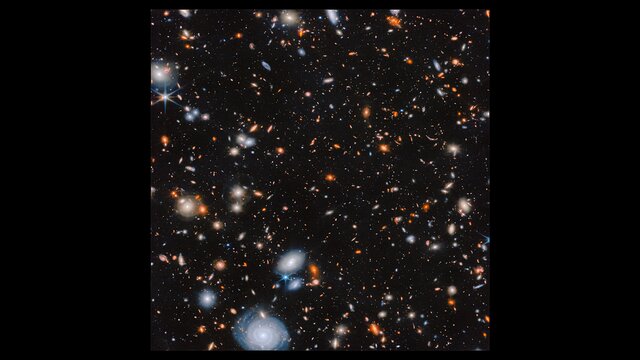
Little Red Dots (NIRCam Image)
Credits/Image: NASA, ESA, CSA, STScI, Dale Kocevski (Colby College)


In December 2022, less than six months after commencing science operations, NASA’s James Webb Space Telescope revealed something never seen before: numerous red objects that appear small on the sky, which scientists soon called “little red dots” (LRDs). Though these dots are quite abundant, researchers are perplexed by their nature, the reason for their unique colors, and what they convey about the early universe.

A team of astronomers recently compiled one of the largest samples of LRDs to date, nearly all of which existed during the first 1.5 billion years after the big bang. They found that a large fraction of the LRDs in their sample showed signs of containing growing supermassive black holes.

“We’re confounded by this new population of objects that Webb has found. We don’t see analogs of them at lower redshifts, which is why we haven’t seen them prior to Webb,” said Dale Kocevski of Colby College in Waterville, Maine, and lead author of the study. “There's a substantial amount of work being done to try to determine the nature of these little red dots and whether their light is dominated by accreting black holes.”

A Potential Peek Into Early Black Hole Growth

A significant contributing factor to the team’s large sample size of LRDs was their use of publicly available Webb data. To start, the team searched for these red sources in the Cosmic Evolution Early Release Science (CEERS) survey before widening their scope to other extragalactic legacy fields, including the JWST Advanced Deep Extragalactic Survey (JADES) and the Next Generation Deep Extragalactic Exploratory Public (NGDEEP) survey.

The methodology used to identify these objects also differed from previous studies, resulting in the census spanning a wide redshift range. The distribution they discovered is intriguing: LRDs emerge in large numbers around 600 million years after the big bang and undergo a rapid decline in quantity around 1.5 billion years after the big bang.

The team looked toward the Red Unknowns: Bright Infrared Extragalactic Survey (RUBIES) for spectroscopic data on some of the LRDs in their sample. They found that about 70 percent of the targets showed evidence for gas rapidly orbiting 2 million miles per hour (1,000 kilometers per second) – a sign of an accretion disk around a supermassive black hole. This suggests that many LRDs are accreting black holes, also known as active galactic nuclei (AGN).

“The most exciting thing for me is the redshift distributions. These really red, high-redshift sources basically stop existing at a certain point after the big bang,” said Steven Finkelstein, a co-author of the study at the University of Texas at Austin. “If they are growing black holes, and we think at least 70 percent of them are, this hints at an era of obscured black hole growth in the early universe.”

Contrary to Headlines, Cosmology Isn’t Broken

When LRDs were first discovered, some suggested that cosmology was “broken.” If all of the light coming from these objects was from stars, it implied that some galaxies had grown so big, so fast, that theories could not account for them.

The team’s research supports the argument that much of the light coming from these objects is from accreting black holes and not from stars. Fewer stars means smaller, more lightweight galaxies that can be understood by existing theories.

“This is how you solve the universe-breaking problem,” said Anthony Taylor, a co-author of the study at the University of Texas at Austin.

Curiouser and Curiouser

There is still a lot up for debate as LRDs seem to evoke even more questions. For example, it is still an open question as to why LRDs do not appear at lower redshifts. One possible answer is inside-out growth: As star formation within a galaxy expands outward from the nucleus, less gas is being deposited by supernovas near the accreting black hole, and it becomes less obscured. In this case, the black hole sheds its gas cocoon, becomes bluer and less red, and loses its LRD status.

Additionally, LRDs are not bright in X-ray light, which contrasts with most black holes at lower redshifts. However, astronomers know that at certain gas densities, X-ray photons can become trapped, reducing the amount of X-ray emission. Therefore, this quality of LRDs could support the theory that these are heavily obscured black holes.

The team is taking multiple approaches to understand the nature of LRDs, including examining the mid-infrared properties of their sample, and looking broadly for accreting black holes to see how many fit LRD criteria. Obtaining deeper spectroscopy and select follow-up observations will also be beneficial for solving this currently “open case” about LRDs.

“There’s always two or more potential ways to explain the confounding properties of little red dots,” said Kocevski. “It’s a continuous exchange between models and observations, finding a balance between what aligns well between the two and what conflicts.”

These results were presented in a press conference at the 245th meeting of the American Astronomical Society in National Harbor, Maryland, and have been accepted for publication in The Astrophysical Journal.

The James Webb Space Telescope is the world’s premier space science observatory. Webb is solving mysteries in our solar system, looking beyond to distant worlds around other stars, and probing the mysterious structures and origins of our universe and our place in it. Webb is an international program led by NASA with its partners, ESA (European Space Agency) and CSA (Canadian Space Agency).


About This Release

Credits:

Media Contact:

Abigail Major
Space Telescope Science Institute, Baltimore, Maryland

Christine Pulliam
Space Telescope Science Institute, Baltimore, Maryland

Science: Dale Kocevski (Colby College)

Permissions: Content Use Policy

Contact Us: Direct inquiries to the News Team.