Showing posts with label PKS 1830-211. Show all posts

Monday, July 06, 2015

Astronomers use cosmic gravity to create a Black-Hole-Scope

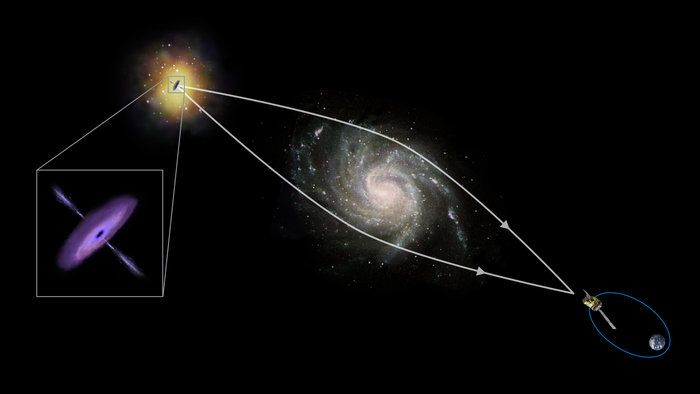
Gravitational lensing
Copyright: ESA/ATG medialab 
 
Simulated microlensing
Copyright: Courtesy of A. Neronov, ISDC, University of Geneva, Switzerland


The Integral, Fermi and Swift space observatories have used the magnifying power of a cosmic lens to explore the inner regions of a supermassive black hole. 

Gamma rays are highly energetic radiation emitted by some of the most extreme objects in our Universe. Jets of gamma rays moving at close to the speed of light stream from the areas around black holes, for example. These jets are thought to be emitted by superheated material spinning wildly as it is devoured by the hungry black hole. 

Our telescopes will never be powerful enough to reveal these inner regions, and scientists struggle to examine exactly how these jets are unleashed into the Universe.

“Because we can’t clearly see what’s going on, we don’t fully understand this behaviour,” says Andrii Neronov of the University of Geneva, Switzerland, lead author on the Nature Physics paper published online today. 

“However, our method allowed us to ‘resolve’ this region, and get an insight into the patch of space directly surrounding a supermassive black hole known as PKS 1830-211.” 

This black hole lies many billions of light-years away. Neither ESA’s Integral satellite nor NASA’s Fermi gamma-ray telescope can observe the region unaided, but a lucky coincidence provides a helping hand: gravitational microlensing. 

“From Earth, black holes are tiny. They’re just so very far away,” notes Dr Neronov. “Trying to observe PKS 1830-211 is like trying to look at an ant sitting on the Moon. 

“None of our telescopes can observe something so small, so we used a trick to resolve the ant: a huge gravitational lens.” 

Massive cosmic objects, from single stars to galaxy clusters, bend and focus the light that flows around them with their gravity, acting like giant magnifying glasses. 

Dr Neronov and colleagues used a star sitting between their target and Earth to ‘zoom in’ to the black hole and measure the size of the jet-emitting region – the first time this method has ever been used with gamma rays. 

They picked out structures on the same angular scale as that of the Moon ant. The observed patch of sky covers a region about 100 times the Earth–Sun distance. In astronomical terms, this is remarkably small. 

“Our observations demonstrate that the gamma rays come from the direct vicinity of the black hole itself,” says Dr Neronov. “This gives us some idea about what is and isn’t important in generating the jets. 

“It’s amazing to be able to see such tiny things at such enormous distances from us. I’m very excited to have a ‘black-hole-scope’ to investigate the inner regions of the jets.”

Observing the gamma-ray source with ESA’s Integral and NASA’s Fermi and Swift allowed the astronomers to build up a more complete picture of the radiation streaming out. 

The more energetic gamma rays, detected by Fermi, are seen to be coming from the tiny base of the jet – the ‘ant on the Moon’-size region – while the lower energy gamma rays, detected by Integral, were emitted from a much larger surrounding region. 

The team also studied X-rays using Integral and Swift. They found these X-rays to be emanating from a region stretching around the hole some 400 billion km or more. 

“This black hole is one of the most powerful known objects of its kind. Fully characterising its emission will hopefully give us real insight into how these jets form,” says Erik Kuulkers, ESA’s Integral project scientist.
“Fortunately, the black hole lies in the field of space located towards the centre of our Galaxy, so Integral sees it often. 

“These observations provide unique information about the high-energy processes taking place around supermassive black holes, by allowing us to ‘look inside’ tiny structures lying very far away from us.” 


Notes for Editors

The results described here are reported in “Central engine of a gamma-ray blazar resolved through the “magnifying glass” of gravitational microlensing,” by A. Neronov, I. Vovk and D. Malyshev, published online in Nature Physics on 6 July.  


For further information, please contact:

Markus Bauer


ESA Science and Robotic Exploration Communication Officer


Tel: +31 71 565 6799


Mob: +31 61 594 3 954


Email:
markus.bauer@esa.int 

Andrii Neronov
ISDC, Astronomy Department
University of Geneva
Switzerland
Tel: +41 22 379 2120
Email:
Andrii.Neronov@unige.ch

Erik Kuulkers
Integral Project Scientist
Directorate of Science and Robotic Exploration
European Space Agency
Tel: +34 918 131 358
Mob: +34 699 439 987
Email:
erik.Kuulkers@sciops.esa.int

Source: ESA


Thursday, April 16, 2015

ALMA Reveals Intense Magnetic Field Close to Supermassive Black HoleIlluminating the mysterious mechanisms at play at the edge of the event horizon

Artist’s impression of a supermassive black hole at the centre of a galaxy

Videos
 
Artist’s impression of a supermassive black hole at the centre of a galaxy


Illuminating the mysterious mechanisms at play at the edge of the event horizon 

The Atacama Large Millimeter/submillimeter Array (ALMA) has revealed an extremely powerful magnetic field, beyond anything previously detected in the core of a galaxy, very close to the event horizon of a supermassive black hole. This new observation helps astronomers to understand the structure and formation of these massive inhabitants of the centres of galaxies, and the twin high-speed jets of plasma they frequently eject from their poles. The results appear in the 17 April 2015 issue of the journal Science.

Supermassive black holes, often with masses billions of times that of the Sun, are located at the heart of almost all galaxies in the Universe. These black holes can accrete huge amounts of matter in the form of a surrounding disc. While most of this matter is fed into the black hole, some can escape moments before capture and be flung out into space at close to the speed of light as part of a jet of plasma. How this happens is not well understood, although it is thought that strong magnetic fields, acting very close to the event horizon, play a crucial part in this process, helping the matter to escape from the gaping jaws of darkness.

Up to now only weak magnetic fields far from black holes — several light-years away — had been probed [1]. In this study, however, astronomers from Chalmers University of Technology and Onsala Space Observatory in Sweden have now used ALMA to detect signals directly related to a strong magnetic field very close to the event horizon of the supermassive black hole in a distant galaxy named PKS 1830-211. This magnetic field is located precisely at the place where matter is suddenly boosted away from the black hole in the form of a jet.

The team measured the strength of the magnetic field by studying the way in which light was polarised, as it moved away from the black hole.

“Polarisation is an important property of light and is much used in daily life, for example in sun glasses or 3D glasses at the cinema,” says Ivan Marti-Vidal, lead author of this work. “When produced naturally, polarisation can be used to measure magnetic fields, since light changes its polarisation when it travels through a magnetised medium. In this case, the light that we detected with ALMA had been travelling through material very close to the black hole, a place full of highly magnetised plasma.”

The astronomers applied a new analysis technique that they had developed to the ALMA data and found that the direction of polarisation of the radiation coming from the centre of PKS 1830-211 had rotated [2]. These are the shortest wavelengths ever used in this kind of study, which allow the regions very close to the central black hole to be probed [3].

"We have found clear signals of polarisation rotation that are hundreds of times higher than the highest ever found in the Universe," says Sebastien Muller, co-author of the paper. "Our discovery is a giant leap in terms of observing frequency, thanks to the use of ALMA, and in terms of distance to the black hole where the magnetic field has been probed — of the order of only a few light-days from the event horizon. These results, and future studies, will help us understand what is really going on in the immediate vicinity of supermassive black holes.”

Notes

[1] Much weaker magnetic fields have been detected in the vicinity of the relatively inactive supermassive black hole at the centre of the Milky Way. Recent observations have also revealed weak magnetic fields in the active galaxy NGC 1275, which were detected at millimetre wavelengths.

[2] Magnetic fields introduce Faraday rotation, which makes the polarisation rotate in different ways at different wavelengths. The way in which this rotation depends on the wavelength tells us about the magnetic field in the region.

[3] The ALMA observations were at an effective wavelength of about 0.3 millimetres, earlier investigations were at much longer radio wavelengths. Only light of millimetre wavelengths can escape from the region very close to the black hole, longer wavelength radiation is absorbed.


More Information

This research was presented in a paper entitled “A strong magnetic field in the jet base of a supermassive black hole” to appear in Science on 17 April 2015


The team is composed of I. Martí-Vidal (Onsala Space Observatory and Department of Earth and Space Sciences, Chalmers University of Technology, Sweden), S. Muller (Onsala Space Observatory and Department of Earth and Space Sciences, Chalmers University of Technology, Sweden), W. Vlemmings (Department of Earth and Space Sciences and Onsala Space Observatory, Chalmers University of Technology, Sweden), C. Horellou (Department of Earth and Space Sciences, Chalmers University of Technology, Sweden) and S. Aalto (Department of Earth and Space Sciences, Chalmers University of Technology, Sweden).


The Atacama Large Millimeter/submillimeter Array (ALMA), an international astronomy facility, is a partnership of ESO, the US National Science Foundation (NSF) and the National Institutes of Natural Sciences (NINS) of Japan in cooperation with the Republic of Chile. ALMA is funded by ESO on behalf of its Member States, by NSF in cooperation with the National Research Council of Canada (NRC) and the National Science Council of Taiwan (NSC) and by NINS in cooperation with the Academia Sinica (AS) in Taiwan and the Korea Astronomy and Space Science Institute (KASI).


ALMA construction and operations are led by ESO on behalf of its Member States; by the National Radio Astronomy Observatory (NRAO), managed by Associated Universities, Inc. (AUI), on behalf of North America; and by the National Astronomical Observatory of Japan (NAOJ) on behalf of East Asia. The Joint ALMA Observatory (JAO) provides the unified leadership and management of the construction, commissioning and operation of ALMA.


ESO is the foremost intergovernmental astronomy organisation in Europe and the world’s most productive ground-based astronomical observatory by far. It is supported by 16 countries: Austria, Belgium, Brazil, the Czech Republic, Denmark, France, Finland, Germany, Italy, the Netherlands, Poland, Portugal, Spain, Sweden, Switzerland and the United Kingdom, along with the host state of Chile. ESO carries out an ambitious programme focused on the design, construction and operation of powerful ground-based observing facilities enabling astronomers to make important scientific discoveries. ESO also plays a leading role in promoting and organising cooperation in astronomical research. ESO operates three unique world-class observing sites in Chile: La Silla, Paranal and Chajnantor. At Paranal, ESO operates the Very Large Telescope, the world’s most advanced visible-light astronomical observatory and two survey telescopes. VISTA works in the infrared and is the world’s largest survey telescope and the VLT Survey Telescope is the largest telescope designed to exclusively survey the skies in visible light. ESO is a major partner in ALMA, the largest astronomical project in existence. And on Cerro Armazones, close to Paranal, ESO is building the 39-metre European Extremely Large Telescope, the E-ELT, which will become “the world’s biggest eye on the sky”.

Links

Contacts

Ivan Marti-Vidal
Onsala Space Observatory
Onsala, Sweden
Tel: +46 31 772 55 57
Email:
ivan.marti-vidal@chalmers.se

Richard Hook
ESO, Public Information Officer
Garching bei München, Germany
Tel: +49 89 3200 6655
Cell: +49 151 1537 3591
Email:
rhook@eso.org

Source: ESO