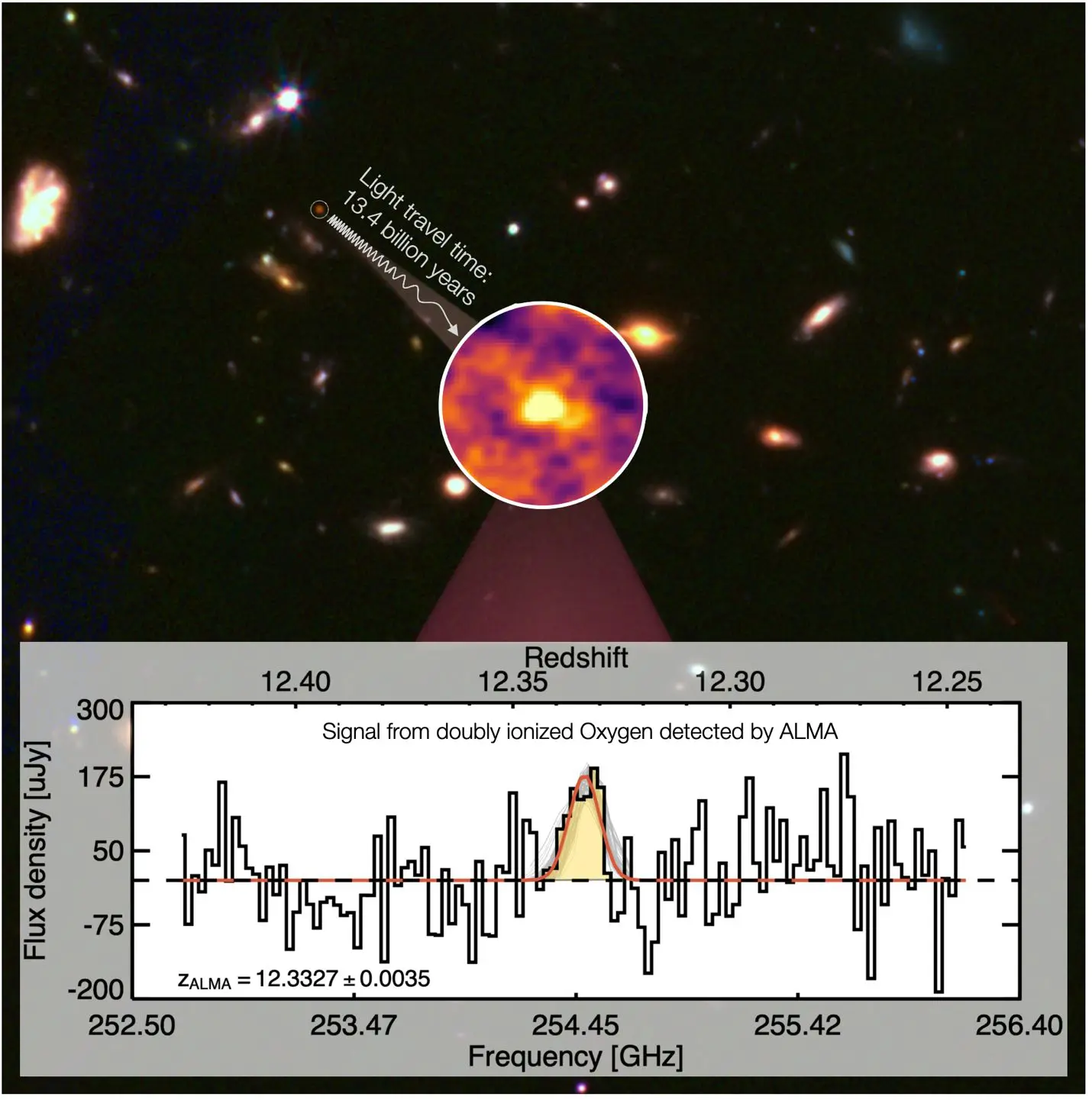
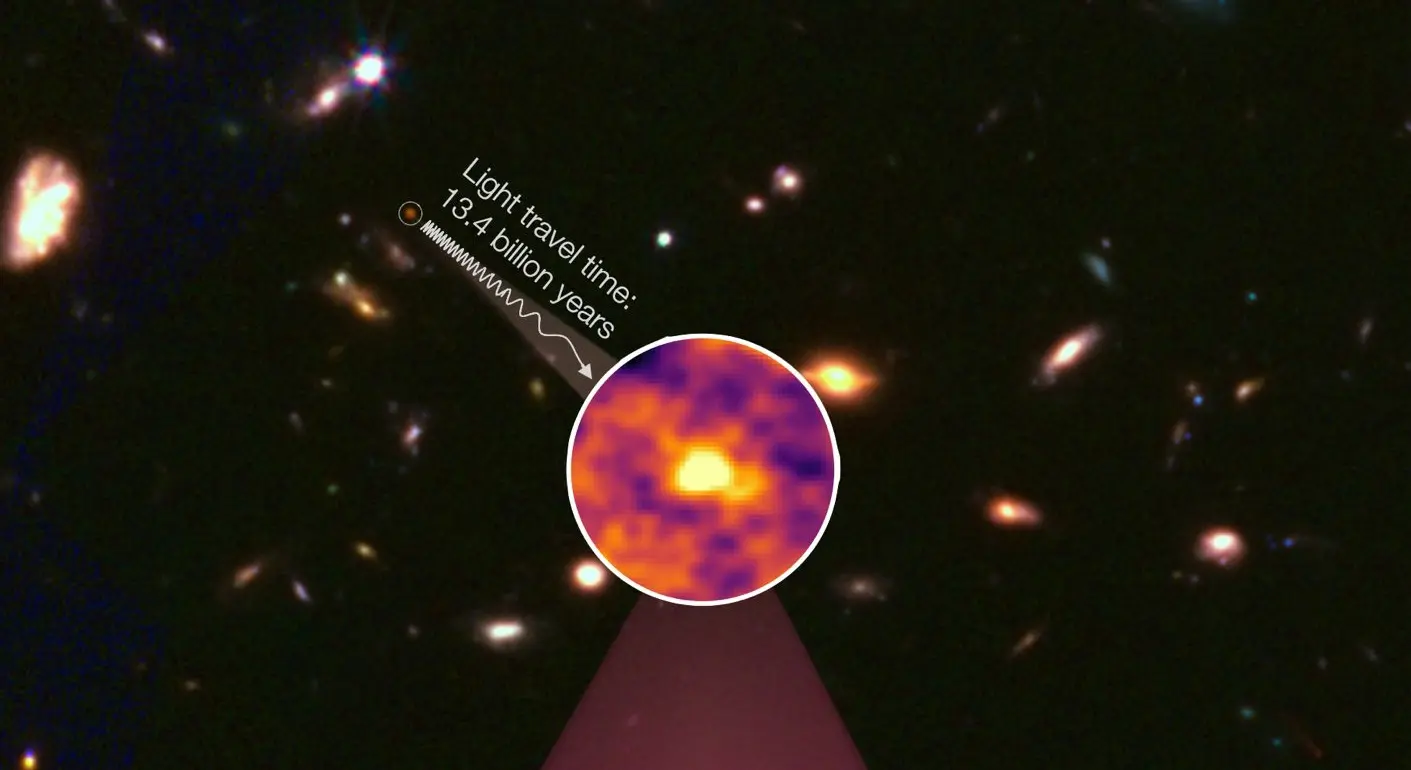
“We pointed the more than forty 12-m antennas of the Atacama Large
Millimeter/submillimeter Array (ALMA) and the 6.5-m James Webb Space
Telescope (JWST) for several hours at a sky position that would appear
empty to the naked human eye, aiming to catch a signal from one of most
distant astronomical objects known to date,” says Jorge Zavala, an
astronomer at the East Asian ALMA Regional Center at the National
Astronomical Observatory of Japan. “And successfully detected the
emission from excited atoms of different elements such as Hydrogen and
Oxygen from an epoch never reached before,” he adds. This is the first
time such emissions have been detected for distant galaxies more than 13
billion light-years away.
The start of this study goes back to the first extragalactic T observations made by JWST in 2022, from which astronomers identified a surprisingly large number of bright far-away galaxy candidates, including the target of these observations: the galaxy GHZ2 (also known as GLASS-z12).
Confirming and characterizing the physical properties of this unexpected population of bright distant objects is crucial to test our current theories of galaxy formation and evolution and understand the earliest phases of galaxies’ assembly history. However, insight into their internal physics requires detailed and sensitive astronomical observations and, particularly, spectroscopy – a technique that allows astronomers to identify specific features that can be unambiguously linked to specific atomic elements, molecules, or more complex compounds. But these observations have proven challenging for these galaxies – not surprisingly, given that they are the most distant astronomical objects ever detected.
The exquisite observations reported in these works have allowed us to gain some of the first insights into the nature of these primeval galaxies. The ALMA detection of the [OIII] 88μm transition from doubly ionized Oxygen places this galaxy at a redshift of z=12.333, approximately 400 million years after the Big Bang, when the cosmos was only 3% of its current age! This corresponds to a light travel time of 13.4 billion years – a record-breaking detection. Indeed, this is the first astronomical object detected by ALMA at z>10 and the most distant galaxy with multiple line detections across the electromagnetic spectrum to date. The availability of this dataset, in combination with the JWST observations taken with the NIRSpec and MIRI instruments, allowed for an unparalleled characterization of this object.
The team discovered that this galaxy is experiencing extreme bursts of star formation under unique conditions that differ from those of the broader population of star-forming galaxies studied over the past decades. The inferred metallicity (relative abundance of elements heavier than hydrogen) is significantly lower compared to most galaxies studies to date – an expected result given the early Universe age at the time – although it has already reached a tenth of the Solar abundance. Similarly, it has a young stellar population that might partially explain its high luminosity due to the presence of short-lived, massive, and hot stars, usually absent in more evolved galaxies.
The total mass of this galaxy of a few hundred million times the mass of the Sun, nicely constrained by the ALMA data, is encapsulated into a surprisingly small region of around (or less than) 100 pc, indicating a high stellar density like that in Globular Clusters – massive, gravitationally bound associations of ancient stars found in our galaxy and others. There are numerous similarities with this enigmatic population of objects, including low metallicity, chemical abundance anomalies, high star-formation rate surface density, and high stellar mass surface density, among others. Objects like GHZ2 could, therefore, help to explain the intriguing origin of globular clusters, whose formation has remained a mystery for many decades.
“This study is a crown on the multi-year endeavor to understand galaxies in the early Universe,” explains Tom Bakx, a researcher at Chalmers University in Sweden who previously worked at Nagoya University. These observations pave the way for future investigations of primordial objects to reveal the earliest phases of galaxy formation. “The analysis of multiple emission lines enabled several key tests of galaxy properties and demonstrates the excellent capabilities of ALMA through an exciting, powerful synergy with other telescopes like the JWST,” concluded Bakx.
The start of this study goes back to the first extragalactic T observations made by JWST in 2022, from which astronomers identified a surprisingly large number of bright far-away galaxy candidates, including the target of these observations: the galaxy GHZ2 (also known as GLASS-z12).
Confirming and characterizing the physical properties of this unexpected population of bright distant objects is crucial to test our current theories of galaxy formation and evolution and understand the earliest phases of galaxies’ assembly history. However, insight into their internal physics requires detailed and sensitive astronomical observations and, particularly, spectroscopy – a technique that allows astronomers to identify specific features that can be unambiguously linked to specific atomic elements, molecules, or more complex compounds. But these observations have proven challenging for these galaxies – not surprisingly, given that they are the most distant astronomical objects ever detected.
The exquisite observations reported in these works have allowed us to gain some of the first insights into the nature of these primeval galaxies. The ALMA detection of the [OIII] 88μm transition from doubly ionized Oxygen places this galaxy at a redshift of z=12.333, approximately 400 million years after the Big Bang, when the cosmos was only 3% of its current age! This corresponds to a light travel time of 13.4 billion years – a record-breaking detection. Indeed, this is the first astronomical object detected by ALMA at z>10 and the most distant galaxy with multiple line detections across the electromagnetic spectrum to date. The availability of this dataset, in combination with the JWST observations taken with the NIRSpec and MIRI instruments, allowed for an unparalleled characterization of this object.
The team discovered that this galaxy is experiencing extreme bursts of star formation under unique conditions that differ from those of the broader population of star-forming galaxies studied over the past decades. The inferred metallicity (relative abundance of elements heavier than hydrogen) is significantly lower compared to most galaxies studies to date – an expected result given the early Universe age at the time – although it has already reached a tenth of the Solar abundance. Similarly, it has a young stellar population that might partially explain its high luminosity due to the presence of short-lived, massive, and hot stars, usually absent in more evolved galaxies.
The total mass of this galaxy of a few hundred million times the mass of the Sun, nicely constrained by the ALMA data, is encapsulated into a surprisingly small region of around (or less than) 100 pc, indicating a high stellar density like that in Globular Clusters – massive, gravitationally bound associations of ancient stars found in our galaxy and others. There are numerous similarities with this enigmatic population of objects, including low metallicity, chemical abundance anomalies, high star-formation rate surface density, and high stellar mass surface density, among others. Objects like GHZ2 could, therefore, help to explain the intriguing origin of globular clusters, whose formation has remained a mystery for many decades.
“This study is a crown on the multi-year endeavor to understand galaxies in the early Universe,” explains Tom Bakx, a researcher at Chalmers University in Sweden who previously worked at Nagoya University. These observations pave the way for future investigations of primordial objects to reveal the earliest phases of galaxy formation. “The analysis of multiple emission lines enabled several key tests of galaxy properties and demonstrates the excellent capabilities of ALMA through an exciting, powerful synergy with other telescopes like the JWST,” concluded Bakx.
Additional Information
The results of the observations are published in the following scientific papers:
- Zavala et al. “ALMA detection of [OIII] 88um at z=12.33: Exploring the Nature and Evolution of GHZ2 as a Massive Compact Stellar System” published in the Astrophysical Journal Letters on 10 December 2024.
- Zavala et al. “A luminous and young galaxy at z = 12.33 revealed by a JWST/MIRI detection of Hα and [O III]” published in Nature Astronomy on 30 October 2024.
- Castellano et al. “JWST NIRSpec Spectroscopy of the Remarkable Bright Galaxy GHZ2/GLASS-z12 at Redshift 12.34” published in the Astrophysical Journal on 3 September 2024
- Calabro et al. “Evidence of Extreme Ionization Conditions and Low Metallicity in GHZ2/GLASS-Z12 from a Combined Analysis of NIRSpec and MIRI Observations” published in the Astrophysical Journal on 6 November 2024.
The original press release was published by the National Astronomical Observatory of Japan (NAOJ), an ALMA partner on behalf of East Asia.
The Atacama Large Millimeter/submillimeter Array (ALMA), an international astronomy facility, is a partnership of the European Organization for Astronomical Research in the Southern Hemisphere (ESO), the U.S. National Science Foundation (NSF) and the National Institutes of Natural Sciences (NINS) of Japan in cooperation with the Republic of Chile. ALMA is funded by ESO on behalf of its Member States, by NSF in cooperation with the National Research Council of Canada (NRC) and the National Science and Technology Council (NSTC) in Taiwan, and by NINS in cooperation with the Academia Sinica (AS) in Taiwan and the Korea Astronomy and Space Science Institute (KASI).
ALMA construction and operations are led by ESO on behalf of its Member States; by the National Radio Astronomy Observatory (NRAO), managed by Associated Universities, Inc. (AUI), on behalf of North America; and by the National Astronomical Observatory of Japan (NAOJ) on behalf of East Asia. The Joint ALMA Observatory (JAO) provides the unified leadership and management of the construction, commissioning, and operation of ALMA.
The Atacama Large Millimeter/submillimeter Array (ALMA), an international astronomy facility, is a partnership of the European Organization for Astronomical Research in the Southern Hemisphere (ESO), the U.S. National Science Foundation (NSF) and the National Institutes of Natural Sciences (NINS) of Japan in cooperation with the Republic of Chile. ALMA is funded by ESO on behalf of its Member States, by NSF in cooperation with the National Research Council of Canada (NRC) and the National Science and Technology Council (NSTC) in Taiwan, and by NINS in cooperation with the Academia Sinica (AS) in Taiwan and the Korea Astronomy and Space Science Institute (KASI).
ALMA construction and operations are led by ESO on behalf of its Member States; by the National Radio Astronomy Observatory (NRAO), managed by Associated Universities, Inc. (AUI), on behalf of North America; and by the National Astronomical Observatory of Japan (NAOJ) on behalf of East Asia. The Joint ALMA Observatory (JAO) provides the unified leadership and management of the construction, commissioning, and operation of ALMA.
Contacts:
Nicolás Lira
Education and Public Outreach Coordinator
Joint ALMA Observatory, Santiago - Chile
Phone: +56 2 2467 6519
Cel: +56 9 9445 7726
Email: nicolas.lira@alma.cl
Yuichi Matsuda
ALMA EA-ARC Staff Member
NAOJ
Email: yuichi.matsuda@nao.ac.jp
Jill Malusky
Public Information Officer
NRAO
Phone: +1 304-456-2236
Email: jmalusky@nrao.edu
Bárbara Ferreira
ESO Media Manager
Garching bei München, Germany
Phone: +49 89 3200 6670
Email: press@eso.org


.png)