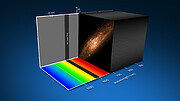
The components of the 4MOST instrument at the VISTA telescope.
© 4MOST Consortium
© 4MOST Consortium
 ,
,First light marks the start of an ambitious mission to decode the physical and chemical fingerprints of thousands of celestial objects at once.
On October 18, the 4-metre Multi-Object Spectroscopic Telescope (4MOST) facility, installed on the VISTA telescope at the European Southern Observatory’s (ESO) Paranal Observatory in Chile, obtained its first light. This milestone is a crucial step in the life of any telescope marking the moment the instrument is deemed ready to begin its scientific journey. 4MOST does not simply take images of the sky; it records spectra, capturing the light of each object in every individual colour. With this capability, it can unravel the light of 2,400 celestial objects simultaneously into 18,000 colour components, allowing astronomers to study their detailed chemical composition and physical properties. And scientists from the Max Planck Institute for Extraterrestrial Physics (MPE) play a key role in this project.
MPE was part of the 4MOST Consortium since the very beginning, and contributed both resources towards the construction of the spectrographs as well as leadership in the development of the Operations System, the complex software system that ensures efficient planning and execution of the 4MOST observations. The planning of observations is done remotely from MPE. The main scientific focus for MPE scientists is the ability of 4MOST to provide spectra and distance measurements (redshifts) for millions of X-ray sources detected by the eROSITA all-sky survey.
Andrea Merloni, PI of one of the 4MOST surveys devoted to the study of growing Supermassive Black Holes, and Local Project Manager of the Operations System team at MPE, remarks: “With the start of 4MOST Operations, a long-term vision of our team gets a step closer to reality. Finally, we will be able to connect the X-ray emission from supermassive black holes and clusters of galaxies detected by eROSITA with the three-dimensional distribution of the Large-Scale Structure, probed by the 4MOST spectroscopic measurements. The combination of these datasets will have a long-lasting legacy impact on extra-galactic astrophysics and Cosmology.”
Jake Laas, who has been involved in the development of the Operations System software over the last five years, adds: “It’s exciting that all the hard work we’ve put in toward automating such a complex survey will soon be put to the true test. The operational concepts which have been designed and implemented for 4MOST as a joint effort between the Consortium and ESO resulted in many unique solutions.”
The 4MOST science team consists of more than 700 investigators from universities and research institutes around the world. The Leibniz-Institut für Astrophysik Potsdam (AIP) is the lead institute of the 4MOST Consortium that has built and will scientifically operate the facility. Next to overall management, AIP has been involved in many aspects of the facility, like its wide field camera with six lenses that are up to 90 cm in diameter, its guiding and focussing system, and its fibre system that contain more than 2500 glass fibres, each with a diameter of a human hair. AIP is also strongly involved in determining 4MOST’s operations scheme, including observing planning and data archiving.
The Principal Investigator for 4MOST, Roelof de Jong from the AIP, remarks: “It is incredible to see the first spectra from our new instrument. The data looks fantastic from the start and bodes well for all the different science projects we want to execute. That we can catch the light that has travelled sometimes for billions of light years into a glass fibre the size of a hair is mindboggling.”
On October 18, the 4-metre Multi-Object Spectroscopic Telescope (4MOST) facility, installed on the VISTA telescope at the European Southern Observatory’s (ESO) Paranal Observatory in Chile, obtained its first light. This milestone is a crucial step in the life of any telescope marking the moment the instrument is deemed ready to begin its scientific journey. 4MOST does not simply take images of the sky; it records spectra, capturing the light of each object in every individual colour. With this capability, it can unravel the light of 2,400 celestial objects simultaneously into 18,000 colour components, allowing astronomers to study their detailed chemical composition and physical properties. And scientists from the Max Planck Institute for Extraterrestrial Physics (MPE) play a key role in this project.
MPE was part of the 4MOST Consortium since the very beginning, and contributed both resources towards the construction of the spectrographs as well as leadership in the development of the Operations System, the complex software system that ensures efficient planning and execution of the 4MOST observations. The planning of observations is done remotely from MPE. The main scientific focus for MPE scientists is the ability of 4MOST to provide spectra and distance measurements (redshifts) for millions of X-ray sources detected by the eROSITA all-sky survey.
Andrea Merloni, PI of one of the 4MOST surveys devoted to the study of growing Supermassive Black Holes, and Local Project Manager of the Operations System team at MPE, remarks: “With the start of 4MOST Operations, a long-term vision of our team gets a step closer to reality. Finally, we will be able to connect the X-ray emission from supermassive black holes and clusters of galaxies detected by eROSITA with the three-dimensional distribution of the Large-Scale Structure, probed by the 4MOST spectroscopic measurements. The combination of these datasets will have a long-lasting legacy impact on extra-galactic astrophysics and Cosmology.”
Jake Laas, who has been involved in the development of the Operations System software over the last five years, adds: “It’s exciting that all the hard work we’ve put in toward automating such a complex survey will soon be put to the true test. The operational concepts which have been designed and implemented for 4MOST as a joint effort between the Consortium and ESO resulted in many unique solutions.”
The 4MOST science team consists of more than 700 investigators from universities and research institutes around the world. The Leibniz-Institut für Astrophysik Potsdam (AIP) is the lead institute of the 4MOST Consortium that has built and will scientifically operate the facility. Next to overall management, AIP has been involved in many aspects of the facility, like its wide field camera with six lenses that are up to 90 cm in diameter, its guiding and focussing system, and its fibre system that contain more than 2500 glass fibres, each with a diameter of a human hair. AIP is also strongly involved in determining 4MOST’s operations scheme, including observing planning and data archiving.
The Principal Investigator for 4MOST, Roelof de Jong from the AIP, remarks: “It is incredible to see the first spectra from our new instrument. The data looks fantastic from the start and bodes well for all the different science projects we want to execute. That we can catch the light that has travelled sometimes for billions of light years into a glass fibre the size of a hair is mindboggling.”
4MOST_First-Observation
From ESO's VISTA telescope in Chile to the First Light sky region. Here, 4MOST used its 2400 fibres to capture the light of many different objects for further spectral analysis, including the centre of the Sculptor Galaxy, stars in the globular cluster NGC288 and the active core of a distant galaxy.
Once fully operational, 4MOST will investigate the formation and evolution processes of stars and planets, the Milky Way and other galaxies, black holes and other exotic objects, and of the Universe as a whole. By analysing the detailed rainbow-like colours of thousands of objects every 10–20 minutes, 4MOST will build a catalogue of distances, temperatures, chemical compositions, velocities and many more physical parameters of tens of millions of objects spread across the entire Southern sky.
The First Light observations exemplify the unique capabilities of 4MOST: its ability to observe a very large field of view and its capability to investigate a large number of very different objects and science cases simultaneously in great detail. One of the objects dominating the First Light observation of 4MOST is the elongated galaxy NGC253, also called the Sculptor or Silver Coin galaxy, which was discovered by Caroline Herschel in 1783 and is at a distance of about 11.5 million lightyears.
The other large object seen in the field is the Globular Cluster NGC288, a very dense group of about 100,000 very old stars in the outskirts of the Milky Way. It formed about 13.5 billion years ago in the very earliest phases of the formation of the Milky Way. Its stars contain very small amounts of most chemical elements heavier than hydrogen and helium, reflecting it’s pristine composition.
Once fully operational, 4MOST will investigate the formation and evolution processes of stars and planets, the Milky Way and other galaxies, black holes and other exotic objects, and of the Universe as a whole. By analysing the detailed rainbow-like colours of thousands of objects every 10–20 minutes, 4MOST will build a catalogue of distances, temperatures, chemical compositions, velocities and many more physical parameters of tens of millions of objects spread across the entire Southern sky.
The First Light observations exemplify the unique capabilities of 4MOST: its ability to observe a very large field of view and its capability to investigate a large number of very different objects and science cases simultaneously in great detail. One of the objects dominating the First Light observation of 4MOST is the elongated galaxy NGC253, also called the Sculptor or Silver Coin galaxy, which was discovered by Caroline Herschel in 1783 and is at a distance of about 11.5 million lightyears.
The other large object seen in the field is the Globular Cluster NGC288, a very dense group of about 100,000 very old stars in the outskirts of the Milky Way. It formed about 13.5 billion years ago in the very earliest phases of the formation of the Milky Way. Its stars contain very small amounts of most chemical elements heavier than hydrogen and helium, reflecting it’s pristine composition.
About 4MOST
4MOST is the largest multi-object spectroscopic
survey facility in the southern hemisphere and is unique in its
combination of large field of view, number of simultaneous observed
objects, and number of spectral colours simultaneously registered.
Development started in 2010 and the facility has been designed to
operate for at least the next 15 years.
The 4MOST Consortium
The 4MOST facility is designed, built, and scientifically operated by a Consortium of 30 universities and research institutes in Europe and Australia under leadership of the Leibniz Institute for Astrophysics Potsdam (AIP). The main institutes involved in building and operating of the facility are:
- Leibniz Institute for Astrophysics Potsdam (AIP): consortium lead, telescope corrector and guiding system, metrology, control software, fibre system, and archive system,
- Macquarie University / Australian Astronomical Optics (AAO): fibre positioner,
- Centre de Recherche Astrophysique de Lyon (CRAL): low-resolution spectrographs,
- European Southern Observatory (ESO): detector systems
- Max Planck Institute for Astronomy (MPIA): instrument control hardware
- Max Planck Institute for Extraterrestrial Physics (MPE): observation planning and remote operations,
- Nederlandse Onderzoekschool Voor Astronomie (NOVA): calibration system,
- University of Cambridge, Institute of Astronomy (IoA): data management,
- Universität Hamburg (UHH), Hamburger Sternwarte: archive and user management,
- Universität Heidelberg, Zentrum für Astronomie (ZAH): high-resolution spectrograph and instrument control software.
Contacts:
Dr. Andrea Merloni
Senior Scientist Highenergy Group; PI eROSITA
Tel: +49 89 30000-3893
Email: am@mpe.mpg.de
Max Planck Institute for Extraterrestrial Physics
Dr. Jake Laas
Tel: +49 89 30000-3812
Email: jclaas@mpe.mpg.de
Max Planck Institute for Extraterrestrial Physics
Further Information:
4MOST Project website
4MOST to follow up on eROSITA sources
On 6 March, a series of White Papers was published to introduce the 4MOST survey program to the scientific community. The 4-metre Multi-Object Spectroscopic Telescope 4MOST will be the largest
spectroscopic survey facility of its kind in the Southern hemisphere and
will address today’s most pressing astronomical questions in the fields
of Galactic archaeology, high-energy astrophysics, galaxy evolution
and cosmology, starting its public survey program in 2022. MPE has
contributed two of the White Papers with the aim of using 4MOST to the
followup of eROSITA sources in two major surveys dedicated to Active
Galactic Nuclei and Clusters of Galaxies, respectively.
more
The X-ray sky opens to the world
January 31, 2024
First eROSITA sky-survey data release makes public the largest ever catalogue of high-energy cosmic sources
more
The X-ray sky opens to the world
January 31, 2024
First eROSITA sky-survey data release makes public the largest ever catalogue of high-energy cosmic sources
eROSITA relaxes cosmological tension
February 14, 2024
Results from the first X-ray sky survey resolve the previous inconsistency between competing measurements of the structure of the Universe
more
Unveiling the 'Ghost' Baryonic Matter
November 19, 2024
A team of scientists from the Max Planck Institute for Extraterrestrial Physics (MPE) has shed light on one of the most elusive components of the universe: the warm-hot intergalactic medium (WHIM).
moreFebruary 14, 2024
Results from the first X-ray sky survey resolve the previous inconsistency between competing measurements of the structure of the Universe
more
Unveiling the 'Ghost' Baryonic Matter
November 19, 2024
A team of scientists from the Max Planck Institute for Extraterrestrial Physics (MPE) has shed light on one of the most elusive components of the universe: the warm-hot intergalactic medium (WHIM).
Cosmic dance of the ‘Space Clover’
April 30, 2024
A group led by MPE has, for the first time, detected X-ray gas at
the location of the cloverleaf ORC, an odd radio circle (ORC). The
origin of ORCs is unknown; in the case of the cloverleaf ORC, the
combined data from different wavelengths indicate that the emission is
due to a merger of two small galaxy groups.
more
more