Showing posts with label NGC 2023. Show all posts

Friday, May 17, 2019

The Birth of the Hunter

NGC 2023
Credit: ESO

The constellation of Orion (The Hunter) is one of the most recognisable collections of stars in the night sky. We have noted Orion’s prominent stars for tens of thousands of years at least, and likely far longer. Chinese astronomers called it 参宿 or Shēn, literally “three stars”, for its three bright dots (which form the Hunter’s belt). The ancient Egyptians regarded it as the gods Sah and Sopdet, manifestations of Osiris and Isis, respectively, whereas Greek astronomers saw a brave hunter — the eponymous Orion — with his sword above his head, ready to strike.

Mythology aside, Orion is a fascinating patch of sky. This image, from ESO's Very Large Telescope, shows a reflection nebula nestled at the heart of the constellation — NGC 2023. Located close to the well-known Horsehead and Flame Nebulae, NGC 2023 lurks about 1500 light-years away from Earth, and is one of the largest reflection nebulae in the sky.

Reflection nebulae are clouds of interstellar dust that reflect the light from nearby or internal sources, like fog around a car headlight. NGC 2023 is illuminated by a massive young star named HD 37903. The star is extremely hot — several times hotter than the Sun — and its bright blue-white light causes NGC 2023’s milky glow. Such nebulae are often the birthplaces of stars, and contain a clumpy distribution of gas that’s significantly denser than the surrounding medium. Under the influence of gravity, these clumps attract one another and merge, eventually creating a new star. In a few million years time, Orion's Belt may gain a new star!

The image was taken with the VLT’s FORS (FOcal Reducer and Spectrograph) instrument as part of the ESO Cosmic Gems programme. This initiative produces images of interesting and visually attractive objects using ESO telescopes, for the purposes of education and outreach. The programme makes use of telescope time that cannot be used for science observations. All data collected may also be suitable for scientific purposes, and are made available to astronomers through ESO’s science archive.

Source: ESO/Potw


Monday, December 22, 2014

Horsehead of a Different Color

The famous Horsehead nebula of visible-light images (inset) looks quite different when viewed in infrared light, as seen in this newly released image from NASA's Spitzer Space Telescope. Image credit: NASA/JPL-Caltech/ESO› Full image and caption


Sometimes a horse of a different color hardly seems to be a horse at all, as, for example, in this newly released image from NASA's Spitzer Space Telescope. The famous Horsehead nebula makes a ghostly appearance on the far right side of the image, but is almost unrecognizable in this infrared view. In visible-light images, the nebula has a distinctively dark and dusty horse-shaped silhouette, but when viewed in infrared light, dust becomes transparent and the nebula appears as a wispy arc.

The Horsehead is only one small feature in the Orion Molecular Cloud Complex, dominated in the center of this view by the brilliant Flame nebula (NGC 2024). The smaller, glowing cavity falling between the Flame nebula and the Horsehead is called NGC 2023. These regions are about 1,200 light-years away.

The two carved-out cavities of the Flame nebula and NGC 2023 were created by the destructive glare of recently formed massive stars within their confines. They can be seen tracing a spine of glowing dust that runs through the image.

The Flame nebula sits adjacent to the star Alnitak, the westernmost star in Orion's belt, seen here as the bright blue dot near the top of the nebula.

In this infrared image from Spitzer, blue represents light emitted at a wavelength of 3.6-microns, and cyan (blue-green) represents 4.5-microns, both of which come mainly from hot stars. Green represents 8-micron light and red represents 24-micron light. Relatively cooler objects, such as the dust of the nebulae, appear green and red. Some regions along the top and bottom of the image extending beyond Spitzer's observations were filled in using data from NASA's Wide-field Infrared Survey Explorer, or WISE, which covered similar wavelengths across the whole sky.

NASA's Jet Propulsion Laboratory, Pasadena, California, manages the Spitzer Space Telescope mission for NASA's Science Mission Directorate, Washington. Science operations are conducted at the Spitzer Science Center at the California Institute of Technology in Pasadena. Spacecraft operations are based at Lockheed Martin Space Systems Company, Littleton, Colorado. Data are archived at the Infrared Science Archive housed at the Infrared Processing and Analysis Center at Caltech. Caltech manages JPL for NASA. 

For more information about Spitzer, visit: http://spitzer.caltech.edu - http://www.nasa.gov/spitzer


Media Contact

Whitney Clavin
Jet Propulsion Laboratory, Pasadena, Calif.
818-354-4673

whitney.clavin@jpl.nasa.gov

Source: JPL-Caltech


Monday, July 25, 2011

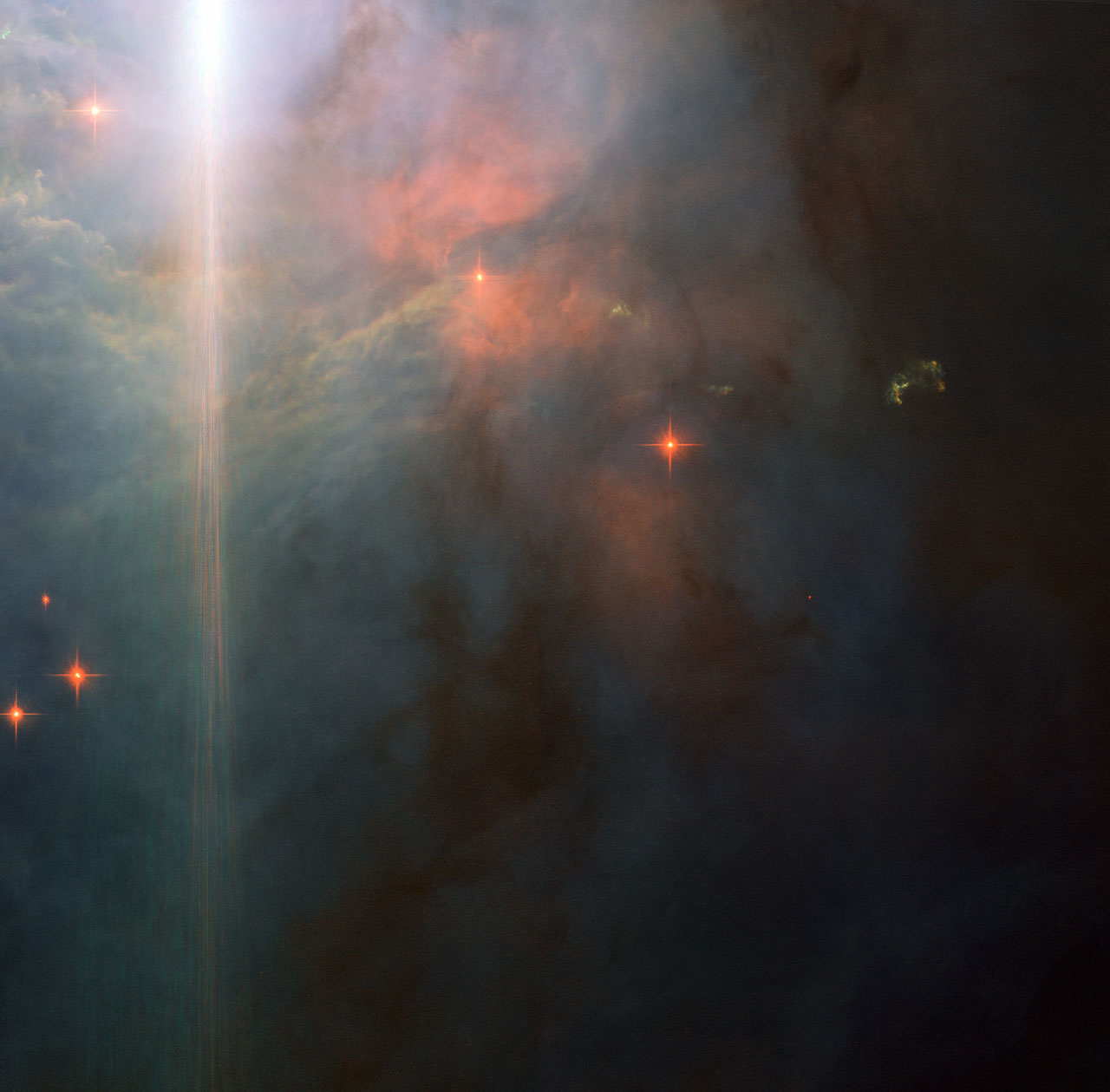
Sunset Glow in Orion

NGC 2023
Credit: ESA/Hubble & NASA
Click to Enlarge

The magnificent reflection nebula NGC 2023 lies nearly 1500 light-years from Earth. It is located within the constellation of Orion (The Hunter), in a prestigious area of the sky close to the well-known Flame and Horsehead Nebulae. The entire structure of NGC 2023 is vast, at four light-years across. This NASA/ESA Hubble Space Telescope picture just takes in the southern part, with the subtle shades of colour closely resembling those of a sunset on Earth.


NGC 2023 surrounds a massive young B-type star. These stars are large, bright and blue-white in colour, and have a high surface temperature, being several times hotter than the Sun. The energy emitted from NGC2023’s B-type star illuminates the nebula, resulting in its high surface brightness: good news for astronomers who wish to study it. The star itself lies outside the field of view, at the upper left, and its brilliant light is scattered by Hubble’s optical system, creating the bright flare across the left side of the picture, which is not a real feature of the nebula.

Stars are forming from the material comprising NGC 2023. This Hubble image captures the billowing waves of gas, 5000 times denser than the interstellar medium. The unusual greenish clumps are thought to be Herbig–Haro objects. These peculiar features of star-forming regions are created when gas ejected at hundreds of kilometres per second from newly formed stars impacts the surrounding material. These shockwaves cause the gas to glow and result in the strange shapes seen here. Herbig–Haro objects typically only last for a few thousand years, which is the blink of eye in astronomical terms.

This picture was created from multiple images taken with the Wide Field Camera of Hubble’s Advanced Camera for Surveys. Exposures through a blue filter (F475W) are coloured blue, exposures through a yellow filter (F625W) are coloured green and images through a near-infrared filter (F850LP) are shown as red. The total exposure times per filter are 800 s, 800 s and 1200 s, respectively, and the field of view spans 3.2 arcminutes.