Credit: X-ray: NASA/CXC/Rutgers/J. Hughes et al.;
Infrared: NASA/ESA/CSA, J.M. Diego (IFCA), B.Frye (Univ. of Arizona), P.Kamieneski, T.Carleton & R.Windhorst (ASU);
Image processing: X-ray: L. Frattare; J. Major, K.Arcand (SAO).
Infrared: A.Pagan (STScI), J.Summers (ASU), J.C.J.D'Silva (UWA), A.M.Koekemoer (STScI), A.Robotham (UWA), R.Windhorst (ASU)
When astronomers discovered the galaxy cluster ACT-CL J0102-4915 in
2012 with NASA's Chandra X-ray Observatory and ground-based optical
telescopes, they nicknamed it "El Gordo" (Spanish for the "Fat One")
because of its gigantic mass. Scientists estimate that El Gordo contains
as much as 3 million billion (3,000,000,000,000,000) times the mass of
the Sun. Thanks to its heft, El Gordo acts as a natural lens, distorting
the light from more distant objects behind it through a process known
as gravitational lensing.
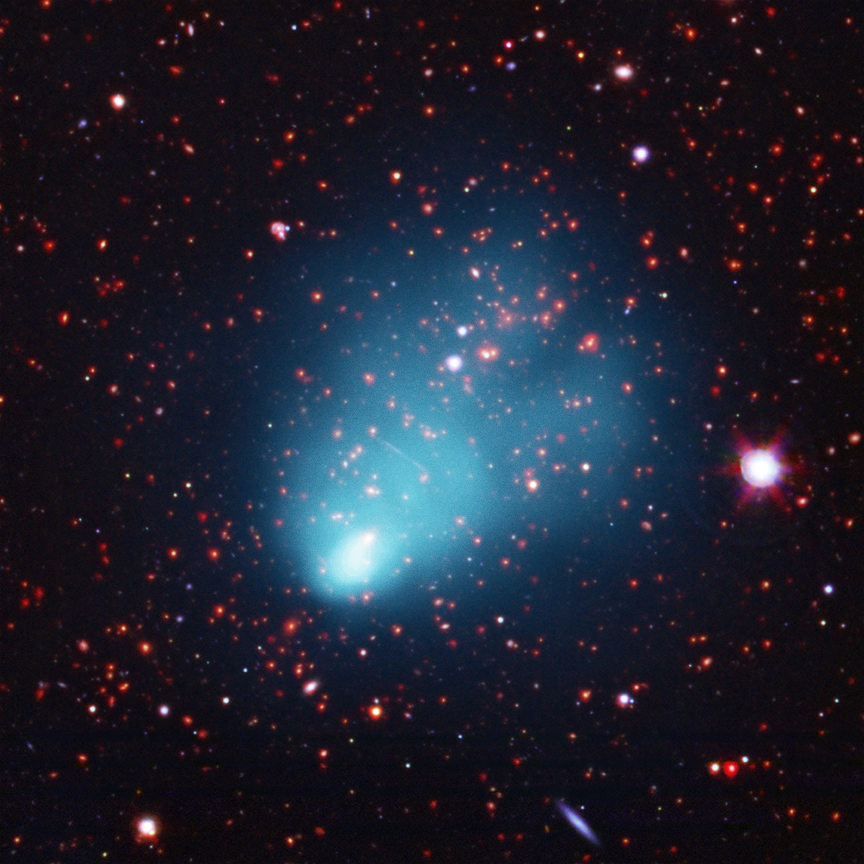
A new composite image of El Gordo shows the diffuse, superheated gas in the cluster observed in X-rays from Chandra (blue) that have been combined with a new infrared image from NASA's James Webb Space Telescope (red, green, and blue). Webb's image shows galaxies in El Gordo plus background galaxies located further away from Earth. El Gordo is located about 7.3 billion light-years from Earth and the background galaxies are at a range of different distances including several that are 12.3 billion light-years from Earth. The appearance of some of the background galaxies has been distorted into a variety of unusual and highly elongated shapes because of gravitational lensing by the cluster.
The X-ray image of El Gordo reveals a distinct cometary appearance. Along with optical data, astronomers reported in 2012 that this shape implies El Gordo is, in fact, the site of two galaxy clusters that ran into one another at several million miles per hour. The same study also used Chandra and other observatories to show that El Gordo is the most massive, and produces the most X-rays, of any known galaxy cluster at its distance or beyond.
Four new papers discussing the Webb observations have recently been accepted, including two that discuss Chandra data. Newer Chandra observations obtained after the 2012 study increase the exposure time by a factor of six, providing much more detailed information about the density and temperature of the cluster’s hot gas. Those Chandra-inclusive papers are led by Brenda Frye (University of Arizona) and Jose Diego (Instituto de Fisica de Cantabria, Spain). All four papers are part of the JWST “Prime Extragalactic Areas for Reionization and Lensing Science” (PEARLS) project led by Rogier Windhorst of Arizona State University. Highlights of the results from the papers are described in a press release from Space Telescope Science Institute.
NASA's Marshall Space Flight Center manages the Chandra program. The Smithsonian Astrophysical Observatory's Chandra X-ray Center controls science operations from Cambridge, Massachusetts, and flight operations from Burlington, Massachusetts.
Source: NASA’s Chandra X-ray Observatory
Visual Description:
The primary image in today's release features a field of distant galaxies and stars with a bright blue, cone-shaped cloud at its core. The cloud is superheated gas in the galaxy cluster known as "El Gordo", meaning "Fat One" in Spanish. "El Gordo" is an immensely hefty galaxy cluster, with a mass as much as 3 million billion times the mass of the Sun.
In this composite image, the bright blue cloud has a cometary appearance, meaning it resembles a comet and its tail, with a bright tip that fades as the cone-shape widens. Here, the bright tip is positioned near our lower left, with the fading conical shape widening toward our upper right. In this image, the color blue represents X-ray light observed by Chandra. The properties of the gas cloud suggests a multi-million mile an hour collision of two galaxy clusters. This collision produces more X-rays than any other galaxy cluster observed at its distance or beyond.
Throughout the gas cloud, and in the background, are thousands of distant galaxies and stars, in whites, golden oranges, and blues. From this distance, some resemble simple specks of light. Others are slightly larger and feature refraction spikes, or upon close inspection, discernible spiraling arms. Many of the distant galaxies behind the cluster appear distorted or elongated. This visual distortion is due to El Gordo's great mass, which bends the light of these galaxies and distorts their appearance.
Fast Facts for ACT J0102-4915 (El Gordo):
Scale: Image is about 2.3 arcmin (6 million light-years) across.
Category: Groups & Clusters of Galaxies
Coordinates (J2000): RA 01h 02m 52.50s | Dec -49° 14´ 58.00"
Constellation: Phoenix
Observation Dates: 3 pointings between 26 Jan 2011 and 21 Feb 2012
Observation Time: 97 hours 30 minutes (4 days 1 hour 30 minutes)
Obs. ID: 12258, 14022, 14023
Instrument: ACIS
Also Known As: ACT-CL J0102-4915
References: Frye, B. et al. 2023, ApJ, 952, 81 (preprint: arXiv:2303.03556); Diego, J. et al. 2023, A&A, 672, 3 (preprint: arXiv:2210.06514)
Color Code: X-ray: blue; Infrared: red, green, blue
Distance Estimate: About 7.3 billion light-years (z=0.87)
Distance Estimate: About 7.3 billion light-years (z=0.87)