Showing posts with label Fornax constellation. Show all posts

Tuesday, February 10, 2026

NASA Telescopes Spot Surprisingly Mature Cluster in Early Universe

JADES-ID1
Credit X-ray: NASA/CXC/CfA/Á Bogdán; Infrared (JWST): NASA/ESA/CSA/STScI;
Image Processing: NASA/CXC/SAO/P. Edmonds and L. Frattare


  • A galaxy cluster pulling itself together has been spotted at a much earlier time in the universe than expected.

  • This “protocluster” is located about 12.7 billion light-years from Earth, or only about 1 billion years after the big bang.

  • Astronomers needed to combine data from NASA’s Chandra and James Webb Space telescopes to find and identify this protocluster.

  • Galaxy clusters are some of the largest structures in the universe and understanding how and when they form is crucial.


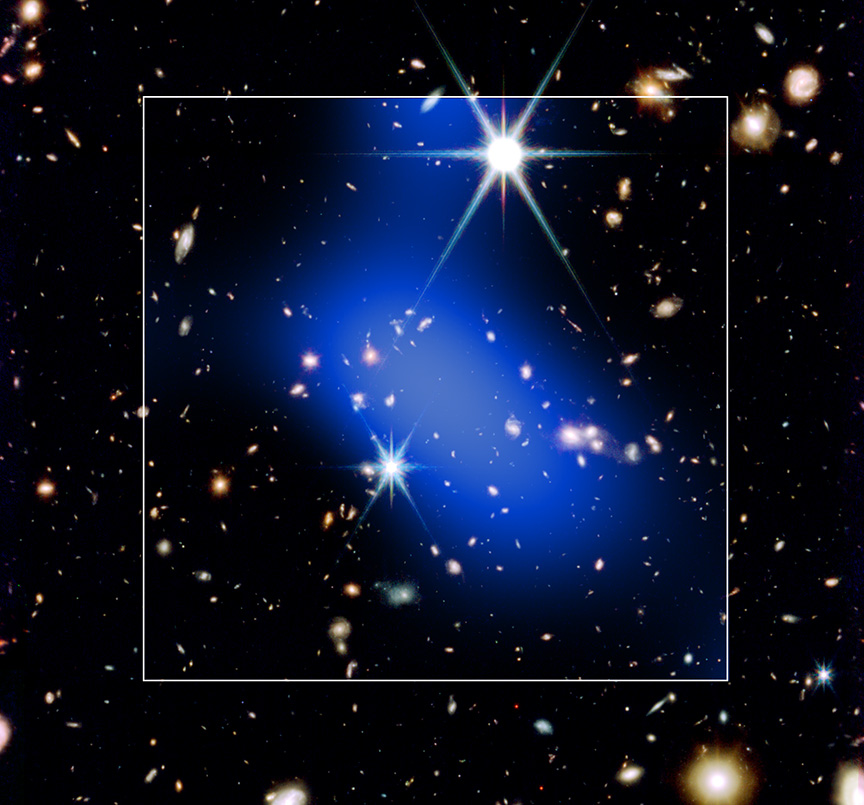
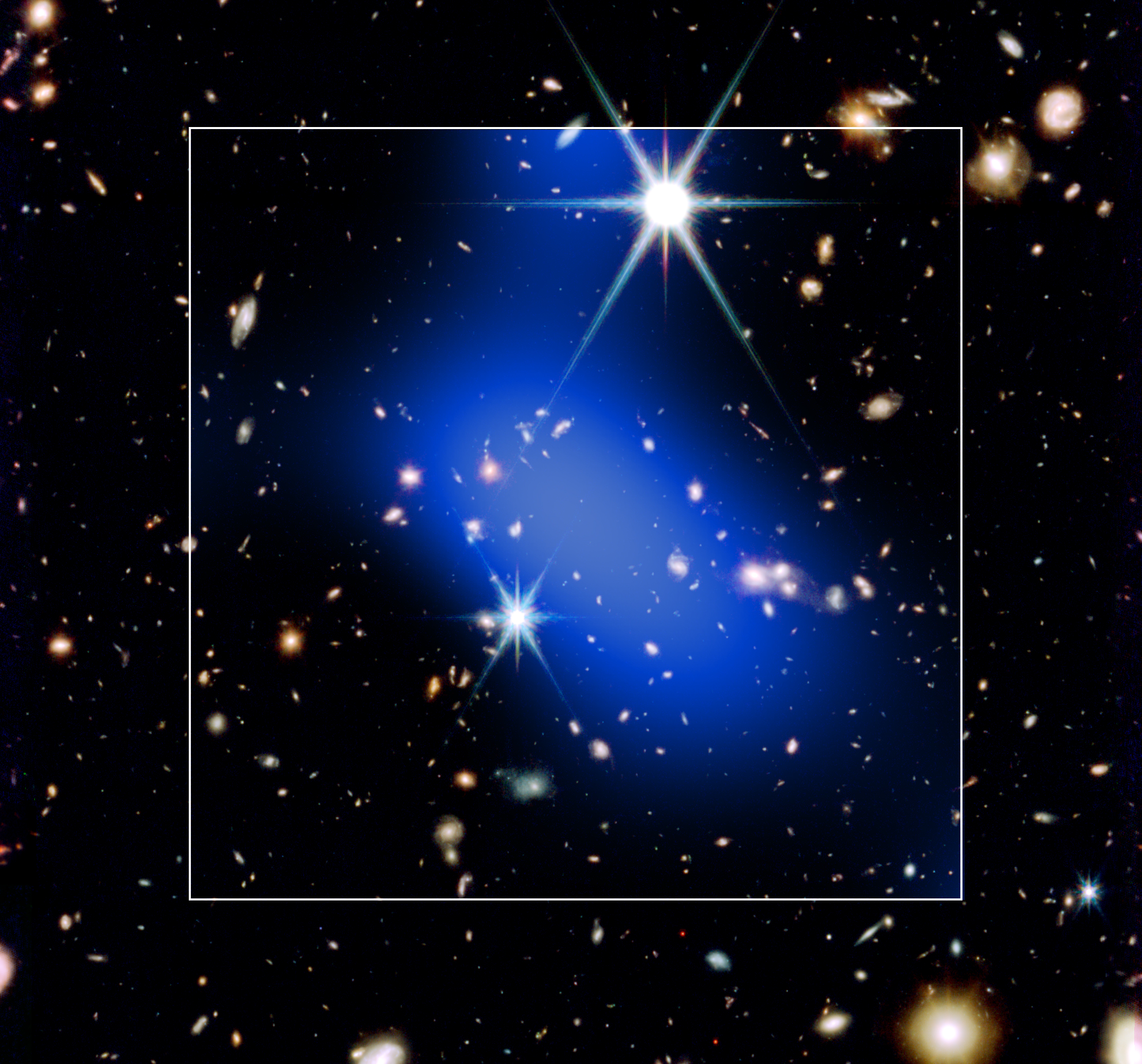
  • This graphic represents the discovery of what may be the most distant protocluster ever found, as described in our latest press release. By using NASA’s Chandra X-ray Observatory together with the James Webb Space Telescope (JWST), astronomers have netted an important piece in the history of the universe: when galaxy clusters, the largest structures held together by gravity, begin to form.

    The main panel contains an infrared image from the JWST Advanced Deep Extragalactic Survey (JADES), a deep infrared imaging project that used more than a month of the telescope’s observing time. The white box outlines X-rays (blue) seen with Chandra.

    The newly-discovered protocluster, dubbed JADES-ID1, is located about 12.7 billion light-years from Earth, or just about a billion years after the big bang. It has a mass of about 20 trillion suns and two important characteristics of a protocluster: a large number of galaxies held together by gravity (Webb sees at least 66 potential members) and a huge cloud of hot gas (detected by Chandra). So that only X-rays from the protocluster are included, only X-rays inside the white box are shown. The annotated version of the image shows circles where astronomers find some of the individual galaxies in JADES-ID1.

    Most models of the universe predict that there likely would not be enough time and a large enough density of galaxies for a protocluster of this size to form at this epoch in the early universe. The previous record holder for a protocluster with X-ray emission is seen much later, about three billion years after the big bang. Therefore, the discovery of JADES-ID1 will force scientists to re-examine their ideas for how galaxy clusters — gigantic collections of galaxies, hot gas, and dark matter — first appeared in the universe.

    To find JADES-ID1, astronomers combined deep observations from both Chandra and Webb. By design, the JADES field overlaps with the Chandra Deep Field South, the site of the deepest X-ray observation ever conducted. This field is thus one of the few in the entire sky where a discovery such as this could be made. The researchers found five other proto-cluster candidates in the JADES field, but only in JADES-ID1 are the galaxies seen to be embedded in hot gas. Only JADES-ID1 possesses enough mass for an X-ray signal from hot gas to be expected.

    A paper describing these results appears in the latest issue of the journal Nature and is available here. The authors of the study are Akos Bogdan and Gerritt Schellenberger (Center for Astrophysics | Harvard & Smithsonian) and Qiong Li and Christopher Conselice (University of Manchester in the United Kingdom).

    The earlier study led by Li was published in the Monthly Notices of the Royal Astronomical Society.

    NASA's Marshall Space Flight Center in Huntsville, Alabama, manages the Chandra program. The Smithsonian Astrophysical Observatory's Chandra X-ray Center controls science operations from Cambridge, Massachusetts, and flight operations from Burlington, Massachusetts.


    Visual Description:

    This composite image features what may be the most distant protocluster ever found; a region of space where a large number of young galaxies are being held together by gravity and hot gas. The image is presented twice, once with, and once without, annotations.

    The image includes scores of glowing dots and specks of light, in white and golden hues, set against the blackness of space. This layer of the composite visual is from a deep infrared imaging project undertaken by the James Webb Space Telescope. The specks range from relatively large oval galaxies with discernible spiral arms, and glowing balls with gleaming diffraction spikes, to minuscule pinpoints of distant light. Several of those pinpoints have been circled in the annotated image, as they are part of the distant protocluster.

    Layered onto the center of this image is a neon blue cloud. This cloud represents hot X-ray gas discovered by Chandra in the deepest X-ray observation ever conducted. In the annotated image, a thin white square surrounds the blue cloud. This represents Chandra’s field of observation. The X-rays from the distant protocluster located within this box are included in the composite image.

    The protocluster, dubbed JADES-1, has a mass of about 20 trillionsuns. It is located some 12.7 billion light-years from Earth, or just a billion years after the big bang. The discovery of a protocluster of this size, at this epoch in the early universe, will lead scientists to re-examine their ideas for how galaxy clusters first appeared in the niverse.


    Fast Facts for JADES-ID1:

    Credit: X-ray: NASA/CXC/CfA/Á Bogdán; Infrared (JWST): NASA/ESA/CSA/STScI; Image Processing: NASA/CXC/SAO/P. Edmonds and L. Frattare
    Release Date: January 28, 2026
    Scale: Image is about 54 arcsec (1.1 million light-years) across.
    Category: Groups & Clusters of Galaxies
    Coordinates (J2000): RA 3h 32m 31.75s | Dec -27° 46´ 51.5"
    Constellation: Fornax
    Observation Dates: 99 observations from May 2000 to Feb 2016
    Observation Time: 1743 hours 36 minutes (72 days, 15 hours, 36 minutes)
    Obs. ID: 441, 582, 1672, 2239, 2312, 1213, 2405, 2406, 2409, 8591-8597, 9575, 9578, 9593, 9596, 9718, 12044-12055, 12123, 12128, 12129, 12135, 12137, 12138, 12213, 12218-12223, 12227, 12230-12234, 16175-16191, 16450-16463, 16620, 16641, 16644, 17416, 17417, 17535, 17546, 17552, 17556, 17573, 17633, 17634, 17677, 18709, 18719, 18730
    Instrument: ACIS
    References: Bogdán, Á; et al. 2026, Nature, in press. Available here.
    Color Code: X-ray: blue; Infrared: red, green, blue
    Distance Estimate: About 12.7 billion light-years from Earth (z~5.7)


    Wednesday, September 24, 2025

    NASA's Chandra Finds Black Hole With Tremendous Growth

    Illustration and X-ray Image of RACS J0320-35
    Credit: X-ray: NASA/CXC/INAF-Brera/L. Ighina et al.; Illustration: NASA/CXC/SAO/M. Weiss;
    Image Processing: NASA/CXC/SAO/N. Wolk


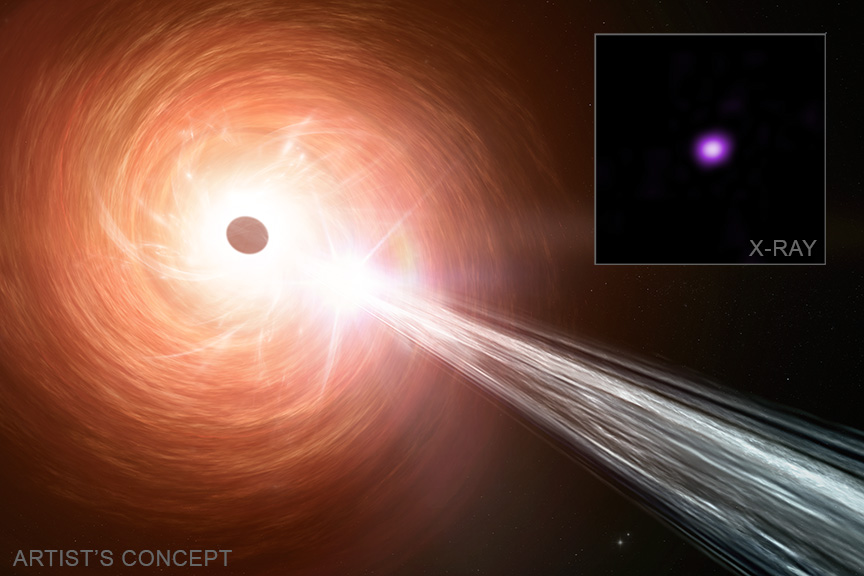
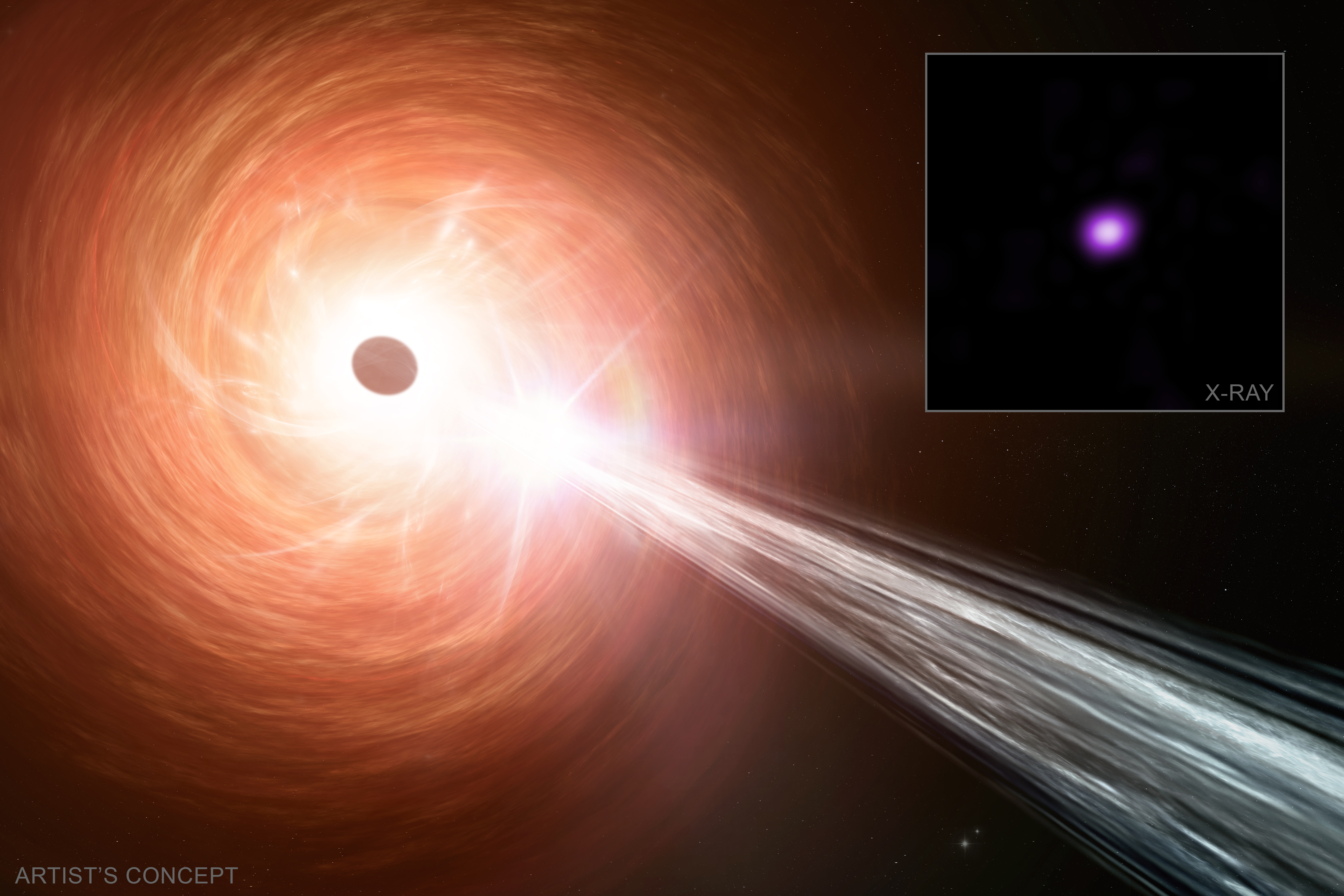
    This graphic describes the discovery of a distant black hole that is growing at one of the fastest rates ever seen, as described in our latest Chandra press release. The main panel is an artist’s illustration of the quasar named RACS J0320-35, which is located about 12.8 billion light-years from Earth. This means the quasar is being seen only about 920 million years after the big bang.

    A quasar is a black hole with large amounts of material in its gravitational grasp, contained in a surrounding disk. These disks generate huge amounts of light, making quasars like RACS J0320-35 visible at enormous distances. The illustration shows this captured material as the red, orange and yellow swirls around the black sphere that represents the black hole. It also shows a jet of energetic particles blasting away from the black hole to the lower right.

    After discovering this quasar with other telescopes in 2023, a team of researchers then used Chandra to examine how fast RACS J0320-35 is pulling matter onto the black hole’s surface and, as a result, growing. The Chandra data are shown in the inset in purple.

    When matter is pulled toward a black hole it is heated and produces intense radiation over a broad spectrum, including X-rays and optical light. This radiation creates pressure on the infalling material. When the rate of infalling matter reaches a critical value, the radiation pressure balances the black hole's gravity and matter cannot normally fall inwards any more rapidly. That maximum is referred to as the Eddington rate.

    Scientists think that black holes growing more slowly than the Eddington rate need to be born with masses of about 10,000 Suns or more so they can reach a billion solar masses within a billion years after the big bang — as has been observed in RACS J0320-35. A black hole with such a high birth mass could directly result from an exotic process: the collapse of a huge cloud of dense gas containing unusually low amounts of elements heavier than helium, conditions that may be extremely rare.

    If RACS J0320-35 is indeed growing at a high rate — estimated at 2.4 times the Eddington limit — and has done so for a sustained amount of time, its black hole could have started out in a more conventional way, with a mass less than a hundred Suns, caused by the implosion of a massive star.

    To figure out how fast this black hole is growing (between 300 and 3,000 Suns per year), the researchers compared computer models with the X-ray signature, or spectrum, from Chandra, which gives the amounts of X-rays at different energies. They found the Chandra spectrum closely matched what they expected from models of a black hole growing faster than the Eddington rate. Data from optical and infrared light also supports the interpretation that this black hole is packing on weight faster than the Eddington limit allows.

    Another scientific mystery addressed by this result concerns the cause of jets of particles that move away from some black holes at close to the speed of light that the team detected in RACS J0320-35. Jets like this are rare for quasars, which may mean that the rapid rate of growth of the black hole is somehow contributing to the creation of these jets.

    A paper describing these results has been accepted for publication i. n The Astrophysical Journal Letters and is available he,brre. The first author of the study is Luca Ighina of the Center for . Astrophysics | Harvard & Smithsonian (CfA) in Cambridge, Mass. A ,hr full list of authors can be found in the paper.

    NASA's Marshall Space Flight Center in Huntsville, Alabama, manages the Chandra program. The Smithsonian Astrophysical Observatory's Chandra X-ray Center controls science operations from Cambridge, Massachusetts, and flight operations from Burlington, Massachusetts.


    Visual Description:

    This release features a quasar located 12.8 billion light-years from Earth, presented as an artist’s illustration and an X-ray image from NASA’s Chandra X-ray Observatory.

    In the artist's illustration, the quasar, RACS J0320-35, sits at our upper left, filling the left side of the image. It resembles a spiraling, motion-blurred disk of orange, red, and yellow streaks. At the center of the disk, surrounded by a glowing, sparking, brilliant yellow light, is a black egg shape. This is a black hole, one of the fastest-growing black holes ever detected. The black hole is also shown in a small Chandra X-ray image inset at our upper right. In that depiction, the black hole appears as a white dot with an outer ring of neon purple.

    The artist's illustration also highlights a jet of particles blasting away from the black hole at the center of the quasar. The streaked silver beam starts at the core of the distant quasar, near our upper left, and shoots down toward our lower right. The blurry beam of energetic particles appears to widen as it draws closer and exits the image.


    Fast Facts for RACS J0320-35:

    Scale: Image is about 21 arcsec (390,000 light-years) across.
    Category: Quasars & Active Galaxies, Black Holes
    Coordinates (J2000): RA 03h 20m 21.4s | Dec -35° 21´ 04.13"
    Constellation: Fornax
    Observation Dates: 3 observations from Jul 2023-Dec 2023
    Observation Time: 16 hours 45 minutes
    Obs. ID: 26709, 27112, 29162
    Instrument: ACIS
    References: Ighina, L. et al., 2025, ApJ, Accepted;
    Color Code: X-ray: purple
    Distance Estimate: About 12.8 billion light-years from Earth (z=6.13)


    Sunday, May 18, 2025

    Hubble Pinpoints Young Stars in Spiral Galaxy

    This NASA/ESA Hubble Space Telescope image features the spiral galaxy NGC 1317
    ESA/Hubble & NASA, J. Lee and the PHANGS-HST Team


    In this image, the NASA/ESA Hubble Space Telescope peers into the spiral galaxy NGC 1317 in the constellation Fornax, located more than 50 million light-years from Earth. Visible in this galaxy image is a bright blue ring that hosts hot, young stars. NGC 1317 is one of a pair, but its rowdy larger neighbor, NGC 1316, lies outside Hubble’s field of view. Despite the absence of its neighboring galaxy, this image finds NGC 1317 accompanied by two objects from very different parts of the universe. The bright point ringed with a crisscross pattern is a star from our own galaxy surrounded by diffraction spikes, whereas the redder elongated smudge is a distant galaxy lying far beyond NGC 1317.

    The data presented in this image are from a vast observing campaign of hundreds of observations from Hubble’s Wide Field Camera 3 and Advanced Camera for Surveys. Combined with data from the ALMA array in the Atacama Desert, these observations help astronomers chart the connections between vast clouds of cold gas and the fiercely hot, young stars that form within them. ALMA’s unparalleled sensitivity at long wavelengths identified vast reservoirs of cold gas throughout the local universe, and Hubble’s sharp vision pinpointed clusters of young stars, as well as measuring their ages and masses.

    Often the most exciting astronomical discoveries require this kind of telescope teamwork, with cutting-edge facilities working together to provide astronomers with information across the electromagnetic spectrum. The same applies to Hubble’s observations that laid the groundwork for the NASA/ESA/CSA James Webb Space Telescope’s scientific observations.


    Media Contact:

    Claire Andreoli

    claire.andreoli@nasa.gov
    NASA's Goddard Space Flight Center, Greenbelt, MD


    Friday, March 28, 2025

    NASA's Webb Sees Galaxy Mysteriously Clearing Fog of Early Universe

    Credits/Image: NASA, ESA, CSA, Brant Robertson (UC Santa Cruz), Ben Johnson (CfA), Sandro Tacchella (Cambridge), Phill Cargile (CfA), Joris Witstok (Cambridge, University of Copenhagen), P. Jakobsen (University of Copenhagen), Alyssa Pagan (STScI), Mahdi Zamani (ESA/Webb), JADES Collaboration

    Credits/Image: NASA, ESA, CSA, Brant Robertson (UC Santa Cruz), Ben Johnson (CfA), Sandro Tacchella (Cambridge), Phill Cargile (CfA), Joris Witstok (Cambridge, University of Copenhagen), P. Jakobsen (University of Copenhagen), Alyssa Pagan (STScI), Mahdi Zamani (ESA/Webb), JADES Collaboration

    Credits/Illustration: NASA, ESA, CSA, S. Carniani (Scuola Normale Superiore), P. Jakobsen (University of Copenhagen), Joseph Olmsted (STScI)


    Using the unique infrared sensitivity of NASA’s James Webb Space Telescope, researchers can examine ancient galaxies to probe secrets of the early universe. Now, an international team of astronomers has identified bright hydrogen emission from a galaxy in an unexpectedly early time in the universe’s history. The surprise finding is challenging researchers to explain how this light could have pierced the thick fog of neutral hydrogen that filled space at that time.

    The Webb telescope discovered the incredibly distant galaxy JADES-GS-z13-1, observed to exist just 330 million years after the big bang, in images taken by Webb’s NIRCam (Near-Infrared Camera) as part of the James Webb Space Telescope Advanced Deep Extragalactic Survey (JADES). Researchers used the galaxy’s brightness in different infrared filters to estimate its redshift, which measures a galaxy’s distance from Earth based on how its light has been stretched out during its journey through expanding space.

    The NIRCam imaging yielded an initial redshift estimate of 12.9. Seeking to confirm its extreme redshift, an international team lead by Joris Witstok of the University of Cambridge in the United Kingdom as well as the Cosmic Dawn Center and the University of Copenhagen in Denmark, then observed the galaxy using Webb’s NIRSpec (Near-Infrared Spectrograph) instrument. In the resulting spectrum the redshift was confirmed to be 13.0. This equates to a galaxy seen just 330 million years after the big bang, a small fraction of the universe’s present age of 13.8 billion years old. But an unexpected feature stood out as well: one specific, distinctly bright wavelength of light, known as Lyman-alpha emission radiated by hydrogen atoms. This emission was far stronger than astronomers thought possible at this early stage in the universe’s development.

    “The early universe was bathed in a thick fog of neutral hydrogen," explained Roberto Maiolino, a team member from the University of Cambridge and University College London. "Most of this haze was lifted in a process called reionization, which was completed about one billion years after the big bang. GS-z13-1 is seen when the universe was only 330 million years old, yet it shows a surprisingly clear, telltale signature of Lyman-alpha emission that can only be seen once the surrounding fog has fully lifted. This result was totally unexpected by theories of early galaxy formation and has caught astronomers by surprise.”

    Before and during the era of reionization, the immense amounts of neutral hydrogen fog surrounding galaxies blocked any energetic ultraviolet light they emitted, much like the filtering effect of colored glass. Until enough stars had formed and were able to ionize the hydrogen gas, no such light — including Lyman-alpha emission — could escape from these fledgling galaxies to reach Earth. The confirmation of Lyman-alpha radiation from this galaxy, therefore, has great implications for our understanding of the early universe.

    “We really shouldn’t have found a galaxy like this, given our understanding of the way the universe has evolved," said Kevin Hainline, a team member from the University of Arizona. "We could think of the early universe as shrouded with a thick fog that would make it exceedingly difficult to find even powerful lighthouses peeking through, yet here we see the beam of light from this galaxy piercing the veil. This fascinating emission line has huge ramifications for how and when the universe reionized.”

    The source of the Lyman-alpha radiation from this galaxy is not yet known, but may include the first light from the earliest generation of stars to form in the universe. “The large bubble of ionized hydrogen surrounding this galaxy might have been created by a peculiar population of stars — much more massive, hotter and more luminous than stars formed at later epochs, and possibly representative of the first generation of stars," said Witstok. A powerful active galactic nucleus, driven by one of the first supermassive black holes, is another possibility identified by the team.

    This research was published Wednesday in the journal Nature.

    The James Webb Space Telescope is the world’s premier space science observatory. Webb is solving mysteries in our solar system, looking beyond to distant worlds around other stars, and probing the mysterious structures and origins of our universe and our place in it. Webb is an international program led by NASA with its partners, ESA (European Space Agency) and CSA (Canadian Space Agency).


    About This Release

    Credits:

    Media Contact:

    Bethany Downer
    ESA/Webb, Baltimore, Maryland

    Christine Pulliam
    Space Telescope Science Institute, Baltimore, Maryland

    Permissions: Content Use Policy

    Contact Us: Direct inquiries to the News Team.

    Related Links and Documents


    Saturday, March 22, 2025

    Oxygen discovered in most distant known galaxy

    PR Image eso2507a
    Furthest detection of oxygen in the early Universe

    PR Image eso2507b
    Oxygen spectrum in most distant known galaxy

    PR Image eso2507c
    Artist’s impression of JADES-GS-z14-0

    PR Image eso2507d
    Wide-field view of the region of the sky around JADES-GS-z14-0


    Videos

    Oxygen discovered in most distant galaxy
    PR Video eso2507a
    Oxygen discovered in most distant galaxy

    When oxygen was first born
    PR Video eso2507b
    When oxygen was first born

    Zooming in on JADES-GS-z14-0
    PR Video eso2507c
    Zooming in on JADES-GS-z14-0


    Two different teams of astronomers have detected oxygen in the most distant known galaxy, JADES-GS-z14-0. The discovery, reported in two separate studies, was made possible thanks to the Atacama Large Millimeter/submillimeter Array (ALMA), in which the European Southern Observatory (ESO) is a partner. This record-breaking detection is making astronomers rethink how quickly galaxies formed in the early Universe.

    JADES-GS-z14-0 is the most distant confirmed galaxy ever found: it is so far away, its light took 13.4 billion years to reach us, meaning we see it as it was when the Universe was less than 300 million years old, about 2% of its present age. The new oxygen detection with ALMA, a telescope array in Chile’s Atacama Desert, suggests the galaxy is much more chemically mature than expected.

    “It is like finding an adolescent where you would only expect babies,” says Sander Schouws, a PhD candidate at Leiden Observatory, the Netherlands, and first author of the Dutch-led study, now accepted for publication in The Astrophysical Journal. “The results show the galaxy has formed very rapidly and is also maturing rapidly, adding to a growing body of evidence that the formation of galaxies happens much faster than was expected."

    Galaxies usually start their lives full of young stars, which are made mostly of light elements like hydrogen and helium. As stars evolve, they create heavier elements like oxygen, which get dispersed through their host galaxy after they die. Researchers had thought that, at 300 million years old, the Universe was still too young to have galaxies ripe with heavy elements. However, the two ALMA studies indicate JADES-GS-z14-0 has about 10 times more heavy elements than expected.

    “I was astonished by the unexpected results because they opened a new view on the first phases of galaxy evolution,” says Stefano Carniani, of the Scuola Normale Superiore of Pisa, Italy, and lead author on the paper now accepted for publication in Astronomy & Astrophysics. “The evidence that a galaxy is already mature in the infant Universe raises questions about when and how galaxies formed.”

    The oxygen detection has also allowed astronomers to make their distance measurements to JADES-GS-z14-0 much more accurate. “The ALMA detection offers an extraordinarily precise measurement of the galaxy’s distance down to an uncertainty of just 0.005 percent. This level of precision — analogous to being accurate within 5 cm over a distance of 1 km — helps refine our understanding of distant galaxy properties,” adds Eleonora Parlanti, a PhD student at the Scuola Normale Superiore of Pisa and author on the Astronomy & Astrophysics study [1].

    “While the galaxy was originally discovered with the James Webb Space Telescope, it took ALMA to confirm and precisely determine its enormous distance,” [2] says Associate Professor Rychard Bouwens, a member of the team at Leiden Observatory. “This shows the amazing synergy between ALMA and JWST to reveal the formation and evolution of the first galaxies.”

    Gergö Popping, an ESO astronomer at the European ALMA Regional Centre who did not take part in the studies, says: "I was really surprised by this clear detection of oxygen in JADES-GS-z14-0. It suggests galaxies can form more rapidly after the Big Bang than had previously been thought. This result showcases the important role ALMA plays in unraveling the conditions under which the first galaxies in our Universe formed."

    Source: ESO/News


    Notes

    [1] Astronomers use a measurement known as redshift to determine the distance to extremely distant objects. Previous measurements indicated that the galaxy JADES-GS-z-14-0 was at a redshift between about 14.12 and 14.4. With their oxygen detections, both teams have now narrowed this down to a redshift around 14.18.

    [2] The James Webb Space Telescope is a joint project of NASA, the European Space Agency (ESA) and the Canadian Space Agency (CSA).


    More information

    This research was presented in two papers to appear in Astronomy & Astrophysics (https://aanda.org/10.1051/0004-6361/202452451) andThe Astrophysical Journal.

    The teams are composed of:

    Italian-led, Astronomy & Astrophysics paper: Stefano Carniani (Scuola Normale Superiore, Pisa, Italy [SNS]), Francesco D’Eugenio (Kavli Institute for Cosmology, University of Cambridge, Cambridge, UK [CAM-KIC]; Cavendish Laboratory, University of Cambridge, Cambridge, UK [CAM-CavL] and INAF – Osservatorio Astronomico di Brera, Milano, Italy), Xihan Ji (CAM-KIC and CAM-CavL), Eleonora Parlanti (SNS), Jan Scholtz (CAM-KIC and CAM-CavL), Fengwu Sun (Center for Astrophysics | Harvard & Smithsonian, Cambridge, USA [CfA]), Giacomo Venturi (SNS), Tom J. L. C. Bakx (Department of Space, Earth, & Environment, Chalmers University of Technology, Gothenburg, Sweden), Mirko Curti (European Southern Observatory, Garching bei München, Germany), Roberto Maiolino (CAM-KIC, CAM-CavL and Department of Physics and Astronomy, University College London, London, UK [UCL]), Sandro Tacchella (CAM-KIC and CAM-CavL), Jorge A. Zavala (National Astronomical Observatory of Japan, Tokyo, Japan), Kevin Hainline (Steward Observatory, University of Arizona, Tucson, USA [UArizona-SO]), Joris Witstok (Cosmic Dawn Center, Copenhagen, Denmark [DAWN] and CAM-CavL), Benjamin D. Johnson [CfA], Stacey Alberts [UArizona-SO], Andrew J. Bunker (Department of Physics, University of Oxford, Oxford, UK [Oxford]), Stéphane Charlot (Sorbonne Université, CNRS, Institut d’Astrophysique de Paris, Paris, France), Daniel J. Eisenstein (CfA), Jakob M. Helton (UArizona-SO), Peter Jakobsen (DAWN and Niels Bohr Institute, University of Copenhagen, Copenhagen, Denmark), Nimisha Kumari (Space Telescope Science Institute, Baltimore, USA), Brant Robertson (Department of Astronomy and Astrophysics University of California, Santa Cruz, USA), Aayush Saxena (Oxford and UCL), Hannah Übler (CAM-KIC and CAM-CavL), Christina C. Williams (NSF NOIRLab, Tucson, USA), Christopher N. A. Willmer (UArizona-SO) and Chris Willott (NRC Herzberg, Victoria, Canada).

    Dutch-led, The Astrophysical Journal paper: Sander Schouws (Leiden Observatory, Leiden University, Leiden, the Netherlands [Leiden]), Rychard J. Bouwens (Leiden), Katherine Ormerod (Astrophysics Research Institute, Liverpool John Moores University, Liverpool, United Kingdom [LJMU]), Renske Smit (LJMU), Hiddo Algera (Hiroshima Astrophysical Science Center, Hiroshima University, Hiroshima, Japan and National Astronomical Observatory of Japan, Tokyo, Japan), Laura Sommovigo (Center for Computational Astrophysics, Flatiron Institute, New York, USA), Jacqueline Hodge (Leiden), Andrea Ferrara (Scuola Normale Superiore, Pisa, Italy), Pascal A. Oesch (Département d’Astronomie, Université de Genève, Versoix, Switzerland; Cosmic Dawn Center, Copenhagen, Denmark and Niels Bohr Institute, University of Copenhagen, Copenhagen, Denmark), Lucie E. Rowland (Leiden), Ivana van Leeuwen (Leiden), Mauro Stefanon (Leiden), Thomas Herard-Demanche (Leiden), Yoshinobu Fudamoto (Center for Frontier Science, Chiba University, Chiba, Japan), Huub Rottgering (Leiden) and Paul van der Werf (Leiden).

    The Atacama Large Millimeter/submillimeter Array (ALMA), an international astronomy facility, is a partnership of ESO, the U.S. National Science Foundation (NSF) and the National Institutes of Natural Sciences (NINS) of Japan in cooperation with the Republic of Chile. ALMA is funded by ESO on behalf of its Member States, by NSF in cooperation with the National Research Council of Canada (NRC) and the National Science and Technology Council (NSTC) in Taiwan and by NINS in cooperation with the Academia Sinica (AS) in Taiwan and the Korea Astronomy and Space Science Institute (KASI). ALMA construction and operations are led by ESO on behalf of its Member States; by the National Radio Astronomy Observatory (NRAO), managed by Associated Universities, Inc. (AUI), on behalf of North America; and by the National Astronomical Observatory of Japan (NAOJ) on behalf of East Asia. The Joint ALMA Observatory (JAO) provides the unified leadership and management of the construction, commissioning and operation of ALMA.

    The European Southern Observatory (ESO) enables scientists worldwide to discover the secrets of the Universe for the benefit of all. We design, build and operate world-class observatories on the ground — which astronomers use to tackle exciting questions and spread the fascination of astronomy — and promote international collaboration for astronomy. Established as an intergovernmental organisation in 1962, today ESO is supported by 16 Member States (Austria, Belgium, Czechia, Denmark, France, Finland, Germany, Ireland, Italy, the Netherlands, Poland, Portugal, Spain, Sweden, Switzerland and the United Kingdom), along with the host state of Chile and with Australia as a Strategic Partner. ESO’s headquarters and its visitor centre and planetarium, the ESO Supernova, are located close to Munich in Germany, while the Chilean Atacama Desert, a marvellous place with unique conditions to observe the sky, hosts our telescopes. ESO operates three observing sites: La Silla, Paranal and Chajnantor. At Paranal, ESO operates the Very Large Telescope and its Very Large Telescope Interferometer, as well as survey telescopes such as VISTA. Also at Paranal ESO will host and operate the Cherenkov Telescope Array South, the world’s largest and most sensitive gamma-ray observatory. Together with international partners, ESO operates ALMA on Chajnantor, a facility that observes the skies in the millimetre and submillimetre range. At Cerro Armazones, near Paranal, we are building “the world’s biggest eye on the sky” — ESO’s Extremely Large Telescope. From our offices in Santiago, Chile we support our operations in the country and engage with Chilean partners and society.


    Links


    Contacts:

    Stefano Carniani
    Scuola Normale Superiore
    Pisa, Italy
    Tel: +39 050 509156
    Email:
    stefano.carniani@sns.it

    Sander Schouws
    Leiden University
    Leiden, The Netherlands
    Email:
    sanderschouws@gmail.com

    Eleonora Parlanti
    Scuola Normale Superiore
    Pisa, Italy
    Email:
    eleonora.parlanti@sns.it

    Rychard Bouwens
    Leiden Observatory, University of Leiden
    Leiden, The Netherlands
    Tel: +31 71 527 8456
    Email:
    bouwens@strw.leidenuniv.nl

    Jacqueline Hodge
    Leiden Observatory, University of Leiden
    Leiden, The Netherlands
    Tel: +31 71 527 8450
    Email:
    hodge@strw.leidenuniv.nl

    Gergö Popping
    European ALMA Regional Centre, European Southern Observatory
    Tel: +49 89 3200 6247
    Email:
    gpopping@eso.org

    Bárbara Ferreira
    ESO Media Manager
    Garching bei München, Germany
    Tel: +49 89 3200 6670
    Cell: +49 151 241 664 00
    Email:
    press@eso.org


    Saturday, August 21, 2021

    Hubble Views a Galaxy in a ‘Furnace’

    NGC 1385
    Text credit: European Space Agency (ESA)
    Image credit: ESA/Hubble & NASA, J. Lee and the
    PHANGS-HST Team
     

    This jewel-bright image from the NASA/ESA Hubble Space Telescope shows NGC 1385, a spiral galaxy 68 million light-years from Earth, which lies in the constellation Fornax. The image was taken with Hubble’s Wide Field Camera 3, which is often referred to as Hubble’s workhorse camera thanks to its reliability and versatility. It was installed in 2009 when astronauts last visited Hubble, and 12 years later it remains remarkably productive. 

    NGC 1385’s home – the Fornax constellation – is not named after an animal or an ancient god, as are many of the other constellations. Fornax is simply the Latin word for a furnace. The constellation was named Fornax by Nicolas-Louis de Lacaille, a French astronomer born in 1713. Lacaille named 14 of the 88 constellations we still recognize today. He seems to have had a penchant for naming constellations after scientific instruments, including Atlia (the air pump), Norma (the ruler, or set square), and Telescopium (the telescope).


    Media Contact:

    Claire Andreoli
    NASA's Goddard Space Flight Center


    Source:  NASA/Solar System and Beyond


    Wednesday, April 17, 2019

    A New Signal for a Neutron Star Collision Discovered

    XT2
    Credit: X-ray: NASA/CXC/Uni. of Science and Technology of China/Y. Xue et al; 
    Optical: NASA/STScI

    JPEG (134.1 kb) - Large JPEG (1.8 MB) - Tiff (29 MB) - More Images

    A Tour of XT2 - More Animations


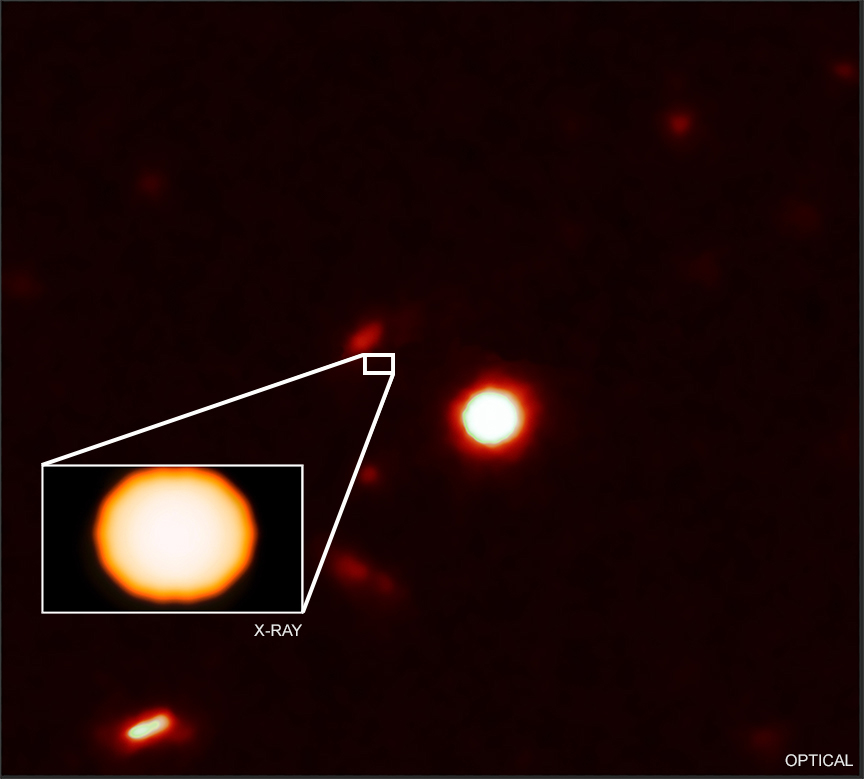
    These images show the location of an event, discovered by NASA's Chandra X-ray Observatory, that likely signals the merger of two neutron stars. A bright burst of X-rays in this source, dubbed XT2, could give astronomers fresh insight into how neutron stars — dense stellar objects packed mainly with neutrons — are built.

    XT2 is located in a galaxy about 6.6 billion light years from Earth. The source is located in the Chandra Deep Field South (CDF-S), a small patch of sky in the Fornax constellation. The CDF-S is the deepest X-ray image ever taken, containing almost 12 weeks of Chandra observing time. The wider field of view shows an optical image from the Hubble Space Telescope of a portion of the CDF-S field, while the inset shows a Chandra image focusing only on XT2. The location of XT2, which was not detected in optical images, is shown by the rectangle, and its host galaxy is the small, oval-shaped object located slightly to the upper left. 

    On March 22, 2015, astronomers saw XT2 suddenly appear in the Chandra data and then fade away after about seven hours. By combing through the Chandra archive, they were able to piece together the history of the source's behavior. The researchers compared the data from XT2 to theoretical predictions made in 2013 of what the X-ray signature from two colliding neutron stars without a corresponding gamma ray bursts would look like.

    When two neutron stars merge they produce jets of high energy particles and radiation fired in opposite directions. If the jet is pointed along the line of sight to the Earth, a flash, or burst, of gamma rays can be detected. If the jet is not pointed in our direction, a different signal is needed to identify the merger. This result provides scientists with an opportunity to study just such a case.

    X-rays from XT2 showed a characteristic signature that matched those predicted for a newly-formed magnetar, that is, a neutron star spinning around hundreds of times per second and possessing a tremendously strong magnetic field about a quadrillion times that of Earth's.

    The team think that the magnetar lost energy in the form of an X-ray-emitting wind, slowing down its rate of spin as the source faded. The amount of X-ray emission stayed roughly constant in X-ray brightness for about 30 minutes, then decreased in brightness by more than a factor of 300 over 6.5 hours before becoming undetectable. This showed that the neutron star merger produced a new, larger neutron star and not a black hole.

    XT2's bright flare of X-rays gives astronomers another signal — in addition to the detection of gravitational waves — to probe neutron star mergers.

    A paper describing these results appeared in the April 11th issue of Nature, led by Yongquan Xue (University of Science and Technology in China). NASA's Marshall Space Flight Center in Huntsville, Alabama, manages the Chandra program for NASA's Science Mission Directorate in Washington. The Smithsonian Astrophysical Observatory in Cambridge, Massachusetts, controls Chandra's science and flight operations.

    Timelapse
    Credit: NASA/CXC/Uni. of Science and Technology of China/Y. Xue et al.

    When two neutron stars merge they produce jets of high energy particles and radiation fired in opposite directions. If the jet is pointed along the line of sight to the Earth, a flash, or burst, of gamma rays can be detected. If the jet is not pointed in our direction, a different signal is needed to identify the merger. This result provides scientists with an opportunity to study just such a case.

    X-rays from XT2 showed a characteristic signature that matched those predicted for a newly-formed magnetar, that is, a neutron star spinning around hundreds of times per second and possessing a tremendously strong magnetic field about a quadrillion times that of Earth's.

    The team think that the magnetar lost energy in the form of an X-ray-emitting wind, slowing down its rate of spin as the source faded. The amount of X-ray emission stayed roughly constant in X-ray brightness for about 30 minutes, then decreased in brightness by more than a factor of 300 over 6.5 hours before becoming undetectable. This showed that the neutron star merger produced a new, larger neutron star and not a black hole.

    XT2's bright flare of X-rays gives astronomers another signal — in addition to the detection of gravitational waves — to probe neutron star mergers.

    A paper describing these results appeared in the April 11th issue of Nature, led by Yongquan Xue (University of Science and Technology in China). NASA's Marshall Space Flight Center in Huntsville, Alabama, manages the Chandra program for NASA's Science Mission Directorate in Washington. The Smithsonian Astrophysical Observatory in Cambridge, Massachusetts, controls Chandra's science and flight operations.


    Fast Facts for CDF-S XT2:

    Scale: Chandra images are about 15 arcsec (360,000 light years) across.
    Category: Neutron Stars/X-ray Binaries
    Coordinates (J2000): RA 3h 32m 18.38s | Dec -27° 52´ 24.2"
    Constellation: Fornax
    Observation Date: Mar 22, 2015
    Observation Time: 19 hours 27 minutes
    Obs. ID: 16453
    Instrument: ACIS
    References: Xue,Y.Q et al, 2019, Nature.  arXiv:1904.05368
    Color Code: X-ray: Orange; Optical: Red
    Distance Estimate: About 6.6 billion light years