Showing posts with label JADES-GS-z14-0. Show all posts

Sunday, May 04, 2025

ALMA Discovers Oxygen in Most Distant Known Galaxy Press Releases ALMA Discovers Oxygen in Most Distant Known Galaxy

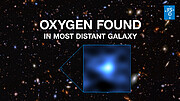
This image shows the location in the night sky of the galaxy JADES-GS-z14-0, an extremely tiny dot in the Fornax constellation. As of today, this is the most distant confirmed galaxy we know of. Its light took 13.4 billion years to reach us and shows the universe's conditions when it was only 300 million years old. The inset of the image shows a close-up of this primordial galaxy as seen with the Atacama Large Millimeter/submillimeter Array (ALMA).

The inset is overlaid on an image taken with the NASA/ESA/CSA James Webb Space Telescope. The two spectra shown here result from an independent analysis of ALMA data by two teams of astronomers. Both found an emission line of oxygen, making this the most distant detection of oxygen when the universe was only 300 million years old. ALMA (ESO/NAOJ/NRAO)/S. Carniani et al./S. Schouws et al./JWST: NASA, ESA, CSA, STScI, Brant Robertson (UC Santa Cruz), Ben Johnson (CfA), Sandro Tacchella (Cambridge), Phill Cargile (CfA).

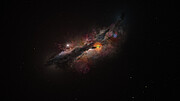
This is an artist’s impression of JADES-GS-z14-0, which as of today is the most distant confirmed galaxy. Galaxies in the early Universe tend to be clumpy and irregular. Supernova explosions in this galaxy would have spread heavy elements forged inside stars, like oxygen, which has been now detected with the Atacama Large Millimeter/submillimeter Array (ALMA).

This artist’s animation shows JADES-GS-z14-0, the most-distant galaxy confirmed to date. We see this galaxy as it was when the Universe was less than 300 million years old, about 2% of its present age. Such galaxies were thought to be too young to be ripe with heavy elements, but the discovery of oxygen by two teams of astronomers suggest this is not the case. Instead, as this recreation shows, JADES-GS-z14-0 must have had multiple generations of stars being born and dying as supernovae, producing and leaving behind heavy elements like oxygen. This element has now been detected thanks to the extreme sensitivity of the Atacama Large Millimeter/submillimeter Array (ALMA). Credits: ESO/M. Kornmesser.


Two different scientific teams have detected oxygen in JADES-GS-z14-0. The breakthrough, reported in two separate studies, was made possible thanks to the Atacama Large Millimeter/submillimeter Array (ALMA). This record-breaking detection makes astronomers rethink how quickly galaxies formed in the early universe.

Discovered in 2024, JADES-GS-z14-0 is the most distant confirmed galaxy ever found. Its light took 13.4 billion years to reach us, meaning we see it as when the universe was less than 300 million (about 2% of its present age). The new oxygen detection with ALMA suggests the galaxy is more chemically mature than expected.

"It is like finding an adolescent where you would only expect babies," says Sander Schouws, a PhD candidate at Leiden Observatory, Netherlands, and first author of the Dutch-led study. "The results show the galaxy has formed and matured very rapidly, adding to a growing body of evidence that the formation of galaxies happens much faster than expected."

Galaxies usually start their lives with plenty of young stars, which are made mostly of light elements like hydrogen and helium. As stars evolve, they create heavier elements like oxygen, which get dispersed through their host galaxy after they die. Researchers thought that, at 300 million years old, the universe was still too young to have galaxies ripe with heavy elements. However, the two ALMA studies indicate that JADES-GS-z14-0 has about 10 times more heavy elements than expected.

"I was astonished by the unexpected results because they opened a new view on the first phases of galaxy evolution," says Stefano Carniani of the Scuola Normale Superiore of Pisa, Italy, and lead author on the second paper. "The evidence that a galaxy is already mature in the infant Universe raises questions about when and how galaxies formed."

The oxygen detection has also allowed astronomers to make their distance measurements to JADES-GS-z14-0 much more accurate. "The ALMA detection offers an extraordinarily precise measurement of the galaxy's distance down to an uncertainty of just 0.005%. This level of precision — analogous to being accurate within 5 cm over 1 km — helps refine our understanding of distant galaxy properties", adds Eleonora Parlanti, a PhD student at the Scuola Normale Superiore of Pisa.

"While the galaxy was originally discovered with the James Webb Space Telescope (JWST), it took ALMA to confirm and precisely determine its enormous distance," says Associate Professor Rychard Bouwens, a team member at Leiden Observatory.". This shows the amazing synergy between ALMA and JWST to reveal the formation and evolution of the first galaxies."

Gergö Popping, an European Southern Observatory (ESO) astronomer at the European ALMA Regional Centre who did not participate in the studies, says: "I was really surprised by this clear detection of oxygen in JADES-GS-z14-0. It suggests galaxies can form more rapidly after the Big Bang than previously thought. This result showcases the important role ALMA plays in unraveling the conditions under which the first galaxies in our universe formed."


< Additional information

The results of the studies are published in the following papers:


The European Southern Observatory (ESO), an ALMA partner on behalf of Europe, published the original press release.

The Atacama Large Millimeter/submillimeter Array (ALMA), an international astronomy facility, is a partnership of the European Southern Observatory (ESO), the U.S. National Science Foundation (NSF), and the National Institutes of Natural Sciences (NINS) of Japan in cooperation with the Republic of Chile. ALMA is funded by ESO on behalf of its Member Sta
tes, by NSF in cooperation with the National Research Council of Canada (NRC) and the National Science and Technology Council (NSTC) in Taiwan, and by NINS in cooperation with the Academia Sinica (AS) in Taiwan and the Korea Astronomy and Space Science Institute (KASI).

ALMA construction and operations are led by ESO on behalf of its Member States; by the National Radio Astronomy Observatory (NRAO), managed by Associated Universities, Inc. (AUI), on behalf of North America; and by the National Astronomical Observatory of Japan (NAOJ) on behalf of East Asia. The Joint ALMA Observatory (JAO) provides the unified leadership and management of ALMA's construction, commissioning, and operation.


Contacts:

Nicolás Lira
Education and Public Outreach Coordinator
Joint ALMA Observatory, Santiago - Chile
Phone:
+56 2 2467 6519
Cel: +56 9 9445 7726
Email: nicolas.lira@alma.cl

Bárbara Ferreira
ESO Media Manager
Garching bei München, Germany
Phone:
+49 89 3200 6670
Email: press@eso.org

Jill Malusky
Public Information Officer
NRAO
Phone:
+1 304-456-2236
Email: jmalusky@nrao.edu

Yuichi Matsuda
ALMA EA-ARC Staff Member
NAOJ
Email:
yuichi.matsuda@nao.ac.jp


Saturday, March 22, 2025

Oxygen discovered in most distant known galaxy

PR Image eso2507a
Furthest detection of oxygen in the early Universe

PR Image eso2507b
Oxygen spectrum in most distant known galaxy

PR Image eso2507c
Artist’s impression of JADES-GS-z14-0

PR Image eso2507d
Wide-field view of the region of the sky around JADES-GS-z14-0


Videos

Oxygen discovered in most distant galaxy
PR Video eso2507a
Oxygen discovered in most distant galaxy

When oxygen was first born
PR Video eso2507b
When oxygen was first born

Zooming in on JADES-GS-z14-0
PR Video eso2507c
Zooming in on JADES-GS-z14-0


Two different teams of astronomers have detected oxygen in the most distant known galaxy, JADES-GS-z14-0. The discovery, reported in two separate studies, was made possible thanks to the Atacama Large Millimeter/submillimeter Array (ALMA), in which the European Southern Observatory (ESO) is a partner. This record-breaking detection is making astronomers rethink how quickly galaxies formed in the early Universe.

JADES-GS-z14-0 is the most distant confirmed galaxy ever found: it is so far away, its light took 13.4 billion years to reach us, meaning we see it as it was when the Universe was less than 300 million years old, about 2% of its present age. The new oxygen detection with ALMA, a telescope array in Chile’s Atacama Desert, suggests the galaxy is much more chemically mature than expected.

It is like finding an adolescent where you would only expect babies,” says Sander Schouws, a PhD candidate at Leiden Observatory, the Netherlands, and first author of the Dutch-led study, now accepted for publication in The Astrophysical Journal. “The results show the galaxy has formed very rapidly and is also maturing rapidly, adding to a growing body of evidence that the formation of galaxies happens much faster than was expected."

Galaxies usually start their lives full of young stars, which are made mostly of light elements like hydrogen and helium. As stars evolve, they create heavier elements like oxygen, which get dispersed through their host galaxy after they die. Researchers had thought that, at 300 million years old, the Universe was still too young to have galaxies ripe with heavy elements. However, the two ALMA studies indicate JADES-GS-z14-0 has about 10 times more heavy elements than expected.

I was astonished by the unexpected results because they opened a new view on the first phases of galaxy evolution,” says Stefano Carniani, of the Scuola Normale Superiore of Pisa, Italy, and lead author on the paper now accepted for publication in Astronomy & Astrophysics. “The evidence that a galaxy is already mature in the infant Universe raises questions about when and how galaxies formed.”

The oxygen detection has also allowed astronomers to make their distance measurements to JADES-GS-z14-0 much more accurate. “The ALMA detection offers an extraordinarily precise measurement of the galaxy’s distance down to an uncertainty of just 0.005 percent. This level of precision — analogous to being accurate within 5 cm over a distance of 1 km — helps refine our understanding of distant galaxy properties,” adds Eleonora Parlanti, a PhD student at the Scuola Normale Superiore of Pisa and author on the Astronomy & Astrophysics study [1].

While the galaxy was originally discovered with the James Webb Space Telescope, it took ALMA to confirm and precisely determine its enormous distance,” [2] says Associate Professor Rychard Bouwens, a member of the team at Leiden Observatory. “This shows the amazing synergy between ALMA and JWST to reveal the formation and evolution of the first galaxies.”

Gergö Popping, an ESO astronomer at the European ALMA Regional Centre who did not take part in the studies, says: "I was really surprised by this clear detection of oxygen in JADES-GS-z14-0. It suggests galaxies can form more rapidly after the Big Bang than had previously been thought. This result showcases the important role ALMA plays in unraveling the conditions under which the first galaxies in our Universe formed."

Source: ESO/News


Notes

[1] Astronomers use a measurement known as redshift to determine the distance to extremely distant objects. Previous measurements indicated that the galaxy JADES-GS-z-14-0 was at a redshift between about 14.12 and 14.4. With their oxygen detections, both teams have now narrowed this down to a redshift around 14.18.

[2] The James Webb Space Telescope is a joint project of NASA, the European Space Agency (ESA) and the Canadian Space Agency (CSA).


More information

This research was presented in two papers to appear in Astronomy & Astrophysics (https://aanda.org/10.1051/0004-6361/202452451andThe Astrophysical Journal.

The teams are composed of:

Italian-led, Astronomy & Astrophysics paper: Stefano Carniani (Scuola Normale Superiore, Pisa, Italy [SNS]), Francesco D’Eugenio (Kavli Institute for Cosmology, University of Cambridge, Cambridge, UK [CAM-KIC]; Cavendish Laboratory, University of Cambridge, Cambridge, UK [CAM-CavL] and INAF – Osservatorio Astronomico di Brera, Milano, Italy), Xihan Ji (CAM-KIC and CAM-CavL), Eleonora Parlanti (SNS), Jan Scholtz (CAM-KIC and CAM-CavL), Fengwu Sun (Center for Astrophysics | Harvard & Smithsonian, Cambridge, USA [CfA]), Giacomo Venturi (SNS), Tom J. L. C. Bakx (Department of Space, Earth, & Environment, Chalmers University of Technology, Gothenburg, Sweden), Mirko Curti (European Southern Observatory, Garching bei München, Germany), Roberto Maiolino (CAM-KIC, CAM-CavL and Department of Physics and Astronomy, University College London, London, UK [UCL]), Sandro Tacchella (CAM-KIC and CAM-CavL), Jorge A. Zavala (National Astronomical Observatory of Japan, Tokyo, Japan), Kevin Hainline (Steward Observatory, University of Arizona, Tucson, USA [UArizona-SO]), Joris Witstok (Cosmic Dawn Center, Copenhagen, Denmark [DAWN] and CAM-CavL), Benjamin D. Johnson [CfA], Stacey Alberts [UArizona-SO], Andrew J. Bunker (Department of Physics, University of Oxford, Oxford, UK [Oxford]), Stéphane Charlot (Sorbonne Université, CNRS, Institut d’Astrophysique de Paris, Paris, France), Daniel J. Eisenstein (CfA), Jakob M. Helton (UArizona-SO), Peter Jakobsen (DAWN and Niels Bohr Institute, University of Copenhagen, Copenhagen, Denmark), Nimisha Kumari (Space Telescope Science Institute, Baltimore, USA), Brant Robertson (Department of Astronomy and Astrophysics University of California, Santa Cruz, USA), Aayush Saxena (Oxford and UCL), Hannah Übler (CAM-KIC and CAM-CavL), Christina C. Williams (NSF NOIRLab, Tucson, USA), Christopher N. A. Willmer (UArizona-SO) and Chris Willott (NRC Herzberg, Victoria, Canada).

Dutch-led, The Astrophysical Journal paper: Sander Schouws (Leiden Observatory, Leiden University, Leiden, the Netherlands [Leiden]), Rychard J. Bouwens (Leiden), Katherine Ormerod (Astrophysics Research Institute, Liverpool John Moores University, Liverpool, United Kingdom [LJMU]), Renske Smit (LJMU), Hiddo Algera (Hiroshima Astrophysical Science Center, Hiroshima University, Hiroshima, Japan and National Astronomical Observatory of Japan, Tokyo, Japan), Laura Sommovigo (Center for Computational Astrophysics, Flatiron Institute, New York, USA), Jacqueline Hodge (Leiden), Andrea Ferrara (Scuola Normale Superiore, Pisa, Italy), Pascal A. Oesch (Département d’Astronomie, Université de Genève, Versoix, Switzerland; Cosmic Dawn Center, Copenhagen, Denmark and Niels Bohr Institute, University of Copenhagen, Copenhagen, Denmark), Lucie E. Rowland (Leiden), Ivana van Leeuwen (Leiden), Mauro Stefanon (Leiden), Thomas Herard-Demanche (Leiden), Yoshinobu Fudamoto (Center for Frontier Science, Chiba University, Chiba, Japan), Huub Rottgering (Leiden) and Paul van der Werf (Leiden).

The Atacama Large Millimeter/submillimeter Array (ALMA), an international astronomy facility, is a partnership of ESO, the U.S. National Science Foundation (NSF) and the National Institutes of Natural Sciences (NINS) of Japan in cooperation with the Republic of Chile. ALMA is funded by ESO on behalf of its Member States, by NSF in cooperation with the National Research Council of Canada (NRC) and the National Science and Technology Council (NSTC) in Taiwan and by NINS in cooperation with the Academia Sinica (AS) in Taiwan and the Korea Astronomy and Space Science Institute (KASI). ALMA construction and operations are led by ESO on behalf of its Member States; by the National Radio Astronomy Observatory (NRAO), managed by Associated Universities, Inc. (AUI), on behalf of North America; and by the National Astronomical Observatory of Japan (NAOJ) on behalf of East Asia. The Joint ALMA Observatory (JAO) provides the unified leadership and management of the construction, commissioning and operation of ALMA.

The European Southern Observatory (ESO) enables scientists worldwide to discover the secrets of the Universe for the benefit of all. We design, build and operate world-class observatories on the ground — which astronomers use to tackle exciting questions and spread the fascination of astronomy — and promote international collaboration for astronomy. Established as an intergovernmental organisation in 1962, today ESO is supported by 16 Member States (Austria, Belgium, Czechia, Denmark, France, Finland, Germany, Ireland, Italy, the Netherlands, Poland, Portugal, Spain, Sweden, Switzerland and the United Kingdom), along with the host state of Chile and with Australia as a Strategic Partner. ESO’s headquarters and its visitor centre and planetarium, the ESO Supernova, are located close to Munich in Germany, while the Chilean Atacama Desert, a marvellous place with unique conditions to observe the sky, hosts our telescopes. ESO operates three observing sites: La Silla, Paranal and Chajnantor. At Paranal, ESO operates the Very Large Telescope and its Very Large Telescope Interferometer, as well as survey telescopes such as VISTA. Also at Paranal ESO will host and operate the Cherenkov Telescope Array South, the world’s largest and most sensitive gamma-ray observatory. Together with international partners, ESO operates ALMA on Chajnantor, a facility that observes the skies in the millimetre and submillimetre range. At Cerro Armazones, near Paranal, we are building “the world’s biggest eye on the sky” — ESO’s Extremely Large Telescope. From our offices in Santiago, Chile we support our operations in the country and engage with Chilean partners and society.


Links


Contacts:

Stefano Carniani
Scuola Normale Superiore
Pisa, Italy
Tel: +39 050 509156
Email:
stefano.carniani@sns.it

Sander Schouws
Leiden University
Leiden, The Netherlands
Email:
sanderschouws@gmail.com

Eleonora Parlanti
Scuola Normale Superiore
Pisa, Italy
Email:
eleonora.parlanti@sns.it

Rychard Bouwens
Leiden Observatory, University of Leiden
Leiden, The Netherlands
Tel: +31 71 527 8456
Email:
bouwens@strw.leidenuniv.nl

Jacqueline Hodge
Leiden Observatory, University of Leiden
Leiden, The Netherlands
Tel: +31 71 527 8450
Email:
hodge@strw.leidenuniv.nl

Gergö Popping
European ALMA Regional Centre, European Southern Observatory
Tel: +49 89 3200 6247
Email:
gpopping@eso.org

Bárbara Ferreira
ESO Media Manager
Garching bei München, Germany
Tel: +49 89 3200 6670
Cell: +49 151 241 664 00
Email:
press@eso.org


Sunday, June 02, 2024

CfA Astronomers Help Find Most Distant Galaxy Using James Webb Space Telescope

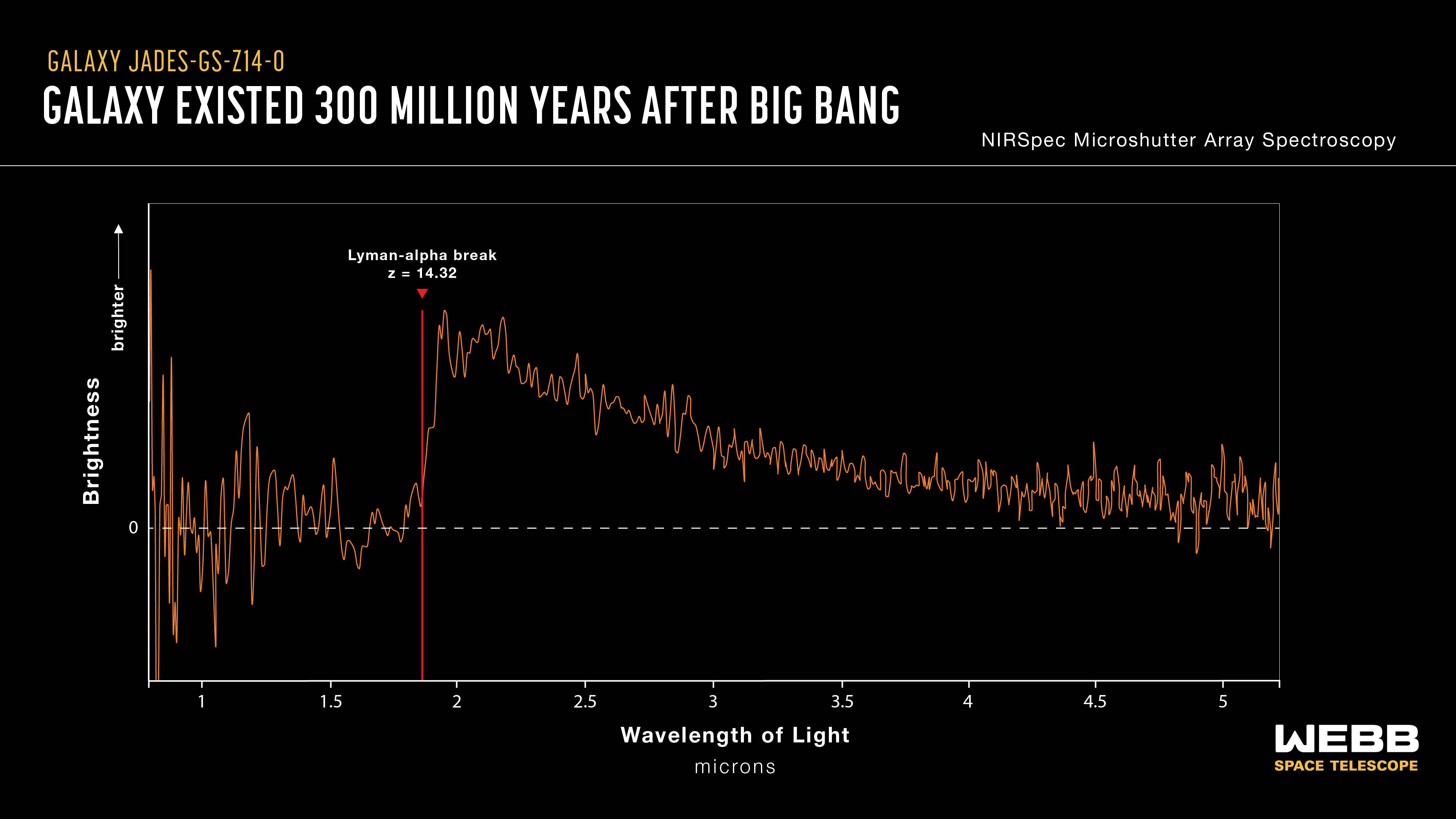
This infrared image from NASA’s James Webb Space Telescope (also called Webb or JWST) was taken by the NIRCam (Near-Infrared Camera) for the JWST Advanced Deep Extragalactic Survey, or JADES, program. The NIRCam data was used to determine which galaxies to study further with spectroscopic observations. One such galaxy, JADES-GS-z14-0 (shown in the pullout), was determined to be at a redshift of 14.32 (+0.08/-0.20), making it the current record-holder for the most distant known galaxy. This corresponds to a time less than 300 million years after the Big Bang. Credit: NASA, ESA, CSA, STScI, Brant Robertson (UC Santa Cruz), Ben Johnson (CfA), Sandro Tacchella (Cambridge), Phill Cargile (CfA). High Resolution Image

Scientists used NASA's James Webb Space Telescope’s NIRSpec (Near-Infrared Spectrograph) to obtain a spectrum of the distant galaxy JADES-GS-z14-0 in order to accurately measure its redshift and therefore determine its age. The redshift can be determined from the location of a critical wavelength known as the Lyman-alpha break. This galaxy dates back to less than 300 million years after the Big Bang. Credit: NASA, ESA, CSA, Joseph Olmsted (STScI). High Resolution Image


Cambridge, MA--An international team of astronomers today announced the discovery of the two earliest and most distant galaxies ever seen, dating back to only 300 million years after the Big Bang. These results, using NASA's James Webb Space Telescope (JWST), mark a major milestone in the study of the early Universe.

The discoveries were made by the JWST Advanced Deep Extragalactic Survey (JADES) team. Daniel Eisenstein from the Center for Astrophysics | Harvard & Smithsonian (CfA) is one of the team leaders of JADES and Principal Investigator of the observing program that revealed these galaxies. Ben Johnson and Phillip Cargile, both Research Scientists at CfA, and Zihao Wu, a Harvard PhD student at CfA, also played important roles.

Because of the expansion of the Universe, the light from distant galaxies stretches to longer wavelengths as it travels. This effect is so extreme for these two galaxies that their ultraviolet light is shifted to infrared wavelengths where only JWST can see it. Because light takes time to travel, more distant galaxies are also seen as they were earlier in time.

The two record-breaking galaxies are called JADES-GS-z14-0 and JADES-GS-z14-1, the former being the more distant of the two. In addition to being the new distance record holder, JADES-GS-z14-0 is remarkable for how big and bright it is. “The size of the galaxy clearly proves that most of the light is being produced by large numbers of young stars," said Eisenstein, a Harvard professor and chair of the astronomy department, “rather than material falling onto a supermassive black hole in the galaxy’s center, which would appear much smaller."

The combination of the extreme brightness and the fact that young stars are fueling this high luminosity makes JADES-GS-z14-0 the most striking evidence yet found for the rapid formation of large, massive galaxies in the early Universe.

"JADES-GS-z14-0 now becomes the archetype of this phenomenon,” says Dr. Stefano Carniani of the Scuola Normale Superiore in Pisa, lead author on the discovery paper. "It is stunning that the Universe can make such a galaxy in only 300 million years."

Evidence for surprisingly vigorous early galaxies appeared even in the first JWST images and has been mounting in the first two years of the mission. This trend runs counter to expectations that most astronomers had before the launch of JWST of theories of galaxy formation.

JADES-GS-z14-0 was a puzzle for the JADES team when they first spotted it over a year ago, as it appears close enough on the sky to a foreground galaxy that the team could not be sure that the two were not neighbors. But in October 2023, the JADES team conducted even deeper imaging—five full days with the JWST Near-Infrared Camera on just one field—and used filters designed to better isolate the earliest galaxies.

"We just couldn't see any plausible way to explain this galaxy as being merely a neighbor of the more nearby galaxy,” says Dr. Kevin Hainline, research professor at the University of Arizona.

The galaxy is located in a field where the JWST Mid-Infrared Instrument had conducted an ultra-deep observation. Its brightness at intermediate infrared wavelengths is a sign of emission from hydrogen and even oxygen atoms in the early Universe.

"Despite being so young, the galaxy is already hard at work creating the elements familiar to us on Earth," said Zihao Wu, a co-author on a second paper about this finding, led by Jakob Helton, a graduate student at the University of Arizona.

Emboldened, the team then obtained a spectrum of each galaxy, and confirmed their hopes that JADES-GS-z14-0 was indeed a record-breaking galaxy and that the fainter candidate, JADES-GS-z14-1, was nearly as far away.

A third paper led by Brant Robertson, professor at the University of California-Santa Cruz, and Ben Johnson, studies the evolution of this early population of galaxies. "This amazing object shows that galaxy formation in the early Universe is very rapid and intense,” said Johnson, “and JWST will allow us to find more of these galaxies, perhaps when the universe was even younger. It is a marvelous opportunity to study how galaxies get started."


About the Center for Astrophysics | Harvard & Smithsonian

The Center for Astrophysics | Harvard & Smithsonian is a collaboration between Harvard and the Smithsonian designed to ask—and ultimately answer—humanity's greatest unresolved questions about the nature of the universe. The Center for Astrophysics is headquartered in Cambridge, MA, with research facilities across the U.S. and around the world.


Media Contact:

Peter Edmonds
Interim CfA Public Affairs Officer
Center for Astrophysics | Harvard & Smithsonian
+1 617-571-7279

pedmonds@cfa.harvard.edu