Showing posts with label Puppis A. Show all posts

Monday, August 10, 2026

A Middle-Aged Supernova Remnant Stays Energetic

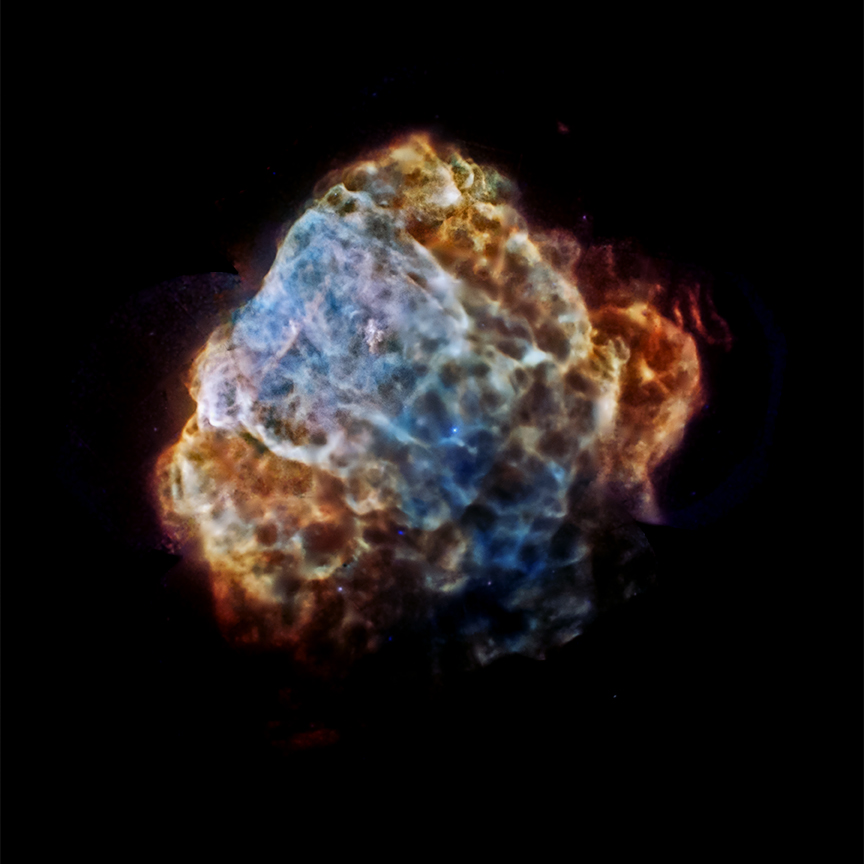
Combined X-ray observations of the Puppis A supernova remnant from Chandra and XMM-Newton, showing the shock waves of material expanding out into space. Low-energy X-rays are shown in red, medium-energy X-rays are in green and higher energy X-rays are colored blue. NuSTAR observations will be able to probe higher energies still. Image credit: NASA/CXC/IAFE/G.Dubner et al & ESA/XMM-Newton. Download Image


During the past week, NuSTAR observed the supernova remnant Puppis A, the expanding debris of a stellar explosion that occurred roughly 4,000 years ago. While supernova remnants are widely believed to be the primary accelerators of Galactic cosmic rays, clear evidence for ongoing production of very high-energy particles is usually found only in much younger systems. Recent X-ray observations, however, revealed a hint of an unexpected enhancement of hard X-rays in the eastern region of Puppis A, where the blast wave is interacting with dense interstellar clouds. These observations suggest the presence of a reflected shock — a secondary shock wave generated when the expanding remnant encounters surrounding material — that may be accelerating particles even today. The primary goal of the NuSTAR observation is to determine whether the newly discovered hard X-rays are produced by freshly accelerated electrons. If confirmed, Puppis A would provide one of the clearest and most remarkable examples of active particle acceleration in middle-aged supernova remnants. Given its age of about 4,000 years, finding signs of fresh acceleration would demonstrate that supernova remnants can continue to energize particles far longer than traditionally expected, offering a rare opportunity to study how cosmic-ray factories evolve long after the original stellar explosion. By measuring the high-energy X-ray spectrum up to energies of tens of keV, NuSTAR will determine how these particles are accelerated, estimate the maximum energies they can reach, and probe the magnetic environment within the shock. These measurements will provide new insight into the long-term evolution of shock acceleration and the origin of cosmic rays in our Galaxy.

Author: Hiromasa Suzuki (Assistant Professor, University of Miyazaki, Japan)


Thursday, May 24, 2018

E0102-72.3: Astronomers Spot a Distant and Lonely Neutron Star

1E 0102.2-7219
Credit: X-ray (NASA/CXC/ESO/F.Vogt et al); 
Optical (ESO/VLT/MUSE & NASA/STScI)


Astronomers have discovered a special kind of neutron star for the first time outside of the Milky Way galaxy, using data from NASA's Chandra X-ray Observatory and the European Southern Observatory's Very Large Telescope (VLT) in Chile.

Neutron stars are the ultra dense cores of massive stars that collapse and undergo a supernova explosion. This newly identified neutron star is a rare variety that has both a low magnetic field and no stellar companion.

The neutron star is located within the remains of a supernova — known as 1E 0102.2-7219 (E0102 for short) — in the Small Magellanic Cloud, located 200,000 light years from Earth.

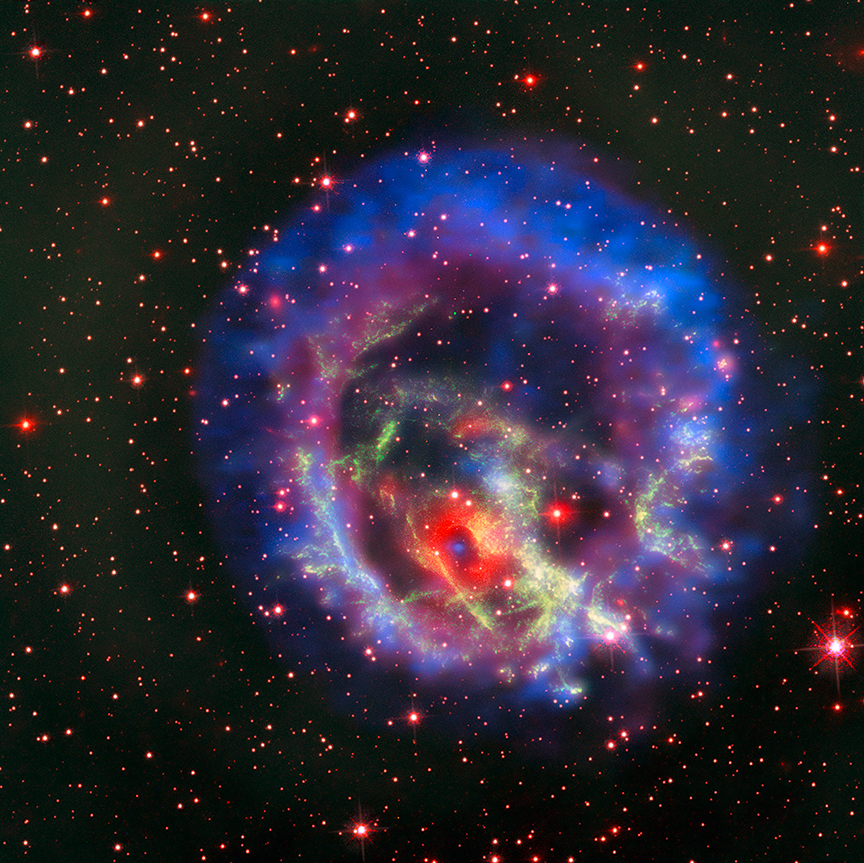
This new composite image of E0102 allows astronomers to learn new details about this object that was discovered more than three decades ago. In this image, X-rays from Chandra are blue and purple, and visible light data from VLT's Multi Unit Spectroscopic Explorer (MUSE) instrument are bright red. Additional data from the Hubble Space Telescope are dark red and green.

Oxygen-rich supernova remnants like E0102 are important for understanding how massive stars fuse lighter elements into heavier ones before they explode. Seen up to a few thousand years after the original explosion, oxygen-rich remnants contain the debris ejected from the dead star's interior. This debris (visible as a green filamentary structure in the combined image) is observed today hurtling through space after being expelled at millions of miles per hour.

Chandra observations of E0102 show that the supernova remnant is dominated by a large ring-shaped structure in X-rays, associated with the blast wave of the supernova. The new MUSE data revealed a smaller ring of gas (in bright red) that is expanding more slowly than the blast wave. At the center of this ring is a blue point-like source of X-rays. Together, the small ring and point source act like a celestial bull's eye.

The combined Chandra and MUSE data suggest that this source is an isolated neutron star, created in the supernova explosion about two millennia ago. The X-ray energy signature, or "spectrum," of this source is very similar to that of the neutron stars located at the center of two other famous oxygen-rich supernova remnants: Cassiopeia A (Cas A) and Puppis A. These two neutron stars also do not have companion stars.

The lack of evidence for extended radio emission or pulsed X-ray radiation, typically associated with rapidly rotating highly-magnetized neutron stars, indicates that the astronomers have detected the X-radiation from the hot surface of an isolated neutron star with low magnetic fields. About ten such objects have been detected in the Milky Way galaxy, but this is the first one detected outside our galaxy.

But how did this neutron star end up in its current position, seemingly offset from the center of the circular shell of X-ray emission produced by the blast wave of the supernova? One possibility is that the supernova explosion did occur near the middle of the remnant, but the neutron star was kicked away from the site in an asymmetric explosion, at a high speed of about two million miles per hour. However, in this scenario, it is difficult to explain why the neutron star is, today, so neatly encircled by the recently discovered ring of gas seen at optical wavelengths.

Another possible explanation is that the neutron star is moving slowly and its current position is roughly where the supernova explosion happened. In this case, the material in the optical ring may have been ejected either during the supernova explosion, or by the doomed progenitor star up to a few thousand years before.

A challenge for this second scenario is that the explosion site would be located well away from the center of the remnant as determined by the extended X-ray emission. This would imply a special set of circumstances for the surroundings of E0102: for example, a cavity carved by winds from the progenitor star before the supernova explosion, and variations in the density of the interstellar gas and dust surrounding the remnant.

Future observations of E0102 at X-ray, optical, and radio wavelengths should help astronomers solve this exciting new puzzle posed by the lonely neutron star.

A paper describing these results was published in the April issue of Nature Astronomy, and is available online. NASA's Marshall Space Flight Center in Huntsville, Alabama, manages the Chandra program for NASA's Science Mission Directorate in Washington. The Smithsonian Astrophysical Observatory in Cambridge, Massachusetts, controls Chandra's science and flight operations.


Fast Facts for E0102-72.3:

Scale: Image is about 2.85 arcmin (165 light years) across
Category: Supernovas & Supernova Remnants
Coordinates (J2000): RA 01h 04m 02.40s | Dec -72° 01´ 55.30"
Constellation: Tucana
Observation Date: 28 pointings between 2/01/2003 - 03/19/2017
Observation Time: 113 hours 21 seconds (4 days 17 hours 21 seconds)
Obs. ID: 3519-3520, 3544-3545, 5123-5124, 5130-5131, 6042-6043, 6074-6075, 6758-6759, 6765-6766, 8365,9694, 10654-10656, 11957, 13093, 14258, 15467, 16589, 18418, 19850
Instrument: ACIS
Also Known As: SN010102-72
References: Vogt, F. et al, 2018, Nature Astronomy, arXiv:1803.01006
Color Code: X-ray (blue, purple); Optical (red, green)
Distance Estimate: About 200,000 light years


Thursday, September 11, 2014

Puppis A: An X-ray Tapestry

Puppis A
Credit: X-ray: NASA/CXC/IAFE/G.Dubner et al & ESA/XMM-Newton

The destructive results of a powerful supernova explosion reveal themselves in a delicate tapestry of X-ray light, as seen in this image from NASA's Chandra X-Ray Observatory and the European Space Agency's XMM-Newton.

The image shows the remains of a supernova that would have been witnessed on Earth about 3,700 years ago. The remnant is called Puppis A, and is around 7,000 light years away and about 10 light years across. This image provides the most complete and detailed X-ray view of Puppis A ever obtained, made by combining a mosaic of different Chandra and XMM-Newton observations. Low-energy X-rays are shown in red, medium-energy X-rays are in green and high energy X-rays are colored blue.

These observations act as a probe of the gas surrounding Puppis A, known as the interstellar medium. The complex appearance of the remnant shows that Puppis A is expanding into an interstellar medium that probably has a knotty structure.

Supernova explosions forge the heavy elements that can provide the raw material from which future generations of stars and planets will form. Studying how supernova remnants expand into the galaxy and interact with other material provides critical clues into our own origins.

A paper describing these results was published in the July 2013 issue of Astronomy and Astrophysics and is available online. The first author is Gloria Dubner from the Instituto de Astronomía y Física del Espacio in Buenos Aires in Argentina.


Fast Facts for Puppis A:


Release Date: September 10, 2014
Scale: Image is about 1.5 degrees across (About 180 light years)
Category: Supernovas & Supernova Remnants
Coordinates (J2000): RA 08h 23m 08.16s | Dec -42º 41' 41.40"
Constellation: Puppis
Observation Date: 9 pointings between January 2000 and November 2010
Observation Time: 44 hours 45 min (1 day 20 hours 45 min).
Obs. ID: 750, 1949-1951, 5564, 6371, 12548, 13183
Instrument: ACIS
References: Dubner, G. et al, 2013, A&A, 555; arXiv:1305.1275; Arendt, R. et al, 2010, ApJ 725:585  
Color Code: X-ray (Red, Green, Blue)
Distance Estimate: About 7,000 light years


Saturday, December 10, 2011

Star Explosion Leaves Behind a Rose

Puppis A
Image credit: NASA/JPL-Caltech/UCLA

About 3,700 years ago people on Earth would have seen a brand-new bright star in the sky. As it slowly dimmed out of sight, it was eventually forgotten, until modern astronomers found its remains -- called Puppis A.
Full image and caption

About 3,700 years ago, people on Earth would have seen a brand-new bright star in the sky. It slowly dimmed out of sight and was eventually forgotten, until modern astronomers later found its remains, called Puppis A. In this new image from NASA's Wide-field Infrared Survey Explorer (WISE), Puppis A looks less like the remains of a supernova explosion and more like a red rose.

Puppis A (pronounced PUP-pis) was formed when a massive star ended its life in a supernova, the most brilliant and powerful form of an explosion in the known universe. The expanding shock waves from that explosion are heating up the dust and gas clouds surrounding the supernova, causing them to glow and appear red in this infrared view. While much of the material from that original star was violently thrown out into space, some of it remained in an incredibly dense object called a neutron star. This particular neutron star (too faint to be seen in this image) is moving inexplicably fast: over 3 million miles per hour! Astronomers are perplexed over its absurd speed, and have nicknamed the object the "Cosmic Cannonball."

Some of the green-colored gas and dust in the image is from yet another ancient supernova -- the Vela supernova remnant. That explosion happened around 12,000 years ago and was four times closer to us than Puppis A.

The colors in this image represent different wavelengths of infrared light that humans can't see with their eyes.

JPL manages and operates the Wide-field Infrared Survey Explorer for NASA's Science Mission Directorate, Washington. The principal investigator, Edward Wright, is at UCLA. The mission was competitively selected under NASA's Explorers Program managed by the Goddard Space Flight Center, Greenbelt, Md. The science instrument was built by the Space Dynamics Laboratory, Logan, Utah, and the spacecraft was built by Ball Aerospace & Technologies Corp., Boulder, Colo. Science operations and data processing take place at the Infrared Processing and Analysis Center at the California Institute of Technology in Pasadena. Caltech manages JPL for NASA.

More information is online at http://www.nasa.gov/wise and http://wise.astro.ucla.edu and http://www.jpl.nasa.gov/wise

Whitney Clavin (818) 354-4673 Jet Propulsion Laboratory, Pasadena, Calif.
whitney.clavin@jpl.nasa.gov