Thursday, December 10, 2020

Hubble Pins Down Weird Exoplanet with Far-Flung Orbit

This Hubble Space Telescope image shows the environment around double star HD 106906. The brilliant light from these stars is masked here to allow fainter features in the system to be seen. The stars' circumstellar disk is asymmetric and distorted, perhaps due to the gravitational tug of the wayward planet HD 106906 b, which is in a very large and elongated orbit. Credits: NASA, ESA, M. Nguyen (University of California, Berkeley), R. De Rosa (European Southern Observatory), and P. Kalas (University of California, Berkeley and SETI Institute). Hi-res image

This Hubble Space Telescope image shows one possible orbit (dashed ellipse) of the 11-Jupiter-mass exoplanet HD 106906 b. This remote world is widely separated from its host stars, whose brilliant light is masked here to allow the planet to be seen. The planet resides outside its system's circumstellar debris disk, which is akin to our own Kuiper Belt of small, icy bodies beyond Neptune. The disk itself is asymmetric and distorted, perhaps due to the gravitational tug of the wayward planet. Other points of light in the image are background stars. Credits: NASA, ESA, M. Nguyen (University of California, Berkeley), R. De Rosa (European Southern Observatory), and P. Kalas (University of California, Berkeley and SETI Institute).
Hi-res image

A planet in an unlikely orbit around a double star 336 light-years away may offer a clue to a mystery much closer to home: a hypothesized, distant body in our solar system dubbed "Planet Nine."

This is the first time that astronomers have been able to measure the motion of a massive Jupiter-like planet that is orbiting very far away from its host stars and visible debris disk. This disk is similar to our Kuiper Belt of small, icy bodies beyond Neptune. In our own solar system, the suspected Planet Nine would also lie far outside of the Kuiper Belt on a similarly strange orbit. Though the search for a Planet Nine continues, this exoplanet discovery is evidence that such oddball orbits are possible.

"This system draws a potentially unique comparison with our solar system," explained the paper's lead author, Meiji Nguyen of the University of California, Berkeley. "It's very widely separated from its host stars on an eccentric and highly misaligned orbit, just like the prediction for Planet Nine. This begs the question of how these planets formed and evolved to end up in their current configuration."

The system where this gas giant resides is only 15 million years old. This suggests that our Planet Nine — if it does exist — could have formed very early on in the evolution of our 4.6-billion-year-old solar system.

A extreme orbit 

The 11-Jupiter-mass exoplanet called HD 106906 b was discovered in 2013 with the Magellan Telescopes at the Las Campanas Observatory in the Atacama Desert of Chile. However, astronomers did not know anything about the planet's orbit. This required something only the Hubble Space Telescope could do: collect very accurate measurements of the vagabond's motion over 14 years with extraordinary precision. The team used data from the Hubble archive that provided evidence for this motion.

The exoplanet resides extremely far from its host pair of bright, young stars — more than 730 times the distance of Earth from the Sun, or nearly 6.8 billion miles. This wide separation made it enormously challenging to determine the 15,000-year-long orbit in such a relatively short time span of Hubble observations. The planet is creeping very slowly along its orbit, given the weak gravitational pull of its very distant parent stars.

The Hubble team was surprised to find that the remote world has an extreme orbit that is very misaligned, elongated and external to the debris disk that surrounds the exoplanet's twin host stars. The debris disk itself is very unusual-looking, perhaps due to the gravitational tug of the wayward planet.

The 11-Jupiter-mass exoplanet called HD 106906 b, shown in this artist's illustration, occupies an unlikely orbit around a double star 336 light-years away. It may be offering clues to something that might be much closer to home: a hypothesized distant member of our solar system dubbed "Planet Nine." This is the first time that astronomers have been able to measure the motion of a massive Jupiter-like planet that is orbiting very far away from its host stars and visible debris disk. Credits: NASA, ESA, and M. Kornmesser (ESA/Hubble).
Hi-res image
 
How did it get there? 
 
So how did the exoplanet arrive at such a distant and strangely inclined orbit? The prevailing theory is that it formed much closer to its stars, about three times the distance that Earth is from the Sun. But drag within the system's gas disk caused the planet's orbit to decay, forcing it to migrate inward toward its stellar pair. The gravitational effects from the whirling twin stars then kicked it out onto an eccentric orbit that almost threw it out of the system and into the void of interstellar space. Then a passing star from outside the system stabilized the exoplanet's orbit and prevented it from leaving its home system.

Using precise distance and motion measurements from the European Space Agency's Gaia survey satellite, candidate passing stars were identified in 2019 by team members Robert De Rosa of the European Southern Observatory in Santiago, Chile, and Paul Kalas of the University of California.

A messy disk 

This scenario for HD 106906 b’s bizarre orbit is similar in some ways to what may have caused the hypothetical Planet Nine to end up in the outer reaches of our own solar system, well beyond the orbit of the other planets and beyond the Kuiper Belt. Planet Nine could have formed in the inner solar system and been kicked out by interactions with Jupiter. However, Jupiter — the proverbial 800-pound gorilla in our solar system — would very likely have flung Planet Nine far beyond Pluto. Passing stars may have stabilized the orbit of the kicked-out planet by pushing the orbit path away from Jupiter and the other planets in the inner solar system.

"It's as if we have a time machine for our own planetary system going back 4.6 billion years to see what may have happened when our young solar system was dynamically active and everything was being jostled around and rearranged," said Kalas.

To date, astronomers only have circumstantial evidence for Planet Nine. They've found a cluster of small celestial bodies beyond Neptune that move in unusual orbits compared with the rest of the solar system. This configuration, some astronomers say, suggests these objects were shepherded together by the gravitational pull of a huge, unseen planet. An alternative theory is that there is not one giant perturbing planet, but instead the imbalance is due to the combined gravitational influence of multiple, much smaller objects. Another theory is that Planet Nine does not exist at all and the clustering of smaller bodies may be just a statistical anomaly.

A target for Webb Telescope

Scientists using NASA's upcoming James Webb Space Telescope plan to get data on HD 106906 b to understand the planet in detail. "One question you could ask is: Does the planet have its own debris system around it? Does it capture material every time it goes close to the host stars? And you'd be able to measure that with the thermal infrared data from Webb," said De Rosa. "Also, in terms of helping to understand the orbit, I think Webb would be useful for helping to confirm our result."

Because Webb is sensitive to smaller, Saturn-mass planets, it may be able to detect other exoplanets that have been ejected from this and other inner planetary systems. "With Webb, we can start to look for planets that are both a little bit older and a little bit fainter," explained Nguyen. The unique sensitivity and imaging capabilities of Webb will open up new possibilities for detecting and studying these unconventional planets and systems.

The team's findings appear in the December 10, 2020, edition of The Astronomical Journal.

The Hubble Space Telescope is a project of international cooperation between NASA and ESA (European Space Agency). NASA's Goddard Space Flight Center in Greenbelt, Maryland, manages the telescope. The Space Telescope Science Institute (STScI) in Baltimore, Maryland, conducts Hubble science operations. STScI is operated for NASA by the Association of Universities for Research in Astronomy, in Washington, D.C.

Media Contacts:

Claire Andreoli
NASA's Goddard Space Flight Center
301-286-1940

claire.andreoli@nasa.gov

Ann Jenkins / Ray Villard
Space Telescope Science Institute, Baltimore, Maryland
410-338-4488 / 410-338-4514

jenkins@stsci.edu / villard@stsci.edu

Science Contacts:

Science Contacts:
Meiji Nguyen 
University of California, Berkeley, California 

meiji274@berkeley.edu

Robert De Rosa 
European Southern Observatory, Santiago, Chile 

rderosa@eso.org

Paul Kalas
University of California, Berkeley, California

kalas@berkeley.edu

Editor: Lynn Jenner

Source: NASA/Solar System and Beyond


Friday, December 04, 2020

Hubble Captures Unprecedented Fading of Stingray Nebula

Hen 3-1357/Stingray Nebula

Credit:  NASA, ESA, B. Balick (University of Washington), M. Guerrero (Instituto de Astrofísica de Andalucía), and G. Ramos-Larios (Universidad de Guadalajara)

 Astronomers have caught a rare look at a rapidly fading shroud of gas around an aging star. Archival data from NASA’s Hubble Space Telescope reveal that the nebula Hen 3-1357, nicknamed the Stingray nebula, has faded precipitously over just the past two decades. Witnessing such a swift rate of change in a planetary nebula is exceeding rare, say researchers.

Images captured by Hubble in 2016, when compared to Hubble images taken in 1996, show a nebula that has drastically dimmed in brightness and changed shape. Bright blue fluorescent tendrils and filaments of gas toward the center of the nebula have all but disappeared, and the wavy edges that earned this nebula its aquatic-themed name are virtually gone. The young nebula no longer pops against the black velvet background of the vast universe.

“This is very, very dramatic, and very weird,” said team member Martín A. Guerrero of the Instituto de Astrofísica de Andalucía in Granada, Spain. “What we’re witnessing is a nebula’s evolution in real-time. In a span of years, we see variations in the nebula. We have not seen that before with the clarity we get with this view.”

Researchers discovered unprecedented changes in the light emitted by glowing nitrogen, hydrogen and oxygen being blasted off by the dying star at the center of the nebula. The oxygen emission, in particular, dropped in brightness by a factor of nearly 1,000 between 1996 and 2016.

“Changes in nebulae have been seen before, but what we have here are changes in the fundamental structure of the nebula,” said Bruce Balick of the University of Washington Seattle, leader of the new research. “In most studies, the nebula usually gets bigger. Here, it’s fundamentally changing its shape and getting fainter, and doing so on an unprecedented time scale. Moreover, to our surprise, it’s not growing any larger. Indeed, the once-bright inner elliptical ring seems to be shrinking as it fades.”

Ground-based observations of other planetary nebulae have shown hints of changes in brightness over time, but those speculations haven’t been confirmed until now. Only Hubble can resolve the changes in structure in this tiny nebula. The new paper examines every image of the Stingray nebula from Hubble’s archives.

“Because of Hubble’s optical stability, we are very, very confident that this nebula is changing in brightness with time,” added Guerrero. “This is something that can only be confirmed with Hubble’s visual acuity.”

The researchers note the nebula’s rapid changes are a response to its central star, SAO 244567, expanding due to a temperature drop, and in turn emitting less ionizing radiation.

A 2016 study by Nicole Reindl now of the University of Potsdam, Germany, and a team of international researchers, also using Hubble data, noted the star at the center of the Stingray nebula, SAO 244567, is special in its own right.

Observations from 1971 to 2002 showed the temperature of the star skyrocketing from less than 40,000 to 108,000 degrees Fahrenheit, more than ten times hotter than the surface of our Sun. Now, Reindl and her research team has shown that SAO 245567 is cooling. Reindl speculates the temperature jump was caused by a brief flash of helium fusion that occurred in a shell around the core of the central star. Recently, the star appears to be backstepping into its early stage of stellar evolution.

“We’re very lucky to observe it just in that moment,” said Reindl. “During such a helium shell flash, it evolves very quickly and that implies short evolutionary timescales so we can’t usually see how these stars evolve. We just happened to be there at the right time to have caught that.”

The team studying the rapid fading of the Stingray nebula can only speculate at this time what’s in store for the future of this young nebula. At its present rates of fading, it’s estimated the nebula will barely be detectable in 20 or 30 years.

The Hubble Space Telescope is a project of international cooperation between NASA and ESA (European Space Agency). NASA’s Goddard Space Flight Center in Greenbelt, Maryland, manages the telescope. The Space Telescope Science Institute (STScI) in Baltimore, Maryland, conducts Hubble science operations. STScI is operated for NASA by the Association of Universities for Research in Astronomy in Washington, D.C.

Source: HubbleSite

Related Links

Contacts

Hannah Braun / Ray Villard
Space Telescope Science Institute, Baltimore, Maryland
410-338-4244 / 410-338-4514

hbraun@stsci.edu / villard@stsci.edu

Bruce Balick
University of Washington, Seattle, Washington

balick@uw.edu

Martín A. Guerrero
Instituto de Astrofísica de Andalucía, Granada, Spain

mar@iaa.es

Gerardo Ramos-Larios
Universidad de Guadalajara, Guadalajara, Jalisco, Mexico

gerardo.astro@gmail.com


Thursday, December 03, 2020

A three-dimensional view of the Milky Way

The Apex telescope makes it possible to observe molecular clouds and star births in the galactic plane

December 03, 2020 In our Milky Way, there are about 200 billion suns as well as large quantities of gas, some of which serves as raw material for star births. The gas collects in compact lumps but also appears as extended molecular clouds. Astronomers have used the Apex sub-millimetre telescope in Chile to look deep into the galactic plane and measure the interstellar medium. They studied the distribution of the cold molecular gas in the inner region of the Milky Way with unprecedented accuracy. The researchers catalogued more than 10,000 interstellar clouds. They found out that currently only about 10% of them contain stars. The project is called SEDIGISM (Structure, Excitation and Dynamics of the Inner Galactic Interstellar Medium) and covers an area of 84 square degrees in the southern sky.

The mapping contains data from 2013 to 2017, which was collected by the 12-metre Apex telescope in the Chilean Andes. “With the publication of this most detailed map of cold molecular clouds in the Milky Way to date, a long-term observation project is now coming to fruition”, says Frederic Schuller from the Max Planck Institute for Radio Astronomy, the project leader of SEDIGISM.

Scientists have been able to observe the southern part of the inner Milky Way with an angular resolution of 30 arcseconds; this corresponds to ¹⁄₆₀ of the apparent diameter of the full moon in the Earth’s sky. They have also gained valuable information on structure, distance, and velocity for all galactic molecular clouds in about two thirds of the inner disc of the Milky Way.

The researchers observed the spectral lines of the carbon monoxide molecule – including the rare isotopes 13CO and C18O – and deduced the mass and three-dimensional distribution of cold and dense molecular gas in the interstellar medium. Various structures such as filaments and recesses were found; these are the result of different physical effects.

Molecular clouds contain the raw material from which new stars are formed. The mapping of these clouds is therefore necessary to determine important parameters such as the efficiency of star formation in the Milky Way. Structures and physical conditions within the clouds provide the fundamental basis for the theories of star formation. It is therefore important to spatially resolve the individual clouds and distinguish them from each other.

One key to the success was the 12-metre Apex telescope with its highly accurate surface and one of the world’s best locations for sub-millimetre astronomy. The instrument is located at an altitude of 5100 meters on the Chajnantor Plain in the Chilean Atacama Desert. Here, there is extremely low water vapour content and thus excellent transparency of the atmosphere.

The new data complement a series of mappings of the galactic plane produced in the mid to far infra-red wavelength range over the past decade. This was done with space telescopes such as the Spitzer, Herschel, and – for longer wavelengths – the Apex itself. However, these projects lacked the speed information that SEDIGISM has now provided. The re-analysis of the data allows a more detailed study of star formation – and thus of the structure and dynamics of the Milky Way itself.


Contact
 
Dr. Norbert Junkes
Press and public relations
Phone:+49 2 28525-399

Dr. Friedrich Wyrowski
Phone:+49 228 525381

Dr. Dario Colombo
Phone:+49 228 525-196


Original Publication
 
1. F. Schuller et al.

The SEDIGISM survey: first data release and overview of the Galactic structure

 
2. A. Duarte-Cabral et al.

The SEDIGISM survey: Molecular clouds in the inner Galaxy

 
3. J. S. Urquhart et al.

SEDIGISM-ATLASGAL: Dense Gas Fraction and Star Formation Efficiency across the Galactic Disk

DOI 

 Source:  Max Planck Institute for Radio Astronomy


Wednesday, December 02, 2020

HETDEX Project On Track to Probe Dark Energy

Pinwheel Galaxy from VIRUS (with labels)
Credit: G. Zeimann/HETDEX Collaboration
M101_with_labels.png

Click to access a video of the Pinwheel Galaxy (M101) that demonstrates the power of the VIRUS instrument designed for the HETDEX survey. Includes captions and access to all images for this release 

FORT DAVIS, Texas — Three years into its quest to reveal the nature of dark energy, the Hobby-Eberly Telescope Dark Energy Experiment (HETDEX) is on track to complete the largest map of the cosmos ever. The team will create a three-dimensional map of 2.5 million galaxies that will help astronomers understand how and why the expansion of the universe is speeding up over time.

“HETDEX represents the coming together of many astronomers and institutions to conduct the first major study of how dark energy changes over time,” said Taft Armandroff, director of The University of Texas at Austin’s McDonald Observatory.

The survey began in January 2017 on the 10-meter Hobby-Eberly Telescope (HET) at McDonald Observatory. Today, the survey is 38% complete. Data reduction and analysis are continuing.

“HETDEX has arrived,” said astronomer Karl Gebhardt. “We’re over a third of the way through our program now, and we have this fantastic data set that we’re going to use to measure the dark energy evolution.”

The survey works by aiming the telescope at two regions of the sky near the Big Dipper and Orion. For each pointing, the telescope records around 32,000 spectra, capturing the cosmic fingerprint of the light from every object within the telescope’s field of view.

“It’s actually a little mind-blowing, how much information is captured in this,” said team member Gary Hill.

These spectra are recorded via 32,000 optical fibers that feed into more than 100 instruments working together as one. This assembly is called VIRUS, the Visible Integral-field Replicable Unit Spectrograph. It’s a massive machine made up of dozens of copies of an instrument working together for efficiency. VIRUS was designed and built especially for HETDEX.

This makes VIRUS one of the most advanced astronomical instruments in the world. Building it “was quite a task to orchestrate,” Hill said, noting that the project has taken a decade to reach fruition. “It’s the largest on many measures,” he said, noting that it has the most optical fibers, as well as having as much detector area as the largest astronomical cameras. It’s also an extremely large instrument, taking up much of the room inside the telescope dome.

HETDEX is a blind survey, meaning that rather than pointing at specific targets, it records everything over a specific patch of sky. Then scientists go through the data to sift out objects they want to study.

Team member Phillip MacQueen has worked on the technical challenges of delivering VIRUS to the HETDEX specifications. He reminds us that map making in astronomy started with the first people who looked at the sky.

“VIRUS is an astronomical cartographer’s delight,” MacQueen said. “It does much more than map where objects are in two dimensions on the sky. HETDEX is using VIRUS to map where objects lie in a truly enormous volume of the universe, both within our galaxy and far beyond it.”

To make the map needed for the dark energy project, they are combing through a billion spectra looking for examples of a specific type of galaxy. These galaxies range in distances from 10 billion to 11.7 billion light-years away, so they represent an epoch when the universe was only a few billion years old. Their spectra carry information about how fast the galaxies are moving away from us as a result of the expansion of the universe. That will allow astronomers to determine how the rate at which the universe expands has changed over the eons, which is key to determining the nature of dark energy.

The HETDEX team expects to complete their observations by December 2023. In total, the completed survey will include 1 billion spectra, “the largest ever spectral survey by far,” Gebhardt said. These data are processed and stored at UT Austin’s Texas Advanced Computing Center (TACC), one of the top supercomputing centers in the world.

Erin Mentuch Cooper is the project’s data manager. “We’re very fortunate to have access” to TACC, she said, explaining that during the summer, a TACC supercomputer processed all of the HETDEX data now in hand in two weeks. It would have taken a single computer 10 years, she said.

Meanwhile, many astronomers are using the data already collected to attack a number of other astronomical mysteries. Several are on the verge of publishing their research.

Among them is UT professor Keith Hawkins. He has made use of the survey’s spectra of about 100,000 stars in our own Milky Way galaxy. Though these stars were not the main quarry for HETDEX, they were captured by the blind survey. “As my grandfather used to say, ‘One man’s trash is another man’s treasure,’” he said.

Hawkins is using these spectra to study the stars’ contents, sizes, temperatures and motions to trace how the different parts of our galaxy came together. His research paper on this work will be published soon. Other astronomers are preparing to publish research on white dwarfs and nearby galaxies for which they used HETDEX data.

HETDEX is a large international collaboration. The project is led by The University of Texas at Austin McDonald Observatory and Department of Astronomy, with participation from Penn State University; Ludwig Maximilians University, Munich; the Max Planck Institute for Extraterrestrial Physics; the Institute for Astrophysics, Gottingen; the Leibniz Institute for Astrophysics, Potsdam; Texas A&M University; The University of Oxford; the Max Planck Institute for Astrophysics; The University of Tokyo; and the Missouri University of Science and Technology.

In addition to institutional support, HETDEX is funded by the National Science Foundation (grant AST-0926815), the State of Texas, the U.S. Air Force (AFRL FA9451-04-2-0355), and generous support from private individuals and foundations.

Source:  The University of Texas McDonald Observatory/News

Media Contact:

Rebecca Johnson, Communications Mgr.
McDonald Observatory
The University of Texas at Austin
512-475-6763

Additional Contacts:

Dr. Taft Armandroff, Director
McDonald Observatory
The University of Texas at Austin
512-471-3300

Dr. Karl Gebhardt, Herman and Joan Suit Professor of Astrophysics
Department of Astronomy
The University of Texas at Austin
512-590-5206


Monday, November 30, 2020

Research suggests our Galaxy’s brightest gamma-ray binary system may be powered by a magnetar star

An impression of the gamma-ray binary system LS 5039. A neutron star (left) and its massive, companion star (right). The research team suggests that the neutron star at the heart of LS 5039 has an ultra-strong magnetic field, and is arguably a magnetar. The field accelerates high-energy particles inside the bow-shaped region, thereby emitting gamma-rays that characterize the gamma-ray binary system. (Credit: Kavli IPMU)

A team of researchers led by members of the Kavli Institute for the Physics and Mathematics of the Universe (Kavli IPMU) has analyzed previously collected data to infer the true nature of a compact object—found to be a rotating magnetar, a type of neutron star with an extremely strong magnetic field—orbiting within LS 5039, the brightest gamma-ray binary system in the Galaxy. 

Including former graduate student Hiroki Yoneda, Senior Scientist Kazuo Makishima and Principal Investigator Tadayuki Takahashi at the Kavli IMPU, the team also suggest that the particle acceleration process known to occur within LS 5039 is caused by interactions between the dense stellar winds of its primary massive star, and ultra-strong magnetic fields of the rotating magnetar.

Gamma-ray binaries are a system of massive, high-energy stars and compact stars. They were discovered only recently, in 2004, when observations of very-high-energy gamma-rays in the teraelectronvolt (TeV) band from large enough regions of the sky became possible. When viewed with visible light, gamma-ray binaries appear as bright bluish-white stars, and are indistinguishable from any other binary system hosting a massive star. However, when observed with X-rays and gamma-rays, their properties are dramatically different from those of other binaries. In these energy bands, ordinary binary systems are completely invisible, but gamma-ray binaries produce intense non-thermal emission, and their intensity appears to increase and decrease according to their orbital periods of several days to several years.

Once the gamma-ray binaries were established as a new astrophysical class, it was quickly recognized that an extremely efficient acceleration mechanism should operate in them. While the acceleration of TeV particles requires tens of years in supernova remnants, which are renowned cosmic accelerators, gamma-ray binaries boost electron energy beyond 1 TeV in just tens of seconds. Gamma-ray binaries can thus be considered one of the most efficient particle accelerators in the Universe.

In addition, some gamma-ray binaries are known to emit strong gamma-rays with energies of several megaelectron volts (MeV). Gamma-rays in this band are currently difficult to observe; they were detected from only around 30 celestial bodies in the whole sky. But the fact that such binaries emit strong radiation even in this energy band greatly adds to the mystery surrounding them, and indicates an extremely effective particle acceleration process going on within them.

Around 10 gamma-ray binaries have been found in the Galaxy thus far—compared to more than 300 X-ray binaries that are known to exist. Why gamma-ray binaries are so rare is unknown, and, indeed, what the true nature of their acceleration mechanism is, has been a mystery—until now.

Through previous studies, it was already clear that a gamma-ray binary is  generally made of a massive primary star that weighs 20-30 times the mass of the Sun, and a companion star that must be a compact star, but it was not clear, in many cases, whether the compact star is a black hole or a neutron star. The research team started their attempt by figuring out which is generally the case.

One of the most direct pieces of evidence for the presence of a neutron star is the detection of periodic fast pulsations, which are related to the neutron star rotation. Detection of such pulsation from a gamma-ray binary almost undoubtedly discards the black hole scenario. 

In this project, the team focused on LS 5039, which was discovered in 2005, and still keep its position as the brightest gamma-ray binary in the X-rays and gamma-ray range. Indeed, this gamma-ray binary was thought to contain a neutron star because of its stable X-ray and TeV gamma-ray radiation. However, until now, attempts to detect such pulses had been conducted with radio waves and soft X-rays—and because radio waves and soft X-rays are affected by the primary star’s stellar winds, detection of such periodical pulses had not been successful.

This time, for the first time, the team focused on the hard X-ray band (>10 keV) and observation data from LS 5039 gathered by the hard X-ray detector (HXD) on board the space-based telescopes Suzaku (between September 9 and 15, 2007) and NuSTAR (between September 1 and 5, 2016)—indeed, the six-day Suzaku observation period was the longest yet using hard X-rays. 

Both observations, while separated by nine years, provided evidence of a neutron star at the core of LS 5039: the periodic signal from Suzaku with a period of about 9 seconds. The probability that this signal arises from statistical fluctuations is only 0.1 percent. NuSTAR also showed a very similar pulse signal, though the pulse significance was lower—the NuSTAR data, for instance, was only tentative. By combining these results, it was also inferred that the spin period is increasing by 0.001 s every year. 

Based on the derived spin period and the rate of its increase, the team ruled out the rotation-powered and accretion-powered scenarios, and found that the magnetic energy of the neutron star is the sole energy source that can power LS 5039.  The required magnetic field reaches 1011 T, which is 3 orders of magnitude higher than those of typical neutron stars. This value is found among so-called magnetars, a subclass of neutron stars which have such an extremely strong magnetic field. The pulse period of 9 seconds is typical of magnetars, and this strong magnetic field prevents the stellar wind of the primary star from being captured by a neutron star, which can explain why LS 5039 does not exhibit properties similar to X-ray pulsars (X-ray pulsars usually occur in X-ray binary systems, where the stellar winds are captured by its companion star).

Interestingly, the 30 magnetars that have been found so far have all been found as isolated stars, so their existence in gamma-ray binaries was not considered a mainstream idea. Besides this new hypothesis, the team suggests a source that powers the non-thermal emission inside LS 5039—they propose that the emission is caused by an interaction between the magnetar’s magnetic fields and dense stellar winds. Indeed, their calculations suggest that gamma-rays with energies of several megaelectronvolts, which has been unclear, can be strongly emitted if they are produced in a region of an extremely strong magnetic field, close to a magnetar.

These results potentially settle the mystery as to the nature of the compact object within LS 5039, and the underlying mechanism powering the binary system. However, further observations and refining of their research is needed to shed new light on their findings. 


Paper details 

Journal: Physical Review Letter
Paper title: Sign of hard X-ray pulsation from the gamma-ray binary system LS 5039

Authors: Hiroki Yoneda (1,2,3), Kazuo Makishima (2,1), Teruaki Enoto (4), Dmitry Khangulyan (5), Takahiro Matsumoto (1), Tadayuki Takahashi (2,1)

Author affiliation:

1. Department of Physics, The University of Tokyo, 7-3-1 Hongo, Bunkyo, Tokyo 113-0033, Japan

2. Kavli Institute for the Physics and Mathematics of the Universe (WPI), The University of Tokyo Institutes for Advanced Study, The University of Tokyo, 5-1-5 Kashiwa-no-ha, Kashiwa, Chiba 277-8583, Japan

3. RIKEN Nishina Center, 2-1 Hirosawa, Wako, Saitama 351-0198, Japan
4. Extreme Natural Phenomena RIKEN Hakubi Research Team, Cluster for Pioneering Research, RIKEN, Hirosawa 2-1, Wako, Saitama 351-0198, Japan
5. Department of Physics, Rikkyo University, 3-34-1 Nishi Ikebukuro, Toshima, Tokyo 171-8501, Japan

DOI: https://doi.org/10.1103/PhysRevLett.125.111103 (Posted on September 8, 2020)
Abstract of the dissertation
Preprint (arXiv.org page)
 

Media contact: 

John Amari
Press officer 
Kavli Institute for the Physics and Mathematics of the Universe, The University of Tokyo
E-mail:
press@ipmu.jp
Tel: 080-4056-2767 

Source:  Kavli Institute for the Physics and Mathematics of the Universe


Sunday, November 29, 2020

Galaxy Survives Black Hole’s Feast – For Now

Illustration of the galaxy called CQ4479. The extremely active black hole at the galaxy’s center is consuming material so fast that the material is glowing as it spins into the black hole’s center, forming a luminous quasar. Quasars create intense energy that was thought to halt all star birth and drive a lethal blow to a galaxy’s growth. But SOFIA found that the galaxy CQ4479 is surviving these monstrous forces, holding on to enough cold gas, shown around the edges in brown, to birth about 100 Sun-sized stars a year, shown in blue. The discovery is causing scientists to re-think their theories of galactic evolution. Credits: NASA/ Daniel Rutter.Hi-res image

The hungriest of black holes are thought to gobble up so much surrounding material they put an end to the life of their host galaxy. This feasting process is so intense that it creates a highly energetic object called a quasar – one of the brightest objects in the universe – as the spinning matter is sucked into the black hole’s belly. Now, researchers have found a galaxy that is surviving the black hole’s ravenous forces by continuing to birth new stars – about 100 Sun-sized stars a year.   

The discovery from NASA’s telescope on an airplane, the Stratospheric Observatory for Infrared Astronomy, can help explain how massive galaxies came to be, even though the universe today is dominated by galaxies that no longer form stars. The results are published in the Astrophysical Journal. 

“This shows us that the growth of active black holes doesn’t stop star birth instantaneously, which goes against all the current scientific predictions,” said Allison Kirkpatrick, assistant professor at the University of Kansas in Lawrence Kansas and co-author on the study. “It’s causing us to re-think our theories on how galaxies evolve.” 

SOFIA, a joint project of NASA and the German Aerospace Center, DLR, studied an extremely distant galaxy, located more than 5.25 billion light years away called CQ4479. At its core is a special type of quasar that was recently discovered by Kirkpatrick called a “cold quasar.” In this kind of quasar, the active black hole is still feasting on material from its host galaxy, but the quasar’s intense energy has not ravaged all of the cold gas, so stars can keep forming and the galaxy lives on. This is the first time researchers have a detailed look at a cold quasar, directly measuring the black hole’s growth, star birth rate, and how much cold gas remains to fuel the galaxy. 

“We were surprised to see another oddball galaxy that defies current theories,” said Kevin Cooke, postdoctoral researcher at the University of Kansas in Lawrence, Kansas, and lead author of this study. “If this tandem growth continues both the black hole and the stars surrounding it would triple in mass before the galaxy reaches the end of its life.” 

As one of the brightest and most distant objects in the universe, quasars, or “quasi-stellar radio sources,” are notoriously difficult to observe because they often outshine everything around them. They form when an especially active black hole consumes huge amounts of material from its surrounding galaxy, creating strong gravitational forces. As more and more material spins faster and faster toward the center of the black hole, the material heats up and glows brightly. A quasar produces so much energy that it often outshines everything around it, blinding attempts to observe its host galaxy. Current theories predict that this energy heats up or expels the cold gas needed to create stars, stopping star birth and driving a lethal blow to a galaxy’s growth. But SOFIA reveals there is a relatively short period  when the galaxy’s star birth can continue while the black hole’s feast goes on powering the quasar’s powerful forces.  

Rather than directly observing the newborn stars, SOFIA used its 9-foot telescope to detect the infrared light radiating from the dust heated by the process of star formation.  Using data collected by SOFIA's High-resolution Airborne Wideband Camera-Plus, or HAWC+ instrument, scientists were able to estimate the amount of star formation over the past 100 million years. 

“SOFIA lets us see into this brief window of time where the two processes can co-exist,” said Cooke. “It’s the only telescope capable of studying star birth in this galaxy without being overwhelmed by the intensely luminous quasar.” 

The short window of joint black hole and star growth represents an early phase in the death of a galaxy, wherein the galaxy has not yet succumbed to the devastating effects of the quasar. Continued research with SOFIA is needed to learn if many other galaxies go through a similar stage with joint black hole and star growth before ultimately reaching the end of life. Future observations with the James Webb Space Telescope, which is scheduled to launch in 2021, could uncover how quasars affect the overall shape of their host galaxies. 

SOFIA is a joint project of NASA and the German Aerospace Center. NASA’s Ames Research Center in California’s Silicon Valley manages the SOFIA program, science, and mission operations in cooperation with the Universities Space Research Association, headquartered in Columbia, Maryland, and the German SOFIA Institute at the University of Stuttgart. The aircraft is maintained and operated by NASA’s Armstrong Flight Research Center Building 703, in Palmdale, California. The HAWC+ instrument was developed and delivered to NASA by a multi-institution team led by NASA’s Jet Propulsion Laboratory (JPL). 

Members of the news media interested in covering this topic should reach out to the NASA Ames newsroom.

Felicia Chou
NASA Headquarters, Washington 
202-358-0257

felicia.chou@nasa.gov

Alison Hawkes 
Ames Research Center, Silicon Valley, Calif.
650-604-4789

alison.hawkes@nasa.gov

Editor: Kassandra Bell
 
Source: NASA/SOFIA


Saturday, November 28, 2020

Extreme-Horizon: Understanding the “Dark” Universe and Primordial Galaxy Formation

The RAMSES simulation code is a numerical code for astrophysics and cosmology. It is based on an adaptive mesh refinement computing technique. The figure illustrates the adaptive mesh configuration based on the density of matter. Credit: CAE

The Extreme-Horizon collaboration run by teams at the CEA, CNRS, Sorbonne Université and Université Paris-Saclay has produced a completely new simulation of the evolution of cosmic structures – galaxies, stars and supermassive black holes – which begins a few moments after the Big Bang and continues to the present day. It describes the intergalactic regions, which represent 90% of the Universe’s volume, in unprecedented resolution. The simulation, which leads to two surprising results at the galactic and cosmological scales, constitutes one of the main ‘grand challenges’ carried out on GENCI’s Joliot-Curie supercomputer, at the CEA’s Very Large Computing Centre (TGCC). The results were published on November 4, 2020, in MNRAS and A&A Letters.

Visible matter constitutes only 16% of the Universe’s total mass. Little is known about the nature of the rest of that mass, which referred to as dark matter. Even more surprising is the fact that the Universe’s total mass accounts for only 30% of its energy. The rest is dark energy, which is totally unknown but is responsible for the Universe’s accelerated expansion.

Figure 1. View of the Extreme-Horizon simulation. The red is hot gas, generally expelled from galaxies by supermassive black holes. The grey is primordial cold gas, which feeds the galaxies along the cosmic filaments. The green is gas enriched with heavy elements (metals) due to the effect of massive star explosions (supernovae). Credit: CAE

To find out more about dark matter and dark energy, astrophysicists use large-scale surveys of the Universe or detailed studies of the properties of galaxies. But they can only interpret their observations by comparing them to predictions by theoretical models of dark matter and dark energy. But these simulations take tens of millions of computing hours on supercomputers.

The Extreme-Horizon collaboration was able to run a simulation of the evolution of cosmic structures from the first few moments after the Big Bang to the present day, on the Joliot-Curie supercomputer, which offers computing power of 22 petaflops (22 x 1015 floating point operations per second). The volume of numerical data processed exceeded 3 TB (1012 bytes) at each step of the computation, justifying the use of new techniques for writing (RAMSES code with adaptive mesh refinement) and reading the simulation data.

Cosmology: correcting the data from the Lyman-α forest

The simulation’s first result concerns the interpretation of large structures of the distant Universe: intergalactic hydrogen clouds. Astrophysicists detect these by measuring the absorption of light from quasars, which are extremely luminous due to the presence of a supermassive black hole that attracts matter in its accretion disk. Each of the clouds along the line of sight produces an ‘absorption line’ (Lyman-α) with a specific redshift, due to the expansion of the Universe. All these lines form a dense ‘forest’, revealing the one-dimensional distribution of the hydrogen clouds, and therefore of matter, at distances between 10 and 12 billion light-years (ly).

Figure 2. View of the Extreme-Horizon simulation showing a region of 50 Mpc square. The gas temperature is shown here (violet ~10^4K – yellow ~10^7K). The main galaxies appear as cold spots within vast haloes of hot gas. Credit: CAE

However, many black holes between these quasars and us expel a considerable amount of energy into the intergalactic medium, changing its thermal state and the properties of the Lyman-α forest. The physical model used in the Extreme-Horizon simulation describes in detail this feedback, which biases estimates of cosmological parameters by several percent. The correction factor calculated will be vital, particularly for the DESI (Dark Energy Spectroscopic Instrument) experiment under construction in Arizona (USA), because the bias can exceed 5%, whereas the target accuracy is 1%.

Ultra-compact massive galaxies formed like a ‘beehive’

The Extreme-Horizon simulation’s high resolution in low density regions meant that it was able to describe ‘cold’ gas accretion by galaxies and the formation of ultra-compact massive galaxies when the Universe was only 2 to 3 billion years old. These atypical galaxies, recently observed with the Alma (Atacama Large Millimeter/Submillimeter Array) radio telescope in Chile, are formed by the rapid clustering of many very small galaxies. It was only possible to identify this ‘beehive’ method of growth because of Extreme-Horizon’s exceptional resolution.

Figure 3. Mass-to-size ratio of the galaxies in the Extreme-Horizon simulation (blue) compared to the ratio for the same region of the Universe re-simulated at the normal resolution of cosmological simulations (red). Extreme-Horizon reproduces the mass-to-size ratio of the galaxies observed (black curve) and explains the presence of ultra-compact galaxies (under the dashed curve) observed in the primordial Universe, through improved resolution in the diffuse medium that feeds galaxy formation. Credit: CAE

Grand challenge on the Joliot-Curie supercomputer 

Designed by the company Atos for GENCI (the French high-performance computing centre), the Joliot-Curie supercomputer, based on Atos’s BullSequana architecture, reached a peak computing power of 22 petaflops in 2020.

Grand challenges are exceptional simulations and computations carried out during the ‘Grand Challenge’ period which follows the installation of a new computer partition. This three-month period provides a unique opportunity for a small number of users to access a large share of the machine’s resources. They benefit from the support of the TGCC’s and the manufacturer’s teams, working together to optimize the computer’s operation during this ‘startup’ phase.

Extreme-Horizon was run on the new AMD ROME computation partition of GENCI’s Joliot-Curie supercomputer, operated by teams of computer scientists from the CEA’s Military Applications Division (DAM) at the Very Large Computing Centre (TGCC at Bruyères-Le-Châtel). The simulation took fifty million computing hours and used new data reading and writing techniques to reduce the disk space used and accelerate data access. The work was done with the support of several institutes and divisions within the CEA and of Université Paris-Saclay’s High-Performance Computing and Simulation Laboratory

The project was run as a collaboration between CEA-Irfu, AIM (CEA, CNRS, Université de Paris), IAP (CNRS, Sorbonne Université) and LIHPC (Université Paris-Saclay, CEA-DAM).

References:

“Formation of compact galaxies in the Extreme-Horizon simulation” by S. Chabanier, F. Bournaud, Y. Dubois, S. Codis, D. Chapon, D. Elbaz, C. Pichon, O. Bressand, J. Devriendt, R. Gavazzi, K. Kraljic, T. Kimm10, C. Laigle, J.-B. Lekien, G. Martin, N. Palanque-Delabrouille, S. Peirani, P.-F. Piserchia, A. Slyz, M. Trebitsch and C. Yèche, 4 November 2020, Astronomy & Astrophysics.

DOI: 10.1051/0004-6361/202038614

“The impact of AGN feedback on the 1D power spectra from the Ly α forest using the Horizon-AGN suite of simulations” by Solène Chabanier, Frédéric Bournaud, Yohan Dubois, Nathalie Palanque-Delabrouille, Christophe Yèche, Eric Armengaud, Sébastien Peirani and Ricarda Beckmann, 7 May 2020, Monthly Notices of the Royal Astronomical Society. 

DOI: 10.1093/mnras/staa1242

 Source: SciTechDaily


Friday, November 27, 2020

Neil Gehrels Swift Observatory Gamma-Ray Burst associated with Kilonovae: ambushing the Standard Candle in its own nest

Illustration 1: NASA's Swift spacecraft spots its thousandth gamma-ray burst
Credit: MASA.

Gamma-Ray Bursts (GRBs) are the most luminous and explosive transient phenomena in the Universe after the Big Bang, but they are still puzzling phenomena regarding their emission mechanism even after more than 50 years from their discovery. A powerful tool for characterizing and classifying GRBs to allow them to be used as tracers of the expansion history of the Universe and to understand their mysterious and debated physical mechanisms has been recently presented by an international team of researchers led by Dr. hab. Maria Dainotti, Assistant Professor at Jagiellonian University, Poland and concurrently serving as Senior Research Scientist at RIKEN and affiliate Research Scientist at Space Science Institute, in Boulder, Colorado.

The new article, which has been accepted by the Astrophysical Journal, pays particular attention to the GRBs associated with Kilonovae, and to a sample called the Platinum sample for which the maximum redshift observed is 5, much more distant than the maximum redshift at which the SNe Ia have been observed.

Astronomers can only directly measure distances to objects that are close to Earth and can extrapolate the distances to objects farther out. All the objects that serve as rungs on the cosmological distance ladder have known luminosities and are referred to as "standard candles". Once the absolute luminosity of the standard candle is known, the distance to that object can be calculated based on its measured brightness. For example, the light of the same standard candle will appear dimmer when it is farther away. GRBs are so powerful that in a few seconds they emit the equivalent of the energy emitted by the Sun during its entire lifetime. Thus, it is possible to observe GRBs at incredibly large distances (a.k.a., high redshift), much further than standard candles like Ia-type supernovae (SNe Ia) that are observed at up to 11 billion light years. Using GRBs as a new type of standard candle will allow astronomers to study and comprehend cosmological issues that could change current models regarding the Universe's history and its evolution.

Despite decades of observations, a comprehensive model able to explain the underlying physical mechanisms and properties of these objects has not been reached yet. Many possible physical origins for GRBs have been proposed, like the explosion of an extremely massive star (the long duration GRBs) or the merging of two compact objects (the short duration GRBs). Many models about the progenitor responsible of powering GRBs have been proposed as well, such as a black hole, a neutron star (NS) or a rapidly rotating newly born NS with a high magnetific field (magnetar).

Kilonovae (in short: KNe) are astrophysical objects linked to short duration gamma-ray bursts, which are the result of explosions occuring after two very dense objects (for exampe, two neutron stars) merge together. The detection of X-ray emission at a location coincident with the given Kilonovae can also provide the missing observational link between short duration GRBs and gravitational wavesproduced by ssuch stellar mergers. The first detection of the Kilonovae associated with both gravitational waves emission and such a short GRB, namely GRB 170817, has opened a new era of observations and theoretical investigation. The missing piece to this long-standing story is the connection of KNe and the GRB observational correlations that Dainotti et al. now provide. 

Figure 2: The LX-T*X-Lpeak relation for the SGRB (short duration GRB) sample with separated KN-SGRB cases. We note here that all the KN-SGRBs (marked in yellow) fall below the best fitting plane. Credit: The Authors.

Even when all the GRBs are observed with the same satellite, in this case the NASA's Neil Gehrels Swift Observatory, the GRBs' features are seen to vary very widely over several orders of magnitude. This applies not only to the prompt emission (the main event in the gamma rays), but also to the extended afterglow phase (which follows the prompt emission and is seen over a wide range of wavelengths). Thus, the key point of the article by Dainotti et al., is the hunt for features which remain invariant according to peculiar classes of GRBs. 

Figure 3: Histograms of the distance from the Short Duration Plane for KN-SGRBs and SGRBs, considering the correction for selection biases and evolutionary effects. Credit: The Authors.

The team has found a 3-D correlation, i.e. a link between the following three variables that identifies a plane: duration of the X-ray plateau phase, its luminosity, and the luminosity of the peak prompt gamma ray feature. The distances of GRBs from a given class's plane allowed the authors to determine if GRBs belong to that particular class by showing different features related to this 3-D correlation. The Dainotti et al. study has also shown that although the GRBs-KNe events are a subsample of the larger class of short duration GRBs (red cuboids), they show some observational peculiarities: indeed, they all lie below the short fundamental plane as shown in Figure 2 (yellow truncated icosahedrons). In this analysis, selection biases and evolutionary effects (namely, how the variables change with distance or redshift) have been accounted for, and after correction for selection bias the 3D correlation for GRB-KNe is still tight together with the platinum sample, the tightest sample for the 3D correlation where only well-sampled determined features are taken into account. Thus, both the platinum and the GRBs-KNe plane seems to be the excellent tools for further cosmological studies.

In fact, the GRBs-KNe plane has the smallest observed distance from its plane, called the intrinsic scatter. Here this scatter is 29% smaller than a previous analysis, see Fig. 2, object of a NASA press in 2016, lead by Dr. Dainotti. We note that this finding has been reached in a natural way without assuming any observational criteria, as had been done in Dainotti et al. previous studies. This new result is thus a step much further ahead than previous analyses.

In addition, the separated KNe plane itself still has a very small distance from the 3D plane related to the KNe when evolution is accounted for, see Fig. 3. The smaller the distance is from the plane, the more useful the plane is to be used as a cosmological tool.

A great advantage of using the GRBs associated with Kilonovae is that the GRB-KNe events have a clearer physical emission process compared to other observational GRB classes. Thus, the leap forward in this study is that this sample has a physical grounding related to the fundamental plane relation regardless of the features of the plateau phase which can vary widely from one GRB to another.


Original publication: 
 
Prof. Maria Giovanna Dainotti, Aleksander Lenart, Giuseppe Sarracino, Shigehiro Nagataki, Salvatore Capozziello, Nissim Fraija; The X-ray fundamental plane of the Platinum Sample, the Kilonovae and the SNe Ib/c associated with GRBs, ApJ 2020 (DOI: 10.3847/1538-4357/abbe8a).


The research was conducted at the Department of High Energy Astrophysics of the Jagiellonian University’s Astronomical Observatory (OA UJ).


Contact:

Maria Giovanna Dainotti
Astronomical Observatory
Jagiellonian

M.Dainotti@oa.uj.edu.pl


Thursday, November 26, 2020

A hint of new physics in polarized radiation from the early Universe

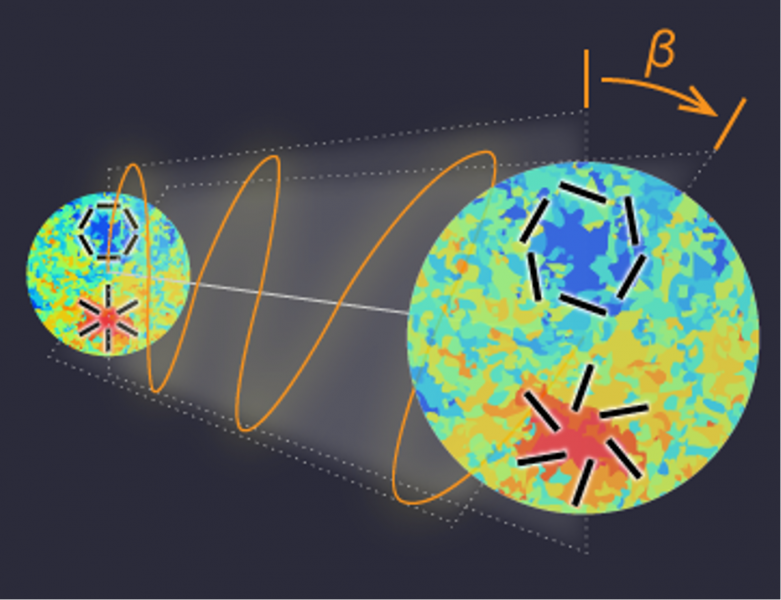
Figure: As the light of the cosmic microwave background emitted 13.8 billion years ago (left image) travels through the Universe until observed on Earth (right image), the direction in which the electromagnetic wave oscillates (orange line) is rotated by an angle β. The rotation could be caused by dark matter or dark energy interacting with the light of the cosmic microwave background, which changes the patterns of polarization (black lines inside the images). The red and blue regions in the images show hot and cold regions of the cosmic microwave background, respectively. (Credit: Y. Minami / KEK). Hi-res image

Using Planck data from the cosmic microwave background radiation, an international team of researchers has observed a hint of new physics. The team developed a new method to measure the polarization angle of the ancient light by calibrating it with dust emission from our own Milky Way. While the signal is not detected with enough precision to draw definite conclusions, it may suggest that dark matter or dark energy causes a violation of the so-called “parity symmetry.” 

The laws of physics governing the Universe are thought not to change when flipped around in a mirror. For example, electromagnetism works the same regardless of whether you are in the original system, or in a mirrored system in which all spatial coordinates have been flipped. If this symmetry, called “parity,” is violated, it may hold the key to understanding the elusive nature of dark matter and dark energy, which occupy 25 and 70 percent of the energy budget of the Universe today, respectively. While both dark, these two components have opposite effects on the evolution of the Universe: dark matter attracts, while dark energy causes the Universe to expand ever faster. 

A new study, including researchers from the Institute of Particle and Nuclear Studies (IPNS) at the High Energy Accelerator Research Organization (KEK), the Kavli Institute for the Physics and Mathematics of the Universe (Kavli IPMU) of the University of Tokyo, and the Max Planck Institute for Astrophysics (MPA), reports on a tantalizing hint of new physics—with 99.2 percent confidence level —which violates parity symmetry. Their findings were published in the journal Physical Review Letters on November 23, 2020; the paper was selected as the “Editors’ Suggestion,” judged by editors of the journal to be important, interesting, and well written.

The hint to a violation of parity symmetry was found in the cosmic microwave background radiation, the remnant light of the Big Bang. The key is the polarized light of the cosmic microwave background. Light is a propagating electromagnetic wave. When it consists of waves oscillating in a preferred direction, physicists call it “polarized.” The polarization arises when the light is scattered. Sunlight, for instance, consists of waves with all possible oscillating directions; thus, it is not polarized. The light of a rainbow, meanwhile, is polarized because the sunlight is scattered by water droplets in the atmosphere. Similarly, the light of the cosmic microwave background initially became polarized when scattered by electrons 400,000 years after the Big Bang. As this light traveled through the Universe for 13.8 billion years, the interaction of the cosmic microwave background with dark matter or dark energy could cause the plane of polarization to rotate by an angle β (Figure).

“If dark matter or dark energy interact with the light of the cosmic microwave background in a way that violates parity symmetry, we can find its signature in the polarization data,” points out Yuto Minami, a postdoctoral fellow at IPNS, KEK.

To measure the rotation angle β, the scientists needed polarization-sensitive detectors, such as those onboard the Planck satellite of the European Space Agency (ESA). And they needed to know how the polarization-sensitive detectors are oriented relative to the sky. If this information was not known with sufficient precision, the measured polarization plane would appear to be rotated artificially, creating a false signal. In the past, uncertainties over the artificial rotation introduced by the detectors themselves limited the measurement accuracy of the cosmic polarization angle β. 

“We developed a new method to determine the artificial rotation using the polarized light emitted by dust in our Milky Way,” said Minami. “With this method, we have achieved a precision that is twice that of the previous work, and are finally able to measure β.” The distance traveled by the light from dust within the Milky Way is much shorter than that of the cosmic microwave background. This means that the dust emission is not affected by dark matter or dark energy, i.e. β is present only in the light of the cosmic microwave background, while the artificial rotation affects both. The difference in the measured polarization angle between both sources of light can thus be used to measure β.

The research team applied the new method to measure β from the polarization data taken by the Planck satellite. They found a hint for violation of parity symmetry with 99.2 percent confidence level. To claim a discovery of new physics, much greater statistical significance, or a confidence level of 99.99995 percent, is required. Eiichiro Komatsu, director at the MPA and Principal Investigator at the Kavli IPMU, said: “It is clear that we have not found definitive evidence for new physics yet; higher statistical significance is needed to confirm this signal. But we are excited because our new method finally allowed us to make this ‘impossible’ measurement, which may point to new physics.”

To confirm this signal, the new method can be applied to any of the existing— and future—experiments measuring polarization of the cosmic microwave background, such as Simons Array and LiteBIRD, in which both KEK and the Kavli IPMU are involved.

Source: Kavli Institute for the Physics and Mathematics of the Universe (Kavli IPMU)

Paper details:

Journal: Physical Review Letters
Title: New extraction of the cosmic birefringence from the Planck 2018 polarization data

Authors: Yuto Minami (1), Eiichiro Komatsu (2,3)
Author affiliation:
1. High Energy Accelerator Research Organization, 1-1 Oho, Tsukuba, Ibaraki, 305-0801, Japan

2. Kavli Institute for the Physics and Mathematics of the Universe (Kavli IPMU, WPI), University of Tokyo, Chiba 277-8582, Japan

3. Max-Planck-Institut für Astrophysik, Karl-Schwarzschild Str. 1, 85741 Garching, Germany 

DOI: https://link.aps.org/doi/10.1103/PhysRevLett.125.221301 (November 23, 2020)
Abstract of the paper (Physical Review Letters page)


Research contact: 

Yuto Minami
Institute of Particle and Nuclear Studies, High Energy Accelerator Research Organization (KEK, Japan)
Postdoctoral Fellow
E-mail:
yminami@post.kek.jp

Eiichiro Komatsu 
Kavli Institute for the Physics and Mathematics of the Universe,The University of Tokyo
Principal Investigator
Max Planck Institute for Astrophysics
Director of the Department of Physical Cosmology
E-mail:
komatsu@mpa-garching.mpg.de
Tel: + 49-89-30000-2208

Media contact:

Hajime Hikino
PR office, High Energy Accelerator Research Organization (KEK, Japan)
E-mail:
press@kek.jp
TEL: +81-29-879-6047

Hiroko Tada
PR office, Institute of Particle and Nuclear Studies, High Energy Accelerator Research Organization (KEK, Japan)
E-mail:
htada@post.kek.jp
Tel: +81-29-864-5638

John Amari
Press officer 
Kavli Institute for the Physics and Mathematics of the Universe, The University of Tokyo
E-mail:
press@ipmu.jp
Tel: 080-4056-2767 

Hannelore Hämmerle 
Press Officer 
Max Planck Institute for Astrophysics
E-mail:
pr@mpa-garching.mpg.de 
Tel: +49-89-30000-3980


Wednesday, November 25, 2020

VLA Sky Survey Reveals Newborn Jets in Distant Galaxies

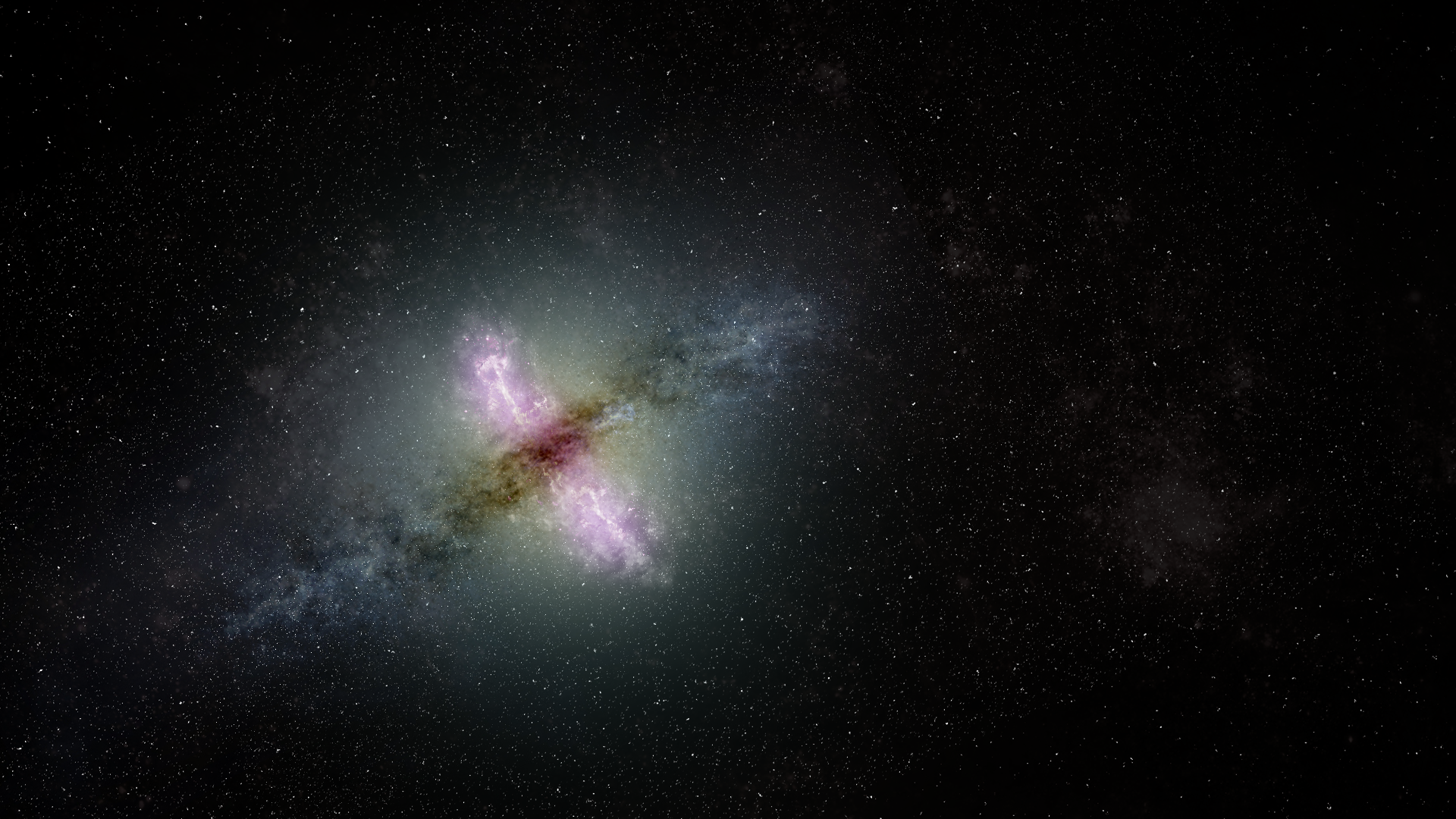
Artist's conception of a galaxy with an active nucleus propelling jets of material outward from the galaxy's center.
Credit: Sophia Dagnello, NRAO/AUI/NSF.  Hi-Res File

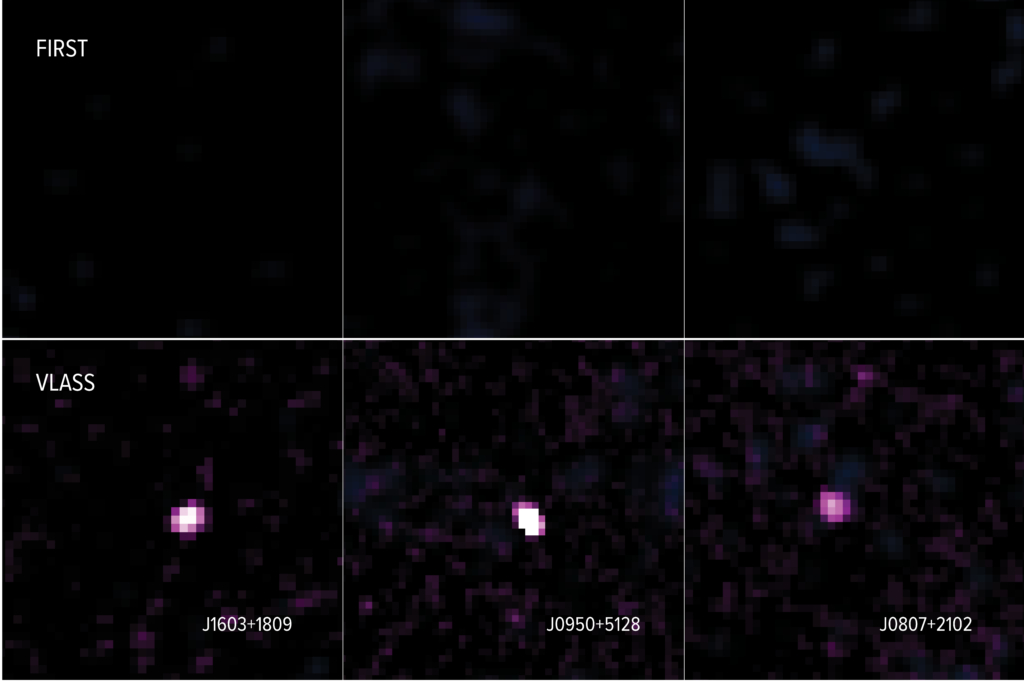
VLA images of three galaxies in the new study, comparing what was seen in the earlier FIRST survey and the later VLASS. The newly-appearing bright radio emission indicates that the galaxies launched new jets of material sometime between the dates of the two observations. Credit: Nyland et al.; Sophia Dagnello, NRAO/AUI/NSF.Hi-Res File

Animation comparing images as seen by two VLA surveys, years apart. The newly-appearing radio emission indicates the galaxies launched new jets of material sometime between the two observations. Credit: Nyland et al.; Sophia Dagnello, NRAO/AUI/NSF.Hi-Res File

Astronomers using data from the ongoing VLA Sky Survey (VLASS) have found a number of distant galaxies with supermassive black holes at their cores that have launched powerful, radio-emitting jets of material within the past two decades or so. The scientists compared data from VLASS with data from an earlier survey that also used the National Science Foundation’s Karl G. Jansky Very Large Array (VLA) to reach their conclusion.

“We found galaxies that showed no evidence of jets before but now show clear indications of having young, compact jets,” said Dr. Kristina Nyland, who is an NRC postdoctoral fellow in residence at the Naval Research Laboratory.

“Jets like these can strongly affect the growth and evolution of their galaxies, but we still don’t understand all of the details. Catching newborn jets with surveys like VLASS provides a measure of the role of powerful radio jets in shaping the lives of the galaxies over billions of years,” Nyland said.

VLASS is a project that will survey the sky visible from the VLA — about 80 percent of the entire sky — three times over seven years. The observations began in 2017 and the first of the three scans now is complete. Nyland and her colleagues compared data from this scan with data from the FIRST survey that used the VLA to observe a smaller portion of the sky between 1993 and 2011.

They found about 2,000 objects that appear in the VLASS images, but were not detected in the earlier FIRST survey. From these, they selected 26 objects that previously were categorized as galaxies with active nuclei — powered by supermassive black holes — by optical and infrared observations. The FIRST observations of the 26 objects had been made between 1994 and 2001. The VLASS observations were made in 2019. The intervals between observations of the objects thus ranged from 18 to 25 years.

They chose 14 of these galaxies for more detailed observations with the VLA. These observations provided higher-resolution images and also were done at multiple radio frequencies to get a more complete understanding of the objects’ characteristics.

“The data from these detailed observations tell us that the most likely cause of the difference in radio brightness between the FIRST and the VLASS observations is that the ‘engines’ at the cores of these galaxies have launched new jets since the FIRST observations were made,” explained Dillon Dong, from Caltech.

The black holes at the cores of galaxies are known to interact with the galaxies themselves, and the two evolve together. The jets launched from the regions near the black holes can affect the amount of star formation within the galaxy.

“Radio jets provide natural laboratories for learning about the extreme physics of supermassive black holes, whose formation and growth are believed to be intrinsically linked to that of the galaxy centers in which they reside,” said Pallavi Patil, of the University of Virginia.

“Jets as young as the ones discovered in our study can provide us with a rare opportunity to gain new insights on how these interactions between the jets and their surroundings work,” Nyland said.

“VLASS has proven to be a key tool for discovering such jets, and we eagerly await the results of its next two observing epochs,” said Mark Lacy, of the National Radio Astronomy Observatory.

Nyland and her colleagues plan further studies of the galaxies using the Very Long Baseline Array (VLBA), the Chandra X-Ray Observatory, and visible-light and infrared telescopes. They are reporting their results in the Astrophysical Journal.

The National Radio Astronomy Observatory is a facility of the National Science Foundation, operated under cooperative agreement by Associated Universities, Inc.


Media Contact:

Dave Finley, Public Information Officer
(575) 835-7302

dfinley@nrao.edu

Source:  National Radio Astronomy Observatory (NRAO)/News