Thursday, November 19, 2020

Hubble Catches Possible 'Shadow Play' of the Disk Around a Black Hole

Dark Rays in IC 5063
Credits: NASA,  ESA, and W.P. Maksym (CfA). Hi-res image - Release images

Some of the most stunning views of our sky occur at sunset, when sunlight pierces the clouds, creating a mixture of bright and dark rays formed by the clouds' shadows and the beams of light scattered by the atmosphere.

Astronomers studying nearby galaxy IC 5063 are tantalized by a similar effect in images taken by NASA's Hubble Space Telescope. In this case, a collection of narrow bright rays and dark shadows is seen beaming out of the blazingly bright center of the active galaxy.

A team of astronomers, led by Peter Maksym of the Center for Astrophysics | Harvard & Smithsonian (CfA), in Cambridge, Massachusetts, has traced the rays back to the galaxy's core, the location of an active supermassive black hole. A black hole is a dense, compact region of space that swallows light and matter under the crushing pull of gravity. The monster object is frenetically feeding on infalling material, producing a powerful gusher of light from superheated gas near it.

Although the researchers have developed several plausible theories for the lightshow, the most intriguing idea suggests that an inner-tube-shaped ring, or torus, of dusty material surrounding the black hole is casting its shadow into space.

According to Maksym's proposed scenario, the dust disk around the black hole doesn't block all of the light. Gaps in the disk allow light to beam out, creating brilliant cone-shaped rays similar to the fingers of light sometimes seen at sunset. However, the rays in IC 5063 are happening on a vastly larger scale, shooting across at least 36,000 light-years.

Some of the light hits dense patches in the ring, casting the ring's shadow into space. These shadows appear as dark finger shapes interspersed with bright rays. These beams and shadows are visible because the black hole and its ring are tipped sideways relative to the plane of the galaxy. This alignment allows the light beams to extend far outside the galaxy.

This interplay of light and shadow offers a unique insight into the distribution of material encircling the black hole. In some areas, the material may resemble scattered clouds. If this interpretation is correct, the observations may provide an indirect probe of the disk's mottled structure.

"I'm most excited by the shadow of the torus idea because it's a really cool effect that I don't think we've seen before in images, although it has been hypothesized," Maksym said. "Scientifically, it's showing us something that is hard—usually impossible—to see directly. We know this phenomenon should happen, but in this case, we can see the effects throughout the galaxy. Knowing more about the geometry of the torus will have implications for anybody trying to understand the behavior of supermassive black holes and their environments. As a galaxy evolves, it is shaped by its central black hole."

Studying the torus is important because it funnels material toward the black hole. If the "shadow" interpretation is accurate, the dark rays provide indirect evidence that the disk in IC 5063 could be very thin, which explains why light is leaking out all around the structure.

Observations of similar black holes by NASA's Chandra X-ray Observatory detected X-rays leaking out of holes in the torus, making the structure appear like Swiss cheese. The holes may be caused by the disk being torqued by internal forces, causing it to warp, Maksym said. "It's possible that the warping creates big enough gaps for some of the light to shine through, and as the torus rotates, beams of light could sweep across the galaxy like lighthouse beams through fog," he added.

Citizen Science Serendipity

Although astronomers have been studying the galaxy for decades, it took a non-scientist to make the surprising discovery. Judy Schmidt, an artist and amateur astronomer based in Modesto, California, uncovered the dark shadows when she reprocessed Hubble exposures of the galaxy in December 2019. Schmidt routinely culls the Hubble archive for interesting observations that she can turn into beautiful images. She shares those images on her Twitter feed with her many followers, who include astronomers such as Maksym.

Schmidt selected the Hubble observations of IC 5063 from the archive because she is interested in galaxies that have active cores. The cone-shaped shadows were not apparent in the original exposures, so she was surprised to see them in her reprocessed image. "I had no idea they were there, and even after I'd processed it, I kept blinking my eyes wondering if I was seeing what I thought I was seeing," she said.

She immediately posted her image to her Twitter account. "It was something I'd never seen before, and even though I had strong suspicions about them being shadow rays or 'crepuscular rays,' as Peter has dubbed them, it's easy to let one's imagination and wishful thinking run wild," she explained. "I figured if I was wrong, someone would come to ground me."

The image prompted a lively Twitter discussion among her astronomer followers, including Maksym, who debated the rays' origin. Maksym had already been analyzing Hubble images of the jets produced by the galaxy's black hole. So he took the lead in studying the rays and writing a science paper. His study is based on near-infrared observations made by Hubble's Wide Field Camera 3 and Advanced Camera for Surveys in March and November 2019. Red and near-infrared light pierces the dusty galaxy to reveal the details that may be enshrouded in dust.

This discovery would not have been possible without Hubble's sharp vision. The galaxy is also relatively nearby, only 156 million light-years from Earth. "Older images from telescopes on the ground showed maybe hints of this kind of structure, but the galaxy itself is such a mess that you'd never guess that this is what's going on without Hubble," Maksym explained. "Hubble has sharp pictures, is sensitive to faint things, and has a big enough field of view to image the entire galaxy."

Maksym hopes to continue his study of the galaxy to determine whether his scenario is correct. "We will want to keep investigating, and it will be great if other scientists try to test our conclusions, too, with new observations and modeling," he said. "This is a project that is just begging for new data because it raises more questions than it answers."

The team's results were published in The Astrophysical Journal Letters

The Hubble Space Telescope is a project of international cooperation between NASA and ESA (European Space Agency). NASA's Goddard Space Flight Center in Greenbelt, Maryland, manages the telescope. The Space Telescope Science Institute (STScI) in Baltimore, Maryland, conducts Hubble science operations. STScI is operated for NASA by the Association of Universities for Research in Astronomy in Washington, D.C.

Contacts

Donna Weaver / Ray Villard
Space Telescope Science Institute, Baltimore, Maryland
410-338-4493 / 410-338-4514

dweaver@stsci.edu / villard@stsci.edu


Peter Maksym
Center for Astrophysics | Harvard & Smithsonian, Cambridge, Massachusetts
walter.maksym@cfa.harvard.edu

Related Links

The science paper by W.P. Maksym et al.
NASA's Hubble Portal

 Source: HubbleSite/News


Wednesday, November 18, 2020

The Cosmic Dust in Your Bones

Evidence indicates that large amounts of cosmic dust are produced as the stellar winds of massive stars collide in Wolf-Rayet binary or multiple-star systems. As the stars orbit each other and dust is produced, a distinctive pinwheel pattern is formed, as shown in this image from the European Southern Observatory. Warm dust like this glows in the mid-infrared wavelengths of light detectable by NASA’s James Webb Space Telescope. Confirming the origin of dust will help account for the mysterious over-abundance of it found in galaxies, which is crucial to the later development of stars, planets, and life as we know it. Credit: ESOand Callingham et al. Release image/Release videos

Discovering too much money in your bank account may not be what you would call a "crisis," but it would still be unexpected and you should figure out how it got there. Astronomers find themselves in a similar position when calculating the amount of dust galaxies should have; there is more dust than expected, and they don’t know where it’s coming from. This matters because cosmic dust is essential to the function of the universe: it shelters forming stars, becomes part of planets, and can contain the organic compounds that lead to life as we know it. Dust led to us.

"What we refer to as the 'dust budget crisis' is the major problem in astronomy of not being able to account for all the dust that's observed in galaxies, both in the nearby and distant, early universe," says Ryan Lau of the Japan Aerospace Exploration Agency. Lau is leading an Director's Discretionary-Early Release Science Program with NASA's upcoming James Webb Space Telescope to study dust-producing Wolf-Rayet binary stars.

Wolf-Rayet stars are very hot and very bright. There is evidence that Wolf-Rayet stars, through interactions with a companion star, produce large amounts of dust in a distinctive pinwheel pattern as the two stars orbit each other and their stellar winds collide. It is possible that these binary-star systems account for a large percentage of a galaxy's "dust budget." However, the intense luminosity and heat coming from the Wolf-Rayet stars has made it difficult to study the faint, more diffuse dust of these systems. This is where Webb comes in.

"The mid-infrared light that Webb can detect is exactly the wavelength of light we want to look at to study the dust and its chemical composition," Lau explains. Infrared wavelengths are longer than the wavelengths of visible light, and so can slide between dust grains to reach the telescope, rather than getting caught up bouncing around in the dust cloud. Webb will detect this light and allow astronomers to read the information it carries, including the signature of chemicals in the dusty environment, some of which may be the same chemicals that form the building blocks of life on Earth.

"Webb has an unprecedented combination of spatial resolution and sensitivity in mid-infrared wavelengths that is really what enables us to conduct these interesting observations," Lau says. "We can achieve the spatial resolution from ground-based telescopes, but lack the sensitivity that Webb can achieve from its observing location in space, without the interference of Earth's atmosphere. Conversely, with previous infrared space-based telescopes like NASA’s Spitzer mission, we could achieve the sensitivity but lacked the spatial resolution."

Targeting Two Dust Factories

Lau and the Director's Discretionary-Early Release Science (DD-ERS) team will use Webb to study two Wolf-Rayet binary systems, using the telescope's Mid-Infrared Instrument (MIRI) and Near Infrared Imager and Slitless Spectrograph (NIRISS). The WR140 binary system has been studied extensively in many wavelengths of light and so will provide a good baseline for gauging Webb's best observing modes for this kind of cosmic subject. Another Wolf-Rayet binary, WR137, will experience its stars’ closest approach to each other—when the most dust is thought to be produced—early in Webb's mission when the DD-ERS program observations are scheduled.

Beyond new discoveries about the formation and chemical composition of dust, the DD-ERS program also will be among the first opportunities astronomers have to test out best practices for Webb’s instruments and processing the data it delivers.

"This DD-ERS program will look at the best ways to maximize Webb’s dynamic range—the difference between the brightest and faintest objects it observes—and that will be useful to the astronomy community in many ways in the future; for example, in studying the dusty disk surrounding the bright center of an active galaxy, or finding a planet orbiting a bright star,” says Mansi Kasliwal, another astronomer on the DD-ERS team. Kasliwal led the laboratory at the California Institute of Technology where Lau performed his post-doctoral research on Wolf-Rayet binaries and developed the proposal for the DD-ERS program.

Both Lau and Kasliwal agree that while the open question of how cosmic dust is created and disseminated throughout the universe is a fascinating one, it is really a stepping stone toward answering one of the biggest questions ever posed: How did we get here? As far as we know, Earth is an island of life in the universe, and in seeking to understand something as seemingly remote as cosmic dust, Lau says that we are ultimately seeking to understand ourselves. "Understanding the formation of dust is critical for us to trace our own cosmic origins," Lau says. "Webb is one of the most powerful scientific tools ever built in the quest to find answers to these fundamental questions."

The James Webb Space Telescope will be the world's premier space science observatory when it launches in 2021. Webb will solve mysteries in our solar system, look beyond to distant worlds around other stars, and probe the mysterious structures and origins of our universe and our place in it. Webb is an international program led by NASA with its partners, ESA (European Space Agency) and the Canadian Space Agency.

Contact:  

Leah Ramsay / Christine Pulliam
Space Telescope Science Institute, Baltimore, Maryland
667-218-6439 / 410-338-4366

lramsay@stsci.edu / cpulliam@stsci.edu 

Related Links:  NASA's Webb Portal


 Source: NASA's James Webb Space Telescope/News


Tuesday, November 17, 2020

More than Meets the Eye: Complete Imaging of a Cluster Collision

Figure 1: Composite image showing HSC J023336-053022 (XLSSC 105), a pair of colliding galaxy clusters located 4 billion light-years away in the constellation Cetus. The background image was taken by the Subaru Telescope. Overlaid colors show the distributions of dark matter (blue), hot gas observed in X-rays (green), and high-pressure gas observed by radio (red). This cluster contains two concentrations of galaxies, which overlap with the distribution of the dark matter. (Credit: GBT/NSF/NAOJ/HSC-SSP/ESA/XMM-Newton/XXL survey consortium).
Hi-res image

A trio of world-leading observatories joined forces to observe colliding galaxy clusters and map their components, including dark matter and intracluster gas which can’t be seen with visible light. They found that the violence of the collision heats the intracluster gas to 400 million degrees centigrade. This is an important result for understanding the evolution of structure in the Universe.

Space is a cold, lonely place so things like to group together. Stars group together into galaxies; galaxies gather together in clusters; and even galaxy clusters collide and merge into larger clusters. But the stars we can see only tell part of the story. Clusters also contain hot intracluster gas and dark matter. The various components behave differently during a collision, so to understand the complete picture we need to observe all of them.

The Subaru Telescope, the XMM-Newton X-ray Survey (XXL), and the Green Bank Telescope (GBT) teamed up to observe HSC J023336-053022 (XLSSC 105), a pair of colliding galaxy clusters. The Subaru Telescope captured the light from the stars in the cluster; XXL observed hot, thin gas; and the MUSTANG-2 receiver installed on the GBT observed high-pressure gas. The technological innovation of the GBT and MUSTANG-2 enabled observations of such a high-pressure gas with high resolution. Astronomers could infer the distribution of the invisible dark matter by using General Relativity to analyze the distortion of the shapes of background galaxies in the Subaru Telescope image. The data for these four components were combined to create a complete picture. The results show that the intracluster gas was originally 40 million degrees and the energy released in the collision raised the temperature by ten times in places. For reference, 400 million degrees centigrade is approximately 720 million degrees Fahrenheit, or about 27 times hotter than the core of the Sun. This agrees with predictions, suggesting that the numerical simulations of cluster collisions are accurate.

Lead researcher Nobuhiro Okabe comments, "None of the observatories alone could have achieved this collaborative result. The ongoing Subaru Telescope HSC-SSP Survey observing the wide and deep Universe provides us with a rare opportunity to discover many clusters undergoing collisions. We hope to carry out follow-up observations of such clusters in X-ray and radio bands in order to understand the details of structure formation of the Universe."

This research was published in Monthly Notices of the Royal Astronomical Society on September 9, 2020 as Okabe, Dicker, Eckert et al. "Active gas features in three HSC-SSP CAMIRA clusters revealed by high angular resolution analysis of MUSTANG-2 SZE and XXL X-ray observations".

The Subaru Telescope Hyper Suprime-Cam (HSC) collaboration includes the astronomical communities of Japan and Taiwan, and Princeton University. The XXL is an international project based around an XMM-Newton Very Large Programme surveying two 25 deg2 extragalactic fields. The Green Bank Observatory is a facility of the National Science Foundation operated by Associated Universities, Inc., under a cooperative agreement with the National Science Foundation.

Source: Subaru Telescope


Monday, November 16, 2020

NASA's Hubble Sees Unexplained Brightness from Colossal Explosion

This image shows the glow from a kilonova caused by the merger of two neutron stars. The kilonova, whose peak brightness reaches up to 10,000 times that of a classical nova, appears as a bright spot (indicated by the arrow) to the upper left of the host galaxy. The merger of the neutron stars is believed to have produced a magnetar, which has an extremely powerful magnetic field. The energy from that magnetar brightened the material ejected from the explosion. Credits: NASA, ESA, W. Fong (Northwestern University), and T. Laskar (University of Bath, UK).Hi-res image

Long ago and far across the universe, an enormous burst of gamma rays unleashed more energy in ahalf-second than the Sun will produce over its entire 10-billion-year lifetime. In May of 2020, light from the flash finally reached Earth and was first detected by NASA's Neil Gehrels Swift Observatory. Scientists quickly enlisted other telescopes — including NASA's Hubble Space Telescope, the Very Large Array radio observatory, the W. M. Keck Observatory, and the Las Cumbres Observatory Global Telescope network — to study the explosion's aftermath and the host galaxy. It was Hubble that provided the surprise.

Based on X-ray and radio observations from the other observatories, astronomers were baffled by what they saw with Hubble: the near-infrared emission was 10 times brighter than predicted. These results challenge conventional theories of what happens in the aftermath of a short gamma-ray burst. One possibility is that the observations might point to the birth of a massive, highly magnetized neutron star called a magnetar.

"These observations do not fit traditional explanations for short gamma-ray bursts," said study leader Wen-fai Fong of Northwestern University in Evanston, Illinois. "Given what we know about the radio and X-rays from this blast, it just doesn't match up. The near-infrared emission that we're finding with Hubble is way too bright. In terms of trying to fit the puzzle pieces of this gamma-ray burst together, one puzzle piece is not fitting correctly."

Without Hubble, the gamma-ray burst would have appeared like many others, and Fong and her team would not have known about the bizarre infrared behavior. "It's amazing to me that after 10 years of studying the same type of phenomenon, we can discover unprecedented behavior like this," said Fong. "It just reveals the diversity of explosions that the universe is capable of producing, which is very exciting."

Light Fantastic

The intense flashes of gamma rays from these bursts appear to come from jets of material that are moving extremely close to the speed of light. The jets do not contain a lot of mass — maybe a millionth of the mass of the Sun — but because they're moving so fast, they release a tremendous amount of energy across all wavelengths of light. This particular gamma-ray burst was one of the rare instances in which scientists were able to detect light across the entire electromagnetic spectrum.

This illustration shows the sequence for forming a magnetar-powered kilonova, whose peak brightness reaches up to 10,000 times that of a classical nova. 1) Two orbiting neutron stars spiral closer and closer together. 2) They collide and merge, triggering an explosion that unleashes more energy in a half-second than the Sun will produce over its entire 10-billion-year lifetime. 3) The merger forms an even more massive neutron star called a magnetar, which has an extraordinarily powerful magnetic field. 4) The magnetar deposits energy into the ejected material, causing it to glow unexpectedly bright at infrared wavelengths. Credits: NASA, ESA, and D. Player (STScI).
Hi-res image

"As the data were coming in, we were forming a picture of the mechanism that was producing the light we were seeing," said the study's co-investigator, Tanmoy Laskar of the University of Bath in the United Kingdom. "As we got the Hubble observations, we had to completely change our thought process, because the information that Hubble added made us realize that we had to discard our conventional thinking, and that there was a new phenomenon going on. Then we had to figure out what that meant for the physics behind these extremely energetic explosions."

Gamma-ray bursts — the most energetic, explosive events known — live fast and die hard. They are split into two classes based on the duration of their gamma rays.

If the gamma-ray emission is greater than two seconds, it's called a long gamma-ray burst. This event is known to result directly from the core collapse of a massive star. Scientists expect a supernova to accompany this longer type of burst.

If the gamma-ray emission lasts less than two seconds, it's considered a short burst. This is thought to be caused by the merger of two neutron stars, extremely dense objects about the mass of the Sun compressed into the volume of a city. A neutron star is so dense that on Earth, one teaspoonful would weigh a billion tons! A merger of two neutron stars is generally thought to produce a black hole.

Neutron star mergers are very rare but are extremely important because scientists think that they are one of the main sources of heavy elements in the universe, such as gold and uranium.

Accompanying a short gamma-ray burst, scientists expect to see a "kilonova" whose peak brightness typically reaches 1,000 times that of a classical nova. Kilonovae are an optical and infrared glow from the radioactive decay of heavy elements and are unique to the merger of two neutron stars, or the merger of a neutron star with a small black hole.

 Magnetic Monster?

Fong and her team have discussed several possibilities to explain the unusual brightness that Hubble saw. While most short gamma-ray bursts probably result in a black hole, the two neutron stars that merged in this case may have combined to form a magnetar, a supermassive neutron star with a very powerful magnetic field.

"You basically have these magnetic field lines that are anchored to the star that are whipping around at about a thousand times a second, and this produces a magnetized wind," explained Laskar. "These spinning field lines extract the rotational energy of the neutron star formed in the merger, and deposit that energy into the ejecta from the blast, causing the material to glow even brighter."

These two images taken on May 26 and July 16, 2020, show the fading light of a kilonova located in a distant galaxy. The kilonova appears as a spot to the upper left of the host galaxy. The glow is prominent in the May 26 image but fades in the July 16 image. The kilonova's peak brightness reaches up to 10,000 times that of a classical nova. A merger of two neutron stars — the source of the kilonova — is believed to have produced a magnetar, which has an extremely powerful magnetic field. The energy from that magnetar brightened the material ejected from the explosion, causing it to become unusually bright at infrared wavelengths of light. Credits: NASA, ESA, W. Fong (Northwestern University), T. Laskar (University of Bath, UK), and A. Pagan (STScI). Video

If the extra brightness came from a magnetar that deposited energy into the kilonova material, then within a few years, the team expects the ejecta from the burst to produce light that shows up at radio wavelengths. Follow-up radio observations may ultimately prove that this was a magnetar, and this may explain the origin of such objects.

"With its amazing sensitivity at near-infrared wavelengths, Hubble really sealed the deal with this burst," explained Fong. "Amazingly, Hubble was able to take an image only three days after the burst. Through a series of later images, Hubble showed that a source faded in the aftermath of the explosion. This is as opposed to being a static source that remains unchanged. With these observations, we knew we had not only nabbed the source, but we had also discovered something extremely bright and very unusual. Hubble's angular resolution was also key in pinpointing the position of the burst and precisely measuring the light coming from the merger."

NASA's upcoming James Webb Space Telescope is particularly well-suited for this type of observation. "Webb will completely revolutionize the study of similar events," said Edo Berger of Harvard University in Cambridge, Massachusetts, and principal investigator of the Hubble program. "With its incredible infrared sensitivity, it will not only detect such emission at even larger distances, but it will also provide detailed spectroscopic information that will resolve the nature of the infrared emission."

The team's findings appear in an upcoming issue of The Astrophysical Journal.

The Hubble Space Telescope is a project of international cooperation between NASA and ESA (European Space Agency). NASA's Goddard Space Flight Center in Greenbelt, Maryland, manages the telescope. The Space Telescope Science Institute (STScI) in Baltimore, Maryland, conducts Hubble science operations. STScI is operated for NASA by the Association of Universities for Research in Astronomy, in Washington, D.C.

Media Contacts:

Claire Andreoli
NASA's Goddard Space Flight Center
301-286-1940

claire.andreoli@nasa.gov

Ann Jenkins / Ray Villard
Space Telescope Science Institute, Baltimore, Maryland
410-338-4488 / 410-338-4514

jenkins@stsci.edu / villard@stsci.edu

Science Contacts:

Wen-fai Fong
Northwestern University, Evanston, Illinois

wfong@northwestern.edu 

Tanmoy Laskar
University of Bath, Bath, United Kingdom

t.laskar@bath.ac.uk 

Edo Berger
Center for Astrophysics | Harvard & Smithsonian, Cambridge, Massachusetts

eberger@cfa.harvard.edu


Editor: Lynn Jenner


Friday, November 13, 2020

Galaxies in the Perseus Cluster

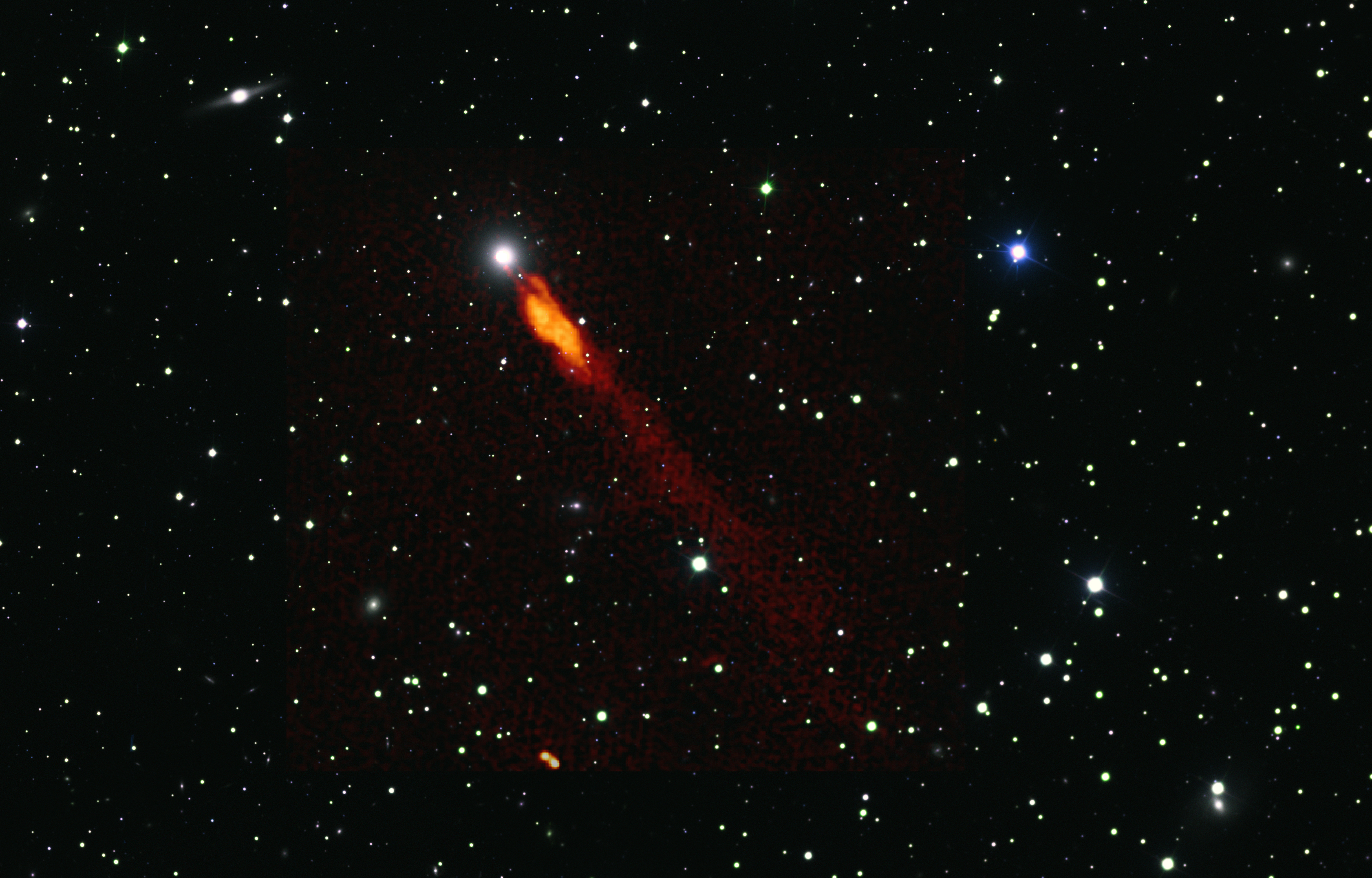
NGC 1275, NGC 1265 and IC 310
Credit: M. Gendron-Marsolais et al.; S. Dagnello, NRAO/AUI/NSF; Sloan Digital Sky Survey.
Hi-res image

The giant galaxy NGC 1275, at the core of the cluster, is seen in new detail, including a newly-revealed wealth of complex, filamentary structure in its radio lobes. Credit: CREDIT: M. Gendron-Marsolais et al.; S. Dagnello, NRAO/AUI/NSF; Sloan Digital Sky Survey.
Hi-res image

The galaxy NGC 1265 shows the effects of its motion through the tenuous material between the galaxies. Its radio jets are bent backward by that interaction, then merge into a single, broad "tail." The tail then is further bent, possibly by motions within the intergalactic material. Credit:  M. Gendron-Marsolais et al.; S. Dagnello, NRAO/AUI/NSF; Sloan Digital Sky Survey.
Hi-res image

The jets of the galaxy IC 310 are bent backward, similarly to NGC 1265, but appear closer because of the viewing angle from Earth. That angle also allows astronomers to directly observe energetic gamma rays generated near the supermassive black hole at the galaxy's core. Credit: M. Gendron-Marsolais et al.; S. Dagnello, NRAO/AUI/NSF; SDSS.
Hi-res image
 
For galaxies, as for people, living in a crowd is different from living alone. Recently, astronomers used the National Science Foundation’s Karl G. Jansky Very Large Array (VLA) to learn how a crowded environment affects galaxies in the Perseus Cluster, a collection of thousands of galaxies some 240 million light-years from Earth.

Left: The giant galaxy NGC 1275, at the core of the cluster, is seen in new detail, including a newly-revealed wealth of complex, filamentary structure in its radio lobes.

Center: The galaxy NGC 1265 shows the effects of its motion through the tenuous material between the galaxies. Its radio jets are bent backward by that interaction, then merge into a single, broad “tail.” The tail then is further bent, possibly by motions within the intergalactic material.

Right: The jets of the galaxy IC 310 are bent backward, similarly to NGC 1265, but appear closer because of the viewing angle from Earth. That angle also allows astronomers to directly observe energetic gamma rays generated near the supermassive black hole at the galaxy’s core.

Such images can help astronomers better understand the complex environment of galaxy clusters, which are the largest gravitationally-bound structures in the universe, and which harbor a variety of still poorly-understood phenomena.

“These images show us previously-unseen structures and details and that helps our effort to determine the nature of these objects,” said Marie-Lou Gendron-Marsolais, an ESO/ALMA Fellow in Santiago, Chile. She and a number of international collaborators are announcing their results in the Monthly Notices of the Royal Astronomical Society.

The National Radio Astronomy Observatory is a facility of the National Science Foundation, operated under cooperative agreement by Associated Universities, Inc.

Media Contact:

Dave Finley, Public Information Officer
(575) 835-7302

dfinley@nrao.edu


Thursday, November 12, 2020

History of temperature changes in the Universe revealed—First measurement using the Sunyaev-Zeldovich effect

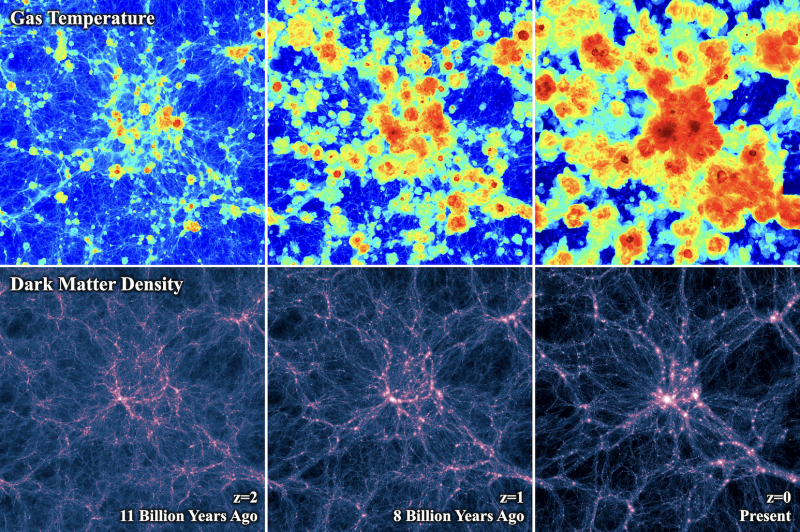
Image: Computer simulation of the evolution of the large-scale structure (bottom) and the temperature (top) of the Universe. The time flows from the left to the right panels, with the rightmost panel showing the present-day epoch. Credit: D. Nelson / Illustris Collaboration
. Hi-res image

Figure: Measured evolution of the temperature of the Universe. The time flows from left to right. The data points show the measurements, the red shaded area shows the physical model, and the blue box shows the estimate of the gravitational energy of the large-scale structure available for heating the gas, which can explain the measured temperature at the present time.   Reference: Chiang, Makiya, Ménard and Komatsu, Astrophysical Journal, 902, 56 (2020).


How hot is the Universe today? How hot was it before? A new study by an international team of researchers, including members of the Kavli Institute for the Physics and Mathematics of the Universe (Kavli IPMU), suggests that the mean temperature of gas in large structures of the Universe has increased about 3 times in the last 8 billion years, to reach about two million Kelvin today.

The large-scale structure of the Universe refers to the global pattern of how galaxies and galaxy clusters are distributed in space. This cosmic net formed from tiny irregularities in the matter distribution in the early Universe, which were amplified through gravitational attraction. “As the Universe evolves, gravity pulls dark matter and gas in space together into galaxies and clusters of galaxies,” said Yi-Kuan Chiang, the lead author of the study, and a research fellow at the Ohio State University Center for Cosmology and AstroParticle Physics. “The drag is violent—so violent that more and more gas is shocked and heated up.”

This heated gas can then be used to measure the mean temperature of the Universe over cosmic time. In particular, the researchers used the so-called “Sunyaev-Zeldovich” effect, named after Rashid Sunyaev, director emeritus at the Max Planck Institute for Astrophysics, and Soviet-era physicist Yakov Zeldovich, who first predicted this phenomenon theoretically. This effect arises when low-energy photons of the cosmic microwave background radiation are scattered by hot electrons in the large-scale structure of the Universe. The scattering transfers energy from electrons to photons, making the hot electron gas visible. The intensity of the Sunyaev-Zeldovich effect is proportional to the thermal pressure of the gas, which, in turn, is proportional to the temperature of electrons.

While this measurement is straightforward in principle, collecting the necessary data was a major undertaking. The study, which has been published in the Astrophysical Journal, was done in a collaboration of researchers at the Kavli IPMU, the Ohio State University, the Johns Hopkins University, and the Max Planck Institute for Astrophysics.

The researchers used data collected by two observatories, the Planck satellite and the Sloan Digital Sky Survey (SDSS). Planck is the European Space Agency mission which measured the cosmic microwave background radiation. SDSS collected detailed images and light spectra of galaxies. Combining the two data sets, the scientists were able to measure the amount of thermal pressure around the locations of galaxies and clusters of galaxies.

“It took astronomers more than 15 years to collect the necessary data using a telescope on the ground and one in space,” said Brice Ménard who led the analysis with Chiang. Ménard, who has been a visiting scientist at the Kavli IPMU since 2011, added: “On the analysis side, our team spent four years developing the algorithms necessary to extract the signal from these data.”

What’s more, interpretation of the data required a physical model, which was provided by Ryu Makiya, a research fellow at the Kavli IPMU. “Combining the latest data with a state-of-the-art theoretical model, we were able to reveal how the temperature of the Universe evolved, and how it was linked to formation of the large-scale structure of the Universe,” Makiya said. “The next goal is to understand details of the physics of thermal and non-thermal phenomena.”

Chiang, from the Ohio Stated University, added: “Our new measurement provides a direct confirmation of the seminal work by Jim Peebles—the 2019 Nobel Laureate in Physics—who laid out the theory of the emergence large-scale structure of the Universe.”

The study determined that about eight billion years ago (at a redshift z=1), the mean electron temperature was some 700,000 Kelvin, rising to about two million Kelvin today. Furthermore, the scientists determined that its evolution is almost entirely driven by the growth of structures, as gas is shock heated in collapsing large-scale structures.

Back in 2000, Eiichiro Komatsu, a Principal Investigator at the Kavli IPMU and Director at the Department of Physical Cosmology at the Max Planck Institute for Astrophysics, was also involved in a previous effort to calculate how the temperature of the Universe evolved. “For 20 years, we have been studying how to measure this using the Sunyaev-Zeldovich effect,” he remembered. “We now have finally measured the temperature of the Universe, not only thanks to the remarkable progress in observational data, but also due to the dedicated efforts of brilliant young scientists such as Yi-Kuan Chiang and Ryu Makiya. This is very satisfying,” Komatsu added.

Paper details:

Journal: The Astrophysical Journal
Title: The Cosmic Thermal History Probed by Sunyaev-Zeldovich Effect Tomography

Authors: Yi-Kuan Chiang (1), Ryu Makiya (2), Brice Ménard (2,3), and Eiichiro Komatsu (2,4)

Author affiliation:

1. Center for Cosmology and AstroParticle Physics (CCAPP), The Ohio State University, Columbus, OH 43210, USA
2. Kavli Institute for the Physics and Mathematics of the Universe (Kavli IPMU, WPI), University of Tokyo, Chiba 277-8582, Japan
3. Department of Physics & Astronomy, Johns Hopkins University, 3400 N. Charles Street, Baltimore, MD 21218, USA
4. Max-Planck-Institut für Astrophysik, Karl-Schwarzschild Str. 1, 85741 Garching, Germany

DOI: https://doi.org/10.3847/1538-4357/abb403 (October 12, 2020)
Abstract of the paper (Astrophysical Journal page)

Preprint (arXiv.org page)

Research contact:

Eiichiro Komatsu
Kavli Institute for the Physics and Mathematics of the Universe (Kavli IPMU)
Principal Investigator
Max Planck Institute for Astrophysics
Director of the Department of Physical Cosmology
E-mail:
komatsu@mpa-garching.mpg.de
TEL: + 49-89-30000-2208

Makiya Ryu
Kavli Institute for the Physics and Mathematics of the Universe (Kavli IPMU)
Visiting Associate Scientist
Institute of Astronomy and Astronomical Physics (ASIAA), Academia Sinica, Taiwan
Postdoctoral Fellow
E-mail:
rmakiya@siaa.sinica.edu.tw
TEL: +8862-2366-5420

Media contact:

John Amari
Press officer
Kavli Institute for the Physics and Mathematics of the Universe, The University of Tokyo
E-mail:
press@ipmu.jp
TEL: 080-4056-2767

Related links:

iNSPIRE
: https://inspirehep.net/literature/1803372

Wednesday, November 11, 2020

Catching a Radio Surprise

An artist view of how a supernova can create an afterglow of radio light

Credit: Benito Marcote (JIVE)

The Very Large Sky Survey (VLASS) is an ambitious project to make a high-resolution radio map of nearly 80% of the . When it is completed in 2024, it will give us the most detailed view of the radio sky ever captured. One of the goals of VLASS is to discover and map radio sources such as quasars and radio jets from black holes. To create this map, the Very Large Array (VLA) in New Mexico captures images of the sky as it drifts overhead. But as it takes these images, the VLA also once in a while captures events known as radio transients.

Radio transients are short-lived events that can last just weeks or days. If a radio telescope isn’t looking in the right direction when it happens, these transients can be missed. But because VLASS maps large sections of the sky in a relatively short time, it has a good chance of capturing radio transients, as it did in July of this year.

On December 12, 2019, a supernova was discovered in the constellation of Pisces by the Zwicky Transient Facility at Palomar Observatory in San Diego, California. The supernova occurred when the core of a large star collapses at the end of its life. The resulting explosion rips the star apart, casting gas and dust rich with new elements into space. Supernovae such as this are one of the ways a galaxy is seeded with material to create new stars and planets.

At its brightest, a supernova can outshine its entire galaxy. In optical light this brilliance does not last long. Within weeks a supernova’s grows dim in visible light, and this makes them difficult to study. But as the outer layers of the star are cast off, they emit a radio glow that can be observed by telescopes like the VLA. The afterglow of a supernova can last for months after the initial explosion.

Earlier this year, a team of astronomers realized that the VLA Sky Survey was scanning the region near the supernova soon after it occurred. So they combed the VLASS data for that region, looking for radio transients. They found one that matched the timing and location of the supernova. The VLASS observations also saw an initial radio glow of light from hydrogen that faded over time. Astronomers don’t fully understand why this occurs, but it could be because the outer layer of the star (which is mostly hydrogen) becomes diffuse and transparent, allowing deeper layers of the supernova to become visible.

The VLASS data also resolved a mystery about the distance of the supernova. An initial measurement of its brightness indicated that it was about 420 million light-years away. A later measurement of its visible spectrum gave a much closer result of 195 million light-years. The brightness of the VLASS transient agrees with the closer distance.

The best way for astronomers to study short-lived phenomena is to capture them at multiple wavelengths, from visible and x-rays to radio. This is one more reason why a radio sky survey such as VLASS is so important.


Source: National Radio Astronomy Observatory (NRAO)/News


Tuesday, November 10, 2020

First direct detection of a brown dwarf with a radio telescope

Artist’s impression of Elegast. The blue loops depict the magnetic field lines. Charged particles moving along these lines emit radio waves that LOFAR detected. Some particles eventually reach the poles and generate aurorae similar to the northern lights on Earth. (Image credit: ASTRON / Danielle Futselaar)

Astronomers at ASTRON have used the LOFAR radio telescope to discover a “brown dwarf” – a faint object more massive than Jupiter, but significantly less massive than the Sun. The discovery of the object dubbed Elegast, opens up a new path that uses radio telescopes to discover faint objects that are close-cousins of Jupiter-like exoplanets. 

Radio waves emitted by brown dwarfs carry information about their magnetic field strength. Until now radio observations could only measure strong magnetic fields – about a hundred times the strength of a common fridge magnet. LOFAR’s low frequency of observation makes it sensitive to magnetic fields comparable to that of a fridge magnet, which is within the range postulated to exist on the coldest brown dwarfs and large exoplanets.

“Magnetic fields control the atmospheric properties and radiation environment around exoplanets and radio observations are our best hope of measuring them. With this discovery, we have taken an important step towards realising the promise of radio astronomy to exoplanet science,” said Dr. Harish Vedantham, ASTRON staff scientist and lead author of the study published today in the Astrophysical Journal Letters.

New discovery technique

The group used a new discovery technique to spot Elegast. Previously, astronomers pointed radio telescopes at known and catalogued brown dwarfs that were all found from their faint glow at infrared wavelengths. “With LOFAR, we want to go down the mass-ladder all the way to Jupiter-like planets that are too faint to have been found in existing infrared surveys, so we decided to search for these objects directly in our radio images,” said Dr. Joe Callingham, a VENI postdoctoral fellow at Leiden Observatory and co-author of the study.

Objects such as Elegast (and exoplanets) stand out in special “polarised” radio images because the electric field of the radio waves they emit rotates in a characteristic circular pattern as it propagates – a phenomenon called circular polarisation. “We could not have picked out Elegast in our standard radio images from among the crowd of millions of galaxies, but Elegast immediately stood out when we made circularly polarised images,” said Dr. Tim Shimwell, ASTRON staff and project scientist of the LOFAR survey that led to Elegast’s discovery. The group then used infrared follow-up observations from the Gemini telescope, a program of NSF's NOIRLab, and NASA’s Infrared Telescope Facility to confirm that Elegast was indeed a cold brown dwarf.

Elegast is the first object of its kind that has been directly identified in radio images. The group is now busy acquiring follow-up observations of Elegast to measure its magnetic field and compare the results with theory. They are also busy sifting through LOFAR data to identify more objects like Elegast.

“Our ultimate goal is to understand magnetism in exoplanets and how it impacts their ability to host life. Because magnetic phenomena of cold brown dwarfs like Elegast are so similar to what is seen on solar system planets, we expect our work to provide a vital datapoint to test theoretical models that predict the magnetic fields of extrasolar bodies,” said Vedantham.

The published journal article can be found here.

An open-access pre-print of the paper can be found here.


Source:  Astron/Astronomy/News


Monday, November 09, 2020

A Distant Quasar as a Cosmic Clock

Artist’s illustration of a primordial galaxy dominated by the supermassive black hole in its center. Credit: NASA/ESA/ESO/Wolfram Freudling et al. (STECF)

In the schematic timeline of the universe, the epoch of reionization is when the first galaxies and quasars began to form and evolve. Credit: [NASA]

Hungry supermassive black holes in the distant cosmos can help us understand what happened shortly after our universe lit up with its first stars and galaxies. New work now probes the most distant supermassive black hole we’ve seen, searching for more clues.

Our Hazy Past

Our early universe, starting just a few million years after the Big Bang, was a dark place. Space was filled with clouds of neutral hydrogen, but there were no sources of visible light.

At some point a few hundred million years after the birth of the universe, the earliest stars began to form, as well as the first large-scale structures like galaxies. Supermassive black holes grew in the centers of those galaxies, and as the black holes accreted mass, they produced powerful radiation, appearing to us now as distant quasars. Within a billion years of the Big Bang, quasars and stars lit the universe and shaped it into its current form.

The details and precise timeline of these critical evolutionary stages, however, remain uncertain.

Let’s Turn Back Time

One way we can further understand this evolution is by using quasars as cosmic clocks. By peering back in time and exploring the earliest known quasars, we learn about the metallicity of gas at the centers of early galaxies — which reveals when this gas first became enriched with the metals formed by early stars.

In a recent study, a team of scientists led by Masafusa Onoue (Max Planck Institute for Astronomy, Germany) has probed this crucial time using one particularly early clock: quasar ULAS J1342+0928.

This schematic of a quasar includes the broad line region, orbiting clouds located very close to the central supermassive black hole. Credt: Urry & Padovani 1995

Peering into a Galaxy’s Center

ULAS J1342+0928 is the most distant, oldest known quasar; it’s located at a redshift of z = 7.54, which corresponds to a time just 680 million years after the Big Bang. Onoue and collaborators obtained deep near-infrared spectra of this distant source using the Gemini North telescope in Hawaii.

By modeling the spectra, Onoue and collaborators were able to measure the ratios of certain emission lines produced within the broad line region (BLR) of the quasar, a region of clouds that orbit very close to the central black hole.

The ratios of these emission lines can serve as a proxy for the clouds’ metallicity. Since this gas is thought to have originated from the interstellar medium of the host galaxy, the metallicity of BLR gas traces the galaxy’s star formation history, telling us when stars formed and enriched this gas with metals. 

The Fe II/Mg II line ratio, which traces the iron enrichment of the gas, is very similar for ULAS J1342+0928 (red diamonds, showing two different models) and other, closer quasars. Credit: Onoue et al. 2020

Early Metal Pollution

Onoue and collaborators found that ULAS J1342+0928’s BLR gas has similar metallicity to the BLR gas of other quasars located at lower redshifts. This result suggests that the enrichment of gas at the centers of galaxies is already largely completed within just 680 million years of the Big Bang — which constrains our understanding of when and how stars form and evolve in the early universe.

What’s next? We need observations of even more distant quasars to push this limit even farther back in time; while we’ve spotted a handful of galaxies at redshifts above z = 8, we’ll need to keep hunting to find quasars at these larger distances so that we can measure their metallicity

Citation

“No Redshift Evolution in the Broad-line-region Metallicity up to z = 7.54: Deep Near-infrared Spectroscopy of ULAS J1342+0928,” Masafusa Onoue et al 2020 ApJ 898 105. doi:10.3847/1538-4357/aba193

By Susanna Kohler

Source: American Astronomical Society (NOVA)


Thursday, November 05, 2020

Supersonic winds, rocky rains forecasted on lava planet News

Artist’s impression of the lava planet K2-141b. At the center of the large illuminated region there is an ocean of molten rock overlain by an atmosphere of rock vapour. Supersonic winds blow towards the frigid and airless nightside, condensing into rock rain and snow, which sluggishly flow back to the hottest region of the magma ocean.

“Rocky” weather could change the surface and atmosphere over time on exoplanet K2-141b

Among the most extreme planets discovered beyond the edges of our solar system are lava planets: fiery hot worlds that circle so close to their host star that some regions are likely oceans of molten lava. According to scientists from McGill University, York University, and the Indian Institute of Science Education, the atmosphere and weather cycle of at least one such exoplanet is even stranger, featuring the evaporation and precipitation of rocks, supersonic winds that rage over 5000 km/hr, and a magma ocean 100 km deep.

In a study published in Monthly Notices of the Royal Astronomical Society, the scientists use computer simulations to predict the conditions on K2-141b, an Earth-size exoplanet with a surface, ocean, and atmosphere all made up of the same ingredients: rocks. The extreme weather forecasted by their analysis could permanently change the surface and atmosphere of K2-141b over time.

“The study is the first to make predictions about weather conditions on K2-141b that can be detected from hundreds of light years away with next-generation telescopes such as the James Webb Space Telescope,” says lead author Giang Nguyen, a PhD student at York University who worked under the supervision of McGill University Professor Nicolas Cowan on the study.

Two-thirds of the exoplanet faces endless daylight

In analyzing the illumination pattern of the exoplanet, the team discovered that about two-thirds of K2-141b faces perpetual daylight – rather than the illuminated hemisphere we are used to on Earth. K2-141b belongs to a subset of rocky planets that orbit very close to their star. This proximity keeps the exoplanet gravitationally locked in place, meaning the same side always faces the star.

The night side experiences frigid temperatures of below -200 C. The day side of the exoplanet, at an estimated 3000 C, is hot enough to not only melt rocks but vaporize them as well, ultimately creating a thin atmosphere in some areas. “Our finding likely means that the atmosphere extends a little beyond the shore of the magma ocean, making it easier to spot with space telescopes,” says Nicolas Cowan, a professor in the Department of Earth & Planetary Sciences at McGill University.

Like Earth’s water cycle, only with rocks

Remarkably, the rock vapour atmosphere created by the extreme heat undergoes precipitation. Just like the water cycle on Earth, where water evaporates, rises into the atmosphere, condenses, and falls back as rain, so too does the sodium, silicon monoxide, and silicon dioxide on K2-141b. On Earth, rain flows back into the oceans, where it will once more evaporate and the water cycle is repeated. On K2-141b, the mineral vapour formed by evaporated rock is swept to the frigid night side by supersonic winds and rocks “rain” back down into a magma ocean. The resulting currents flow back to the hot day side of the exoplanet, where rock evaporates once more.

Still, the cycle on K2-141b is not as stable as the one on Earth, say the scientists. The return flow of the magma ocean to the day side is slow, and as a result they predict that the mineral composition will change over time – eventually changing the very surface and atmosphere of K2-141b.

“All rocky planets­, including Earth, started off as molten worlds but then rapidly cooled and solidified. Lava planets give us a rare glimpse at this stage of planetary evolution,” says Professor Cowan of the Department of Earth and Planetary Sciences.

The next step will be to test if these predictions are correct, say the scientists. The team now has data from the Spitzer Space Telescope that should give them a first glimpse at the day-side and night-side temperatures of the exoplanet. With the James Webb Space Telescope launching in 2021, they will also be able to verify whether the atmosphere behaves as predicted.

About the study

"Modelling the atmosphere of lava planet K2-141b: implications for low and high resolution spectroscopy" by T. Giang Nguyen, Nicolas Cowan, Agnibha Banerjee and John Moores is published in Monthly Notices of the Royal Astronomical Society.

DOI: http://dx.doi.org/10.1093/mnras/staa2487

About McGill University

Founded in Montreal, Quebec, in 1821, McGill University is Canada’s top ranked medical doctoral university. McGill is consistently ranked as one of the top universities, both nationally and internationally. It is a world-renowned institution of higher learning with research activities spanning two campuses, 11 faculties, 13 professional schools, 300 programs of study and over 40,000 students, including more than 10,200 graduate students. McGill attracts students from over 150 countries around the world, its 12,800 international students making up 31% of the student body. Over half of McGill students claim a first language other than English, including approximately 19% of our students who say French is their mother tongue.

http://www.mcgill.ca/newsroom/
http://twitter.com/McGillU

Contact Information:

Shirley Cardenas
Organization:
Media Relations Office, McGill University
Email: shirley.cardenas@mcgill.ca
Office Phone: (514) 398-6751
Mobile Phone: (514) 594-6877


Wednesday, November 04, 2020

Astronomers report first detection of ultrabright radio flashes in our own galaxy

This artist's impression of a magnetar in outburst, showing complex magnetic field structure and beamed emission, is here imagined as following a crust-cracking episode. Credits: Image: McGill University Graphic Design Team 

The fast radio bursts are likely generated by a magnetar, the most magnetic type of star in the universe.

 
Fast radio bursts are extremely bright flashes of energy that last for a fraction of a second, during which they can blast out more than 100 million times more power than the sun.

Since they were first detected in 2007, astronomers have observed traces of fast radio bursts, or FRBs, scattered across the universe, but their sources have been too far away to clearly make out. It has been a mystery, then, as to what astrophysical objects could possibly produce such brief though brilliant radio flares.

Now astronomers at MIT, McGill University, the University of British Columbia, the University of Toronto, the Perimeter Institute for Theoretical Physics, and elsewhere report that they have observed fast radio bursts in our own galaxy, for the first time. The radio pulses are the closest FRBs detected to date, and their proximity has allowed the team to pinpoint their source.

It appears that the observed radio pulses were produced by a magnetar — a type of neutron star with a hugely powerful magnetic field. Physicists have hypothesized that magnetars might produce FRBs. This is the first time scientists have direct observational proof that magnetars are indeed sources of fast radio bursts.

“There’s this great mystery as to what would produce these great outbursts of energy, which until now we’ve seen coming from halfway across the universe,” says Kiyoshi Masui, assistant professor of physics at MIT, who led the team’s analysis of the FRB’s brightness. “This is the first time we’ve been able to tie one of these exotic fast radio bursts to a single astrophysical object.”

The researchers have published their results today in the journal Nature. The authors are all members of the Canadian Hydrogen Intensity Mapping Experiment (CHIME) Collaboration, a team of over 50 scientists led by McGill University, the University of British Columbia, the University of Toronto, the Perimeter Institute for Theoretical Physics, and the National Research Council of Canada.

Staccato bursts

The astronomers picked up signals of an FRB using the CHIME radio telescope at the Dominion Radio Astrophysical Observatory in British Columbia. CHIME is made up of four large reflectors, each as long as a football field and resembling skateboarding halfpipes, which focus incoming radio waves onto over a thousand antennas. Together, the antennas continuously monitor swaths of the sky for incoming radio waves — energy emitted within the radio band of the electromagnetic spectrum.

Toward the end of April 2020, astronomers picked up some bursts of activity, in the X-ray band of the spectrum, from a magnetar in the Milky Way, toward the galaxy’s center and about 30,000 light years from Earth. The magnetar is among a handful of known magnetars in our galaxy, and until April, it was, as Masui describes, a “run-of-the-mill” magnetar. Astronomers labeled it SGR 1935+2154, for its coordinates in the sky.

“There was some buzz in the astronomy community about this magnetar that had become active in the X-ray, and it had been mentioned within our collaboration that we should keep an eye out for something more from this magnetar,” Masui says. Sure enough, the team found that, shortly after the magnetar burst in the X-ray band, CHIME picked up two sharp staccato peaks in the radio band, within several milliseconds of each other, signaling a fast radio burst. The researchers were able to track the radio bursts to a point in the sky that was within a fraction of a degree of SGR 1935+2154 — the same magnetar that was blasting out X-rays around the same time.

“If it was coming from any other object close to the magnetar, it would be a very big coincidence,” says Masui.

Masui then led the effort to measure the brightness of the magnetar as it was generating the radio bursts — a tricky task, as the bursts were detected at CHIME’s periphery, where the telescope is less sensitive, and its instrumentation is trickier to interpret. So the team used calibration data from other astrophysical sources to estimate the magnetar’s brightness.

In the end, they calculated that the magnetar, in the fraction of a second that the FRB flashed, was 3,000 times brighter than any other magnetar radio signal that has yet been observed.

“Measuring its brightness was really what established this is not a normal pulse,” Masui says. “This is a fast radio burst happening in our own galaxy, that is thousands of times brighter than any other pulse we’ve ever seen.”

“Eyes open”

Now that it’s been shown that magnetars can produce fast radio bursts, the question remains: how? While proposals abound, scientists are unsure of exactly how FRBs are generated in the universe, and specifically, how magnetars might produce them.

Most radio emissions in the universe are produced through a process known as synchrotron radiation, in which a gas of randomly moving high-energy electrons interacts with magnetic fields, in a way that emits energy at radio frequencies. Radio waves are often generated in this way by supermassive black holes, supernova remnants, and hot gas sitting in galaxies.

But physicists suspect that magnetars may generate radio waves through an entirely different process, where electrons, instead of interacting randomly with a magnetic field, are doing so en masse. This “coherent” process would be similar to the way in which we generate radio waves on Earth, by directing electrons through a wire, in the same direction.

“We think some sort of process like that, some coherent currents running through space, is causing this radio emission that we see,” Masui says. “The mechanics of how that happens astrophysically, in magnetars or pulsars, is not well-understood.”

Since the team discovered the radio-bursting magnetar, other groups have trained different telescopes on the source, and have reported that the magnetar has emitted subsequent radio bursts, though not nearly as intense as the initial FRB.

“It’s been doing interesting things, and we’re trying to piece together what it all means,” Masui says. “We’ve got our eyes open for other magnetars, but the big thing now is to study this one source and really drill down to see what it tells us about how FRBs are made.”

This research was funded, in par,t by the Canada Foundation for Innovation, and other supporting institutions.

Jennifer Chu | MIT News Office


Source: MIT/News


Monday, November 02, 2020

Towards a new understanding of the cosmos - First observations within the Sloan Digital Sky Survey V

This image shows a sampling of data from the first SDSS-V data. The central sky image is a single field of SDSS-V observations. The purple circle indicates the telescope’s field-of-view on the sky, with the full Moon shown as a size comparison. SDSS-V simultaneously observes 500 targets at a time within a circle of this size.  The left panel shows the optical-light spectrum of a quasar--a supermassive black hole at the center of a distant galaxy, which is surrounded by a disk of hot, glowing gas. The purple blob is an SDSS image of the light from this disk, which in this dataset spans about 1 arcsecond on the sky, or the width of a human hair as seen from about 21 meters (63 feet) away. The right panel shows the image and spectrum of a white dwarf -- the left-behind core of a low-mass star (like the Sun) after the end of its life. Image Credit: Hector Ibarra Medel, Jon Trump, Yue Shen, Gail Zasowski, and the SDSS-V Collaboration. Central background image: unWISE / NASA/JPL-Caltech / D.Lang (Perimeter Institute).

The Sloan Digital Sky Survey’s fifth generation (SDSS-V) collected its very first observations of the cosmos on October 24, 2020. The groundbreaking all-sky survey will bolster our understanding of the formation and evolution of galaxies — including our own home galaxy, the Milky Way. MPIA is an important partner in this outstanding international collaboration.

The just-launched SDSS-V will continue the path-breaking tradition set by the survey's previous generations, with a focus on the ever-changing night sky and the physical processes occurring in the objects that comprise our view of it.  SDSS-V is designed to track these transitions, from the flickers and flares of supermassive black holes to the back-and-forth shifts of stars being orbited by distant planets.

“In a year when humanity has been challenged across the globe, I am so proud of the worldwide SDSS team for demonstrating—every day—the very best of human creativity, ingenuity, improvisation, and resilience. It has been a challenging period for the team, but I’m happy to say that the pandemic may have slowed us, but it has not stopped us” said SDSS-V Director, Juna Kollmeier.

Funded primarily by member institutions, along with grants from the Alfred P Sloan Foundation, the U.S. National Science Foundation, and the Heising-Simons Foundation, SDSS-V will focus on three primary areas of investigation, each exploring different aspects of the cosmos using different spectroscopic tools. Together these three project pillars—called “Mappers”—will observe more than six million objects in the sky, and monitor changes in more than a million of those objects over time.

The survey’s Local Volume Mapper will enhance our understanding of galaxy formation and evolution by probing the interactions between the stars that make up galaxies and the interstellar gas and dust that is dispersed between them. The Milky Way Mapper will reveal the physics of stars in our Milky Way, the diverse architectures of its star and planetary systems, and the chemical enrichment of our galaxy since the early universe. The Black Hole Mapper will measure masses and growth over cosmic time of the supermassive black holes that reside in the hearts of galaxies as well as the smaller black holes left behind when stars die.

“We are thrilled to start taking the first data for two of our three Mappers,” added SDSS-V Spokesperson Gail Zasowski, of the University of Utah. “These early observations are already important for a wide range of science goals. Even these first targets cover goals from mapping the inner regions of supermassive black holes and searching for exotic multiple-black hole systems, to studying nearby stars and their dead cores, to tracing the chemistry of potential planet-hosting stars across the Milky Way.”

"In addition to the scientific potential, perhaps the most innovative thing about SDSS-V is that, for the first time, we will enable global spectral scanning of the entire sky” said MPIA director Hans-Walter Rix, who is the Project Scientist of the SDSS-V Organization. Spectroscopy is used to break down the light from celestial objects into its components.  This allows a variety of physical properties of the objects to be examined in detail.

SDSS-V will operate out of both Apache Point Observatory in New Mexico, home of the survey’s original 2.5-meter telescope, and Carnegie’s Las Campanas Observatory in Chile, where it uses the 2.5-meter du Pont telescope. 

SDSS-V's first observations were gathered in New Mexico with existing SDSS instruments, as a necessary change of plans due to the pandemic. As laboratories and workshops around the world navigate safe reopening, SDSS-V's own suite of new innovative hardware is on the horizon - in particular, systems of automated robots to aim the fiber optic cables used to collect the light from the night sky. These will be installed at both observatories over the next year. New spectrographs and telescopes are also being constructed to enable the Local Volume Mapper observations.

Link to the original press release by the Carnegie Institution for Science at www.sdss5.org

See also here for details on the collaboration and key people and here for an earlier MPIA news release about SDSS-V with further information.

KJ (based on the original press release)

 Source: Max Planck Institute for Astronomy

Contact:

Hans-Walter Rix
Managing director
Phone: +49 6221 528-210

Klaus Jäger
Scientific coordinator
Phone: +49 6221 528-379