Friday, July 13, 2018

Hubble and Gaia Team Up to Fuel Cosmic Conundrum

Using two of the world’s most powerful space telescopes — NASA’s Hubble and ESA’s Gaia — astronomers have made the most precise measurements to date of the universe’s expansion rate. This is calculated by gauging the distances between nearby galaxies using special types of stars called Cepheid variables as cosmic yardsticks. By comparing their intrinsic brightness as measured by Hubble, with their apparent brightness as seen from Earth, scientists can calculate their distances. Gaia further refines this yardstick by geometrically measuring the distances to Cepheid variables within our Milky Way galaxy. This allowed astronomers to more precisely calibrate the distances to Cepheids that are seen in outside galaxies.  Science: NASA, ESA, and A. Riess (STScI/JHU)


Using the power and synergy of two space telescopes, astronomers have made the most precise measurement to date of the universe’s expansion rate.

The results further fuel the mismatch between measurements for the expansion rate of the nearby universe, and those of the distant, primeval universe — before stars and galaxies even existed.

This so-called “tension” implies that there could be new physics underlying the foundations of the universe. Possibilities include the interaction strength of dark matter, dark energy being even more exotic than previously thought, or an unknown new particle in the tapestry of space.

Combining observations from NASA’s Hubble Space Telescope and the European Space Agency’s (ESA) Gaia space observatory, astronomers further refined the previous value for the Hubble constant, the rate at which the universe is expanding from the big bang 13.8 billion years ago.

But as the measurements have become more precise, the team’s determination of the Hubble constant has become more and more at odds with the measurements from another space observatory, ESA’s Planck mission, which is coming up with a different predicted value for the Hubble constant.

Planck mapped the primeval universe as it appeared only 360,000 years after the big bang. The entire sky is imprinted with the signature of the big bang encoded in microwaves. Planck measured the sizes of the ripples in this Cosmic Microwave Background (CMB) that were produced by slight irregularities in the big bang fireball. The fine details of these ripples encode how much dark matter and normal matter there is, the trajectory of the universe at that time, and other cosmological parameters.

These measurements, still being assessed, allow scientists to predict how the early universe would likely have evolved into the expansion rate we can measure today. However, those predictions don’t seem to match the new measurements of our nearby contemporary universe.

“With the addition of this new Gaia and Hubble Space Telescope data, we now have a serious tension with the Cosmic Microwave Background data,” said Planck team member and lead analyst George Efstathiou of the Kavli Institute for Cosmology in Cambridge, England, who was not involved with the new work.

“The tension seems to have grown into a full-blown incompatibility between our views of the early and late time universe,” said team leader and Nobel Laureate Adam Riess of the Space Telescope Science Institute and the Johns Hopkins University in Baltimore, Maryland. “At this point, clearly it’s not simply some gross error in any one measurement. It’s as though you predicted how tall a child would become from a growth chart and then found the adult he or she became greatly exceeded the prediction. We are very perplexed.”

In 2005, Riess and members of the SHOES (Supernova H0 for the Equation of State) Team set out to measure the universe’s expansion rate with unprecedented accuracy. In the following years, by refining their techniques, this team shaved down the rate measurement’s uncertainty to unprecedented levels. Now, with the power of Hubble and Gaia combined, they have reduced that uncertainty to just 2.2 percent.

Because the Hubble constant is needed to estimate the age of the universe, the long-sought answer is one of the most important numbers in cosmology. It is named after astronomer Edwin Hubble, who nearly a century ago discovered that the universe was uniformly expanding in all directions—a finding that gave birth to modern cosmology.

Galaxies appear to recede from Earth proportional to their distances, meaning that the farther away they are, the faster they appear to be moving away. This is a consequence of expanding space, and not a value of true space velocity. By measuring the value of the Hubble constant over time, astronomers can construct a picture of our cosmic evolution, infer the make-up of the universe, and uncover clues concerning its ultimate fate.

The two major methods of measuring this number give incompatible results. One method is direct, building a cosmic “distance ladder” from measurements of stars in our local universe. The other method uses the CMB to measure the trajectory of the universe shortly after the Big Bang and then uses physics to describe the universe and extrapolate to the present expansion rate. Together, the measurements should provide an end-to-end test of our basic understanding of the so-called “Standard Model” of the universe. However, the pieces don’t fit
.
Using Hubble and newly released data from Gaia, Riess’ team measured the present rate of expansion to be 73.5 kilometers (45.6 miles) per second per megaparsec. This means that for every 3.3 million light-years farther away a galaxy is from us, it appears to be moving 73.5 kilometers per second faster. However, the Planck results predict the universe should be expanding today at only 67.0 kilometers (41.6 miles) per second per megaparsec. As the teams’ measurements have become more and more precise, the chasm between them has continued to widen, and is now about 4 times the size of their combined uncertainty.

Over the years, Riess’ team has refined the Hubble constant value by streamlining and strengthening the “cosmic distance ladder,” used to measure precise distances to nearby and far-off galaxies. They compared those distances with the expansion of space, measured by the stretching of light from nearby galaxies. Using the apparent outward velocity at each distance, they then calculated the Hubble constant.

To gauge the distances between nearby galaxies, his team used a special type of star as cosmic yardsticks or milepost markers. These pulsating stars, called Cepheid variables, brighten and dim at rates that correspond to their intrinsic brightness. By comparing their intrinsic brightness with their apparent brightness as seen from Earth, scientists can calculate their distances.

Gaia further refined this yardstick by geometrically measuring the distance to 50 Cepheid variables in the Milky Way. These measurements were combined with precise measurements of their brightnesses from Hubble. This allowed the astronomers to more accurately calibrate the Cepheids and then use those seen outside the Milky Way as milepost markers.

“When you use Cepheids, you need both distance and brightness,” explained Riess. Hubble provided the information on brightness, and Gaia provided the parallax information needed to accurately determine the distances. Parallax is the apparent change in an object’s position due to a shift in the observer’s point of view. Ancient Greeks first used this technique to measure the distance from Earth to the Moon.

“Hubble is really amazing as a general-purpose observatory, but Gaia is the new gold standard for calibrating distance. It is purpose-built for measuring parallax—this is what it was designed to do,” Stefano Casertano of Space Telescope Science Institute and a member of the SHOES Team added. “Gaia brings a new ability to recalibrate all past distance measures, and it seems to confirm our previous work. We get the same answer for the Hubble constant if we replace all previous calibrations of the distance ladder with just the Gaia parallaxes. It’s a crosscheck between two very powerful and precise observatories.”

The goal of Riess’ team is to work with Gaia to cross the threshold of refining the Hubble constant to a value of only one percent by the early 2020s. Meanwhile, astrophysicists will likely continue to grapple with revisiting their ideas about the physics of the early universe.

The Riess team's latest results are published in the July 12 issue of the Astrophysical Journal.

The Hubble Space Telescope is a project of international cooperation between NASA and ESA (European Space Agency). NASA's Goddard Space Flight Center in Greenbelt, Maryland, manages the telescope. The Space Telescope Science Institute (STScI) in Baltimore, Maryland, conducts Hubble science operations. STScI is operated for NASA by the Association of Universities for Research in Astronomy, in Washington, D.C.


Related Links

This site is not responsible for content found on external links


Contacts

Ann Jenkins / Ray Villard
Space Telescope Science Institute, Baltimore, Maryland
410-338-4488 / 410-338-4514

jenkins@stsci.edu/ villard@stsci.edu

Adam Riess
Space Telescope Science Institute, Baltimore, Maryland
410-516-4474

ariess@stsci.edu


Thursday, July 12, 2018

Colourful Celestial Landscape

Celestial Art 

PR Image eso1823b
RCW 38 in the Constellation of Vela

PR Image eso1823c
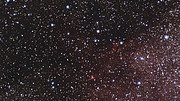
Digitized Sky Survey image around the stellar cluster RCW 38


Videos

ESOcast 171 Light: Colourful Celestial Landscape (4K UHD)

ESOcast 171 Light: Colourful Celestial Landscape (4K UHD)

Zooming into RCW 38

Panning across RCW 38


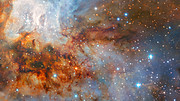
New observations with ESO’s Very Large Telescope show the star cluster RCW 38 in all its glory. This image was taken during testing of the HAWK-I camera with the GRAAL adaptive optics system. It shows RCW 38 and its surrounding clouds of brightly glowing gas in exquisite detail, with dark tendrils of dust threading through the bright core of this young gathering of stars.

This image shows the star cluster RCW 38, as captured by the HAWK-I infrared imager mounted on ESO’s Very Large Telescope (VLT) in Chile. By gazing into infrared wavelengths, HAWK-I can examine dust-shrouded star clusters like RCW 38, providing an unparalleled view of the stars forming within. This cluster contains hundreds of young, hot, massive stars, and lies some 5500 light-years away in the constellation of Vela (The Sails).

The central area of RCW 38 is visible here as a bright, blue-tinted region, an area inhabited by numerous very young stars and protostars that are still in the process of forming. The intense radiation pouring out from these newly born stars causes the surrounding gas to glow brightly. This is in stark contrast to the streams of cooler cosmic dust winding through the region, which glow gently in dark shades of red and orange. The contrast creates this spectacular scene — a piece of celestial artwork.

Previous images of this region taken in optical wavelengths are strikingly different — optical images appear emptier of stars due to dust and gas blocking our view of the cluster. Observations in the infrared, however, allow us to peer through the dust that obscures the view in the optical and delve into the heart of this star cluster.

HAWK-I is installed on Unit Telescope 4 (Yepun) of the VLT, and operates at near-infrared wavelengths. It has many scientific roles, including obtaining images of nearby galaxies or large nebulae as well as individual stars and exoplanets. GRAAL is an adaptive optics module which helps HAWK-I to produce these spectacular images. It makes use of four laser beams projected into the night sky, which act as artificial reference stars, used to correct for the effects of atmospheric turbulence — providing a sharper image.

This image was captured as part of a series of test observations — a process known as science verification — for HAWK-I and GRAAL. These tests are an integral part of the commissioning of a new instrument on the VLT, and include a set of typical scientific observations that verify and demonstrate the capabilities of the new instrument.


More Information

The Principal Investigator of the observing proposal which led this spectacular image was Koraljka Muzic (CENTRA, University of Lisbon, Portugal). Her collaborators were Joana Ascenso (CENTRA, University of Porto, Portugal), Amelia Bayo (University of Valparaiso, Chile), Arjan Bik (Stockholm University, Sweden), Hervé Bouy (Laboratoire d’astrophysique de Bordeaux, France), Lucas Cieza (University Diego Portales, Chile), Vincent Geers (UKATC, UK), Ray Jayawardhana (York University, Canada), Karla Peña Ramírez (University of Antofagasta, Chile), Rainer Schoedel (Instituto de Astrofísica de Andalucía, Spain), and Aleks Scholz (University of St Andrews, UK).

The Science Verification of HAWK-I with the GRAAL adaptive optics module was presented in an article in ESO’s quarterly journal The Messenger entitled HAWK-I GRAAL Science Verification.

The science verification team was composed of Bruno Leibundgut, Pascale Hibon, Harald Kuntschner, Cyrielle Opitom, Jerome Paufique, Monika Petr-Gotzens, Ralf Siebenmorgen, Elena Valenti and Anita Zanella, all from ESO.

ESO is the foremost intergovernmental astronomy organisation in Europe and the world’s most productive ground-based astronomical observatory by far. It has 15 Member States: Austria, Belgium, the Czech Republic, Denmark, France, Finland, Germany, Italy, the Netherlands, Poland, Portugal, Spain, Sweden, Switzerland and the United Kingdom, along with the host state of Chile and with Australia as a strategic partner. ESO carries out an ambitious programme focused on the design, construction and operation of powerful ground-based observing facilities enabling astronomers to make important scientific discoveries. ESO also plays a leading role in promoting and organising cooperation in astronomical research. ESO operates three unique world-class observing sites in Chile: La Silla, Paranal and Chajnantor. At Paranal, ESO operates the Very Large Telescope and its world-leading Very Large Telescope Interferometer as well as two survey telescopes, VISTA working in the infrared and the visible-light VLT Survey Telescope. ESO is also a major partner in two facilities on Chajnantor, APEX and ALMA, the largest astronomical project in existence. And on Cerro Armazones, close to Paranal, ESO is building the 39-metre Extremely Large Telescope, the ELT, which will become “the world’s biggest eye on the sky”.


Links


Contacts 

Calum Turner
ESO Assistant Public Information Officer
Garching bei München, Germany
Tel: +49 89 3200 6670
Email: pio@eso.org

Source: ESO/News  


Wednesday, July 11, 2018

NASA's Webb Space Telescope to Inspect Atmospheres of Gas Giant Exoplanet

This is an artist's impression of the Jupiter-size extrasolar planet, HD 189733b, being eclipsed by its parent star. Astronomers using the Hubble Space Telescope have measured carbon dioxide and carbon monoxide in the planet's atmosphere. The planet is a "hot Jupiter," which is so close to its star that it completes an orbit in only 2.2 days. The planet is too hot for life as we know it. But under the right conditions, on a more Earth-like world, carbon dioxide can indicate the presence of extraterrestrial life. This observation demonstrates that chemical biotracers can be detected by space telescope observations. Credits: ESA, NASA, M. Kornmesser (ESA/Hubble), and STScI


In April 2018, NASA launched the Transiting Exoplanet Survey Satellite (TESS). Its main goal is to locate Earth-sized planets and larger “super-Earths” orbiting nearby stars for further study. One of the most powerful tools that will examine the atmospheres of some planets that TESS discovers will be NASA’s James Webb Space Telescope. Since observing small exoplanets with thin atmospheres like Earth will be challenging for Webb, astronomers will target easier, gas giant exoplanets first.

Some of Webb’s first observations of gas giant exoplanets will be conducted through the Director’s Discretionary Early Release Science program. The transiting exoplanet project team at Webb’s science operations center is planning to conduct three different types of observations that will provide both new scientific knowledge and a better understanding of the performance of Webb’s science instruments.

“We have two main goals. The first is to get transiting exoplanet datasets from Webb to the astronomical community as soon as possible. The second is to do some great science so that astronomers and the public can see how powerful this observatory is,” said Jacob Bean of the University of Chicago, a co-principal investigator on the transiting exoplanet project.

“Our team’s goal is to provide critical knowledge and insights to the astronomical community that will help to catalyze exoplanet research and make the best use of Webb in the limited time we have available,” added Natalie Batalha of NASA Ames Research Center, the project’s principal investigator.

Transit – An atmospheric spectrum

When a planet crosses in front of, or transits, its host star, the star’s light is filtered through the planet’s atmosphere. Molecules within the atmosphere absorb certain wavelengths, or colors, of light. By splitting the star’s light into a rainbow spectrum, astronomers can detect those sections of missing light and determine what molecules are in the planet’s atmosphere.

For these observations, the project team selected WASP-79b, a Jupiter-sized planet located about 780 light-years from Earth. The team expects to detect and measure the abundances of water, carbon monoxide, and carbon dioxide in WASP-79b. Webb also might detect new molecules not yet seen in exoplanet atmospheres.

Phase curve – A weather map

Planets that orbit very close to their stars tend to become tidally locked. One side of the planet permanently faces the star while the other side faces away, just as one side of the Moon always faces the Earth. When the planet is in front of the star, we see its cooler backside. But as it orbits the star, more and more of the hot day-side comes into view. By observing an entire orbit, astronomers can observe those variations (called a phase curve) and use the data to map the planet’s temperature, clouds, and chemistry as a function of longitude.

The team will observe a phase curve of the “hot Jupiter” known as WASP-43b, which orbits its star in less than 20 hours. By looking at different wavelengths of light, they can sample the atmosphere to different depths and obtain a more complete picture of its structure. “We have already seen dramatic and unexpected variations for this planet with Hubble and Spitzer. With Webb we will reveal these variations in significantly greater detail to understand the physical processes that are responsible,” said Bean.

Eclipse – A planet’s glow

The greatest challenge when observing an exoplanet is that the star’s light is much brighter, swamping the faint light of the planet. To get around this problem, one method is to observe a transiting planet when it disappears behind the star, not when it crosses in front of the star. By comparing the two measurements, one taken when both star and planet are visible, and the other when only the star is in view, astronomers can calculate how much light is coming from the planet alone.

This technique works best for very hot planets that glow brightly in infrared light. The team plans to study WASP-18b, a planet that is baked to a temperature of almost 4,800 degrees Fahrenheit (2,900 K). Among other questions, they hope to determine whether the planet’s stratosphere exists due to the presence of titanium oxide, vanadium oxide, or some other molecule.

Habitable planets

Ultimately, astronomers want to use Webb to study potentially habitable planets. In particular, Webb will target planets orbiting red dwarf stars since those stars are smaller and dimmer, making it easier to tease out the signal from an orbiting planet. Red dwarfs are also the most common stars in our galaxy.

“TESS should locate more than a dozen planets orbiting in the habitable zones of red dwarfs, a few of which might actually be habitable. We want to learn whether those planets have atmospheres and Webb will be the one to tell us,” said Kevin Stevenson of the Space Telescope Science Institute, a co-principal investigator on the project. “The results will go a long way towards answering the question of whether conditions favorable to life are common in our galaxy.”

The James Webb Space Telescope is the world’s premier infrared space observatory of the next decade. Webb will solve mysteries of our solar system, look beyond to distant worlds around other stars, and probe the mysterious structures and origins of our universe and our place in it. Webb is an international program led by NASA with its partners, the European Space Agency (ESA) and the Canadian Space Agency (CSA).


Contact:

Christine Pulliam
Space Telescope Science Institute, Baltimore, Maryland
410-338-4366
cpulliam@stsci.edu


Related Links

This site is not responsible for content found on external links


Tuesday, July 10, 2018

Uranus Giant Impacts: Low Angular Momentum


Image credit: NASA/JPL/STScI

Scientists have always wondered how Uranus got tilted so much that it spins on its side, and now research on the planet’s early formation gives us new insight. Four billion years ago, scientists believe a young proto-planet of rock and ice collided with Uranus, causing its extreme tilt. Instead of rotating like a top spinning nearly upright, as Earth does, the planet “rolls” on its side as it circles the sun.

The research team, led by Durham University, UK, in collaboration with scientists at NASA's Ames Research Center in Silicon Valley, used advanced computing techniques to create the most detailed simulation to date of the suspected impact.
A simulation of the most likely Uranus-impact scenario that caused today’s tilted orbit, according to new, highly detailed simulations. Light gray represents ice materials from Uranus, while dark gray represents rock materials from Uranus. Purple represents ice materials from the impactor, while brown represents rock from the impactor. Light blue represents Uranus’ atmosphere. Credits: Jacob Kegerreis / Durham University

Through more than 50 simulations of impact scenarios using a supercomputer, this research group determined that an object at least twice the mass of Earth likely impacted the young planet with a grazing blow. The collision was so strong it reshaped the entire planet and pushed it onto its side. But, the collision was likely not strong enough to blast the planet’s atmosphere off into space or significantly change its orbit around the Sun. This research was the first of its type to take the planet’s atmosphere into account in its simulations of the impact. This helped the scientists better define what that event might have looked like.

The impact might have left molten ice and lopsided lumps of rock within the planet, perhaps explaining its tilted and off-center magnetic field, too. Rock and ice thrown into orbit would have then clumped together to form the rings and moons around Uranus, now in its newly established rotation.

But this discovery goes beyond explaining how Uranus became what it is today. It helps us on our search to understand other planets outside our solar system – exoplanets. Uranus is a medium-size, gaseous planet with a rocky and icy core. Based on findings from the Kepler space telescope, the more common type of exoplanet is very similar to Uranus. Learning about this impact helps us understand how similar collisions lead to the formation of other planets, and what this means for their ability to support life.

The findings, published in The Astrophysical Journal, paint a riveting picture of Uranus’ early tumultuous years, and gives us the tools to understand planets like it throughout the cosmos.

Author: Frank Tavares

Members of the news media interested in learning more about this research should refer to the NASA Ames Media Contacts page to get in touch.

Editor: Abigail Tabor

Source: NASA/Ames


Monday, July 09, 2018

Distant Quasar Providing Clues to Early-Universe Conditions

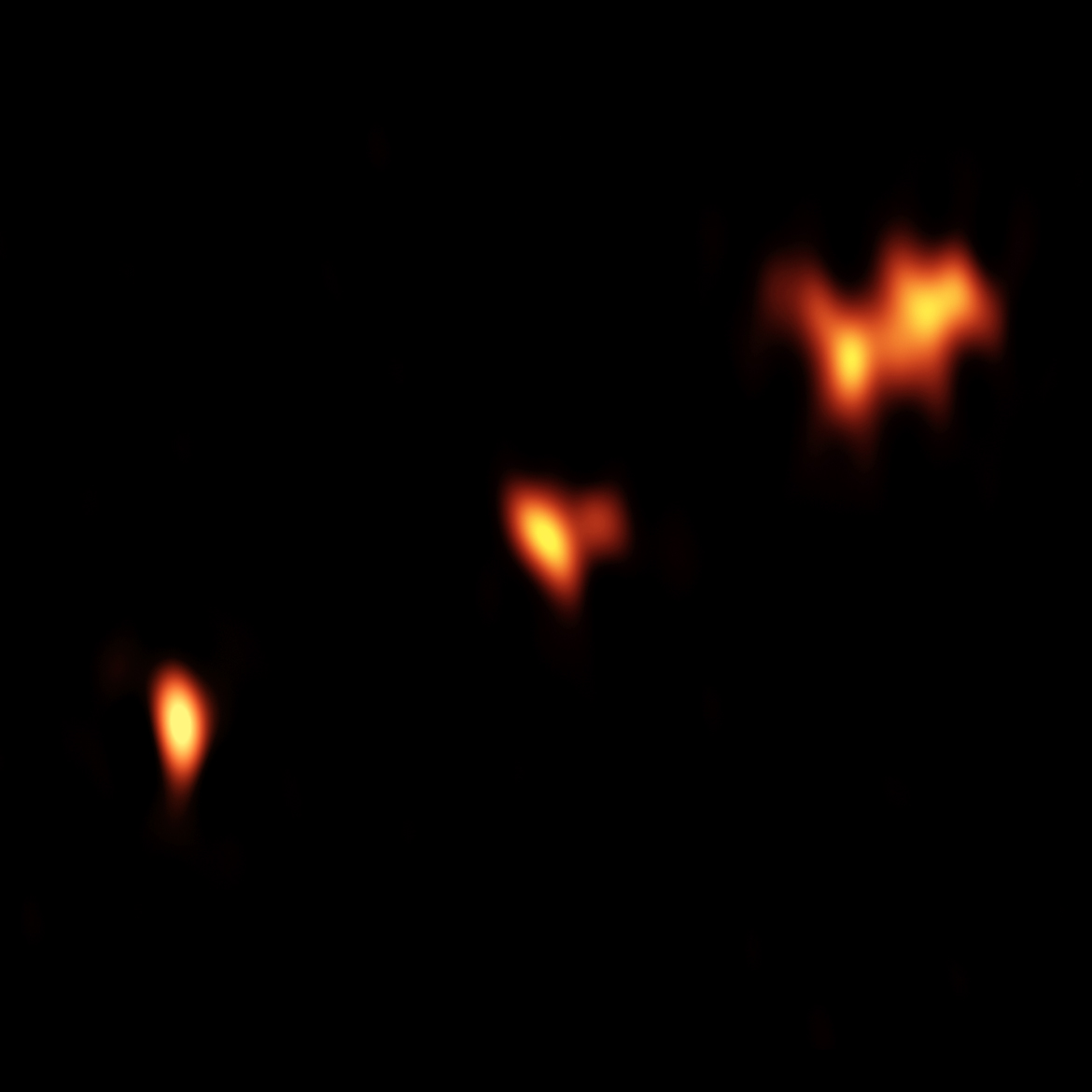
VLBA image of the quasar P352–15, at a distance of nearly 13 billion light-years from Earth. Three main components of the object are seen, with two of them showing further substructure. Credit: Momjian, et al.; B. Saxton (NRAO/AUI/NSF). Hi-res image

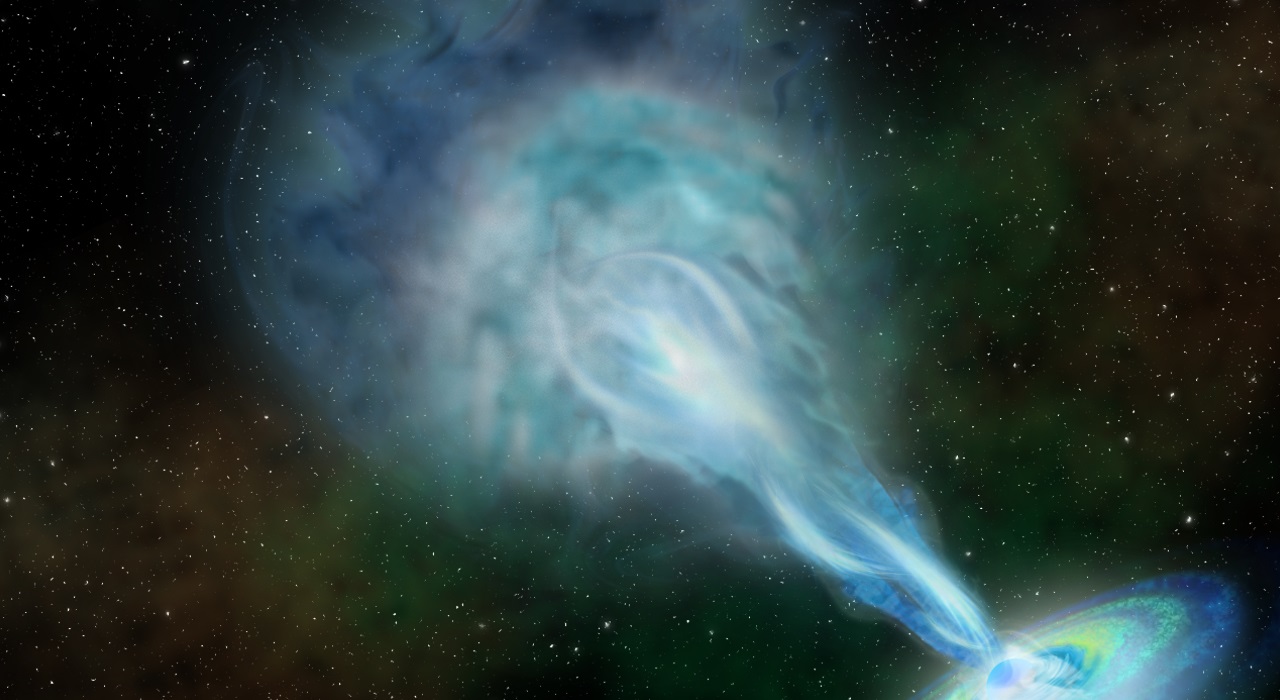
Artist's conception of distant quasar P352-15, with disk of material orbiting the black hole and jet of fast-moving particles ejected into space. Credit: Robin Dienel, courtesy of Carnegie Institution for Science. Hi-res image


Astronomers using the National Science Foundation’s Very Long Baseline Array (VLBA) have made an image revealing tantalizing details of a quasar nearly 13 billion light-years from Earth — an object that may provide important clues about the physical processes at work in the Universe’s first galaxies.

The scientists studied a quasar called PSO J352.4034-15.3373 (P352-15), an unusually bright emitter of radio waves for an object so distant. The extremely sharp radio “vision” of the VLBA showed the object split into three major components, two of which show further subdivision. The components are spread over a distance of only about 5,000 light-years.

Quasars are galaxies with supermassive black holes at their cores — black holes millions or billions of times more massive than the Sun. The powerful gravitational pull of such a black hole draws in nearby material, which forms a rotating disk around the massive object. The rapidly-spinning disk spews jets of particles moving outward at speeds approaching that of light. These energetic “engines” are bright emitters of light and radio waves.

“This is the most detailed image yet of such a bright galaxy at this great distance,” said Emmanuel Momjian, of the National Radio Astronomy Observatory (NRAO).

“There is a dearth of known strong radio emitters from the Universe’s youth and this is the brightest radio quasar at that epoch by a factor of 10,” said Eduardo Banados of the Carnegie Institution for Science in Pasadena, California.

“We are seeing P352-15 as it was when the Universe was less than a billion years old, or only about 7 percent of its current age,” said Chris Carilli, of NRAO. “This is near the end of a period when the first stars and galaxies were re-ionizing the neutral hydrogen atoms that pervaded intergalactic space. Further observations may allow us to use this quasar as a background ‘lamp’ to measure the amount of neutral hydrogen remaining at that time,” he added.

The astronomers said the three major components of P352-15 can be explained in one of two ways. One explanation is that they’re seeing the bright core of the quasar, corresponding to the location of the supermassive black hole itself, at one end, and the two other bright spots are parts of a one-sided jet. The other possibility is that their middle object is the core, and the other objects are jets ejected in opposite directions. Because one of the end objects is closest to the position of the quasar as seen with visible-light telescopes, they consider the one-sided jet to be the more likely explanation.

The one-sided jet explanation raises the exciting possibility that astronomers may be able to detect and measure the expansion of the jet by observing P352-15 over several years.

“This quasar may be the most distant object in which we could measure the speed of such a jet,” Momjian said.

If, instead, the middle object is the core, with two oppositely-moving jets, its small size suggests that it may be very young or be embedded in dense gas that is slowing the jets’ expansion.

Planned future observations will tell which scenario is accurate, the scientists said.

“This quasar’s brightness and its great distance make it a unique tool to study the conditions and processes that prevailed in the first galaxies in the Universe,” Carilli said. “We look forward to unraveling more of its mysteries,” he added.

Momjian, Banados, and Carilli worked with Fabian Walter of the Max Planck Institute for Astronomy in Heidelberg, Germany; and Bram Venemans, also of the Max Planck Institute. The astronomers are reporting their findings in the Astrophysical Journal.

The Long Baseline Observatory is a facility of the National Science Foundation, operated under cooperative agreement by Associated Universities, Inc.


Media Contact:

Dave Finley, Public Information Officer
(575) 835-7302
dfinley@nrao.edu


Papers:

in ApJ: Resolving the Powerful Radio-loud Quasar at z ~ 6: https://doi.org/10.3847/1538-4357/aac76f

In APJ Letters: A Powerful Radio-loud Quasar at the End of Cosmic Reionization: https://doi.org/10.3847/2041-8213/aac511


Thursday, July 05, 2018

ALMA spies a new planetary nursery

MWC 758
Credit: ESO/R. Dong et al.; ALMA (ESO/NAOJ/NRAO)


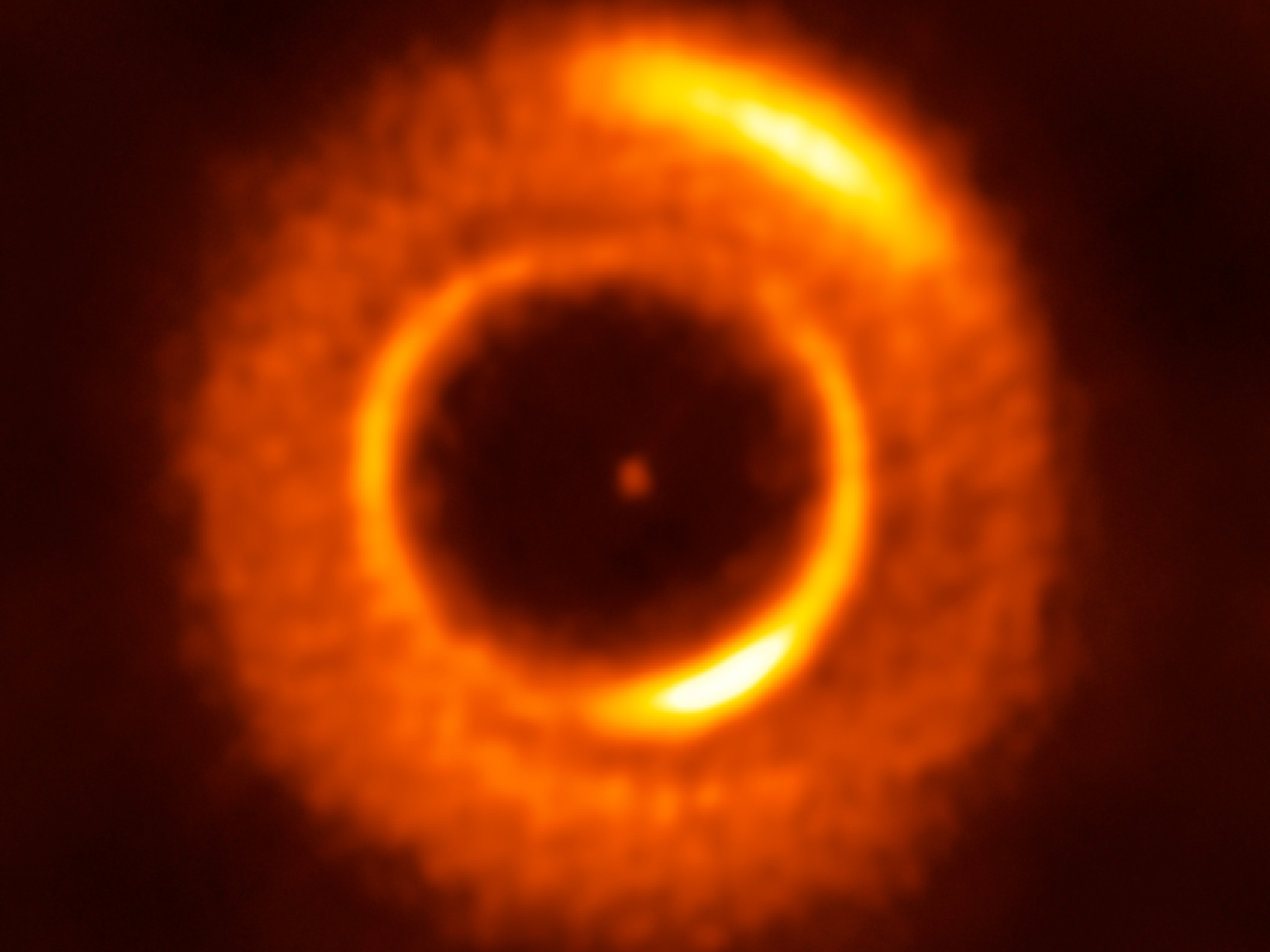
This image from the Atacama Large Millimeter/submillimeter Array (ALMA) shows MWC 758, a young star that is approaching adulthood and surrounded by knotty, irregular rings of cosmic dust, three of which can be seen here. Unusually, these rings are elliptical in shape rather than being perfectly circular — making this the first discovery of an intrinsically elliptical protoplanetary disc with ALMA!

The outer and inner rings each contain one particularly bright clump, visible as arcs of yellow.  Additionally there appear to be spiral arms traced out within the dust, as well as a core dust-free cavity that is slightly off-centre. These are all features that hint at the presence of unseen planets. As planets form, they gravitationally interact with the disc and create various telltale features and structures. Astronomers can thus observe a system like MWC 758 and not only infer the existence of potential hidden planets, but also estimate their masses, locations, and orbits.

This is a wonderful example of the planet-finding power of ALMA. Using the observatory to study such dusty discs allows scientists to investigate the very first stages of planet formation in a bid to understand how these infant systems form and evolve. Learning more about planetary systems throughout the cosmos may help us know more about how the Solar System formed, and how it evolved to become the cosmic home we live in today.


Source: ESO/Potw

Wednesday, July 04, 2018

NASA's NuSTAR Mission Proves Superstar Eta Carinae Shoots Cosmic Rays

Eta Carinae's great eruption in the 1840s created the billowing Homunculus Nebula, imaged here by Hubble. Now about a light-year long, the expanding cloud contains enough material to make at least 10 copies of our Sun. Astronomers cannot yet explain what caused this eruption. Credit: NASA, ESA, and the Hubble SM4 ERO Team. Hi res image

A new study using data from NASA’s NuSTAR space telescope suggests that Eta Carinae, the most luminous and massive stellar system within 10,000 light-years, is accelerating particles to high energies — some of which may reach Earth as cosmic rays.

“We know the blast waves of exploded stars can accelerate cosmic ray particles to speeds comparable to that of light, an incredible energy boost,” said Kenji Hamaguchi, an astrophysicist at NASA’s Goddard Space Flight Center in Greenbelt, Maryland, and the lead author of the study. “Similar processes must occur in other extreme environments. Our analysis indicates Eta Carinae is one of them.”

Astronomers know that cosmic rays with energies greater than 1 billion electron volts (eV) come to us from beyond our solar system. But because these particles — electrons, protons and atomic nuclei — all carry an electrical charge, they veer off course whenever they encounter magnetic fields. This scrambles their paths and masks their origins.


Zoom into Eta Carinae, where the outflows of two massive stars collide and shoot accelerated particles — cosmic rays — into space. Credits: NASA's Goddard Space Flight Center. Download this video in HD formats from NASA Goddard's Scientific Visualization Studio

Eta Carinae, located about 7,500 light-years away in the southern constellation of Carina, is famous for a 19th century outburst that briefly made it the second-brightest star in the sky. This event also ejected a massive hourglass-shaped nebula, but the cause of the eruption remains poorly understood.
The system contains a pair of massive stars whose eccentric orbits bring them unusually close every 5.5 years. The stars contain 90 and 30 times the mass of our Sun and pass 140 million miles (225 million kilometers) apart at their closest approach — about the average distance separating Mars and the Sun.

“Both of Eta Carinae’s stars drive powerful outflows called stellar winds,” said team member Michael Corcoran, also at Goddard. “Where these winds clash changes during the orbital cycle, which produces a periodic signal in low-energy X-rays we’ve been tracking for more than two decades.”

NASA’s Fermi Gamma-ray Space Telescope also observes a change in gamma rays — light packing far more energy than X-rays — from a source in the direction of Eta Carinae. But Fermi’s vision isn’t as sharp as X-ray telescopes, so astronomers couldn’t confirm the connection.

Eta Carinae shines in X-rays in this image from NASA's Chandra X-ray Observatory. The colors indicate different energies. Red spans 300 to 1,000 electron volts (eV), green ranges from 1,000 to 3,000 eV and blue covers 3,000 to 10,000 eV. For comparison, the energy of visible light is about 2 to 3 eV. NuSTAR observations (green contours) reveal a source of X-rays with energies some three times higher than Chandra detects. X-rays seen from the central point source arise from the binary’s stellar wind collision. The NuSTAR detection shows that shock waves in the wind collision zone accelerate charged particles like electrons and protons to near the speed of light. Some of these may reach Earth, where they will be detected as cosmic ray particles. X-rays scattered by debris ejected in Eta Carinae's famous 1840 eruption may produce the broader red emission. Credits: NASA/CXC and NASA/JPL-Caltech. Hi-res image


To bridge the gap between low-energy X-ray monitoring and Fermi observations, Hamaguchi and his colleagues turned to NuSTAR. Launched in 2012, NuSTAR can focus X-rays of much greater energy than any previous telescope. Using both newly taken and archival data, the team examined NuSTAR observations acquired between March 2014 and June 2016, along with lower-energy X-ray observations from the European Space Agency’s XMM-Newton satellite over the same period.

Eta Carinae’s low-energy, or soft, X-rays come from gas at the interface of the colliding stellar winds, where temperatures exceed 70 million degrees Fahrenheit (40 million degrees Celsius). But NuSTAR detects a source emitting X-rays above 30,000 eV, some three times higher than can be explained by shock waves in the colliding winds. For comparison, the energy of visible light ranges from about 2 to 3 eV.

The team’s analysis, presented in a paper published on Monday, July 2, in Nature Astronomy, shows that these “hard” X-rays vary with the binary orbital period and show a similar pattern of energy output as the gamma rays observed by Fermi.

The researchers say that the best explanation for both the hard X-ray and the gamma-ray emission is electrons accelerated in violent shock waves along the boundary of the colliding stellar winds. The X-rays detected by NuSTAR and the gamma rays detected by Fermi arise from starlight given a huge energy boost by interactions with these electrons.

Some of the superfast electrons, as well as other accelerated particles, must escape the system and perhaps some eventually wander to Earth, where they may be detected as cosmic rays.

“We’ve known for some time that the region around Eta Carinae is the source of energetic emission in high-energy X-rays and gamma rays”, said Fiona Harrison, the principal investigator of NuSTAR and a professor of astronomy at Caltech in Pasadena, California. “But until NuSTAR was able to pinpoint the radiation, show it comes from the binary and study its properties in detail, the origin was mysterious.”

NuSTAR is a Small Explorer mission led by Caltech and managed by JPL for NASA's Science Mission Directorate in Washington. NuSTAR was developed in partnership with the Danish Technical University and the Italian Space Agency (ASI). The spacecraft was built by Orbital Sciences Corp., Dulles, Virginia. NuSTAR's mission operations center is at UC Berkeley, and the official data archive is at NASA's High Energy Astrophysics Science Archive Research Center. ASI provides the mission's ground station and a mirror archive. Caltech manages JPL for NASA.

For more information on NuSTAR, visit:  https://www.nasa.gov/nustar  - http://www.nustar.caltech.edu


By Francis Reddy
NASA's Goddard Space Flight Center, Greenbelt, Md.

Editor: Rob Garner

Source: NASA/NuSTAR


Tuesday, July 03, 2018

Detecting the boiling atmosphere of the hottest known exoplanet


Astronomers have found that the atmosphere of the hottest known exoplanet, the hot Jupiter-like planet KELT-9b, is "boiling off," with the escaping gas being captured by the host star. Using the CARMENES instrument at Calar Alto Observatory, Fei Yan and Thomas Henning of the Max Planck Institute for Astronomy in Heidelberg were able to detect the escaping hydrogen atmosphere of the planet. Their observations indicate a spread-out hydrogen envelope that is being pulled towards the host star. 

By all definitions, KELT-9b is a hellish kind of exoplanet: Due to its proximity to an extremely hot host star, the planet itself is the hottest exoplanet yet discovered. Now Fei Yan and Thomas Henning of the Max Planck Institute for Astronomy have detected that planet's extended atmosphere, showing that the star is not only heating up the planet's hydrogen atmosphere – it is then using its gravity to pull the hydrogen onto itself.

Specifically, the planet's host star KELT-9 is an extremely hot star with a temperature of up to 10,000 K (compare this with the Sun's much more modest 5800 K, or 5500 degrees Celsius). The planet's orbit is extremely small – ten times smaller than the orbit of Mercury in our Solar system (corresponding to only about 3% of the diameter of Earth's orbit around the Sun). When the planet was discovered in 2017 by a team of astronomers led by B. Scott Gaudi (Ohio State University), the astronomers measured its day-side temperature to be at 4600 K (4300 degrees Celsius), which is hotter than many stars!

The planet itself is a significantly larger version of our Solar System's Jupiter, at almost 3 times Jupiter's mass and almost twice Jupiter's diameter. These properties combined place KELT-9b firmly in the class of what astronomers call "hot Jupiter". 

The planet's orbit regularly takes it between the host star and an observer on Earth – during each such transit, the planet blocks some of the starlight, causing the star to dim a little bit as measured by telescope on Earth. The planet was initially discovered by astronomers looking for that kind of regular little dip in the star's apparent brightness (the so-called transit method).

When Yan and Henning observed KELT-9b using the CARMENES spectrograph installed at the 3.5 meter telescope at Calar Alto Observatory, they found traces of the planet's atmosphere: Whenever the planet was in front of its star, there would be a clear absorption line for hydrogen (Ha), a narrow wavelength region where the planet's hydrogen-rich atmosphere absorbs some of it's host star's bright light. CARMENES gives a particularly detailed, high-resolution view of stellar spectral making it an excellent tool for this kind of observation.

The extended hydrogen atmosphere surrounding KELT-9b is surprisingly large – more than half as large again as the planet's radius. Models of how the star's gravity will pull on the planet's gas show that this is close to the maximal size of such an atmosphere. The large size suggests that the planet is losing hydrogen gas at a significant rate of more than 100,000 tons of hydrogen per second. The star is "boiling off" the planet's atmosphere, and pulling the gas onto itself, in a blatant case of interplanetary theft.

The way the wavelength of the absorption line changes during the transit amounts to a rare direct detection of the planet's motion: the wavelength shift is due to the Doppler shift, which tells us how fast the planet is moving towards us or away from us. Fey Yan, lead author of the article, says: "This is a very special kind of measurement – this kind of direct measurement of planetary motion has only been possible for about half a dozen exoplanets so far."

Thomas Henning, director at the MPIA and co-author of the study, says: "This planet reminds me of the mythical Icarus, who came to close to the Sun and crashed. Our planet will not crash, but it will certainly lose an essential part of itself, namely its atmosphere."

Background information

The results described here are published as F. Yan and Th. Henning, "An extended hydrogen envelope of the extremely hot giant exoplanet KELT-9b" in the journal Nature Astronomy. Both authors are at the Max Planck Institute for Astronomy.

For advance access to the paper before the end of the embargo, journalists should please contact

CARMENES [kár-men-es](short for the "Calar Alto high-Resolution search for M dwarfs with Exoearths with Near-infrared and optical Échelle Spectrographs") is a next-generation instrument built for the 3.5m telescope at the Calar Alto Observatory by a consortium of German and Spanish institutions. The principal investigators of CARMENES are Andreas Quirrenbach of the Zentrum für Astronomie of Heidelberg University and Pedro J. Amado of IAA Granada. The Max Planck Institute for Astronomy is part of the CARMENES consortium, and the instrument has received funding from the Max Planck Society.


Science Contact:

Fei Yan
Phone: (+49/0) 6221528-358
Email: fyan@mpia.de
Room: 308/3
Links: Personal homepage

Thomas K. Henning
Director
Phone: (+49|0) 6221 528-200
Email: henning@mpia.de
Room: 216 G
Links: Personal homepage


Public Information Officer:

Markus Pössel
Managing scientist, HdA, and senior MPIA outreach scientist
Phone: (+49|0) 6221 528-261
Email: info@hda-hd.de
Room: H-517
Links: Personal homepage


Monday, July 02, 2018

First Confirmed Image of Newborn Planet Caught with ESO’s VLT

SPHERE image of the newborn planet PDS 70b


PR Image eso1821b
Widefield image of the sky around PDS 70
 
The dwarf star PDS 70 in the constellation Centaurus


Videos

ESOcast 169 Light: First Confirmed Image of Newborn Planet (4K UHD)
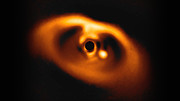

Zooming in on the orange dwarf star PDS 70 and its newly discovered planet


Spectrum reveals cloudy atmosphere 

SPHERE, a planet-hunting instrument on ESO’s Very Large Telescope, has captured the first confirmed image of a planet caught in the act of forming in the dusty disc surrounding a young star. The young planet is carving a path through the primordial disc of gas and dust around the very young star PDS 70. The data suggest that the planet’s atmosphere is cloudy.

Astronomers led by a group at the Max Planck Institute for Astronomy in Heidelberg, Germany have captured a spectacular snapshot of planetary formation around the young dwarf star PDS 70. By using the SPHERE instrument on ESO’s Very Large Telescope (VLT) — one of the most powerful planet-hunting instruments in existence — the international team has made the first robust detection of a young planet, named PDS 70b, cleaving a path through the planet-forming material surrounding the young star [1].

The SPHERE instrument also enabled the team to measure the brightness of the planet at different wavelengths, which allowed properties of its atmosphere to be deduced.
The planet stands out very clearly in the new observations, visible as a bright point to the right of the blackened centre of the image. It is located roughly three billion kilometres from the central star, roughly equivalent to the distance between Uranus and the Sun. The analysis shows that PDS 70b is a giant gas planet with a mass a few times that of Jupiter. The planet's surface has a temperature of around 1000°C, making it much hotter than any planet in our own Solar System.

The dark region at the centre of the image is due to a coronagraph, a mask which blocks the blinding light of the central star and allows astronomers to detect its much fainter disc and planetary companion. Without this mask, the faint light from the planet would be utterly overwhelmed by the intense brightness of PDS 70.

“These discs around young stars are the birthplaces of planets, but so far only a handful of observations have detected hints of baby planets in them,” explains Miriam Keppler, who lead the team behind the discovery of PDS 70’s still-forming planet. “The problem is that until now, most of these planet candidates could just have been features in the disc.”

The discovery of PDS 70’s young companion is an exciting scientific result that has already merited further investigation. A second team, involving many of the same astronomers as the discovery team, including Keppler, has in the past months followed up the initial observations to investigate PDS 70’s fledgling planetary companion in more detail. They not only made the spectacularly clear image of the planet shown here, but were even able to obtain a spectrum of the planet. Analysis of this spectrum indicated that its atmosphere is cloudy.

PDS 70’s planetary companion has sculpted a transition disc — a protoplanetary disc with a giant “hole” in the centre. These inner gaps have been known about for decades and it has been speculated that they were produced by disc-planet interaction. Now we can see the planet for the first time.

Keppler’s results give us a new window onto the complex and poorly-understood early stages of planetary evolution,” comments André Müller, leader of the second team to investigate the young planet. “We needed to observe a planet in a young star’s disc to really understand the processes behind planet formation.” By determining the planet’s atmospheric and physical properties, the astronomers are able to test theoretical models of planet formation.

This glimpse of the dust-shrouded birth of a planet was only possible thanks to the impressive technological capabilities of ESO’s SPHERE instrument, which studies exoplanets and discs around nearby stars using a technique known as high-contrast imaging — a challenging feat. Even when blocking the light from a star with a coronagraph, SPHERE still has to use cleverly devised observing strategies and data processing techniques to filter out the signal of the faint planetary companions around bright young stars [2] at multiple wavelengths and epochs.

Thomas Henning, director at the Max Planck Institute for Astronomy and leader of the teams, summarises the scientific adventure: “After more than a decade of enormous efforts to build this high-tech machine, now SPHERE enables us to reap the harvest with the discovery of baby planets!


Notes
[1] The disc and planet images and the planet’s spectrum have been captured in the course of the two survey programmes called SHINE (SpHere INfrared survey for Exoplanets) and DISK (sphere survey for circumstellar DISK). SHINE aims to image 600 young nearby stars in the near-infrared using SPHERE’s high contrast and high angular resolution to discover and characterise new exoplanets and planetary systems. DISK explores known, young planetary systems and their circumstellar discs to study the initial conditions of planetary formation and the evolution of planetary architectures.

[2] In order to tease out the weak signal of the planet next to the bright star, astronomers use a sophisticated method that benefits from the Earth's rotation. In this observing mode, SPHERE continuously takes images of the star over a period of several hours, while keeping the instrument as stable as possible. As a consequence, the planet appears to slowly rotate, changing its location on the image with respect to the stellar halo. Using elaborate numerical algorithms, the individual images are then combined in such a way that all parts of the image that appear not to move during the observation, such as the signal from the star itself, are filtered. This leaves only those that do apparently move — making the planet visible.


More Information
The team behind the discovery paper is composed of  M. Keppler (Max Planck Institute for Astronomy, Heidelberg, Germany), M. Benisty (Univ. Grenoble, France and Unidad Mixta Internacional Franco-Chilena de Astronomía, Chile),  A. Müller (Max Planck Institute for Astronomy, Heidelberg, Germany), Th. Henning (Max Planck Institute for Astronomy, Heidelberg, Germany), R. van Boekel (Max Planck Institute for Astronomy, Heidelberg, Germany), F. Cantalloube (Max Planck Institute for Astronomy, Heidelberg, Germany), C. Ginski (Leiden Observatory, The Netherlands), R.G. van Holstein (Leiden Observatory, The Netherlands), A.-L. Maire (Max Planck Institute for Astronomy, Heidelberg, Germany),  A. Pohl (Max Planck Institute for Astronomy, Heidelberg, Germany), M. Samland (Max Planck Institute for Astronomy, Heidelberg, Germany), H. Avenhaus (Max Planck Institute for Astronomy, Heidelberg, Germany), J.-L. Baudino (Department of Physics, University of Oxford, Oxford, UK), A. Boccaletti (LESIA, Observatoire de Paris, France), J. de Boer (Leiden Observatory, The Netherlands), M. Bonnefoy (Univ. Grenoble, France), S. Desidera (INAF - Osservatorio Astronomico di Padova, Italy),  M. Langlois (Aix Marseille Univ, CNRS, LAM, Marseille, France and CRAL, UMR 5574, CNRS, Université de Lyon, Ecole Normale Supérieure de Lyon, France), C. Lazzoni (INAF - Osservatorio Astronomico di Padova, Italy), N. Pawellek (Max Planck Institute for Astronomy, Heidelberg, Germany), T. Stolker (Institute for Particle Physics and Astrophysics, ETH Zurich, Switzerland), A. Vigan (Aix Marseille Univ, CNRS, LAM, Marseille, France), T. Birnstiel (University Observatory, Faculty of Physics, Ludwig-Maximilians- Universität München, Germany), W. Brandner(Max Planck Institute for Astronomy, Heidelberg, Germany), G. Chauvin (Univ. Grenoble, France and Unidad Mixta Internacional Franco-Chilena de Astronomía, Chile), M. Feldt (Max Planck Institute for Astronomy, Heidelberg, Germany), M. Flock (Jet Propulsion Laboratory, California Institute of Technology, USA and Kavli Institute For Theoretical Physics, University of California, USA), J. Girard(Univ. Grenoble, France and ESO, Chile), R. Gratton (INAF - Osservatorio Astronomico di Padova, Italy), J. Hagelberg (Univ. Grenoble, France), A. Isella (Rice University, Department of Physics and Astronomy, USA), M. Janson (Max Planck Institute for Astronomy, Heidelberg, Germany and  Department of Astronomy, Stockholm University, Sweden), A. Juhasz (Institute of Astronomy, Cambridge, UK), J. Kemmer (Max Planck Institute for Astronomy, Heidelberg, Germany), Q. Kral (LESIA, Observatoire de Paris, PSL Research University, CNRS, Sorbonne Universités, UPMC, Univ. Paris 06, Univ. Paris Diderot, Sorbonne Paris Cité, France and Institute of Astronomy, Cambridge, UK), A.-M. Lagrange (Univ. Grenoble, France), R. Launhardt (Max Planck Institute for Astronomy, Heidelberg, Germany), G. Marleau (Institut für Astronomie und Astrophysik, Eberhard Karls Universität Tübingen, Germany and Max Planck Institute for Astronomy, Heidelberg, Germany) A. Matter (Université Côte d’Azur, OCA, CNRS, France), F. Ménard (Univ. Grenoble, France), J. Milli (ESO, Chile), P. Mollière (Leiden Observatory, The Netherlands), C. Mordasini (Physikalisches Institut, Universität Bern, Switzerland), J. Olofsson (Max Planck Institute for Astronomy, Heidelberg, Germany, Instituto de Física y Astronomía, Facultad de Ciencias, Universidad de Valparaíso, Chile, and Núcleo Milenio Formación Planetaria - NPF, Universidad de Valparaíso, Chile), L. Pérez (Max-Planck-Institute for Astronomy, Bonn, Germany and Universidad de Chile, Departamento de Astronomia, Chile), P. Pinilla (Department of Astronomy/Steward Observatory, University of Arizona, USA), C. Pinte (Univ. Grenoble, France, UMI-FCA, CNRS/INSU, France (UMI 3386), and Dept. de Astronomía, Universidad de Chile, Chile, and  Monash Centre for Astrophysics (MoCA) and School of Physics and Astronomy, Monash University, Australia), S. Quanz (Institute for Particle Physics and Astrophysics, ETH Zurich, Switzerland), T. Schmidt (LESIA, Observatoire de Paris, PSL Research University, CNRS, Sorbonne Universités, UPMC, Univ. Paris 06, Univ. Paris Diderot, France), S. Udry (Geneva Observatory, University of Geneva, Switzerland), Z. Wahhaj (ESO, Chile), J. Williams (Institute for Astronomy, University of Hawaii at Manoa, Honolulu, USA), A. Zurlo (Aix Marseille Univ, CNRS, LAM, Laboratoire d’Astrophysique de Marseille, France, Núcleo de Astronomía, Facultad de Ingeniería y Ciencias, Universidad Diego Portales, Chile, Escuela de Ingeniería Industrial, Facultad de Ingeniería y Ciencias, Universidad Diego Portales, Chile), E. Buenzli (Institute for Particle Physics and Astrophysics, ETH Zurich, Switzerland), M. Cudel (Univ. Grenoble, France), R. Galicher (LESIA, Observatoire de Paris, PSL Research University, CNRS, Sorbonne Universités, UPMC, Univ. Paris 06, Univ. Paris Diderot, France), M. Kasper (ESO, Germany), J. Lannier (Univ. Grenoble, France), D. Mesa (INAF - Osservatorio Astronomico di Padova, Italy and INCT, Universidad De Atacama, Copiapó, Chile), D. Mouillet (Univ. Grenoble, France), S. Peretti (Geneva Observatory, University of Geneva, Switzerland), C. Perrot (LESIA, Observatoire de Paris, PSL Research University, CNRS, Sorbonne Universités, UPMC, Univ. Paris 06, Univ. Paris Diderot, Sorbonne Paris Cité, France), G. Salter (Aix Marseille Univ, CNRS, LAM, Laboratoire d’Astrophysique de Marseille, France), E. Sissa (INAF - Osservatorio Astronomico di Padova, Italy), F. Wildi (Geneva Observatory, University of Geneva, Switzerland), L. Abe (Université Côte d’Azur, OCA, CNRS, Lagrange, France), J. Antichi (INAF - Osservatorio Astrofisico di Arcetri, Italy), J.-C. Augereau (Univ. Grenoble, France), P. Baudoz (LESIA, Observatoire de Paris, PSL Research University, CNRS, Sorbonne Universités, UPMC, Univ. Paris 06, Univ. Paris Diderot, Sorbonne Paris Cité, France), J.-L. Beuzit (Univ. Grenoble, France), P. Blanchard (Aix Marseille Univ, CNRS, LAM, Laboratoire d’Astrophysique de Marseille, France), S. S. Brems (Landessternwarte Königstuhl, Zentrum für Astronomie der Universität Heidelberg, Germany),  M. Carle (Aix Marseille Univ, CNRS, LAM, Laboratoire d’Astrophysique de Marseille, France), A. Cheetham (Geneva Observatory, University of Geneva, Switzerland), A. Costille (Aix Marseille Univ, CNRS, LAM, Laboratoire d’Astrophysique de Marseille, France), A. Delboulbé (Univ. Grenoble, France), C. Dominik (Anton Pannekoek Institute for Astronomy, The Netherlands), P. Feautrier (Univ. Grenoble, France), L. Gluck (Univ. Grenoble, France), D. Gisler (Institute for Particle Physics and Astrophysics, ETH Zurich, Switzerland), Y. Magnard (Univ. Grenoble, France), D. Maurel (Univ. Grenoble, France), M. Meyer (Institute for Particle Physics and Astrophysics, ETH Zurich, Switzerland), T. Moulin (Univ. Grenoble, France), T. Buey (LESIA, Observatoire de Paris, PSL Research University, CNRS, Sorbonne Universités, UPMC, Univ. Paris 06, Univ. Paris Diderot, France), A. Baruffolo (INAF - Osservatorio Astronomico di Padova, Italy), A. Bazzon (Institute for Particle Physics and Astrophysics, ETH Zurich, Switzerland), V. De Caprio (INAF - Osservatorio Astronomico di Capodimonte, Italy), M. Carbillet (Université Côte d’Azur, OCA, CNRS, Lagrange, France), E. Cascone (INAF - Osservatorio Astronomico di Capodimonte, Italy), R. Claudi (INAF - Osservatorio Astronomico di Padova, Italy), K. Dohlen (Aix Marseille Univ, CNRS, LAM, Laboratoire d’Astrophysique de Marseille, France), D. Fantinel (INAF - Osservatorio Astronomico di Padova, Italy), T. Fusco (ONERA (Office National d’Etudes et de Recherches Aérospatiales), France), E. Giro (INAF - Osservatorio Astronomico di Padova, Italy), C. Gry (Aix Marseille Univ, CNRS, LAM, Laboratoire d’Astrophysique de Marseille, France), N. Hubin (ESO, Germany), E. Hugot (Aix Marseille Univ, CNRS, LAM, Laboratoire d’Astrophysique de Marseille, France), M. Jaquet (Aix Marseille Univ, CNRS, LAM, Laboratoire d’Astrophysique de Marseille, France), D. Le Mignant (Aix Marseille Univ, CNRS, LAM, Laboratoire d’Astrophysique de Marseille, France), M. Llored (Aix Marseille Univ, CNRS, LAM, Laboratoire d’Astrophysique de Marseille, France), O. Möller-Nilsson (Max Planck Institute for Astronomy, Heidelberg, Germany), F. Madec (Aix Marseille Univ, CNRS, LAM, Laboratoire d’Astrophysique de Marseille, France), P. Martinez (Université Côte d’Azur, OCA, CNRS, Lagrange, France), L. Mugnier (ONERA (Office National d’Etudes et de Recherches Aérospatiales), France), A. Origné (Aix Marseille Univ, CNRS, LAM, Laboratoire d’Astrophysique de Marseille, France), P. Puget (Univ. Grenoble, France), D. Perret (LESIA, Observatoire de Paris, PSL Research University, CNRS, Sorbonne Universités, UPMC, Univ. Paris 06, Univ. Paris Diderot, France), J. Pragt (NOVA Optical Infrared Instrumentation Group, Dwingeloo, The Netherlands), F. Rigal (Anton Pannekoek Institute for Astronomy, The Netherlands), R. Roelfsema (NOVA Optical Infrared Instrumentation Group, Dwingeloo, The Netherlands), A. Pavlov (Max Planck Institute for Astronomy, Heidelberg, Germany), C. Petit (ONERA (Office National d’Etudes et de Recherches Aérospatiales), France), G. Rousset (LESIA, Observatoire de Paris, PSL Research University, CNRS, Sorbonne Universités, UPMC, Univ. Paris 06, Univ. Paris Diderot, France), J. Ramos (Max Planck Institute for Astronomy, Heidelberg, Germany), P. Rabou (Univ. Grenoble, France), S. Rochat (Univ. Grenoble, France), A. Roux (Univ. Grenoble, France), B. Salasnich (INAF - Osservatorio Astronomico di Padova, Italy),C. Soenke (ESO, Germany), E. Stadler (Univ. Grenoble, France), J.-F. Sauvage (ONERA (Office National d’Etudes et de Recherches Aérospatiales), France), M. Suarez ( INAF - Osservatorio Astrofisico di Arcetri, Italy), A. Sevin (LESIA, Observatoire de Paris, PSL Research University, CNRS, Sorbonne Universités, UPMC, Univ. Paris 06, Univ. Paris Diderot, France), M. Turatto (INAF - Osservatorio Astronomico di Padova, Italy), L. Weber (Geneva Observatory, University of Geneva, Switzerland).

The team behind the characterisation paper consisted of A. Müller (Max Planck Institute for Astronomy, Heidelberg, Germany), M. Keppler (Max Planck Institute for Astronomy, Heidelberg, Germany), Th. Henning (Max Planck Institute for Astronomy, Heidelberg, Germany), M. Samland (Max Planck Institute for Astronomy, Heidelberg, Germany), G. Chauvin (Univ. Grenoble Alpes, France and Unidad Mixta Internacional Franco-Chilena de Astronomía, CNRS/INSU Universidad de Chile, Chile), H. Beust (Univ. Grenoble Alpes, France), A.-L. Maire (Max Planck Institute for Astronomy, Heidelberg, Germany), K. Molaverdikhani (Max Planck Institute for Astronomy, Heidelberg, Germany), R. van Boekel (Max Planck Institute for Astronomy, Heidelberg, Germany),  M. Benisty (Univ. Grenoble Alpes, France and Unidad Mixta Internacional Franco-Chilena de Astronomía, CNRS/INSU Universidad de Chile, Chile), A. Boccaletti (LESIA, Observatoire de Paris, PSL Research University, CNRS, Sorbonne Universités, UPMC, Univ. Paris 06, Univ. Paris Diderot, France), M. Bonnefoy (Univ. Grenoble Alpes, France), F. Cantalloube (Max Planck Institute for Astronomy, Heidelberg, Germany), B. Charnay (LESIA, Observatoire de Paris, PSL Research University, CNRS, Sorbonne Universités, UPMC, Univ. Paris 06, Univ. Paris Diderot, France), J.-L. Baudino (Department of Physics, University of Oxford, UK), M. Gennaro (Space Telescope Science Institute, USA), Z. C. Long (Space Telescope Science Institute, USA), A. Cheetham (Geneva Observatory, University of Geneva, Switzerland), S. Desidera (INAF - Osservatorio Astronomico di Padova, Italy), M. Feldt (Max Planck Institute for Astronomy, Heidelberg, Germany), T. Fusco (DOTA, ONERA, Université Paris Saclay, and Aix Marseille Université, CNRS, LAM Marseille, France), J. Girard (Univ. Grenoble Alpes, France and Space Telescope Science Institute, USA), R. Gratton (INAF - Osservatorio Astronomico di Padova, Italy), J. Hagelberg (Institute for Particle Physics and Astrophysics, ETH Zurich, Switzerland), M. Janson (Max Planck Institute for Astronomy, Heidelberg, Germany and Department of Astronomy, Stockholm University, Sweden),  A.-M. Lagrange (Univ. Grenoble Alpes, France), M. Langlois (Aix Marseille Univ, CNRS, LAM, Marseille, France and CRAL, UMR 5574, CNRS, Université de Lyon, Ecole Normale Supérieure de Lyon, France), C. Lazzoni (INAF - Osservatorio Astronomico di Padova, Italy), R. Ligi (INAF-Osservatorio Astronomico di Brera, Italy), F. Ménard (Univ. Grenoble Alpes, France), D. Mesa (INAF - Osservatorio Astronomico di Padova, Italy and INCT, Universidad De Atacama, Copiapó, Atacama, Chile), M. Meyer (Institute for Particle Physics and Astrophysics, ETH Zurich, Switzerland and Department of Astronomy, University of Michigan, USA), P. Mollière (Leiden Observatory, Leiden University, the Netherlands), C. Mordasini (Physikalisches Institut, Universität Bern, Switzerland), T. Moulin (Univ. Grenoble Alpes, France), A. Pavlov (Max Planck Institute for Astronomy, Heidelberg, Germany), N. Pawellek (Max Planck Institute for Astronomy, Heidelberg, Germany and Konkoly Observatory, Research Centre for Astronomy and Earth Sciences, Hungarian Academy of Sciences, Hungary), S. Quanz (Institute for Particle Physics and Astrophysics, ETH Zurich, Switzerland), J. Ramos (Max Planck Institute for Astronomy, Heidelberg, Germany), D. Rouan (LESIA, Observatoire de Paris, PSL Research University, CNRS, Sorbonne Universités, UPMC, Univ. Paris 06, Univ. Paris Diderot, France), E. Sissa (INAF - Osservatorio Astronomico di Padova, Italy),  E. Stadler (Univ. Grenoble Alpes, France), A. Vigan (Aix Marseille Univ, CNRS, LAM, Laboratoire d’Astrophysique de Marseille, France), Z. Wahhaj (ESO, Chile), L. Weber (Geneva Observatory, University of Geneva, Switzerland), A. Zurlo (Núcleo de Astronomía, Facultad de Ingeniería y Ciencias, Universidad Diego Portales, Chile, Escuela de Ingeniería Industrial, Facultad de Ingeniería y Ciencias, Universidad Diego Portales, Chile).
ESO is the foremost intergovernmental astronomy organisation in Europe and the world’s most productive ground-based astronomical observatory by far. It has 15 Member States: Austria, Belgium, the Czech Republic, Denmark, France, Finland, Germany, Italy, the Netherlands, Poland, Portugal, Spain, Sweden, Switzerland and the United Kingdom, along with the host state of Chile and with Australia as a strategic partner. ESO carries out an ambitious programme focused on the design, construction and operation of powerful ground-based observing facilities enabling astronomers to make important scientific discoveries. ESO also plays a leading role in promoting and organising cooperation in astronomical research. ESO operates three unique world-class observing sites in Chile: La Silla, Paranal and Chajnantor. At Paranal, ESO operates the Very Large Telescope and its world-leading Very Large Telescope Interferometer as well as two survey telescopes, VISTA working in the infrared and the visible-light VLT Survey Telescope. ESO is also a major partner in two facilities on Chajnantor, APEX and ALMA, the largest astronomical project in existence. And on Cerro Armazones, close to Paranal, ESO is building the 39-metre Extremely Large Telescope, the ELT, which will become “the world’s biggest eye on the sky”.


Links


Contacts:

Miriam Keppler
Max Planck Institute for Astronomy
Heidelberg, Germany
Tel: +49 6221 528 203
Email:
keppler@mpia.de

André Müller
Max Planck Institute for Astronomy
Heidelberg, Germany
Tel: +49 6221 528 227
Email:
amueller@mpia.de

Thomas Henning
Max Planck Institute for Astronomy
Heidelberg, Germany
Tel: +49 6221 528 200
Email:
henning@mpia.de

Mariya Lyubenova
ESO Outreach Astronomer
Garching bei München, Germany
Tel: +49 89 3200 6188
Email:
mlyubeno@eso.org


Source: ESO/News