Showing posts with label MWC 758. Show all posts

Tuesday, December 17, 2024

Dusty Crescents Around a Baby Star

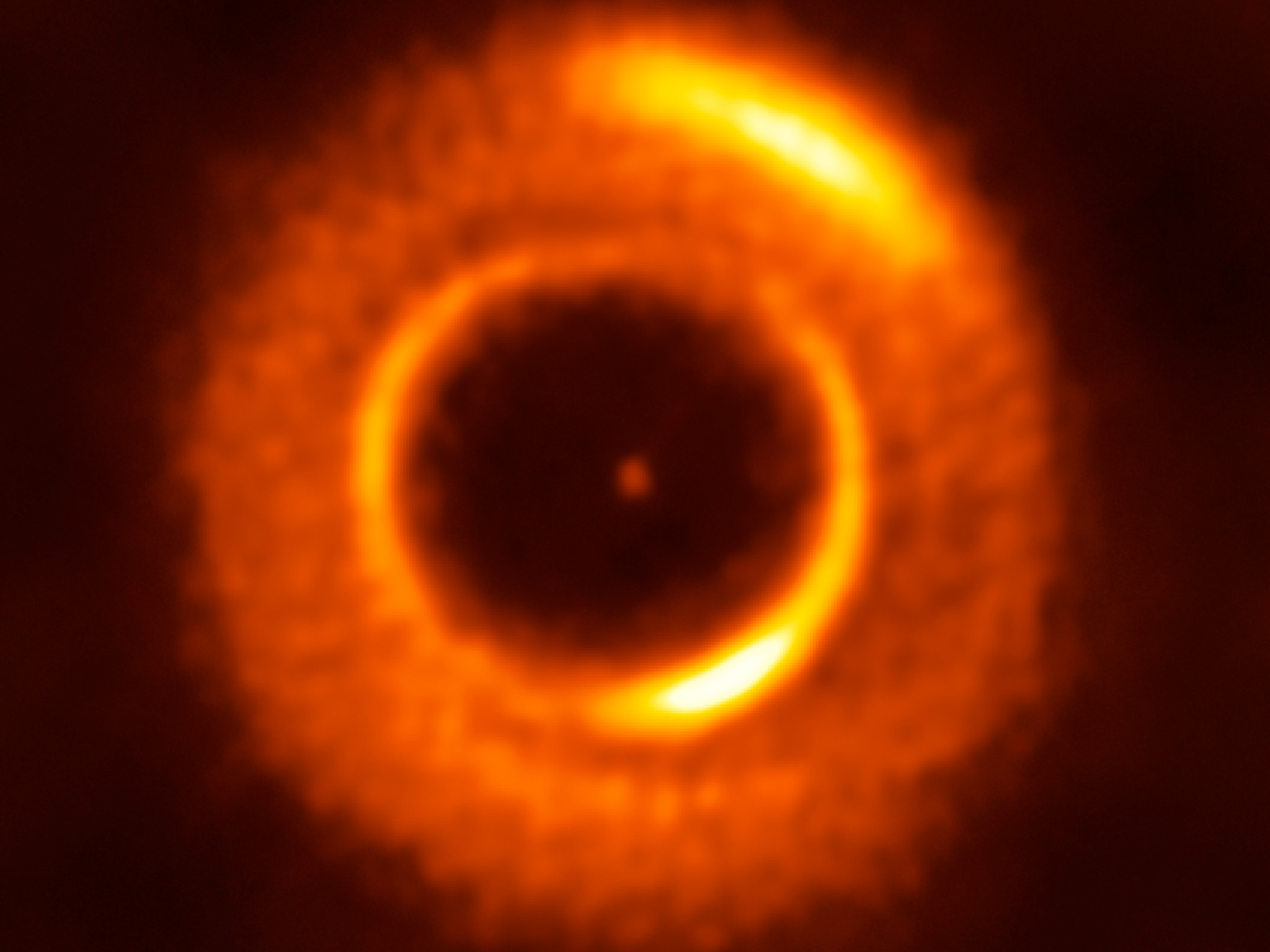
The MWC 758 protoplanetary disk, as seen by the Very Large Telescope (yellow areas) and the Atacama Large Millimeter/submillimeter Array (blue areas). Credit: ESO/A. Garufi et al.; R. Dong et al.; ALMA (ESO/NAOJ/NRAO); CC BY 4.0


Complicated Disks

Did vortices sculpt the crescent-shaped clumps of dust around the young star MWC 758? Using data from the Atacama Large Millimeter/submillimeter Array (ALMA), researchers have mapped the motions of the dust clumps and weighed in on the vortex hypothesis.

How planets form is one of the most pressing questions in astronomy. Observations increasingly show that protoplanetary disks, the sites of planet formation, are complex objects. These disks feature rings, gaps, spirals, and vortices, any of which might signal the presence of baby planets.

Among the intriguing features seen in protoplanetary disks are crescents: asymmetric regions where the density of dust is enhanced. These regions are readily visible in observations by ALMA and have been found in several protoplanetary disks.

Researchers suspect that crescents are caused by swirling regions called vortices. Like debris caught in an eddy in a stream, dust could theoretically become trapped in a vortex, forming the clumps seen in images — and potentially creating a perfect dusty ecosystem for planets to form.

Images of the MWC 758 disk taken at a wavelength of 1.3 mm in 2017 (left) and 2021 (right).
Credit: Kuo et al. 2024

The Causes of Crescents

Recently, a team led by I-Hsuan Genevieve Kuo (Academia Sinica Institute of Astronomy and Astrophysics, Taiwan; University of Arizona) investigated the causes of crescents in the protoplanetary disk around the star MWC 758, also called HD 36112. MWC 758 is a 1.5–2-solar-mass star that is about 3.5 million years old and less than 500 light-years away. Its disk sports several intriguing features, including two crescents and a spiral. Previous research has attributed these features to the presence of one or more planets.

Vortex theory predicts that vortices in a protoplanetary disk will revolve around the central star at the Keplerian velocity (i.e., following the predictions of Kepler’s laws of motion). To test this theory, Kuo’s team used ALMA data from 2017 and 2021 to measure the motion of the two crescents. They found that the crescents moved in the direction of the disk’s rotation, with the inner crescent moving 50% slower than expected for the vortex hypothesis and the outer crescent moving 33% faster than expected.

Observed azimuthal (i.e., around the disk) velocity of the dust clumps (green and dark blue triangles) and expected velocity for Keplerian rotation (aqua circles).Credit: Kuo et al. 2024

Spiral vs. Vortex

Does this finding necessarily rule out the vortex hypothesis? Kuo and coauthors first investigated and eliminated the possibility that imperfections in the disk, like warps or eccentricity, were the cause of the mismatch with theory. They then noted that the motion of the crescents matches the Keplerian velocity at a radius of about 0.46 arcsecond. If a planet were present at that radius, there’s a chance it could throw the system off-kilter and produce the observed behavior — but MWC 758’s putative planets are located well inside and outside this radius.

Instead, the non-Keplerian rotation of the dust clumps might be caused by the interaction of vortices and spirals. In this case, the vortices themselves, which are invisible to us, are moving in the way predicted by theory, but the spiral knocks the (visible) dust off course.

Luckily, this prediction is testable. If vortices and spirals are vying for control of the dust crescents in MWC 758’s disk, their power struggle would be less effective on large dust grains than on small dust grains. In other words, large dust grains should adhere more closely to the expected Keplerian velocity than small dust grains do. Future high-resolution observations at different wavelengths, which probe grains of different sizes, may provide an answer.

By Kerry Hensley

Citation

“ALMA Observations of Proper Motions of the Dust Clumps in the Protoplanetary Disk MWC 758,” I-Hsuan Genevieve Kuo et al 2024 ApJL 975 L33. doi:10.3847/2041-8213/ad86c1


Wednesday, July 22, 2020

A Stellar Flyby Makes Some Waves

Artist's impression of the dusty circumstellar disk surrounding UX Tauri A. A new study has discovered that this disk is being perturbed by the fly-by of another star in the UX Tauri system. Credit: NASA/JPL/Caltech

An example of spiral arms detected in a protoplanetary disk, MWC 758
Credit: NASA/ESA/ESO/M. Benisty et al

The intensity (top) and radial velocities (bottom) of the molecular gas observed in UX Tauri reveals a disk around both UX Tau A (top star in both images) and UX Tau C (bottom star), as well as a stream of gas connecting the two. Curves tracing the spiral arms in the disk surrounding UX Tau A are overlaid in the top image. [Adapted from Zapata et al. 2020]

The gaseous, dusty disks surrounding newly born stars can reveal a wealth of information about how distant stellar systems form and evolve. In a new study, scientists have now watched the interaction of two such disks in a stellar flyby.

Spotting Spirals

In the past decade, new instrumentation has led to a dramatic improvement in our views of circumstellar environments. We’ve spotted remarkable structure in the dusty disks that surround newborn stars — including, in many cases, pronounced spiral arms.

The presence of these spiral arms has provoked much discussion and debate. Are they caused by gravitational instabilities in the gas and dust? Or are they produced by perturbations from unseen, newborn planets orbiting within the disks? While both of these explanations could be at play in different systems, there’s an additional possibility to consider: the arms could be excited by tidal interactions with another star.

In a new study led by Luis Zapata (UNAM Radio Astronomy and Astrophysics Institute, Mexico), a team of scientists has used the sensitive and high-angular-resolution observations of the Atacama Large Millimeter/submillimeter Array (ALMA), located in Chile, to understand how tidal interactions with an orbiting star might be responsible for spiral arms observed in UX Tauri.

A New Disk Found

Located ~450 light-years away, the UX Tauri system consists of four stars: UX Tau A (the main star), UX Tau B (a binary star), and UX Tau C (a close companion that lies just to UX Tau A’s south). Past observations have revealed a disk of gas and dust around UX Tau A exhibiting distinct spiral arms.

Zapata and collaborators have now followed up with detailed ALMA observations to explore the structure of the molecular gas and dust in UX Tau. In addition to further resolving the disk around UX Tau A, the team was also able to detect — for the first time — molecular gas swirling in a disk around UX Tau C. What’s more, the observations reveal tidal interactions between the two disks that surround these stars.

Drama in UX Tau

What do these findings mean? Zapata and collaborators suggest that we’re witnessing a close flyby of UX Tau C as it progresses on a wide, evolving, and eccentric orbit around the disk of UX Tau A. As UX Tau C plowed through UX Tau A’s circumstellar disk, it captured some of the gas, forming its own disk. Through its motion and this tidal interaction, UX Tau C also excited the observed spiral arms in UX Tau A’s disk.

The drama spotted in UX Tauri represents one of the few cases of binary disk interactions that have been mapped out in molecular gas — but this is likely a common occurrence, since stars often occur in multiple-star systems. Sensitive observations like the ALMA detections presented here will likely reveal more such interactions in the future, shining additional light on the process of star and planet formation.

Citation

“Tidal Interaction between the UX Tauri A/C Disk System Revealed by ALMA,” Luis A. Zapata et al 2020 ApJ 896 132. doi:10.3847/1538-4357/ab8fac

By Susanna Kohler

Source: American Astronomical Society (AAS)


Thursday, July 05, 2018

ALMA spies a new planetary nursery

MWC 758
Credit: ESO/R. Dong et al.; ALMA (ESO/NAOJ/NRAO)


This image from the Atacama Large Millimeter/submillimeter Array (ALMA) shows MWC 758, a young star that is approaching adulthood and surrounded by knotty, irregular rings of cosmic dust, three of which can be seen here. Unusually, these rings are elliptical in shape rather than being perfectly circular — making this the first discovery of an intrinsically elliptical protoplanetary disc with ALMA!

The outer and inner rings each contain one particularly bright clump, visible as arcs of yellow.  Additionally there appear to be spiral arms traced out within the dust, as well as a core dust-free cavity that is slightly off-centre. These are all features that hint at the presence of unseen planets. As planets form, they gravitationally interact with the disc and create various telltale features and structures. Astronomers can thus observe a system like MWC 758 and not only infer the existence of potential hidden planets, but also estimate their masses, locations, and orbits.

This is a wonderful example of the planet-finding power of ALMA. Using the observatory to study such dusty discs allows scientists to investigate the very first stages of planet formation in a bid to understand how these infant systems form and evolve. Learning more about planetary systems throughout the cosmos may help us know more about how the Solar System formed, and how it evolved to become the cosmic home we live in today.


Source: ESO/Potw

Friday, October 30, 2015

Spirals in Dust Around Young Stars May Betray Presence of Massive Planets

MWC 758
[Right] — Observations taken by the European Southern Observatory's Very Large Telescope show a protoplanetary disk around the young star MWC 758. The disk has two spiral arms that extend over 10 billion miles from the star.


[Left] — A computer model reproduces the two-spiral-arm structure; the "x" is the location of a putative planet. The planet, which cannot be seen directly, probably excites the two spiral arms.

Photo Credit: NASA, ESA, ESO, M. Benisty et al. (University of Grenoble), R. Dong (Lawrence Berkeley National Laboratory), and Z. Zhu (Princeton University).  Release Images


A team of astronomers is proposing that huge spiral patterns seen around some newborn stars, merely a few million years old (about one percent our sun's age), may be evidence for the presence of giant, unseen planets. This idea not only opens the door to a new method of planet detection, but also could offer a look into the early formative years of planet birth.

Though astronomers have cataloged thousands of planets orbiting other stars, the very earliest stages of planet formation are elusive because nascent planets are born and embedded inside vast, pancake-shaped disks of dust and gas encircling newborn stars, known as circumstellar disks.

The conclusion that planets may betray their presence by modifying circumstellar disks on large scales is based on detailed computer modeling of how gas-and-dust disks evolve around newborn stars, which was conducted by two NASA Hubble Fellows, Ruobing Dong of Lawrence Berkeley National Laboratory, and Zhaohuan Zhu of Princeton University. Their research was published in the Aug. 5 edition of The Astrophysical Journal Letters.

"It's difficult to see suspected planets inside a bright disk surrounding a young star. Based on this study, we are convinced that planets can gravitationally excite structures in the disk. So if you can identify features in a disk and convince yourself those features are created by an underlying planet that you cannot see, this would be a smoking gun of forming planets," Dong said.

Identifying large-scale features produced by planets offers another method of planet detection that is quite different from all other techniques presently used. This approach can help astronomers find currently forming planets, and address when, how, and where planets form.

Gaps and rings seen in other circumstellar disks suggest invisible planets embedded in the disk. However gaps, presumably swept clean by a planet's gravity, often do not help show the location of the planet. Also, because multiple planets together may open a single common gap, it’s very challenging to estimate their numbers and masses.

Ground-based telescopes have photographed two large-scale spiral arms around two young stars, SAO 206462 and MWC 758. A few other nearby stars also show smaller spiral-like features. "How they are created has been a big mystery until now. Scientists had a hard time explaining these features," Dong said. If the disks were very massive, they would have enough self-gravity to become unstable and set up wave-like patterns. But the disks around SAO 206462 and MWC 758 are probably just a few percent of the central star's mass and therefore are not gravitationally unstable.

The team generated computer simulations of the dynamics of a disk and how a star's radiation propagates through a disk with embedded planets. This modeling created spiral structures that very closely resemble observations. The mutual gravitational interaction between the disk and the planet creates regions where the density of gas and dust increases, like traffic backing up on a crowded expressway. The differential rotation of the disk around the star smears these over-dense regions into spiral waves. "Although it had been speculated that planets can produce spiral arms, we now think we know how," said Zhu.

"Simulations also suggest that these spiral arms have rich information about the unseen planet, revealing not only its position but also its mass," Zhu said. The simulations show that if there were no planet present, the disk would look smooth. To make the grand-scale spiral arms seen in the SAO 206462 and MWC 758 systems, the unseen planet would have to be bulky, at least 10 times the mass of Jupiter, the largest planet in our solar system.

The first planet orbiting a normal star was identified in 1995. Thanks to ground-based telescopes and NASA's Kepler mission, a few thousand exoplanets have been cataloged to date. But because the planets are in mature systems, many millions or a few billion years old, they offer little direct clues as to how they formed.

"There are many theories about how planets form but very little work based on direct observational evidence confirming these theories," Dong said. "If you see signs of a planet in a disk right now, it tells you when, where, and how planets form."

Astronomers will use the upcoming NASA James Webb Space Telescope to probe circumstellar disks and look for features, as simulated by the modeling, and will then try to directly observe the predicted planet causing the density waves.


Contacts

Ray Villard
Space Telescope Science Institute, Baltimore, Maryland
410-338-4514
villard@stsci.edu

Ruobing Dong
Lawrence Berkeley National Laboratory, and University of California, Berkeley, California
rdong2013@berkeley.edu

Zhaohuan Zhu
Princeton University, Princeton, New Jersey
zhzhu@astro.princeton.edu

Source: HubbleSite