Showing posts with label WASP-18b. Show all posts

Thursday, August 09, 2018

Water Is Destroyed, Then Reborn in Ultrahot Jupiters

These simulated views of the ultrahot Jupiter WASP-121b show what the planet might look like to the human eye from five different vantage points, illuminated to different degrees by its parent star. The images were created using a computer simulation being used to help scientists understand the atmospheres of these ultra-hot planets. Credit: NASA/JPL-Caltech/Vivien Parmentier/Aix-Marseille University (AMU).  › Full image and caption


Imagine a place where the weather forecast is always the same: scorching temperatures, relentlessly sunny, and with absolutely zero chance of rain. This hellish scenario exists on the permanent daysides of a type of planet found outside our solar system dubbed an "ultrahot Jupiter." These worlds orbit extremely close to their stars, with one side of the planet permanently facing the star.

What has puzzled scientists is why water vapor appears to be missing from the toasty worlds' atmospheres, when it is abundant in similar but slightly cooler planets. Observations of ultrahot Jupiters by NASA's Spitzer and Hubble space telescopes, combined with computer simulations, have served as a springboard for a new theoretical study that may have solved this mystery. 

According to the new study, ultrahot Jupiters do in fact possess the ingredients for water (hydrogen and oxygen atoms). But due to strong irradiation on the planet's daysides, temperatures there get so intense that water molecules are completely torn apart. 

"The daysides of these worlds are furnaces that look more like a stellar atmosphere than a planetary atmosphere," said Vivien Parmentier, an astrophysicist at Aix Marseille University in France and lead author of the new study. "In this way, ultrahot Jupiters stretch out what we think planets should look like." 

While telescopes like Spitzer and Hubble can gather some information about the daysides of ultrahot Jupiters, the nightsides are difficult for current instruments to probe. The new paper proposes a model for what might be happening on both the illuminated and dark sides of these planets, based largely on observations and analysis of the ultrahot Jupiter known as WASP-121b, and from three recently published studies, coauthored by Parmentier, that focus on the ultrahot Jupiters WASP-103b
WASP-18b and HAT-P-7b, respectively. The new study suggests that fierce winds may blow the sundered water molecules into the planets' nightside hemispheres. On the cooler, dark side of the planet, the atoms can recombine into molecules and condense into clouds, all before drifting back into the dayside to be splintered again. 

Water is not the only molecule that may undergo a cycle of chemical reincarnation on these planets, according to the new study. Previous detections of clouds by Hubble at the boundary between day and night, where temperatures mercifully fall, have shown that titanium oxide (popular as a sunscreen) and aluminum oxide (the basis for ruby, the gemstone) could also be molecularly reborn on the ultrahot Jupiters' nightsides. These materials might even form clouds and rain down as liquid metals and fluidic rubies. 

Star-planet hybrids

Among the growing catalog of planets outside our solar system -- known as exoplanets -- ultrahot Jupiters have stood out as a distinct class for about a decade. Found in orbits far closer to their host stars than Mercury is to our Sun, the giant planets are tidally locked, meaning the same hemisphere always faces the star, just as the Moon always presents the same side to Earth. As a result, ultrahot Jupiters' daysides broil in a perpetual high noon. Meanwhile, their opposite hemispheres are gripped by endless nights. Dayside temperatures reach between 3,600 and 5,400 degrees Fahrenheit (2,000 and 3,000 degrees Celsius), ranking ultrahot Jupiters among the hottest exoplanets on record. Nightside temperatures are around 1,800 degrees Fahrenheit cooler (1,000 degrees Celsius), cold enough for water to re-form and, along with other molecules, coalesce into clouds.

Hot Jupiters, cousins to ultrahot Jupiters with dayside temperatures below 3,600 degrees Fahrenheit (2,000 Celsius), were the first widely discovered type of exoplanet, starting back in the mid-1990s. Water has turned out to be common in their atmospheres. One hypothesis for why it appeared absent in ultrahot Jupiters has been that these planets must have formed with very high levels of carbon instead of oxygen. Yet the authors of the new study say this idea could not explain the traces of water also sometimes detected at the dayside-nightside boundary. 

To break the logjam, Parmentier and colleagues took a cue from well-established physical models of the atmospheres of stars, as well as "failed stars," known as brown dwarfs, whose properties overlap somewhat with hot and ultrahot Jupiters. Parmentier adapted a brown dwarf model developed by Mark Marley, one of the paper's coauthors and a research scientist at NASA's Ames Research Center in Silicon Valley, California, to the case of ultrahot Jupiters. Treating the atmospheres of ultrahot Jupiters more like blazing stars than conventionally colder planets offered a way to make sense of the Spitzer and Hubble observations. 

"With these studies, we are bringing some of the century-old knowledge gained from studying the astrophysics of stars, to the new field of investigating exoplanetary atmospheres," said Parmentier.

Spitzer's observations in infrared light zeroed in on carbon monoxide in the ultrahot Jupiters' atmospheres. The atoms in carbon monoxide form an extremely strong bond that can uniquely withstand the thermal and radiational assault on the daysides of these planets. The brightness of the hardy carbon monoxide revealed that the planets' atmospheres burn hotter higher up than deeper down. Parmentier said verifying this temperature difference was key for vetting Hubble's no-water result, because a uniform atmosphere can also mask the signatures of water molecules. 

"These results are just the most recent example of Spitzer being used for exoplanet science -- something that was not part of its original science manifest," said Michael Werner, project scientist for Spitzer at NASA's Jet Propulsion Laboratory in Pasadena, California. "In addition, it's always heartening to see what we can discover when scientists combine the power of Hubble and Spitzer, two of NASA's Great Observatories."

Although the new model adequately described many ultrahot Jupiters on the books, some outliers do remain, suggesting that additional aspects of these worlds' atmospheres still need to be understood. Those exoplanets not fitting the mold could have exotic chemical compositions or unanticipated heat and circulation patterns. Prior studies have argued that there is a more significant amount of water in the dayside atmosphere of WASP-121b than what is apparent from observations, because most of the signal from the water is obscured. The new paper provides an alternative explanation for the smaller-than-expected water signal, but more studies will be required to better understand the nature of these ultrahot atmospheres.

Resolving this dilemma could be a task for NASA's next-generation James Webb Space Telescope, slated for a 2021 launch. Parmentier and colleagues expect it will be powerful enough to glean new details about the daysides, as well as confirm that the missing dayside water and other molecules of interest have gone to the planets' nightsides.

"We now know that ultrahot Jupiters exhibit chemical behavior that is different and more complex than their cooler cousins, the hot Jupiters," said Parmentier. "The studies of exoplanet atmospheres is still really in its infancy and we have so much to learn."

The new study is forthcoming in the journal Astronomy and Astrophysics.

NASA's Jet Propulsion Laboratory, Pasadena, California, manages the Spitzer Space Telescope mission for NASA's Science Mission Directorate, Washington. Science operations are conducted at the Spitzer Science Center at Caltech in Pasadena. Spacecraft operations are based at Lockheed Martin Space, Littleton, Colorado. Data are archived at the Infrared Science Archive housed at IPAC at Caltech. Caltech manages JPL for NASA. 

Hubble is a project of international cooperation between NASA and ESA. NASA's Goddard Space Flight Center in Greenbelt, Maryland, manages Hubble. The Space Telescope Science Institute (STScI) in Baltimore conducts Hubble science operations.

News Media Contact

Calla Cofield
Jet Propulsion Laboratory, Pasadena, Calif.
818-393-1821

Calla.e.cofield@jpl.nasa.gov

Written by Adam Hadhazy


Wednesday, July 11, 2018

NASA's Webb Space Telescope to Inspect Atmospheres of Gas Giant Exoplanet

This is an artist's impression of the Jupiter-size extrasolar planet, HD 189733b, being eclipsed by its parent star. Astronomers using the Hubble Space Telescope have measured carbon dioxide and carbon monoxide in the planet's atmosphere. The planet is a "hot Jupiter," which is so close to its star that it completes an orbit in only 2.2 days. The planet is too hot for life as we know it. But under the right conditions, on a more Earth-like world, carbon dioxide can indicate the presence of extraterrestrial life. This observation demonstrates that chemical biotracers can be detected by space telescope observations. Credits: ESA, NASA, M. Kornmesser (ESA/Hubble), and STScI


In April 2018, NASA launched the Transiting Exoplanet Survey Satellite (TESS). Its main goal is to locate Earth-sized planets and larger “super-Earths” orbiting nearby stars for further study. One of the most powerful tools that will examine the atmospheres of some planets that TESS discovers will be NASA’s James Webb Space Telescope. Since observing small exoplanets with thin atmospheres like Earth will be challenging for Webb, astronomers will target easier, gas giant exoplanets first.

Some of Webb’s first observations of gas giant exoplanets will be conducted through the Director’s Discretionary Early Release Science program. The transiting exoplanet project team at Webb’s science operations center is planning to conduct three different types of observations that will provide both new scientific knowledge and a better understanding of the performance of Webb’s science instruments.

“We have two main goals. The first is to get transiting exoplanet datasets from Webb to the astronomical community as soon as possible. The second is to do some great science so that astronomers and the public can see how powerful this observatory is,” said Jacob Bean of the University of Chicago, a co-principal investigator on the transiting exoplanet project.

“Our team’s goal is to provide critical knowledge and insights to the astronomical community that will help to catalyze exoplanet research and make the best use of Webb in the limited time we have available,” added Natalie Batalha of NASA Ames Research Center, the project’s principal investigator.

Transit – An atmospheric spectrum

When a planet crosses in front of, or transits, its host star, the star’s light is filtered through the planet’s atmosphere. Molecules within the atmosphere absorb certain wavelengths, or colors, of light. By splitting the star’s light into a rainbow spectrum, astronomers can detect those sections of missing light and determine what molecules are in the planet’s atmosphere.

For these observations, the project team selected WASP-79b, a Jupiter-sized planet located about 780 light-years from Earth. The team expects to detect and measure the abundances of water, carbon monoxide, and carbon dioxide in WASP-79b. Webb also might detect new molecules not yet seen in exoplanet atmospheres.

Phase curve – A weather map

Planets that orbit very close to their stars tend to become tidally locked. One side of the planet permanently faces the star while the other side faces away, just as one side of the Moon always faces the Earth. When the planet is in front of the star, we see its cooler backside. But as it orbits the star, more and more of the hot day-side comes into view. By observing an entire orbit, astronomers can observe those variations (called a phase curve) and use the data to map the planet’s temperature, clouds, and chemistry as a function of longitude.

The team will observe a phase curve of the “hot Jupiter” known as WASP-43b, which orbits its star in less than 20 hours. By looking at different wavelengths of light, they can sample the atmosphere to different depths and obtain a more complete picture of its structure. “We have already seen dramatic and unexpected variations for this planet with Hubble and Spitzer. With Webb we will reveal these variations in significantly greater detail to understand the physical processes that are responsible,” said Bean.

Eclipse – A planet’s glow

The greatest challenge when observing an exoplanet is that the star’s light is much brighter, swamping the faint light of the planet. To get around this problem, one method is to observe a transiting planet when it disappears behind the star, not when it crosses in front of the star. By comparing the two measurements, one taken when both star and planet are visible, and the other when only the star is in view, astronomers can calculate how much light is coming from the planet alone.

This technique works best for very hot planets that glow brightly in infrared light. The team plans to study WASP-18b, a planet that is baked to a temperature of almost 4,800 degrees Fahrenheit (2,900 K). Among other questions, they hope to determine whether the planet’s stratosphere exists due to the presence of titanium oxide, vanadium oxide, or some other molecule.

Habitable planets

Ultimately, astronomers want to use Webb to study potentially habitable planets. In particular, Webb will target planets orbiting red dwarf stars since those stars are smaller and dimmer, making it easier to tease out the signal from an orbiting planet. Red dwarfs are also the most common stars in our galaxy.

“TESS should locate more than a dozen planets orbiting in the habitable zones of red dwarfs, a few of which might actually be habitable. We want to learn whether those planets have atmospheres and Webb will be the one to tell us,” said Kevin Stevenson of the Space Telescope Science Institute, a co-principal investigator on the project. “The results will go a long way towards answering the question of whether conditions favorable to life are common in our galaxy.”

The James Webb Space Telescope is the world’s premier infrared space observatory of the next decade. Webb will solve mysteries of our solar system, look beyond to distant worlds around other stars, and probe the mysterious structures and origins of our universe and our place in it. Webb is an international program led by NASA with its partners, the European Space Agency (ESA) and the Canadian Space Agency (CSA).


Contact:

Christine Pulliam
Space Telescope Science Institute, Baltimore, Maryland
410-338-4366
cpulliam@stsci.edu


Related Links

This site is not responsible for content found on external links


Wednesday, September 17, 2014

WASP-18: NASA's Chandra X-ray Observatory Finds Planet That Makes Star Act Deceptively Old

WASP-18
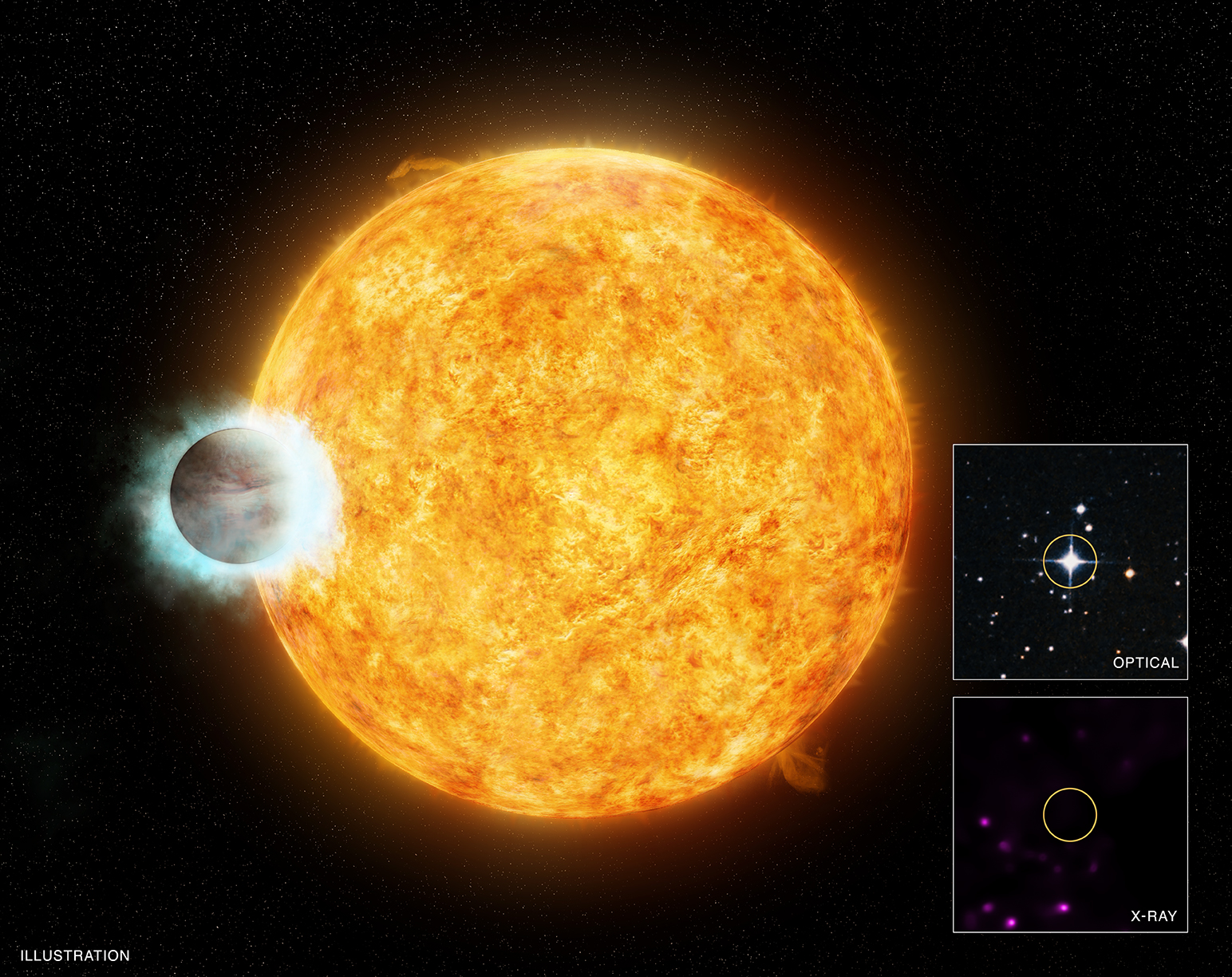
Credit: X-ray: NASA/CXC/SAO/I.Pillitteri et al; Optical: DSS; Illustration: NASA/CXC/M.Weiss

A new study using data from NASA's Chandra X-ray Observatory has shown that a planet is making the star that it orbits act much older than it actually is, as explained in our latest press release. The artist's illustration featured in the main part of this graphic depicts the star, WASP-18, and its planet, WASP-18b. 

WASP-18b is a "hot Jupiter," a giant exoplanet that orbits very close to its star, located about 330 light years from Earth. Specifically, the mass of WASP-18b is estimated to be about ten times that of Jupiter, yet it orbits its star about once every 23 hours. By comparison, it takes Jupiter about 12 years to complete one trip around the Sun from its great distance.

The new Chandra data of the WASP-18 system show that this huge planet is so close to its star that it may be causing a dampening of the star's magnetic field. As stars age, their X-ray and magnetic activity decreases. Astronomers determined that WASP-18 is only between 500 million and 2 billion years old, a relatively young age for a star. Given this age, astronomers expect that WASP-18 would be giving off copious amounts of X-rays.

Surprisingly, the long Chandra observations reveal no X-rays being emitted from WASP-18, as seen in the lower inset box. The same field-of-view in the upper inset box shows that in optical light WASP-18 is a bright source. Using established relations between the magnetic activity and X-ray emission of stars and their age, the researchers concluded that WASP-18 is about 100 times less active than it should be at its age.

The low amount of magnetic activity from WASP-18 is shown in the artist's illustration by the lack of sunspots and strong flares on the surface of the star. The weak X-ray emission from the star has relatively little effect on the outer atmosphere of the nearby planet, giving it a symmetrical appearance. By contrast, much stronger X-rays from the star CoRoT-2a are eroding the atmosphere of its nearby planet, producing a tail-like appearance.

Tidal forces from the gravitational pull of the massive planet - similar to those the Moon has on Earth's tides but on a much larger scale - may be responsible for disrupting the magnetic field of the star. The strength of the magnetic field in a star depends on the amount of convection, the process by which hot gas moves around the stellar interior. The planet's gravity may cause motions of gas inside the star that weaken the convection. Because WASP-18 has a narrower convection zone than most stars, it is more vulnerable to the impact of tidal forces that tug at it.

The effect of tidal forces from the planet may also explain an unusually high amount of lithium found in earlier, optical studies of WASP-18. Lithium is usually abundant in younger stars, but over time convection carries lithium to the hot inner regions of a star, where it is destroyed by nuclear reactions. If there is less convection, the lithium does not circulate into the interior of the star as much, allowing more of it to survive.

These results were published in the July 2014 issue of Astronomy and Astrophysics and are available online. The first author is Ignazio Pillitteri of the Istituto Nazionale di Astrofisica (INAF)-Osservatorio Astronomico di Palermo in Italy. The co-authors are Scott Wolk of the Harvard-Smithsonian Center for Astrophysics in Cambridge, Massachusetts; Salvatore Sciortino also from INAF-Osservatorio Astronomico di Palermo in Italy and Victoria Antoci from Aarhus University in Denmark.

Fast Facts for WASP-18:

Scale: Inset image is about 5.3 arcmin across (about 0.5 light years)
Category: Normal Stars & Star Clusters
Coordinates (J2000): RA 01h 37m 25.00s | Dec -45º 40' 40.30"
Constellation: Phoenix
Observation Date: 26 Feb 2013
Observation Time: 23 hours 43 min.
Obs. ID: 14566
Instrument: ACIS
References: Pillitteri, I et al, 2014, A&A, 567, 128; arXiv:1406.2620
Color Code: Inset: X-ray (Pink), Optical (Red, Green, Blue)
Distance Estimate: About 326 light years


Monday, August 12, 2013

Poised for Discovery: Gemini’s Much-anticipated Infrared Instrument Goes On-sky

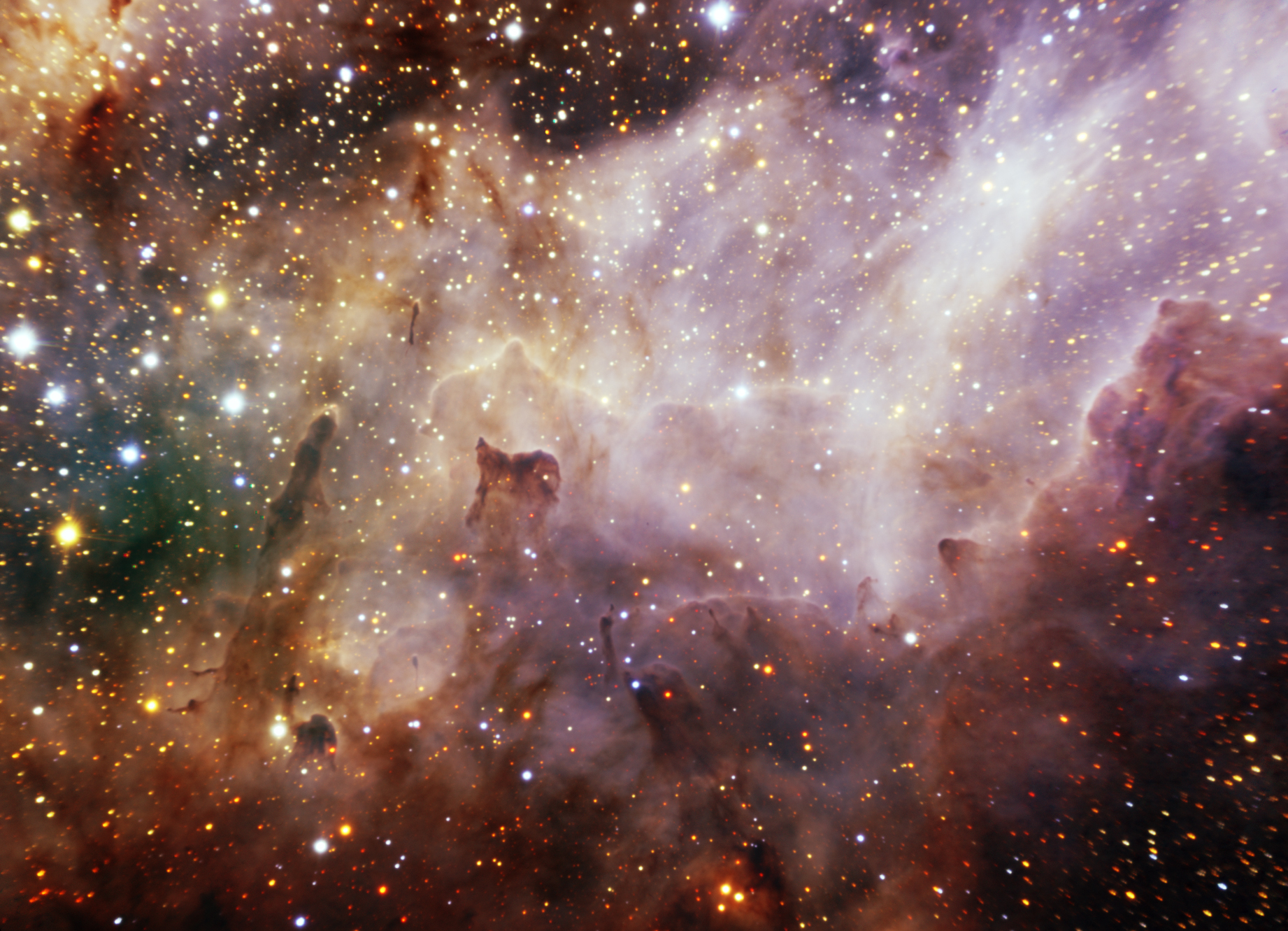
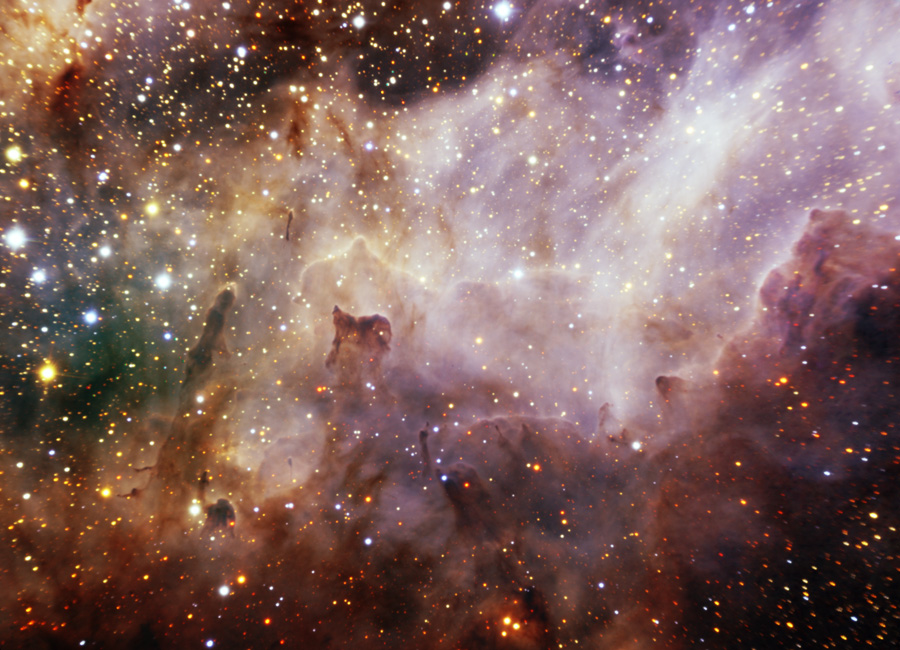
This FLAMINGOS-2 near-infrared image details part of the magnificent Swan Nebula (M17), where ultraviolet radiation streaming from young hot stars sculpts a dense region of dust and gas into myriad fanciful forms. M17 lies some 5,200 light-years distant in the constellation Sagittarius and is one of the most massive and luminous star-forming region's in our Galaxy. It is also one of the most studied. Field of view: 5.5 x 4.0 arcmin. Credit: Gemini Observatory/AURA.  Full Resolution TIF (4MB) | Full Resolution JPG (2MB) | Med Resolution JPG (280KB) 

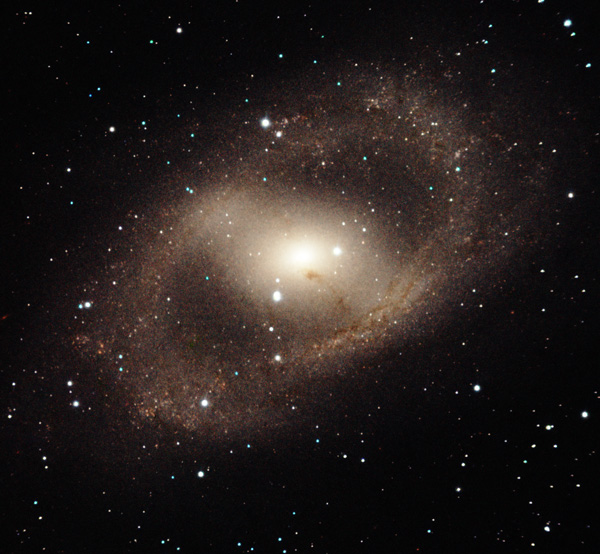
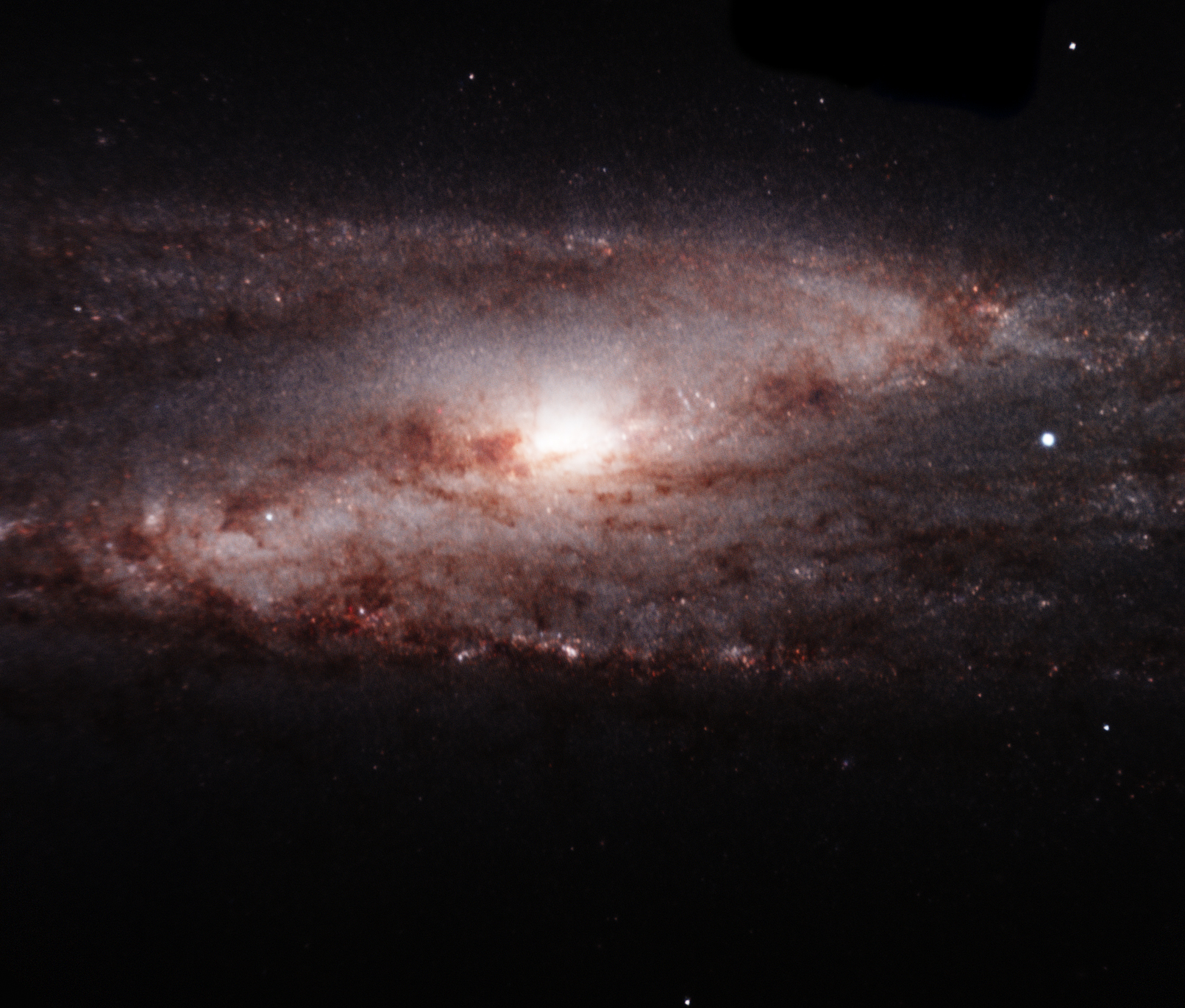
NGC 6300 is an intriguing barred spiral galaxy in the constellation of Ara. This near-infrared image with FLAMINGOS-2 shows the galaxy’s complex arm structure forming a spectacular ring of star formation. The galaxy’s bar also has a strong vein of dust that almost obscures its bright active nucleus –– whose prodigious energy is the result of matter accreting onto a black hole with an estimated mass of 280,000 Suns. Field of view: 3.1 x 2.9 arcmin. Credit: Gemini Observatory/AURA. Full Resolution TIF (2.3MB) | Full Resolution JPG (1.2MB) | Med Resolution JPG (153KB) 

In this near-infrared image, FLAMINGOS-2 peered deep into the heart of spiral galaxy NGC 253, which lies about 11.5 million light-years nearby in the constellation of Sculptor. The new instrument captured an intricate whirlpool of dust spiraling in to a diffuse nuclear region, where violent star formation may be occurring around a supermassive black hole. The instrument also imaged a dusting of star forming sites in its spiral arms. Field of view: 4.8 x 4.1 arcmin. Credit: Gemini Observatory/AURA.   Full Resolution TIF (4MB) | Full Resolution JPG (2MB) | Med Resolution JPG (141KB) 

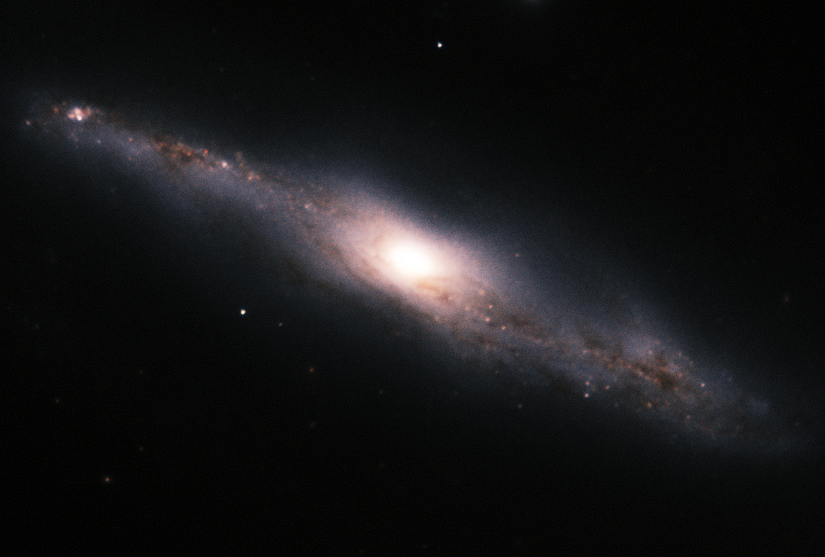
Spiral galaxy NGC 7582 is the brightest member of the Grus Quartet of galaxies, some 60 million light-years distant traveling together through space. In this near-infrared image, FLAMINGOS-2 resolved its high quantity of dust that line NGC 7582’s arms as well as regions rich in star formation. Field of view: 2.5 x 1.7 arcmin. Credit: Gemini Observatory/AURA.  Full Resolution TIF (836KB) | Med Resolution JPG (425KB)

Gemini Observatory’s latest instrument, a powerful infrared camera and spectrograph at Gemini South, reveals its potential in a series of striking on-sky commissioning images released today. 
 
Gemini Observatory’s latest tool for astronomers, a second-generation infrared instrument called FLAMINGOS-2, has “traveled a long road” to begin science observations for the Gemini scientific community. Recent images taken by FLAMINGOS-2 during its last commissioning phase dramatically illustrate that the instrument was worth the wait for astronomers around the world who are anxious to begin using it. 

“It’s already one of our most requested instruments at the Gemini telescopes,” remarks Nancy Levenson, Gemini’s Deputy Director and Head of Science. “We see a long and productive life ahead for FLAMINGOS-2 once astronomers really start using it later this year.” 

“It has not been an easy journey,” says Percy Gomez Gemini’s FLAMINGOS-2 Instrument Scientist, “but thanks to the dedicated work of Gemini engineers and scientists very soon astronomers will be able to use a reliable and robust instrument.” After significant redesign and rebuilds for optimal performance on the Gemini South telescope, FLAMINGOS-2 has proven that it will provide astronomers with a powerful mix of capabilities. These include extreme sensitivity to infrared (heat) radiation from the universe, high-resolution wide-field imaging, and a combination of spectroscopic capabilities that will allow cutting-edge research in topics spanning from the exploration of our Solar System, to the most distant and energetic explosions in our universe. 

While work still remains on some of its spectroscopic features, as well as refining imaging at the edge of its large field of view, Gemini’s team of engineers and scientists has mitigated its most severe risk – potential damage to a large collimator lens that catastrophically cracked during a planned final commissioning in early 2012 (it was later replaced). The thermal environment surrounding this lens – located where the temperature changes periodically for routine switching of masks for multi-object spectroscopy - creates special challenges. It was these temperature changes that initially caused the crack, but a year later procedures and design modifications are now in place to significantly reduce risks to the lens’s integrity and functionality. 

“The Gemini team has done a remarkable job in optimizing this instrument for Gemini and it will soon be everything, and more, that we had envisioned years ago when the project began,” says Steve Eikenberry, who led the team who built FLAMINGOS-2 at the University of Florida. “Like a lot of scientists, I’m anxious to use FLAMINGOS-2 to collect data – specifically, I want to look toward the center of our Galaxy and study binary black holes as well as the mass evolution of the super-massive black hole that lurks at the heart of our Galaxy.” Eikenberry and collaborators are eager to make the most of FLAMINGOS-2’s power as soon as the instrument’s multi-object spectroscopy capability is fully functional. “With most of the challenges behind us, now the fun begins!” Eikenberry said. 

Kevin Stevenson of the University of Chicago already has plans to use FLAMINGOS-2 later this year to study the intriguing exoplanet WASP-18b. This well-known exoplanet is being strongly heated by its ultra-nearby host star and according to Stevenson, “It's even hotter than some of the coolest, low-mass stars known.” Stevenson and his team hope to determine the abundances of water vapor and methane when the planet is eclipsed by its host star. “Our plan is to compare the system's light immediately before and during an eclipse to measure the contribution from the planet. When we do this over several parts of the infrared part of the light spectrum, we can piece together the planet's spectrum and learn about its temperature and composition.” 

The quality and usefulness of FLAMINGOS-2 for these and future projects is reflected in the images released today. They cover a wide range of targets which are representative of the types of science in which FLAMINGOS-2 is expected to excel. In addition, the instrument may later accept an adaptive optics (AO) feed for extremely high-resolution imaging from GeMS (Gemini Multi-conjugate adaptive optics System). 

It is expected that most of these systems, including multi-object spectroscopy, will be fully integrated in 2014 with imaging and long-slit spectroscopy available now. The next round of observations with FLAMINGOS-2 are slated to begin on September 1st.

Contacts:

  • Percy Gomez
    Gemini Observatory, La Serena, Chile
    Phone (Desk): 56-51-2-205696
    Email:
    pgomez@gemini.edu

  • Peter Michaud
    Gemini Observatory, Hilo, Hawai‘i
    Office: +1 (808) 974-2510
    Cell: +1 (808) 936-6643

    pmichaud@gemini.edu

  • Antonieta Garcia
    Gemini Observatory, La Serena, Chile
    Phone (Desk): 56-51-2-205628
    Cell: 09-69198294
    Email:
    agarcia@gemini.edu