Wednesday, June 10, 2015

Lonely Galaxy 'Lost in Space'

NGC 6503
Credit: NASA, ESA, D. Calzetti (University of Massachusetts), H. Ford (Johns Hopkins University), 
and the Hubble Heritage (STScI/AURA)-ESA/Hubble Collaboration

This magnificent spiral galaxy is at the edge of what astronomers call the Local Void. The Local Void is a huge volume of space that is at least 150 million light-years across that doesn't seen to contain anything much. There are no obvious galaxies. This void is simply part of the structure of the universe where matter grows clumpy over time so that galaxies form clusters and chains, which are separated by regions mostly devoid of galaxies. This results in sort of a "soap bubble" structure on large scales. The galaxy, as photographed by NASA's Hubble Space Telescope, is especially colorful where bright red patches of gas can be seen scattered through its spiral arms. Bright blue regions contain newly forming stars. Dark brown dust lanes snake across the galaxy's bright arms and center, giving it a mottled appearance.


Most galaxies are clumped together in groups or clusters. A neighboring galaxy is never far away. But this galaxy, known as NGC 6503, has found itself in a lonely position, at the edge of a strangely empty patch of space called the Local Void.

The Local Void is a huge stretch of space that is at least 150 million light-years across. It seems completely empty of stars or galaxies. The galaxy's odd location on the edge of this never-land led stargazer Stephen James O'Meara to dub it the "Lost-In-Space galaxy" in his 2007 book, Hidden Treasures.

NGC 6503 is 18 million light-years away from us in the northern circumpolar constellation of Draco. NGC 6503 spans some 30,000 light-years, about a third of the size of the Milky Way.

This Hubble Space Telescope image shows NGC 6503 in striking detail and with a rich set of colors. Bright red patches of gas can be seen scattered through its swirling spiral arms, mixed with bright blue regions that contain newly forming stars. Dark brown dust lanes snake across the galaxy's bright arms and center, giving it a mottled appearance.

The Hubble Advanced Camera for Surveys data for NGC 6503 were taken in April 2003, and the Wide Field Camera 3 data were taken in August 2013.


Source: HubbleSite

A Celestial Butterfly Emerges from its Dusty Cocoon

VLT/SPHERE image of the star L2 Puppis and its surroundings

VLT/SPHERE and NACO image of the star L2 Puppis and its surroundings

The star L2 Puppis in the constellation of Puppis

Wide-field view of the sky around the red giant star L2 Puppis


Videos
 
Zooming in on the red giant star L2 Puppis


SPHERE reveals earliest stage of planetary nebula formation


Some of the sharpest images ever made with ESO’s Very Large Telescope (VLT) have, for the first time, revealed what appears to be an ageing star giving birth to a butterfly-like planetary nebula. These observations of the red giant star L2 Puppis, from the ZIMPOL mode of the newly installed SPHERE instrument, also clearly showed a close companion. The dying stages of stars continue to pose astronomers with many riddles, and the origin of such bipolar nebulae, with their complex and alluring hourglass figures, doubly so. This new imaging mode means that the VLT is currently the sharpest astronomical direct imaging instrument in existence.

At about 200 light-years away, L2 Puppis is one of the closest red giants to Earth known to be entering its final stages of life. The new observations with the ZIMPOL mode of SPHERE were made in visible light using extreme adaptive optics, which corrects images to a much higher degree than standard adaptive optics, allowing faint objects and structures close to bright sources of light to be seen in greater detail. They are the first published results from this mode and the most detailed of such a star.

ZIMPOL can produce images that are three times sharper than those from the NASA/ESA Hubble Space Telescope, and the new observations show the dust that surrounds L2 Puppis in exquisite detail [1]. They confirm earlier findings, made using NACO, of the dust being arranged in a disc, which from Earth is seen almost completely edge-on, but provide a much more detailed view. The polarisation information from ZIMPOL also allowed the team to construct a three dimensional model of the dust structures [2].

The astronomers found the dust disc to begin about 900 million kilometres from the star — slightly farther than the distance from the Sun to Jupiter — and discovered that it flares outwards, creating a symmetrical, funnel-like shape surrounding the star. The team also observed a second source of light about 300 million kilometres — twice the distance from Earth to the Sun — from L2 Puppis. This very close companion star is likely to be another red giant of slightly lower mass, but less evolved.

The combination of a large amount of dust surrounding a slowly dying star, along with the presence of a companion star, mean that this is exactly the type of system expected to create a bipolar planetary nebula. These three elements seem to be necessary, but a considerable amount of good fortune is also still required if they are to lead to the subsequent emergence of a celestial butterfly from this dusty chrysalis.

Lead author of the paper, Pierre Kervella, explains: “The origin of bipolar planetary nebulae is one of the great classic problems of modern astrophysics, especially the question of how, exactly, stars return their valuable payload of metals back into space — an important process, because it is this material that will be used to produce later generations of planetary systems.”

In addition to L2 Puppis’s flared disc, the team found two cones of material, which rise out perpendicularly to the disc. Importantly, within these cones, they found two long, slowly curving plumes of material. From the origin points of these plumes, the team deduces that one is likely to be the product of the interaction between the material from L2 Puppis and the companions star’s wind and radiation pressure, while the other is likely to have arisen from a collision between the stellar winds from the two stars, or be the result of an accretion disc around the companion star.

Although much is still to be understood, there are two leading theories of bipolar planetary nebulae, both relying on the existence of a binary star system [3]. The new observations suggest that both of these processes are in action around L2 Puppis, making it appear very probable that the pair of stars will, in time, give birth to a butterfly.

Pierre Kervella concludes: “With the companion star orbiting L2 Puppis only every few years, we expect to see how the companion star shapes the red giant’s disc. It will be possible to follow the evolution of the dust features around the star in real time — an extremely rare and exciting prospect.


Notes


[1] SPHERE/ZIMPOL use extreme adaptive optics to create diffraction-limited images, which come a lot closer than previous adaptive optics instruments to achieving the theoretical limit of the telescope if there were no atmosphere. Extreme adaptive optics also allows much fainter objects to be seen very close to a bright star. These images are also taken in visible light — shorter wavelengths than the near-infrared regime, where most earlier adaptive optics imaging was performed. These two factors result in significantly sharper images than earlier VLT images. Even higher spatial resolution has been achieved with VLTI, but the interferometer does not create images directly.

[2] The dust in the disc was very efficient at scattering the stars’ light towards Earth and polarising it, a feature that the team could use to create a three-dimensional map of the envelope using both ZIMPOL and NACO data and a disc model based on the RADMC-3D radiative transfer modeling tool, which uses a given set of parameters for the dust to simulate photons propagating through it.

[3] The first theory is that the dust produced by the primary, dying star’s stellar wind is confined to a ring-like orbit about the star by the stellar winds and radiation pressure produced by the companion star. Any further mass lost from the main star is then funneled, or collimated, by this disc, forcing the material to move outwards in two opposing columns perpendicular to the disc.

The second holds that most of the material being ejected by the dying star is accreted by its nearby companion, which begins to form an accretion disc and a pair of powerful jets. Any remaining material is pushed away by the dying star’s stellar winds, forming an encompassing cloud of gas and dust, as would normally occur in a single star system. The companion star’s newly created bipolar jets, moving with much greater force than the stellar winds of the dying star, then carve dual cavities through the surrounding dust, resulting in the characteristic appearance of a bipolar planetary nebula.


More Information

This research was presented in a paper entitled “The dust disk and companion of the nearby AGB star L2 Puppis”, by P. Kervella, et al., to appear in the journal Astronomy & Astrophysics on 10 June 2015.


The team is composed of P. Kervella (Unidad Mixta Internacional Franco-Chilena de Astronomía, CNRS/INSU, France; Departamento de Astronomía, Universidad de Chile, Santiago, Chile; Observatoire de Paris, LESIA, France; Université Paris-Diderot, Meudon, France), M. Montargès (LESIA, France;  Institut de Radio-Astronomie Millimétrique, St Martin d’Hères, France), E. Lagadec (Laboratoire Lagrange, Université de Nice-Sophia Antipolis, CNRS, Observatoire de la Côte d’Azur, Nice, France), S. T. Ridgway (National Optical Astronomy Observatories, Tucson, Arizona, USA), X. Haubois (ESO, Santiago, Chile), J. H. Girard (ESO, Chile), K. Ohnaka (Instituto de Astronomía, Universidad Católica del Norte, Antofagasta, Chile), G. Perrin (Observatoire de Paris, LESIA, France) and A. Gallenne (Universidad de Concepción, Departamento de Astronomía, Concepción, Chile).


ESO is the foremost intergovernmental astronomy organisation in Europe and the world’s most productive ground-based astronomical observatory by far. It is supported by 16 countries: Austria, Belgium, Brazil, the Czech Republic, Denmark, France, Finland, Germany, Italy, the Netherlands, Poland, Portugal, Spain, Sweden, Switzerland and the United Kingdom, along with the host state of Chile. ESO carries out an ambitious programme focused on the design, construction and operation of powerful ground-based observing facilities enabling astronomers to make important scientific discoveries. ESO also plays a leading role in promoting and organising cooperation in astronomical research. ESO operates three unique world-class observing sites in Chile: La Silla, Paranal and Chajnantor. At Paranal, ESO operates the Very Large Telescope, the world’s most advanced visible-light astronomical observatory and two survey telescopes. VISTA works in the infrared and is the world’s largest survey telescope and the VLT Survey Telescope is the largest telescope designed to exclusively survey the skies in visible light. ESO is a major partner in ALMA, the largest astronomical project in existence. And on Cerro Armazones, close to Paranal, ESO is building the 39-metre European Extremely Large Telescope, the E-ELT, which will become “the world’s biggest eye on the sky”.

Links

Contacts

Pierre Kervella
Departamento de Astronomía, Universidad de Chile
Santiago, Chile
Cell: +33 628 076 550
Email:
pierre.kervella@obspm.fr

Richard Hook
ESO Public Information Officer
Garching bei München, Germany
Tel: +49 89 3200 6655
Cell: +49 151 1537 3591
Email:
rhook@eso.org

Source: ESO

Tuesday, June 09, 2015

Wide View of the Crab Nebula

Credit: ESO / Manu Mejias


The Crab Nebula, which also goes by the names Messier 1, NGC 1952 and Taurus A, is one of the best studied astronomical objects in the sky. It is the remnant of a supernova explosion which was observed by Chinese astronomers in 1054. The tangled filaments visible in this image are the remains of the exploded star, which are still expanding outwards at about 1500 kilometres per second.

Although not visible to the naked eye due to foreground filaments of helium and hydrogen the heart of the nebula hosts two faint stars. It is one of these that is responsible for the nebula that we see today — a star that is known as the Crab Pulsar, or CM Tau. This is the small, dense, corpse of the original star that caused the supernova. It is now only about 20 kilometres in diameter and rotates around its axis 30 times every second!

The star emits pulses of radiation in all wavelengths, ranging from gamma rays — for which it is one of the brightest sources in the sky — to radio waves. The radiation from the star is so strong that it is creating a wave of material that is deforming the inner parts of the nebula. The appearance of these structures changes so fast that astronomers can actually observe how they reshape. This provides a rare opportunity as cosmic timescales are usually much too long for change to be observed to this extent.

The data from the Wide Field Imager on the MPG/ESO 2.2-metre telescope at ESO’s La Silla Observatory in Chile used to make this image were selected from the ESO archive by Manu Mejias as part of the Hidden Treasures competition.

Source: ESO/Images

Stars forming in the Taurus Molecular Cloud

Stars forming in the Taurus Molecular Cloud
Copyright: ESA/Herschel/PACS, SPIRE/Gould Belt survey Key Programme/Palmeirim et al. 2013

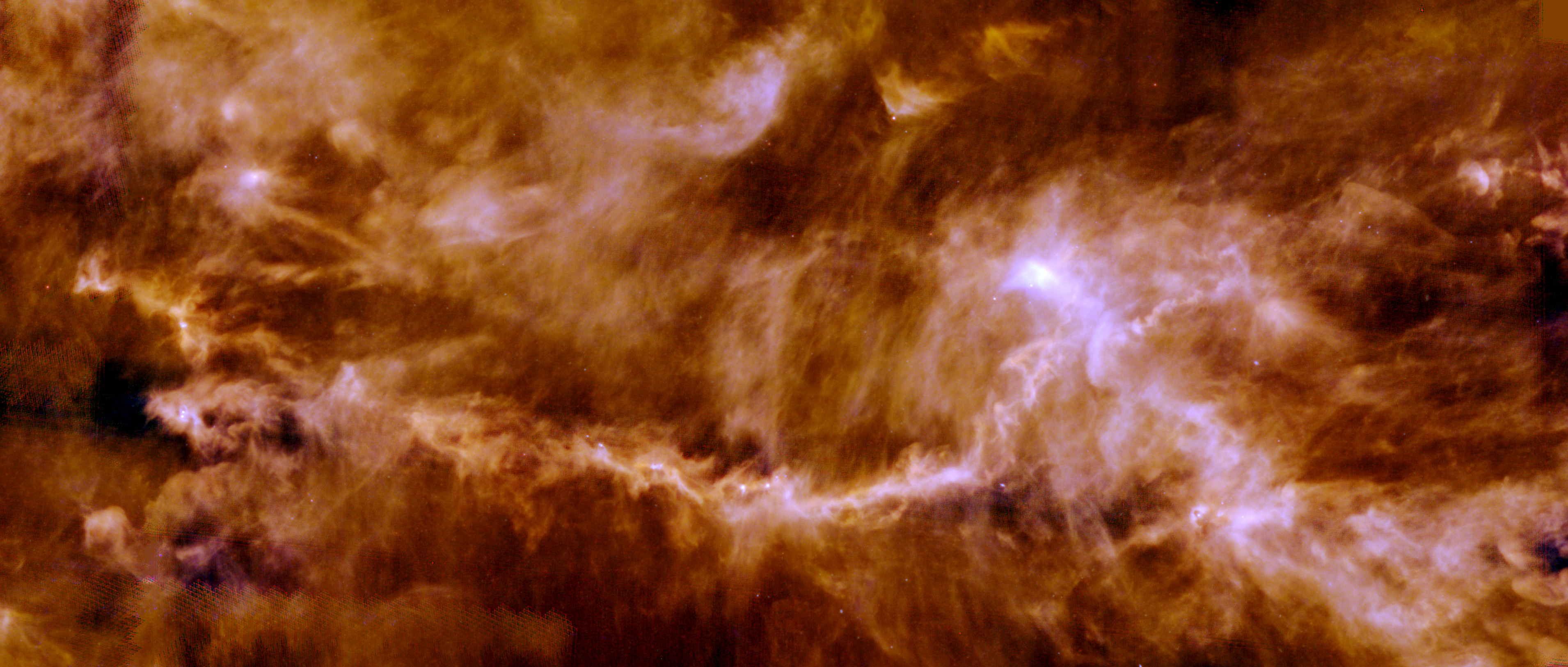
The intricate jumble depicted in this image from ESA’s Herschel space observatory shows the distribution of gas and dust in the Taurus Molecular Cloud, a giant stellar nursery about 450 light-years away in the constellation Taurus, the Bull.

Launched in 2009, Herschel studied the sky at far-infrared wavelengths for almost four years, detecting the glow of cosmic dust in the interstellar medium that pervades our Galaxy, the Milky Way. Dust is a minor but crucial ingredient in this diffuse mixture that provides the raw material for stars to form.

One of the observatory’s most striking discoveries was the detection of ubiquitous filaments – elongated and thin structures of gas and dust weaving their way across the Galaxy. Interstellar filaments were already known before Herschel, but the new data revealed them almost everywhere in the Milky Way and highlighted their role as preferred hubs for stellar birth.

Astronomers now believe that filaments precede the onset of most star formation, funnelling interstellar gas and dust into increasingly denser concentrations. Gravity later causes the densest filaments to contract and fragment, eventually leading to the formation of stars.

This image shows a tangle of filaments emerging from the cloud material, which are dotted with a few compact, bright cores: the seeds of future stars. The view also reveals a network of smaller threads, perpendicular to the most prominent filament.

This pattern is suggestive of accretion flows, indicating that the material along filaments is not at all static and that the most massive among them might be drawing matter from their surroundings. Some numerical simulations of star formation in molecular clouds also predict a similar arrangement of interstellar material, with gas and dust streaming towards the densest filaments along routes that are shaped by the local magnetic field.

This three-colour image combines Herschel bands at 160 microns (blue), 250 microns (green) and 500 microns (red), and spans about 5º on the long side. The data were acquired with Herschel as part of the Gould Belt survey Key Programme in 2010 and 2012, and a study of the filamentary structure is presented in a paper by P. Palmeirim et al. 2013. The image was first published on ESA’s Science and Technology website in May 2015.


Source: ESA

Monday, June 08, 2015

Sharpest View Ever of Star Formation in the Distant Universe

Montage of the SDP.81 Einstein Ring and the lensed galaxy

The lensed galaxy

The Einstein Ring SDP.81 seen with ALMA

Hubble image of the region around SDP.81

Montage of the SDP.81 Einstein Ring and the lensed galaxy (no annotations)


Videos 

Gravitational lensing of distant star-forming galaxies (schematic)


Gravitational lensing of distant star-forming galaxies (schematic)


ALMA’s observation of Einstein Ring reveals extraordinary detail

ALMA’s Long Baseline Campaign has produced a spectacular image of a distant galaxy being gravitationally lensed. The image shows a magnified view of the galaxy’s star-forming regions, the likes of which have never been seen before at this level of detail in a galaxy so remote. The new observations are far sharper than those made using the NASA/ESA Hubble Space Telescope, and reveal star-forming clumps in the galaxy equivalent to giant versions of the Orion Nebula in the Milky Way. 

ALMA’s Long Baseline Campaign has produced some amazing observations, and gathered unprecedentedly detailed information about the inhabitants of the near and distant Universe. Observations made at the end of 2014 as part of the campaign targeted a distant galaxy called HATLAS J090311.6+003906, otherwise known as SDP.81. This light from this galaxy is a victim of a cosmic effect known as gravitational lensing. A large galaxy sitting between SDP.81 and ALMA [1] is acting as a lens, warping and magnifying the view of a more distant galaxy and creating a near-perfect example of a phenomenon known as an Einstein Ring [2].

At least seven groups of scientists [3] have independently analysed the ALMA data on SDP.81. This flurry of research papers has revealed unprecedented information about the galaxy, including details about its structure, contents, motion, and other physical characteristics.

ALMA acts as an interferometer. Simply speaking, the array’s multiple antennas work in perfect synchrony to collect light as an enormous virtual telescope [4]. As a result, these new images of SDP.81 have a resolution up to six times higher [5] than those taken in the infrared with the NASA/ESA Hubble Space Telescope.

The astronomers’ sophisticated models reveal fine, never-before-seen structure within SDP.81, in the form of dusty clouds thought to be giant repositories of cold molecular gas — the birthplaces of stars and planets. These models were able to correct for the distortion produced by the magnifying gravitational lens.

As a result, the ALMA observations are so sharp that researchers can see clumps of star formation in the galaxy down to a size of about 200 light-years, equivalent to observing giant versions of the Orion Nebula producing thousands of times more new stars at the far side of the Universe. This is the first time this phenomenon has been seen at such an enormous distance.

“The reconstructed ALMA image of the galaxy is spectacular,” says Rob Ivison, co-author of two of the papers and ESO’s Director for Science. “ALMA’s huge collecting area, the large separation of its antennas, and the stable atmosphere above the Atacama desert all lead to exquisite detail in both images and spectra. That means that we get very sensitive observations, as well as information about how the different parts of the galaxy are moving. We can study galaxies at the other end of the Universe as they merge and create huge numbers of stars. This is the kind of stuff that gets me up in the morning!”

Using the spectral information gathered by ALMA, astronomers also measured how the distant galaxy rotates, and estimated its mass. The data showed that the gas in this galaxy is unstable; clumps of it are collapsing inwards, and will likely turn into new giant star-forming regions in the future.

Notably, the modeling of the lensing effect also indicates the existence of a supermassive black hole at the centre of the foreground galaxy lens [6]. The central part of SDP.81 is too faint to be detected, leading to the conclusion that the foreground galaxy holds a supermassive black hole with more than 200–300 million times the mass of the Sun.

The number of papers published using this single ALMA dataset demonstrates the excitement generated by the potential of the array’s high resolution and light-gathering power. It also shows how ALMA will enable astronomers to make more discoveries in the years to come, also uncovering yet more questions about the nature of distant galaxies.


Notes

[1] The lensed galaxy is seen at a time when the Universe was only 15 percent of its current age, just 2.4 billion years after Big Bang. The light has taken over twice the age of the Earth to reach us (11.4 billion years), detouring along the way around a massive foreground galaxy that is comparatively close at four billion light-years away from us.

[2] Gravitational lenses were predicted by Albert Einstein as part of his theory of general relativity. His theory tells us that objects bend space and time. Any light approaching this curved space-time will itself follow the curvatures created by the object. This enables particularly massive objects — huge galaxies and galaxy clusters — to act as cosmic magnifying glasses. An Einstein ring is a special type of gravitational lens, in which the Earth, the foreground lensing galaxy, and the background lensed galaxy are in perfect alignment, creating a harmonious distortion in the form of a ring of light. This phenomenon is illustrated in Video A.

[3] The science teams are listed below.

[4] ALMA’s ability to see the finest detail is achieved when the antennas are at their greatest separation, up to 15 kilometres apart. For comparison, earlier observations of gravitational lenses made with ALMA in a more compact configuration, with a separation of only around 500 metres, can be seen here.

[5] Details down to 0.023 arc-seconds, or 23 milli-arcseconds, can be measured in these data. Hubble observed this galaxy in the near-infrared, with a resolution of about 0.16 arc-seconds. Note, however, that when observing at shorter wavelengths, Hubble can reach finer resolutions, down to 0.022 arcseconds in the near-ultraviolet. ALMA’s resolution can be adjusted depending on the type of observations by moving the antennas further apart or closer together. For these observations, the widest separation was used, resulting in the finest resolution possible.

[6] The high-resolution ALMA image enables researchers to look for the central part of the background galaxy, which is expected to appear at the centre of the Einstein ring. If the foreground galaxy has a supermassive black hole at the centre, the central image becomes fainter. The faintness of the central image indicates how massive the black hole in the foreground galaxy is.


More Information

This research was presented in eight papers to appear in the near future. The science teams are listed below.

http://arxiv.org/abs/1503.07605
Yoichi Tamura (The University of Tokyo), Masamune Oguri (The University of Tokyo), Daisuke Iono (National Astronomical Observatory of Japan/SOKENDAI), Bunyo Hatsukade (National Astronomical Observatory of Japan), Yuichi Matsuda (National Astronomical Observatory of Japan/SOKENDAI), and Masao Hayashi (National Astronomical Observatory of Japan).

http://arxiv.org/abs/1503.08720
Simon Dye (University of Nottingham), Christina Furlanetto (University of Nottingham; CAPES Foundation, Ministry of Education of Brazil, Brazil), Mark Swinbank (Durham University), Catherine Vlahakis (Joint ALMA Observatory, Chile; ESO, Chile), James Nightingale (University of Nottingham), Loretta Dunne (University of Canterbury, New Zealand; Institute for Astronomy [IfA], Royal Observatory Edinburgh), Steve Eales (Cardiff University), Ian Smail (Durham), Ivan Oteo-Gomez (IfA, Edinburgh; ESO, Germany), Todd Hunter (National Radio Astronomy Observatory, Charlottesville, Virginia, USA), Mattia Negrello (INAF, Osservatorio Astronomico di Padova, Vicolo Osservatorio, Padova, Italy), Helmut Dannerbauer (Universitat Wien, Vienna, Austria), Rob Ivison (IfA, Edinburgh; ESO, Germany), Raphael Gavazzi (Universite Pierre et Marie Curie, Paris), Asantha Cooray (California Institute of Technology, USA) and Paul van der Werf (Leiden University, The Netherlands).

http://arxiv.org/abs/1505.05148
Mark Swinbank (Durham University), Simon Dye (University of Nottingham), James Nightingale (University of Nottingham), Christina Furlanetto (University of Nottingham; CAPES Foundation, Ministry of Education of Brazil, Brazil), Ian Smail (Durham), Asantha Cooray (California Institute of Technology, USA), Helmut Dannerbauer (Universitat Wien, Vienna, Austria), Loretta Dunne (University of Canterbury, New Zealand; Institute for Astronomy [IfA], Royal Observatory Edinburgh), Steve Eales (Cardiff University), Raphael Gavazzi (Universite Pierre et Marie Curie, Paris), Todd Hunter (National Radio Astronomy Observatory, Charlottesville, Virginia, USA), Rob Ivison (IfA, Edinburgh; ESO, Germany), Mattia Negrello (INAF, Osservatorio Astronomico di Padova, Vicolo Osservatorio, Padova, Italy), Ivan Oteo-Gomez (IfA, Edinburgh; ESO, Germany), Renske Smit (Durham), Paul van der Werf (Leiden University, The Netherlands), and Catherine Vlahakis (Joint ALMA Observatory, Chile; ESO, Chile).

http://arxiv.org/abs/1503.05558
Kenneth C. Wong (Institute of Astronomy and Astrophysics, Academia Sinica (ASIAA), Taipei, Taiwan), Sherry H. Suyu (ASIAA, Taiwan), and Satoki Matsushita (ASIAA, Taiwan)

http://arxiv.org/abs/1503.07997
Bunyo Hatsukade (National Astronomical Observatory of Japan, Tokyo, Japan) Yoichi Tamura (Institute of Astronomy, University of Tokyo, Tokyo, Japan), Daisuke Iono (National Astronomical Observatory of Japan; The Graduate University for Advanced Studies [SOKENDAI], Tokyo, Japan), Yuichi Matsuda (National Astronomical Observatory of Japan), Masao Hayashi (National Astronomical Observatory of Japan), Masamune Oguri (Research Center for the Early Universe, University of Tokyo, Tokyo, Japan; Department of Physics, University of Tokyo, Tokyo, Japan; Kavli Institute for the Physics and Mathematics of the Universe [Kavli IPMU, WPI], University of Tokyo, Chiba, Japan)

http://arxiv.org/abs/1503.02652
The ALMA Partnership, C. Vlahakis (Joint ALMA Observatory [JAO]; ESO) , T. R. Hunter (National Radio Astronomy Observatory [NRAO]), J. A. Hodge (NRAO) , L. M. Pérez (NRAO) , P. Andreani (ESO), C. L. Brogan (NRAO) , P. Cox (JAO, ESO) , S. Martin (Institut de Radioastronomie Millimétrique [IRAM]) , M. Zwaan (ESO) , S. Matsushita (Institute of Astronomy and Astrophysic, Taiwan) , W. R. F. Dent (JAO, ESO), C. M. V. Impellizzeri (JAO, NRAO), E. B. Fomalont (JAO, NRAO), Y. Asaki (National Astronomical Observatory of Japan; Institute of Space and Astronautical Science (ISAS), Japan Aerospace Exploration Agency [JAXA]) , D. Barkats (JAO, ESO) , R. E. Hills (Astrophysics Group, Cavendish Laboratory), A. Hirota (JAO; National Astronomical Observatory of Japan), R. Kneissl (JAO, ESO), E. Liuzzo (INAF, Istituto di Radioastronomia), R. Lucas (Institut de Planétologie et d’Astrophysique de Grenoble) , N. Marcelino (INAF), K. Nakanishi (JAO, National Astronomical Observatory of Japan), N. Phillips (JAO, ESO), A. M. S. Richards (University of Manchester), I. Toledo (JAO), R. Aladro (ESO), D. Broguiere (IRAM), J. R. Cortes (JAO, NRAO), P. C. Cortes (JAO, NRAO), D. Espada (ESO, National Astronomical Observatory of Japan), F. Galarza (JAO), D. Garcia-Appadoo (JAO, ESO), L. Guzman-Ramirez (ESO), A. S. Hales (JAO, NRAO) , E. M. Humphreys (ESO) , T. Jung (Korea Astronomy and Space Science Institute) , S. Kameno (JAO, National Astronomical Observatory of Japan) , R. A. Laing (ESO), S. Leon (JAO,ESO) , G. Marconi (JAO, ESO) , A. Mignano (INAF) , B. Nikolic (Astrophysics Group, Cavendish Laboratory), L. A. Nyman (JAO, ESO), M. Radiszcz (JAO), A. Remijan (JAO, NRAO), J. A. Rodón (ESO), T. Sawada (JAO, National Astronomical Observatory of Japan), S. Takahashi (JAO, National Astronomical Observatory of Japan), R. P. J. Tilanus (Leiden University), B. Vila Vilaro (JAO, ESO), L. C. Watson (ESO), T. Wiklind (JAO, ESO), Y. Ao (National Astronomical Observatory of Japan) , J. Di Francesco (National Research Council Herzberg Astronomy & Astrophysics), B. Hatsukade (National Astronomical Observatory of Japan), E. Hatziminaoglou (ESO), J. Mangum (NRAO), Y. Matsuda (National Astronomical Observatory of Japan), E. Van Kampen (ESO), A. Wootten (NRAO), I. De Gregorio-Monsalvo (JAO, ESO), G. Dumas (IRAM), H. Francke (JAO), J. Gallardo (JAO), J. Garcia (JAO), S. Gonzalez (JAO), T. Hill (ESO), D. Iono (National Astronomical Observatory of Japan), T. Kaminski (ESO), A. Karim (Argelander-Institute for Astronomy), M. Krips (IRAM), Y. Kurono (JAO, National Astronomical Observatory of Japan) , C. Lonsdale (NRAO), C. Lopez (JAO), F. Morales (JAO), K. Plarre (JAO), L. Videla (JAO), E. Villard (JAO, ESO), J. E. Hibbard (NRAO), K. Tatematsu (National Astronomical Observatory of Japan)

http://arxiv.org/abs/1503.02025
M. Rybak (Max Planck Institute for Astrophysics), J. P. McKean (Netherlands Institute for Radio Astronomy; University of Groningen) S. Vegetti (Max Planck Institute for Astrophysics), P. Andreani (ESO) and S. D. M. White (Max Planck Institute for Astrophysics)

http://arxiv.org/abs/1506.01425
M. Rybak (Max Planck Institute for Astrophysics), S. Vegetti (Max Planck Institute for Astrophysics), J. P. McKean (Netherlands Institute for Radio Astronomy; University of Groningen), P. Andreani (ESO) and S. D. M. White (Max Planck Institute for Astrophysics)


The Atacama Large Millimeter/submillimeter Array (ALMA), an international astronomy facility, is a partnership of ESO, the US National Science Foundation (NSF) and the National Institutes of Natural Sciences (NINS) of Japan in cooperation with the Republic of Chile. ALMA is funded by ESO on behalf of its Member States, by NSF in cooperation with the National Research Council of Canada (NRC) and the National Science Council of Taiwan (NSC) and by NINS in cooperation with the Academia Sinica (AS) in Taiwan and the Korea Astronomy and Space Science Institute (KASI).

ALMA construction and operations are led by ESO on behalf of its Member States; by the National Radio Astronomy Observatory (NRAO), managed by Associated Universities, Inc. (AUI), on behalf of North America; and by the National Astronomical Observatory of Japan (NAOJ) on behalf of East Asia. The Joint ALMA Observatory (JAO) provides the unified leadership and management of the construction, commissioning and operation of ALMA.


ESO is the foremost intergovernmental astronomy organisation in Europe and the world’s most productive ground-based astronomical observatory by far. It is supported by 16 countries: Austria, Belgium, Brazil, the Czech Republic, Denmark, France, Finland, Germany, Italy, the Netherlands, Poland, Portugal, Spain, Sweden, Switzerland and the United Kingdom, along with the host state of Chile. ESO carries out an ambitious programme focused on the design, construction and operation of powerful ground-based observing facilities enabling astronomers to make important scientific discoveries. ESO also plays a leading role in promoting and organising cooperation in astronomical research. ESO operates three unique world-class observing sites in Chile: La Silla, Paranal and Chajnantor. At Paranal, ESO operates the Very Large Telescope, the world’s most advanced visible-light astronomical observatory and two survey telescopes. VISTA works in the infrared and is the world’s largest survey telescope and the VLT Survey Telescope is the largest telescope designed to exclusively survey the skies in visible light. ESO is a major partner in ALMA, the largest astronomical project in existence. And on Cerro Armazones, close to Paranal, ESO is building the 39-metre European Extremely Large Telescope, the E-ELT, which will become “the world’s biggest eye on the sky”. ESO is a major partner in ALMA, the largest astronomical project in existence. And on Cerro Armazones, close to Paranal, ESO is building the 39-metre European Extremely Large Telescope, the E-ELT, which will become “the world’s biggest eye on the sky”.


Links

Research papers;


Contacts

Lars Lindberg Christensen
Head of ESO ePOD
Garching bei München, Germany
Tel: +49 89 3200 6761
Cell: +49 173 3872 621
Email:
lars@eso.org

Source: ESO

The Ages of Extragalactic Jets

The bright radio galaxy NGC 4261 as seen in visible light (white) and radio (orange), showing a pair of opposed jets emanating from the nucleus. Astronomers have determined that the lobes are about thirty million years old, and were produced from multiple outbursts from around the nuclear black hole. Credit: Wide-Field and Planetary Camera of the Hubble Space Telescope, and National Radio Astronomy Observatory


The longest known highly collimated structures in the universe are the narrow jets that emanate from the vicinity of powerful black holes in certain types of galactic nuclei. These narrow beams, often in pairs propagating in opposite directions, can stretch across millions of light-years. They transport huge amounts of energy from the nuclear black hole regions where they originate into intergalactic space. The jets were discovered at radio wavelengths but they emit at X-ray wavelengths as well because the electrons in the jets move at close to the speed of light. These galaxies are active areas of research both because they are among the most energetic phenomena in the universe and because they are the primary mechanism that injects energy into the clusters of galaxies in which these radio monsters reside.

The development of these jets, their ages, and their ultimate dispositions are only vaguely understood. Astronomers suspect their lives have three phases, starting with the supersonic inflation of lobes of hot gas around the particle jets. It appears that in most sources this first phase is brief. Afterwards, the lobes expand gradually until their internal temperatures and pressures drop down to the values of the ambient gas. In the final phase, the jet ejection mechanisms shut down and the associated lobes become unobservable. There are numerous examples of galaxies at these various stages that provide the basis for these notions.

CfA astronomers Ewan O’Sullivan, Diana Worrall, and Mark Birkinshaw, together with four colleagues, examined the jets in the powerful radio galaxy 3C270 (also known as NGC 4261). This source has its brightest radio emission knots closest to the black hole nucleus (the other common type of radio jet galaxy has its brightest regions farthest away from the nucleus). The projected linear scale for the lobes in this source is about 250 thousand light-years at its maximum extent. The scientists used new and archival radio observations of the lobes, taken at twelve different wavelengths, combined with X-ray observations, to model the emission mechanisms throughout the lobes more precisely than previously done. The multi-wavelength data allow them to map how the character of the emission (i.e., its relative strength at different wavelengths) varies, and to model those variations. They conclude that the two lobes are respectively about twenty-nine and thirty-seven million years old, contrary to the conventional wisdom that they are about twice as old based on dynamical models. They also conclude that the lobes are the result of multiple outbursts of activity from the vicinity of black hole. The total energy needed to heat these lobes is stupendous, roughly equivalent to the Sun’s total power output over a million billion years, more than the age of the universe.

Reference(s):

"New Insights into the Evolution of the FR I Radio Galaxy 3C 270 (NGC 4261) from VLA and GMRT Radio Observations,” Kolokythas, Konstantinos, O'Sullivan, Ewan, Giacintucci, Simona, Raychaudhury, Somak, Ishwara-Chandra, C. H., Worrall, Diana M., Birkinshaw, Mark, MNRAS, 450, 1732, 2015.

Friday, June 05, 2015

A fascinating core

Credit: ESA/Hubble & NASA

This NASA/ESA Hubble Space Telescope image captures the galaxy Messier 84 — also known as NGC 4374 — an object from the Messier catalogue, published in its final version in 1781 by Charles Messier.

This elliptical galaxy was discovered in March 1781 and lies about 60 million light-years away from Earth in the constellation of Virgo (The Virgin). The galaxy is part of the very heavily populated centre of the Virgo Cluster, a cluster which consists of more than 1000 galaxies.

This image does not show the whole galaxy but only its very interesting centre, and is likely to be the best image of the region ever captured. Previous observations using Hubble’s Space Telescope Imaging Spectrograph (STIS) revealed a supermassive black hole in the centre of Messier 84. Astronomers found the supermassive black hole by mapping the motion of the gas and the stars which are caught in its grip.

Next to its interesting centre Messier 84 is also known for its supernovae. Two supernovae have been observed within the galaxy. The first, SN1957 was discovered in 1957 and another, called SN1991bg, was discovered in 1991.


Thursday, June 04, 2015

Hubble Finds Two Chaotically Tumbling Pluto Moons

Artist's Illustration of the Chaotic Spin of Pluto's Moon Nix
This set of artist's illustrations of Pluto's moon Nix shows how the orientation of the moon changes unpredictably as it orbits the "double planet" Pluto-Charon. This illustration is based on dynamical models of spinning bodies in complex gravitational fields — like the field produced by Pluto and Charon's motion about each other. Astronomers used this simulation to try to understand the unpredictable changes in reflected light from Nix as it orbits Pluto-Charon. They also found that Pluto's moon Hydra also undergoes chaotic spin. The football shape of both moons contributes to their wild motion. The consequences are that if you lived on either moon, you could not predict the time or direction the sun would rise the next day. (The moon is too small for Hubble to resolve surface features, and so the surface textures used here are purely for illustration purposes.)   Credit: NASA, ESA, M. Showalter (SETI Institute), and G. Bacon (STScI)

Nix, Hydra, Kerberos, Styx and Charon
This artist's illustration shows the scale and comparative brightness of Pluto's small satellites, as discovered by the Hubble Space Telescope over the past several years. Pluto's binary companion, Charon (discovered in 1978), is placed at the bottom for scale. Two of the moons are highly oblate. The reflectivity among the moons varies from dark charcoal to the brightness of white sand. Hubble cannot resolve surface features on the moons and so the cratered textures seen here are purely for illustration purposes. Credit: NASA, ESA, M. Showalter (SETI Institute), and A. Feild (STScI)


If you lived on one of Pluto's moons Nix or Hydra, you'd have a hard time setting your alarm clock. That's because you could not know for sure when, or even in which direction, the sun would rise.

A comprehensive analysis of all available Hubble Space Telescope data shows that two of Pluto's moons, Nix and Hydra, are wobbling unpredictably. Scientists believe the other two small moons, Kerberos and Styx, are likely in a similar situation, pending further study.

"Hubble has provided a new view of Pluto and its moons revealing a cosmic dance with a chaotic rhythm," said John Grunsfeld, associate administrator of NASA's Science Mission Directorate in Washington, D.C. "When the New Horizons spacecraft flies through the Pluto system in July we'll get a chance to see what these moons look like up close and personal."

Why the chaos? Because the moons are embedded inside a dynamically shifting gravitational field caused by the system's two central bodies, Pluto and Charon, whirling about each other. The variable gravitational field induces torques that send the smaller moons tumbling in unpredictable ways. This torque is strengthened by the fact the moons are football shaped rather than spherical.

The surprising results of the Hubble research, conducted by Mark Showalter of the SETI Institute in Mountain View, California, and Doug Hamilton of the University of Maryland at College Park, are appearing in the June 4 issue of the British science journal Nature.

"Prior to the Hubble observations nobody appreciated the intricate dynamics of the Pluto system," Showalter said. "Our report provides important new constraints on the sequence of events that led to the formation of the system."

Hubble's monitoring of Pluto's four outer moons has also revealed that three of them, Nix, Styx, and Hydra, are presently locked together in resonance where there is a precise ratio among their orbital periods. "This ties together their motion in a way similar to that of three of Jupiter's large moons," noted Hamilton. "If you were sitting on Nix you would see that Styx orbits Pluto twice for every three orbits made by Hydra."

Hubble provides observational evidence that the satellites are also orbiting chaotically. "However, that does not necessarily mean that the system is on the brink of flying apart," Showalter added. "We need to know a lot more about the system before we can determine its long-term fate."

To the surprise of astronomers, Hubble also found that the moon Kerberos is as dark as a charcoal briquette, while the other satellites are as bright as white sand. It was predicted that pollution by dust blasted off the satellites by meteorite impacts should overcoat all the moons, giving their surfaces a homogeneous look. "This is a very provocative result," Showalter said.

NASA's New Horizons probe, which will fly by the Pluto-Charon system in July 2015, may help settle the question of the asphalt-black moon as well as the other oddities uncovered by Hubble. These new discoveries are being used in the science planning for New Horizons's observations.

The chaos in the Pluto-Charon system offers insights into how planets orbiting a double-star might behave. "We are learning that chaos may be a common trait of binary systems," Hamilton said. "It might even have consequences for life on planets in such systems." NASA's Kepler space observatory has found several planetary systems orbiting double stars.

Clues to the Pluto chaos first came when astronomers measured variations in the light reflected off of the two moons Nix and Hydra. Their brightness changed unpredictably. "The data were confusing; they made no sense at all. We had an inkling something was fishy," Showalter said. His team analyzed Hubble images of Pluto taken during 2005-2012. They compared the unpredictable changes in the moons' reflectivity to dynamical models of spinning bodies in complex gravitational fields.

Virtually all large moons, as well as small moons in close-in orbits, keep one hemisphere facing their parent planet. This means that the satellite's rotation is perfectly matched to the orbital period. This is not coincidental, but the consequence of gravitational tides between moon and planet. (Hyperion, which orbits Saturn, is the only other solar-system example of chaotic rotation; it is due to the combined gravitational tugs of the planet and it largest moon, Titan).

Pluto's moons are hypothesized to have formed by a collision between the dwarf planet and another similar-sized body early in the history of the solar system. The smashup flung material that coalesced into the family of satellites observed around Pluto today. Its large binary companion, Charon, was discovered in 1978. The object is almost half the size of Pluto. Hubble discovered Nix and Hydra in 2005, Kerberos in 2011, and Styx in 2012. These little moons, measuring just tens of miles across, were found as part of a Hubble search for potential hazards to the New Horizons spacecraft flyby.

Pluto and Charon are called a double planet because they orbit about a common center of gravity that is located in the space between the bodies. Some regard the Earth-moon system as a double planet, too, although the center of gravity falls beneath Earth's surface. (Our moon has 1/80th of Earth's mass, whereas Charon has 1/8th of Pluto's mass.)

Researchers say that a combination of monitoring data from Hubble, New Horizons's brief close-up look, and eventually, observations with the James Webb Space Telescope will help settle many mysteries of the Pluto-Charon system. No ground-based telescopes have yet been able to detect the smallest moons.

"Pluto will continue to surprise us when New Horizons flies past it in July," Showalter said. "Our work with the Hubble telescope just gives us a foretaste of what's in store."

Contacts:

Ray Villard
Space Telescope Science Institute, Baltimore, Maryland
410-338-4514

villard@stsci.edu

Felicia Chou
NASA Headquarters, Washington, D.C.
202-358-0257

felicia.chou@nasa.gov

Mark Showalter
SETI Institute, Mountain View, California
605-810-0234

mshowalter@seti.org

Doug Hamilton
University of Maryland, College Park, Maryland
301-405-1548

dhamil@astro.umd.edu


Source: HubbleSite

Wednesday, June 03, 2015

A new observable of the large-scale structure: the position-dependent two-point correlation function

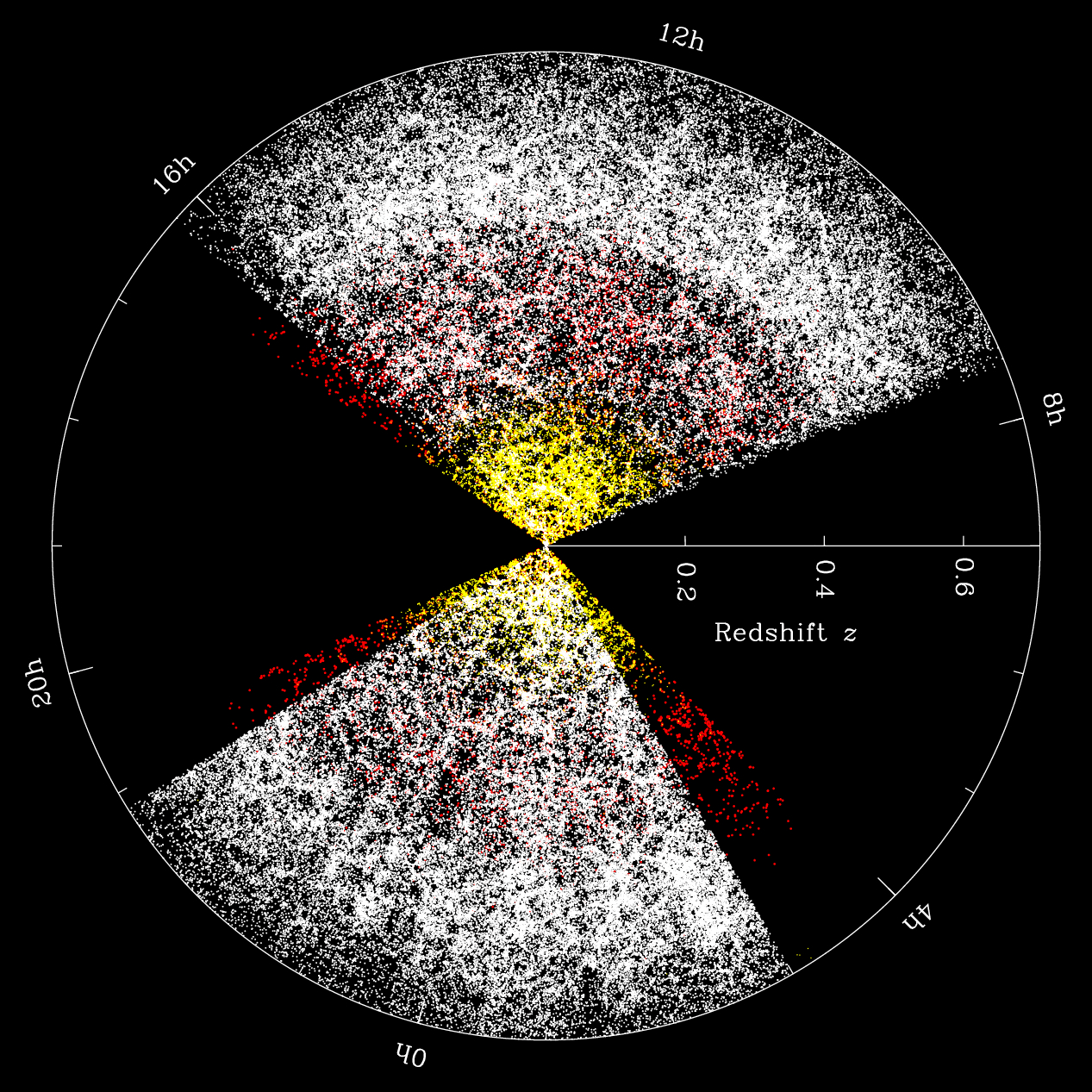
Fig. 1: Projected slice of the galaxies observed in the SDSS with distances (redshifts). (The position on the sky is measured in observation coordinates: RA labelled in hours, with DEC being projected onto the plane.) The yellow, red, and white points are the main galaxy sample, the red luminous galaxies, and the BOSS CMASS sample, respectively. Credit:Michael Blanton and SDSS collaboration

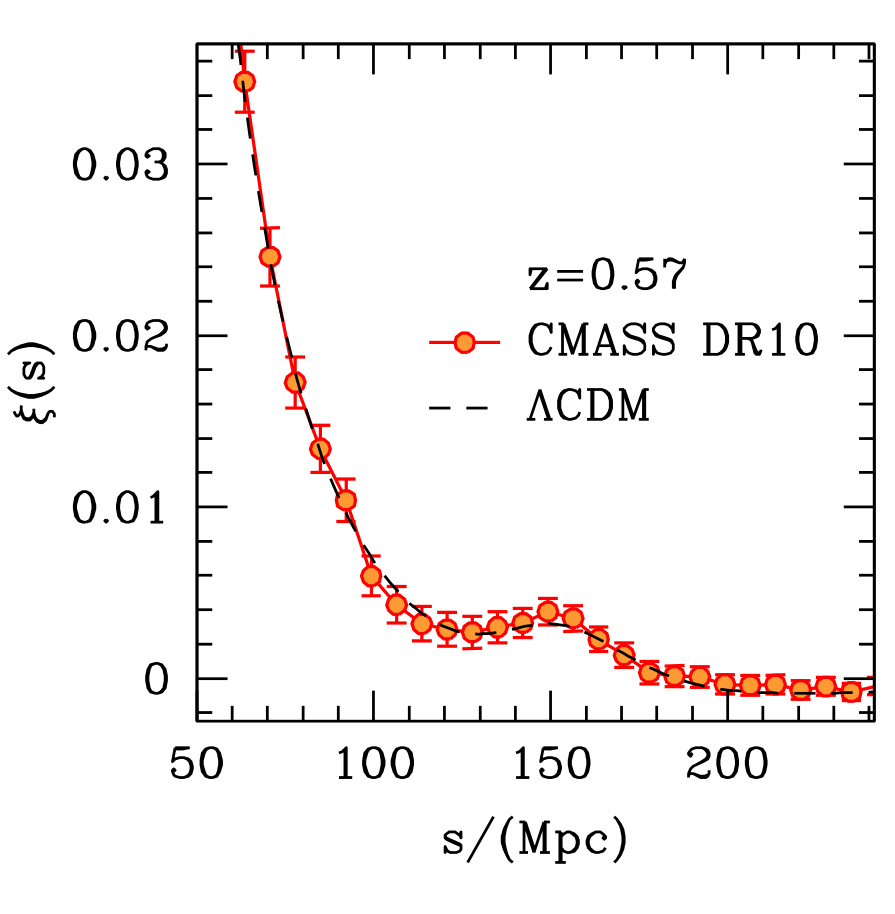
Fig. 2: The two-point correlation function of the BOSS DR10 CMASS sample. The orange data points are the measurements for the observed galaxies, the dashed line denotes the expectation from the currently accepted cosmological model. Credit: Ariel G. Sánchez and SDSS collaboration

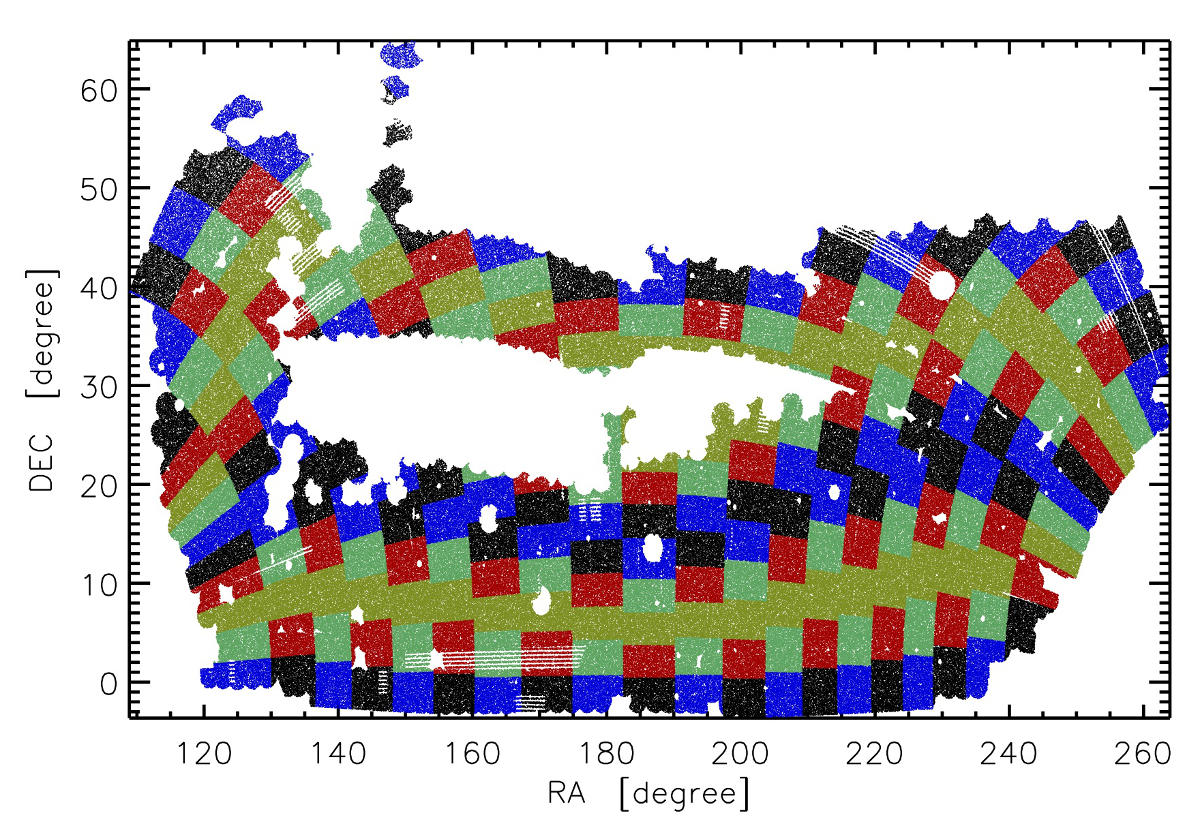
Fig. 3: The division of the BOSS DR10 CMASS sample into sub-volumes on the sky. 
 Each coloured block extends over the whole redshift range.  


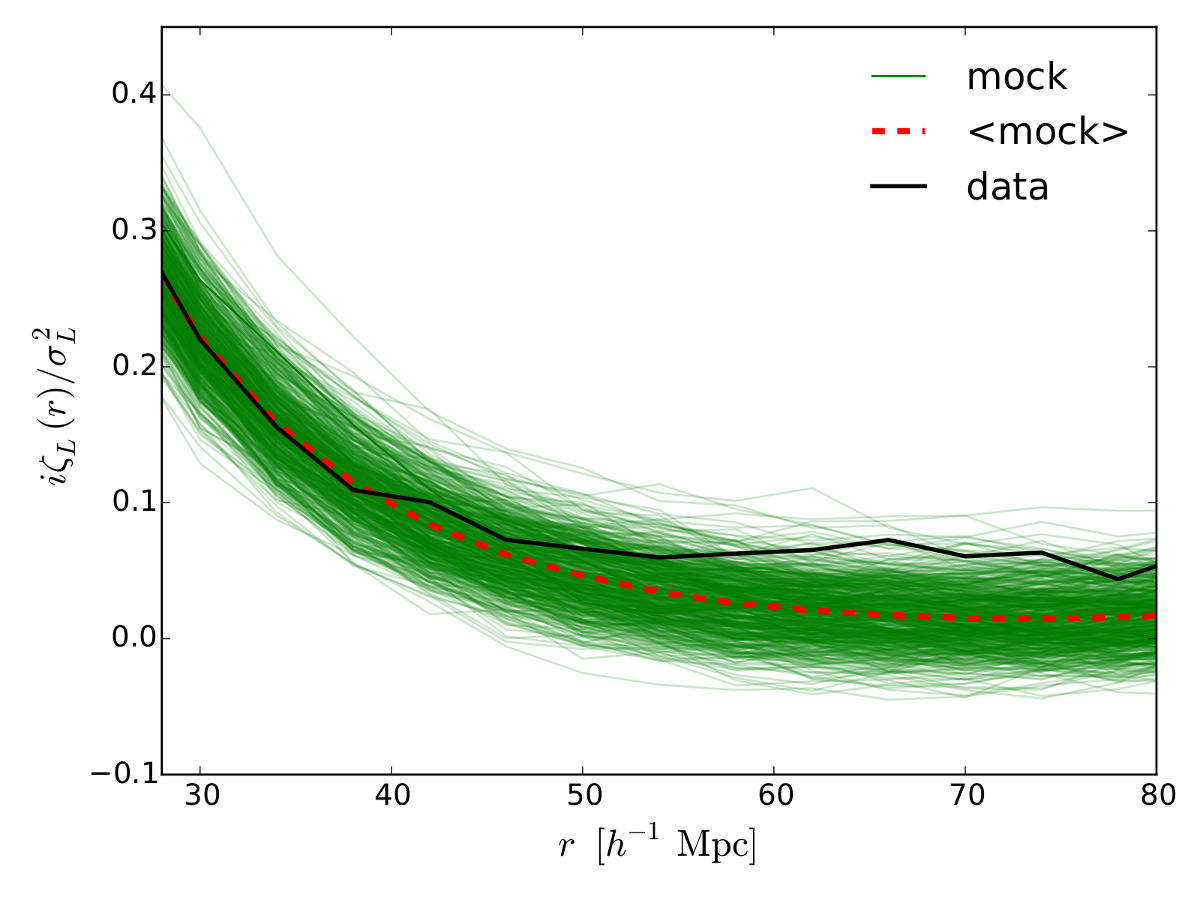
Fig. 4: First measurement of the integrated three-point function from the BOSS DR10 CMASS sample. The thick black solid line shows the measurement for real data, the thin green lines show the results for each of the 600 mock realisations, while the thick red dashed line shows the mean of the mock realisations. 


Observations of the large-scale structure, such as galaxy surveys, are one of the most important tools to study our universe. In particular, how the growth of structure is affected by the large-scale environment can be used to test our understanding of gravity, as well as the physics of inflation. A research group at MPA has recently developed a new technique to extract this signal more efficiently from real observations. Specifically, we divide a galaxy survey into sub-volumes, quantify the structure and the environment in each sub-volume, and measure the correlation between these two quantities. This technique thus opens a new avenue to critically test fundamental physics from real observations.

The large-scale structure is one of the most important observables in modern astronomy to probe the properties of our universe. Large galaxy survey programmes such as the 2dF Galaxy Redshift Survey and the Sloan Digital Sky Survey (SDSS) measure the angular positions on the sky and the distance (redshift) of millions of galaxies, currently out to 6.4 billion years ago. Scientists then use these data to construct a three-dimensional map of our universe, as shown in figure 1.

As the visual rendering in figure 1 shows, one can clearly see filamentary structures as well as relatively empty regions. This is how our universe looks like. To quantify these structures of our universe, scientists use in particular the so-called "two-point correlation function," which measures how likely it is to find galaxies in pairs with some given separation. For example: if we choose a separation of 150 Mpc (which corresponds to 490 million light-years or 4.6 sextillion kilometres), we then count the number of galaxy pairs that we can find with a distance of 150 Mpc between them. Once we are done with this separation, we move on to the next separation we are interested in. As we keep doing this counting, we get the two-point correlation as a function of separation.

The orange data points in figure 2 show the measurement of the two-point correlation function from the galaxies observed in the SDSS. At a separation of roughly 150 Mpc we find a small bump. This means that it is more likely to find galaxy pairs with this separation compared to smaller or larger distances. This bump was imprinted only 400,000 years after the Big Bang by sound waves in the plasma filling the (then ionized) universe.

While the two-point correlation function is the most common statistic to quantify structures in our universe, the observed galaxies contain more information. One interesting question, in particular, is if and how the structures depend on their large-scale environment. More specifically, we want to study whether or not there will be more structure in a relatively over-dense region compared to an under-dense region.

This question can be addressed by the "three-point correlation function", i.e. looking for three galaxies with given separations. However, these measurements rely on finding galaxy triplets, which is computationally challenging due to the large number of observed galaxies.

Recently, a research group at MPA has developed a new method, the position-dependent two-point correlation function, to address the question of how structure depends on the environment and capture this particular signal from the observed galaxies. Specifically, for a given galaxy survey, we divide the entire survey volume into small sub-volumes (see Figure 3). We then measure the mean over-density (with respect to the entire survey) and the two-point correlation function in each sub-volume, to get a position-dependent two-point correlation function. Finally, we measure the correlation between these two quantities. If we find a positive correlation, this means that it is more likely to find more structures in the over-dense background, and vice versa. In mathematical terms, this correlation measures an integral over the three-point function; therefore we call it the integrated three-point function. Since this new method requires only the counting of galaxy pairs, the computational problems with the three-point function are largely alleviated.

We apply this new technique to "real" and "mock" data of a sample of SDSS galaxies, the BOSS DR10 CMASS sample. The real data contain positions and distances (redshifts) for about 0.4 million observed galaxies, while the 600 mock catalogues were generated by simulations to match the properties of the real data for data analysis. The first measurement of the integrated three-point function for the BOSS DR10 CMASS sample is shown in figure 4. We find that even though the integrated three-point function of the observed galaxies does not agree perfectly with the mean of the mock realisations, it is within the scatter of the simulated results. Moreover, both the measurements for the real data and the mean mock results are above zero for all separations, meaning that in our universe the structures do grow more strongly if they are in an over-dense environment.

The coupling between small-scale structures and their environment or background plays a fundamental role in cosmology. This correlation arises because of gravitational evolution, and possibly from inflationary physics. This new observable, the position-dependent two-point correlation function, therefore allows us to test our understanding of gravity and the physics of inflation. Combining our first measurement with other probes such as the global two-point correlation function and the weak lensing signal, we are able to constrain how galaxies trace the underlying dark matter density. In the future, with better data, we shall utilise this technique to study the properties of inflation, which is one of the biggest mysteries in physics and at the same time provided the seeds for all present-day structures.

Chi-Ting Chiang

Publications: 

Chi-Ting Chiang, Christian Wagner, Ariel G. Sánchez, Fabian Schmidt, and Eiichiro Komatsu Position-dependent correlation function from the SDSS-III Baryon Oscillation Spectroscopic Survey Data Release 10 CMASS Sample, http://arxiv.org/abs/1504.03322


Monday, June 01, 2015

Astronomers Discover a Young Solar System Around a Nearby Star

Figure 1: Image of HD 115600 showing a bright debris ring viewed nearly edge-on and located just beyond a Pluto-like distance to its star.  One or more unseen solar system-like planets are causing the disk center to be offset from the star's position (cross). Figure without labels is here. (Credit: Thayne Currie/NAOJ)

An international team led by Thayne Currie of the Subaru Telescope and using the Gemini South telescope, has discovered a young planetary system that shares remarkable similarities to our own early solar system. Their images reveal a ring-like disk of debris surrounding a Sun-like star, in a birth environment similar to the Sun’s. The disk appears to be sculpted by at least one unseen solar system-like planet, is roughly the same size as our solar system’s Edgeworth-Kuiper Belt (commonly called the Kuiper Belt), and may contain dust and icy particles. This work provides a valuable key to understanding the early formation of the Sun and planets.

The discovery of the bright ring of orbiting the star HD 115600 changes everything, said Currie, a Subaru Project Fellow research astronomer. “It’s kind of like looking at outer solar system when it was a toddler.”

Remarkably, the ring is almost exactly the same distance from its host star as the Kuiper Belt is from the Sun (Figure 1), and it receives about the same amount of light. The star itself is just slightly more massive than the Sun and is a member of a massive grouping of 10- to 20-million-year-old stars called the Scorpius-Centaurus OB association. Its birth cloud is very similar to the nebula in which the Sun formed some 4.5 billion years ago.

There are strong indications that the ring around HD 115600 is being shaped by interactions with an unseen solar system-like planet. The team measured the position of the ring with respect to the star and found that the ring was significantly offset and has an eccentric shape (meaning that it’s not very circular). This is likely due to the gravitational effect of a massive planet. The calculated eccentricity of the disk is among the largest known thus far, possibly more than the ring around the planet-hosting star Fomalhaut (which has at least one planet).

By using models that predict how planets of different masses and orbital separations shape a debris disk, the team calculated what kind of planet might be distorting HD 115600’s ring. They found that eccentric versions of planets much like Jupiter, Saturn, Uranus, or Neptune could explain the shape and other properties of the ring.

Other clues suggest that the ring may have a composition similar to the Kuiper Belt. Its spectrum implies some types of dust, as well as major Kuiper Belt constituents such as ice and silicates. When compared with other debris disks, this one is much more efficient at scattering starlight, which implies it has a higher-reflecting, ice-like composition.

The discovery of the ring was made using the Gemini Planet Imager (GPI), an instrument dedicated to detecting planets and Kuiper Belt-like disks at never-before-seen scales. It is similar to the Subaru Coronagraphic Extreme Adaptive Optics (SCExAO) instrument currently being commissioned on the Subaru Telescope.

The results are very promising. “Even in just one of our many 50-second exposures, we could see what previous instruments failed to see in more than 50 minutes,” Currie said. “Given this success with GPI, I’m very optimistic that Subaru’s own, state-of-the-art planet-hunting instrument, SCExAO, will soon discover many Kuiper belt-like disks and young planets and will put us well on our way towards seeing another Earth.”


Comparing the Kuiper Belt to HD 115600’s Disk

Located just beyond Neptune’s orbit, the Kuiper Belt contains numerous icy dwarf planets such as Pluto, Haumea, and Makemake. It is also home to thousands of remnants from the earliest stages of icy planet formation, and thus provides a key to understanding the early solar system.

The study of cold, Kuiper belt-like debris rings around nearby young Sun-like stars provides the best picture of what our own early, outer solar system might have been like. However, the few such rings that have been imaged so far haven’t always been similar to ours. They usually surround stars much more massive than the Sun, or lie at greater distances than the Kuiper Belt, or are located in sparse star-forming regions unlike the massive and populous region in which the Sun was born. Until now, studies of these disks lacked the scattered-light spectra needed to explore them. Such studies can tell give information about the structure of the ring, as well as its motions.

The paper reporting these results is accepted for publication in The Astrophysical Journal Letters with a title “Direct Imaging and Spectroscopy of a Young Extrasolar Kuiper Belt in the Nearest OB Association” and can be found here.

Authors:

  • Thayne Currie (Subaru Telescope, National Astronomical Observatory of Japan, USA)
  • Carey M. Lisse (The Johns Hopkins University, USA)
  • Marc Kuchner (NASA-Goddard Space Flight Center, USA)
  • Nikku Madhusudhan (University of Cambridge, UK)
  • Scott J. Kenyon (Harvard-Smithsonian Center for Astrophysics, USA)
  • Christian Thalmann (ETH-Zurich, Switzerland)
  • Joseph Carson (The College of Charleston, USA)
  • John Debes (Space Telescope Science Institute, USA)


Links:
  • SCExAO Project website is here.
  • Press release from Gemini Observatory is here.
  • Press release from the Cambridge University, UK is here.


Source:  Subaru Telescope