Friday, December 06, 2013

NASA's Cassini Spacecraft Obtains Best Views of Saturn Hexagon

This colorful view from NASA's Cassini mission is the highest-resolution view of the unique six-sided jet stream at Saturn's north pole known as "the hexagon." This movie, made from images obtained by Cassini's imaging cameras, is the first to show the hexagon in color filters, and the first movie to show a complete view from the north pole down to about 70 degrees north latitude. Image credit: NASA/JPL-Caltech/SSI/Hampton University.  Full image and caption

This infrared movie from NASA's Cassini mission shows the churning of the curious six-sided jet stream at Saturn's north pole known as "the hexagon." The movie, which was sped up here, covers 2 hours and 45 minutes in real time. It was made from data obtained by Cassini's visual and infrared mapping spectrometer in the 5-micron wavelength of radiation. This channel shows clouds in silhouette against infrared light emanating from Saturn's interior. These clouds are composed of relatively large particles and are thick, blocking light so they appear dark. These kinds of clouds tend to lie deep in Saturn's atmosphere, at about 3 bars of pressure. Image credit: NASA/JPL-Caltech/University of Arizona. Full image and caption -  enlarge image

This black-and-white movie from NASA's Cassini mission shows a polar projection of the curious six-sided jet stream at Saturn's north pole known as "the hexagon" in the infrared. Image credit: NASA/JPL-Caltech/University of Arizona.  Full image and caption - enlarge image

NASA's Cassini spacecraft has obtained the highest-resolution movie yet of a unique six-sided jet stream, known as the hexagon, around Saturn's north pole.

This is the first hexagon movie of its kind, using color filters, and the first to show a complete view of the top of Saturn down to about 70 degrees latitude. Spanning about 20,000 miles (30,000 kilometers) across, the hexagon is a wavy jet stream of 200-mile-per-hour winds (about 322 kilometers per hour) with a massive, rotating storm at the center. There is no weather feature exactly, consistently like this anywhere else in the solar system.

"The hexagon is just a current of air, and weather features out there that share similarities to this are notoriously turbulent and unstable," said Andrew Ingersoll, a Cassini imaging team member at the California Institute of Technology in Pasadena. "A hurricane on Earth typically lasts a week, but this has been here for decades -- and who knows -- maybe centuries."

Weather patterns on Earth are interrupted when they encounter friction from landforms or ice caps. Scientists suspect the stability of the hexagon has something to do with the lack of solid landforms on Saturn, which is essentially a giant ball of gas.

Better views of the hexagon are available now because the sun began to illuminate its interior in late 2012. Cassini captured images of the hexagon over a 10-hour time span with high-resolution cameras, giving scientists a good look at the motion of cloud structures within.

They saw the storm around the pole, as well as small vortices rotating in the opposite direction of the hexagon. Some of the vortices are swept along with the jet stream as if on a racetrack. The largest of these vortices spans about 2,200 miles (3,500 kilometers), or about twice the size of the largest hurricane recorded on Earth.

Scientists analyzed these images in false color, a rendering method that makes it easier to distinguish differences among the types of particles suspended in the atmosphere -- relatively small particles that make up haze -- inside and outside the hexagon.

"Inside the hexagon, there are fewer large haze particles and a concentration of small haze particles, while outside the hexagon, the opposite is true," said Kunio Sayanagi, a Cassini imaging team associate at Hampton University in Virginia. "The hexagonal jet stream is acting like a barrier, which results in something like Earth's Antarctic ozone hole."

The Antarctic ozone hole forms within a region enclosed by a jet stream with similarities to the hexagon. Wintertime conditions enable ozone-destroying chemical processes to occur, and the jet stream prevents a resupply of ozone from the outside. At Saturn, large aerosols cannot cross into the hexagonal jet stream from outside, and large aerosol particles are created when sunlight shines on the atmosphere. Only recently, with the start of Saturn's northern spring in August 2009, did sunlight begin bathing the planet's northern hemisphere.

"As we approach Saturn's summer solstice in 2017, lighting conditions over its north pole will improve, and we are excited to track the changes that occur both inside and outside the hexagon boundary," said Scott Edgington, Cassini deputy project scientist at NASA's Jet Propulsion Laboratory in Pasadena, Calif.

A black-and-white version of the imaging camera movie and movies obtained by Cassini's visual and infrared mapping spectrometer are also tools Cassini scientists can use to look at wind speeds and the mini-storms inside the jet stream.

Cassini launched in 1997 and arrived at Saturn on July 1, 2004. Its mission is scheduled to end in September 2017. The Cassini-Huygens mission is a cooperative project of NASA, the European Space Agency and the Italian Space Agency. JPL manages the mission for NASA's Science Mission Directorate in Washington. JPL designed, developed and assembled the Cassini orbiter and its two onboard cameras. The imaging team is based at the Space Science Institute, Boulder, Colo.

A Google+ Hangout to discuss these results and other Cassini images will take place today at 12:30 p.m. PST (3:30 p.m. EST): http://bit.ly/askcassini .

The event will be broadcast live on NASA Television and streamed on the agency's website. For information on NASA TV, visit: http://www.nasa.gov/ntv .

The event will also be streamed live on Ustream with a moderated chat available at: http://www.ustream.tv/nasajpl2 .

Questions can be asked on the Google Hangout event page, in the chat box on the Ustream site and via Twitter using the hashtag #askCassini.

More information about Cassini is available at: http://www.nasa.gov/cassini and http://saturn.jpl.nasa.gov .


Jia-Rui C. Cook 818-354-0850
Jet Propulsion Laboratory, Pasadena, Calif.

jccook@jpl.nasa.gov

Dwayne Brown 202-358-1726
NASA Headquarters, Washington

dwayne.c.brown@nasa.gov


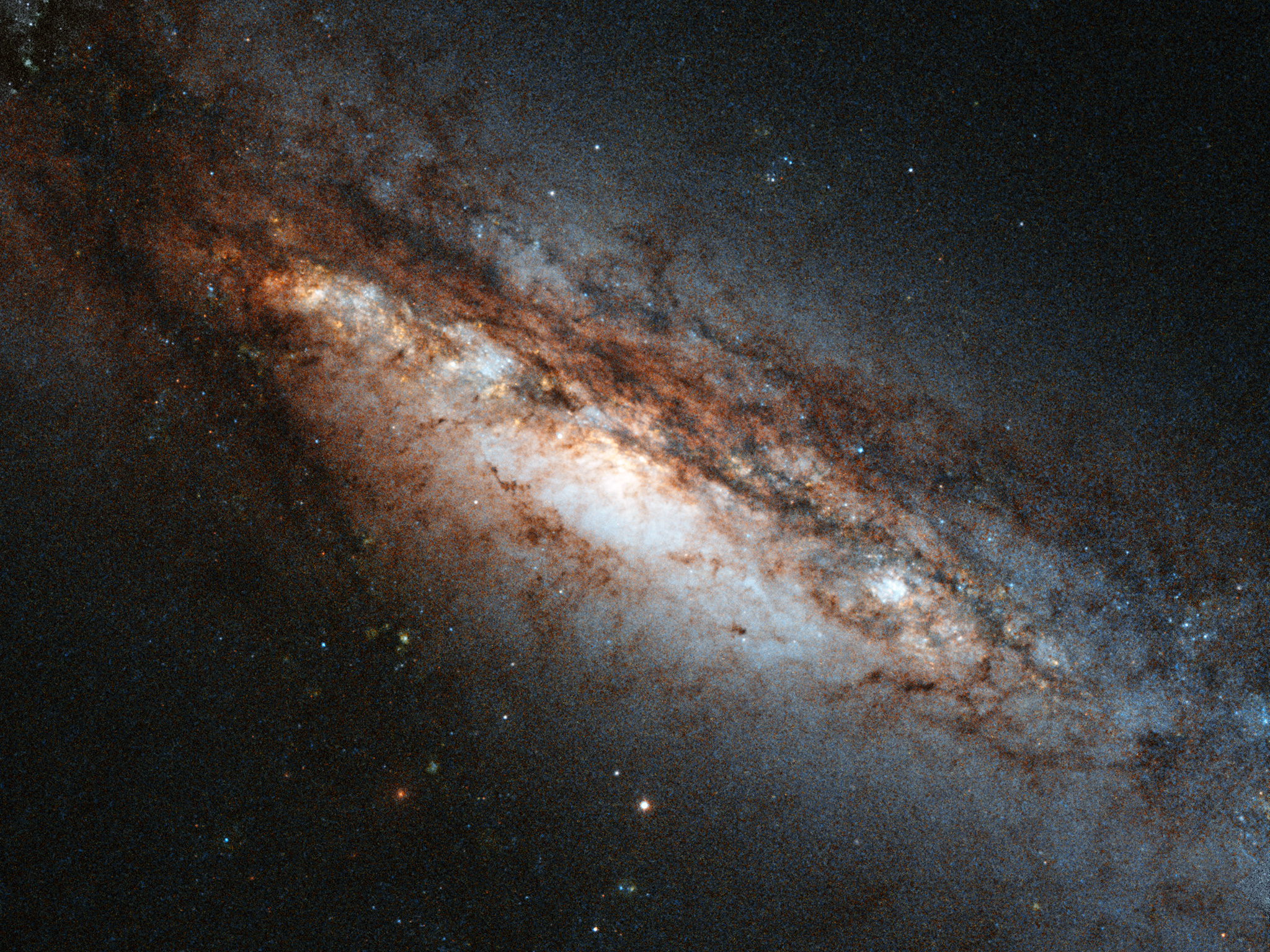
A bizarre cosmic rarity: NGC 660

Credit: ESA/Hubble & NASA

This new Hubble image shows a peculiar galaxy known as NGC 660, located around 45 million light-years away from us.

NGC 660 is classified as a "polar ring galaxy", meaning that it has a belt of gas and stars around its centre that it ripped from a near neighbour during a clash about one billion years ago. The first polar ring galaxy was observed in 1978 and only around a dozen more have been discovered since then, making them something of a cosmic rarity.

Unfortunately, NGC 660’s polar ring cannot be seen in this image, but has plenty of other features that make it of interest to astronomers – its central bulge is strangely off-kilter and, perhaps more intriguingly, it is thought to harbour exceptionally large amounts of dark matter. In addition, in late 2012 astronomers observed a massive outburst emanating from NGC 660 that was around ten times as bright as a supernova explosion. This burst was thought to be caused by a massive jet shooting out of the supermassive black hole at the centre of the galaxy.


Thursday, December 05, 2013

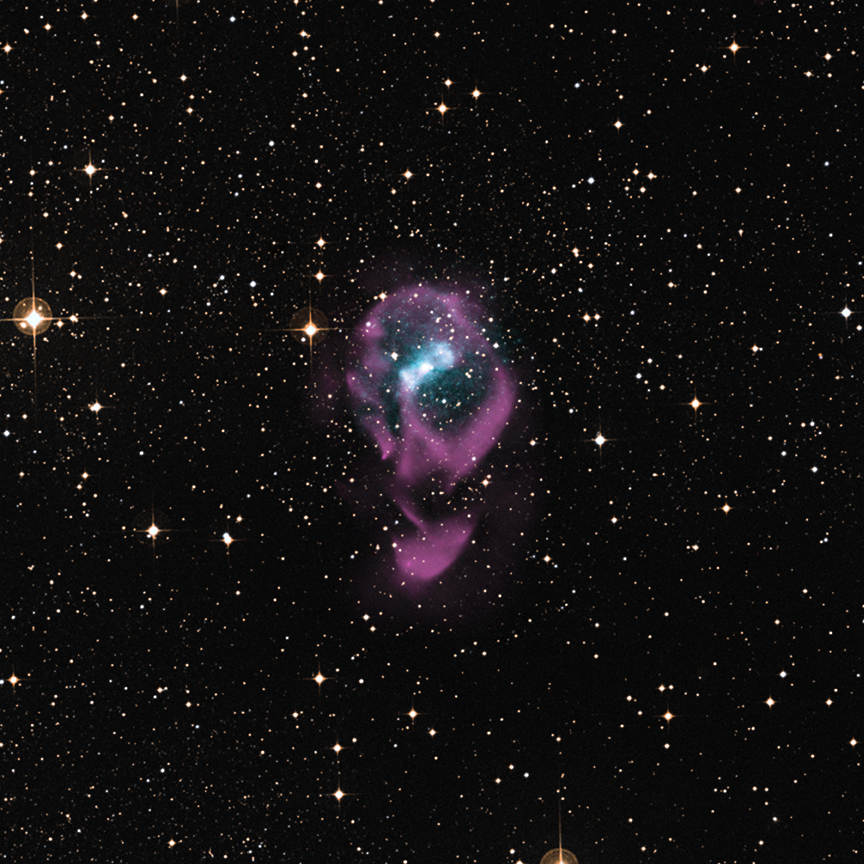
Circinus X-1: Supernova Blast Provides Clues to Age of Binary Star System

Credit: X-ray: NASA/CXC/Univ. of Wisconsin-Madison/S.Heinz et al; 
Optical: DSS; Radio: CSIRO/ATNF/ATCA 


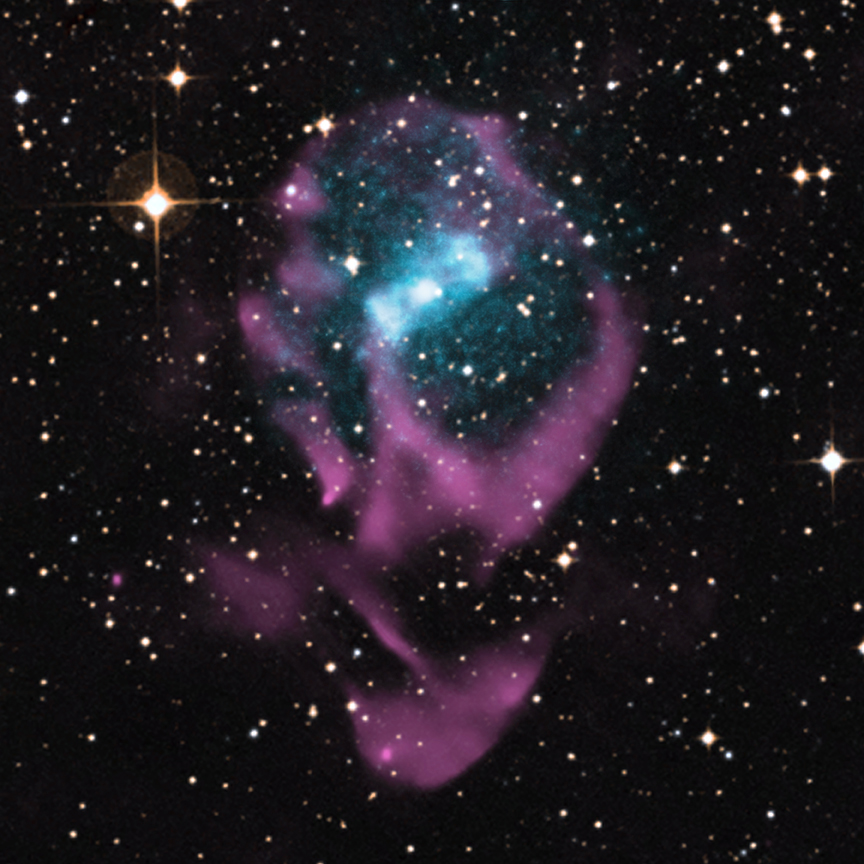
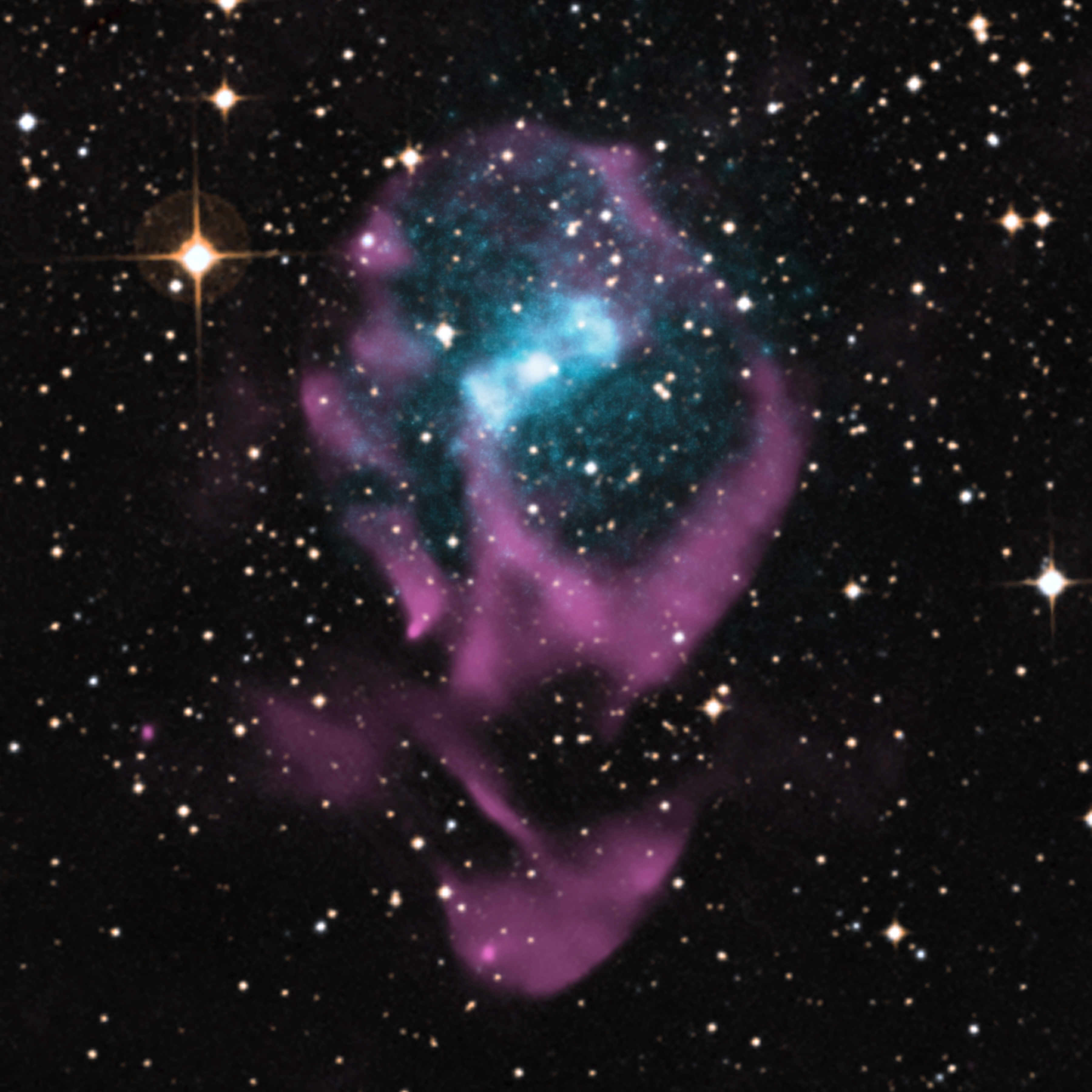
The youngest member of an important class of objects has been found using data from NASA's Chandra X-ray Observatory and the Australia Compact Telescope Array. A composite image shows the X-rays in blue and radio emission in purple, which have been overlaid on an optical field of view from the Digitized Sky Survey. This discovery, described in the press release, allows scientists to study a critical phase after a supernova and the birth of a neutron star.

Systems known as "X-ray binaries" are some of the brightest X-ray sources in the sky. They consist of either an ultra-dense star packed with neutrons --- a.k.a., a "neutron star" --- or a black hole that is paired with a normal star like the Sun. As these two objects orbit one another, the neutron star or black hole pulls material from the companion star onto it.

A new study shows that the X-ray binary called Circinus X-1 is less than 4,600 years old, making it the youngest ever seen. Astronomers have detected hundreds of X-ray binaries throughout the Milky Way and other nearby galaxies. However, these older X-ray binaries only reveal information about what happens later in the evolution of these systems.

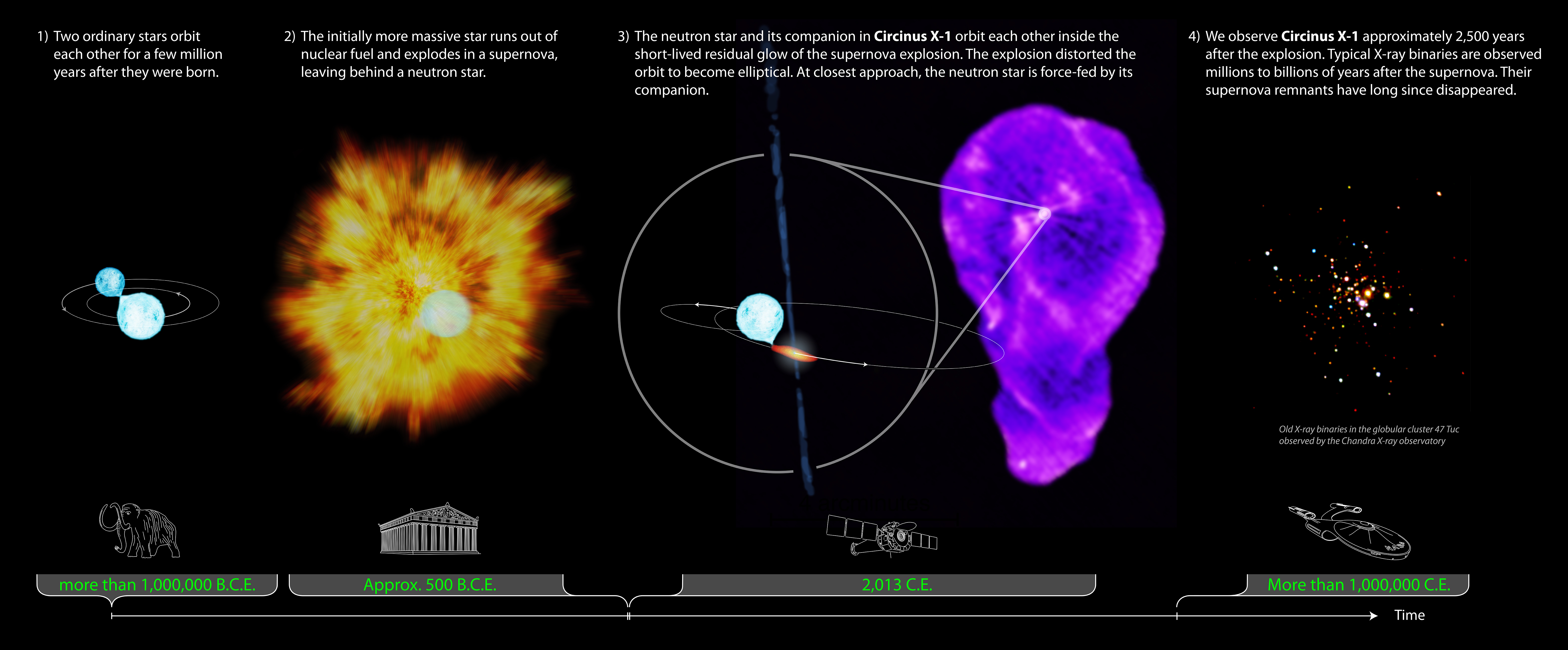
Circinus X-1 Infographic
Researchers have found that the neutron star in Circinus X-1 is less than 4,600 years old, making it much younger than any other X-ray binary known in the Milky Way. Credit: Univ. of Wisconsin-Madison/S.Heinz et al.

Astronomers were able to determine the age of Circinus X-1 by examining material around the orbiting pair. While the source itself has been known for decades, the neutron star is usually so bright that the glare from its X-ray light overwhelms any faint emission surrounding it. The new Chandra data were obtained while the neutron star was in a very faint state, which meant it was dim enough for astronomers to detect the faint afterglow created by the supernova explosion plowing through the surrounding interstellar gas. This, combined with characteristics of the radio emission, allowed the researchers to pinpoint the age of the supernova remnant. In turn, this information reveals the age of the neutron star since they were formed at the same time.

These results have been published in the December 4th issue of The Astrophysical Journal. In addition to those mentioned above, the other authors on this paper are Peter Jonker of the SRON Netherlands Institute for Space Research, Niel Brandt of Penn State University, Daniel Emilio Calvelo-Santos of the University of Southampton, Tasso Tzioumis of the Australia Telescope National Facility, Michael Nowak and Norbert Schultz of the Kavli Institute/MIT, Rudy Wijnands and Michiel van der Klis of the University of Amsterdam.

Fast Facts for Circinus X-1: 

Scale: Image is 10 arcmin across (about 76 light years) 
Category: Neutron Stars/X-ray Binaries 
Coordinates (J2000): RA 15h 20m 41.00s | Dec -51° 10' 00 
Constellation: Circinus 
Observation Date: 1 May 2009 
Observation Time: 27 hours 25 min (1 day 3 hours 25 min) 
Obs. ID: 10062 
Instrument: ACIS 
Color Code: X-ray (Blue); Optical (Red, Green, Blue); Radio (Pink) D
Distance Estimate: About 26,000 light years


Hubble Traces Subtle Signals of Water on Hazy Worlds

Using the powerful­ eye of NASA's Hubble Space Telescope, two teams of scientists have found faint signatures of water in the atmospheres of five distant planets.

 The presence of atmospheric water was reported previously on a few exoplanets orbiting stars beyond our solar system, but this is the first study to conclusively measure and compare the profiles and intensities of these signatures on multiple worlds.

 
Although exoplanets are too far away to be imaged, detailed studies of their size, composition and atmospheric makeup are possible. This video explains how researchers investigate those characteristics.Image Credit: NASA Goddard/ESA/Hubble. Download this video in HD formats from NASA Goddard's Scientific Visualization Studio

NASA scientists found faint signatures of water in the atmospheres of five distant planets orbiting three different stars. All five planets appear to be hazy. This illustration shows a star's light illuminating the atmosphere of a planet.Image Credit: NASA's Goddard Space Flight Center. Large image

The five planets -- WASP-17b, HD209458b, WASP-12b, WASP-19b and XO-1b -- orbit nearby stars. The strengths of their water signatures varied. WASP-17b, a planet with an especially puffed-up atmosphere, and HD209458b had the strongest signals. The signatures for the other three planets, WASP-12b, WASP-19b and XO-1b, also are consistent with water.

"We're very confident that we see a water signature for multiple planets," said Avi Mandell, a planetary scientist at NASA's Goddard Space Flight Center in Greenbelt, Md., and lead author of an Astrophysical Journal paper, published today, describing the findings for WASP-12b, WASP-17b and WASP-19b. "This work really opens the door for comparing how much water is present in atmospheres on different kinds of exoplanets, for example hotter versus cooler ones."

The studies were part of a census of exoplanet atmospheres led by L. Drake Deming of the University of Maryland in College Park. Both teams used Hubble's Wide Field Camera 3 to explore the details of absorption of light through the planets' atmospheres. The observations were made in a range of infrared wavelengths where the water signature, if present, would appear. The teams compared the shapes and intensities of the absorption profiles, and the consistency of the signatures gave them confidence they saw water. The observations demonstrate Hubble's continuing exemplary performance in exoplanet research.

"To actually detect the atmosphere of an exoplanet is extraordinarily difficult. But we were able to pull out a very clear signal, and it is water," said Deming, whose team reported results for HD209458b and XO-1b in a Sept. 10 paper in the same journal. Deming's team employed a new technique with longer exposure times, which increased the sensitivity of their measurements.

To determine what’s in the atmosphere of an exoplanet, astronomers watch the planet pass in front of its host star and look at which wavelengths of light are transmitted and which are partially absorbed.Image Credit: NASA's Goddard Space Flight Center. Large image

The water signals were all less pronounced than expected, and the scientists suspect this is because a layer of haze or dust blankets each of the five planets. This haze can reduce the intensity of all signals from the atmosphere in the same way fog can make colors in a photograph appear muted. At the same time, haze alters the profiles of water signals and other important molecules in a distinctive way.

The five planets are hot Jupiters, massive worlds that orbit close to their host stars. The researchers were initially surprised that all five appeared to be hazy. But Deming and Mandell noted that other researchers are finding evidence of haze around exoplanets.

"These studies, combined with other Hubble observations, are showing us that there are a surprisingly large number of systems for which the signal of water is either attenuated or completely absent," said Heather Knutson of the California Institute of Technology, a co-author on Deming's paper. "This suggests that cloudy or hazy atmospheres may in fact be rather common for hot Jupiters."

Hubble's high-performance Wide Field Camera 3 is one of few capable of peering into the atmospheres of exoplanets many trillions of miles away. These exceptionally challenging studies can be done only if the planets are spotted while they are passing in front of their stars. Researchers can identify the gases in a planet's atmosphere by determining which wavelengths of the star's light are transmitted and which are partially absorbed.


Wednesday, December 04, 2013

Massive Black Hole Duo: Possible Sighting by NASA's WISE

Two black holes are entwined in a gravitational tango in this artist's conception. Supermassive black holes at the hearts of galaxies are thought to form through the merging of smaller, yet still massive black holes, such as the ones depicted here. Image credit: NASA.  Full image and caption

Astronomers have spotted what appear to be two supermassive black holes at the heart of a remote galaxy, circling each other like dance partners. The incredibly rare sighting was made with the help of NASA's Wide-field Infrared Survey Explorer, or WISE.

Follow-up observations with the Australian Telescope Compact Array near Narrabri, Australia, and the Gemini South telescope in Chile, revealed unusual features in the galaxy, including a lumpy jet thought to be the result of one black hole causing the jet of the other to sway.

"We think the jet of one black hole is being wiggled by the other, like a dance with ribbons," said Chao-Wei Tsai of NASA's Jet Propulsion Laboratory, Pasadena, Calif., who is lead author of a paper on the findings appearing in the Dec. 10 issue of Astrophysical Journal. "If so, it is likely the two black holes are fairly close and gravitationally entwined."

The findings could teach astronomers more about how supermassive black holes grow by merging with each other.
The WISE satellite scanned the entire sky twice in infrared wavelengths before being put into hibernation in 2011. NASA recently gave the spacecraft a second lease on life, waking it up to search for asteroids, in a project called NEOWISE.

The new study took advantage of previously released all-sky WISE data. Astronomers sifted through images of millions of actively feeding supermassive black holes spread throughout our sky before an oddball, also known as WISE J233237.05-505643.5, jumped out.

"At first we thought this galaxy's unusual properties seen by WISE might mean it was forming new stars at a furious rate," said Peter Eisenhardt, WISE project manager at NASA's Jet Propulsion Laboratory, Pasadena, Calif., and a co-author of the study. "But on closer inspection, it looks more like the death spiral of merging giant black holes."

Almost every large galaxy is thought to harbor a supermassive black hole filled with the equivalent in mass of up to billions of suns. How did the black holes grow so large? One way is by swallowing ambient materials. Another way is through galactic cannibalism. When galaxies collide, their massive black holes sink to the center of the new structure, becoming locked in a gravitational tango. Eventually, they merge into one even-more-massive black hole.

The dance of these black hole duos starts out slowly, with the objects circling each other at a distance of about a few thousand light-years. So far, only a few handfuls of supermassive black holes have been conclusively identified in this early phase of merging. As the black holes continue to spiral in toward each other, they get closer, separated by just a few light-years.

It is these close-knit black holes, also called black hole binaries, that have been the hardest to find. The objects are usually too small to be resolved even by powerful telescopes. Only a few strong candidates have been identified to date, all relatively nearby. The new WISE J233237.05-505643.5 is a new candidate, and located much farther away, at 3.8 billion light-years from Earth.

Radio images with the Australian Telescope Compact Array were key to identifying the dual nature of WISE J233237.05-505643.5. Supermassive black holes at the cores of galaxies typically shoot out pencil-straight jets, but, in this case, the jet showed a zigzag pattern. According to the scientists, a second massive black hole could, in essence, be pushing its weight around to change the shape of the other black hole's jet.

Visible-light spectral data from the Gemini South telescope in Chile showed similar signs of abnormalities, thought to be the result of one black hole causing disk material surrounding the other black hole to clump. Together, these and other signs point to what is probably a fairly close-knit set of circling black holes, though the scientists can't say for sure how much distance separates them.

"We note some caution in interpreting this mysterious system," said Daniel Stern of JPL, a co-author of the study. "There are several extremely unusual properties to this system, from the multiple radio jets to the Gemini data, which indicate a highly perturbed disk of accreting material around the black hole, or holes. Two merging black holes, which should be a common event in the universe, would appear to be simplest explanation to explain all the current observations."

The final stage of merging black holes is predicted to send gravitational waves rippling through space and time. Researchers are actively searching for these waves using arrays of dead stars called pulsars in hopes of learning more about the veiled black hole dancers (see http://www.nasa.gov/centers/jpl/news/pulsar20131106.html ).

The technical paper is online at http://arxiv.org/abs/1310.2257 .

NASA's Jet Propulsion Laboratory, Pasadena, Calif., manages and operates the WISE mission for NASA's Science Mission Directorate. The WISE mission was selected competitively under NASA's Explorers Program managed by the agency's Goddard Space Flight Center in Greenbelt, Md. The science instrument was built by the Space Dynamics Laboratory in Logan, Utah. The spacecraft was built by Ball Aerospace & Technologies Corp. in Boulder, Colo. Science operations and data processing take place at the Infrared Processing and Analysis Center at the California Institute of Technology in Pasadena. Caltech manages JPL for NASA. More information is online at http://www.nasa.gov/wise and http://wise.astro.ucla.edu and http://www.jpl.nasa.gov/wise .


Whitney Clavin 818-354-4673
Jet Propulsion Laboratory, Pasadena, Calif.

whitney.clavin@jpl.nasa.gov

Fast, Furious, Refined: Smaller Black Holes Can Eat Plenty

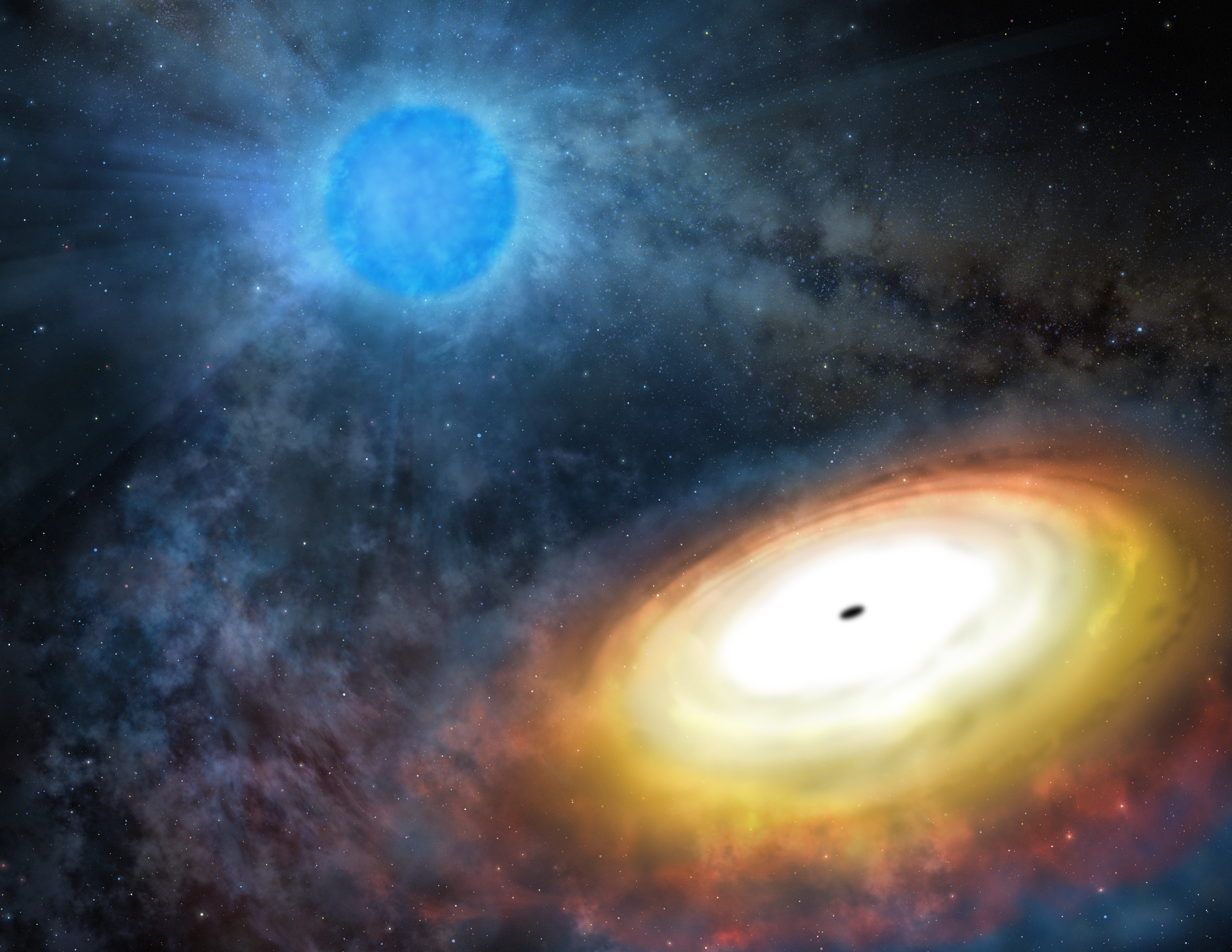
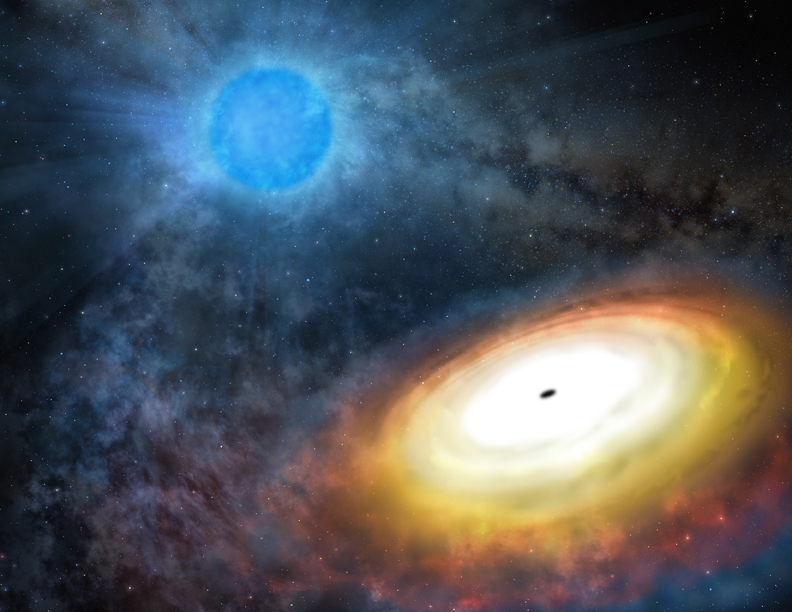
Figure 1. Artist’s visualization of the environment around M101 ULX-1, showing a stellar-mass black hole (foreground) with accretion disk. Gas from the Wolf-Rayet star (background) feeds the black hole’s voracious appetite. Credit: Gemini Observatory/AURA artwork by Lynette Cook.  Full Resolution JPEG (5 MB) | Medium Resolution JPEG | Full Resolution TIFF (24 MB)

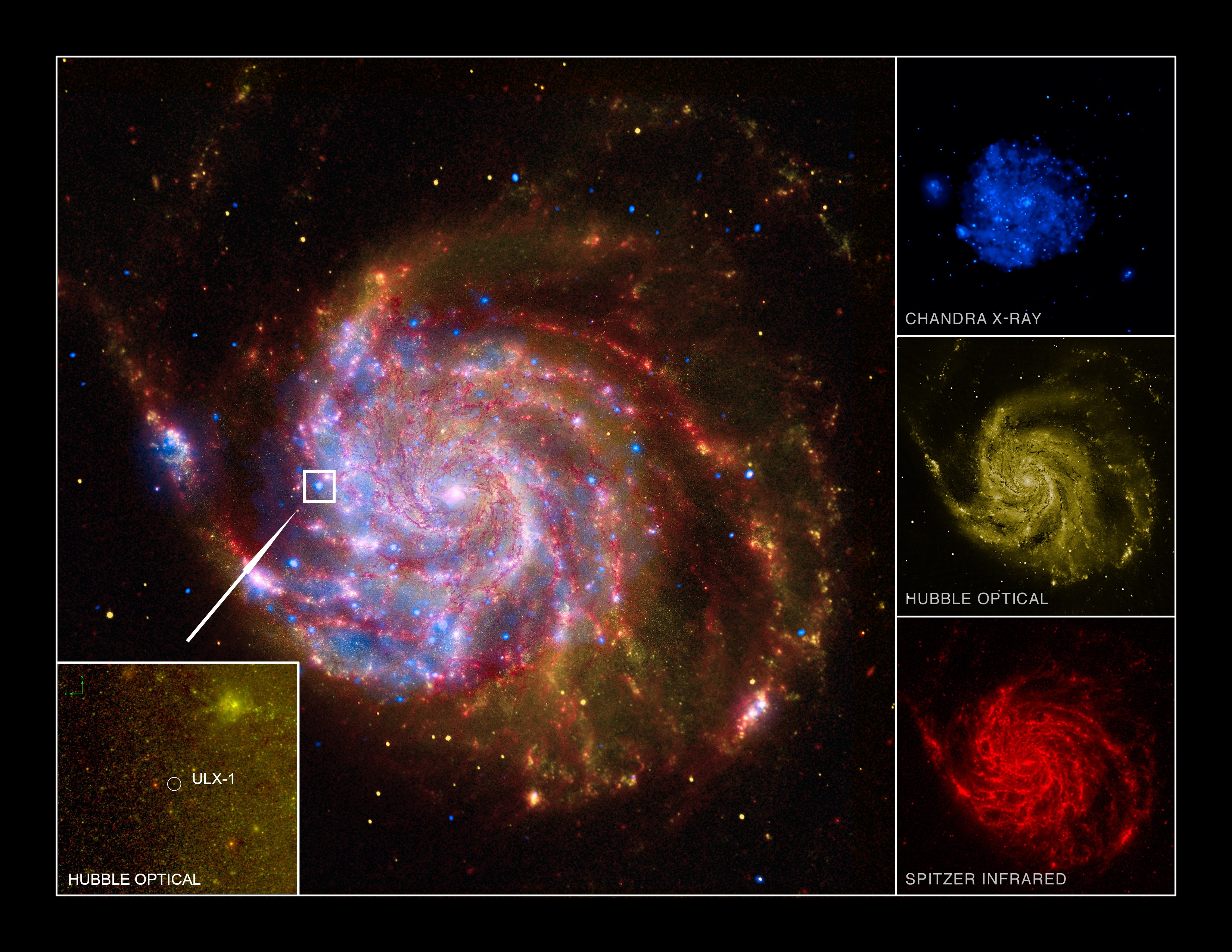
Figure 2. ULX-1 is located near a spiral arm of M101. The image for M101 is composed from X-ray (Chandra X-ray Observatory; Purple), Infrared (Spitzer Satellite; Red), Optical (Hubble Space Telescope; Yellow) and Ultraviolet (GALEX satellite; Blue). Credit: Chandra X-ray Observatory, Spitzer Satellite, Hubble Space Telescope, and GALEX Satellite. Full Resolution JPEG (2 MB) 

Gemini observations support an unexpected discovery in the galaxy Messier 101. A relatively small black hole (20-30 times the mass of our Sun) can sustain a hugely voracious appetite while consuming material in an efficient and tidy manner – something previously thought impossible. The research also affects the long quest for elusive intermediate-mass black holes. The findings are published in the November 28, 2013, issue of the journal Nature. 
 
After embargo, the complete Nature paper can be accessed at: http://dx.doi.org/10.1038/nature12762
Observations of a black hole powering an energetic X-ray source in a galaxy some 22 million light-years away could change our thinking about how some black holes consume matter. The findings indicate that this particular black hole, thought to be the engine behind the X-ray source’s high-energy light output, is unexpectedly lightweight, and, despite the generous amount of dust and gas being fed to it by a massive stellar companion, it swallows this material in a surprisingly orderly fashion. 

“It has elegant manners,” says research team member Stephen Justham, of the National Astronomical Observatories of China, Chinese Academy of Sciences. Such lightweights, he explains, must devour matter at close to their theoretical limits of consumption to sustain the kind of energy output observed. "We thought that when small black holes were pushed to these limits, they would not be able to maintain such refined ways of consuming matter," Justham explains. "We expected them to display more complicated behavior when eating so quickly. Apparently we were wrong." 

A Surprising Twist
 
X-ray sources give off high- and low-energy X-rays, which astronomers call hard and soft X-rays, respectively. In what might seem like a contradiction, larger black holes tend to produce more soft X-rays, while smaller black holes tend to produce relatively more hard X-rays. This source, called M101 ULX-1, is dominated by soft X-rays, so researchers expected to find a larger black hole as its energy source. 

In a surprising twist, however, the new observations made at the Gemini Observatory, and published in the November 28th issue of the journal Nature, indicate that M101 ULX-1’s black hole is on the small side, and astrophysicists don’t understand why. 

In theoretical models of how matter falls into black holes and radiates energy, the soft X-rays come primarily from the accretion disk (see illustration), while hard X-rays are typically generated by a high-energy “corona” around the disk. The models show that the corona’s emission strength should increase as the rate of accretion gets closer to the theoretical limit of consumption. Interactions between the disk and corona are also expected to become more complex. 

Based on the size of the black hole found in this work, the region around M101-ULX-1 should, theoretically, be dominated by hard X-rays and appear structurally more complicated. However, that isn’t the case. 

“Theories have been suggested which allow such low-mass black holes to eat this quickly and shine this brightly in X-rays. But those mechanisms leave signatures in the emitted X-ray spectrum, which this system does not display,” says lead author Jifeng Liu, of the National Astronomical Observatories of China, Chinese Academy of Sciences. “Somehow this black hole, with a mass only 20-30 times the mass of our Sun, is able to eat at a rate near to its theoretical maximum while remaining relatively placid. It’s amazing. Theory now needs to somehow explain what’s going on.” 

An Intermediate-mass Black Hole Dilemma
 
The discovery also delivers a blow to astronomers hoping to find conclusive evidence for an “intermediate-mass” black hole in M101 ULX-1. Such black holes would have masses roughly between 100 and 1000 times the mass of the Sun, placing them between normal stellar-mass black holes and the monstrous supermassive black holes that reside in the centers of galaxies. So far these objects have been frustratingly elusive, with potential candidates but no broadly-accepted detection. Ultra-luminous X-ray sources (ULXs) have been one of the main proposed hiding places for intermediate-mass black holes, and M101 ULX-1 was one of the most promising-looking contenders. 

“Astronomers hoping to study these objects will now have to focus on other locations for which indirect evidence of this class of black holes has been suggested, either in the even brighter ‘hyper-luminous’ X-ray sources or inside some dense clusters of stars,” explains research team member Joel Bregman of the University of Michigan. 

“Many scientists thought it was just a matter of time until we had evidence for an intermediate-mass black hole in M101 ULX-1,” says Liu. But the new Gemini findings both take away some of that hope to solve an old puzzle and adds the fresh mystery of how this stellar-mass black hole can consume matter so calmly. 

To determine the mass of the black hole, the researchers used the Gemini Multi-Object Spectrograph at the Gemini North telescope on Mauna Kea, Hawai‘i to measure the motion of the companion. This star, which feeds matter to the black hole, is of the Wolf-Rayet variety. Such stars emit strong stellar winds, from which the black hole can then draw in material. This study also revealed that the black hole in M101 ULX-1 can capture more material from that stellar wind than astronomers had anticipated. 

M101 ULX-1 is ultra-luminous, shining a million times more brightly than the Sun in both X-rays (from the black hole accretion disk) and in the ultraviolet (from the companion star). Co-author Paul Crowther from the University of Sheffield in the United Kingdom adds, "Although this isn't the first Wolf-Rayet black hole binary ever discovered, at some 22 million light-years away, it does set a new distance record for such a system. The Wolf-Rayet star will have died in a small fraction of the time it has taken for light to reach us, so this system is now likely a double black hole binary." 

“Studying objects like M101 ULX-1 in distant galaxies gives us a vastly larger sampling of the diversity of objects in our universe,” says Bregman. “It’s absolutely amazing that we have the technology to observe a star orbiting a black hole in another galaxy this far away.” 

Media Contacts:


  • Peter Michaud
    Gemini Observatory, Hilo, HI
    Email:
    pmichaud@gemini.edu
    Cell: (808) 936-6643
    Desk: (808) 974-2510

Science Contacts:


  • Ji-Feng Liu
    Chinese Academy of Sciences, Beijing, China
    Email:
    jfliu@nao.cas.cn
    Desk: +86 010 6488 8713

  • Stephen Justham
    Chinese Academy of Sciences, Beijing, China
    Email:
    sjustham@bao.ac.cn
    Cell: +86 150 1100 3278

  • Paul Crowther
    University of Sheffield, Sheffield, UK
    Email:
    Paul.crowther@sheffield.ac.uk
    Cell: +44 (0) 7946 638474
    Desk: +44 (0)114 222 4291

  • Joel Bregman
    University of Michigan
    Email:
    jbregman@umich.edu
    Cell: 734-476-9338
    Desk: 734-764-3441


Tuesday, December 03, 2013

First Confirmed Reverse Shock in a Gamma Ray Burst

An artist's depiction of a gamma ray burst, the most powerful explosive event in the universe. The bursts can produce both forward and reverse shocks as the ejecta slam into the circumstellar material, and measurements of an April 2013 burst taken at wavelengths stretching from the radio to the X-ray, all during the brief lifetime of the burst, find for the first time convincing evidence for the effects of the reverse shock. Credit: Gemini Observatory/AURA, artwork by Lynette Cook

Gamma ray bursts (GRBs) are the brightest events in the known universe. These flashes of high-energy light occur about once a day, randomly, from around the sky. While a burst is underway, it is many millions of times brighter than an entire galaxy. Astronomers are anxious to decipher their nature not only because of their dramatic energetics, but also because their tremendous brightnesses enables them to be seen across cosmological distances and times, providing windows into the young universe.

The somewhat longer lasting variety of GRB is associated with the death of massive stars. The details of these bursts reflect the nature of the progenitor stars, the structure of the explosion environment, and the composition of the ejecta. Even after the explosion ends, the powerful ejecta generate an afterglow that can be analyzed as the particles plow into the circumstellar material around the progenitor star. Studies of the afterglow find two light signatures: one produced when a forward moving shock slams into the material, and a second kind resulting when a backward moving shock (the "reverse shock") is produced (roughly similar to the way a water wave, encountering an obstacle, spawns a backward moving wave). Both the forward and reverse shocks reveal different details of the cataclysm; the reverse shock is a particularly valuable probe of particle velocities in the burst.

Although in the past there have been some diagnostic hints found of a reverse shock in the radiation, the conclusions were indecisive because they lacked a full decomposition of the radiation into both its forward and reverse components. Each of these components radiates over a very broad band of wavelengths, with each kind if shock characterized by a distinct intensity peak at a different wavelength band. One problem has been that observations over the full range from optical to radio are needed to sort things out, but there is very little time during a burst to collect all the data.

CfA astronomers Tanmoy Laskar, Edo Berger, Bevin Zauderer, Raffaella Margutti, Alicia Soloderberg, Sayan Chakraborti, Ragnhild Lunnan, and Ryan Chornock and two colleagues present extensive observations of a burst that occurred on April 27. They obtained data from radio and submillimeter wavelengths through the infrared, optical, ultraviolet, and X-rays, and all in the short period from 0.67 days to 12 days after the burst. Their careful analysis convincingly finds the signature of the reverse shock, and determines the characteristic velocity of the ejecta as being 99.997% of the speed of light - very fast indeed. This benchmark dataset offers a so-far unique view of the reverse shock, helps to confirm theoretical models, and illustrates to power of detailed, multi-wavelength modeling of GRBs.

Reference: 
 
"A Reverse Shock in GRB 130427A," T. Laskar, E. Berger, B. A. Zauderer, R. Margutti, A. M. Soderberg, S. Chakraborti, R. Lunnan, R. Chornock, P. Chandra, and A. Ray, ApJ 776, 119, 2013.


D³PO: Denoising, Deconvolving, and Decomposing Photon Observations

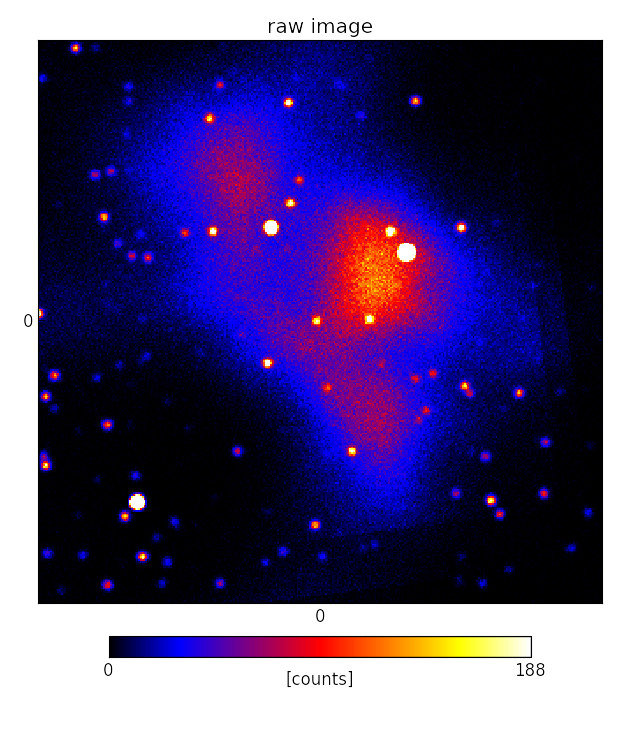
Fig. 1: Simulated observation showing a 32 × 32 arcmin2 patch of the sky with a resolution of 0.1 arcmin.

Fig. 2: Reconstruction of the point-like photon flux, where each marker indicates a source, and its gray scale the corresponding flux. 

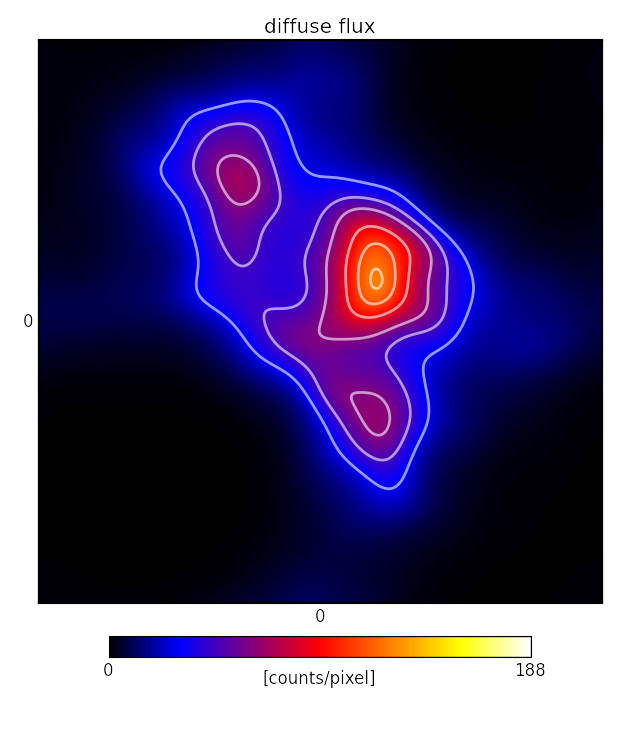
Fig. 3: Reconstruction of the diffuse photon flux in which noise and instrumental artefacts have been removed.

A common problem for scientists analysing astronomical images is the separation of diffuse and point-like components. This analysis has now become easier: scientists at the Max Planck Institute for Astrophysics have recently published the D³PO algorithm, which removes noise effects and instrumental artefacts from the observed images, while simultaneously separating diffuse and point-like contributions. 

Modern observatories provide raw images of the sky with high spatial resolution. In the X-ray and gamma-ray domain, individual photons are collected and depicted in photon count images. Since the number of photons detected is random to a certain degree, the raw image suffers from granularity due to the so-called shot noise. Further, an inhomogeneous sky exposure - especially for larger area surveys - and other instrumental effects leave unwanted imprints in the observational data. Imperfect instrument optics can, for example, cause point sources to be spread out so that they appear as smeared out blobs in the raw image. Furthermore, the sky emission is often an overlay of emission from different sources. Distinguishing between them on the image is ambiguous as it is often not clear from which of the sources a particular photon originates. It is therefore a real challenge to extract the original, astrophysical information contained in these noisy images and to sharpen them to high resolution. 

To refine such raw images and reconstruct the original emission sources as reliably as possible, researchers from Garching have now developed a novel, intelligent imaging algorithm, which denoises, deconvolves, and decomposes photon observations — thus the name "D³PO". The removal or suppression of noise is commonly denoted as "denoising". In case of photon count images, this requires that the shot noise statistics is taken fully into account. "Deconvolution" in this context denotes the rectification of instrumental artefacts such as by imperfect optics. Spread out point sources are hereby remapped and sharpened to a single position on the image. Finally, "decomposition" is the separation of the photon count image into two different images, one for the extended and one for the point-like sources. The distinction between these morphologically different components is the most difficult task since the algorithm needs to decide on how to split the observed photons into the two possible source classes. 

In order to achieve all this simultaneously, the D³PO algorithm relies on probabilistic inference that considers and weighs virtually all possible images of the sky while taking into account the raw photon image and all available a priori knowledge of how the sky could look like. For example, from the knowledge of how the observatory works, one has a decent idea of how a point source should look like in the raw image. Given an observation, one can judge how likely it is that a certain feature is a point source, diffuse emission, or just shot noise. This probabilistic reasoning has been designed using the framework of Information Field Theory, which provides a convenient language for the derivation of optimal imaging methods. 

The images delivered by the D³PO algorithm are not only cured from noise and instrumental artefacts, but also provide a separation of the photon flux into extended and point-like sources. This is crucial for analysing high energy observations with respect to the astrophysical nature of the emission. On the one hand, extended emission regions, such as galactic clouds, galaxy clusters, or unresolved cosmic background emission, can be studied in the images without blooming point sources. And on the other hand, the analysis of point sources, like neutron stars and quasi-stellar objects (so-called quasars), can be carried out in images, where the background has been removed. 

The D³PO algorithm is currently applied to data from the Chandra X-ray observatory and the Fermi gamma-ray space telescope at the Max Planck Institute for Astrophysics. The resulting images will hopefully provide the astrophysical community with a sharpened view on the high energy Universe.

Marco Selig, Torsten Enßlin, and Hannelore Hämmerle

Background:

The D³PO algorithm has been developed by Marco Selig at the Max Planck Institute for Astrophysics. Marco Selig is currently a PhD student in the research group of Torsten Enßlin and investigates information field theory-based imaging methods for high-energy astrophysics. His implementation of the D³PO algorithm will be released to the public in the near future.

References:

Marco Selig and Torsten A. Enßlin, "Denoising, Deconvolving, and Decomposing Photon Observations", submitted to Astronomy & Astrophysics, http://arxiv.org/abs/1311.1888


Monday, December 02, 2013

Home Computers Discover Gamma-ray Pulsars

 
Since its launch in 2008, the Fermi satellite has been observing the entire sky in gamma-rays. It has discovered thousands of previously unknown gamma-ray sources, among which are possibly hundreds of yet undiscovered pulsars – compact and rapidly rotating remnants of exploded stars. Identifying these new gamma-ray pulsars, however, is computationally very expensive – wide parameter ranges have to be “scanned” at very high resolution.

“Our innovative solution for the compute intensive search for gamma-ray pulsars is the combination of particularly efficient methods along with the distributed computing power of Einstein@Home,” says Holger Pletsch, Independent Research Group Leader at the Max Planck Institute for Gravitational Physics (Albert Einstein Institute/AEI), and lead author of the study. “The volunteers from around the world enable us to deal with the huge computational challenge posed by the Fermi data analysis. In this way, they provide an invaluable service to astronomy,” says Pletsch.


Pulsars for everyone
The volunteers who contributed to the discoveries are thrilled. “At first I was a bit dumbfounded and thought someone was playing a hoax on me. But after I did some research everything checked out. That someone as insignificant as myself could make a difference was amazing,” says Thomas M. Jackson from Kentucky in the USA, who runs Einstein@Home on his quad-core processor.

Hans-Peter Tobler from Rellingen, Germany, has been participating in Einstein@Home since 2005 and has now helped in the discovery of a gamma-ray pulsar: “I'm fascinated by astronomy. Einstein@Home allows me to contribute to this field of science, even though I'm not a professional astronomer myself.” With hundreds of thousands of computers teaming up, he never expected that his PC would discover anything.
All Einstein@Home volunteers are acknowledged for their contributions in the scientific publication. The astronomers particularly mention the eight volunteers whose computers made the discoveries. The volunteers are from Australia, Canada, France, Germany, Japan, and the USA. As a token of appreciation, they receive special certificates of discovery.


New Window for the Discovery of Neutron Stars
Not only are the four gamma-ray pulsars the first to be found with a distributed volunteer computing project, but also the pulsars are special, too. “It is exciting that all four pulsars are in the plane of our Milky Way,” says co-author Michael Kramer, director at the Max Planck Institute for Radio Astronomy (MPIfR). Earlier surveys with radio telescopes have been thoroughly searching this part of the sky, but the four new pulsars had remained hidden and only one comparable neutron star had been found.

Apparently, the pulsars are only visible in gamma-rays. The radio and gamma-ray emission are produced in different regions around the pulsar. Depending on the orientation of the pulsar, the narrow radio beam might miss Earth, while the wider beam of gamma-ray photons could be detectable. Dedicated follow-up observations of all four new discoveries with the MPIfR's 100-meter Effelsberg radio telescope and the Australian Parkes Observatory confirm the absence of any detectable radio emission.

“With the successful blind searches for gamma-ray pulsars, we use a new window for the discovery of neutron stars,” says Kramer. The new searches employ methods inspired by gravitational-wave data analysis. Using these, astronomers around Pletsch discovered all of the eleven gamma-ray pulsars found in the last three years of blind searches in Fermi data.


Young Neutron Stars with a Hiccup
Two of the newly discovered pulsars exhibited a sudden change in their otherwise perfectly regular rotation – they suffered a so-called pulsar glitch. During a glitch, the neutron star's rotation suddenly speeds up, then gradually becomes slower and returns to the initial rotation period after a few weeks. “We don't know the exact cause of these glitches yet, but measuring them can provide new insights into the incompletely understood neutron star interior,” says co-author Lucas Guillemot, who worked as a researcher at MPIfR when the discoveries were made and has recently taken up a position at the LPC2E in Orléans.

Glitches mostly happen in newly born pulsars. According to the measurements of the astronomers, the four pulsars discovered now are between 30,000 and 60,000 years old – youngsters among neutron stars.

Discovery Potential
In the future, the efficient search methods will become increasingly important, since Fermi is scheduled to take data for at least another five years. The longer the measurement time, the weaker the pulsars the scientists can discover. With increasing measurement time, however, the computational costs grow quickly. Conventional methods are already too costly at present, but there is still headroom for the new methods.

“Only our methods will enable efficient blind pulsar searches in Fermi data in the future. Using the distributed computing power provided by the Einstein@Home volunteers, we hope to discover gamma-ray pulsars that are particularly far away or faint,” says Pletsch.

Pulsars
Neutron stars are exotic objects. They are made up of matter much more densely packed than normal, giving the entire star a density comparable to an atomic nucleus. The diameter of our sun would shrink to less than 30 km if it was that dense.

Neutron stars also have extremely strong magnetic fields. Charged particles accelerated along the field lines emit electromagnetic radiation in different wavelengths. This radiation is bundled into a cone along the magnetic field axis. As the neutron star turns about its rotational axis, the cones of emitted radiation sweep through the sky like a lighthouse beam because the rotational axis is usually inclined relative to the magnetic field axis. The neutron star is then visible as a pulsar. Pulsars rotate with cycles of a few seconds up to only milliseconds with a precision that makes them the most accurate clocks in the world.

These cosmic lighthouses were first discovered in 1967 by Jocelyn Bell Burnell and identified as radio pulsars. X-ray and gamma-ray pulsars are also known to exist today. Even though not all pulsars are observable in all wavelengths, scientists assume that they still emit radiation in the entire electromagnetic spectrum. However the mechanisms which govern radiation emission in different frequency ranges are not yet completely understood.

Gamma-ray Pulsars and Radio Pulsars
A plausible explanation could be that lower-energy radio waves are bundled in a tighter cone at the magnetic poles than high-energy gamma-radiation. Since radiation is mainly emitted along the surface of the cone and different wavelengths are emitted in cones with a different spread, radio waves and gamma waves would leave the neutron star in different directions. A pulsar might thus become visible as a gamma-ray or radio pulsar to a distant observer (depending on which cone sweeps across the observers position). Another model has gamma radiation originating not in the polar regions of the magnetic field but rather the equatorial plane where the field lines are disrupted. It is therefore very important to observe as many pulsars as possible in all wavelengths to better understand these mechanisms.

Data Analysis
When analyzing data from gravitational wave detectors, scientists have to rely on very effective algorithms and high computing power. This is necessary, because a possible gravitational wave signal would be scarcely stronger than the background noise at the current measurement accuracy.

The data is analyzed in several steps. First, the astrophysicists scan large areas of the sky for signals. If there is a conspicuous signal in one direction, they investigate the vicinity with an algorithm which has a narrower search grid and thus requires more computing time. If the signal is confirmed, the scientists analyse its temporal characteristic and examine whether it can be assigned to a specific pulsar period, for example. The Hanover scientists have modified the algorithm to search for continuous sources of gravitational waves and used it successfully to search for gamma-ray pulsars in Fermi data.

Einstein@Home
This project for distributed volunteer computing connects PC users from all over the world, who voluntarily donate spare computing time on their home and office computers. So far more than 350,000 volunteers have participated and it is therefore one of the largest projects of this kind. Scientific supporters are the Center for Gravitation and Cosmology at the University of Wisconsin-Milwaukee and the Max Planck Institute for Gravitational Physics (Albert Einstein Institute, Hanover) with financial support from the National Science Foundation and the Max Planck Society. Since 2005, Einstein@Home has examined data from the gravitational wave detectors within the LIGO-Virgo-Science Collaboration (LVC) for gravitational waves from unknown, rapidly rotating neutron stars.

As of March 2009, Einstein@Home has also been involved in the search for signals from radio pulsars in observational data from the Arecibo Observatory in Puerto Rico and the Parkes Observatory in Australia.

Since the first discovery of a radio pulsar by Einstein@Home in August 2010, the global computer network has discovered more than 50 new radio pulsars.

A new search for gamma-ray pulsars in data of the Fermi satellite was added in August 2011. It made the four discoveries reported now. The project is looking for, among other things, the first millisecond pulsar, visible only in the gamma-ray range.


Science Contacts

Dr. Holger J. Pletsch
Independent Research Group Leader

Phone:+49 511 762-17171Fax:+49 511 762-2784


Homepage Holger J. Pletsch


Prof. Dr. Bruce Allen
Director

Phone:+49 511 762-17148Fax:+49 511 762-17182


Homepage of Bruce Allen


Media Contacts

Dr. Benjamin Knispel
Press Officer AEI Hannover

Phone:+49 511 762-19104Fax:+49 511 762-17182
Email: benjamin.knispel@aei.mpg.de
   
Dr. Norbert Junkes
Press Officer MPIfR

Phone:+49 228 525-399Fax:+49 228 525-438


Figures of Eight and Peanut Shells: How stars move at the centre of the Galaxy

An artist’s impression showing how the Milky Way galaxy would look seen from almost edge on and from a very different perspective than we get from the Earth. The central bulge shows up as a peanut shaped glowing ball of stars and the spiral arms and their associated dust clouds form a narrow band. Credit: ESO/NASA/JPL-Caltech/M. Kornmesser/R. Hurt. Click here  for a larger image

Two months ago astronomers created a new 3D map of stars at the centre of our Galaxy (the Milky Way), showing more clearly than ever the bulge at its core. Previous explanations suggested that the stars that form the bulge are in banana-like orbits, but a paper published this week in Monthly Notices of the Royal Astronomical Society suggests that the stars probably move in peanut-shell or figure of eight-shaped orbits instead.

The difference is important; astronomers develop theories of star motions to not only understand how the stars in our galaxy are moving today but also how our galaxy formed and evolves. The Milky Way is shaped like a spiral, with a region of stars at the centre known as the “bar,” because of its shape. In the middle of this region, there is a “bulge” that expands out vertically.

In the new work Alice Quillen, professor of astronomy at the University of Rochester, and her collaborators created a mathematical model of what might be happening at the centre of the Milky Way. Unlike the Solar System where most of the gravitational pull comes from the Sun and is simple to model, it is much harder to describe the gravitational field near the centre of the Galaxy, where millions of stars, vast clouds of dust, and even dark matter swirl about. In this case, Quillen and her colleagues considered the forces acting on the stars in or near the bulge.

As the stars go round in their orbits, they also move above or below the plane of the bar. When stars cross the plane they get a little push, like a child on a swing. At the resonance point, which is a point a certain distance from the centre of the bar, the timing of the pushes on the stars is such that this effect is strong enough to make the stars at this point move up higher above the plane. (It is like when a child on the swing has been pushed a little every time and eventually is swinging higher.) These stars are pushed out from the edge of the bulge.

The resonance at this point means that stars undergo two vertical oscillations for every orbital period. But what is the most likely shape of the orbits in between? The researchers showed through computer simulations that peanut-shell shaped orbits are consistent with the effect of this resonance and could give rise to the observed shape of the bulge, which is also like a peanut-shell.

Next month the European Space Agency will launch the Gaia spacecraft, which is designed to create a 3D map of the stars in the Milky Way and their motions. This 3D map will help astronomers better understand the composition, formation and evolution of our Galaxy.

“It is hard to look back into the past of our galaxy and know what was there, but simulations can give us clues,” explained Quillen. “Using my model I saw that, over time, the resonance with the bar, which is what leads to these peculiarly shaped orbits, moves outwards. This may be what happened in our Galaxy.”

“Gaia will generate huge amounts of data – on billions of stars,” said Quillen. This data will allow Quillen and her colleagues to finesse their model further. “This can lead to a better understanding of how the Milky Way might have evolved into the shape it has today.”

Quillen explained that there are different models as to how the galactic bulge was formed. Astronomers are interested in finding out how much the bar has slowed down over time and whether the bulge “puffed up all at once or slowly.” Understanding the distributions of speeds and directions of motion (velocities) of the stars in the bar and the bulge might help determine this evolution.

“One of the predictions of my model is that there is a sharp difference in the velocity distributions inside and outside the resonance,” Quillen said. “Inside – closer to the galactic centre – the disk should be puffed up and the stars there would have higher vertical velocities. Gaia will measure the motions of the stars and allow us to look for variations in velocity distributions such as these.”

To be able to generate a model for the orbits of stars in the bulge, Quillen needed to factor in different variables. She first needed to understand what happens at the region of the resonance, which depends on the speed of the rotating bar and the mass density of the bar.

“Before I could model the orbits, I needed the answer to what I thought was a simple question: what is the distribution of material in the inner galaxy?” Quillen said. “But this wasn’t something I could just look up. Luckily my collaborator Sanjib Sharma was able to help out.”

Sharma worked out how the speed of circular orbits changed with distance from the galactic centre (called the rotation curve). Using this information, Quillen could compute a mass density at the location of the resonance, which she needed for her model.

Quillen was also able to combine the new orbit models with the speed of the bar (which is rotating) to get a more refined estimate of the mass density 3000 light years from the Galaxy centre (about one eighth of the distance from the centre of the Galaxy to Earth), which is where the edge of the bulge is.

And there is not long now to wait now for Gaia to start collecting data. Gaia's launch is set for 0912 GMT on December 19, and will be streamed live on the ESA Portal.


Media contacts


Leonor Sierra
University of Rochester
Tel: +1 585 276 6264

lsierra@ur.rochester.edu

Dr Robert Massey
Royal Astronomical Society
Tel: +44 (0)20 7734 3307 x214
Mob: +44 (0)794 124 8035

rm@ras.org.uk


Further information

Quillen’s co-authors in this paper are Sanjib Sharma, Sydney Institute for Astronomy, Australia; Ivan Minchev, Astronomy Institute of Potsdam, Germany; Yu-Jing Qin, Shanghai Astronomical Observatory, China; and Paola Di Matteo, Paris-Meudon Observatory, France.

The new work appears in “A Vertical Resonance Heating Model for X- or Peanut-Shaped Galactic Bulges”, Monthly Notices of the Royal Astronomical Society, Alice C. Quillen, in press.

A preprint of the paper can be seen at http://arxiv.org/pdf/1307.8441.pdf


Image and movies

An artist’s impression showing how the Milky Way galaxy would look seen from almost edge on and from a very different perspective than we get from the Earth. The central bulge shows up as a peanut shaped glowing ball of stars and the spiral arms and their associated dust clouds form a narrow band. Credit: ESO/NASA/JPL-Caltech/M. Kornmesser/R. Hurt.  http://www.eso.org/public/usa/images/eso1339a/

Two movies of N-body simulations, one showing a bar that buckles, the other without buckling. These movies show face-on and edge-on views of barred galaxies. Both movies show that the peanut shape becomes more extended as the bar slows down. Credit: Ivan Minchev.


Notes for editors

The University of Rochester (www.rochester.edu) is one of the leading private universities in the United States. Located in Rochester, N.Y., the University gives students exceptional opportunities for interdisciplinary study and close collaboration with faculty through its unique cluster-based curriculum. Its College, School of Arts and Sciences, and Hajim School of Engineering and Applied Sciences are complemented by its Eastman School of Music, Simon School of Business, Warner School of Education, Laboratory for Laser Energetics, School of Medicine and Dentistry, School of Nursing, Eastman Institute for Oral Health, and the Memorial Art Gallery.

The Royal Astronomical Society (RAS, www.ras.org.uk),  founded in 1820, encourages and promotes the study of astronomy, solar-system science, geophysics and closely related branches of science. The RAS organizes scientific meetings, publishes international research and review journals, recognizes outstanding achievements by the award of medals and prizes, maintains an extensive library, supports education through grants and outreach activities and represents UK astronomy nationally and internationally. Its more than 3500 members (Fellows), a third based overseas, include scientific researchers in universities, observatories and laboratories as well as historians of astronomy and others.

Follow the RAS on Twitter via @royalastrosoc